Where There’s Room for Us Summary, Characters and Themes
Where There’s Room for Us by Hayley Kiyoko is a rich and evocative novel that centers on Freya Tallon, the daughter of an aristocratic family, and Ivy Yada-Lovell, a scandalous poet with a controversial past. Set against the backdrop of British high society, the novel explores themes of love, duty, identity, and societal expectations.
Freya, feeling the pressure to conform to her family’s expectations and make a suitable marriage, finds herself torn between her duty and her own desires. At the same time, Ivy, with her own struggles regarding love and societal norms, enters Freya’s life and challenges everything she thought she knew about herself and love. Their connection develops slowly, beautifully revealing the tension between their desires and the weight of their respective worlds. The novel ultimately explores their journey of self-discovery and love amid the rigid structures of their society.
Summary
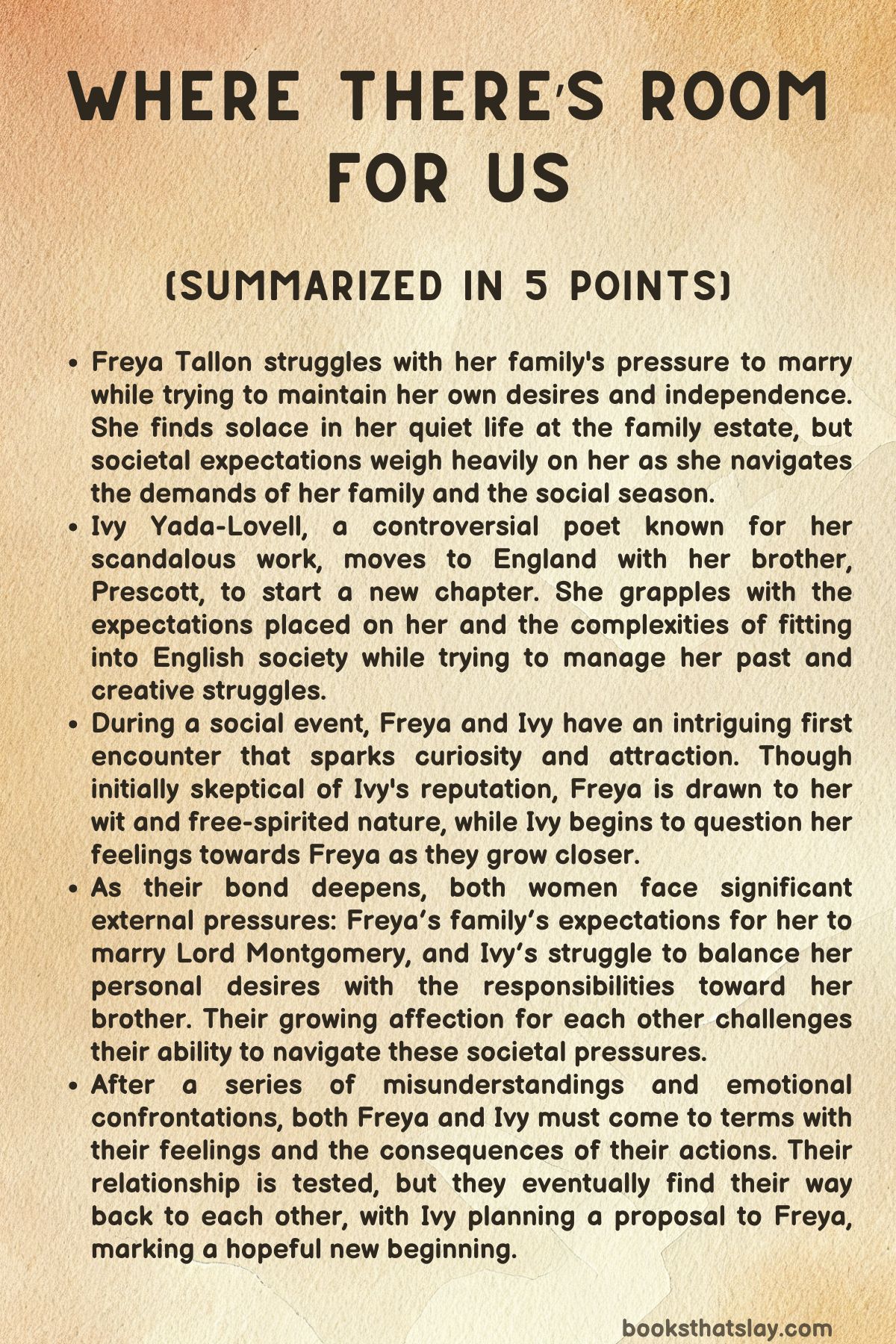
Freya Tallon, one of the four Tallon sisters, enjoys a rare afternoon with her family at their London home when her younger sister, Dani, bursts in with excitement. Dani holds a book titled The Silk Secrets, a controversial poetry collection that has been banned in Britain for its provocative themes.
The poet behind the book, Ivy Yada-Lovell, is notorious for her bold and scandalous works, which have caused a stir not only in Britain but also in New York. Freya, curious yet alarmed by the intimate nature of Ivy’s poetry, briefly reads the book, but quickly sets it aside, unsure how to respond to its provocative nature.
Months later, Freya finds herself at Tallon Manor in Berkshire, the family’s country estate, where the pressure to make a marriage decision weighs heavily on her. Her father, Lord Tallon, is adamant that she find a suitor, and the upcoming social season will likely be filled with potential matches.
Freya, however, is more content with the quiet life she leads at the estate—swimming in the lake and spending time with her sisters—while the looming pressure of marriage makes her feel trapped.
Meanwhile, Ivy Yada-Lovell, the controversial poetess, is traveling to England with her brother Prescott, who has recently inherited the title of Viscount Yada-Lovell. They arrive at Silverthorne Manor, their new home, where they are met by distant relatives, including Cousin June and her wife Deepti.
As Prescott adjusts to the weight of his new responsibilities, Ivy is struggling with her own personal and professional challenges. Known for her scandalous poetry, Ivy feels nervous about how her work will be received by the more conservative English society.
Prescott, meanwhile, is more concerned about his duty to marry an Englishwoman and ensure the future of the estate.
Back at Tallon Manor, Freya is caught between the expectations of her family and her own desires. Her father insists that she marry Lord Montgomery, a potential suitor, but Freya is not sure about him.
The social pressure to marry grows heavier as the season continues. The Tallon family attends a ball, where Freya is introduced to Ivy and Prescott.
The ball proves to be a turning point, as Ivy’s arrival causes quite a stir due to her controversial reputation. Freya is intrigued by Ivy, especially after hearing about her past scandals, and a brief but meaningful conversation between the two sparks an unexpected connection.
During the ball, Freya finds herself distracted by Ivy’s presence, while Ivy becomes intrigued by another woman, Fleur. The two women share a charged moment, leaving Ivy feeling confused and stirred.
The night becomes a crucial moment for both women as they grapple with their personal desires and the weight of societal expectations. Ivy begins to question her identity, while Freya is forced to confront her own emotions and what she wants from life.
After the ball, Freya continues to reflect on her encounter with Ivy, while her sister Dani becomes more enchanted by Ivy’s charm. Dani seems drawn to Prescott, Ivy’s brother, and Freya finds herself increasingly protective of her younger sister.
Meanwhile, Ivy has been researching potential wives for Prescott, out of familial duty, rather than romantic interest, which complicates her interactions with Freya. Despite the misunderstandings, the two women continue to be drawn to one another, and their connection deepens.
Ivy’s flirtatious nature and independent spirit begin to captivate Freya, whose life is governed by more traditional and restrained expectations. As they continue to spend time together, their bond strengthens, and Freya starts to realize her attraction to Ivy, despite the complications of their respective lives.
Ivy, on the other hand, is struggling with the pressure to help her brother find a suitable wife while grappling with her own feelings toward Freya. As the tension builds, both women begin to confront their feelings and the realities of their situations.
Their relationship becomes more complicated when Ivy is drawn into a political movement, and Freya is devastated to learn that Ivy may have been involved with a society that is causing friction within her family. Confronting Ivy, Freya is heartbroken and torn between her love for Ivy and her duty to her family.
Ivy, filled with guilt, tries to explain her actions, but the strain on their relationship grows. Freya, overwhelmed by the emotional turmoil, decides to distance herself and retreats to her sister Angelica’s house.
Months later, Freya begins to come to terms with the complexities of her feelings and her desire for independence. She finds solace in her new role as a teacher, focusing on educating children and embracing her own self-discovery.
Meanwhile, Ivy continues to grapple with her actions and the consequences of her relationship with Freya. She regrets her involvement in the political movement and fears that she has lost Freya for good.
Despite the pain, both women continue to live their lives, with Ivy struggling to rebuild her bond with Freya. After some time apart, Freya receives a letter from Ivy, which rekindles her emotions and leads her to a moment of reconciliation.
However, their relationship remains fragile, and it becomes clear that rebuilding trust will take time.
Eventually, Freya receives an invitation to Prescott’s wedding, where she is once again confronted with Ivy. The two share an emotional dance, and Freya begins to realize that she still loves Ivy.
Following the wedding, they have a private conversation where Ivy apologizes once more, and Freya acknowledges her own feelings of hurt. Slowly, they begin the process of healing, knowing that it will take time to rebuild the trust that was broken between them.
A year later, Ivy prepares to propose to Freya, and when the moment arrives, Freya, overwhelmed with emotion, accepts. This marks the beginning of a new chapter in their lives, filled with hope, love, and the promise of a shared future.
Characters
Freya Tallon
Freya Tallon is a central character in Where There’s Room for Us. As the daughter of the prominent Tallon family, Freya finds herself constantly at odds with the expectations placed on her by society and her family, particularly regarding marriage.
Throughout the story, she is portrayed as a thoughtful and introspective young woman who enjoys the tranquility of life at the family’s country estate, Tallon Manor. Freya’s quiet rebellion against her father’s rigid marriage plans reveals her desire for independence and true love, which becomes more complicated as she grows closer to Ivy.
Initially, Freya’s world revolves around societal expectations, but her developing relationship with Ivy challenges those norms, pushing her to question what she truly wants out of life and love. Despite the pressure from her father to marry Lord Montgomery, she remains conflicted, feeling drawn to Ivy’s free-spirited nature.
Freya’s character evolves as she grapples with her growing feelings for Ivy while also navigating her family’s political and social dynamics, including her father’s increasing demands. Her emotional journey is deeply personal, from grappling with the weight of family obligations to embracing her desires and questioning her identity.
Over time, Freya’s connection with Ivy encourages her to break free from societal constraints, eventually leading her toward a path of self-discovery and love.
Ivy Yada-Lovell
Ivy Yada-Lovell, a renowned poetess with a scandalous reputation, plays a pivotal role in Where There’s Room for Us. Known for her controversial poetry that often touches on themes of intimacy, scandal, and women’s experiences, Ivy is a complex character whose outward confidence masks deeper vulnerabilities.
Ivy arrives in England with her brother Prescott, adjusting to her new life as the sister of a newly titled Viscount, while trying to balance her identity as a writer with the societal expectations that come with her new role. Though she initially came to England with the intention of helping her brother find a wife, Ivy soon finds herself drawn to Freya, and the attraction becomes undeniable.
Ivy’s internal conflict stems from her past heartbreaks and the trauma of a failed relationship with Astoria Parker, which leaves her hesitant to fully trust or commit to someone new. However, her connection with Freya feels different, and Ivy’s emotions become tangled as she faces the possibility of a love that challenges everything she has known.
Despite being caught in the complexities of family duty, societal pressures, and her own past scars, Ivy is determined to pursue a future with Freya. Her relationship with Freya evolves from a playful flirtation into a profound emotional bond that forces Ivy to confront her fears and desires, ultimately reshaping her understanding of love and loyalty.
Prescott Yada-Lovell
Prescott Yada-Lovell, Ivy’s brother, is a more reserved and pragmatic character compared to Ivy. As the newly inherited Viscount, he faces the weight of familial responsibility, particularly the pressure to secure the future of his estate by marrying an Englishwoman.
Prescott’s character is shaped by his sense of duty to uphold the family name and legacy, which often leaves him feeling overwhelmed and out of place in the aristocratic world he has inherited. His relationship with Ivy is one of mutual support, though his focus remains on the practicalities of their new life in England, while Ivy is more concerned with personal expression and emotional connections.
Prescott’s concern for his sister’s well-being is evident throughout the story, especially as Ivy becomes increasingly involved with Freya. Although Prescott initially struggles with his own feelings of displacement and responsibility, he remains a supportive figure to Ivy, offering encouragement and advice, especially as Ivy navigates her complicated emotions towards Freya.
Prescott’s character serves as a foil to Ivy’s more rebellious nature, grounding her and reminding her of the family obligations she must consider. Ultimately, Prescott’s storyline highlights the tension between personal desires and familial duty, a theme that runs parallel to Ivy and Freya’s evolving relationship.
Lord Montgomery
Lord Montgomery is a recurring character in Where There’s Room for Us who represents the societal pressures that Freya faces. He is a suitor chosen by Freya’s father, Lord Tallon, as a potential match for Freya.
Though Lord Montgomery is polite and attentive, Freya feels no genuine connection with him, making the prospect of a marriage to him feel more like an obligation than a romantic possibility. His presence highlights the conflict Freya experiences between fulfilling her family’s expectations and following her own desires.
Lord Montgomery’s role in the narrative primarily serves to illustrate Freya’s growing dissatisfaction with her prescribed role as a dutiful daughter, and her emotional distance from him only intensifies as she becomes more involved with Ivy. His persistence throughout the social season and the pressure he places on Freya to choose him as her future partner serves as a foil to the deeper, more authentic connection Freya shares with Ivy.
His character embodies the traditional values of society, which ultimately serve as the antagonist to Freya’s desires for a love that defies convention.
Marigold Tallon
Marigold Tallon, one of Freya’s sisters, plays a supportive yet somewhat pragmatic role in Where There’s Room for Us. Unlike Freya, who is more contemplative and reserved, Marigold is more open about her personal desires, though she too feels the weight of societal expectations.
Marigold is already married to Ros, a union that represents a practical and loving partnership, and she serves as a source of counsel for Freya. Her advice encourages Freya to explore her emotions and desires without shame, especially as Freya begins to develop feelings for Ivy.
Marigold’s character contrasts with Freya’s internal struggles, offering a more open and accepting perspective on love. While Marigold’s marriage is grounded in practicality, her relationship with Ros is one of mutual understanding and respect, which provides a solid foundation for her support of Freya’s more passionate, unconventional romance with Ivy.
Marigold’s ability to embrace her own relationship and provide guidance to Freya underscores the importance of familial support in the face of societal pressures.
Dani Tallon
Dani Tallon, Freya’s younger sister, plays a less central but still significant role in Where There’s Room for Us. Dani is portrayed as a lively and curious character, unafraid to defy convention, especially when it comes to her admiration for Ivy and her poetry.
She is the one who introduces the controversial book, The Silk Secrets, to the family, sparking discussions about Ivy’s past and the potential scandal surrounding her poetry. Dani’s flirtation with Ivy’s brother, the Viscount Yada-Lovell, further complicates the dynamics of the Tallon family, as Freya feels protective of her younger sister and concerned about the potential heartbreak that may come from pursuing a relationship with someone like Prescott.
Despite her youth, Dani’s character represents the spirit of rebellion against societal norms, mirroring some of Ivy’s more liberated attitudes. Her relationship with Ivy is one of fascination and admiration, but it also serves as a foil to Freya’s more complex and deepening connection with Ivy.
June
June, a distant cousin of the Tallon family, is a character in Where There’s Room for Us who represents the political and social ideals that challenge traditional norms. As a member of the Ridings Society, a political movement advocating for women’s rights, June becomes entangled in the drama surrounding Ivy’s relationship with Freya.
She plays a pivotal role in the distribution of the controversial pamphlet that causes a rift between Ivy and Freya. June’s character is marked by her advocacy for women’s rights, and her involvement with Ivy, particularly in the political sphere, adds a layer of complexity to Ivy’s already complicated relationship with Freya.
June’s role in the narrative highlights the intersection of personal relationships and broader social movements, and she ultimately serves as a catalyst for Freya’s growing awareness of her own beliefs about women’s independence and her role in society. While June’s actions cause tension, they also help Freya explore her identity and the conflicts between love, loyalty, and social duty.
Themes
Societal Expectations and Gender Roles
In Where There’s Room for Us, societal expectations and gender roles play a crucial part in shaping the lives and decisions of the main characters, especially Freya and Ivy. The novel takes place during a time when women were often bound by strict societal rules regarding marriage and behavior.
Freya is under constant pressure from her family, particularly her father, to secure a suitable marriage for her future. Her role as a woman in society is defined by the pursuit of a good match, and this weighs heavily on her personal desires and ambitions.
Despite her family’s expectations, Freya finds herself struggling to conform to the mold of a typical aristocratic lady. Her longing for independence, personal freedom, and the ability to choose her own path are at odds with the traditions and customs of her time.
Ivy, on the other hand, is also subject to societal norms, but her defiance is more overt. As a poet with a controversial past, Ivy has long been the subject of public scrutiny and scandal, both in England and America.
Her poetry challenges traditional norms, especially in regards to love and women’s autonomy, which puts her at odds with the conservative expectations of the time. The tension between personal desires and societal obligations forms the emotional core of the story, with both women fighting to navigate their feelings and their futures within a society that demands conformity.
The story examines how these pressures not only impact the choices the women make but also influence their relationships with one another and with their families. Freya’s journey is one of self-discovery, as she learns to challenge the expectations placed upon her and embrace a love that defies convention.
For Ivy, her challenge lies in reconciling her past transgressions with the expectations placed upon her as a woman, poet, and potential wife.
Love and Identity
The theme of love and identity is deeply intertwined in Where There’s Room for Us, as both Freya and Ivy must come to terms with their feelings and the role they play in shaping their identities. For Freya, love is not just an emotion but a force that forces her to question her identity within her family and society.
Her attraction to Ivy, who represents freedom and nonconformity, makes her confront her own feelings about love, especially in the context of the restrictive norms of her aristocratic upbringing. Freya’s developing feelings for Ivy challenge her understanding of what love should look like, forcing her to choose between societal expectations and her personal desires.
Ivy’s journey is similarly rooted in the exploration of love as it relates to her sense of self. Having faced heartbreak and disillusionment in the past, Ivy is cautious about trusting love again.
However, her connection with Freya sparks a new sense of possibility, and as she falls deeper in love with Freya, she must confront the conflict between her past scars and her desire for a future with someone who represents everything she has longed for. The love between Freya and Ivy transcends mere attraction; it becomes a vehicle for self-discovery and transformation.
Through their relationship, both women find the strength to embrace their true selves, stepping away from the roles society has assigned to them. Their love serves as a liberating force, allowing them to step into their own identities as individuals who are not defined by their families or societal roles.
The novel explores how love can be both a source of joy and conflict, but ultimately, it is through love that Freya and Ivy discover who they truly are and what they truly want from life.
Family and Duty
Family and duty are central themes that influence the characters’ actions and motivations in Where There’s Room for Us. Freya’s relationship with her family, particularly with her father, is marked by tension, as her father’s relentless pressure to marry for the good of the family conflicts with Freya’s desire for personal freedom.
The weight of family expectations hangs heavily over Freya, and the notion of duty to her family often takes precedence over her own happiness. This is exemplified in her father’s insistence that she marry Lord Montgomery, a suitor he believes will secure the family’s social standing.
This sense of duty to family obligations is a recurring theme, as both Freya and Ivy navigate their lives in the shadow of family expectations. Ivy, too, feels the weight of duty, but in a different way.
As the sister of a viscount, Ivy’s role is also shaped by her family’s expectations, particularly her brother Prescott’s need for a suitable wife to maintain the family’s estate. Ivy’s loyalty to her brother and her desire to help him secure his future is in direct conflict with her own desires, particularly when her growing feelings for Freya complicate her sense of duty.
The theme of family duty is not just about fulfilling obligations but also about the emotional toll it takes on the individuals involved. Both Freya and Ivy must learn to balance their familial duties with their own personal desires, which leads to a deeper understanding of what family means and how it can both support and constrain individual growth.
Ultimately, the novel portrays family as a complex force—one that can provide love and support but also create immense pressure that can shape the course of one’s life.
Self-Discovery and Empowerment
Where There’s Room for Us explores the theme of self-discovery and empowerment, particularly through the experiences of Freya and Ivy. Both women are on journeys of self-realization, though their paths are shaped by different circumstances.
For Freya, her self-discovery is initially stifled by the constraints placed upon her by her family and society. As she grows closer to Ivy and begins to explore her own feelings, Freya is forced to confront the limitations of her upbringing and the expectations that have shaped her life.
Through her relationship with Ivy, Freya is given the opportunity to challenge these constraints, leading to a process of self-empowerment. She begins to recognize her own worth beyond the role of a marriageable woman and starts to embrace her desires and ambitions on her own terms.
Similarly, Ivy’s journey is one of self-empowerment. She starts as a poet haunted by her past, unsure of her place in society and uncertain about the future.
As she becomes more entangled with Freya, Ivy’s sense of self is revitalized. The connection between them allows Ivy to embrace her own identity as a woman, poet, and lover, free from the burden of societal judgment and personal guilt.
Both women learn to assert their agency, rejecting the passive roles they have been expected to play in favor of a life led by their own choices. The novel celebrates the power of self-discovery, emphasizing that true empowerment comes when individuals are able to embrace their full selves, free from the constraints imposed by society or family.
Reconciliation and Forgiveness
The theme of reconciliation and forgiveness is explored in Where There’s Room for Us as both Freya and Ivy navigate the emotional aftermath of their confrontation and misunderstandings. The strain on their relationship becomes a pivotal moment in their growth, as both women must confront their fears, insecurities, and mistakes in order to rebuild the trust that was broken.
Ivy’s involvement with the Ridings Society creates a rift between her and Freya, causing a deep sense of betrayal for Freya, who struggles with the idea that Ivy’s actions were motivated by personal interests rather than genuine love. However, the process of reconciliation is slow and fraught with emotional complexity.
Both women must grapple with their pain, and as they navigate their feelings, they come to understand that forgiveness is necessary for healing. For Freya, forgiveness is not just about absolving Ivy of her mistakes but also about letting go of the expectations placed on her by her family and society.
Ivy, on the other hand, must learn to forgive herself for her past actions, including her involvement with the Ridings Society and the impact it had on her relationship with Freya. The journey toward forgiveness is a painful but necessary one, ultimately allowing both women to heal and find a way back to one another.
The theme of reconciliation underscores the idea that love and trust, though fragile, can be rebuilt when both parties are willing to confront their pasts and work together toward a shared future.