Where You Belong Summary, Characters and Themes
Where You Belong by Kristen Proby is a contemporary small-town romance set in Montana’s Bitterroot Valley. It follows Juliet, a careful, guarded restaurant owner who returns to her hometown after years of living under fear and control.
Across the street is Brooks, her first love—now a steady, stubborn mechanic with a big family and a long memory. When fate pushes them back into each other’s orbit, old damage resurfaces alongside the feelings neither one truly lost. The story centers on second chances, rebuilding trust, and choosing a life that finally feels safe and shared. It’s the 5th book in The Blackwells of Montana series.
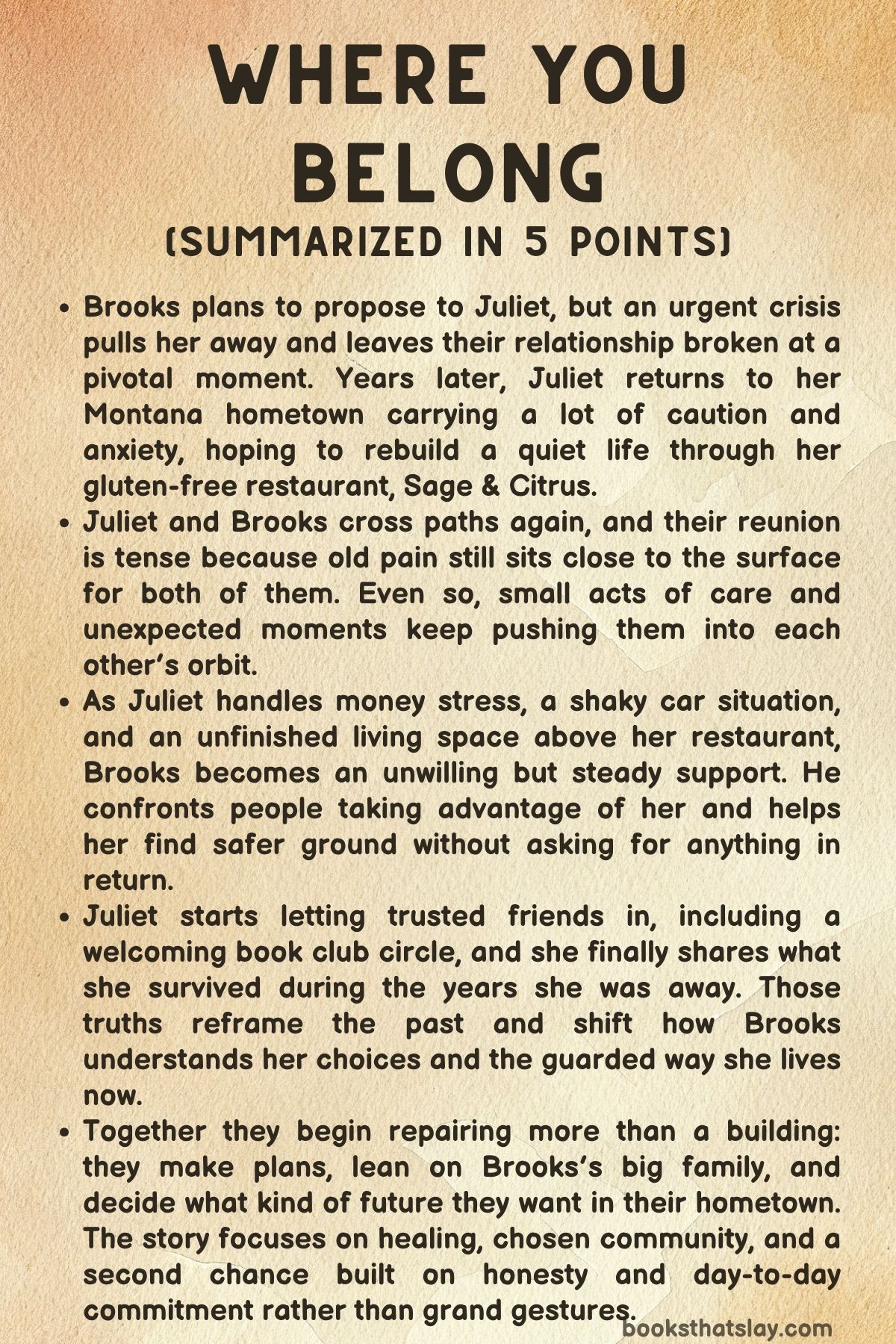
Summary
Fifteen years ago, Brooks has everything planned. Juliet is coming home from college, and he’s ready to propose.
His family helps set up flowers and a dinner, and he rides over with a ring in his pocket and a clear picture of their future. But when he arrives, Juliet is frantic.
Her college roommate, Justin, has attempted suicide, and she insists she has to rush back to Seattle because she believes only she can stop him from dying. Brooks tries to make her see a pattern—Justin’s crises always seem to pull her away—but Juliet defends him as someone who’s ill and in need.
Brooks finally draws a line: if she goes, their relationship is over. Juliet leaves anyway.
Brooks walks away with the ring still in his pocket and a life he thought was about to start suddenly gone.
In the present, Juliet is back in Bitterroot Valley, living above her gluten-free restaurant, Sage & Citrus. She moves through town with caution, always aware of her surroundings, always checking locks and listening for footsteps.
Her mother has died, her father disappeared long ago, and she’s returned alone, determined to build something stable for herself. The restaurant is her pride and her refuge, a “safe” kitchen for customers with celiac disease and for Juliet’s own health.
She leans on a few friendly faces—people like Jackie—and tries to keep her world simple and controlled.
Then she sees Brooks again. He’s leaving a local coffee shop when their eyes meet, and the warmth she once expected from him is gone.
His face hardens, and he turns away as if she isn’t there. Juliet feels the rejection like a bruise, but she keeps walking, telling herself she can handle living in the same town as him.
Brooks, meanwhile, is rooted in Bitterroot Valley. He owns an auto shop, is surrounded by siblings and nieces and nephews, and carries responsibility like it’s part of his spine.
He’s also never forgiven Juliet for leaving. His niece Birdie has celiac disease and loves a new restaurant in town that feels safe—Juliet’s restaurant—and Brooks hates how complicated that makes everything.
He avoids serious relationships and keeps his emotions locked down, but Juliet’s return rattles him. He tells himself to stay away, yet finds himself watching her from across the street, noticing details, tracking whether she’s okay, and getting angry at the fact that he still cares.
Juliet’s practical problems pile up. Because Brooks made it clear she wasn’t welcome at his shop, she takes her unreliable car to a mechanic in nearby Silver Springs.
The bills are brutal, and the work doesn’t even solve the issue. She’s trying to finish her upstairs living space, keep the restaurant running, and stay afloat, but money is tight and the stress is constant.
One rainy day she slips on the metal stairs behind her building and scrapes her shin badly. At the pharmacy, Brooks appears, sees the blood, and demands to know what happened.
Juliet tries to brush it off, but he’s rattled by the sight of her hurt. Soon after, she discovers anti-slip treads installed on her stairs—quiet help she recognizes as Brooks’s doing, even if he won’t say it.
Brooks has his own secret: years ago he bought the big corner house Juliet once dreamed about. He told himself it was an investment project, something to fix up and sell, but the truth is simpler and harder—he couldn’t stand the idea of someone else owning their dream.
He also reveals, later, that he bought his current home fifteen years earlier because he was preparing to propose and wanted a place for them. Juliet’s return doesn’t just reopen old feelings; it forces both of them to face the life that could have been.
Juliet tentatively reconnects with the community. She attends Billie Blackwell’s book club, encouraged by new friends like Harper and Ava, and is surprised by how welcome she feels.
Over salads and conversations, Juliet finally admits pieces of what happened years ago and how she spent a long time hiding. She says Justin is dead, but she doesn’t yet explain what he truly was to her.
Her car situation reaches a breaking point when it dies again on the highway. Juliet is stuck on the shoulder, overwhelmed and terrified about what she’ll do next.
Brooks happens to spot her and pulls over. She startles hard when he knocks—her nervous system still tuned for danger—but he calms her with steady direction and breathing.
Brooks looks under the hood, sees the mess, and decides immediately that he’s towing the car to his shop. He takes her paperwork, gives her his helmet, and rides her back to town on his motorcycle with her clinging to him, both of them painfully aware of how familiar it feels.
When Brooks walks into Juliet’s upstairs space, he’s shocked to find she’s been living in an unfinished, exposed-stud storage area with barely any comforts. He reads the invoices and realizes the Silver Springs mechanic has been taking advantage of her.
Furious, Brooks gets his brothers involved, confronts the mechanic, and forces him to refund thousands of dollars. Juliet is grateful but also furious that Brooks is back in her life making decisions.
Their arguments crackle with old hurt and current attraction.
The dam finally breaks one night when Juliet brings Brooks dinner at his garage and finds him working on her engine. The tension between them snaps into a kiss, and they end up together in a way that’s raw and long-awaited.
Brooks notices a hidden tattoo on Juliet’s ribs that marks her connection to him. Afterward, Juliet retreats emotionally, refusing to let physical closeness substitute for real safety.
She tells him she won’t be with someone who hates her, and she forces him to leave.
Soon, Juliet tells her friends the truth about Justin. He wasn’t just a roommate or a “friend.” He became her husband through manipulation—suicide threats, lies, isolation, control, and fear.
He claimed he had cancer and used supposed relapses to keep her trapped. They lived in separate bedrooms, and Juliet spent years trying to survive him rather than live with him.
When he died in a car accident, she learned at the hospital he never had cancer. She also discovered he had mistresses and left behind financial messes that kept his shadow over her life, including aggressive emails from a woman demanding money.
Then disaster hits: a pipe bursts in Juliet’s upstairs space, flooding her building and damaging both the apartment area and the restaurant. Power is shut off, and she can’t open.
Juliet tries to endure it alone, but Brooks and his family show up. Brooks insists she come stay with him, and this time she accepts.
In the quiet of his home, with him close by, Juliet finally tells Brooks everything—what Justin did, how fear shaped her, and why she disappeared from the life she once wanted. Brooks listens, shaken and angry on her behalf, and begins to understand that Juliet didn’t leave him for another man in any simple way; she was pulled into something that kept tightening around her.
Living together changes the rhythm between them. They fall back into intimacy, but now it’s paired with honesty and care.
Juliet starts to accept help and stops treating independence as punishment. She also decides to use the money Justin left her instead of letting it sit like a stain.
She pays her staff while the restaurant is closed and funds repairs without leaning on others. As the restaurant rebuild progresses, she faces the reality that her old upstairs space needs a real renovation too—and admits she loves being with Brooks more than she wants to admit.
Brooks eventually takes Juliet into the dream house across the street and reveals he owns it. They talk about renovating it together, and Juliet keeps saying “we,” a word that matters more than any blueprint.
Brooks’s family rallies around Juliet as well, including a full kitchen overhaul to make Brooks’s home safe for Juliet’s food needs. Juliet is moved by how naturally she fits with them, even when she’s afraid she doesn’t deserve it.
One night Juliet asks Brooks to marry her immediately at the courthouse, choosing certainty over hesitation. Brooks produces the engagement ring he has kept for years—his mother’s ring, saved for the proposal that never happened.
Juliet says yes, and they marry with minimal witnesses, then are swept into a joyful family celebration that welcomes Juliet without question. Brooks’s mother tells Juliet plainly that she belongs with them.
While renovations continue, Juliet has a terrifying accident in the old house. She discovers a hidden attic space and falls through weak flooring, getting stuck, bleeding, and trapped in the dark for hours.
Brooks realizes she’s missing and mobilizes the whole family to search. When he finds her, the rescue is careful and urgent, with family, emergency responders, and steady voices keeping Juliet awake and alive.
She’s taken to the hospital and recovers at home, surrounded by care she once would have refused.
In the aftermath, Juliet makes choices that reflect her new freedom. She decides to donate most of Justin’s money, keeping only an emergency cushion, and gives the rest to a domestic violence shelter.
An attorney finally confirms another crucial truth: the so-called trust Juliet had been paying from was never legitimate, and the account was only hers. Juliet realizes she was manipulated again through fraud, but the revelation also means she’s free—no more obligation to keep feeding money into someone else’s demands.
The man behind the scheme is later found dead, and Juliet is left with complicated feelings, but also relief that the last thread tying her to the past has snapped.
Years later, Juliet and Brooks have finished their home, built a loud, loving family life, and welcomed children. The future Brooks imagined as a young man finally exists—not as a recovered past, but as something they chose, rebuilt, and protected together.
Characters
Brooks
Brooks is introduced as a young man who is intensely certain about commitment, family, and building a future, and that certainty becomes the emotional bedrock of who he is in the present. Fifteen years after Juliet leaves, his anger isn’t performative so much as it is protective—he has lived with the humiliation of a public, life-altering rejection and has structured his adult life to avoid being vulnerable in that specific way again.
Yet the story repeatedly shows that his love never truly moved on: he keeps the engagement ring, buys and maintains the corner “dream house,” and watches over Juliet from a distance even while insisting she doesn’t exist to him. What makes Brooks compelling is the tension between his hardness and his caretaking impulse; his default response to pain is control—drawing boundaries, refusing access, making rules—but when Juliet is in danger, his body overrides his pride.
His protective streak can come out as possessive anger (especially when confronting Barry or reacting to Juliet’s panic), but it also becomes the engine of healing: he fixes the stairs, takes over the car situation, gives her shelter after the flood, and eventually offers something more vulnerable than protection—belief. By the time they marry, Brooks has shifted from needing Juliet to “prove” she won’t leave again to choosing, actively and daily, to build with her anyway, which transforms him from a man defined by abandonment into a partner defined by steadiness.
Juliet Blackwell
Juliet’s defining trait is hypervigilance—she moves through the world as if danger is always one breath away—and the narrative makes it clear that this is not simply anxiety but the afterimage of prolonged coercion and emotional abuse. In the past, she is compassionate to a fault and easily manipulated by crises framed as life-or-death, which is why Justin’s suicide attempt becomes a lever that pries her away from Brooks.
In the present, she has built a life that looks independent and successful on the outside—owning and operating Sage & Citrus, maintaining a “safe” kitchen, carving out a reputation in town—but her living situation and financial strain reveal how much of her independence is also a form of self-punishment and self-erasure. Juliet’s strength isn’t flashy; it is persistent.
She keeps showing up, running the restaurant, paying her staff, enforcing boundaries with abusive customers, and refusing to collapse even when debt, harassment, and disaster pile up. Her arc is about reclaiming agency: she stops letting fear decide where she lives, who helps her, and what resources she is allowed to use.
Importantly, Juliet’s growth does not require her to become emotionally invulnerable; instead, she learns to accept care without translating it into debt or shame. Her decision to donate most of the inherited money to a domestic violence shelter underscores who she becomes by the end—someone who converts a coerced, painful history into a deliberate act of protection for others, while still allowing herself to keep enough security to live freely.
Justin
Justin functions as the central shadow over Juliet’s adulthood: a person who weaponizes fragility to gain control and weaponizes control to keep Juliet psychologically trapped. Early on, he appears indirectly—through a suicide attempt that pulls Juliet away from Brooks—and that pattern sets the template for their future: emergencies that demand Juliet’s attention, emotional blackmail disguised as illness, and a constant rewriting of reality so that Juliet feels responsible for keeping him alive.
As Juliet later reveals, Justin escalates manipulation into long-term coercion—faking cancer, manufacturing relapses, isolating her socially, and using fear as entertainment. The chilling detail of separate bedrooms highlights the emotional truth: this is not romance but captivity wrapped in the outward legitimacy of marriage.
Even in death, Justin’s reach persists through the supposed trust and executor role, showing how abusers can design “afterlife” control mechanisms that force ongoing contact and compliance. Justin is not complex in the sense of being morally ambiguous; his complexity lies in method—how convincingly he can perform victimhood, how he exploits Juliet’s empathy, and how effectively he turns her best qualities into tools against her.
His presence is ultimately the obstacle Juliet and Brooks must name honestly in order to stop living as if it still owns them.
Daniel
Daniel is the later-stage continuation of Juliet’s entanglement with manipulation, representing how trauma can create vulnerability to secondary predators who recognize a practiced pattern of compliance. He appears as the architect behind the false trust structure and the pressure campaign that drains Juliet financially and keeps her emotionally activated through threats, paperwork, and urgency.
Unlike Justin, whose power comes from intimacy, Daniel’s power comes from bureaucracy—documents, accounts, legal language, and the implied authority of “this is how it works,” which can be especially destabilizing for someone already conditioned to doubt herself. His fraud keeps Juliet in a loop of fear and responsibility even after Justin’s death, reinforcing the theme that escaping an abusive relationship does not automatically end the systems built around it.
When Chad later reveals the trust was never legitimate and that Juliet had been paying from an account only in her name, Daniel’s role becomes crystal clear: he is a parasite exploiting her confusion and grief. His death by apparent suicide resolves the immediate threat, but more importantly, it symbolically ends Juliet’s long season of being managed by other people’s lies.
Chad
Chad represents legitimate authority used correctly, and his arrival matters because Juliet’s life has been shaped by authority used against her—Justin’s manufactured illness narratives, Daniel’s fabricated legal scaffolding, and the social pressure to be “reasonable” and compliant. Chad’s role is not romantic or dramatic; it is stabilizing.
He brings verification, clarity, and a reality-based framework that restores Juliet’s sense of ground beneath her feet. By confirming there was no real trust and that fraud occurred, he gives Juliet something she has rarely been granted: the right to stop paying, stop responding, and stop performing responsibility for other people’s manipulations.
Chad is also important structurally because he converts the story’s emotional truth into actionable truth—he turns “I feel trapped” into “You are legally free,” which is a form of rescue that complements Brooks’s physical rescues.
Nadine
Nadine is less a fully individuated character than a catalyst and a symbol of collateral damage created by Justin’s double life. She is presented as a woman tied to Justin through the idea of a trust and payments, and her presence keeps Juliet tethered to Justin’s legacy long after his death.
Whether Nadine herself is knowingly complicit or also manipulated matters less than the function she serves in Juliet’s psyche: she becomes the face of the ongoing intrusion, the reminder that Justin’s choices created obligations Juliet never consented to. Once the trust is revealed as illegitimate, Nadine’s threat dissolves, and with it dissolves Juliet’s sense that she must keep paying penance to be safe.
Rose
Rose, as Chad’s receptionist, is a small but meaningful portrayal of the everyday gatekeeping that can intensify a person’s stress when they are already overwhelmed. The phone tag and missed calls are not villainous actions, but they amplify the theme that systems move slowly while fear moves fast.
In Juliet’s storyline, even minor delays carry emotional weight because her history has trained her to expect consequences for not responding immediately. Rose therefore functions as a realistic friction point that highlights how hard it can be for survivors to access clean, timely help—even when that help exists.
Jackie
Jackie embodies “hometown safety,” offering Juliet a connection that is not transactional and not conditional. As a family friend who supports Juliet, Jackie helps establish that Juliet is not returning to an empty place; there are threads of community available to her, even if she feels alone.
Jackie’s presence matters because Juliet’s trauma narrative is rooted in isolation—first by circumstance (family loss) and later by control (Justin). Jackie is one of the first signals that Juliet can belong somewhere again without having to earn it through crisis management.
Ava
Ava operates as both practical support and emotional bridge. She helps Juliet navigate logistics—rides, food, companionship—and she is also the person who creates space for Juliet to tell the truth about her past without being minimized or sensationalized.
Ava’s role highlights how healing often requires witnesses: people who can hear the story, accept it, and still see the survivor as whole. She also represents the social re-entry Juliet has avoided for years; through Ava, Juliet starts practicing normal friendship again, which is a quieter but essential form of recovery.
Harper
Harper contributes to Juliet’s reconstruction of a life that includes community rather than mere survival. She is part of the network that gently insists Juliet is allowed to participate—book club, meals, rides, shared routines—without needing to justify her presence.
Harper’s function is to normalize Juliet’s return, which counters Juliet’s fear that she will always be the outsider or the problem. In a story where Juliet has been defined by other people’s crises, Harper helps shift the tone to “you get to have ordinary joy.”
Billie Blackwell
Billie is positioned as a social anchor and an engine of belonging, providing institutional warmth through book club and later the girls’ night that reinforces Juliet’s integration. Her home and her library are not just details of wealth; they symbolize abundance—space, comfort, cultural life, chosen community—things Juliet has denied herself for years.
Billie’s invitation-based leadership contrasts with Justin’s coercion-based leadership; she gathers people by making them welcome, not by making them responsible for her emotions. That difference subtly teaches Juliet that closeness can be safe.
Birdie
Birdie, Brooks’s niece with celiac disease, is an emotional hinge between Juliet’s private world and Brooks’s family world. Birdie’s love for Sage & Citrus makes Juliet’s restaurant matter beyond commerce; it becomes an act of care that tangibly protects someone Brooks loves.
This creates a layered irony early on—Brooks resents Juliet’s presence while benefiting from her competence—and it pushes Brooks toward a kind of respect he can’t easily dismiss. Birdie also helps define Juliet as nurturing and attentive in a way that is healthy, bounded, and voluntary, which contrasts sharply with the forced caretaking Juliet experienced with Justin.
Beckett
Beckett represents the “brotherhood” aspect of Brooks’s life: loyalty, backup, and a shared code of protectiveness. When Brooks confronts Barry, Beckett’s presence shows that Brooks is not an isolated hero; he is part of a family system that mobilizes quickly when someone is wronged.
Beckett’s willingness to stand beside Brooks also underscores a key theme: Juliet is not trying to join a man’s life that has no room for her—Brooks’s world has infrastructure, and once the anger softens, that infrastructure can support her too.
Bridger
Bridger is the family member most directly associated with emergency response and practical rescue, arriving during the flood and coordinating help with competence and calm. His presence reinforces the idea that Juliet is entering a family that treats crises as solvable problems rather than leverage.
Where Justin created emergencies to trap Juliet, Bridger responds to emergencies to free her. That contrast matters emotionally, because it shows Juliet—through repeated experience—that asking for help does not automatically lead to manipulation.
Barry
Barry is a straightforward antagonist whose role is to externalize Juliet’s vulnerability in the marketplace. He exploits her isolation, limited options, and financial anxiety by overcharging and doing poor work, escalating her sense that she cannot trust anyone.
Narratively, Barry’s dishonesty also gives Brooks a channel for righteous anger that is safer than his unresolved anger at Juliet; it’s easier to confront a clear villain than to confront old heartbreak. When Brooks forces a refund, Barry becomes the first concrete example that Juliet can be protected without being controlled, and that justice can be pursued without her having to beg or perform.
Tandy
Tandy helps portray Juliet as a leader and protector within her own space. The incident with the rude customer reveals how Juliet’s past has not made her passive; it has sharpened her sense of boundaries, especially when someone is being targeted.
Tandy also anchors Sage & Citrus as a lived-in workplace with relationships and stakes, not just a backdrop for romance. Through Tandy, the story shows Juliet’s competence in conflict: she remains clear, firm, and principled, choosing staff dignity over appeasing bad behavior.
Abbi Wild
Abbi Wild’s role emphasizes practical community support—someone who can step in with services that reduce Juliet’s burden when her car and building issues spiral. Importantly, Abbi’s help is transactional in a healthy way: Juliet pays for a service and receives relief without emotional strings attached.
That matters because Juliet’s history has taught her that “help” often comes with hooks. Abbi represents a world where assistance can be straightforward and safe, reinforcing Juliet’s gradual recalibration of trust.
Christy
Christy, as a manager figure at Sage & Citrus, represents the stability Juliet has built through work. Her competence allows Juliet to step away during crisis and recovery without the business collapsing, which signals a shift in Juliet’s life: she no longer has to hold every piece alone.
Christy’s presence also underlines Juliet’s growth as an employer and mentor—she has created systems that empower others rather than creating dependency, a subtle reversal of the controlling dynamics Juliet endured.
Noah
Noah’s addition to the restaurant team, particularly with bread and pastries, symbolizes renewal and sustainability. For someone with Juliet’s background, learning to plan beyond survival is a major milestone, and staffing up is one concrete expression of that.
Noah also supports the narrative claim that Juliet’s restaurant is more than a coping mechanism; it is a thriving, community-serving enterprise that can function as a long-term foundation for her life with Brooks.
Connor
Connor functions as a reminder that Juliet has resources and allies available, even outside Brooks, and that accepting advice or connections does not have to come at the cost of autonomy. His willingness to help financially contrasts with Juliet’s insistence on handling repairs herself, revealing her deep need to remain self-determined after years of coercion.
Their dynamic highlights a central tension in Juliet’s recovery: she wants support, but she fears dependence. Connor’s role helps show that Juliet can accept guidance while still choosing the terms.
Millie
Millie, the coffee shop owner, plays the warm “town witness” role—someone who receives the news of Juliet and Brooks’s marriage with joy and normalizes it publicly. Her reaction contributes to Juliet’s sense that she is not being judged or exiled, which matters because shame has been one of Juliet’s quiet burdens.
Millie’s presence adds to the story’s theme that community acceptance can be part of healing, not just private love.
Dani
Dani is part of the hands-on, affectionate female support system that immediately turns love into action. By showing up with supplies for “Operation make-the-kitchen-safe-for-Jules,” Dani demonstrates the family’s instinct to accommodate Juliet’s needs without making her feel difficult or burdensome.
That kind of care directly challenges the way Juliet has been trained to minimize her needs. Dani’s energy also reinforces that Juliet is not simply marrying Brooks; she is being absorbed into a community that expresses love through labor and inclusion.
Darby
Darby’s role emphasizes continuity and social reintegration. Her presence at book club, her conversations with Juliet, and her ongoing friendship signals that Juliet’s return to town can become a real life rather than a temporary refuge.
Darby also provides a softer mirror to Juliet’s internal world—someone who can talk about fear, excitement, and future plans in a normal way—helping Juliet practice hope without immediately bracing for loss.
Skyla
Skyla appears during Juliet’s recovery period and helps illustrate how Juliet is surrounded by care after the attic accident. Her presence strengthens the theme that Juliet no longer has to endure pain privately to prove strength.
Skyla’s visit is part of the communal “net” that catches Juliet when she falls—literally and figuratively—reinforcing that belonging is not just a romantic promise but a lived reality.
Chase Wild
Chase Wild represents protective competence outside Brooks’s immediate family role, stepping in to search unofficially when Juliet goes missing. His presence raises the stakes and shows that the community takes Juliet’s disappearance seriously, mobilizing quickly and strategically.
Chase also reinforces that Juliet’s safety is now a shared priority, not something she must manage alone through hypervigilance.
Blake
Blake’s role during the rescue is calm, clinical, and grounding, which is exactly what Juliet needs in a moment where panic could tip into shock. By starting an IV, providing warm fluids, and managing pain, Blake embodies competent care that does not demand emotional repayment.
For Juliet, who has been conditioned to associate medical crises with manipulation and terror, Blake’s steadiness is another corrective experience: an emergency handled with professionalism rather than weaponized desperation.
Simon
Simon’s offer to track Juliet’s phone highlights the modern, practical ways a community can respond to crisis and adds to the portrayal of Brooks’s circle as capable and well-resourced. His role is brief but functional, reinforcing that Juliet is now within a network that will use every available tool to find her.
It also contrasts with Juliet’s earlier life, where tools and systems were used to trap her; here, systems are used to free her.
Miller
Miller contributes a crucial piece of clear thinking—suggesting they check the house across the street—which catalyzes Juliet’s rescue. In crisis narratives, the person who cuts through panic with the right idea can be as vital as the person who performs the physical rescue.
Miller’s role also reinforces the “many hands” theme: Juliet is saved not only by Brooks’s love, but by collective attention and teamwork.
Ryker
Ryker appears at the edge of the narrative as a bridge into the next story, and even in brief form he is defined by duty, stoicism, and sudden vulnerability. As a veteran and a Seattle hockey captain, his identity is built around leadership and endurance, but the frantic calls about Ray’s stroke force him into a different kind of urgency—one where control is limited and time is merciless.
His rapid return to Montana, accompanied by Gideon and Willow, suggests he has a chosen family or close support system similar in spirit to Brooks’s. Ryker’s introduction frames him as a man who can handle public pressure but is unprepared for private loss, setting up a character arc driven by grief, loyalty, and the question of where home truly is.
Ray
Ray functions as a father-figure archetype whose importance is measured by the way others rush to him and gather around him at the end. Even without extensive backstory in this summary, his impact is clear: he is the person Ryker cannot lose without losing a piece of his own foundation.
Ray’s inability to speak after the stroke intensifies the emotional stakes because it denies closure and forces goodbye into silence. His death marks a thematic pivot from the main story’s restoration and rebuilding to a new story’s rupture and mourning, using Ray as the emotional hinge that pulls Ryker into a different kind of reckoning.
Gideon
Gideon’s role in Ryker’s introduction signals loyalty and immediate response. The fact that he travels with Ryker to the hospital implies shared history and trust, and his presence suggests that Ryker does not face crisis entirely alone.
Gideon’s function is to establish the support cast for the next narrative thread, indicating that the coming story will also revolve around relational networks, not just individual struggle.
Willow
Willow, like Gideon, appears as part of the small group that reaches the hospital and witnesses Ray’s final moments. Her inclusion signals emotional accessibility and caretaking potential within Ryker’s orbit, positioning her as someone likely to be central to how grief is processed in the next story.
Even in brief form, Willow’s presence contributes to the sense that Ray’s death is not an isolated event but a communal loss, witnessed and shared by those who matter most.
Themes
Belonging as something you choose and build
Where You Belong treats “home” as more than a location on a map; it becomes a lived decision, tested by history and rebuilt through everyday actions. Juliet returns to Bitterroot Valley carrying the kind of loneliness that isn’t fixed by simply going back to familiar streets.
She has no parents to anchor her, no comfortable childhood safety net, and she moves through town with hyper-alert habits—checking locks, staying aware of sounds—because her body has learned that security can disappear without warning. Against that, the community around her offers belonging in practical, repeated ways rather than grand speeches.
The book club welcomes her before she thinks she deserves it. Friends give rides, share meals, and fold her into routines that make her life feel less like survival and more like living.
Brooks’s family does something even more direct: they make space for Juliet as if she has always had a seat at the table, not as a guest who must earn her place. That acceptance matters because Juliet’s past trained her to believe she is tolerated only when she is useful or compliant.
The family’s response rewrites that belief by treating her needs—especially her health needs—as normal and worth planning around. Belonging also shows up in the way Juliet learns to stop isolating herself out of pride.
She built Sage & Citrus with fierce independence, even sleeping in an unfinished attic to keep ownership, but the story makes it clear that self-reliance without support can become another kind of cage. The movement toward belonging happens when Juliet lets care reach her: accepting help after the flood, staying at Brooks’s house, allowing the town to show up during her injury, and eventually choosing a marriage and a shared future.
The final picture of their life—kids, cookouts, a home filled with people—doesn’t present belonging as luck. It presents it as the outcome of returning, being seen, and then staying long enough to be woven into the daily life of others without feeling like she has to earn the right to exist there.
Trust after betrayal and the slow work of emotional safety
Trust in Where You Belong is not treated as an automatic result of love; it is shown as a fragile resource that must be rebuilt with consistency and truth. Juliet and Brooks begin the present-day story with a wound that never closed.
For Brooks, the memory of the near-proposal and Juliet’s sudden departure still reads like a choice against him, and his cold refusal to acknowledge her in town shows how much he has protected himself by turning pain into distance. For Juliet, his rejection confirms a fear she already carries: that people will punish her for what she endured and for decisions she made while trapped in a harmful relationship.
When they reconnect, their physical chemistry returns quickly, but the book makes a point that physical closeness does not automatically create emotional safety. Juliet’s responses—flinching at surprise knocks, freezing in panic, scanning surroundings—reveal a nervous system trained by years of control and intimidation.
Brooks’s anger and protectiveness can look similar from the outside, which means he has to prove that his intensity will not become another form of dominance. The story shows him doing that not by making promises, but through actions that respect Juliet’s autonomy even when he is upset: fixing the stairs so she doesn’t get hurt, towing her car instead of blaming her, pushing back against exploitation without demanding repayment, staying nearby at night because she is frightened, and asking if she is sure when she proposes marriage instead of taking advantage of the moment.
Trust grows each time Juliet tells a painful truth and Brooks does not weaponize it. When she explains how Justin used suicide threats, fake illness, and isolation to trap her, the point is not to excuse the past but to reframe it: Juliet did not leave because she valued someone else more than Brooks; she left because she had been trained to believe she was responsible for keeping another person alive.
As Brooks finally understands that dynamic, his anger shifts away from Juliet and toward the systems of manipulation that stole her choices. Juliet also has to learn trust in a different direction: trusting that good care is real and not a trap.
Letting Brooks and his family “make the kitchen safe,” letting friends manage the restaurant while she heals, letting professionals finish dangerous renovations—these are trust exercises, not conveniences. By the end, emotional safety becomes visible in small moments: Juliet asking directly for what she wants, Brooks responding without punishment, and both of them planning a future based on shared decisions rather than fear.
Community as protection, accountability, and daily care
Bitterroot Valley functions as a social ecosystem that either catches people or allows them to fall through gaps, and the story highlights how community becomes a form of safety. Juliet’s earlier life in Seattle was defined by isolation, secrecy, and control.
In Montana, the social environment pushes against that pattern by making isolation harder to maintain. Friends check in.
People notice when she is missing. The book club creates low-pressure connection that isn’t based on Juliet’s trauma or her relationship status.
Brooks’s family operates as a rapid-response network: when Juliet disappears in the renovation house, the search becomes immediate and organized, drawing in relatives, friends, and professionals. That scene is important because it shows what Juliet did not have during her marriage—people who would question what is happening and intervene.
Community also enforces accountability. Barry’s predatory behavior doesn’t remain a private shame; Brooks and his brothers confront him with receipts and consequences.
The town’s knowledge that Barry is dishonest suggests a shared memory that can be used either to protect or to enable, and the book shows it being used to protect once Juliet has allies willing to act. The restaurant itself becomes a community symbol.
It is more than a business; it is a place where safety is intentionally designed for people with dietary restrictions, including Brooks’s niece Birdie. That design signals Juliet’s values and invites people who need care to trust her.
The scene with the rude customer demonstrates another dimension: community norms are defended when Juliet refuses to allow staff abuse, and the restaurant applauds the boundary. That applause matters because it shows support for dignity and respect, not just for Juliet personally.
Later, after Juliet’s injury and during her recovery, the ongoing visits with food and books show how community care continues after the emergency has passed. The theme argues that belonging is sustained by repetition: meals dropped off, rides given, repairs coordinated, kitchens sterilized, and phone calls returned.
It also suggests that community is not purely comforting; it is protective infrastructure that reduces the power of abusers and opportunists by keeping people visible, connected, and supported. For Juliet, this visibility is healing because it replaces the secrecy where coercive control thrives.
For Brooks, it softens his solitary grief and gives him a structure where love is shared rather than carried alone.
The body as a record of fear, healing, and resilience
Juliet’s anxiety is depicted not as a vague mood but as a physical state that shapes her choices and reactions. Her constant checking of locks, her preference to walk without headphones, and her strong startle response when Brooks taps on her car window show a body trained to anticipate danger.
That training comes from years where safety was not stable, and the book keeps returning to moments where Juliet’s body reacts before her mind can explain. The flood triggers panic not only because of property loss, but because chaos and helplessness are familiar threats.
The hidden attic accident pushes this theme to an extreme: Juliet is trapped in darkness, freezing, bleeding, unable to reach her phone, and hearing noises that her fear interprets as danger. Her mind becomes confused, her body weakens, and the story makes the trauma response visible through disorientation and shock.
Importantly, healing is also shown through the body, not just through conversations. Brooks guiding her breathing on the roadside is a direct intervention in panic, offering regulation rather than advice.
When she stays at his house and he remains nearby at night, it reduces vigilance enough for rest. The “safe kitchen” effort addresses bodily safety too, because Juliet’s gluten issues are not treated as a minor detail; her ability to eat without fear becomes part of what it means to live in a home that supports her.
Even the tattoo on her ribs, “his wildfire,” functions as a bodily marker of longing and identity during years when her life was constrained. It’s private and hidden, like a truth she carried even when she couldn’t live it openly.
After the rescue, the medical care—IV fluids, warmth, pain management—highlights that survival and recovery are practical processes, not motivational speeches. The decision to hire professionals and seal off access to the dangerous attic is another bodily-safety choice, acknowledging that willpower doesn’t prevent injury.
By the epilogue, the body theme resolves into ordinary health and vitality: pregnancy, parenting, physical closeness that is chosen rather than compelled, and a life where Juliet’s nervous system can settle because her environment is consistent. The story doesn’t pretend scars vanish.
Instead, it suggests that resilience includes building conditions where the body no longer has to stay on alert to survive, and where care is offered in ways that are steady, respectful, and real.