While the Dark Remains Summary, Characters and Themes
While the Dark Remains by Joanna Ruth Meyer is a darkly enchanting fantasy that examines trauma, resilience, and redemption against a backdrop of magic and tyranny. The story follows Brynja, a former child acrobat who was enslaved by a cruel king and forced to perform for his amusement.
Ten years after escaping her imprisonment, Brynja is drawn back to the mountain fortress of her nightmares—Tenebris—to help her homeland end a brutal war. Torn between fear and duty, love and vengeance, she must confront her past, rediscover her power, and decide whether mercy or destruction will define her future.
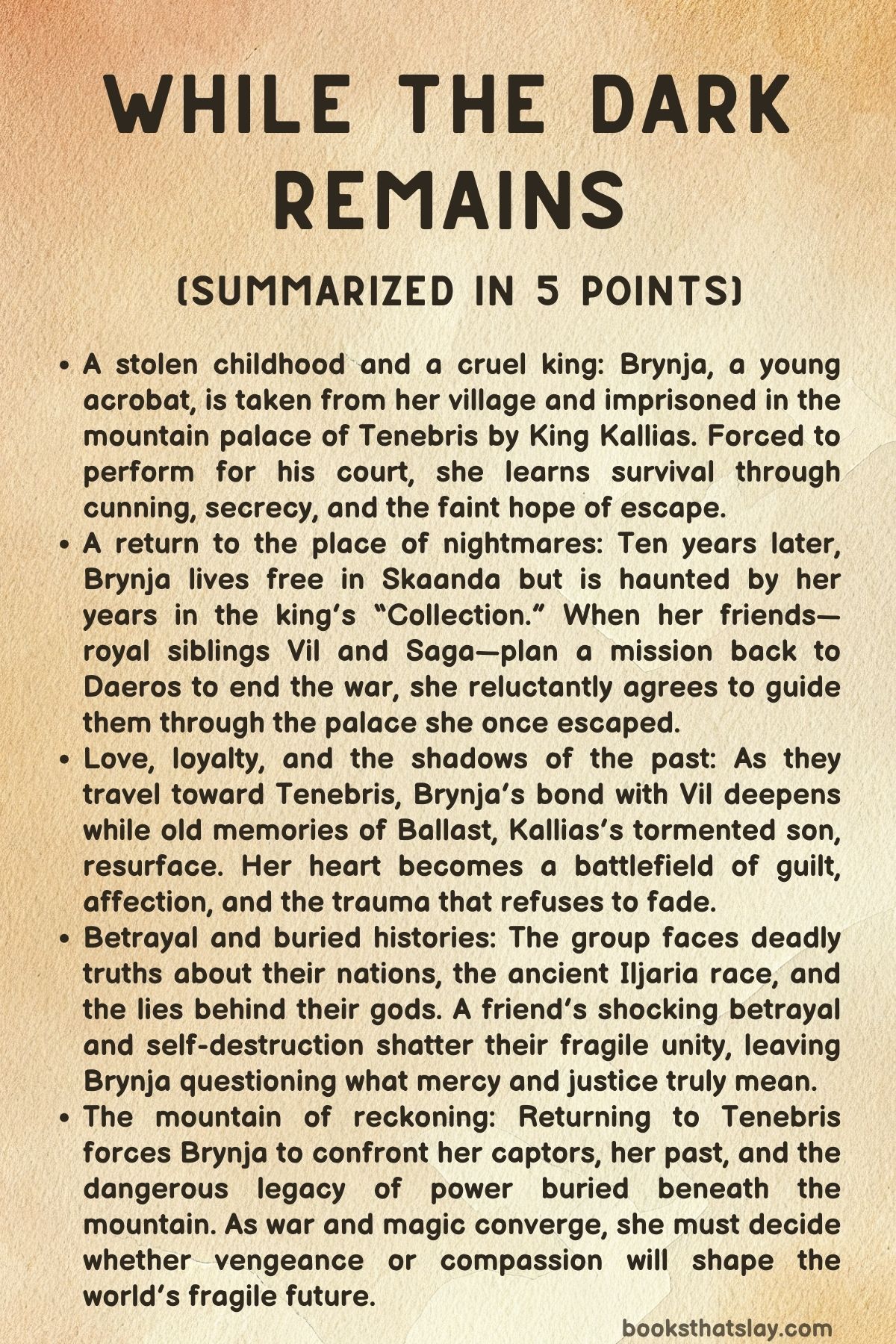
Summary
The story begins in the ruined village of Skaanda, where a young acrobat named Brynja performs for the King of Daeros. Her act of grace and skill wins her no freedom; instead, she is purchased and taken to the mountain fortress of Tenebris.
There, she joins the king’s “Collection” of enslaved children—artists, magicians, and performers held in iron cages suspended above the great hall. Under constant threat of execution, Brynja survives by perfecting her art and learning the palace’s hidden paths from Gulla, the king’s Iljaria wife and former captive.
She begins to dream of escape, even as she watches others perish.
Years later, Brynja awakens in the Skaandan royal palace, now free but haunted by her past. She and Saga, the crown princess and fellow survivor, have been home for nearly two years.
Saga and her brother, Crown Prince Vilhjalmur (Vil), plan a peace mission to Daeros under the guise of diplomacy, concealing a military campaign meant to overthrow King Kallias. They ask Brynja to join them, as she alone knows the secret tunnels beneath Tenebris.
Fearful yet moved by Vil’s compassion and sincerity, she reluctantly agrees.
Their journey across Skaanda and into Daeros is marked by growing tension and unspoken affection between Brynja and Vil. Haunted by her years in captivity and memories of Ballast—the king’s son who once showed her kindness—Brynja struggles to trust herself or others.
Along the way, she recalls fragments of her past: a childhood filled with ambition, a family who prized intellect, and the betrayal that led to her enslavement. Through long nights of travel, she and Vil dance, argue, and begin to bridge the gap between pain and tenderness.
The group encounters the Iljaria, an ancient people of immense magic who once ruled Daeros. Their leader’s power unsettles Brynja, awakening buried fears.
The Skaandans debate history, guilt, and war, revealing that their nation descends from Iljaria children once cast out for lacking magic. These tensions deepen when Indridi, Saga’s trusted handmaiden, is revealed as an Iljaria spy sent by the mysterious Prism Master.
Her betrayal devastates Saga, and when she chooses death by fire rather than capture, the group is left broken. The tragedy cements Vil’s resolve to conquer Daeros and Brynja’s internal conflict about vengeance and mercy.
Flashbacks return to Brynja’s years in the Collection. In secret, she explored Tenebris’s hidden corridors and befriended Ballast, the king’s son.
Their quiet companionship offered moments of light in her captivity, but when Ballast’s father discovered his compassion, he punished him brutally. Their friendship ended abruptly, leaving Brynja with guilt and longing.
Later, she witnessed the horrors of the king’s cruelty—Ballast forced to command beasts to kill another prisoner under royal decree. When Ballast eventually escaped into the frozen wilderness, Brynja clung to the hope that he survived.
Back in the present, Brynja and her companions approach Tenebris through the tundra. Saga grieves Indridi, Vil and Brynja grow closer, and the moral cost of their mission looms large.
Brynja remains determined to kill Kallias herself, hoping that act will finally end her nightmares. Upon arriving at the mountain fortress, memories of the cages and the Sea of Bones—the abyss where the dead are thrown—return in full force.
Inside Tenebris, she reconnects with Gulla, who now quietly resists the king. Together, they begin to plan how to stop Kallias’s rumored excavation of an ancient Iljaria weapon said to hold world-ending power.
Brynja’s path crosses again with Ballast, who now serves his father with one ruined eye and a hollow spirit. Their encounters are charged with pain and memory; he urges her to flee while he remains trapped by duty.
Meanwhile, the Skaandan delegation struggles to maintain its false peace mission as tensions rise. Brynja sabotages the excavation site by planting enchanted stones, buying time to prevent the awakening of the weapon.
In a cruel twist, Kallias names Ballast his heir, forcing him into the same tyranny he once despised. Brynja attends the ceremony, her resolve hardening to bring both the king and the weapon’s threat to an end.
As war breaks out, Brynja seeks Ballast in the tundra. She finds him leading an army of beasts, his magic a wild force bound by sorrow.
She begs his help against Brandr, an Iljaria warlord seeking to unleash the Yellow Lord—one of the ancient powers sealed away by the gods. Brynja confesses that she killed Kallias and pleads for Ballast’s trust.
He agrees, revealing that he sacrificed his eye to manipulate his father and protect Daeros from within. To reclaim her lost magic, Brynja undergoes a spiritual trial: she dives into her own consciousness, opens the locked chest of her power, and restores it through searing pain and divine guidance.
Reborn, she and Ballast set out for Tenebris together.
The final battle erupts at the Sea of Bones. Three armies clash—the Skaandans emerging from tunnels, Daerosians defending their land, and Iljaria sorcerers commanding elemental power.
Ballast’s beasts join the fray, and the battlefield becomes chaos of fire, snow, and song. Brynja faces Brandr, invading his mind to strip away his power and confront the Ghost Lord who fuels him.
By binding Brandr’s magic, she neutralizes his threat but cannot stop the Yellow Lord’s awakening.
To end the destruction, Brynja and Ballast combine their power and hurl themselves into the Sea of Bones with the Yellow Lord. In a realm of light and shadow, the ancient gods offer the Yellow Lord a final choice between redemption and eternal darkness.
He chooses light, vanishing into the sun, and the world is spared.
When the survivors return to the surface, the sky bears a new light—the sign of the Yellow Lord’s ascension. The armies lay down their weapons.
Ballast is hailed as king, while Saga claims Tenebris for Skaanda but ultimately departs in grief. Vil, disillusioned, withdraws.
Brynja helps free the surviving children of the Collection and begins rebuilding the broken kingdom alongside Ballast. Their bond, born of pain and forgiveness, becomes a fragile promise of healing.
In the quiet aftermath, Brynja decides to journey to the Iljaria to reclaim her identity and understand her restored magic. She and Ballast part with the vow that she will return.
As dawn rises over the mountains and the Sea of Bones stills, the long shadow of darkness lifts. For the first time, there is peace—and in that peace, the faint beginning of hope.
Characters
Brynja
Brynja, the protagonist of While the Dark Remains, is a character forged in both terror and resilience. Taken from her home as a child and imprisoned in King Kallias’s macabre “Collection,” she grows up in an iron cage, performing acrobatics under the threat of death.
Her early life is one of brutal survival, yet within her burns an unyielding will to live and a quiet defiance that evolves into the courage to escape. Through her journey, Brynja embodies trauma transformed into purpose.
Even after freedom, she carries the scars of captivity—physical, emotional, and spiritual. Fear, guilt, and the haunting memory of Kallias’s cruelty cloud her relationships, especially with Vil and Ballast, two men tied to opposite poles of her past and future.
Brynja’s arc becomes one of reclamation: she must learn to open herself to love and trust while confronting the remnants of her own fear. Her rediscovery of magic near the story’s end symbolizes this healing—the restoration of a self long denied.
In every sense, Brynja is both survivor and redeemer, her strength rooted not in vengeance but in her capacity for mercy and renewal.
Ballast
Ballast is perhaps the most complex figure in While the Dark Remains, the embodiment of guilt, power, and redemption. The son of King Kallias and an Iljaria woman, he exists at the intersection of two worlds, never belonging fully to either.
Under his father’s brutal rule, he becomes both victim and unwilling perpetrator, forced to use his power to kill and control. His relationship with Brynja begins in quiet acts of compassion within the darkness of Tenebris—a fragile bridge between two captives.
However, his trauma manifests in self-loathing and restraint, shaping him into a man torn between duty and humanity. As the story progresses, Ballast evolves from the shadow of his father into a leader capable of uniting divided realms.
His love for Brynja is redemptive; it humanizes his suffering and ultimately empowers him to face the destructive legacies of both bloodlines. Ballast’s final act—joining Brynja in the battle against the Yellow Lord—completes his transformation.
He becomes a symbol of reconciliation, of power tempered by conscience.
Saga
Saga, the crown princess of Skaanda and Brynja’s closest friend, mirrors the human cost of vengeance and grief. Like Brynja, she was once a captive of Kallias, but her response to trauma is fueled by anger rather than reflection.
Fierce, loyal, and impulsive, Saga channels her pain into the pursuit of justice for her people and revenge for her lover Hilf’s death. Her friendship with Brynja is both intimate and volatile—built on shared suffering yet strained by their opposing ways of healing.
Saga’s inability to forgive Ballast for Hilf’s murder and her rigid sense of justice set her on a tragic trajectory. She is the voice of the wounded nation, but also its warning: when pain becomes identity, peace remains out of reach.
By the novel’s end, Saga’s departure represents both loss and inevitability—her story remains unfinished, defined by exile and the refusal to reconcile.
Vilhjalmur (Vil)
Vilhjalmur, or Vil, stands as the political and emotional fulcrum of While the Dark Remains. As the crown prince of Skaanda, he is guided by the belief that peace must be won through calculated strength.
Unlike his sister Saga, Vil is pragmatic and controlled, a man whose compassion is often concealed by strategy. His relationship with Brynja is tender yet tinged with sorrow—he loves her deeply but is haunted by the awareness that she is still bound to her past.
His patience and decency contrast with the brutality of the world around him, yet he too is capable of hardness when duty demands it, as shown in his decision to execute Indridi. Vil’s character reflects the painful balance between mercy and necessity in leadership.
Ultimately, he embodies the limits of human goodness in a world governed by war, unable to bridge the emotional chasm between himself and Brynja.
King Kallias
King Kallias of Daeros is the monstrous architect of the story’s central traumas. A tyrant obsessed with beauty, talent, and control, he collects children like possessions to display and destroy.
Beneath his cruelty lies an emptiness—a desire to command the divine through art, talent, and pain. His reign over Tenebris is both literal and symbolic darkness.
Through Kallias, the novel examines the corruption of power and the commodification of human worth. Yet he is not portrayed as merely insane; rather, he is chillingly deliberate, embodying the kind of evil that thrives through order and ritual.
His manipulation of Ballast and enslavement of Brynja expose his perverse hunger to dominate not only bodies but souls. Even after his death, his shadow lingers, shaping the fears and choices of those who survived him.
Indridi
Indridi, Saga’s handmaiden and a secret Iljaria spy, adds a tragic note of moral ambiguity to the narrative. For years she lives among the Skaandans, serving faithfully, sharing laughter and danger alike—until her true identity is revealed.
Her dual existence forces readers to confront questions of loyalty and identity. Indridi’s final act—choosing death rather than capture—reveals both her devotion to her people and her exhaustion from living a lie.
Her immolation is one of the novel’s most haunting moments, a sacrifice that deepens the grief and distrust within the group. Through Indridi, the story captures the anguish of those trapped between nations and the devastating cost of divided loyalties.
Gulla
Gulla, once Kallias’s Iljaria wife and one of his first captives, represents resilience through quiet endurance. She is a survivor who uses her knowledge of the palace’s secret architecture to guide Brynja toward freedom.
Gulla’s presence is gentle yet commanding; she becomes a maternal figure to Brynja, shaping her understanding of courage and compassion. Later, in the battle at the Sea of Bones, Gulla’s song of life counters Iljaria death-magic, reaffirming her as a force of healing amid destruction.
Her arc, though subtle, reinforces the novel’s theme that even within captivity, hope can be nurtured and passed on.
Brandr
Brandr, the Iljaria adversary and eventual vessel of the Yellow Lord, serves as the embodiment of corrupted ambition. Intelligent and charismatic, he seeks to reshape the world through destruction, believing himself chosen by divine power.
His manipulation of faith and his alliance with the Ghost Lord mirror Kallias’s lust for control, but through a different means—one cloaked in righteousness. Brandr’s confrontation with Brynja is both ideological and spiritual: where he seeks dominion, she seeks restoration.
His ultimate defeat signifies the triumph of balance over domination, the central moral equilibrium the novel strives toward.
Finnur
Finnur, one of the Iljaria children imprisoned in Kallias’s Collection, is a symbol of innocent resilience. Despite his suffering, he retains creativity and empathy, helping Brynja by crafting enchanted stones to halt Kallias’s destructive mining.
His brief freedom and quiet acceptance of reimprisonment reveal the small acts of bravery that underpin resistance. Finnur’s role, though secondary, highlights the enduring humanity of those reduced to objects by tyranny.
Themes
Trauma and the Struggle for Healing
Brynja’s journey in While the Dark Remains reflects the profound and enduring scars left by trauma. Her years of captivity under King Kallias are not simply memories of physical confinement but psychological chains that shape every part of her being.
The story portrays trauma as something that transforms perception—Brynja’s surroundings, relationships, and even her sense of self are filtered through the lens of survival. Her fear of returning to Tenebris symbolizes the internal battle between the need to confront pain and the instinct to flee from it.
Throughout the narrative, the text emphasizes that healing is neither linear nor complete; it is an ongoing negotiation between memory and resilience. Even when surrounded by friends and potential love, Brynja cannot easily trust her own emotions.
Her nightmares, hesitations, and self-imposed distance serve as reminders that the past lingers as an echo in the present. Yet, the act of returning to Tenebris—her place of torment—becomes an act of reclamation.
She is no longer the caged performer but a woman determined to face the shadows that once defined her. The novel presents healing not as forgetting but as integration: to survive is to remember without letting the memory rule.
Through Brynja, trauma is reimagined as both a wound and a source of strength, a force that compels transformation even as it leaves its mark.
Power, Oppression, and Resistance
The dynamics of control in While the Dark Remains are rooted in systems of exploitation, from the king’s “Collection” to the hierarchical divisions among races and nations. King Kallias embodies the grotesque extremes of power—his obsession with beauty and talent manifests as cruelty disguised as appreciation.
Each caged child becomes a reflection of his tyranny, a mirror to his own hunger for dominance. Against this backdrop, resistance takes many forms: silent endurance, covert rebellion, and the eventual uprising that defines the novel’s climax.
Brynja’s defiance begins not with open confrontation but with small acts—stealing objects, learning the palace’s secrets, daring to dream of escape. Power is shown to thrive on fear and isolation; thus, solidarity among the oppressed becomes a subversive act.
The story also extends this theme beyond personal tyranny to political and divine scales. Nations manipulate ideals of peace and war to justify conquest, and gods themselves embody different philosophies of control.
What emerges is a meditation on moral complexity: even the pursuit of justice can become tainted by the desire to dominate. Brynja’s final confrontation with Brandr and the elemental lords reveals that true power lies not in command but in balance—the strength to act without destroying, to lead without enslaving.
The novel exposes the corrupting allure of authority while suggesting that liberation begins in self-mastery.
Identity, Transformation, and Reclamation
Identity in While the Dark Remains is portrayed as fluid, shaped by circumstance, memory, and choice. Brynja’s evolution from enslaved acrobat to warrior of peace captures a profound metamorphosis that is both physical and spiritual.
Her sense of self fractures under captivity, yet fragments of her former life—her family, her artistry, her lost magic—linger as embers of who she might still become. The unlocking of her magic serves as a metaphor for reclaiming agency, an act that unites her fractured identities: performer, survivor, lover, and leader.
The novel explores how identity can be stolen or suppressed by power, as seen in Kallias’s Collection and the Iljaria’s manipulation of lineage and magic. But it also shows that reclamation is possible through conscious choice.
Brynja’s decision to return to Tenebris and later to restore her own power becomes an act of self-definition. Similarly, Ballast’s struggle with his father’s legacy and his half-Iljaria heritage underscores how identity can carry both guilt and promise.
Their bond becomes a union of broken selves seeking wholeness. Transformation, then, is not escape from the past but reconciliation with it—a recognition that every scar, every memory, contributes to the person who finally chooses to stand in her own light.
Love, Guilt, and Redemption
Love in While the Dark Remains exists in tension with guilt, shaping the emotional gravity of every relationship. Brynja’s affection for both Vil and Ballast reveals her divided heart: one symbolizes safety and future, the other represents pain and the haunting past.
Her love is never uncomplicated; it bears the weight of survival, fear, and remorse. The story refuses romantic idealism—instead, love is portrayed as a fragile negotiation between trust and vulnerability.
For Ballast, love becomes a form of penance. Haunted by the atrocities he was forced to commit under his father’s rule, he yearns for forgiveness but believes himself irredeemable.
Their reunion late in the story is therefore not only romantic but spiritual—a merging of two broken souls who learn that redemption is not bestowed but chosen. Even secondary relationships, such as the friendship between Brynja and Saga or the lost bond with Indridi, carry undertones of grief and forgiveness.
The narrative insists that love, to be genuine, must confront the truth of what has been done and what cannot be undone. Through this lens, redemption emerges not as absolution but as courage—the courage to love despite the ruin, to hope even when haunted by ghosts.
War, Faith, and the Cost of Peace
The world of While the Dark Remains is one perpetually at war, where politics and divine myth intertwine to question the morality of violence. The Skaandan and Daerosian conflict, mirrored by the rivalries of the gods, exposes the cyclical nature of vengeance.
Each side believes its cause righteous, yet both perpetuate suffering. The novel treats war as a disease of pride—its wounds cut across nations and generations.
The mythic framework of the Bronze God, Prism Goddess, and Yellow Lord transforms faith into a mirror for human struggle. The gods are not distant arbiters but embodiments of human desire, wrath, and mercy.
Brynja’s confrontation with divine forces during the final battle blurs the boundary between mortal and celestial, suggesting that faith is ultimately a reflection of human conscience. Her choice to restore balance rather than dominate signifies a rejection of blind zeal.
The cost of peace is heavy: loss, betrayal, and the burden of moral responsibility. Yet the ending offers a restrained hope, where peace is not triumph but endurance—a fragile state that must be maintained through humility and remembrance.
The novel closes not with victory hymns but with quiet resilience, honoring those who chose compassion over conquest.