Wicked Ends by Mila Kane Summary, Characters and Themes
Wicked Ends by Mila Kane is a dark romance that blends obsession, redemption, and the haunting pull of past trauma. Set in the rugged coastal town of Hade Harbor, Maine, it follows two people bound by secrets and danger.
Arianna, a woman running from her violent past under a false identity, seeks a fresh start as a university professor. Marcus Bailey, a hockey player with ties to a criminal biker family, battles his inner chaos and loyalty to blood. Their chance encounter at a bar ignites a storm of passion, manipulation, and forbidden attraction that threatens to destroy—or save—them both. It’s the 4th book in the Hellions of Hade Harbor series by the author.
Summary
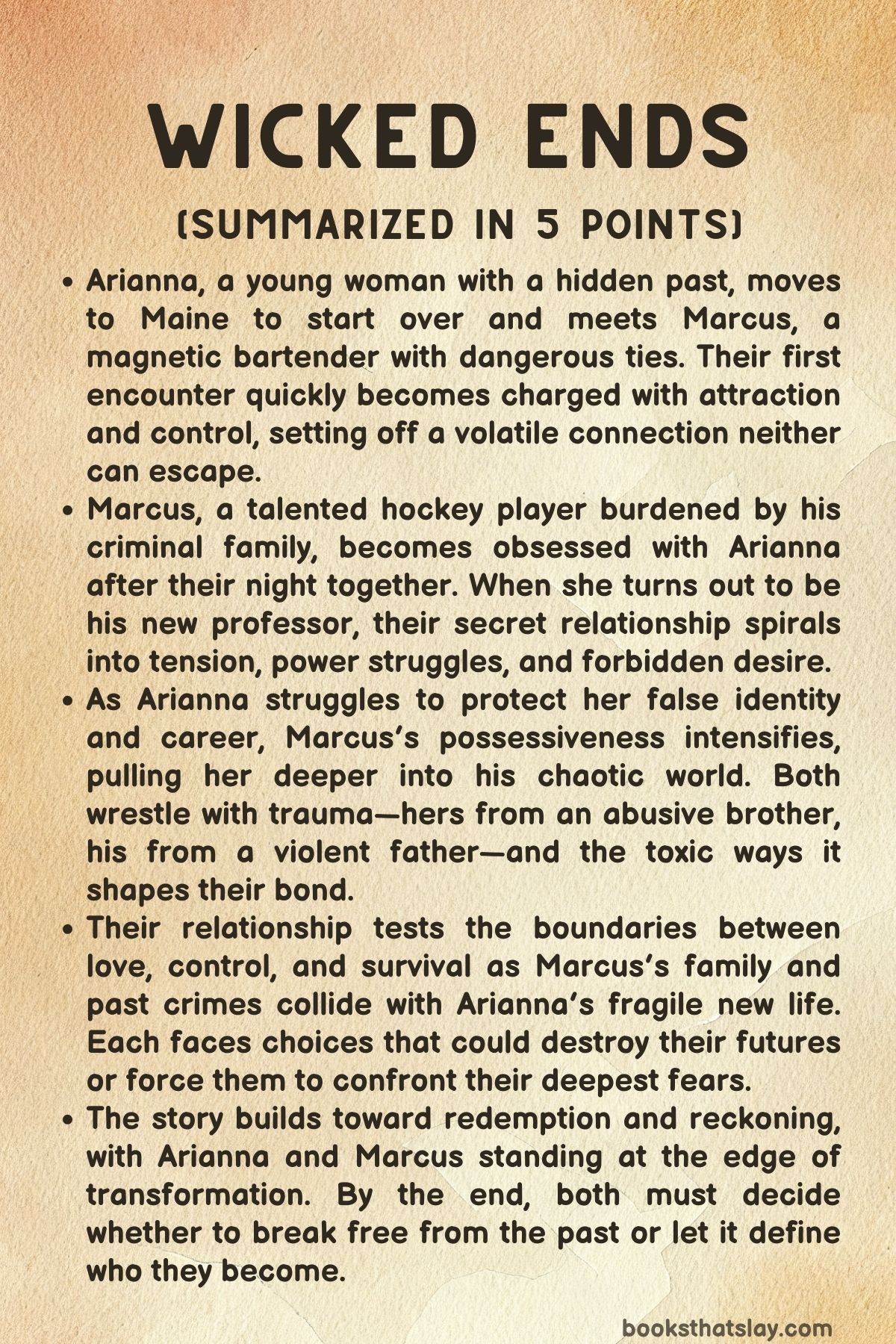
Arianna arrives in the quiet town of Hade Harbor, Maine, hoping to leave behind her painful past in California. She stays at a rundown motel, trying to rebuild her life under the name “Anna Moore.
” One night, she visits a local biker bar called The Clutch to celebrate her twenty-fifth birthday alone. There, she meets Marcus Bailey, the bar’s tattooed bartender and a star goalie for the local hockey team, the Hellions.
Their chemistry is immediate and dangerous. After a bar fight, Arianna tends to his wounded hand in a back room, and their flirtation turns physical.
Marcus’s intensity both frightens and fascinates her, and they spend a passionate night together.
The next morning, Arianna slips away quietly, determined to focus on her new job at Hade Harbor University. She hopes to leave the encounter behind, unaware that Marcus can’t stop thinking about her.
Soon, their lives collide again in the most unexpected way—Marcus walks into her classroom as one of her students. Shock and fear grip Arianna as she realizes that her reckless night has come back to haunt her.
Marcus, both amused and enraged that she left him, begins a calculated game of dominance, insisting she can’t ignore what happened between them.
Despite Arianna’s efforts to keep her distance, Marcus’s obsession grows. Their confrontations in and out of class blur the lines between power and desire.
He teases, threatens, and seduces her while she fights to preserve her new identity and fragile stability. Meanwhile, Marcus wrestles with his own demons: a childhood marked by violence, a father in prison for murder, and a brother, Cole, who leads the Harbor Hounds motorcycle gang.
His life on the ice offers him a glimpse of redemption, but his connection with Arianna pulls him back toward chaos.
Arianna’s backstory unfolds gradually—her brother Dale was abusive and controlling, inheriting their family estate and tormenting her for years. She fled California with fake documents after enduring years of manipulation.
Marcus becomes both her protector and her danger, embodying the violence she escaped yet also the only person who truly sees her. When Marcus discovers that Arianna may have taken a bag of money from his bar, his anger and desire mix explosively.
He kidnaps her and takes her to his old cabin in the woods. There, his obsession deepens into possession; he burns her clothes, chains her to the bed, and forces her to confront her feelings for him.
Their time at the cabin transforms from control to twisted intimacy, revealing that both crave freedom in each other’s captivity.
Arianna’s resilience challenges Marcus’s control. She refuses to break, forcing him to confront his own fears and guilt.
When she demands space and promises to return to him after the semester ends, he reluctantly agrees, setting boundaries neither fully believes in. Back in town, they attempt to maintain distance, but fate keeps drawing them together—on campus, in games, and at parties.
Marcus’s jealousy and temper flare when other men show interest in her, especially fellow professor Wade. Their dynamic becomes a dangerous dance of power and surrender, secrecy and revelation.
At the centennial “100 Years of Hell” hockey celebration, tensions erupt. Marcus gets into a brutal fight on the ice with rival player Brody Sinclair after hearing crude remarks about Arianna.
The brawl jeopardizes his career and reputation. Though suspended from the team, he remains fixated on Arianna, and she continues to risk everything to help him.
Their relationship teeters between destruction and salvation.
As the story darkens, Arianna’s brother Dale resurfaces, threatening her fragile peace. Marcus’s criminal world closes in when a gang member is stabbed, and his father’s parole hearing forces old wounds open.
Determined to protect Arianna from the monsters of both their pasts, Marcus hunts Dale down with the help of his biker allies. He captures and kills him, fulfilling a vow to end Arianna’s torment and give her freedom.
With Dale gone, Arianna begins to reclaim her life. She helps Marcus by convincing the university dean and his coach to give him a second chance, even as her false identity is exposed.
When Marcus takes the blame for the scandal involving leaked classroom photos, his honesty earns him redemption. His brother Cole steps in to ensure Marcus’s hockey future is secure, revealing a rare moment of loyalty between them.
Marcus surprises Arianna by leading her to a seaside house—her dream home—renovated and secured in her name. It’s both a gift and a promise.
There, he proposes, asking her to stop running and to start a shared life with him. She accepts, recognizing that love, even when born from darkness, can lead to light.
In the epilogue, Marcus returns to the rink, now calmer and more grounded. The Hellions win their final game, and he publicly acknowledges Arianna as his fiancée, ending his feud with Brody Sinclair with quiet confidence.
Arianna, now offered a permanent teaching position at the university, finds balance between her music, her identity, and her future with Marcus. Their relationship remains intense but rooted in mutual understanding and transformation.
The novel closes with a teaser for the next story, shifting focus to Brody Sinclair—a disciplined, closed-off hockey player whose world collides with Selena, his rebellious new stepsister. Their volatile connection promises another storm of desire and defiance in Mila Kane’s continuing saga of love born from ruin.
Characters
Arianna (Anna Moore)
Arianna is the emotional core of Wicked Ends, a woman defined by her trauma, reinvention, and fierce, if fragile, sense of self. Her story begins with reinvention — she arrives in Maine under the alias “Anna Moore,” seeking to escape a life overshadowed by abuse and betrayal.
Her past, marked by her brother Dale’s cruelty and control, shapes her every action. Arianna’s internal struggle is between fear and freedom: the desperate need to remain unseen wars with her yearning to finally live fully.
Her musicality and synesthesia symbolize both her sensitivity and her ability to perceive beauty in chaos — she literally “sees” sound in color, a poetic reflection of her emotional depth. Her encounter with Marcus awakens something long dormant: desire, risk, and an assertion of selfhood.
Yet, as their relationship veers between passion and peril, Arianna’s journey becomes one of reclaiming agency. Her growth is measured not in grand gestures but in the quiet defiance of a woman choosing to face her past rather than flee from it.
In the end, she evolves from a fugitive in hiding to a woman who builds a life on her own terms, embodying resilience, tenderness, and courage.
Marcus Bailey
Marcus is a study in contradictions — a man torn between his brutal heritage and his search for redemption. A professional hockey player with a criminal family background, he straddles two worlds that constantly threaten to consume him.
Marcus’s life is built on violence and loyalty, both inherited from his father’s biker gang, the Harbor Hounds. Yet beneath his volatile exterior lies an almost boyish vulnerability — a hunger to be seen and loved without condition.
His obsession with Arianna stems from her being everything he is not: gentle, artistic, uncorrupted. Through her, he experiences vulnerability, something that both terrifies and liberates him.
However, Marcus’s love manifests through dominance and control, his affection often expressed in destructive ways that blur the line between devotion and possession. His evolution throughout Wicked Ends is marked by struggle — the battle to tame his impulses, reject his father’s legacy, and become a man capable of true love.
His eventual choice to protect Arianna, even at great personal cost, transforms him from an antihero into a man who understands that strength also lies in restraint.
Cole Bailey
Cole stands as both protector and tormentor in Marcus’s life. The older brother who once shielded Marcus from their father’s violence becomes a figure of conflicting authority — part savior, part enabler.
As leader of the Harbor Hounds, Cole is a man steeped in the world of crime and vengeance, yet his actions are often motivated by a twisted form of love. He pushes Marcus relentlessly, believing toughness is the only way to survive.
Cole’s dynamic with Marcus is deeply psychological: he is the mirror reflecting what Marcus could become if he never escapes the gravity of their family. His pragmatic ruthlessness contrasts Marcus’s volatile emotions, grounding the story’s criminal undercurrent.
In the end, Cole’s grudging support for Marcus’s career and relationship with Arianna reveals an unspoken redemption arc of his own — one that shows that even within the darkness of violence, loyalty and love can take fractured, unconventional forms.
Dale
Dale represents the embodiment of Arianna’s trauma — the abuser whose manipulation drives her into hiding. As her brother, his cruelty carries a particular intimacy, making his betrayal devastatingly personal.
Dale’s character exposes the cycle of power and degradation that defines many of the novel’s relationships, serving as the shadow from which Arianna must break free. His eventual downfall — orchestrated by Marcus — serves as both poetic justice and a moral reckoning.
Dale’s death is not just the end of Arianna’s torment but also the moment where Marcus’s violent world intersects completely with hers, forcing both to confront what vengeance costs. Dale’s presence lingers even after his demise, as the memory of his control becomes the crucible through which Arianna reclaims her strength.
MacKenna Brooks (Kenna)
MacKenna is Arianna’s anchor — a figure of friendship, practicality, and warmth in a narrative dominated by danger and deceit. As the friend who helps Arianna establish a new life, she represents normalcy and emotional refuge.
Kenna’s lighthearted demeanor conceals quiet strength; she is the emotional ballast that allows Arianna to navigate her chaotic relationship with Marcus. Though largely peripheral to the central romance, Kenna’s presence underscores the importance of chosen family and female solidarity.
In a world of manipulation and male power, her loyalty and care remind Arianna — and the reader — that gentleness can be a form of defiance.
Claire and Lulu
Claire, Dale’s widow, and her daughter Lulu embody innocence and renewal. Claire’s survival and eventual peace mirror Arianna’s own recovery, while Lulu serves as a living symbol of hope — the next generation freed from the violence of their predecessors.
Claire’s acceptance of Marcus’s vengeance, though morally ambiguous, signals her recognition of the cyclical nature of trauma and the desperate need to end it. Together, mother and daughter represent healing, the fragile yet powerful aftermath of justice and survival.
Frank Bailey
Frank, Marcus and Cole’s father, looms over Wicked Ends as the ghost of patriarchal corruption. His violent past and manipulative presence define the Bailey brothers’ struggles with morality and control.
Even from prison, Frank exerts power — a reminder that legacy can be both inherited and battled against. He is the origin of Marcus’s temper and Cole’s hardness, the poisoned root from which their story grows.
His failure to earn parole and his ultimate insignificance by the novel’s end symbolize the death of the old order, clearing the way for Marcus and Arianna to redefine strength and love on their own terms.
Wade and the Sinclair Brothers
Wade, the sleazy English professor, and Brody and Callahan Sinclair, Marcus’s hockey rivals, serve as external antagonists who intensify the story’s conflict. Wade’s predatory advances highlight the institutional hypocrisy surrounding Arianna’s academic life, while the Sinclair brothers embody the toxic competitiveness that dogs Marcus’s career.
Brody, in particular, functions as Marcus’s foil — disciplined, arrogant, and provocatively cruel. His taunts expose Marcus’s insecurities but also push him toward growth.
Their rivalry evolves from violence to controlled mastery, culminating in Marcus’s eventual triumph both on and off the ice.
Themes
Identity and Reinvention
The story of Wicked Ends is steeped in the pursuit of identity and the desperate act of reinvention. Arianna’s life is a constant act of self-preservation through disguise—her transformation into Anna Moore represents both an escape and a rebirth.
Her decision to abandon her past in California, marred by her brother’s abuse and her emotional scars, is not simply a move toward anonymity but an effort to construct an entirely new self. Her fake documents, new profession, and guarded demeanor embody a fragile architecture of identity that she tries to sustain while the past threatens to resurface.
The psychological strain of maintaining this duality is evident in every interaction, particularly once Marcus re-enters her life. His discovery of her secret identity shatters her illusion of safety and exposes how fragile reinvention can be when it isn’t built on acceptance but fear.
For Marcus, identity is also fractured—he is torn between the man he wants to be and the one the world expects of him. As a hockey player aspiring to an honorable career, he must constantly fight the pull of his criminal family’s legacy.
His inherited surname carries both power and shame. Together, Arianna and Marcus embody the dual struggle of escaping inherited pain and reclaiming control over self-definition.
Their relationship becomes the space where masks fall away—sometimes violently—and where both learn that reinvention without confronting truth is only temporary.
Power, Control, and Consent
The dynamic between Marcus and Arianna unfolds as a relentless negotiation of power. Their encounters blur the line between dominance and affection, coercion and surrender, revealing how control operates both physically and psychologically.
Marcus’s dominance is not just sexual—it is the product of a lifetime defined by subjugation under his father’s violence and his brother’s authority. His obsession with control, especially over Arianna, stems from a need to reclaim the agency that was stripped from him as a child.
Arianna’s submission, on the other hand, is deeply tied to her trauma. Having lived under an abusive brother who weaponized fear and dependency, she confuses control with protection.
When Marcus chains her, manipulates her emotions, and forces choices upon her, the story explores how love can dangerously overlap with possession. Yet, Wicked Ends does not portray her as powerless; she learns to manipulate Marcus’s control, forcing him to confront his emotional vulnerability.
The “game of chicken” at the cabin is symbolic of their psychological war—her refusal to surrender becomes a reclamation of her autonomy. The narrative questions whether love born from imbalance can ever truly be redemptive, ultimately suggesting that healing requires both characters to dismantle their need for dominance and face the terror of equality.
Trauma and Cycles of Violence
Trauma saturates the world of Wicked Ends, shaping every choice its characters make. Both Marcus and Arianna are products of violence—his from a father who turned cruelty into ritual, hers from a brother who used familial duty as a weapon.
Their connection is, in many ways, trauma recognizing itself in another. Each of them carries memories that manifest in destructive behavior: Marcus’s volatility, Arianna’s mistrust, their simultaneous craving for and fear of intimacy.
The novel demonstrates how unresolved pain perpetuates cycles of violence—Marcus reenacts the domination of his father through his obsessive control of Arianna, even as he believes he is protecting her. Arianna, haunted by past helplessness, relives her trauma in choosing men who echo her abuser’s intensity.
The moment Marcus tortures and kills Dale is not merely revenge but a grim reflection of how violence becomes inherited language. Yet, the conclusion attempts to break this cycle.
Arianna’s decision to rebuild her life openly, and Marcus’s pursuit of a future detached from his father’s code, signify the beginning of generational healing. The story insists that trauma cannot be buried under new identities—it must be faced, understood, and rewritten through acts of defiance and truth.
Love as Redemption and Destruction
Love in Wicked Ends is never simple or gentle; it is fierce, consuming, and often indistinguishable from destruction. Marcus and Arianna’s relationship thrives on tension—its passion feeds on fear and defiance as much as desire.
Their chemistry, from the very first encounter, operates on the edge of danger. Marcus’s love manifests as obsession, a desperate attempt to claim stability through possession.
Arianna’s love evolves through conflict—she learns to recognize the difference between protection and control, tenderness and dominance. The novel uses their bond to question whether redemption can exist in relationships born from chaos.
Love becomes both the instrument of ruin and the mechanism for rebirth. When Marcus burns her clothes, chains her, or risks his career for her, his acts reveal the paradox of passion that destroys in the name of devotion.
Yet, their final union—tempered by confessions, sacrifices, and shared accountability—marks love’s potential to transform destruction into restoration. Their story concludes not in idealized romance but in an understanding that love’s redemptive power lies not in erasing darkness but in accepting it as part of one’s whole self.
Family, Loyalty, and Legacy
The theme of family in Wicked Ends is both anchor and curse. Every major conflict arises from inherited loyalties and the struggle to escape blood-bound expectations.
Marcus’s relationship with his brother Cole and their imprisoned father defines his moral landscape. The Baileys operate under a code of loyalty that conflates protection with control—an ideology Marcus subconsciously replicates in his treatment of Arianna.
His journey is about learning where loyalty ends and selfhood begins. For Arianna, family is synonymous with betrayal and pain.
Her brother Dale represents the corruption of familial duty, while her late grandmother symbolizes the tenderness she lost too soon. Her longing for safety drives her toward found family—Kenna, Claire, and eventually Marcus—through whom she reconstructs a sense of belonging free from abuse.
The novel draws a clear distinction between inherited family and chosen family, suggesting that love and loyalty only hold meaning when freely given. Marcus’s eventual defiance of his father’s code, his reconciliation with Cole, and Arianna’s reclamation of her name collectively signify liberation from toxic legacy.
Family becomes not a chain of blood but a conscious act of rebuilding trust after generations of damage.
Freedom and Entrapment
Freedom in Wicked Ends is paradoxical—every attempt to grasp it leads to another form of confinement. Arianna’s escape from California promises liberty, yet she remains trapped in fear, falsehood, and emotional dependence.
Marcus’s career in hockey is his supposed escape from crime, but his loyalty to the Harbor Hounds binds him tighter than any physical chain. Their romance operates within this tension: each seeks freedom through the other, yet their possessive love initially breeds only more captivity.
The cabin scenes epitomize this conflict—Arianna is literally chained, yet she begins to experience a sense of emotional clarity. Marcus, who believes control equates to safety, learns that his obsession isolates him.
True freedom, the novel implies, is achieved not through flight or dominance but through confrontation and honesty. When Arianna finally stops running and Marcus chooses transparency over manipulation, they both experience release.
The final image of them building a home together suggests that freedom is not found in escape but in creating a life where the ghosts of the past no longer dictate the present.