Widow’s Point Summary, Characters and Themes
Widow’s Point by Richard Chizmar and WH (Billy) Chizmar is a compact, found-footage-style horror novella set on the wind-lashed coast of Nova Scotia. It follows Thomas Livingston, a bestselling writer who makes his name investigating supposedly haunted places.
Hoping to separate rumor from reality, he arranges an extreme stay: three nights alone in the infamous Widow’s Point Lighthouse, a site tied to nearly two centuries of madness, murder, and disappearance. Presented through his video attempt and then his audio logs, the story builds a claustrophobic record of a skeptic confronting a location that seems to remember every death inside it—and wants one more.
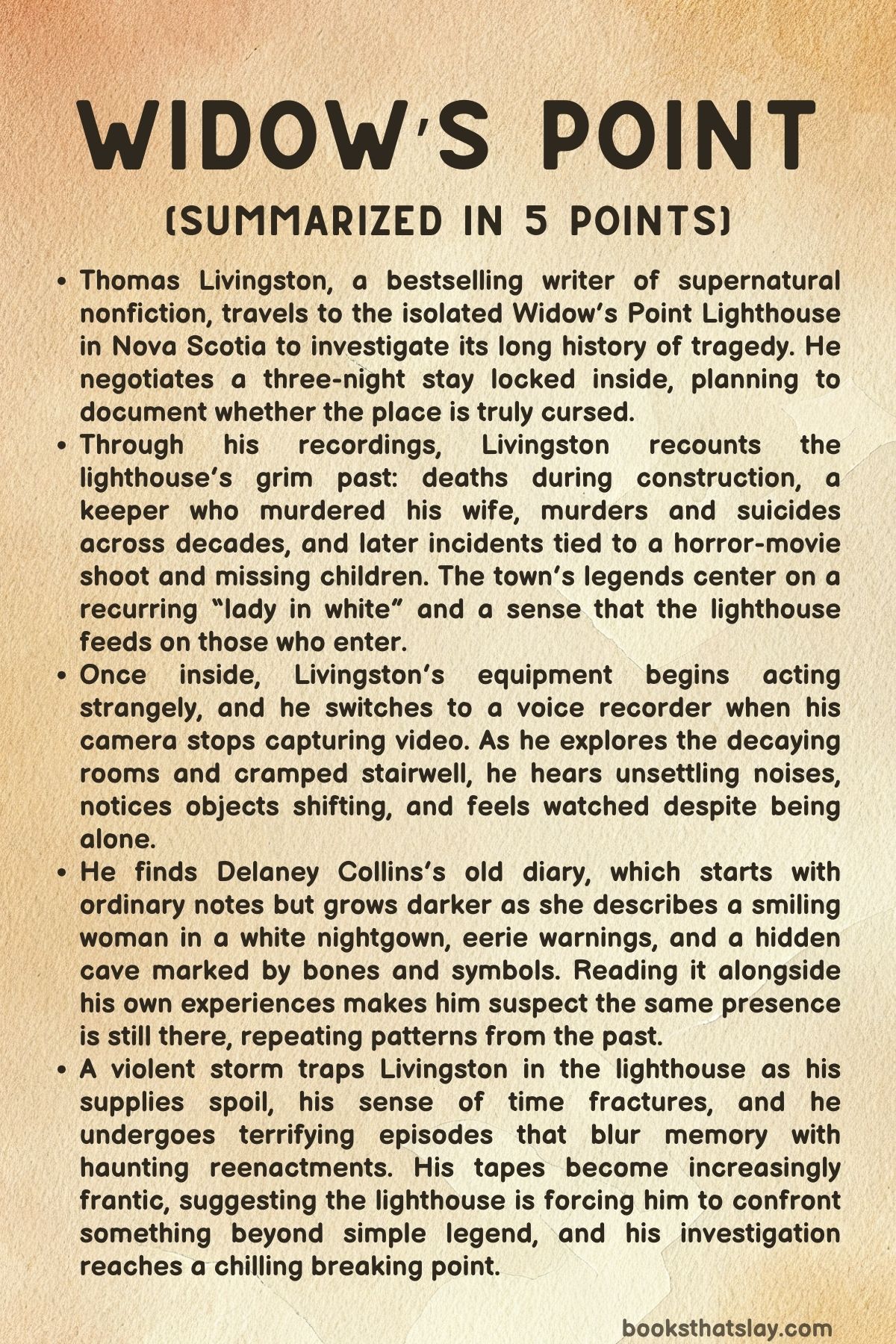
Summary
Thomas Livingston checks into a cheap hotel, tests his video camera, and begins documenting his trip to Harper’s Cove. He films the quiet countryside, a tidy coastal town, and then a busy fishing port.
From the road he spots the lighthouse rising over the trees, and his excitement is obvious. At the beach he pans across sand, jagged rocks, and cliffs until the lens settles on Widow’s Point Lighthouse: battered stone surrounded by trees and sealed behind razor wire.
Into the camera he says this is why he has come.
He drives up a rutted dirt road to the fenced property, with the sea below looking black and hostile. Ronald Parker, the elderly owner, meets him at the gate and immediately dislikes the camera, insisting it be turned off.
Livingston complies and sets up his tripod near the cliffs, but gusting wind knocks it over. Once he restarts, Livingston stands before the lighthouse and introduces himself properly.
He explains that he writes supernatural nonfiction and seeks to test legends personally.
On camera he recounts the lighthouse’s history. Built in 1838 by Franklin Washburn II, it gained a cursed reputation almost at once.
Three men died during construction, including Washburn’s nephew, who fell from the tower on a calm day. The first keeper, Ian Gallagher, went mad during a storm, killed his wife, and then himself.
Over the decades there were more suicides, accidents, vanished visitors, and bloodshed, climaxing in the 1933 slaughter of the Collins family. Stories of devil worship circulated, and eventually the lighthouse was shut down.
Livingston also describes a later incident in 1985 during the shoot of a horror film called Rosemary’s Spirit. The production ran smoothly until supporting actress Lydia Pearl hanged herself from the catwalk.
Authorities called it heartbreak; locals blamed the place. In 1986 two young girls vanished nearby, and by 1988 the property was closed off behind fencing.
Livingston lays out his plan: he has negotiated to stay three days and nights alone inside, locked in with food, water, lanterns, a flashlight, notebooks, and a Sony digital voice recorder. Parker will chain the door from outside and return Monday morning.
Livingston steps into the tower, and the video abruptly goes black though audio still runs. We hear Parker locking chains and a padlock.
Livingston sets down supplies and climbs the 268 steps to the living quarters, narrating as he goes.
At the top, in darkness, he describes a thick, waiting silence. He says he will explore further.
Soon after, he switches to the voice recorder because the camera fails: from the moment he entered, it captures sound but produces a blank image. Test shots confirm it.
Annoyed but determined, he decides to log everything by audio.
He inventories supplies, eats, and begins telling the full story of the Collins tragedy. Keeper Patrick Collins lived there with his wife and children.
His friend Joseph O’Leary claimed to have met a seductive woman in white in a tiny storage area that locals nicknamed the “Shit Room. ” Afterward O’Leary grew obsessed, returned to the lighthouse in a fevered state, bludgeoned the Collins family to death, and then jumped from the catwalk.
Livingston describes the interior as he sees it now. The old living quarters are a rotting storage dump filled with boxes, barrels, broken furniture, mannequin parts, and rats.
He chooses the Watch Room as his base—dusty, thick with cobwebs, and marked by carved initials “DC” in an old dresser drawer. Above sits the lantern room and the catwalk.
He settles in for the night, struggling to sleep through cold drafts and noises that resemble chains shifting and footsteps on stairs. Eventually he dozes off, repeating that he wants only the truth.
In the morning he sounds brighter. He goes over theories about the curse, then logs more modern disasters.
He recalls Lydia Pearl’s strange behavior before her death, the disappearance of the Ellington twins, teenage satanic killings by Michael Risley, and photographer Clifford McGee’s collapse after taking thousands of nearly identical photos of the sea from the catwalk, as if compelled to capture something no one else could see.
While searching through the cluttered lower floors, he finds a moldy diary belonging to Delaney Collins, aged twelve. At first the entries are ordinary complaints and family notes.
Then they shift. Delaney writes about a “lady in white” appearing in her mirror, smiling in a way that feels hungry.
She screams, but her father dismisses it as imagination. Later she describes a cave in the cliff filled with bones and strange symbols.
From within she hears an old man’s disembodied voice warning, “They’re coming for all of you. ” The diary makes Livingston uneasy, but he keeps reading.
As the day goes on, he experiences small disturbances. He hears footsteps below when no one should be there.
Objects seem to move at the edge of his sight. After returning from the catwalk, he finds his notebook opened to a clean page bearing the words “WE ARE HERE” in block letters he did not write.
His bottled water begins tasting faintly salty. Storm clouds roll in far too fast, and the lighthouse shudders under sudden wind.
Livingston admits that whatever is in the tower may not be legend.
That night, Saturday July 12, 2017, a powerful storm lashes the coast. Alone in the upper quarters, Livingston realizes his flashlight is missing despite his certainty he left it beside his sleeping bag.
Soon he hears faint singing, like a child somewhere below. Each time he steps toward the doorway to listen, the sound stops.
A sharp, repetitive banging begins under the floor, raising the sense of a presence moving inside the lighthouse.
To steady himself, he returns to Delaney’s diary. In one entry she recounts brushing her hair and opening her eyes to see the woman in white smiling behind her in the mirror.
Another entry describes Delaney waking to find her younger brother Stephen standing stiffly at the foot of her bed holding their father’s hunting knife, as if sleepwalking. She slaps him awake; he collapses sobbing and apologizing.
Delaney’s fear grows across later pages until her final entry, where she believes the hauntings have stopped and looks forward to a family poker night, unaware of what will happen next.
As the storm worsens, Livingston feels someone behind him. His lantern keeps going out, plunging him into darkness broken only by lightning.
At 10:06 p. m.
his failing video camera suddenly powers on. While he checks it, a terrible sound drives him up the stairs and onto the catwalk.
In the middle of the storm he sees what appears to be a huge ship smashing into the rocks below. He hears men screaming as they are swallowed by waves.
He films in shock, convinced he is witnessing a real wreck. But when he reviews the recording, the ship and drowning men are absent—only thunder, lightning, and empty water remain.
Before dawn he finds himself descending the spiral staircase in a trance, calmly counting steps. When morning comes he is filthy, aching, and scraped raw, his feet torn as if he has wandered barefoot for miles.
The food and water he left upstairs are empty, stale, or rotten. He staggers to his cooler on the ground floor, but every sealed bottle is filled with salt water and every item of food is spoiled with mold and maggots.
He pounds on the chained front door and searches for a way out, finding none. He is trapped until Parker returns Monday.
While recording his panic, an invisible force grabs him. Something clamps his shoulder and rips away a clump of hair.
He flees upward, counting far more steps than the lighthouse should contain. In the Watch Room he finds a bloody hammer lying on his sleeping bag, its polished handle carved with “J.
O. ” His smuggled cell phone shows a strong signal but will not place calls.
The hammer is smeared with blood, tangled with auburn hair and bits of flesh. Overwhelmed, Livingston suddenly experiences Delaney’s murder as if reliving it: her face, her screams, the hammer rising and falling.
He sobs that he was there, holding it, killing her.
From that point his recordings break into terror and confusion. He hears girls singing closer.
Unseen hands touch, bite, and crush him. His glasses vanish.
Time loses shape; he cannot tell day from night. A buzzing phone call connects to a voice claiming to be his dead father, mocking him for his failures.
Livingston smashes the phone and staggers on, bleeding. In his last coherent words he runs toward the catwalk, shouting that someone is coming for him.
The tapes end.
Monday morning, July 14, Parker returns, unlocks the gate, and calls for Livingston. No answer.
Inside, he finds the cooler nearly full, dried vomit on the floor, a blood-soaked sleeping bag, equipment scattered, and strange blood symbols on the walls. The recorder sits on the catwalk, but Livingston is gone.
Police search the locked tower, his car, and the grounds without finding him. His disappearance joins the lighthouse’s long list of victims, leaving Widow’s Point sealed in mystery once again.
Characters
Thomas Livingston
Thomas Livingston is the narrative anchor of Widows Point: a bestselling writer of supernatural nonfiction who arrives with the confidence of someone used to turning fear into content. At first, he presents himself as methodical and skeptical-but-open, treating the lighthouse like a case study he can document, control, and later monetize through a book or film deal.
That professional poise slowly fractures as the stay progresses. His early rationalizations—camera glitches, wind, nerves—give way to a raw, bodily panic when the environment begins to rewrite the rules of reality around him.
What makes him compelling is the way his identity as an investigator becomes his trap: he can’t stop interpreting, narrating, and pushing forward, even when instinct says to flee. By the end, he is reduced from author to subject, from observer to participant in the lighthouse’s cycle, and his disappearance finalizes that reversal.
His arc is built on the erosion of authority—intellectual, emotional, and physical—until all that remains is a terrified human voice swallowed by a place that doesn’t want to be explained.
Ronald Parker
Ronald Parker functions as a gatekeeper figure, embodying the town’s exhausted relationship with the lighthouse. Elderly, irritable, and openly hostile to cameras, he is less a villain than someone who has spent a lifetime living beside a wound that never closes.
His refusal to engage with Livingston’s spectacle suggests deep distrust of outsiders who come hunting for thrills in local tragedy. Yet he still takes the money and locks Livingston in, which makes him morally complicated: he’s a pragmatist who believes the curse is real enough to fear, but not real enough to stop him from enabling another investigation.
Parker’s final discovery of the aftermath—blood, symbols, abandoned gear—places him in the role of witness to the inevitable. He represents the human boundary around Widow’s Point, and his helplessness in the face of what occurs inside underlines the lighthouse’s dominance over every person connected to it.
Delaney Collins
Delaney Collins emerges through her diary as the most intimate voice the lighthouse ever recorded, and that intimacy is what makes her terrifyingly vulnerable. She begins as a normal twelve-year-old, preoccupied with routine, family life, and the small dramas of childhood, which makes the intrusion of the “lady in white” feel like a violation of innocence rather than a gothic thrill.
Delaney’s entries chart a psychological tightening: curiosity turning into fear, fear turning into anticipatory dread, and dread turning into a desperate hope that things have finally stopped. That hope in her last entry is heartbreaking precisely because the reader already knows what is coming.
She becomes both victim and messenger—her diary is the bridge that carries the lighthouse’s past into Livingston’s present, and her death becomes the central trauma that the lighthouse replays through him. Delaney symbolizes the lighthouse’s appetite for the young and the trusting, and the way it Haarlem-threads terror into ordinary life.
Patrick Collins
Patrick Collins, the keeper during the 1933 massacre, is presented mostly through legend and aftermath, but his role is pivotal because he represents the “family man” destroyed by proximity to the curse. He is not characterized as cruel or deranged prior to the tragedy, which frames the murder of his family as an external infection rather than an internal flaw.
His existence in the story highlights a major theme in Widows Point: the lighthouse doesn’t just kill individuals, it corrupts domestic safety. Patrick’s inability to protect his household and his position as keeper—someone meant to maintain light and order—make his family’s slaughter feel like a perverse inversion of his duty.
Even in absence, he functions as a warning about what happens to caretakers who think familiarity grants immunity.
Joseph O’Leary
Joseph O’Leary is the story’s classic conduit character: the outsider-friend who encounters the supernatural directly and becomes the instrument of catastrophe. His claimed meeting with a seductive ghost woman in the so-called “Shit Room” casts him as both unreliable narrator and tragic pawn.
Whether he is possessed, hallucinating, or rationalizing hidden violence, the end result is the same—he returns to bludgeon the Collins family and then leaps from the catwalk. The initials “J.
O. ” carved on the hammer found later creates a chilling continuity between his violence and Livingston’s experience, implying the lighthouse preserves its instruments across time.
O’Leary embodies the curse’s method: it works through human hands, turning desire or curiosity into murder. He is less a fully realized personality than a case study in how the place converts contact into compliance.
Stephen Collins
Stephen, Delaney’s younger brother, is a quiet but crucial figure because his sleepwalking episode shows the curse seeping into children before open violence occurs. His rigid posture, the hunting knife in hand, and his tearful confusion afterward suggest a mind hijacked by something he cannot name.
Unlike Delaney, who processes fear through writing, Stephen experiences it through his body, as if the lighthouse uses him as a rehearsal for later brutality. His presence deepens the tragedy by showing that the family is being dismantled from the inside long before the final attack.
He also functions as a mirror to Livingston’s later trance-like descent, reinforcing the idea that the lighthouse can impose rituals of movement and counting on selected victims.
The “Lady in White”
The “lady in white” is the lighthouse’s most consistent face, but she is defined more by effect than biography. Her predatory smile in Delaney’s mirror and her implied influence over Joseph O’Leary suggest she is not a passive haunting but an active recruiter.
She operates like a narrative virus: appearing in reflective surfaces, bedrooms, and liminal spaces, she collapses the boundary between private safety and public terror. The ambiguity around her origin—ghost, demon, echo, or shared hallucination—intensifies her power, because she becomes a symbol that can house multiple explanations without ever being reduced to one.
In practical terms, she is the lure that draws people into the lighthouse’s cycle, and in thematic terms, she represents how evil in Widows Point is seductive before it is destructive.
Lydia Pearl
Lydia Pearl, the supporting actress who hangs herself during the 1985 shoot, illustrates how the lighthouse’s curse adapts to modern contexts. She arrives as part of a film crew treating Widow’s Point as a set, a playground for horror fiction, and her death abruptly makes that fiction real.
The official story—romantic despair—feels thin beside accounts of her disturbing behavior beforehand, positioning her as another victim whose motives are overwritten by the place. Lydia’s role widens the lighthouse’s reach beyond keepers and locals; it can claim anyone who enters, even those surrounded by people.
Her suicide also serves as a cultural hinge, transforming Widow’s Point from a historical rumor into a contemporary scandal, which helps explain why Livingston later believes he can “solve” it through documentation.
Franklin Washburn II
Franklin Washburn II, builder of the lighthouse in 1838, is less a character in the active story than a foundational presence. His legacy is tied to ambition and hubris: erecting a monumental structure on a hostile coast, then watching it immediately absorb death during construction.
The early casualties, including his nephew’s inexplicable fall, mark him as the unwitting origin point of the curse’s public narrative. Washburn represents the human impulse to impose order on nature, and how Widow’s Point answers that impulse with violence.
Even without personal scenes, his name carries the weight of “first mistake,” the moment the lighthouse began collecting blood.
Ian Gallagher
Ian Gallagher, the first keeper who murders his wife during a storm and then kills himself, is the earliest confirmed example of the lighthouse turning guardians into threats. His breakdown sets the template that later tragedies repeat: isolation, weather as amplifier, sudden madness, domestic murder, and self-destruction from the catwalk.
Gallagher’s significance lies in how quickly the lighthouse escalates from bad luck to moral horror. He is proof that this is not just a dangerous building but a place that can warp the human mind into brutality.
In the book’s mythology, he is the first keeper to be “taken,” establishing a lineage that Livingston unwittingly steps into.
Michael Risley
Michael Risley, the teenager linked to satanic killings, brings a different shade of terror into the history: the possibility that the lighthouse doesn’t only possess but also inspires human cruelty. His presence suggests that the curse can radiate outward into the community, infecting vulnerable minds with ritualized violence.
Whether he is genuinely influenced by supernatural forces or exploiting local legends to justify his own darkness, Risley amplifies the lighthouse’s reputation into the late twentieth century. He represents adolescence twisted into fanaticism, and his story reinforces that Widow’s Point doesn’t require solitude inside its walls to be lethal; sometimes belief alone is enough.
Clifford McGee
Clifford McGee, the photographer who obsessively shoots thousands of identical ocean pictures from the catwalk before collapsing mentally, embodies the lighthouse’s talent for trapping people in repetition. His breakdown is quieter than murder or suicide, but profoundly unsettling because it resembles a slow erasure of self.
The act of photographing the same frame over and over reads like enforced ritual—one the lighthouse chooses for him. McGee’s story highlights the theme of compulsion that later overtakes Livingston: counting steps, returning to certain spaces, repeating actions without control.
He shows that Widow’s Point can hollow a person out without needing immediate bloodshed, leaving them alive but no longer wholly themselves.
The Ellington Twins
The two little girls who vanish near the lighthouse serve as a stark, minimal tragedy—almost no details, only absence. Their story functions as a communal scar for Harper’s Cove, explaining why the property is fenced off and feared.
Narratively, they reinforce the lighthouse’s indiscriminate appetite and its preference for the young. The twins also push the curse beyond the interior of the tower, implying that the surrounding grounds are part of the danger.
They are not developed as personalities, but their disappearance is emotionally loud: it fuels the moral tension behind every later decision to enter Widow’s Point.
Themes
The lure of forbidden places and the cost of seeking truth
Thomas Livingston arrives at the lighthouse with the practiced confidence of someone who has built a career on turning other people’s nightmares into orderly narratives. His drive, his careful filming, and the way he introduces local history as a series of “cases” show a mind that believes the world can be pinned down if he gathers enough evidence.
The setting constantly argues back. The razor-wire fence, the owner’s hostility, and the sea described as dark and threatening frame Widow’s Point as a place that resists being converted into content.
Livingston’s goal is not thrill-seeking for its own sake; he wants a clean answer about whether the curse is real. Yet the story shows how this kind of pursuit can become self-destructive when the seeker assumes that truth is something to be captured rather than something that might change the capturer.
The camera’s failure the moment he crosses the threshold is a thematic turning point: the tools that made him authoritative outside no longer work inside. His insistence on staying anyway reveals a deeper hunger—proving himself right, proving his bravery, proving that he is the kind of man who can enter a legendary site and return with certainty.
That hunger blinds him to the possibility that the lighthouse does not offer truth on human terms. The more he tries to verify, the more he loses basic stability: his supplies rot, his steps don’t add up, and he becomes part of the very history he is studying.
His discovery of the diary and the “WE ARE HERE” message tempts him into believing he is on the edge of the answer, but those signs also function like bait, nudging him toward dependence on the lighthouse’s rules. By the time he sobs that he murdered Delaney, the search for truth has inverted into a collapse of self, suggesting that some mysteries consume the investigator the moment he treats them as trophies.
The theme is not that curiosity is wrong; it is that curiosity coupled with ego and a demand for closure can turn a person into raw material for the thing he wants to explain.
Isolation, fear, and the fragility of identity
From the instant Parker locks the padlock, Livingston’s experience becomes an experiment in loneliness under pressure. The lighthouse is physically narrow and vertical, forcing him into repetitive movement, and that architectural monotony mirrors an internal narrowing.
At first, he narrates with professional composure, but the place chips away at his social bearings: no friendly voices, no small comforts, no daylight rhythm that feels normal. The story tracks how isolation doesn’t just make him scared; it loosens the bonds that tell him who he is.
Small disruptions arrive first—missing flashlight, faint singing, footsteps that stop when he listens. These are classic triggers for a mind that needs to orient itself.
When he cannot, he compensates by reading Delaney’s diary and rehearsing old tragedies, as if anchoring himself in known stories will keep him stable. Instead, those stories enter him.
The diary’s intimate tone, a child’s careful counting, and her growing terror become a second heartbeat in the building, giving Livingston another consciousness to echo. His trance descent, counting steps like Delaney once counted brush strokes, shows identity turning porous; he is no longer a separate observer but a vessel for the lighthouse’s patterns.
The degradation of food and water intensifies the theme by removing the last threads of control. Hunger, thirst, and exhaustion are not background details; they are mechanisms that push his mind toward helplessness and hallucination.
When he finds the hammer and experiences a reenactment that convinces him he killed Delaney, the story suggests that under severe isolation, a person’s sense of self can be rewritten by environment and suggestion. Even the phone call in his father’s voice attacks the emotional core that usually holds identity together—family memory, personal worth, unfinished grief.
With no external reality-check, Livingston can’t fight the voice; he can only react. His final state—bleeding, disoriented, unsure of day or night—shows fear not as a momentary spike but as a slow solvent.
The lighthouse doesn’t need to “kill” him in a conventional way; it only needs to reduce him to someone who cannot say where he ends and the place begins. His disappearance after the locked-room search underlines that isolation can erase a person without leaving a clear footprint, because the true erasure has already happened inside.
The weight of history and how violence repeats through place
Widow’s Point is presented less as a building and more as an archive made of stone, wind, and rumor. The long record of deaths—construction accidents, murders, suicides, disappearances, and the Collins family massacre—is not just backstory.
Each event is a layer that changes what the lighthouse is allowed to mean. The locals’ belief in a curse, the fenced-off property, and the owner’s bitterness show a community treating the place like a wound that never sealed.
Livingston enters this history with a modern perspective, expecting that chronology and rational framing will keep past horror safely behind glass. Instead, the story insists that some sites store trauma in ways that are active rather than static.
Delaney’s diary gives the history a human pulse: a child witnessing a “lady in white,” bones in a cave, and a warning voice. Her writing shows that violence isn’t only a sudden eruption in 1933; it is a pressure building over weeks, shaping dreams, family routines, and a child’s understanding of safety.
When Livingston later finds the hammer with “J. O.
” and auburn hair, the past becomes literal evidence in the present. The initials connect to Joseph O’Leary, tying Livingston’s panic to the same pattern that drove O’Leary to murder.
The reenactment of Delaney’s death is thematic proof that history at Widow’s Point is not finished; it recruits new actors. Even the shipwreck vision fits this theme.
Whether it is a ghostly replay or a manufactured illusion, the effect is the same: the lighthouse produces scenes of loss that force the witness to carry them. The repetition extends beyond individuals to genres—Rosemary’s Spirit being filmed there, Lydia Pearl’s suicide, Clifford McGee’s obsessive photographs.
Different decades, different people, same gravitational pull toward breakdown and death. This suggests that violence in the story is not random; it behaves like a local law.
The lighthouse lures, distorts, and then adds another story to itself. By ending with a locked lighthouse and an unsolved disappearance, the book implies that history is not a sequence moving forward but a loop.
Places can become engines of repetition when they are saturated with fear and belief, and every new attempt to “solve” them only provides another chapter of suffering for the engine to run on.
The unreliability of perception and the limits of recording reality
The narrative is framed through devices meant to guarantee accuracy—video camera, Sony voice recorder, notebooks, timestamps. Livingston’s professional identity depends on the idea that if he documents carefully, he can later reconstruct what happened.
The lighthouse attacks that assumption at every step. The camera captures audio but not video, turning his most trusted tool into a partial witness.
That partiality becomes symbolic: he can hear the place but not see it clearly, which mirrors the reader’s position and highlights how truth is always filtered. The shipwreck scene pushes this further.
Livingston sees a massive ship breaking apart, hears screams, and reacts as if witnessing a real disaster. Yet the footage shows nothing.
The theme here isn’t just “ghosts can fool cameras. ” It is that experience itself can be vivid and sincere while still being wrong, incomplete, or manipulated.
Livingston’s emotional certainty does not make the event factual. As the night continues, perception degrades: singing stops when he listens, footsteps mislead him, lanterns go out at crucial moments, and stair counts expand beyond physical possibility.
These are not random scares; they are systematic ways of separating inner experience from outer verification. His trance walk and the ruined supplies in the morning illustrate a reality he cannot reconcile: he “knows” he slept upstairs, but the evidence suggests a different night.
When he later believes he murdered Delaney, the theme reaches its sharpest point. The lighthouse can implant a narrative so powerfully that it overrides lived memory.
He accepts guilt without clear cause, showing that perception plus suggestion can create a counterfeit past. The mocking call in his father’s voice adds another layer, using intimacy to make the illusion harder to reject.
Importantly, the story never gives an authoritative correction. Parker finds blood symbols and a missing man, but no explanation.
The reader is left with competing possibilities—supernatural event, psychological collapse, or both—and the recording devices cannot settle the dispute. The broader point is that evidence is only as stable as the world allowing it to exist.
In Widows Point, reality is not a neutral stage waiting to be taped; it is an antagonist that can edit, erase, and rewrite. Livingston’s failure to produce a definitive record shows the human desire for proof running into a domain where proof cannot survive.
Childhood vulnerability and the corruption of innocence
Delaney Collins’ diary introduces the lighthouse’s terror through the eyes of someone who has the least power to defend herself. Her early entries are ordinary and youthful, full of routine and small observations, which makes the later intrusion of the “lady in white” feel like a violation of a sacred space.
The mirror scene is thematically loaded because mirrors are linked to self-recognition; Delaney is performing a harmless act of self-care and counting her strokes, a child’s attempt at order. The ghost’s predatory smile breaks that order and teaches her that even her own reflection can be taken from her.
Her father’s dismissal reinforces how children are trapped not only by the supernatural threat but by adult blindness. She cannot persuade the people meant to protect her, so fear grows in silence.
Stephen’s sleepwalking with the knife continues the theme. It shows innocence being turned into a weapon without consent.
Stephen is not evil; he is a child pulled into the lighthouse’s influence, and Delaney has to become the protector in a situation where she herself is unprotected. Her dreams of endless stairs underline how childhood fear expands in confined spaces, turning a home into a maze.
The tragic irony of her final entry—believing the hauntings have ended and looking forward to poker night—stresses how innocence includes hope even when it is unsafe to hope. The horror of her murder is not only in the act but in the betrayal of that hope.
Livingston’s later reenactment and discovery of the hammer extend this theme into the present. The lighthouse does not stop harming children once they are dead; it uses their suffering to torment adults, converting childhood pain into a tool for new violence.
The singing of little girls, the presence that tugs at Livingston, and the echoes of Delaney’s voice suggest that the child victims remain central to the hauntings. They are not background casualties; they are the emotional core of the curse’s cruelty.
The theme finally points outward to the town’s wider history, including the Ellington twins’ disappearance. Children in this world are the easiest targets for forces that thrive on helplessness and disbelief.
By structuring so much of the fear around Delaney’s perspective and fate, the book argues that the true horror of Widow’s Point is how it preys on what is trusting, fragile, and still learning what danger looks like. Innocence isn’t just lost there—it is actively hunted.