Wild Love by Elsie Silver Summary, Characters and Themes
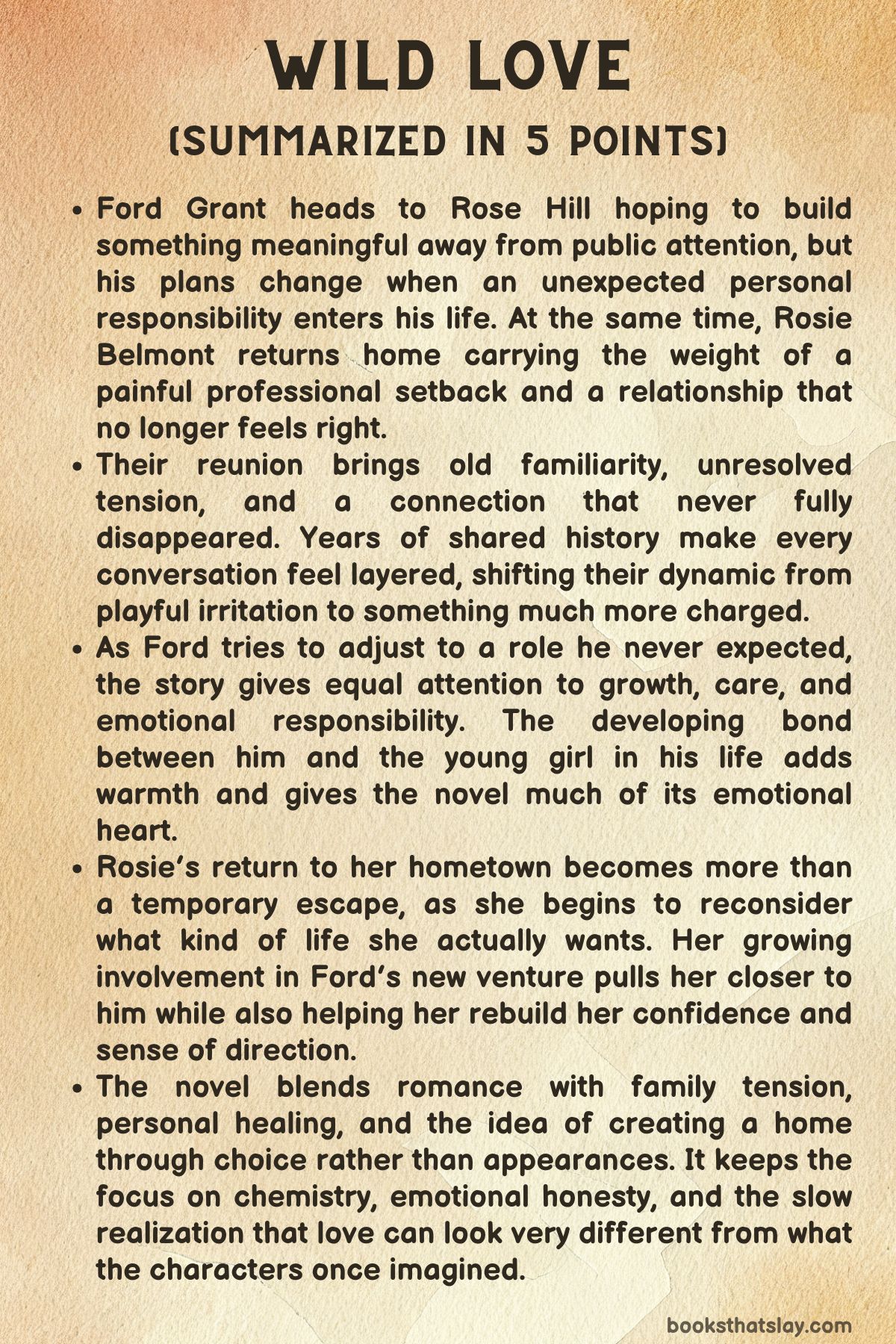
Wild Love by Elsie Silver is a small-town romance built around second chances, long-held feelings, and the unexpected ways a life can change course. Set in the mountain town of Rose Hill, the story follows Ford Grant, a wealthy music entrepreneur trying to build something meaningful away from public attention, and Rosie Belmont, the younger sister of his best friend, who returns home after her career and relationship begin to unravel.
Their history gives the romance a strong emotional base, while Ford’s sudden responsibility for a teenage daughter adds depth and urgency. The novel balances family, healing, desire, and belonging with a playful, intimate tone. It’s the 1st book in the Rose Hill series.
Summary
Ford Grant arrives in Rose Hill with a plan to create a recording studio and music company on a property tied to some of his happiest childhood memories. Although he is famous for his wealth and business success, he wants distance from public attention and a life that feels more grounded.
His quiet reset is interrupted when a teenage girl named Cora appears at his door and tells him she is his biological daughter. At first, Ford thinks it has to be some kind of joke or scam, but he soon learns the truth.
Years earlier, as a teenager, he donated sperm for quick cash, never imagining it would matter again. Cora explains that her father has died, her mother Marilyn is struggling with severe depression, and she may be left without stable care.
Faced with a frightened girl who has nowhere else to turn, Ford steps in.
Ford quickly becomes responsible for Cora through a temporary kinship arrangement. He is unprepared, uncertain, and worried that he will fail her, but he is determined to help.
Cora is sharp, funny, guarded, and carrying far more than someone her age should. As Ford tries to adjust to this sudden role, Rosie Belmont returns to Rose Hill.
She has left Vancouver after being sexually assaulted by her boss, ignored by her boyfriend Ryan, and pushed out of her job when she tried to do the right thing. She comes home embarrassed, angry, and unsure of what her future looks like.
What she does not expect is to find Ford there.
Rosie and Ford have known each other since childhood. He was her brother West’s best friend, and she spent years orbiting their friendship, irritating Ford, admiring him, and misunderstanding the depth of his feelings.
Seeing each other again stirs up old habits and old attraction almost immediately. Their dynamic is easy, teasing, and charged with years of unfinished emotion.
Ford hires Rosie to help manage his new business, giving her a reason to stay in Rose Hill and a way to regain her footing. The job places them side by side every day, forcing them to confront a connection that never really disappeared.
As Rosie settles into work, she becomes part of Cora’s life too. She picks her up from school, jokes with her, listens to her, and earns her trust in ways that feel natural.
Cora quickly senses the pull between Ford and Rosie and often pushes them together with the blunt confidence of a teenager who can see what adults try to hide. Rosie also sees something Ford misses in himself: although awkward and unsure, he is already becoming a steady, caring presence for Cora.
He tries too hard, worries too much, and second-guesses every choice, but his actions show real devotion. He wants to give her the safety, attention, and ordinary joys she has missed.
At the same time, Rosie is trying to recover from what happened in Vancouver. She has not fully dealt with the violation, the job loss, or the collapse of her relationship with Ryan.
Ryan represents the life she thought she was building, but his indifference makes clear that it is already over. Ford becomes the person who notices her pain without dismissing it.
When Rosie finally tells him what happened, his anger is immediate, but so is his tenderness. He holds space for her grief instead of trying to rush her past it.
That moment changes the emotional shape of their relationship. The joking remains, but underneath it is a deeper trust.
Their shared history resurfaces in other ways too. Rosie’s old diary reappears after Ford reveals that he once retrieved it from the roadside years earlier and kept it safe without reading it.
The diary becomes a quiet thread through the story, reminding both of them that their bond began long before either was ready to name it. Rosie had once written about the times Ford came through for her: rescuing her after heartbreak, standing by her when she was scared, and understanding her in ways others did not.
Ford, for his part, has carried feelings for Rosie for years, even when he believed acting on them would be impossible or wrong.
The emotional tension between them keeps building through long workdays, dockside conversations, family dinners, and moments with Cora. Their banter often acts as cover for what they both want.
Ford tries to keep boundaries in place because Rosie works for him and because he is conscious of how power can be abused, especially after what happened to her at her last job. Rosie, however, is tired of pretending that their connection is not real.
They circle each other through jealousy, flirtation, and near-confessions until eventually the restraint breaks. Their first kiss comes out of frustration and longing, and from there the relationship becomes impossible to deny.
Even after they give in to the attraction, the story does not become simple. Ford still worries about timing, responsibility, and whether he is making things harder for Rosie rather than better.
Rosie is ready to choose Rose Hill and a new life, but she wants honesty and partnership, not protection that shuts her out. Their physical relationship finally turns into an emotional one as both admit what has been true for years: this is not temporary desire but love that has survived time, distance, and bad timing.
Family plays a major role in how that love develops. West, despite being Rosie’s older brother and Ford’s closest friend, is not truly surprised when he learns they are together.
He understands the history between them and supports it. Ford’s family also enters the picture, especially once his parents and sister learn about Cora.
There is tension at first because Ford kept the truth from them, fearing public complications and old family patterns. But once they meet Cora, she is welcomed with warmth, especially through their shared love of music.
These scenes broaden the novel beyond romance and show Ford building a more honest life with the people who matter most.
Cora’s presence remains central throughout. Her struggles at school, her grief over her father, her concern for her mother, and her growing attachment to Ford give the story much of its emotional force.
Ford becomes more confident as a parent not because he stops being afraid, but because he keeps showing up. Rosie also becomes essential to Cora, offering care, humor, and guidance, especially in the moments when Cora needs a woman she can trust.
Together, Ford and Rosie begin to feel like a family long before anyone says it aloud.
Conflict returns when Rosie discovers that Ford and West have taken steps behind her back to punish the man who assaulted her. Ford uses his wealth and influence to target the company connected to Rosie’s former boss, believing he is defending her.
But Rosie is furious that he turned her trauma into something he could manage without her consent. Their argument forces Ford to confront how easily money and status allow him to act without considering the cost to others.
It is one of the most important turning points in the book because it challenges his instincts and makes clear that loving Rosie means respecting her agency, not just trying to shield her.
They reconcile only after Rosie is given space to be angry and Ford understands what he did wrong. In a gesture that reflects both apology and commitment, he gives Rosie ownership and partnership in the business they are building together.
He renames the label Wild Rose Records, tying their future to something shared rather than controlled by him alone. This is not just romantic; it is practical, symbolic, and rooted in mutual respect.
The ending brings several threads together. Marilyn improves and chooses to move to Rose Hill so Cora can stay close to the life and support system she has found there.
Ford is overwhelmed when he hears Cora refer to him as her dad. Rosie fully claims Rose Hill as home and steps into a future that includes Ford, Cora, and the work they are creating together.
In the epilogue, Ford proposes, and the moment reflects the spirit of their relationship: affectionate, playful, and full of history. What began with old feelings and sudden upheaval ends with chosen family, honest love, and the sense that both of them have finally arrived where they belong.
Characters
Ford Grant
Ford Grant begins as a man who appears to have complete control over his life. He is rich, successful, highly visible, and used to making decisions quickly and effectively.
Yet beneath that polished exterior, he is restless and dissatisfied. His move to Rose Hill shows that money and status have not given him peace.
He wants work that feels personal, a place that feels safe, and a life that is not shaped by publicity or family reputation. His new studio project reflects the better side of his personality: he is ambitious, but he also wants to create something that supports other people rather than simply expanding his own power.
That balance between confidence and quiet emptiness defines him in the early part of the story.
The arrival of Cora forces Ford into the most intimate and unplanned role of his life. Until then, he has been able to solve problems with intelligence, money, and discipline, but fatherhood does not respond to any of those tools in a simple way.
He cannot spreadsheet his way into emotional closeness with a grieving teenage girl. This is what makes his character compelling.
He is not careless, indifferent, or selfish with Cora; in fact, he cares so much that he becomes stiff and self-conscious. His fear of failure is what makes him awkward.
He wants to get everything right because he understands how vulnerable she is. Over time, his relationship with her reveals his deepest qualities: protectiveness, patience, devotion, and a willingness to grow.
He becomes a father not through instant ease, but through repeated effort, humility, and presence.
Ford’s emotional life is also shaped by the distance he keeps from others. He is private because he grew up too close to fame, scandal, and public scrutiny.
He has learned to guard himself, and that instinct affects nearly every relationship in his life. He delays telling his family about Cora because he assumes exposure will create danger.
He hesitates with Rosie because he fears crossing boundaries and because his feelings for her are so serious that they make him vulnerable. Even when he is playful, there is restraint under it.
He uses sarcasm and banter to cover longing. He acts cool when he is not cool at all.
That emotional guardedness makes his eventual honesty more meaningful, because love for him is not casual or easy. It is something he has resisted for years and finally accepts fully.
His relationship with Rosie reveals the difference between youthful attraction and mature devotion. As a younger man, he already cared for her deeply, but timing, loyalty to West, and his own uncertainty kept him silent.
When she reenters his life, those feelings return with force, yet they are no longer just adolescent fantasy. He respects her intelligence, notices her pain, admires her resilience, and wants to build a real life with her.
At times, though, his protectiveness tips into control. His revenge against the people who hurt her is rooted in love, but it also exposes one of his flaws: he can mistake action for understanding.
He believes he is helping when in fact he is taking over. That mistake is important because it prevents him from becoming too idealized.
He is a good man, but not a perfect one, and the story makes him earn his growth.
By the end, Ford becomes a fuller version of himself. He is still capable, driven, and powerful, but he is no longer trying to stand apart from emotional dependence.
He lets himself belong to people. He accepts Cora as his daughter in feeling as well as responsibility.
He gives Rosie not just affection but partnership. He opens himself to family instead of hiding behind privacy.
His final shape as a character is not that of a billionaire who rescues everyone, but of a man who learns that love requires listening, accountability, and shared vulnerability. That makes him the emotional center of Wild Love.
Rosie Belmont
Rosie Belmont is one of the strongest emotional anchors in the story because she arrives at a turning point in her life. On the surface, she has done everything right.
She is educated, responsible, accomplished, and generally seen as the dependable one in her family. Yet when the story begins, that identity has been badly shaken.
She has been violated at work, unsupported by the man she thought she could rely on, and pushed out of the life she carefully built. Her return home is not a romantic homecoming at first; it is an act of exhaustion, self-protection, and quiet grief.
What makes Rosie so effective as a character is that she does not collapse into passivity. Even when she is hurt, she remains sharp, funny, observant, and capable of making choices for herself.
A major part of Rosie’s character lies in the contrast between how others see her and what she carries internally. She has long been the competent daughter, the organized one, the one expected to hold things together.
That image makes it harder for her to admit pain. She feels shame over losing her job and ending her relationship, even though neither failure is truly hers.
She also struggles with the familiar burden of being the person who does not want to disappoint anyone. This explains why she hesitates to tell her parents the truth, why she drifts too long in her relationship with Ryan, and why she initially resists help.
Her pride is not arrogance; it is a defense against feeling powerless. The novel treats that pride with sympathy, showing how deeply it is tied to her need for dignity.
Rosie’s wit is central to her identity. She uses humor as both charm and armor.
Around Ford, especially, her teasing becomes a language of intimacy. She pokes at him, challenges him, provokes him, and refuses to let him retreat into seriousness for too long.
This keeps their dynamic lively, but it also reveals her courage. She is not intimidated by wealth, fame, or male ego.
She sees through Ford’s polish and speaks to the boy and man underneath it. That ability gives her unusual power in their relationship.
She is not simply the object of his old feelings; she is the person who can unsettle him, humble him, and call him out when needed.
Her bond with Cora reveals another side of her character. Rosie’s care for Cora grows naturally because she recognizes loneliness, vigilance, and the instinct to make oneself small.
She knows what it is to manage emotions quietly and to avoid becoming a burden. That recognition allows her to connect with Cora in a way that feels immediate and authentic.
She can be playful with her, but she can also offer real comfort and guidance, especially in moments that require female support and emotional patience. These scenes make Rosie more than a romantic lead.
They show her capacity for nurturing without turning her into a saintly figure. She is warm, but she is still funny, flawed, and human.
Rosie’s relationship with Ford is powerful because she remembers him in layers. She remembers the boy who irritated her, the young man who showed up when she needed help, and the person she perhaps loved before she had the language to admit it.
The recovered diary becomes proof that her feelings were always more complicated than she claimed. As an adult, she no longer wants to stay in that confusing middle ground.
She wants clarity, desire, honesty, and equal partnership. That is why she pushes Ford so often.
She is not trying to create drama; she is trying to force truth into the open. Even when she gives in to attraction, she still demands respect.
She refuses to let him love her only in private or protect her in ways that erase her choices.
One of the most important things about Rosie is that the story allows her anger to matter. When she learns that Ford and West acted on her assault story behind her back, her hurt is treated as legitimate and morally serious.
She is not told to be grateful simply because they meant well. Instead, the novel shows that being loved does not cancel the right to self-determination.
That moment strengthens her characterization considerably. She is not a woman whose arc ends once she is chosen romantically.
She remains a full person with her own boundaries, judgments, and decisions. By the end, she has not only found love but also reclaimed agency, home, and meaningful work.
She becomes someone who chooses her future rather than inheriting it.
Cora Holland
Cora is the catalyst who changes nearly every relationship in the novel, but she is far more than a plot device. She enters the story under painful circumstances, carrying grief, uncertainty, and the pressure of having to advocate for herself when the adults around her cannot fully care for her.
Her decision to seek out Ford shows both her desperation and her courage. She is young, but she is not passive.
She makes an enormous choice, takes a risk, and arrives with a kind of dark humor that protects her from humiliation. That first impression captures much of what defines her: she is vulnerable, but she refuses to present herself as fragile.
One of Cora’s most effective qualities as a character is her tonal complexity. She can be sarcastic, funny, moody, perceptive, and quietly tender in rapid succession.
She is a teenager under extreme stress, and the novel lets her feel like one. She tests adults, says blunt things, and notices everything.
She is especially good at spotting tension between Ford and Rosie, often long before they will admit it themselves. Her observations add humor, but they also establish her intelligence.
She reads rooms well because she has had to. Losing one parent and watching the other struggle has made her emotionally alert in ways that are not entirely fair for someone her age.
Her relationship with Ford develops slowly and convincingly. At first, she is not looking for a replacement father in any sentimental sense.
She comes to him because she needs help, not because she expects emotional rescue. Ford’s challenge is that he wants to care for her so much that he becomes awkward, while Cora is wary of being another burden.
This creates distance, but the distance is believable and meaningful. As they spend time together, especially through small rituals like school pickups, music, campfires, and daily routines, trust builds.
What makes their bond moving is that it forms through ordinary acts of consistency. Ford does not win her over with grand speeches.
He shows up. He listens badly at times, but he keeps trying.
Cora, in turn, begins to relax into being wanted.
Cora’s bond with Rosie is equally important. Rosie offers something different from Ford: a kind of emotional fluency and ease that Cora desperately needs.
She can joke with her, confide in her, and ask her questions she may not be ready to bring to Ford. Their relationship never feels secondary; it is one of the most affecting parts of the book because it shows Cora gaining not just one safe adult, but a fuller support system.
Rosie’s presence helps Cora imagine stability again, and Cora’s affection for Rosie also pushes the central romance forward by showing how naturally the three of them fit together.
Cora also embodies one of the novel’s key ideas: family can be chosen, built, and expanded in unexpected ways. She begins as a disruption to Ford’s plans, but soon becomes central to his emotional life.
At the same time, the story does not erase her love for her first father or her loyalty to her mother. That matters.
She is not asked to trade one family for another. Instead, her arc allows grief and new attachment to coexist.
By the time she casually refers to Ford as her dad, the moment feels earned because it grows out of many smaller moments of safety, care, and trust. Cora ends the novel not as a problem solved, but as a young girl with a future, a voice, and a place where she is fully wanted.
West Belmont
West functions at first as comic energy and old-friend familiarity, but he becomes much more than the easygoing best friend. He is one of the emotional bridges of the story, tying together Ford’s past, Rosie’s family life, and the larger community of Rose Hill.
His long friendship with Ford gives the novel a sense of history and masculine intimacy that is not built on silence alone. They tease each other, challenge each other, and understand one another deeply.
The years between them are visible in the shorthand of their conversations, and that makes West feel lived-in as a character rather than merely supportive.
West’s role as Rosie’s older brother could have turned him into an overprotective obstacle, but the novel handles him more thoughtfully than that. He is protective, certainly, but he is also perceptive enough to see what has long existed between Rosie and Ford.
He does not react with manufactured outrage when they finally come together. Instead, his response suggests maturity and trust.
He knows Ford’s character, and he wants Rosie to be happy. That choice prevents him from becoming possessive in a way that would diminish Rosie’s autonomy.
It also underscores his confidence in his bond with Ford.
Another strong element of West’s characterization is the way fatherhood has changed him. The man he once was seems to have had a wilder, less responsible side, but caring for his children has given him steadiness and purpose.
His son’s selective mutism is one of the details that deepens him, because it shows his patience and attentiveness as a parent. He is not presented as a flawless father, but as a present one.
His co-parenting relationship with Mia also suggests emotional growth. There is history, complexity, and likely some pain there, but the emphasis is on mutual care for their children rather than bitterness.
West’s decision to involve himself in avenging what happened to Rosie shows both his strengths and his flaws. He is fiercely loyal and unwilling to let harm against his sister pass without response.
At the same time, his involvement becomes part of the larger ethical conflict over Rosie’s agency. That is useful for his characterization because it reminds the reader that protectiveness can become messy when it acts without permission.
Still, his motivations are rooted in love and outrage rather than ego. Even when he makes reckless choices, he remains recognizably decent.
He is a man who loves hard, acts quickly, and means well, even when that is not enough.
Marilyn Holland
Marilyn is not on the page as often as the central trio, but her presence is deeply important to the emotional structure of the story. She represents the aftermath of grief not as a dramatic collapse, but as a long, debilitating struggle that affects both parent and child.
After her husband’s death, she is unable to function in the way Cora needs, and this creates the crisis that sends Cora to Ford. The narrative treats her with compassion rather than blame.
She is not depicted as neglectful in a cruel sense; she is unwell, overwhelmed, and in need of help. That distinction matters because it gives emotional credibility to Cora’s situation without turning Marilyn into an antagonist.
Her character also broadens the novel’s understanding of motherhood. Marilyn loves Cora, but love alone is not enough to make her capable in that period of her life.
The story allows that painful truth to exist without punishing her forever. When she begins to recover and eventually decides to move closer, the development feels hopeful without being simplistic.
She is not restored by magic. Instead, she slowly becomes able to reenter her daughter’s life in a healthier way.
Her gratitude toward Ford carries emotional weight because she knows he stepped in when she could not. By the end, Marilyn helps complete the novel’s idea of family as something that can survive disruption and reorganize around care rather than perfection.
Ryan
Ryan is important not because he is especially complex, but because he reveals what Rosie has been settling for. He is not dramatically cruel, explosive, or openly malicious.
His failure is more ordinary and therefore more recognizable: he is emotionally absent when presence matters most. When Rosie tells him about the assault and its consequences, his instinct is not to support her but to manage inconvenience.
He is practical in the most hollow way, more concerned with career optics and scheduling than with her fear or pain. That response defines him.
He represents a version of partnership built on habit, compatibility on paper, and emotional underinvestment.
What makes Ryan effective in the story is that Rosie does not leave him because of one argument alone. Their relationship has already gone quiet, flat, and distant.
The assault simply exposes what is already missing. He does not fight for her in a meaningful way, but he also does not seem to fully understand what he has failed to do.
This makes him less a villain than a symbol of a life Rosie has outgrown. He belongs to the version of her life that looked respectable but offered little nourishment.
Compared with Ford, whose feelings are messy but genuine, Ryan highlights the emptiness of a relationship sustained by routine rather than emotional courage.
Willa Grant
Willa serves as both family pressure and emotional comic relief, but she also plays a useful role in revealing Ford’s blind spots. Her anger at being excluded from the truth about Cora is justified, and the confrontation shows that Ford’s privacy can shade into unfairness.
Willa refuses to let him hide behind his usual reserve, and that makes her valuable in the family dynamic. She is direct, lively, and quick to say what others might avoid.
At the same time, she warms to Cora almost immediately, which suggests a generous heart beneath her irritation.
Her interactions with Ford also show the affection and irritation typical of siblings who know each other too well. She is one of the few people who can tease him, challenge him, and then stand firmly in his corner.
Her support for the relationship with Rosie is especially important because she recognizes what Ford himself struggles to say plainly. She understands that he has loved Rosie for a long time, and she pushes him toward honesty rather than hesitation.
Though not a central character, Willa helps move emotional truths into the open.
Gemma Grant
Gemma is memorable because she brings warmth, boldness, and a refreshingly open presence to the family scenes. As Ford’s mother, she contrasts nicely with his more guarded instincts.
She is less interested in silence, less embarrassed by intimacy, and often quicker to respond emotionally. Her profession and personality make her unusually candid, which adds humor but also supports the novel’s larger atmosphere of emotional directness.
She can be outrageous, but she is not careless. She tends to understand people quickly and respond with generosity.
Her response to Cora is especially important. Ford fears complications and judgment, yet Gemma meets the revelation with steadiness and confidence.
She senses that once the family truly meets the girl, affection will follow. In that way, she represents a more optimistic model of family acceptance than Ford expects.
She also seems to recognize the truth about Ford and Rosie before either of them says it aloud. Gemma brings permission into the story: permission to feel, to be honest, and to stop acting as if love is a crisis.
Ford Grant Sr.
Ford’s father casts a long shadow because of fame, reputation, and the family history of public scandal. Even before he appears directly, he affects Ford’s decisions.
Ford expects scrutiny, control, and legal defensiveness because that is the model he grew up around. This makes the actual bond between father and son more interesting.
There is pressure there, but not total coldness. The father’s musical career has shaped Ford’s world, and in some ways Ford’s own business ambitions seem both influenced by and resistant to that legacy.
When he meets Cora, the response is gentler than Ford feared. The immediate musical connection between grandfather and granddaughter softens the tension and suggests that family inheritance is not only about fame or damage, but also about art, instinct, and affection.
He remains somewhat larger than life, but he is not reduced to a stereotype. He matters most as a figure Ford has spent years reacting to, and the later scenes imply that some of Ford’s fears about him are rooted as much in old anxiety as present reality.
Stan
Stan is not a nuanced or sympathetic figure, but he is an important one because he embodies institutional sexism and abuse of power. His behavior toward Rosie is invasive, entitled, and immediately harmful.
More importantly, the aftermath reveals the systems that protect men like him. Rosie is not only assaulted; she is also isolated and professionally punished.
Stan’s role therefore extends beyond one act of misconduct. He represents the workplace culture that relies on hierarchy, silence, and intimidation to survive.
His presence continues to matter because he becomes the focal point of the moral debate around revenge, justice, and agency. Ford and West want to punish him.
Rosie wants ownership over how her experience is handled. This means Stan is less significant as a person than as the source of a wound that ripples outward through several other characters.
He is written not to be psychologically rich, but to show how ordinary power can become predatory and how badly institutions often fail women.
Mia
Mia is a quieter but grounding presence in the broader family circle. As West’s former partner and the mother of his children, she helps establish that not all broken romantic relationships in the story are toxic or hostile.
Her co-parenting arrangement with West appears respectful and stable, which adds maturity to the background of the novel. She also helps define West through contrast: if he can parent well alongside an ex, then he has grown beyond the troublemaker he once was.
Though Mia does not dominate the narrative, she contributes to the sense that Rose Hill is a lived community with interconnected lives rather than merely a stage for the main romance. Her presence supports the novel’s interest in functional, evolving family structures.
Not every family in the book follows one traditional pattern, and Mia is part of that wider picture.
Greta and Andy Belmont
Rosie’s parents bring warmth, familiarity, and a long family memory into the story. They are part of what makes Rose Hill feel like home rather than just a location.
Their interactions with Rosie reveal the pressures she has always felt to be the responsible child, especially in contrast to West’s more chaotic youth. Even in loving families, roles can harden over time, and Rosie’s anxiety about disappointing them suggests how deeply she has internalized their expectations.
At the same time, they are not harsh or emotionally unreachable figures. Their home remains a place Rosie returns to when she needs grounding.
Andy’s easy observations about Ford and Rosie show that some truths have been visible to others for years. Greta’s domestic warmth reinforces the sense of continuity and care that shapes Rosie’s attachment to the place.
Together, they help explain why returning home is healing for her. Rose Hill is not merely escape; it is the setting where she can begin again among people who already know her.
Sebastian and Scotty
Sebastian, as the contractor who helps bring the studio to life, adds to the community texture of the novel and highlights Rosie’s competence in the business sphere. Through negotiations and planning, he becomes one of the people who make the professional side of Ford and Rosie’s partnership believable.
Scotty, meanwhile, functions more as a spark for Ford’s jealousy than as a fully developed character. His flirtation with Rosie matters because it pushes Ford past delay and denial.
Even minor characters like these help expose the emotional states of the leads by forcing reaction, competition, and clarity.
Themes
Chosen Family and the Redefinition of Home
Home in this novel is not treated as a fixed place or a matter of bloodline alone. It becomes something built through care, repetition, trust, and the decision to remain present for one another.
Rose Hill matters because it carries memory and emotional safety for both Ford and Rosie, but the novel does not stop at using the town as a sentimental backdrop. Instead, it asks what makes a place feel like home after life has gone off course.
Ford arrives with wealth and freedom, yet he is emotionally adrift. Rosie returns with shame, heartbreak, and uncertainty.
Cora arrives in crisis, carrying grief and instability. None of them begin the story feeling settled, and that shared rootlessness is what gives the theme so much force.
Home becomes meaningful only when the characters begin to create it together.
Cora’s arrival is central to this idea. She enters Ford’s life through biology, but the emotional bond between them has to be formed through effort rather than instinct.
The story is careful not to reduce family to genetics. Ford is connected to Cora by donation, but that technical truth means little on its own.
What matters is that he chooses responsibility when it would have been easier to step back. He rearranges his life, learns her moods, tries to meet her needs, and grows into a father through ordinary acts of showing up.
That process turns a legal or biological connection into something emotionally real. The same applies to Rosie’s place in Cora’s life.
She is not a relative, yet she becomes one of the people Cora trusts most. Through humor, guidance, and steadiness, she helps shape the emotional environment that allows Cora to feel safe again.
The family that forms around Cora is not accidental, but chosen.
The Belmonts and Grants also contribute to this theme by expanding the circle around the main trio. Parents, siblings, old friendships, and co-parenting arrangements all create a wider sense of belonging.
Importantly, these family structures are not presented as perfect or simple. There are omissions, arguments, worries, and old habits that complicate every bond.
Yet the novel insists that imperfections do not cancel love. People can fail, recover, apologize, and still be part of one another’s lives in meaningful ways.
That view gives the book emotional maturity. It does not imagine home as a flawless refuge.
It imagines home as a place where people continue choosing each other despite awkwardness, pain, and change.
Rosie’s decision to stay matters just as much as Ford’s decision to care for Cora. She returns to Rose Hill thinking she may only be pausing there while her life falls apart elsewhere.
By the end, she understands that the place she once thought of as her past can also be her future. Her choice is not about retreating from ambition or hiding from adulthood.
It is about recognizing where she can live honestly, work meaningfully, and love fully. Home, in that sense, is not where she is sent back after failure.
It is where she finally claims her life on her own terms. This makes the theme far richer than simple small-town comfort.
The novel argues that home is made when people who have been lonely, guarded, or displaced begin to trust that they can stay.
Healing After Violation, Loss, and Emotional Displacement
Pain in this story does not arrive in one form, and that is what gives the theme of healing its depth. Rosie is dealing with sexual harassment and professional retaliation.
Cora is living through grief, instability, and the fear of abandonment. Marilyn is incapacitated by depression after losing her husband.
Ford, though outwardly successful, is struggling with emotional emptiness, distrust, and a life shaped by public scrutiny rather than inner peace. The novel places all of these experiences beside one another to show that healing is not a neat personal triumph.
It is uneven, relational, and often dependent on being witnessed by the right people at the right time.
Rosie’s storyline is especially important because the narrative treats her experience with seriousness rather than using it only to intensify romance. What happened to her at work is not framed as a brief obstacle or a convenient way to move her back to Rose Hill.
It affects her confidence, her sense of self, and her ability to make decisions without feeling ashamed. She is not only harmed by one man’s actions, but also by the indifference of the system around him and by Ryan’s emotional failure.
That combination leaves her isolated. The novel’s strength lies in how it shows that recovery begins not with instant empowerment, but with being able to speak the truth of what happened.
When Rosie tells Ford, the scene matters because he does not minimize, redirect, or doubt her. He responds with anger, yes, but also with tenderness.
He allows the event to be what it is: a source of pain that deserves acknowledgment. That recognition becomes part of her healing, even if it does not erase what happened.
Cora’s healing is structured differently, but it is just as powerful. She has lost one parent and is temporarily losing the other to illness and treatment.
Her instinct is to make herself manageable, to avoid becoming a burden, and to treat emotional need as something dangerous. This is one of the most affecting dynamics in the book because it reveals how grief can make a child hyperaware of other people’s limits.
Ford and Rosie help her heal not by forcing emotional breakthroughs, but by making room for ordinary safety. School pickups, campfires, record listening, shopping trips, and shared jokes all become important because they restore routine and predictability.
The novel understands that healing often looks quiet before it looks dramatic. Cora does not suddenly become carefree.
She slowly learns that she can ask for help and still be wanted.
Ford’s healing is more understated but equally central. His issue is not visible collapse but emotional detachment disguised as competence.
He has spent years being effective rather than open, successful rather than fulfilled. Through Cora and Rosie, he is pulled into forms of care he cannot control from a distance.
Parenting forces him to stay emotionally available. Loving Rosie forces him to confront fear, restraint, and long-suppressed desire.
Even his mistakes, especially the way he mishandles Rosie’s trauma by trying to avenge it without her consent, become part of his growth. He has to learn that care is not the same as control.
That lesson is essential to his healing because it moves him away from performing protection and toward practicing mutuality. Across all these arcs, the novel suggests that recovery does not mean returning to who one was before pain.
It means building a life that can hold pain without being ruled by it.
Power, Protection, and the Limits of Good Intentions
Power in this novel is personal, social, economic, and gendered, and one of its most interesting questions is whether love can become harmful when it ignores the agency of the person it wants to protect. Ford is a man with enormous wealth, public recognition, influence, and the confidence of someone used to getting things done.
Rosie, by contrast, has just come out of a workplace situation where a man used his professional power to violate her and where institutional authority closed ranks against her. That contrast shapes much of the emotional and ethical tension between them.
The story does not simply celebrate Ford’s protectiveness as inherently romantic. It tests it, exposing both its appeal and its danger.
Part of what makes Ford attractive is that he sees Rosie’s suffering clearly and feels fierce loyalty toward her. He is not passive like Ryan, and he does not hide from conflict when someone he loves has been harmed.
In a romantic sense, that intensity has obvious force. Rosie is drawn to the way he notices, responds, and refuses indifference.
Yet the novel is sharp enough to ask what happens when protection becomes a form of takeover. Ford’s wealth gives him access to tools Rosie does not have.
He can buy property, influence outcomes, and move against institutions in ways that seem decisive and satisfying. But when he uses those tools to pursue revenge for Rosie without fully involving her, he repeats, in a different register, the same disrespect for her agency that traumatized her in the first place.
His intentions are loving, but the action is still presumptuous.
This is where the theme becomes especially strong. The novel refuses the easy fantasy that a powerful man’s devotion automatically solves injustice.
Rosie’s anger is not treated as irrational or ungrateful. She recognizes that Ford and West mean well, but she also understands that the story of what happened to her belongs first to her.
She does not want to be turned into the reason men prove their loyalty to one another. This reaction gives the book a more serious moral center.
It insists that support must include consent, that solidarity must not erase the person supposedly being defended, and that anger can be a sign of self-respect rather than emotional excess.
The theme also extends beyond Rosie’s plotline. Ford’s concern about being Rosie’s boss once they become involved shows that he is aware, at least partly, of the imbalance that comes with authority.
He does not want to recreate a dynamic in which a woman’s workplace safety depends on a man’s desire or restraint. That awareness is meaningful, even if he does not always handle it perfectly.
In the end, the story resolves this theme not by stripping Ford of power, but by making him share it. Giving Rosie true partnership in the business matters because it transforms their bond from one of employer and employee into something more equal and mutually constructed.
The novel’s position is not that power itself is corrupt, but that love without respect for agency becomes possessive, while love that listens can turn power into partnership.
Longing, Timing, and the Movement from Fantasy to Adult Love
The central romance is shaped by years of unfinished feeling, but the novel is careful to distinguish between adolescent fascination and adult love. Ford and Rosie have a long history of noticing, irritating, protecting, and misunderstanding one another.
Their attraction is not new, and that gives the story a strong emotional charge from the beginning. At the same time, the book understands that feeling intensely about someone at seventeen or nineteen is not the same as being ready to build a life with them.
What makes their relationship satisfying is that the present-day story revisits those old emotions under new conditions. They are no longer children or almost-adults working from fantasy, pride, and silence.
They are people bruised by experience, and that changes the meaning of reunion.
Rosie’s diary serves as one of the clearest symbols of this theme. It preserves a younger version of her emotional world, full of confusion, embarrassment, attraction, and the inability to name what Ford meant to her.
Those entries prove that what she felt was always more tender than she admitted, but they also highlight how incomplete her understanding was at the time. She saw moments, gestures, and jealousy, but not the larger shape of what was forming.
Ford’s choice to keep the diary safe without violating her privacy is equally significant. He has been carrying evidence of that younger emotional world while also respecting the fact that some truths cannot be rushed.
The diary becomes a bridge between past longing and present recognition.
Timing is what gives those feelings room to mature. If they had come together earlier, the relationship might have remained half-formed, defined by secrecy, power imbalance, or the limitations of youth.
When they reconnect, both have changed. Rosie has lost faith in the polished life she once thought she wanted.
Ford has achieved the public success he once chased and discovered its emptiness. Both now understand vulnerability in a way they did not before.
This allows their attraction to deepen into something less idealized and more durable. They are no longer interested only in being desired.
They want to be known, chosen, and trusted.
The novel also shows that adult love requires speaking plainly where younger love survives on implication. Much of the tension between them comes from the old habit of hiding seriousness beneath teasing.
Their banter is enjoyable, but it cannot carry the full emotional truth forever. The relationship only becomes real when both begin naming what is at stake: jealousy, fear, love, and the wish for permanence.
That movement is crucial. The story is not just about finally acting on old chemistry.
It is about learning that love cannot stay in the realm of memory, fantasy, or near-misses if it is meant to last. It must enter the practical world of family, work, conflict, apology, and shared plans.
By the end, the relationship succeeds because it has moved beyond the beauty of what might have been and into the harder, richer reality of what two people are willing to build together.