Willing Prey Summary, Characters and Themes
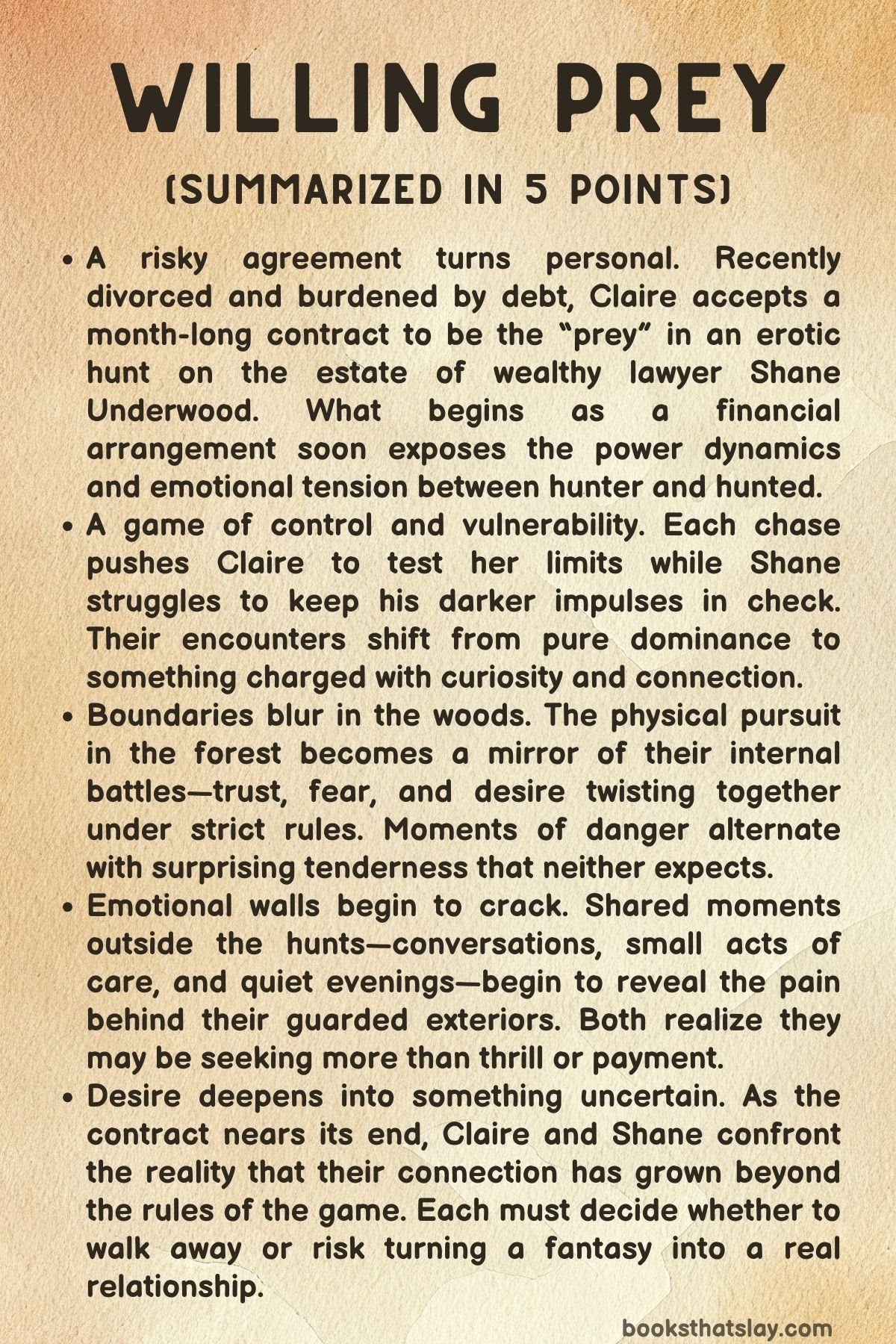
Willing Prey by Allie Oleander is an erotic romance set in the forests of coastal Maine, built around an unusual contract that turns a private estate into the stage for a consensual chase. Claire, a newly divorced PE teacher drowning in bills and betrayal, agrees to spend thirty days at Shane Underwood’s Victorian home as his “prey” in a structured hunt-for-pay arrangement.
What begins as a money-driven decision becomes a tense, rule-bound game of power, boundaries, and trust—one that forces both of them to confront what they actually want when the contract ends.
Summary
Claire arrives at Shane Underwood’s imposing Victorian house in Maine with a signed contract and a simple goal: earn $30,000 in thirty days and walk away debt-free. The terms are clear but intimidating.
She will be “prey” in a private hunting game Shane orchestrates on his property. His assistant, Margot, gives Claire a tour of the lavish home and explains the system: Claire wears a smartwatch, and when Shane sends the message “Run” followed by a number, she gets that many minutes to flee and hide before he comes after her.
Margot also offers warnings that feel less like workplace guidance and more like survival tips. Two women before Claire didn’t last the full arrangement, and Margot advises her not to cry during a chase because Shane reacts badly to it.
Claire tries to treat the whole thing like a job, but the house, the isolation, and the rules make it hard to pretend she’s just there for a paycheck.
That first night, the controlled distance between employer and employee collapses. Claire steps out of the shower and finds Shane already in her room, silent and watchful.
He speaks with careful politeness, but the tension is unmistakable. When he tries to take control immediately, Claire refuses.
Her defiance triggers a fast escalation that turns into a real pursuit through the house and out onto the roof. She scrambles down and runs toward the trees, only to be caught quickly.
The moment leaves her shaken and furious—and also forced to admit that the game hits something deep inside her, something complicated that she doesn’t know how to name yet.
Shane, privately, has his own history with Claire. They met before, at a law-firm party where Claire’s then-husband, Keith, bragged about the couple’s private bedroom games while he was drunk.
Shane listened, fixated, and later tried to copy the dynamic with other women, only to find it empty without the one person he actually wanted. After Claire’s divorce—triggered by Keith’s affair with a paralegal—Shane approached her with the contract, presenting it as business while hiding how personal it really was.
He tells himself the arrangement has rules, boundaries, and an end date, as if that makes his obsession safer.
The first official hunt arrives the next morning. Claire’s watch vibrates: “Run.
7.” She bolts into the woods, pushing her body the way a PE teacher knows how, using her fitness and nerves to stay sharp. She hides high in a tree and attempts to mislead him with false trails.
Shane proves patient and skilled, reading the forest like it’s a second language. Claire manages a brief escape, but he catches her in a clearing after anticipating her movement.
The confrontation becomes the pattern of their days: chase, capture, a struggle for control, and an encounter that is physical and intense—structured around his command for her to “Yield,” and her choice to comply. Claire surprises herself by responding not only with resistance but with desire, and by the end she can’t deny that she wants the game on her own terms, not only on his.
As the days continue, Claire grows smarter about the terrain. Shane adjusts the head starts, sometimes giving her more time, sometimes tightening the window to test her.
She learns to think like a runner and a hider, making decoys and changing routes. During one hunt, she lures Shane toward the lake, tricks him, and steals his clothes while he swims, turning the chase into something almost playful.
He follows anyway, amused and relentless, and when he catches her, the tone shifts back to dominance and challenge. Claire, emboldened, admits out loud that she enjoys being hunted.
The confession changes the atmosphere between them: less like a paid performance, more like a shared secret.
Outside the hunts, the house begins to feel less like a work site and more like a strange kind of home. After a close call with wildlife in the woods, Shane becomes protective about getting Claire back safely before dark.
Then a small problem—Claire finding a tick in her scalp—forces a moment of practical intimacy that doesn’t fit their roles. Shane helps her remove it, and the conversation turns unexpectedly honest.
They share wounds they rarely name: Claire’s humiliation and anger over Keith’s betrayal, and Shane’s own history of being left behind when he trusted someone. The vulnerability doesn’t erase the power dynamic, but it complicates it.
Shane starts offering care after the intense moments, and Claire starts expecting it.
Their evenings shift into a routine: renovation shows, shared laughter, quiet talks on the couch. The closeness grows in the spaces between the hunts, where neither of them is supposed to want anything real.
Claire keeps reminding herself she’s paid to be there and that the contract has an end date. Shane, for his part, begins to fear the end.
He can manage rules during the chase, but he can’t control what he feels when Claire falls asleep against him, relaxed and safe.
One hunt during an approaching storm pushes them to an edge. The weather turns the woods wild and loud, and the intensity of the game spikes.
Afterward, Claire is left cold and overwhelmed, unsure where the line is between the role she agreed to and the emotions she didn’t plan for. Shane notices her reaction and, shaken by his own loss of control, responds with careful aftercare—bathing her, treating her wounds, and giving her space.
Alone, he worries he’s ruined everything, and he searches for guidance on how to care for someone after a high-intensity scene, realizing he wants to protect her feelings as much as he wants the chase.
Rain keeps them indoors for days, and the quiet creates distance. Claire misreads his restraint as disinterest.
On the final night, she hints at another run, and Shane suggests an indoor version instead. She hides in his closet; he searches the house slowly; and when he finds her, the encounter is still dominant but more connected, with clear mutual participation.
Afterward, they shower together in a calm, unguarded silence that makes Claire wonder whether he wants her beyond the contract—but she can’t bring herself to ask.
The next morning, Claire overhears Margot showing a young woman named Sophia around the house. Claire assumes Shane already has her replacement lined up.
The thought hits like a rejection she didn’t know she feared. She packs quickly and leaves without seeing him, returning home to find the payment deposited but feeling hollow.
She tries to reset by camping alone, hoping distance will clear her head.
Shane returns to an empty house and panics. Margot and Gretchen confront him for letting Claire leave without a goodbye.
He admits the truth: he wanted to ask Claire to stay, not as prey, but as his partner, and he froze because he didn’t want her to think she was being bought. When he learns Claire left upset, he realizes his silence created exactly the message he feared.
He goes after her.
At the campsite, Claire wakes to find Shane there, having tracked her down. She confronts him, demanding the truth about Sophia.
Shane explains Sophia is Margot’s sister, not a replacement, and he apologizes for turning his feelings into a contract instead of simply asking Claire out. Claire admits she wanted him too, but assumed she was only temporary.
They choose each other without the paperwork, and Shane asks her to move in for real. Claire agrees—and, in a playful reversal, decides she wants to be the hunter this time.
They switch roles, turning the game into something shared and equal, rooted in trust rather than transaction.
Years later, they’re married, still keeping the chase as part of their relationship—now built on communication, consent, and confidence in each other. As they prepare for a long hiking trip on the Appalachian Trail, they tease one last run, laughing as they disappear into the dark, partners in every sense.
Characters
Claire
Claire is a multifaceted character whose journey is defined by emotional turmoil, physical challenges, and personal growth. At the beginning of Willing Prey, she is introduced as a recently divorced PE teacher, reeling from her husband’s betrayal.
This personal heartbreak sets the stage for her acceptance of Shane’s peculiar offer, agreeing to become his “prey” for thirty days in exchange for a substantial amount of money. While she begins this arrangement with a sense of resignation, driven by her debts and the aftermath of her failed marriage, her character slowly evolves.
As she participates in the hunts, her relationship with Shane deepens, and she grapples with feelings of attraction and confusion. Initially, Claire resists her growing emotional connection to Shane, understanding that their relationship is strictly business.
However, as she experiences both physical dominance and vulnerability in their interactions, she begins to let her guard down. Her internal struggle between being “prey” and desiring more from Shane reveals her longing for intimacy and validation.
By the end of the story, Claire’s transformation is evident as she goes from a woman caught in the complexities of an unconventional arrangement to someone who embraces her desires and takes control of her future, both with Shane and in her own life.
Shane
Shane Underwood is a wealthy lawyer whose complex character lies at the intersection of obsession, control, and vulnerability. At the outset, Shane is portrayed as a man who uses his wealth and power to create a hunt where he controls every aspect, from the rules of engagement to the physical chase.
His initial obsession with Claire stems from his fixation on her since their first meeting, where her husband Keith had unknowingly divulged intimate details about their sexual games. This obsession, masked as a business arrangement, drives Shane to offer Claire the chance to participate in the hunt, but it is clear that his motivations are more personal than he lets on.
Over the course of their encounters, Shane’s character begins to unravel. His dominance shifts to something more complicated, as he finds himself torn between maintaining control and grappling with genuine emotions.
Shane’s desire to protect Claire, demonstrated by his concern during their post-hunt moments, and his vulnerability during their quiet, tender moments together, illustrate that he is more than just a predator in the woods. His internal conflict peaks when he realizes that his feelings for Claire go beyond the physical and that he cares for her deeply.
By the story’s conclusion, Shane’s character undergoes significant growth. He learns to open up emotionally, shedding the mask of the dominant figure, and becomes more attuned to his vulnerabilities and fears.
His transformation into a man capable of love and partnership shows the depth of his character beyond the initial predatory nature.
Margot
Margot plays an intriguing supporting role in Willing Prey, acting as Shane’s assistant and confidante. While she is not as central to the plot as Claire and Shane, Margot’s presence is essential in shaping Claire’s understanding of the rules and dynamics at play in the house.
She serves as the initial guide for Claire, explaining the boundaries of the hunt and the expectations Shane has for her participation. Through her conversations with Claire, Margot reveals the darker side of Shane’s character, particularly his obsessive tendencies and the lengths to which he will go to ensure his hunts are successful.
Though Margot is presented as somewhat of an enigma, her moments of vulnerability show that she is more than just a passive observer. Her relationship with Shane seems to be one of loyalty and practicality, as she helps maintain the structure of the hunts, but there are hints that she may have deeper emotions, possibly linked to her own complicated past.
Margot’s role highlights the complexities of the relationships within the story, particularly how power dynamics and emotions are intertwined. Though she does not undergo significant development herself, Margot’s impact on the unfolding events cannot be understated, particularly when she inadvertently becomes a catalyst for Shane’s eventual self-reflection.
Gretchen
Gretchen, though a minor character, serves as a counterpoint to the central dynamic between Shane and Claire. She works as another staff member in Shane’s house, adding another layer of structure to the daily routines within the Victorian home.
While her presence is more passive compared to Margot’s, Gretchen plays a role in the way the household functions and provides a semblance of normalcy amidst the chaos of the hunt. She is largely seen in the background, performing her duties with little involvement in the personal drama that takes place between the central characters.
However, her importance lies in her role as a silent observer of Claire’s transformation throughout the thirty-day contract. Though she does not actively engage in the emotional narrative, Gretchen’s steady, unchanging demeanor contrasts with the tumultuous shifts occurring in the lives of Claire and Shane.
In many ways, her presence acts as a reminder of the lives that continue outside the intense, personal world of Shane and Claire, symbolizing the normalcy that the two characters have both lost and are striving to regain.
Sophia
Sophia enters the story toward the end, representing the uncertainty and emotional turmoil that arises when Claire’s relationship with Shane evolves beyond the confines of their original arrangement. When Claire finds Sophia touring the house, she initially assumes that the young woman is her replacement, symbolizing the end of their affair.
Sophia’s brief role serves as a catalyst for Shane’s realization of how much he cares for Claire and his growing regret for not having expressed his feelings sooner. Her character, while only briefly introduced, plays a crucial part in forcing Shane to confront his emotions and ultimately take action to find Claire and reconcile.
Although Sophia is not deeply explored, her presence in the narrative provides the necessary push for Shane’s emotional growth and the resolution of the story’s central conflict.
Themes
Power and Control
The theme of power and control is a central force in the dynamics between Claire and Shane throughout Willing Prey. Initially, the concept of control is established through the arrangement of the erotic hunt, where Claire is explicitly the prey and Shane the hunter.
This relationship sets the stage for a complex exploration of dominance, submission, and the shifting dynamics of power. What begins as a one-sided power struggle, where Shane appears to hold all the control due to the rules of the game, gradually evolves into a more nuanced interaction as the characters’ emotional and psychological layers unfold.
Shane’s control is not limited to the physical hunt but extends to the psychological manipulation of Claire. He sets the terms of their encounters, choosing when to engage and when to retreat, and at first, Claire is subjected to his rules.
However, as the game progresses, the lines between victim and aggressor blur. Claire, initially uneasy, starts to adapt to the hunt, not just physically but mentally, learning how to outsmart Shane and take back some semblance of control.
As she masters the environment, it becomes clear that she is not only running from Shane but also running towards her own awakening and power. This dynamic shift is mirrored in their sexual encounters, where Claire’s resistance gradually gives way to a powerful, mutual surrender, marking her agency within a structured situation designed to rob her of it.
Their evolving relationship questions the nature of true power in intimacy—whether it’s imposed or mutual, and whether the desire for control can coexist with vulnerability and connection. By the end of the story, power no longer resides with Shane alone, as Claire asserts her dominance, reversing the roles and taking the lead in their final hunt.
This culmination highlights that power is not a static trait but a fluid force that can shift and evolve depending on the emotional and physical context between individuals.
Emotional Healing and Trust
Emotional healing and the gradual development of trust are deeply embedded in Willing Prey, making it a core theme that influences the progression of the characters’ relationship. Both Claire and Shane enter the story burdened by past traumas.
Claire is still reeling from her divorce, feeling betrayed by her ex-husband’s affair and seeking a way to regain financial stability and emotional control. Shane, too, carries emotional scars, notably the painful betrayal of his fiancée, which has left him with a deep sense of distrust and an obsession with control.
Initially, their interactions are raw and focused on physical desire, but as the days pass, their shared vulnerability during intimate moments creates an unexpected avenue for emotional healing.
The bond between them starts to shift from a purely transactional one to something deeper, as trust begins to form. Their conversations and shared moments of tenderness—like when Shane cares for Claire after an intense hunt—slowly unravel the guarded facades they’ve built.
As they open up about their respective pasts, there’s a sense of emotional catharsis for both characters. The act of healing is not instantaneous; it is woven into their encounters, from their playful banter to the vulnerability they show after moments of intense passion.
Claire, who initially sees herself as nothing more than Shane’s “prey,” begins to feel seen and valued beyond the physical. Similarly, Shane, despite his initial intentions, finds himself drawn to Claire not just as a partner in a game, but as someone he deeply cares for, leading him to question his emotional detachment.
By the end of the story, the theme of emotional healing culminates in their reconciliation after the misunderstanding involving Sophia. The emotional journey from estrangement to understanding, where they both learn to trust and rely on each other, marks the turning point where their relationship evolves into a genuine, lasting connection.
Their final act of love, a playful yet intimate hunt, serves as a metaphor for how they have navigated their own emotional landscapes, finding balance, healing, and mutual respect in the process.
Identity and Self-Discovery
In Willing Prey, identity and self-discovery are explored through Claire’s transformation over the course of the narrative. When she first agrees to participate in Shane’s hunt, she is vulnerable and financially desperate, seeking a way out of the emotional and financial turmoil left by her divorce.
Claire’s initial sense of self is tied to her role as a teacher and wife, but her identity is fractured by the betrayal she experiences from her ex-husband. Entering into the hunt, she is not just running from Shane but also from her own past, from the life she once knew, and from her own fears of inadequacy and failure.
The hunt, in this context, becomes both a literal escape and a journey toward self-rediscovery.
Through the intense and often violent encounters with Shane, Claire begins to explore new facets of herself. The hunt forces her to engage with her body, her desires, and her agency in ways that she never had to before.
As she evolves from a reluctant participant to someone who not only understands but embraces the power dynamics in their encounters, she discovers a sense of strength and self-worth that was previously hidden under the layers of hurt and rejection. Her participation in the hunt, and her increasing enjoyment of the chase, signifies a reclaiming of her autonomy and identity.
In contrast to her prior life, where she was defined by the expectations of marriage and societal norms, Claire learns to define herself through her experiences and desires, breaking free from the confines of traditional roles.
Similarly, Shane’s own identity undergoes a transformation as he is forced to confront his emotional vulnerabilities. Initially, he is consumed by the need for control and sees Claire only as prey, an object to fulfill his obsession.
However, as he becomes more emotionally attached to her, he begins to reassess his own identity—no longer just a wealthy, detached lawyer but a man who is capable of caring deeply and being vulnerable. By the end of the book, both characters have undergone profound changes.
Claire becomes more confident in her desires and her worth, while Shane learns that true intimacy and connection cannot be reduced to dominance and control alone. Together, they navigate the complexities of their identities and form a new, mutual understanding of themselves and each other.
Love and Relationship Dynamics
At its core, Willing Prey is an exploration of unconventional love and the complexities of relationship dynamics. The narrative examines how love can grow out of an arrangement that seems devoid of affection, driven initially by control and lust.
Both Claire and Shane enter the relationship with preconceived notions—Claire, initially seeing the arrangement as merely a financial transaction, and Shane, viewing her only as the object of his obsession. However, as their relationship develops, both characters realize that the connection between them is far more profound than they ever anticipated.
Love in this context is not a traditional, soft, and romantic connection. It begins with an intense, sometimes violent dynamic, where power and dominance play central roles.
However, as they spend more time together, their encounters shift from raw physicality to deeper emotional connection. The moments of tenderness, such as when Shane tends to Claire’s wound after their intense sexual encounters or when they share vulnerable stories about their past, reveal the underlying affection that builds beneath the surface.
These moments of care and understanding gradually dismantle the walls they have built around themselves, leading them to question the nature of their relationship. Is it just a game?
Or is it something more meaningful?
By the end of the book, love is portrayed as multifaceted and evolving. Their relationship is not defined by a single act or encounter but by the accumulation of experiences—both intense and gentle—that forge a unique bond between them.
They redefine what love means for them, shedding traditional expectations and embracing a partnership based on mutual respect, trust, and a shared willingness to evolve. The narrative suggests that love can emerge from the most unexpected places and take on forms that challenge societal norms, illustrating that love is not always neat or easily categorized but can be deep, transformative, and ever-changing.