Wisdom Corner Summary, Characters and Themes
Wisdom Corner by David Heska is a crime novel centered on Virgil Wounded Horse, a Sicangu Lakota man trying to leave behind his former life as an unofficial enforcer on the Rosebud Reservation.
His attempt at personal change is tested by gang threats, political corruption, unresolved family history, the legacy of Native boarding schools, and the murder of the medicine man who guided him. The story combines a murder investigation with questions about justice, cultural responsibility, grief, land, and spiritual survival. At its center is Virgil’s struggle to decide whether protecting his community requires violence or whether real strength lies in restraint, cooperation, and healing. It’s the 2nd book of the Virgil Wounded Horse series.
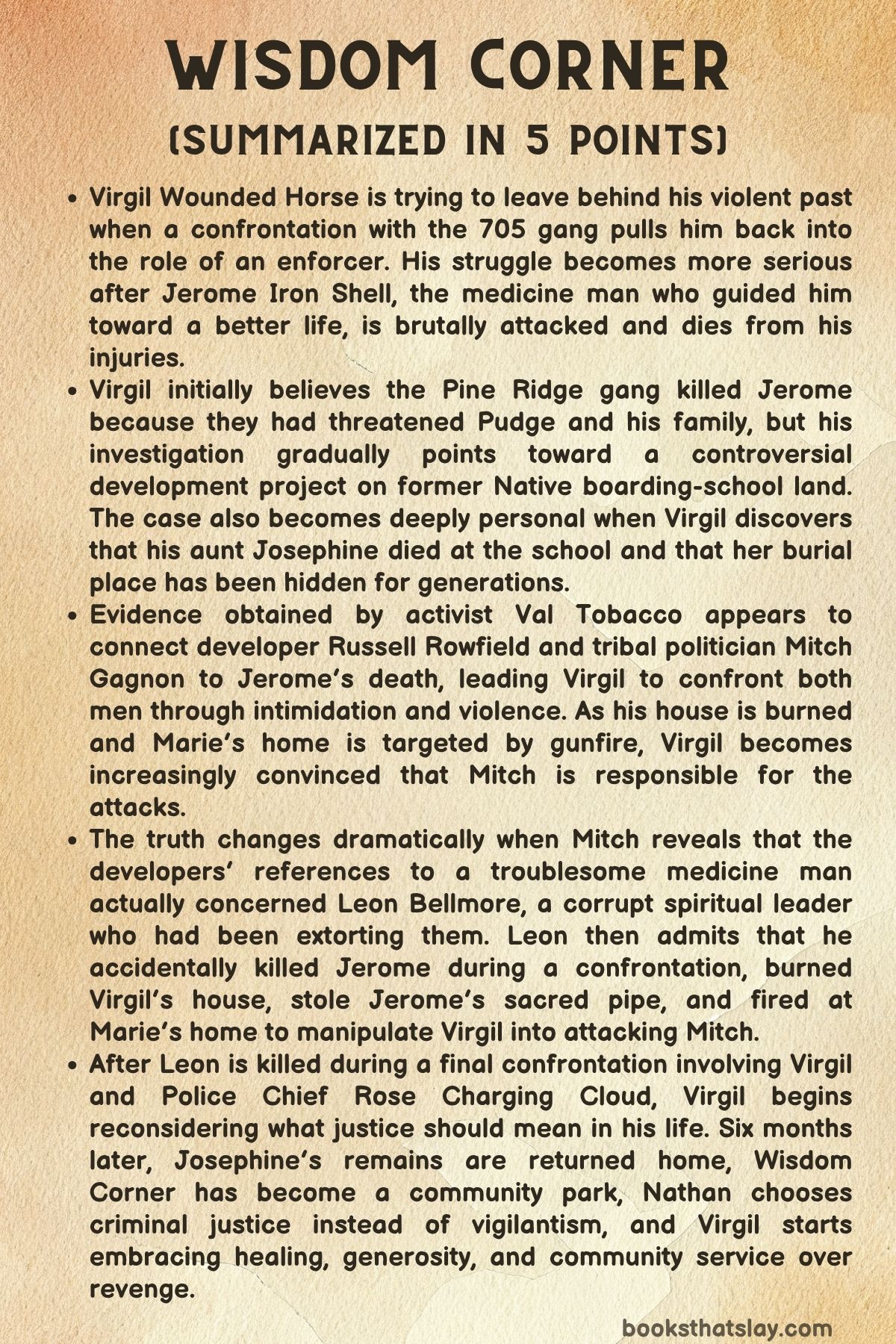
Summary
Virgil Wounded Horse has spent the past year trying to abandon the violent reputation that once defined him. He made a promise to himself and the Creator that he would stop hurting people, hoping to follow a healthier path with Marie Short Bear and his nephew Nathan.
That promise is tested when Virgil accompanies Pudge Iron Shell to the deteriorated gathering place known as Wisdom Corner. Members of the Pine Ridge 705 gang are attempting to force Pudge, a bootlegger with his own moral limits, into their expanding liquor operation.
The gang leader Bear makes it clear that Pudge has no real choice. Virgil initially tries to avoid violence, but after one member attacks him, he smashes a vodka bottle against Bear’s head, slashes Shorty’s face with the broken glass, and escapes with Pudge.
The confrontation awakens something Virgil thought he had left behind. He feels guilty because he has violated his promise, yet he also recognizes the old exhilaration that violence gives him.
Marie immediately understands the danger. She is campaigning for a tribal council position against Mitch Gagnon, and Virgil’s reputation gives Mitch an easy way to attack her politically.
Virgil turns to Jerome Iron Shell, Pudge’s uncle and the medicine man who has become his spiritual adviser. Jerome reminds him that patience, generosity, responsibility, and service are more valuable than domination, while also discussing a growing dispute involving land connected to the former Rapid City Indian School.
Developers are constructing expensive projects on land associated with the school despite questions surrounding its ownership and the possibility that Native children remain buried there. The controversy becomes more serious when a building under construction is destroyed by fire.
Virgil’s connection to the boarding school becomes personal when attorney Charley Leader Charge shows him records identifying Native children whose deaths had been hidden. Among the names is Josephine Wounded Horse, Virgil’s mother’s older sister.
Virgil had known almost nothing about Josephine. Realizing that an aunt he barely understood may have died at the school sends him to Rapid City searching for answers.
Before investigating the school grounds, Virgil accepts a job serving legal papers on Jesse Legrand, a man whose methamphetamine addiction destroyed his marriage and led him to injure his daughter. Jesse and several coworkers confront Virgil after he delivers the documents.
Virgil deliberately provokes Jesse after learning what he did to his child. Jesse attacks, and Virgil knocks him unconscious, giving Virgil another uncomfortable reminder that he is not merely defending himself when violence occurs.
His growing awareness that fighting behaves almost like an addiction becomes more disturbing when he takes old prescription painkillers for his injured hand. Under their influence, he visits the cemetery connected to the boarding school and seems to see Native children moving through the grounds.
A young girl asks him to help her return home before Virgil loses consciousness. When he wakes, he meets Val Tobacco, an Oglala activist connected to the land-recovery movement, who explains that researchers are using ground-penetrating radar to locate previously unknown graves.
Josephine cannot yet be found. Val promises to continue searching, but Virgil’s attention is suddenly redirected when Marie calls to tell him Jerome has been brutally attacked.
Jerome has been struck in the head and suffers catastrophic brain injuries. Virgil immediately suspects the attack may be connected to the 705 gang because Pudge reveals that they threatened not only him and Virgil but Pudge’s family as well.
Jerome dies from his injuries. His passing is portrayed through his spiritual journey as he remembers his parents, boarding-school experiences, calling as a healer, years of practicing Lakota ceremonies despite government repression, marriage, family losses, and decades of service.
He ultimately accepts that his work in the physical world has ended and joins the relatives who preceded him. For Virgil, however, Jerome’s death creates an enormous absence.
At Jerome’s memorial, Virgil sees how extensively the medicine man affected people throughout the community. He also learns that Jerome sometimes called him Takini, meaning Survivor or someone brought back to life.
The memorial is disrupted when Mitch Gagnon turns his remarks into political promotion. Mitch’s behavior reinforces Marie’s belief that he views nearly every public event through the needs of his campaign.
Virgil becomes obsessed with determining who killed Jerome. His desire for justice is mixed with guilt because he fears that his own attack on the 705 gang may have placed Jerome in danger.
His family life reveals another consequence of his past. Nathan announces that he wants to become an enforcer like Virgil rather than attend college, believing that punishing bad people can become both a profession and a source of respect.
Virgil is horrified because Nathan is copying the very behavior he is trying to abandon. Marie makes him confront the contradiction between telling Nathan that violence is wrong and continuing to use violence whenever he believes conventional justice is inadequate.
Searching for direction, Virgil travels to Stronghold Table, a place associated with Lakota resistance and the violent history surrounding Wounded Knee. There he appears to encounter the spirit of Plenty Horses, the Lakota man whose historical case raised questions about warfare, resistance, and killing.
Plenty Horses does not give Virgil permission to pursue revenge. Instead, he challenges him to distinguish personal anger from genuine defense of a people or community.
Meanwhile, Marie’s campaign against Mitch becomes increasingly hostile. Mitch introduces severe proposals targeting criminals, supposed accomplices, and even relatives while repeatedly using Virgil’s reputation as an indirect weapon against Marie.
Marie responds at a candidate forum by openly discussing her father Ben Short Bear, his involvement in drugs, and the fact that she killed him while stopping him from murdering Virgil. By speaking honestly about her own grief and guilt, she refuses to allow Mitch to control the meaning of her history.
Virgil remains convinced that the 705 gang is responsible for Jerome’s death, especially after the gang vandalizes Pudge’s vehicle. He travels alone to Pine Ridge, where Bear, Shorty, and several gang members corner him.
Police arrive before the encounter becomes fatal. Virgil spends the night in custody before discovering that Rose Charging Cloud arranged the intervention after Marie told her where he had gone.
Rose is furious that Virgil concealed the gang’s threats rather than working with tribal police. She also begins considering whether Jerome’s death might have connections beyond the Pine Ridge bootlegging conflict.
The investigation changes dramatically when Val uncovers information about Willow Creek Development. The company discovered graves beneath its construction area but concealed the finding because acknowledging Native remains could threaten the project.
More alarming is an email in which the company’s CEO orders its Rosebud contact to deal with “the medicine man.” Virgil and Val naturally assume the message refers to Jerome.
Virgil confronts Willow Creek executive Russell Rowfield in a parking garage. Armed with a gun and baton, he forces Rowfield to reveal the identity of the company’s local contact.
Virgil nearly kills Rowfield during the interrogation but stops after mentally returning to Jerome’s teachings. Rowfield eventually gives him the name Mitch Gagnon.
Virgil now believes the mystery has been solved. Mitch appears to possess both financial connections to the developers and a motive for eliminating Jerome, whose activism threatened the development project.
Rose is less certain because the evidence was obtained illegally or through coercion. Val begins searching for additional digital evidence while Virgil tries, with mixed success, to cooperate with Rose rather than conducting everything himself.
The danger soon reaches Virgil’s family directly when his house burns. Nathan rushes inside to rescue Ava, and Virgil follows, nearly dying before what appears to be another intervention from Plenty Horses leads him toward Nathan.
Everyone survives, but Virgil loses almost all his possessions. Photographs, family keepsakes, ceremonial objects, and items connected to Jerome disappear in the fire.
When federal authorities decline to pursue the suspected arson, Rose quietly gives Virgil information about the 705 gang’s bootlegging house. This time he takes Tommy, Pudge, Boots, and Joe rather than going alone.
The confrontation unexpectedly ends with negotiation. Bear and Shorty admit vandalizing Pudge’s vehicle but deny attacking Jerome or burning Virgil’s house, and Virgil believes them.
His original theory collapses. The gang is dangerous, but its members are not responsible for the crimes that have defined his investigation.
Then a gunshot tears through Marie’s window and flying glass injures Val. Virgil becomes certain that Mitch is attempting to silence everyone who can expose him.
Virgil storms Mitch’s house and beats him unconscious. Once Mitch awakens, however, his explanation destroys Virgil’s second theory.
Mitch admits taking money from Willow Creek and participating in questionable dealings, but he claims the email about “the medicine man” referred to Leon Bellmore rather than Jerome. Leon, he explains, has been extorting the developers after burning their construction project and threatening their families.
Mitch says his proposed banishment law was intended to remove Leon from Rosebud. He also insists that he neither killed Jerome nor burned Virgil’s house.
Before Virgil can fully process the revelation, Leon appears with a gun. He openly admits that Mitch has been telling the truth about the central mystery.
Leon shoots Mitch and plans to make it appear that Virgil committed murder before killing himself. He confesses that he attacked Jerome after the older medicine man confronted him for exploiting Lakota spirituality and charging people for ceremonies.
Their dispute became physical, Leon struck Jerome, and the injury killed him. Rather than expressing regret, Leon treats Jerome’s death as something that benefited his own position.
Leon also admits stealing Jerome’s sacred pipe and setting Virgil’s house on fire after realizing Virgil’s investigation might expose his extortion scheme. The shot through Marie’s window was deliberately intended to push Virgil into attacking Mitch.
Virgil fights Leon while struggling against the very instincts he has been questioning throughout the story. Even when he has an opportunity to use potentially fatal force, he hesitates rather than surrendering completely to vengeance.
Leon eventually overpowers him. Virgil again encounters visions of Mitch and Plenty Horses, and their messages give him the determination to continue resisting.
Rose arrives before Leon can kill Virgil. During the resulting standoff, Virgil wounds Leon’s leg with broken glass, creating an opening for Rose to shoot him.
The truth finally exposes how much of Virgil’s investigation was shaped by assumptions. He repeatedly interpreted incomplete evidence through anger, guilt, and expectations about who his enemies were.
Six months later, substantial changes have taken place. The neglected Wisdom Corner has become a community park containing spaces for children, families, and elders.
Marie withdraws from the election and begins pursuing a plan to make affordable Indigenous food. Pudge leaves bootlegging behind, runs for tribal council, and wins.
Nathan abandons his dream of becoming an enforcer and instead plans to study criminal justice. Shawna considers universities where she can pursue science and public health.
Construction on the former boarding-school land is suspended while graves are identified and Native children are returned to their communities. Val continues working on the project and finally locates Josephine.
Virgil brings Josephine’s remains home to Rosebud and buries her near family. The act gives his family a form of closure denied to them for generations.
Rose even suggests that Virgil consider becoming a tribal police officer. Her proposal reflects how much his understanding of justice has changed from solitary punishment toward accountability within the community.
Virgil later follows information Mitch gave him during his final vision and discovers a hidden toolbox filled with money connected to Mitch’s dealings. Instead of keeping it, he decides to give the money to Marie so she can establish her Indigenous food business.
His final action shows how deeply Jerome’s teachings have survived. Rather than answering injury with more destruction, Virgil chooses generosity and restoration.
The story closes with Virgil visiting Jerome’s house and sitting with Rocky. They spend hours talking about Jerome before finally sharing the silence, allowing memory, grief, and community to exist without requiring another fight.
Characters
Virgil Wounded Horse
Virgil Wounded Horse is the central character of Wisdom Corner, and nearly every major conflict tests the identity he is trying to leave behind. Once known as an unofficial enforcer who punished people outside the legal system, he begins the book determined to follow the Good Red Road and live without relying on violence.
The difficulty is that violence has become emotionally familiar to him. Fighting does not merely solve immediate problems; it gives him an intense sense of energy and control, which is why his confrontations with the 705 gang, Jesse Legrand, Russell Rowfield, and Mitch repeatedly disturb him afterward.
Virgil’s self-awareness separates him from a simple vigilante hero. He understands that claiming self-defense does not erase the fact that he sometimes wants people to attack him because it gives him permission to hurt them.
Jerome’s death pushes this struggle to its limit. Virgil wants justice for someone he loved, but grief repeatedly transforms justice into a desire for punishment, causing him to assume guilt before sufficient evidence exists.
His investigation therefore becomes as much an examination of Virgil’s judgment as a search for a murderer. He wrongly focuses first on the 705 gang and then on Mitch because each theory fits his existing anger and expectations.
Nathan’s admiration creates another source of moral pressure. Virgil can no longer pretend that his choices belong only to him when he sees a young man he loves imitating his methods and imagining violence as an honorable profession.
His spiritual experiences with Plenty Horses deepen the conflict rather than providing easy answers. Virgil is forced to distinguish community defense from personal revenge and righteous action from violence motivated by wounded pride.
By the ending, his development is visible in the choices he makes after the mystery has been solved. Returning Josephine home, considering work within tribal law enforcement, supporting Marie’s business, and refusing to keep Mitch’s hidden money show that he is beginning to define justice through restoration rather than domination.
Marie Short Bear
Marie is Virgil’s partner, moral counterweight, and one of the most independent figures in the novel. She loves Virgil without romanticizing his violent past and repeatedly challenges him when he attempts to excuse behavior that contradicts his promises.
Her political campaign reveals another side of her character. Marie wants tribal leadership to address real community needs, but her relationship with Virgil, her mixed heritage, and her family history make her vulnerable to Mitch’s attacks.
The candidate forum becomes her defining political moment because she refuses to remain defensive about her father. Instead of allowing Mitch to turn Ben Short Bear into a weapon against her, she openly acknowledges her father’s drug dealing, his attempt to kill Virgil, and her own decision to stop him.
Marie’s honesty demonstrates considerable emotional courage. She does not pretend that killing her father left her untouched, nor does she reduce him to a convenient villain simply because acknowledging complicated grief would be politically difficult.
Her influence on Virgil is equally important. She understands that revenge will not end with the person Virgil believes deserves punishment because every violent choice affects Nathan, their home, their future, and Virgil’s own character.
Marie also refuses to demand that Virgil abandon the search for Jerome’s killer. Her position is more demanding: she wants him to find the truth while remaining accountable to the person he claims he wants to become.
By the end, Marie steps away from electoral politics and directs her abilities toward affordable Indigenous food. The decision reflects adaptability rather than defeat, allowing her service to the community to take a form that is practical, culturally meaningful, and personally sustainable.
Jerome Iron Shell
Jerome is the spiritual and ethical center of Wisdom Corner, even though he dies relatively early in the central investigation. His influence continues through Virgil, Rocky, Pudge, and the many community members whose lives were affected by his ceremonies, counsel, and generosity.
His life represents endurance across generations of pressure placed on Native spiritual and cultural practices. He survives boarding school, learns ceremonies during periods when Indigenous spiritual traditions were suppressed, is imprisoned for practicing them, and nevertheless dedicates his life to healing others.
Jerome’s understanding of strength differs sharply from Virgil’s earlier worldview. Where Virgil often thinks of protection through force, Jerome emphasizes patience, service, generosity, balance, and responsibility.
His death therefore creates more than personal grief. The community loses someone who connected spiritual tradition with everyday guidance, while Virgil loses the person most capable of challenging his instinct to equate justice with punishment.
Jerome’s spiritual passage after death also allows his life to be considered as a completed journey rather than merely as a murder victim’s history. His memories of family, ceremony, loss, imprisonment, healing, and teaching establish the depth of what the community has lost.
Even after his death, Jerome remains active through memory. Virgil repeatedly imagines what Jerome would expect of him, while Rocky assumes responsibility for carrying forward ceremonies and knowledge his grandfather entrusted to him.
The revelation that Jerome called Virgil Takini is especially important. By seeing Virgil as a survivor who has been brought back to life, Jerome had already recognized the possibility that Virgil could become something greater than the violent reputation he had built.
Nathan
Nathan functions as Virgil’s mirror because he imitates the version of Virgil that Virgil himself is trying to escape. His early desire to become an enforcer reveals how easily violence can appear noble when viewed from the perspective of someone who sees only the reputation and not the emotional cost.
His protection scheme at school makes this imitation even clearer. Nathan believes he is providing a useful service by collecting money to protect younger students, repeating the same moral logic Virgil once used when people paid him to punish offenders.
Virgil’s anger at Nathan is therefore complicated by hypocrisy. Nathan has learned from what Virgil did rather than what Virgil now says, forcing Virgil to understand that personal transformation must become visible through consistent behavior.
Nathan also displays courage that is not dependent on aggression. When Ava is trapped inside the burning house, he runs back inside and shields her with his own body despite the enormous risk.
That incident helps separate bravery from violence. Nathan proves he can be courageous through protection and sacrifice rather than through dominance.
His eventual decision to study criminal justice represents an important change. Instead of copying Virgil’s old method of enforcing private justice, he begins imagining a future in which protection can operate through responsibility, education, and legitimate institutions.
Pudge Iron Shell
Pudge occupies a morally complicated position because he is a bootlegger but is not presented as cruel or predatory. He operates illegally while maintaining personal boundaries, making him different from the 705 gang members who want to expand their control through intimidation.
His connection to Jerome makes the gang dispute especially significant. Once the 705 threatens Pudge’s family, he becomes convinced that his bootlegging conflict may have contributed to his uncle’s murder.
Pudge’s guilt parallels Virgil’s own tendency to assume responsibility for Jerome’s death. Both men initially interpret the killing through the consequences of their confrontation at Wisdom Corner.
His eventual negotiation with Bear helps expose the mistake in that theory. Pudge remains capable of dealing pragmatically with dangerous people without treating every conflict as a battle requiring complete victory.
His later retirement from bootlegging is one of the clearest signs of social change in the ending. Winning a tribal council seat gives him an opportunity to redirect his influence from an illegal business toward public responsibility.
Rose Charging Cloud
Rose Charging Cloud represents institutional justice in a story where legal systems are repeatedly shown to be incomplete, underfunded, and historically unreliable. She understands those limitations while still believing that investigation, evidence, and accountability matter.
Her relationship with Virgil is defined by frustration and reluctant respect. Rose dislikes his habit of interfering with police work because his actions can compromise evidence, alert suspects, create additional crimes, and place himself or others in danger.
At the same time, she knows Virgil understands the community and sometimes reaches information formal systems cannot easily obtain. Their relationship gradually shifts from open conflict toward imperfect cooperation.
Her intervention in Pine Ridge demonstrates that she cares about Virgil even while criticizing him. After Marie contacts her, Rose uses her relationship with Clyde Conquering Bear to ensure police officers reach Virgil before the 705 gang can seriously harm him.
Rose also recognizes the structural limits surrounding her work. She cannot legally act on hacked emails or confessions obtained through threats, and the FBI’s refusal to pursue the suspected arson leaves her with fewer options than the seriousness of the situation warrants.
The climax confirms the importance of her presence. Rather than Virgil executing Leon in revenge, Rose arrives as a law-enforcement officer and ultimately uses lethal force when Leon presents an immediate threat.
Her suggestion that Virgil consider becoming a tribal police officer shows how much their relationship has changed. Rose has begun to believe that his protective instincts could serve the community if they were disciplined by accountability and law.
Val Tobacco
Val Tobacco connects the personal mystery surrounding Josephine with the larger conflict over boarding-school land and hidden Native graves. She combines scholarship, activism, technological skill, and a willingness to operate outside conventional legal boundaries.
Her identity as a hacktivist makes her particularly valuable to the investigation. She gains access to information powerful institutions would prefer to conceal, including evidence that Willow Creek continued construction despite discovering graves.
Val is motivated by more than curiosity. Her work is connected to historical justice, repatriation, and the belief that Native children whose deaths were hidden deserve to be identified and returned to their communities.
Her partnership with Virgil is productive precisely because their methods are very different. Virgil relies on physical presence and intimidation, while Val uses digital access, research, and information.
Both methods also create ethical and legal complications. Rose cannot simply act upon Val’s hacked records, demonstrating that discovering the truth and proving it within a legal system are not always the same process.
Val’s most important contribution may ultimately be finding Josephine. That discovery transforms years of institutional erasure into a concrete act of return, allowing Virgil to bring his aunt home and restore her place within the family.
Mitch Gagnon
Mitch is constructed for much of the novel as an obvious antagonist. He is opportunistic, politically aggressive, willing to exploit personal tragedy, and connected financially to developers whose conduct toward Native burial sites is deeply unethical.
His treatment of Marie makes him particularly unpleasant. He uses her family history, Virgil’s reputation, and coded attacks on identity and criminality in an effort to strengthen his own political position.
The investigation encourages Virgil and the reader to interpret Mitch’s corruption as evidence of murder. His secret relationship with Willow Creek and his involvement in the proposed banishment law appear to support nearly every suspicion directed toward him.
The revelation at Mitch’s house complicates rather than absolves him. He has accepted substantial money, concealed important relationships, and participated in questionable development negotiations, but he is not Jerome’s killer.
His explanation exposes the danger of assuming that a morally compromised person must be responsible for every nearby crime. Virgil’s certainty about Mitch becomes another example of how anger can turn circumstantial evidence into imagined proof.
Mitch’s death is therefore unsettling. Leon kills him before he can answer publicly for the things he actually did, leaving a character who was guilty of corruption but falsely accused of more serious acts.
His appearance in Virgil’s later vision, where he apologizes and reveals the hidden money, gives him a final moment of self-recognition. It does not erase his conduct, but it allows him to contribute indirectly to something beneficial after his death.
Leon Bellmore
Leon is the novel’s true human antagonist because he corrupts the very spiritual responsibilities Jerome spent his life protecting. He presents himself as a medicine man while exploiting ceremonies for money, status, and influence.
His conflict with Jerome is therefore much deeper than personal rivalry. Jerome represents spiritual practice grounded in service and responsibility, while Leon treats cultural authority as something that can be monetized and manipulated.
Leon’s criminal activity also extends well beyond Jerome’s murder. He burns Willow Creek property, extorts company executives, threatens their families, steals Jerome’s sacred pipe, burns Virgil’s house, and fires at Marie’s home to manipulate Virgil into attacking Mitch.
What makes Leon especially dangerous is his understanding of other people’s weaknesses. He knows Virgil is impulsive when angry and uses the shooting at Marie’s home to direct that anger toward Mitch.
His lack of remorse after confessing Jerome’s death establishes the scale of his moral corruption. He even views Jerome’s absence as beneficial because it increases interest in his own ceremonies.
Leon therefore becomes a dark contrast to both Jerome and Virgil. Jerome uses spiritual authority in service to others, Virgil struggles to control violent impulses, and Leon willingly uses both cultural authority and violence for personal gain.
Tommy Good Shield
Tommy is one of Virgil’s most dependable friends and provides emotional steadiness during periods when Virgil is consumed by grief or suspicion. His humor creates relief, but his loyalty is never superficial.
He is willing to help Virgil practically, including supplying information and obtaining the safety vest used during the Rowfield confrontation. More importantly, he offers companionship without pretending he can solve Virgil’s internal problems.
Their conversation after Jerome’s death shows the depth of their friendship. Tommy reminds Virgil that Jerome continues through what he taught others and allows both men to acknowledge losses they often conceal beneath jokes.
Tommy’s confidence that Virgil will discover the truth provides support when Virgil doubts himself. His loyalty also becomes physical when he joins the group confronting the 705 gang rather than allowing Virgil to repeat his earlier mistake of going alone.
Rocky
Rocky is Jerome’s grandson and the person most directly responsible for carrying forward his grandfather’s spiritual knowledge. His grief therefore contains both personal sorrow and a newly intensified sense of cultural responsibility.
Jerome deliberately prepared Rocky in ceremonies and traditions before his death. Rocky’s decision to perform the keeping-of-the-soul ceremony shows that Jerome’s teachings have not vanished with him.
At the memorial, Rocky describes Jerome as both healer and warrior. His understanding of warriorhood is important because it emphasizes service and defending what is right without seeking attention or personal glory.
The final scene between Rocky and Virgil provides a quiet resolution. Their long conversation about Jerome followed by shared silence demonstrates that remembrance can itself become a form of continuation.
Shawna
Shawna is a supporting character whose ambitions provide a hopeful contrast to several of the destructive cycles surrounding the adults. Her interest in higher education, science, and public health represents possibilities available to a younger generation.
Her relationship with Nathan also helps reveal his changing priorities. As Nathan moves away from the fantasy of becoming an enforcer, both young people begin imagining futures based on education and service.
Shawna also connects easily with Val, demonstrating a generational comfort with technology and broader educational opportunities. By the ending, her plans reinforce the novel’s movement toward futures built through knowledge rather than retaliation.
Plenty Horses
Plenty Horses appears to Virgil through encounters that remain deliberately uncertain in literal terms. Whether understood as spirit, vision, dream, ancestral guidance, or some combination of these, he functions as a challenger rather than a source of simple instructions.
His historical experience makes him particularly suited to Virgil’s questions about violence. Plenty Horses forces Virgil to consider the difference between personal revenge and action taken when a community faces genuine aggression.
He repeatedly resists Virgil’s desire for easy moral permission. Instead of telling Virgil whom to punish, he pushes him toward clarity, patience, and a larger understanding of responsibility.
His appearances during moments of physical danger also connect Virgil’s survival to a broader historical consciousness. He reminds Virgil that Indigenous resistance has always involved difficult questions about survival, justice, violence, and the meaning of defending one’s people.
Josephine Wounded Horse
Josephine never participates directly in the present-day action, yet her absence profoundly affects Virgil. As his mother’s older sister who died while attending the Rapid City Indian School, she embodies a family history that institutional secrecy prevented later generations from fully knowing.
Finding her name transforms the boarding-school investigation from a public issue into an intimate one. Virgil is no longer thinking only about anonymous children whose graves have been concealed; he is searching for a member of his own family.
The inability to locate Josephine initially demonstrates how thoroughly boarding-school systems could erase children from both records and family memory. Her missing remains become evidence of an unresolved historical wound.
When Val finally identifies her burial location, Virgil can bring Josephine home. Her reburial near relatives restores a connection that had been broken for generations and gives physical meaning to the larger process of repatriation.
Bear
Bear, whose real name is Kerwin, initially appears to be one of the book’s principal threats. As leader of the 705 gang, he attempts to expand the group’s bootlegging operation into Rosebud and uses intimidation to force Pudge into cooperation.
His conflict with Virgil becomes personal after Virgil attacks him at Wisdom Corner. The gang’s later threats and vandalism make Bear seem like a plausible suspect in Jerome’s murder and the fire at Virgil’s home.
The eventual confrontation at the bootlegging house reveals important limits to his criminality. Bear admits what the gang actually did while denying crimes they did not commit, and Virgil comes to believe him.
That distinction matters because Bear remains dangerous without becoming a convenient explanation for every act of violence. His role helps demonstrate how easily an existing enemy can become the target of assumptions unsupported by evidence.
Shorty
Shorty carries the most personal resentment toward Virgil among the 705 members because Virgil permanently scars his face during the confrontation at Wisdom Corner. His desire for retaliation makes later encounters particularly volatile.
When Virgil is cornered in Pine Ridge, Shorty is prepared to use a knife against him, confirming that the gang conflict poses a genuine threat. Later, he appears with a handgun when Virgil and his allies enter the bootlegging house.
Despite that hostility, Shorty supports Bear’s denial regarding Jerome and the arson. His role reinforces the distinction between being capable of violence and being responsible for the particular crimes Virgil is investigating.
Rich Cortings
Professor Rich Cortings contributes historical and intellectual context to Virgil’s growing understanding of Native history. His conversations address legal doctrines used to justify Indigenous dispossession and overlooked Native contributions to American culture.
Rich helps Virgil see how institutional power shapes accepted versions of history. The law may claim neutrality while being built upon assumptions that benefited settlers and reduced Indigenous rights.
His discussion of the Carlisle football teams serves a similar purpose. Virgil realizes that Native achievements can disappear from mainstream narratives just as Native suffering can be minimized or concealed.
Rich therefore broadens the investigation beyond individual criminal acts. He helps establish the historical structures surrounding the land dispute and supports efforts to challenge the continuing consequences of those structures.
Charley Leader Charge
Charley serves as one of the figures who connects Virgil’s everyday work with the larger boarding-school investigation. By hiring Virgil to serve papers on Jesse Legrand, he indirectly places Virgil in another situation that exposes his difficulty controlling violence.
More significantly, Charley shows Virgil the newly discovered records concerning children who died at the former school. His identification of Josephine Wounded Horse becomes the moment that permanently changes Virgil’s relationship to the land dispute.
Charley’s role is brief but essential because information rather than force drives the most important discovery he gives Virgil. Through him, hidden records begin restoring identities to children whose deaths were intentionally obscured.
Jesse Legrand
Jesse represents the kind of person who makes Virgil’s old form of justice emotionally tempting. His methamphetamine addiction has devastated his family, and his violence toward his young daughter makes him difficult for Virgil to regard with restraint.
Virgil could simply serve the legal papers and leave, but he deliberately reveals Jesse’s abuse in front of his coworkers and provokes him. The resulting fight demonstrates that Virgil’s struggle is not only about situations where violence is unavoidable.
Jesse becomes an early test that Virgil fails. His wrongdoing does not excuse Virgil’s desire to experience the satisfaction of punishing him personally.
Themes
Justice, Revenge, and Moral Responsibility
Justice in Wisdom Corner is presented as something far more difficult than identifying a guilty person and delivering punishment. Virgil begins from a worldview in which direct action feels more reliable than institutions, especially because reservation communities often face limited resources, federal indifference, historical injustice, and legal systems that have not consistently protected Native people.
The problem is that private justice is vulnerable to anger and assumption. Virgil repeatedly becomes convinced that he knows who is responsible before he possesses enough evidence, first blaming the 705 gang and later believing Mitch ordered Jerome’s murder.
His mistakes reveal how easily grief can turn suspicion into certainty. Because Virgil is capable of violence, acting on that certainty could permanently punish people for crimes they did not commit.
Jerome and Plenty Horses complicate the issue further by refusing to define all force as morally identical. Protecting others may sometimes require confrontation, but violence motivated by rage or wounded pride cannot automatically be called justice.
Rose represents another imperfect alternative. Law enforcement operates within rules of evidence and jurisdiction, yet those rules leave her unable to act immediately on hacked communications, coerced confessions, or an arson case rejected by federal authorities.
The ending moves toward a restorative definition of justice. Virgil returns Josephine home, gives away corrupt money, considers legitimate public service, and recognizes that repairing damaged relationships can accomplish what retaliation cannot.
Indigenous Memory, History, and the Recovery of the Dead
The boarding-school storyline shows how historical violence continues to shape families long after the original institutions disappear. Josephine’s death is not simply an event from the distant past because the concealment of her fate prevents Virgil’s family from understanding what happened to one of its own members.
The unidentified graves expand that personal loss into collective history. Children listed only by age or sex demonstrate how institutions removed not only lives but names, relationships, and individual identities.
Willow Creek’s decision to continue construction after discovering graves creates a modern continuation of that disregard. Profit is again treated as more important than Native people, even when the people being disregarded are dead children whose descendants may still be searching for them.
Rich’s discussions of legal doctrine and overlooked Native achievements reinforce the theme. Historical narratives are shaped by power, determining which stories become common knowledge and which are minimized or forgotten.
Val’s technological investigation becomes a modern tool for recovering what institutions attempted to hide. Her research ultimately makes Josephine identifiable again after decades of absence.
Bringing Josephine back to Rosebud is therefore more than a family burial. It reverses part of the removal imposed on her as a child by restoring her physical remains, name, family connection, and place within the community.
Violence, Masculinity, and Breaking Inherited Patterns
Virgil’s greatest internal problem is not simply that he knows how to fight but that violence has become connected to his sense of usefulness. Being an enforcer once gave him reputation, income, purpose, and the belief that he could protect people when official systems failed.
The physical excitement he experiences after fighting shows why leaving that identity behind is difficult. Violence produces immediate certainty in situations where ethical questions are much harder to resolve.
Nathan exposes the social consequences of that identity. He sees Virgil’s reputation and concludes that an enforcer is admirable, then reproduces the same structure at school by charging younger children for protection.
Virgil is forced to recognize that young people absorb examples more readily than lectures. He cannot successfully tell Nathan that violence is destructive while continuing to solve his own problems through intimidation.
The novel also broadens the meaning of courage. Nathan’s decision to run into a burning house to save Ava requires enormous bravery, yet it has nothing to do with defeating another person.
Jerome provides another model of masculine strength through service, spiritual responsibility, patience, and endurance. Even Plenty Horses refuses to reduce warriorhood to aggression.
By the end, Nathan chooses criminal justice and Virgil considers tribal policing. Their changes suggest that protective instincts do not need to disappear; they can be redirected into forms that reduce rather than reproduce destructive cycles.
Community, Healing, and Cultural Continuity
The transformation of Wisdom Corner from a neglected location associated with alcohol and drugs into a park for children, families, and elders reflects the novel’s larger movement from damage toward renewal. The place itself demonstrates that communities can reclaim spaces without pretending their difficult histories never existed.
Jerome’s influence provides the strongest example of cultural continuity. His death removes an important spiritual leader, but it does not erase the ceremonies, teachings, and values he transmitted to Rocky, Virgil, and others.
Rocky’s responsibility for carrying forward those traditions shows that culture survives through practice rather than memory alone. The same principle appears when Virgil applies Jerome’s teachings to decisions Jerome is no longer alive to witness.
Healing also occurs through practical forms of community investment. Marie’s food project, Pudge’s move into tribal government, Nathan and Shawna’s educational plans, and the restoration of the park all redirect energy toward building something useful.
The repatriation of boarding-school children connects community healing with historical responsibility. Recovery requires identifying what was taken, acknowledging what happened, and restoring relationships wherever possible.
Virgil’s final decision to give Mitch’s hidden money to Marie completes this movement. Money associated with secrecy and corruption is redirected toward nourishment and community service, turning the remains of exploitation into an opportunity for renewal.