Witch of the Wolves Summary, Characters and Themes
Witch of the Wolves by Kaylee Archer is a paranormal fantasy romance set in an alternate Victorian-flavored London where witches, werewolves, demons, and sorcerers exist in uneasy proximity. The story follows Cordelia Carter, a young witch raised to believe she is only human-adjacent, until a sudden attack reveals her hidden lineage as the daughter of a powerful werewolf Alpha.
Thrust from city life into the brutal politics of the Albion Pack, Cordelia must navigate betrayal, family secrets, and a dangerous mating scheme while discovering the wolf traits awakening inside her. At its core, the book blends survival, power struggles, and reluctant intimacy.
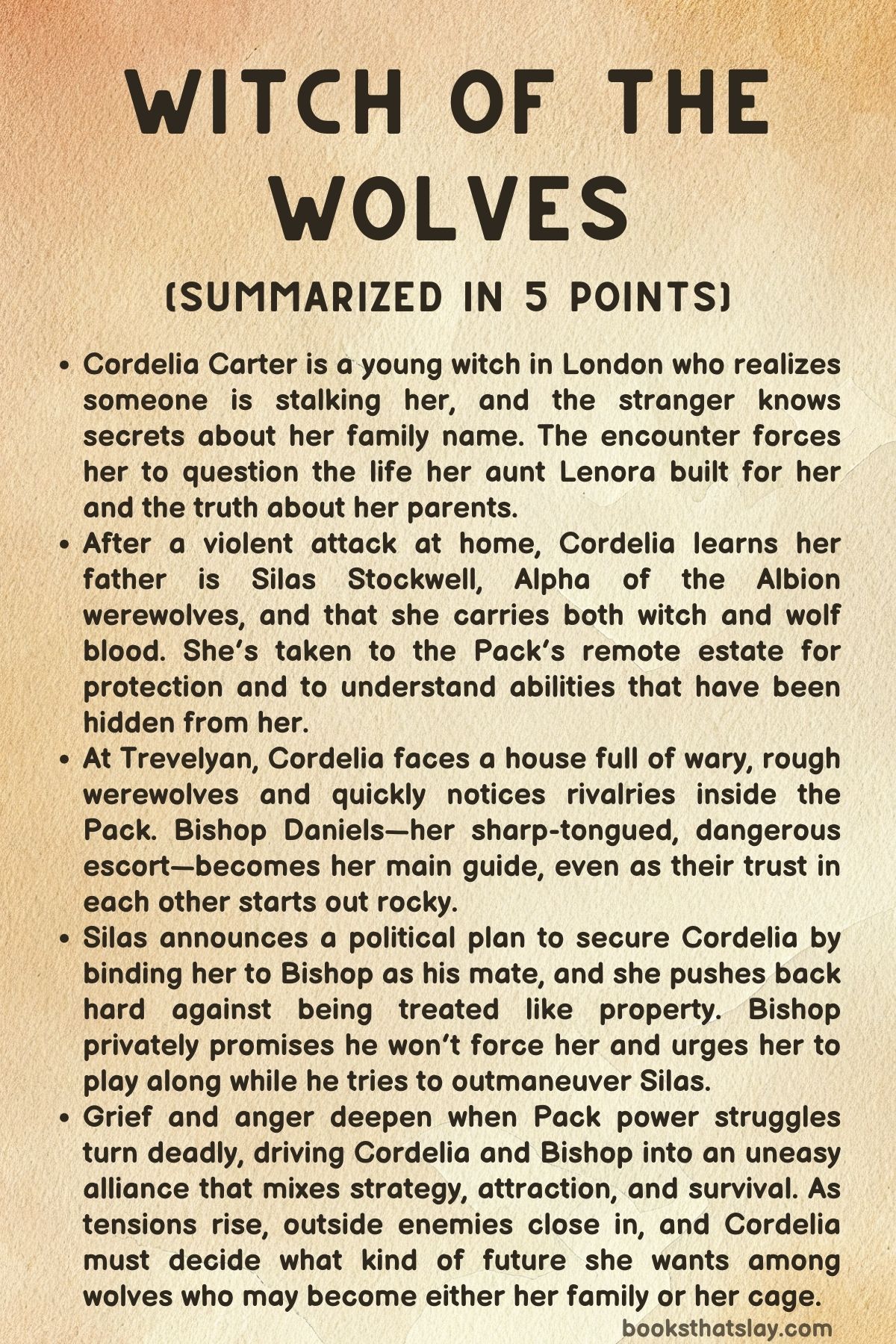
Summary
Cordelia Carter, a twenty-three-year-old witch living quietly in London with her aunt Lenora, senses a stranger shadowing her through the streets. She tries to flush him out with quick spells, but he slips away, leaving behind a scent that stirs something strange and familiar in her.
Later, after Cordelia delivers dark magical goods to Lord Wilkes, a half-demon client, the same man confronts her directly. He calls her “Miss Levine,” a name Cordelia has never used and that Lenora has always avoided.
When he attempts to seize her, Cordelia blasts him with magic and refuses to go anywhere without answers. He backs off only when her friend Audrey arrives, claiming he confused her for someone else.
At home, Lenora reacts with panic when Cordelia reports the encounter. She reveals the stalker is Bishop Daniels, a werewolf who works for Cordelia’s father.
Cordelia is stunned: her whole life she was told her father was a French perfumer and long dead. Lenora orders her to grab emergency supplies, implying they must flee immediately.
Before she can explain more, a messenger arrives from Lord Wilkes insisting Lenora and Cordelia come at once because of a supposed mistake in his order. Lenora senses danger, lies that Cordelia is away, and leaves with the messenger, ordering Cordelia to ward the house and hide in their secret locked room.
Cordelia throws herself into sealing doors and windows, draining her magic. The doorbell rings again, and she assumes trouble is at the threshold, but it is Audrey and Henrietta, her human friends.
They insist the stalker has been circling Cordelia for days. While they try to distract her with a game of chess, Cordelia’s mind races.
She recalls her odd senses—night vision, restless energy, a surge of thrill at the stalker’s scent—and connects them to Lenora’s rushed confession. The truth lands hard: her father must be a werewolf, likely the Alpha of a local Pack.
The wards collapse without warning. Cordelia runs to send her friends away, only to find the parlor empty and the chessboard disturbed.
Audrey’s scent leads her to a closet, where she finds Audrey held hostage. “Henrietta” stands over her with a knife, speaking like a stranger.
Cordelia realizes Henrietta is an impostor witch who embedded herself in their circle to get to Lenora through Cordelia. The impostor claims allies are already coming.
Cordelia attacks, taking a cut on her arm, wrenching the knife free, and dragging Audrey out. They flee upstairs as the impostor fires sorcerer magic after them.
In panic, Cordelia unleashes a knockback spell too strong; the impostor crashes down the stairs and dies. Horrified but moving on instinct, Cordelia gets Audrey into a hidden attic passage and forces her to escape across rooftops while Cordelia uses a candle trick to mislead pursuers.
A towering fire half-demon corners Cordelia in the attic, mocking her for killing her “cousin. ” She fights with what little power she has left, but he destroys her escape ladder.
Before he can seize her, something unseen slams into him. A massive black wolf appears—Bishop Daniels.
Cordelia recognizes the scent at once. She attacks him with her last fireball and then stabs him with the stolen knife when she runs dry.
He barely flinches before she locks herself in the secret room. Bishop cannot break in as a wolf.
Shifting back to human, he speaks through the door, confirming he serves her father and that she has inherited rare secondary wolf traits. He says other Packs know she is half-lycan and are hunting her.
Cordelia refuses to go. Bishop tricks the lock, restrains her, and calls another werewolf, Julius, who knocks Cordelia out.
She wakes at a country estate called Trevelyan, face-to-face with Silas Stockwell, Alpha of the Albion Pack and her father. He explains his past with Cordelia’s mother, why her heritage was hidden, and how foreign wolves now want to claim Cordelia because a witch-wolf hybrid can bear sons, making her a prize for breeding.
He admits Lenora despises him for killing her half-demon lover years ago and for taking Cordelia’s mother away while she was pregnant. Silas promises safety and offers to train Cordelia’s emerging traits, placing Bishop as her instructor.
Shaken and furious but with nowhere safe to return, Cordelia agrees to stay for now.
Bishop escorts her from London to Trevelyan and warns her the estate is full of rough Pack men who may see her as property. She is told never to walk alone and to accept only Bishop, Julius, or her uncle Oliver as escorts.
Trevelyan is huge and remote, and the moment she enters, dozens of wolves stare, make crude remarks, and test boundaries. Bishop violently punishes one offender, revealing simmering tensions inside the Pack.
Cordelia is shut into a guarded room meant to contain uncontrolled shifting. She meets Marjorie, her fire half-demon maid; Ann, a necromancer helper with a cold edge; and Tabitha, a mute twelve-year-old witch.
Cordelia notices her room has been prepared with custom clothes and small comforts, proof her father has been watching her longer than she knew.
At a formal dinner, Silas announces Cordelia’s danger to the Pack and then publicly names Bishop as his chosen heir. Before Cordelia can process that, Silas declares that an “old tradition” will protect her: Bishop will take her as his mate.
The Pack erupts in approval. Cordelia is stunned, realizing she has been brought here to be married off without consent.
She refuses to be treated as a trophy and demands time. Silas grants a delay, but the threat hangs over her like a chain.
Outside afterward, Cordelia confronts Bishop for hiding the plan. He admits he suspected it but swears he will not marry someone forced.
He urges her to appear compliant, stay alive, and let him manage Silas while she watches for openings. Against her better judgment, Cordelia agrees to cooperate cautiously.
The fragile arrangement shatters when Silas murders Lenora, using her death as a warning to Cordelia and anyone who might defy him. Cordelia collapses into grief and rage, and Bishop carries her to a basement cell to keep her out of Silas’s reach.
She vows to kill Silas and then Bishop. Bishop admits he misjudged how far Silas would go and accepts blame for bringing her into his grasp.
Silas demands evidence that Bishop punished Cordelia for her defiance. Cordelia proposes that Bishop beat her hard enough to convince Silas, but Bishop refuses to hurt her directly.
Their argument turns raw and close, and Cordelia tests his control, trusting he will not truly harm her. The tension snaps into a fierce, consensual kiss, then rough intimacy that leaves bruises usable as proof.
They agree to use Silas’s assumptions against him, letting him think Bishop is distracted by desire and eager for heirs. Julius helps stage the story when Silas arrives, and Silas is satisfied.
Reginald, Silas’s elderly advisor, later tries to trick Cordelia into fleeing, claiming her grandmother waits for her. Cordelia knows it’s a lie and escapes anyway, only to be chased into the forest by Henry Cain, the Pack enforcer aligned against Bishop.
Bishop leaps from a window to protect her, fighting Henry while Henry’s son joins in. Cordelia and Oliver help turn the tide.
Silas arrives furious, but Cordelia and Bishop spin the truth: Reginald tried to lure her out, and she ran to Bishop for help. Silas reluctantly places her in Bishop’s custody again.
Cordelia heals Bishop’s injuries, and their bond deepens through shared danger and chosen intimacy, even as Bishop holds back from fully claiming her while she remains under threat.
The Pack soon gathers for an Alpha challenge. Cordelia is bound beside Julius as Bishop faces Silas in wolf form.
Silas cheats from the start, tearing Bishop’s shoulder before the signal. Bishop adapts, using speed and stamina to exhaust Silas while the crowd jeers his evasive style.
Silas forces Bishop out of the ring and tries to maul him against the walls. Bishop collapses, appearing dead.
As Silas goes for the killing bite, Bishop springs up, seizes Silas’s throat, and rips it open. Silas dies on the floor, and Bishop is declared the new Alpha.
A few wolves rebel, but Julius and Marjorie crush the uprising, and most kneel, though the Pack is shaken and reduced.
Almost immediately, a new threat arrives. Tabitha storms in raging over Lenora’s death, and Ann reveals her necromancer power by raising Silas’s corpse for Tabitha to punish before Cordelia breaks it for closure.
Marjorie then pulls Cordelia into a hidden room where a cluster of witches waits, led by Beryl Levine—Cordelia’s real grandmother. Beryl admits she orchestrated the earlier attack to seize Cordelia for the Levine cabal.
Silas betrayed that deal, and now Beryl wants blood repayment. Bishop bursts in, but Beryl demands his execution along with Julius and Claude.
When Claude offers negotiation, Beryl tortures and kills him. Cordelia erupts in uncontrolled magic, injuring witches, and Julius drags her and Bishop out as fighting explodes across Trevelyan.
Beryl’s forces storm the estate. The exhausted Pack battles for survival.
Cordelia fights with fists and limited spells, while Ann raises enemy dead to turn on their own side. Together with Bishop and Julius, they drive the invaders off, but only nine wolves survive.
Trevelyan burns as the cabal tries to flush them into open ground. The survivors flee through a hidden tunnel into the forest.
Marjorie, bound by blood magic to Beryl, chooses to stay behind to stall pursuit, sacrificing her freedom to save the others. Outside, the manor collapses into flames behind them.
In the aftermath, the battered group—Bishop, Cordelia, Julius, Oliver, Ann, Tabitha, and a few remaining wolves—camp in the woods, grieving and facing a future without home or numbers. Bishop shares his history: his family was exiled by Silas, and Bishop spent years plotting to restore the Pack with Claude’s help.
Claude’s death devastates him, yet he commits to rebuilding a new, stronger alliance. He tells Cordelia she is free to leave now that Silas is gone, and he fears his wolf side may cling to her unfairly.
Cordelia, still raw with loss but seeing in Bishop a genuine chance at safety and choice, decides to stay by his side for now. Bishop vows to rebuild a Pack worthy of her and imagines a future where she stands with him not as a prize, but as a partner.
Characters
Cordelia Carter (Cordelia Levine)
Cordelia is the emotional and narrative center of Witch of the Wolves, presented first as a self-possessed young witch who believes she understands her world, only to have that certainty shattered. Her early life in London under Lenora’s protection has made her cautious, clever, and fiercely independent; she negotiates dangerous clients, uses decoys and wards instinctively, and trusts her own judgment over authority.
The revelation of her hidden lineage forces a rapid identity reformation: her heightened senses, bodily restlessness, and instinctive reaction to wolf scent are not treated as small curiosities but as the beginning of a profound dual nature. What defines Cordelia most is her refusal to be reduced to anyone’s property—whether by half-demons, Pack politics, or a witch cabal.
Even when physically captured, she keeps testing boundaries, bargaining, planning, and looking for leverage. Her arc mixes grief, rage, and awakening desire, but she never becomes passive in any of these states; her grief for Lenora hardens into a clear moral line against Silas, while her attraction to Bishop is framed through choice, consent, and strategy.
By the end, she emerges not as a sheltered heir but as a survivor who has started to claim both sides of her heritage on her own terms.
Bishop Daniels
Bishop begins as a threatening shadow in Cordelia’s London life, but quickly reveals himself to be a disciplined, duty-bound werewolf trapped between obedience and conscience. His defining trait is restraint: he has the physical dominance to force Cordelia immediately, yet he keeps trying (awkwardly) to do things through introduction, structure, and Pack protocol.
That tension makes him a layered figure—dangerous in capability, but morally unwilling to become the monster others assume or demand. His loyalty to Silas is real but not blind; he understands the Pack’s rot and has been preparing to challenge it, yet he delays until he can protect Cordelia and keep the challenge legitimate rather than mutinous.
Bishop’s relationship with Cordelia is built on mutual need and wary respect, sharpened by banter that masks shared fear and attraction. He repeatedly draws a line around consent—refusing to beat her, refusing to take her virginity under coercion, refusing to marry her unwillingly—which positions him as someone redefining Pack masculinity away from entitlement.
After becoming Alpha, Bishop’s grief over Claude and the massacre exposes his vulnerability, while his vow to rebuild shows that leadership for him is not conquest but repair. He is a man who has lived with long-term rage against injustice, but who wants power primarily to end cruelty, not replicate it.
Silas Stockwell
Silas is the primary embodiment of corrupted authority in Witch of the Wolves: charming on the surface, predatory underneath, and convinced that every relationship is a hierarchy he must control. His love story with Cordelia’s mother is recounted in tones of romance and regret, but even there he positions himself as the agent of destiny, someone whose desire justifies upheaval and pursuit.
As Alpha, he rules through fear, spectacle, and the manipulation of tradition—publicly naming Bishop heir while simultaneously using Cordelia as bait to secure that heir’s loyalty. Silas’s obsession with lineage and breeding exposes a worldview that treats women as strategic resources, not people, and it is this utilitarian cruelty that drives Cordelia’s hatred more than any single act.
His murder of Lenora finalizes him as irredeemable and reveals his instability: old grievances and wounded pride override Pack welfare. In the challenge, his cheating and brutality demonstrate a leader who believes rules exist only for others, which is why his death feels less like a twist and more like a necessary collapse of a failing regime.
Lenora
Lenora is a protector forged by fear, secrecy, and sacrifice, and her love for Cordelia is expressed through control rather than comfort. Her decision to hide Cordelia’s identity and father is not casual deception but a survival strategy born from knowing what Packs and cabals do to rare bloodlines.
She is pragmatic to the core—stockpiling emergency bags, maintaining a locked safe room, and moving within London’s supernatural underworld with practiced caution. Yet Lenora’s terror at Bishop’s appearance shows the cost of her vigilance: she has been living in a long fight with ghosts of the past.
Her hatred of Silas is deeply personal, tied to a half-demon lover he killed and the way he disrupted her sister’s life, suggesting that Lenora’s protectiveness is also fueled by unresolved grief and guilt. Even in death, she shapes Cordelia’s arc; Cordelia’s rage, distrust of Pack politics, and insistence on autonomy all intensify because Lenora’s murder proves that appeasement never would have saved her.
Audrey
Audrey functions as Cordelia’s anchor to ordinary human intimacy and moral normalcy, and her presence highlights what Cordelia is at risk of losing. She is observant enough to notice danger around Cordelia and brave enough to voice it, but she is also vulnerable in a supernatural world that doesn’t recognize her agency.
Her kidnapping and near-murder show the collateral damage of hidden wars, and her escape is important not just logistically but emotionally—Audrey survives because Cordelia refuses to let a human friend pay for supernatural secrets. After that, Audrey becomes part of Cordelia’s moral compass; Cordelia’s desire to write to her and reassure her underscores that Cordelia’s humanity is not diluted by wolf blood but strengthened by loyalty.
Henrietta (Impostor cousin)
The impostor posing as Henrietta represents infiltration, betrayal, and the kind of calculated cruelty that contrasts with Cordelia’s reactive violence. She embeds herself patiently in Cordelia’s life, using mimicry and social trust as weapons, which makes her more frightening than a straightforward attacker.
Her cold willingness to slit Audrey’s throat exposes her as mission-first, empathy-last, and her taunts about being Cordelia’s cousin suggest that blood ties in this story can be either sacred or exploitative depending on who wields them. Her accidental death at Cordelia’s hands becomes a key trauma point for Cordelia—proof of her power, her instability under pressure, and the irreversible moral costs of survival.
Even after she is gone, her death fuels Beryl’s vengeance and binds Cordelia more tightly into inter-family war.
Julius
Julius is the story’s blend of levity and competence: a doctor, a fighter, and one of the few Pack men whose humor doesn’t mask entitlement. He reads situations quickly—spotting Bishop’s strategy in the challenge and understanding the value of Cordelia’s deception plan without ego.
His teasing of both Bishop and Cordelia serves a social purpose: he lowers tension in moments where fear might fracture alliances. Yet he is not careless; his medical checks, rule enforcement, and willingness to physically step into leadership crises make him part of the Pack’s spine.
Julius also helps reframe Pack culture as something that can be humane, showing Cordelia that not every wolf is Silas or Henry.
Oliver Stockwell
Oliver is a quiet counterpoint to Silas, embodying loyalty that is sincere but not predatory. His kindness toward Cordelia feels understated and steady—checking on her, listening without demanding submission, and explaining Pack dynamics without weaponizing them.
He represents the tragedy of decent people inside oppressive systems: he obeys Silas because that is what Pack law and survival require, not because he shares Silas’s worldview. In battle he proves his worth, but his real role is emotional and ethical—he adds legitimacy to Bishop’s emerging leadership by being a respected elder who can choose to support change rather than cling to tradition.
Marjorie
Marjorie starts as an almost theatrical presence—confident, stylish, and clearly powerful—but becomes one of the story’s most morally complex figures. As a fire half-demon serving Cordelia, she brings warmth, glamour, and guarded truth, while subtly steering Cordelia through Pack life.
Her allegiance is split by blood magic binding her to Beryl, meaning her earlier helpfulness exists alongside coerced betrayal. What makes her compelling is her eventual choice: she confesses, warns the survivors, and stays behind to fight, turning her fire into both weapon and redemption.
Marjorie illustrates how constraint can distort loyalty, and how agency can be reclaimed even at fatal cost.
Ann
Ann’s hostility first reads as personal dislike, but later resolves into a hard-edged survival stance shaped by necromancy and dangerous alliances. She is pragmatic, quick to withdraw from emotional entanglement, and wary of Cordelia’s role in Pack politics.
Once the cabal attacks, Ann’s full power and purpose come forward: she turns enemy dead against them, treats the battlefield like a grim ledger, and refuses to be sentimental about necessary violence. Her bond with Tabitha and Cordelia after Silas’s death reveals that beneath her sharpness is a fierce protective instinct for vulnerable girls in predatory worlds.
Tabitha
Tabitha is the quiet heartbreak of Witch of the Wolves: a twelve-year-old mute witch who has been pushed into servitude despite her power. Her shyness and eagerness to listen make her seem fragile, but her sudden intensity when Cordelia offers to teach her spells hints at a thirst for autonomy and recognition.
When Silas falls, Tabitha’s furious outburst and physical attack on his corpse show the depth of her trauma and the courage she has been forced to bury. She represents the future Cordelia wants to protect—a girl who should have been a child, not a tool.
Claude
Claude is present for relatively little page time in the summary, but his impact is structural: he is Bishop’s confidant, financial mind, and co-architect of the plan to overthrow Silas. His attempts to negotiate with Beryl highlight his strategic temperament; he is the kind of leader who seeks solutions that preserve life rather than glorify martyrdom.
His brutal death by cabal torture becomes a turning-point loss that hardens Bishop’s resolve while stripping away the Pack’s stabilizing intellect. Claude’s fate underscores how revolution costs the best people first.
Henry Cain
Henry is the Pack’s enforcer and a living symbol of Silas’s culture—dominance as identity, cruelty as entertainment, and female bodies as status objects. His lewdness toward Cordelia is not just personal vice but a political signal to test whether the Alpha’s daughter can be treated as prey.
His hostility to Bishop reflects factional rot: he thrives under Silas because Silas rewards brutality. Henry’s attempt to abduct Cordelia into the woods and his willingness to manipulate her “escape” show that for him, violence is both strategy and pleasure.
Harry Cain
Harry inherits his father’s aggression but without his authority, making him reckless and combustible. He joins assaults quickly, asserting Pack entitlement through force rather than standing.
His presence in the final conflict, and his retreat after being burned and dominated, show him as a bully dependent on stronger tyrants; once the old regime collapses, he lacks the spine to lead.
Augustus
Augustus serves as the embodiment of Pack law—stern, ritual-bound, and trying to keep tradition meaningful rather than merely a mask for tyranny. As referee of the Alpha challenge, he insists on rules even when Silas violates them, signaling that some institutional conscience still survives in the Pack.
His restraint from intervening physically also shows the fragility of law under a murderous Alpha; he must preserve the legitimacy of the challenge even while watching it be perverted. In the escape, his knowledge of hidden passages makes him a practical guardian of what is left.
Reginald
Reginald is the politics of cowardice made flesh: an elderly advisor who operates through manipulation, plausible deniability, and self-preservation. His attempt to lure Cordelia with a fake grandmother story shows he assumes she can be steered like a child, and his likely goal—engineering her disappearance so the Pack can shed responsibility—reveals his priority is stability, not justice.
His mutilated corpse later marks the endpoint of serving monsters: even the schemers are disposable to someone like Silas.
Beryl Levine
Beryl is a chilling mirror to Silas, wielding witch power with the same entitlement to other people’s bodies and futures. She claims family loyalty and cabal tradition, but her actions reveal a colonial mindset toward Cordelia—Cordelia is bloodline first, person second.
The fact that she orchestrated the original kidnapping for breeding leverage makes her one of the story’s deepest betrayals: she is not a rescuer arriving late, but an architect of Cordelia’s suffering. Her execution demands on Bishop’s inner circle are framed as justice for cabal losses, yet her willingness to torture and slaughter indiscriminately shows she is driven by ego and domination.
Beryl represents the danger on the witch side of Cordelia’s heritage: even kinship can be weaponized into ownership.
Alfred
Alfred exists as Lenora’s sorcerer ally and lover, and through that role he expands Lenora beyond solitary guardian into someone who trusted at least one partner. His presence during Lenora’s search suggests he is dependable and embedded enough in supernatural networks to help her move fast.
Though not deeply characterized in the summary, he functions as a reminder that Lenora built a life and resistance community, not just a hiding place.
Lord Wilkes
Lord Wilkes, the half-demon client, is part of the London underworld backdrop that makes Cordelia competent before the Pack ever enters her world. His dealings with dark magical items show Cordelia’s proximity to danger and moral grayness, and the messenger he sends becomes a catalyst for the house attack.
Even indirectly, he represents the larger ecosystem of supernatural politics that Cordelia was already navigating—politics that now intersect violently with her bloodline.
Felix
Felix appears mainly in the escape sequence, but his actions are revealing: he abandons safety to save the horses, then returns so the survivors can flee faster. In a story about wolves who treat others as assets, Felix is a quiet example of Pack loyalty used for communal survival rather than oppression.
His continued wolf form also highlights the physical cost of the massacre—some survivors are too exhausted or traumatized to return fully to human life in the moment.
Charlie
Charlie’s sudden death in the tunnel is less about his personal arc and more about what his loss signifies. He is one of the unnamed-but-real wolves who make up the Pack’s ecosystem, and his instant killing by a sorcerer emphasizes how outmatched and hunted the survivors are.
Charlie stands for the ordinary lives crushed between ambitious leaders and ancient feuds.
Themes
Identity, Heritage, and the Shock of Hidden Truths
Cordelia’s life in London rests on a story that turns out to be deliberate misdirection, and the sudden collapse of that story forces her to rebuild her sense of self from scratch. From the first moments of being followed and called “Miss Levine,” her body already knows something her upbringing has concealed.
Her heightened senses, the pull of Bishop’s scent, and her instinctive thrill in danger all point to a heritage that is not only real but active inside her. The theme is not just about discovering a secret parentage; it is about realizing that identity can be shaped by absence as much as by presence.
Lenora’s fear-driven protection and her mother’s silence create a version of Cordelia that is incomplete, and when that incompleteness is exposed, she experiences a kind of emotional vertigo. What makes this theme hit hard is that heritage in Witch of the Wolves is not a quiet background detail.
It is a political resource, a physical reality, and a social label that other people try to claim before Cordelia even understands it. She becomes “valuable” in the eyes of foreign packs because her mixed blood makes her capable of bearing sons, which turns her body into a contested territory.
At the same time, her father frames her heritage as a promise of safety and belonging, offering training and a place in the Pack. Both views reduce her to what she is rather than who she chooses to be.
Cordelia’s struggle, then, is to reclaim identity as an act of agency instead of fate. Even when she temporarily agrees to stay at Trevelyan, she does so on her own terms, with the intention to learn what she is and decide what to do with that knowledge.
The tension between biology and choice keeps tightening as she learns her secondary traits, sees the Pack’s rules, and notices how quickly others slot her into roles like “Alpha’s daughter” or “Bishop’s mate. ” Her journey shows that identity is not revealed once and settled; it is negotiated repeatedly under pressure, especially when the world treats heritage like property.
Power, Control, and the Politics of Packs and Cabals
The story places Cordelia inside two overlapping systems of domination: werewolf Pack hierarchy and witch cabal influence. Both systems rely on loyalty, fear, and tradition, and both reveal how power survives by controlling narratives.
Silas Stockwell embodies a model of leadership where authority is maintained through intimidation, public spectacle, and the idea that he alone defines what is acceptable. His announcement that Bishop will take Cordelia as mate is a political move disguised as protection, using “lost tradition” as a shield for coercion.
The fact that the Pack roars approval shows how collective structures can normalize personal violations when they are framed as duty. Bishop’s looming challenge to Silas brings another layer: power is not only about ruling but about who gets to claim legitimacy.
Bishop positions his rebellion as a lawful challenge instead of mutiny, insisting that change must still pass through the Pack’s sanctioned rituals. That tension highlights how even resistance can be trapped inside the language of the system it fights.
The cabal threat led by Beryl Levine adds a parallel form of control, one rooted in bloodlines, debts, and strategic violence. Beryl’s willingness to sacrifice wolves, torture Claude, and demand executions shows a cold calculus: lives are bargaining chips in securing influence over a rare hybrid witch.
Both Silas and Beryl claim a moral right to Cordelia because of her blood, and both treat violence as a valid tool of governance. The theme becomes sharper when the old order collapses.
Silas dies, but the vacuum does not create freedom; it creates chaos that Beryl exploits. Bishop’s sudden Alphahood is won through brutal necessity, not ceremony alone, and the Pack’s near destruction makes leadership less about privilege and more about survival.
Cordelia sees that power is fragile when built on fear, and she also sees that decent intentions are not enough if structures stay the same. Her choice to stay with Bishop is not a romantic surrender to authority but a calculated bet on a different kind of rule—one that must be built from ashes and defended against future exploitation.
Autonomy, Consent, and the Fight Against Being Treated as Property
Cordelia’s conflict with forced mating proposals and breeding threats is a sustained examination of bodily autonomy under supernatural patriarchy. She is pursued first as a target for kidnapping, then as a political bride, and the constant through line is that others presume the right to decide her future.
The foreign Pack’s plan to seize her “as breeding stock” is the bluntest expression of this theme, turning a person into a reproductive tool. Silas’s version is more polished but not kinder; by announcing her mating to Bishop in front of the Pack, he tries to lock her into a role through public pressure and tradition.
Cordelia’s refusal is immediate and absolute. She insists she is “no man’s prize,” and that statement echoes through every later decision.
Even when she cooperates tactically—agreeing to appear compliant or using staged intimacy to mislead Silas—she does so as strategy, not submission. The basement scene after Lenora’s death is especially important because it shows consent as complex but still central.
Cordelia and Bishop enter a charged, rough intimacy for mutual reasons: grief, anger, and survival within a violent political trap. The moment is not written as her being conquered; it is written as her choosing a tool that helps her endure and also helps subvert Silas’s control.
Bishop’s refusal to beat her, or to take her virginity while she might be trapped in a forced marriage, reinforces that consent here is not a single yes/no but a continuous respect for context and freedom. The Pack’s culture, however, constantly threatens that freedom.
Male wolves stare, make comments, and treat Cordelia’s presence as entitlement, and even benevolent figures like Oliver still obey Silas because hierarchy demands it. Autonomy in Witch of the Wolves is therefore not just personal rebellion; it is a daily contest against a social order that expects her compliance.
Her arc insists that agency includes the right to be angry, to refuse tradition, to use intimacy on her own terms, and to walk away if she chooses. By the end, her choice to stay with Bishop is framed as temporary and self-directed.
She is not bound by Pack law or cabal blood debts; she is staying because she wants to, and because leaving right then would mean abandoning people she has chosen to stand beside. That difference is the heart of the theme.
Loyalty, Betrayal, and Chosen Family Under Fire
Nearly every bond in the story is tested by violence, secrecy, or competing duties, making loyalty a moving target rather than a simple virtue. Lenora’s guardianship is loyal in intent but built on deception, and the cost of that deception becomes clear when Cordelia is blindsided by enemies who already know what she is.
Silas’s claim of paternal loyalty is tangled with past bloodshed and possessiveness; he protects her from outside threats while also creating new threats from inside his home. The Pack as a whole presents loyalty as obedience to Alpha rule, yet that rule turns murderous and unstable.
Reginald’s attempt to smuggle Cordelia out by lying about her grandmother shows loyalty operating as quiet sabotage, perhaps meant to spare the Pack conflict, perhaps meant to rid them of a disruptive heir. Henry Cain’s faction reveals another form of betrayal: loyalty to an idea of power rather than to people.
When he drags Cordelia into the forest to enforce his own agenda, he uses Pack loyalty language as cover for personal ambition. Against this unstable background, chosen family begins to matter more than blood.
Bishop is connected to Cordelia through Pack politics and scent-based wolf instincts, yet the trust that grows between them is earned through repeated moments where he refuses to harm her even when ordered, returns her knife, risks himself fighting Henry, and treats her decisions as real. Julius, Marjorie, Tabitha, Ann, and Oliver form a fragile but meaningful circle around Cordelia, each representing a different kind of allegiance that is not guaranteed by lineage.
Tabitha’s fierce grief and rage at Silas’s corpse, and Ann’s choice to fight alongside the wolves despite her icy distance earlier, show loyalty as something forged in shared suffering. Marjorie’s confession that she was blood-bound to Beryl but chooses to defy her anyway is loyalty breaking free from coercion.
The burning of Trevelyan and the death toll strip relationships down to their truth: who stands with you when the rules collapse. In the aftermath, only nine wolves survive, and the survivors’ loyalty is no longer to a stable institution but to each other and to the possibility of rebuilding.
Cordelia’s decision to stay with Bishop is deeply tied to this theme. She is not staying because he is her assigned mate or because her father decreed it; she is staying because she recognizes in this broken group a family she helped create through hard choices.
Loyalty here is not blind faith—it is a deliberate act of choosing people, again and again, even when blood ties have failed.
Grief, Rage, and the Transformation of Pain Into Action
Loss in the story is not treated as a quiet internal ache; it is a force that changes decisions, alliances, and even the shape of magic. Lenora’s murder is the turning point for Cordelia’s emotional world.
Her grief is immediate, physical, and numbing, then flashes into heat when she blames Silas and Bishop. What follows is not a neat arc of healing but a messy coexistence of sorrow and fury.
Cordelia’s vow to kill Silas is not melodrama; it is grief demanding justice in the only language the Pack understands. The basement encounter where she seeks a release through consensual passion shows another face of grief: the desperate need to feel alive when the world has become unbearable.
That scene matters because it does not romanticize her pain or treat intimacy as cure. It is a momentary shelter, a way to keep breathing, and she names it that way.
Her rage also becomes a source of power, literally. When Beryl Levine kills Claude and threatens the remaining wolves, Cordelia’s magic erupts into a spellstorm she does not fully control.
Pain unlocks scale, but it also risks collateral harm, showing that grief can expand capability while also eroding precision. The theme continues through the Alpha challenge.
Cordelia watches Silas cheat, brutalize Bishop, and try to kill him, and that fear for Bishop’s life fuses with her hatred for Silas. When Silas finally dies and is briefly raised as a zombie, Cordelia snapping his neck again is symbolic: grief refuses to accept a simple end; it demands acknowledgment, punishment, and closure.
Yet the story does not let rage be the final note. After Trevelyan burns and the survivors flee, grief becomes communal.
Bishop mourns Claude and the lost Pack, Cordelia mourns Lenora, and even the quiet kindness of a guard offering shortbread lands like a small human thread in a torn world. That shared mourning changes the survivors from a political unit into something closer to a family.
Pain in Witch of the Wolves is therefore not stagnant. It pushes characters toward risk, rebellion, intimacy, and rebuilding.
The theme argues that grief is not only something to survive; it is something that can shape a new moral order if the people carrying it refuse to let it turn them into the same monsters who caused it.