Witch You Would Summary, Characters and Themes
Witch You Would by Lia Amador is a contemporary fantasy romance set in a magic-soaked Miami where spellcasting is both craft and show business. Penelope Delmar is a talented but underpaid spell technician stuck in a toxic job at Espinosa’s Spell Supplies, dreaming of a future where her skills are recognized.
Gilberto Contreras, better known online as the chaotic “Leandro Presto,” hides behind a goofy viral persona to protect his real life and his serious love of magic. When a televised competition throws them together as partners, their clashing reputations, shared ambitions, and messy feelings collide, forcing them to decide what kind of magic—and love—they want to build.
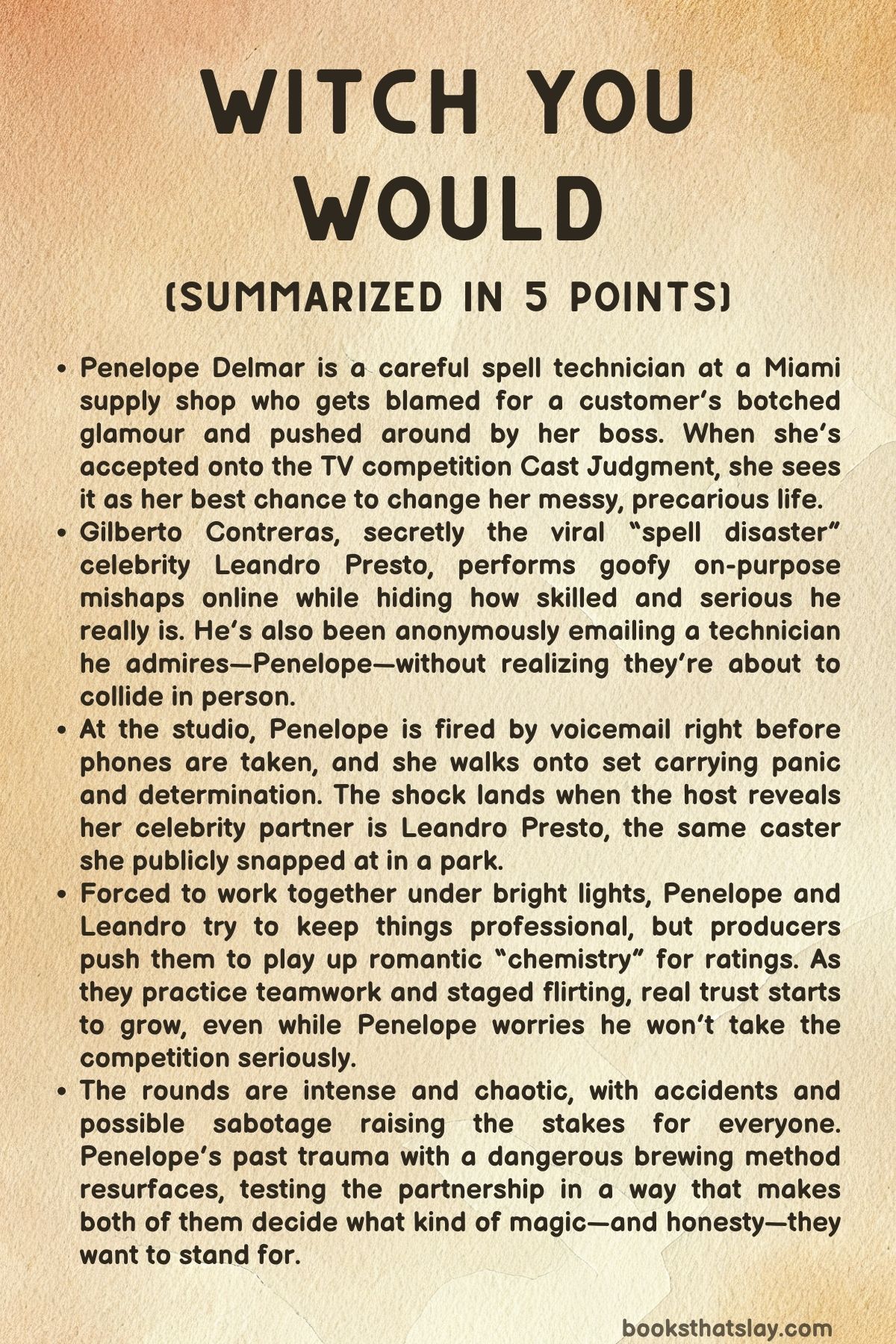
Summary
Penelope Delmar starts her day at Espinosa’s Spell Supplies dealing with an angry customer whose at-home glamour spell has gone wrong, leaving his hair shooting sparks. She quickly spots the issue: the online recipe called for a duskywing butterfly wing, a delicate ingredient that becomes unstable if cracked.
Penelope offers a fair fix, but her boss, Ofelia Espinosa, barges in, takes over, and sends Penelope away as if she can’t handle her own counter. The humiliation stings, especially because Penelope knows she did nothing wrong.
She cools off in the café next door with her best friend Rosy, who shows her a new viral video from Leandro Presto, a Jinxd celebrity famous for spells that appear to fail for laughs. Penelope can’t stand his clownish antics even while she notices the skill underneath.
She’s distracted anyway: she’s about to join Cast Judgment, the legendary televised spell-casting contest. This season’s hook is that each contestant is paired with a celebrity partner, and Penelope secretly hopes for Charlotte Sharp, the most respected artisanal caster in the country.
Because of the show’s strict nondisclosure contract, she can’t tell Rosy she’s even competing.
Back at the shop, Ofelia punishes Penelope by making her pay for the reagents to fix the customer’s spell and threatens her job if she misses work the next day. Penelope knows the threat is hollow and cruel, but she also knows this contest is her one real chance to escape her dead-end life.
She decides to go to Cast Judgment no matter what.
Across town, Gilberto Contreras prepares another episode for his channel, Mage You Look, while acting in public as his alter ego Leandro Presto—oversized thrift-store shirts, fake curled mustache, and an air of reckless comedy. The persona protects him from past stalking and lets him perform in a loud, easy way that sells online.
He’s also been exchanging emails with a thoughtful spell technician he knows only as “Doctor Witch,” and he’s quietly fallen for her. He’s too nervous to visit her shop in person, so he keeps checking his inbox instead.
Gil films a live show in a park, performing a jellyfish-in-a-jar spell that “malfunctions” on purpose in front of cheering fans. During the act, a brunette in a Frogtail T-shirt criticizes his reagent ratios and warns that copying his stunts could get people hurt.
The crowd turns on her, and she storms off furious. Gil feels awful when he learns she’s a spell technician who’s had a brutal day.
He doesn’t realize yet that the woman he embarrassed is Penelope.
The next morning Penelope arrives at the Cast Judgment studio exhausted and jittery. Right before production confiscates all phones, she gets a voicemail from Ofelia firing her and threatening to accuse her of theft.
Panicked, she texts her sister Emelia for help returning store keys through their cousin Carina. She also tries to email Gil from the shop account to warn him that she’s on the show and might be unreachable, but she’s been locked out; she sends a rushed personal email instead.
Gil’s auto-reply says he’s traveling, so she can’t confirm he saw it.
On camera the contestants are introduced and partnered with celebrities. Penelope’s hope is crushed when Charlotte Sharp is paired with another contestant, Felicia.
Then the host announces Penelope’s partner: Leandro Presto. Penelope and Gil lock eyes, stunned to recognize each other from the park.
Production forces them to redo their “first meeting” with bigger smiles, while Penelope realizes she must compete alongside the man she openly insulted.
Behind the scenes, producers push them to act friendly and hint that a romantic storyline would boost ratings. Gil and Penelope agree to play along lightly for the cameras while setting boundaries.
Penelope, desperate after being fired and facing a shaky financial future, tells Gil she needs him to take the contest seriously and not turn their work into jokes. Gil promises professionalism without revealing that his on-screen failures are staged.
In the first challenge, a celebration-themed task to create safe party lighting, Penelope freezes under pressure. Gil steadies her with humor and clear teamwork, and they design “Tempest in a Teapot,” a storm-cloud light effect using mist and gentle lightning.
Their collaboration clicks, and they survive the round after a sudden blackout disrupts the set.
In later rounds, they grow closer. Penelope builds strict schedules and checklists, while Gil quietly admires her focus and hides his true identity.
During a botanical spectacle challenge, a catalyst jar shatters across their station. Penelope assumes Gil caused it, and a fight sparks.
With time running out, they improvise, finishing a vine-wreath spell called “Miami Metamorphosis. ” The result is beautiful but flawed, and they barely advance again after another team’s disaster breaks the rules of the round.
Repeated accidents make Penelope suspect sabotage. She’s also battling fear linked to fire: as a teenager she rushed a pressure-cooked soap spell that exploded and burned her grandmother.
Gil learns about this trauma when Penelope finally admits it, and he supports her through the shame and panic. Their partnership shifts from tense to tender.
On a rest day Penelope confesses to Emelia that she’s falling for her partner and also has a long-time email crush named Gil—the same person she doesn’t yet know is sitting beside her on the show. Gil reads Penelope’s email revealing her identity and asking to meet after filming.
The knowledge that she cares for “Gil” while also falling for “Leandro” twists him up. Encouraged by his grandfather Fred, he tries to tell her the truth, but they’re interrupted.
The truth comes out anyway. Penelope overhears Gil telling his friends Sam and Ed that he is both Gilberto and Leandro, that she’s his pen pal, and that producers are pressuring him to chase fake celebrity hookups.
She runs, furious and hurt. Gil follows, explains his past stalking, and admits he hid behind Leandro out of fear.
Penelope is shaken but relieved to finally understand him. After asking for a moment to breathe, she chooses to be with him, and they begin a real relationship built on honesty rather than performance.
Just as they settle into that new trust, the show throws fresh pressure at them. Gil is offered a huge network deal for a new street-magic series in Los Angeles, with heavy travel and a push to keep his persona front and center.
He tells Penelope, and she supports him but worries about what it means for them. Trying to protect their future, Gil says they should stop the fake on-camera flirting so nothing spirals into scandal.
Penelope misunderstands, thinking he’s ending everything. She’s already drowning in stress when Charlotte’s company offers her a contract: take a job with them if she throws the finale, or face penalties if she refuses.
Feeling abandoned and desperate for stability, she signs.
Before the final challenge, Gil notices Penelope pulling away and forces a real conversation. They realize the misunderstanding, confess they love each other, and decide to be real on and off camera even if it costs them.
Penelope tells him about the contract and plans to void it. They design a finale spell called “Making Magic Together,” a top hat spectacle honoring Gil’s charity, Schools Are Magic.
Penelope sets a trap to reveal tampering, and it catches judge Doris Twist sabotaging ingredients. Production tries to bury the scandal, but the contestants keep working.
Penelope decides their spell needs something personal and brave. She chooses to face her old fear by adding a pressure-cooked memory segment of her grandmother, binding it with her own blood into the catalyst.
The finale performance is wild and luminous: classic stage illusions cascade out of the hat, transforming through animals, flowers, butterflies, cards, fireworks, and finally a mist-image of Penelope’s dancing abuela. The judges praise the ambition but say the flow isn’t as smooth as Felicia and Charlotte’s winter-wonderland spectacle.
Felicia and Charlotte win.
The sabotage scandal explodes after the finale, collapsing the production. The season is canceled, and the cast enters arbitration over compensation and promised charity funds.
Penelope lands a new job with judge Fabienne Desgraves in Miami, teaching and performing children’s spells under a playful stage name. Gil keeps Mage You Look, balances serious tutorials with comedy, and continues teaching.
Free from secrets, they date openly, plan their next steps together, and wait out the settlement knowing they’ve already made the kind of life—and love—they wanted.
Characters
Penelope Delmar
Penelope Delmar is the emotional and moral center of Witch You Would, a skilled spell technician whose quiet competence is constantly tested by anxiety, injustice, and sudden public scrutiny. From the start, she is positioned as someone who cares deeply about doing things correctly—her instinct is to troubleshoot the customer’s botched glamour by following the recipe and respecting the fragility of reagents, which shows both her technical mastery and her fairness.
Yet that same conscientiousness makes her vulnerable in a workplace where blame rolls downhill. Her arc is driven by a mix of suppressed ambition and survival panic: she wants Cast Judgment not for vanity but as a real doorway out of a dead-end job and rising rent, and that pressure shapes many of her choices.
Penelope’s defining internal conflict is between control and fear. She copes through hyper-organization—checklists, schedules, careful measurements—because her past trauma with pressure-cooking spells and the fire that injured her grandmother created a lasting association between haste, risk, and catastrophe.
That history doesn’t just explain a phobia; it explains a worldview: mistakes have consequences, and she refuses to treat magic like a toy. Her early contempt for Leandro’s clownish “failures” is therefore not snobbery so much as self-protection and ethical alarm.
Over the competition, Penelope learns to trust collaboration and improvisation without surrendering her standards. Her reconciliation with pressure-cooking in the finale is the clearest symbol of growth: she chooses risk not out of recklessness but out of love, memory, and agency, reclaiming a technique that once represented harm.
Romantically, Penelope is tender but guarded. She’s inexperienced, easily rattled by performative flirting, and slower to trust, yet she is also capable of boldness once clarity arrives—seen when she demands seriousness from her partner, then later chooses intimacy even after feeling betrayed.
By the end, her trajectory has moved from being someone pushed around by power (Ofelia, Charlotte, Isaac, even the show’s rules) to someone who can set boundaries, void exploitative contracts, and define her craft on her own terms.
Gilberto Contreras / Leandro Presto
Gilberto Contreras, who performs under the spellebrity persona Leandro Presto, embodies the book’s exploration of identity and performance. Gil is not a fraud; he is a highly competent caster with a teacher’s instincts, but he hides those instincts behind a deliberately chaotic brand.
His thrift-store costumes, fake mustache, and staged “malfunctions” are a shield built from two wounds: a past stalking incident that taught him the cost of visibility, and the pressure of internet fame that rewards spectacle over substance. That tension makes him both playful and achingly cautious.
On camera he leans into recklessness for the crowd, yet off camera he checks ratios, worries about copycat harm, and feels guilty when fans pile on a critic. His kindness is practical rather than sentimental—he cleans up messes, brings Penelope coffee the way she likes it, talks her through a panic attack with steady grounding, and consistently chooses her safety over his ego.
Gil’s arc is about learning that hiding can become another kind of dishonesty. He begins the story paralyzed by fear of meeting Penelope in person and clinging to Leandro’s mask, even while craving a real connection with the woman behind the emails.
The competition forces that collision: he can’t maintain a clean separation between “brand” and “self” once intimacy and teamwork demand honesty. His confession shows a man who understands why the mask exists but also accepts that trust means giving someone the power to see you fully.
Professionally, Gil faces a parallel temptation: Isaac and Rick offer him fame on a bigger stage if he is willing to flatten himself into a commodity and fake relationships for publicity. His refusal to prioritize that machine over authenticity marks his maturation.
In love, Gil is earnest, awkward, and surprisingly vulnerable for a public figure—his terrible pickup-line practice and self-conscious uncertainty about flirting underline how much of his confidence is performative. By the end, his persona evolves rather than dies: he keeps Mage You Look, adds serious tutorials, and finds a way to be both entertainer and educator without betraying either role, suggesting a resolved identity rather than a split one.
Ofelia Espinosa
Ofelia Espinosa functions as the book’s earliest and most personal antagonist, representing institutional exploitation hidden behind “professionalism. ” As Penelope’s boss, Ofelia uses authority not to mentor but to control—she dismisses Penelope’s correct assessment of the customer’s mistake, forces her to pay for reagents, and weaponizes time off by threatening to revoke it and fire her.
What makes Ofelia particularly sharp as a character is that she doesn’t need a grand villain backstory to be damaging; her cruelty is procedural, embedded in how she runs the shop. She embodies a workplace culture where optics matter more than truth and where loyalty is expected without reciprocity.
Ofelia’s firing voicemail is a power play meant to destabilize Penelope right before a major opportunity, and her threat to blame Penelope for missing inventory hints at a willingness to rewrite reality to protect herself. Even though she exits the main stage of the plot early, her shadow stays over Penelope’s motivation: the insecurity she creates fuels Penelope’s urge to win, and her unfairness crystallizes what Penelope refuses to become.
Ofelia is less a complexly redeemed figure than a clear portrait of petty authoritarianism, and that clarity is purposeful—she is the concrete “before” that makes Penelope’s eventual “after” meaningful.
Rosy
Rosy is Penelope’s grounding friend and an early mirror to Penelope’s inner world. She provides warmth, humor, and a slice of ordinary life in a story that quickly turns high-stakes and televised.
Rosy’s casual delight in Leandro’s Jinxd videos contrasts with Penelope’s irritation, illustrating that Penelope’s discomfort with spectacle is personal and rooted in her careful approach to magic. Rosy’s role is not to push plot mechanics forward but to keep Penelope connected to herself; she is someone Penelope can decompress with, someone who laughs with her rather than at her, and someone whose normalcy highlights how abnormal Penelope’s secret opportunity feels.
Even her ignorance of Penelope’s Cast Judgment acceptance—because of the NDA—adds texture to Penelope’s isolation. Rosy represents the safe intimacy Penelope has before fame and romance complicate everything, and that baseline helps the reader feel the cost of Penelope’s risks.
Emelia Delmar
Emelia, Penelope’s sister, is a quiet stabilizing force who expresses the family love that Penelope fears she might fail. She is supportive without being overbearing, offering practical encouragement that helps Penelope fight her spirals: she tells Penelope to stop overthinking, to trust herself, and later pushes her to communicate honestly with her partner instead of letting suspicion metastasize.
Emelia also acts as Penelope’s emergency anchor when Ofelia fires her—she immediately arranges for Carina to return the shop keys, demonstrating a family system that steps in decisively in crisis. Importantly, Emelia’s presence keeps Penelope from becoming a lone-wolf heroine; Penelope’s courage is personal, but it’s nurtured within a web of care.
When Penelope confesses complicated feelings—about hooking up with Gil/Leandro while also loving her email pen pal—Emelia doesn’t shame her; she listens, suggests trust, and lets Penelope define what she wants. That emotional nonjudgment is one of the story’s softest forms of refuge.
Carina
Carina plays a brief but meaningful role as the cousin who handles a practical crisis when Penelope can’t. By retrieving and returning the shop keys after Ofelia’s firing, Carina becomes a reminder that Penelope is not alone in navigating the fallout.
She represents the wider family network that operates off-page but matters on-page, reinforcing the theme that survival often depends on community competence rather than solo heroics.
Sam and Ed
Sam and Ed, Gil’s production partners, serve as the embodiment of platform pressure and the economics of virality. They are not villains, but they do represent a force that pulls Gil away from the kind of content and identity he values.
Their push for shorter, more viral videos over detailed tutorials highlights the tension between teaching and entertaining, between craft integrity and algorithmic incentive. They also function as Gil’s reality check and peer group; he trusts them enough to confess his relationship with Penelope and Isaac’s crude demands.
In that moment they become part of Gil’s moral recalibration, showing that he has people outside the show who can help him see exploitation clearly. Their presence frames Gil’s fame not as solitary genius but as collaborative labor, making his later decisions about authenticity feel more grounded.
Rachel
Rachel, the production manager, represents the show’s bureaucratic neutrality. She enforces rules—device confiscation, secrecy around pairings—with calm efficiency, embodying how reality television maintains control through process rather than overt cruelty.
She isn’t a character with a personal arc, but her presence helps establish the pressure-cooker environment: once Rachel takes the phones, contestants enter a sealed world where perception is curated and external support is cut off. She is part of the machinery that makes the show feel simultaneously glamorous and claustrophobic.
Syd Hart
Syd Hart, as host, functions as the polished face of Cast Judgment’s spectacle. Syd’s role is to generate theatrical stakes—announcing pairings, hyping challenges, choreographing reactions—and thereby highlight the distance between real emotion and performed emotion.
Syd isn’t cruel in the summary; instead, Syd embodies how entertainment structures govern people’s lives without needing to be personally malicious. Through Syd, the show becomes a character in its own right: a glittering system that demands smiles on cue, surprise on schedule, and vulnerability as content.
Isaac Knight
Isaac Knight is the primary structural antagonist of the competition era, a showrunner who treats human relationships as story beats. His insistence that Penelope and Gil fake romantic chemistry for drama, his manipulative “optional but encouraged” framing, and his later fury when their feelings become real reveal a worldview in which authenticity is only valuable if it can be monetized and controlled.
Isaac is charismatic in a predatory way—he can laugh with contestants, dangle career opportunities, and speak the language of “potential,” but he ultimately prioritizes ratings over safety, continuing filming even after sabotage becomes clear. His cruelty toward Penelope in the hallway, and his pressure on Gil to drop her for hotter fake hookups, shows that he doesn’t just exploit a system; he actively enjoys bending people within it.
Isaac’s function is to externalize the book’s critique of fame culture: he is the voice that says your selfhood is negotiable if the brand benefits.
Rick
Producer Rick is Isaac’s smoother counterpart, representing corporate opportunity and its hidden costs. He offers Gil a lucrative network show, framing it as a natural next step, but his interest is intertwined with the desire to blur Gil’s real identity into the Leandro brand.
Rick is less overtly cruel than Isaac and therefore more dangerous in a different way—he normalizes the erosion of boundaries as “career growth. ” His presence forces Gil to confront a future where success might require sacrificing the private, careful life he has built, making Gil’s eventual choice to keep Mage You Look and stay authentic feel like a genuine act of agency rather than a default.
Charlotte Sharp
Charlotte Sharp is an intimidating icon whose polished reputation masks deep insecurity and manipulation. To Penelope, Charlotte initially symbolizes everything she wants—artisanal prestige, mastery, a career beyond retail drudgery.
But Charlotte’s condescension on the party bus and her later contract attempting to buy Penelope’s loss reveal a person who protects her status through control rather than through generosity. Charlotte’s magic is excellent, but she uses excellence as a cudgel; paired with Felicia, she cultivates an aura of inevitability, and her offer to Penelope exploits financial desperation as a tool of obedience.
Her implied involvement in sabotage positions her as someone who cannot tolerate unpredictability in the hierarchy she benefits from. Charlotte therefore becomes a cautionary figure: a vision of success unmoored from ethics.
She is not just a rival; she is a possible future Penelope rejects.
Felicia
Felicia is a competitive foil who channels elitism and disdain. Aloof from the start, she sneers at others’ weaknesses, mocks Penelope and Gil’s team bonding, and aligns socially with Charlotte’s dominance.
Felicia’s dismissiveness helps sharpen the book’s theme that talent without humility can become cruelty. Yet Felicia isn’t purely cartoonish; she is also competent and capable of strategic alliance, which makes her a credible finalist.
Her eventual presentation victory with Charlotte underscores that systems often reward polished power pairs, even when their ethics are questionable. Felicia’s smaller moment—Penelope helping her fix a reagent mistake—also shows the difference between them: Penelope chooses generosity under pressure, while Felicia defaults to superiority.
Quentin
Quentin is one of the other contestants whose main role is to flesh out the competitive ecosystem. His presence, along with Amy and Dylan, emphasizes that Penelope and Gil are not isolated protagonists but part of a broader field of talent.
Quentin’s pairing with Tanner Byrne and his participation in the show’s rituals help portray Cast Judgment as a layered social arena, not just a two-person romance track. Even without a deep subplot in the summary, he contributes to the sense of stakes by being a capable competitor who can beat or be beaten.
Amy
Amy, paired with Jaya Kamath, adds texture to the contestant lineup and highlights the variety of caster personalities drawn to the show. She is part of the contrast that makes Penelope’s seriousness stand out: while others adapt easily to the cameras and celebrity partners, Penelope flinches under it.
Amy’s performance stability also helps show that not all contestants are spiraling; some thrive in the spectacle, which makes Penelope’s struggle feel personal rather than universal.
Dylan
Dylan, paired with Zeke Murphy, represents bold creativity and the high-risk, high-reward side of competitive casting. His team’s spectacular edible transformation sculpture sets a bar that exposes the weakness in Penelope and Gil’s second-round spell.
Dylan’s role is crucial in showing that the protagonists are not coasting on plot armor; they are genuinely outmatched at times. His participation in containing the fireball eruption also underscores the camaraderie that can surface even inside a cutthroat environment.
Jaya Kamath, Tanner Byrne, and Zeke Murphy
These celebrity partners serve primarily as structural contrasts. They show how each contestant’s fate is tied to the temperament and skill of their assigned spellebrity, raising the stakes of Penelope’s unexpected pairing with Leandro.
Their presence makes the pairing twist feel consequential rather than gimmicky: celebrities are not interchangeable props but active variables shaping the competition’s outcome.
Doris Twist
Doris Twist is the hidden saboteur whose reveal reframes the season’s chaos. As a judge, Doris occupies a trusted role, so her sabotage is not merely a personal betrayal but an institutional one, confirming Penelope’s growing suspicion that disasters were not accidental.
Doris represents corruption within supposedly objective authority, and her exposure aligns with the book’s broader critique of systems that monetize risk while denying responsibility. The fact that Isaac destroys the evidence and continues filming emphasizes how Doris is both an individual wrongdoer and a symptom of a larger machine that tolerates harm for spectacle.
Manny
Manny appears during the fireball crisis as someone who acts decisively to help, using a foam extinguisher to smother the flames. His role is brief but thematically supportive: he shows that competence and care still exist within the chaos, and that safety on set depends on individuals choosing to intervene despite pressures to keep the show rolling.
Fabienne Desgraves
Fabienne Desgraves, another judge, becomes a quiet symbol of the benevolent side of the craft world. By hiring Penelope after the show collapses, Fabienne provides the kind of professional validation Penelope has been denied, and she offers a path forward rooted in mentorship and real artistry rather than manufactured spectacle.
Fabienne’s choice to bring Penelope into her Miami studio confirms that Penelope’s value was always real, even when the competition’s outcome didn’t crown her.
Grandpa Fred
Grandpa Fred is Gil’s moral compass and emotional home base. His advice—telling Gil he can’t hide behind the alter ego forever and should trust Penelope—pins down the story’s central question about vulnerability.
He also humanizes Gil by connecting him to lineage and responsibility; Gil’s charity origin story tied to Alan Kazam gains depth through this family link. Grandpa Fred’s role emphasizes that Gil’s goodness is learned and nurtured, not accidental, and that courage sometimes means letting someone into the parts of you you’re most afraid to expose.
Themes
Identity, Performance, and the Cost of Masks
Public identity in Witch You Would is not a simple label but a daily job, negotiated in front of crowds, cameras, bosses, and comment sections. Gil lives two lives at once: a careful, private self who teaches and cares about craft, and the loud “Leandro Presto” persona designed to entertain and stay safe.
The story shows how a mask can be both protection and prison. Gil originally uses comedy to make magic accessible and to shield himself after being stalked, but the longer he stays inside that character, the harder it becomes to tell where safety ends and avoidance begins.
Penelope is also performing, even without a stage name. At Espinosa’s shop she is required to act apologetic for other people’s mistakes; on Cast Judgment she is expected to smile, flatter, and sell a storyline that isn’t hers.
In both places, performance is demanded by power structures that benefit from her silence. The competition intensifies this pressure: reaction shots are redone until they fit the show’s needs, and the fake romance plan is pitched as “optional” while clearly being a career lever.
That environment turns identity into a commodity, something edited for ratings and sponsorships.
What makes the theme sharp is that the book doesn’t frame performance as purely bad. Gil’s showmanship brings people joy, funds his charity, and builds a community.
Penelope’s ability to keep her cool on camera becomes a survival skill. The problem is control.
When production and celebrity culture insist on a specific version of a person, authenticity becomes risky. Gil fears that revealing himself will destroy his career or endanger him again; Penelope fears that being honest will cost her the only path out of precarity.
Their relationship becomes the testing ground for this theme. Penelope falls for a man she thinks is reckless, then discovers that recklessness is a crafted act.
Gil has to face the fact that hiding his truth also means manipulating her consent and emotions, even if unintentionally. The eventual confession isn’t treated as a dramatic twist for its own sake; it is an ethical reckoning about what it means to be known.
By the end, both characters learn that identity can be multiple things at once, but it cannot thrive when it is controlled by fear or by an industry that profits from distortion. The story argues that a real self is not the opposite of performance; it is what remains when you are finally allowed to choose the terms of your own presentation.
Labor, Exploitation, and the Fight for Dignity
Work in Witch You Would is shown as a place where magic and capitalism collide, and where talent doesn’t guarantee stability. Penelope’s job at Espinosa’s Spell Supplies is a clear picture of exploitation hiding behind small-business “family” rhetoric.
She is blamed for a customer’s careless casting, docked pay for ingredients she did not misuse, and threatened with loss of approved leave. Ofelia’s behavior is not only personal cruelty; it reflects a broader system where employees are treated as disposable buffers between management and public anger.
Penelope’s panic after being fired is tied less to pride and more to immediate material danger: rent hikes, loss of income, and the risk of being framed for missing inventory. This makes her decision to compete feel urgent in a grounded way.
The book keeps returning to the idea that poverty forces impossible choices, like risking public humiliation on a reality show because ordinary work offers no path forward.
The competition itself is another workplace with shinier lighting and higher stakes, but the same underlying logic. Contestants are reminded that judges can be “retired” without warning, signaling that nobody is safe.
Producers confiscate phones, control narratives, and pressure participants into fake romance for engagement. The show demands sixteen-hour days and discourages talk of sabotage because acknowledging systemic failure would threaten the brand.
Even Gil, a celebrity partner with a following, is pushed to shorten his educational content in favor of virality and is later offered a network deal that comes with instructions to market his personal life. Labor here includes emotional labor: smiling after sabotage, flirting for cameras, carrying trauma quietly so it doesn’t slow production.
The story exposes how entertainment industries extract not only skill but also vulnerability, turning private crises into consumable drama.
Importantly, the theme is not just about suffering under these conditions; it’s about reclaiming dignity. Penelope’s growth includes refusing to accept blame she doesn’t deserve, advocating for her craft, and eventually confronting Charlotte’s coercive contract.
Gil’s fight is about resisting a career path that would erase his values: the offer to blur Leandro and Gil for profit threatens his teaching, his charity’s integrity, and his chance at a real relationship. Their final choices—keeping Mage You Look serious and educational, taking a job that respects Penelope’s skill, dating openly on their terms—are framed as labor victories as much as romantic ones.
The collapse of the show after sabotage is also a kind of justice: an institution built on disposability cannot survive once the exploitation is visible. The book’s emotional payoff comes from watching two people move from being used by systems to setting boundaries against them, even when that means uncertainty.
Dignity, in this world, is not handed down by employers or producers; it is built through mutual respect, honest work, and the refusal to let survival erase self-worth.
Trust, Consent, and Repair After Betrayal
Trust in Witch You Would is treated as something built through behavior under pressure, not through easy declarations. Penelope and Gil’s partnership begins in misunderstanding and resentment: she sees him as a careless fame-chaser, and he sees her as a harsh critic who doesn’t understand the intent behind his act.
Their early teamwork forces them to read each other more carefully. Penelope’s checklists and discipline become proof of her seriousness; Gil’s behind-the-scenes competence shows he isn’t a clown in the ways that matter.
The story uses the competition structure to keep putting trust on the line. When their workspace is disrupted and a jar shatters, Penelope’s reflex is suspicion, shaped by a set already rumbling with sabotage rumors.
Gil experiences the harm of being doubted without evidence. Their reconciliation after her apology is meaningful because it recognizes how fear can distort judgment, and how accountability can reopen collaboration.
The theme deepens when the secret identity comes into play. Gil’s decision to hide that he is Leandro is understandable from a safety and career standpoint, but it creates a complicated consent problem.
Penelope has been flirting and sleeping with him while believing she knows who she’s choosing. When she overhears the truth and runs, the book doesn’t rush to excuse him or to punish her; it lets the rupture sit as real emotional injury.
Penelope’s anger is not simply about the lie, but about the power imbalance it created. He knew her identity from the start through emails, while she was left blind; he was managing the narrative while she was living inside it.
Trust breaks when information is uneven, even if the intent is protective. Gil’s explanation about his stalker past and the viral evolution of his persona adds context, but it doesn’t erase the breach.
Repair is shown as a process rather than a single grand gesture. Penelope asks for time, then returns to make her own choice of intimacy with full knowledge.
That moment re-centers her agency. Their later agreement to stop fake flirting, use boundaries, and be honest with each other keeps reinforcing that consent is ongoing.
Miscommunication still happens—Penelope mistakenly thinks Gil “dumped” her because the distinction between fake dating and real feelings had been blurred by the show. What matters is that they confront it directly, without hiding behind roles or producer scripts.
The hallway confession of love in front of the crew is a risk, but also a signal that they won’t let public narrative override private truth.
The theme also extends beyond romance into professional trust. Penelope helps Felicia despite rivalry, showing that ethical craft can matter more than winning.
Gil supports Penelope through a panic attack, and she later trusts him enough to face her fear of pressure-cooking again. These acts build a relationship where safety is earned through consistent care.
By the end, their trust is tied to transparency and shared values rather than to glamour or fame. The story suggests that betrayal is survivable when both people name the harm, respect autonomy, and choose repair over performance.
Consent and trust are not romantic accessories here; they are the backbone of both love and partnership in a world that constantly tries to script people instead of listening to them.
Trauma, Fear of Failure, and Choosing Courage Anyway
Penelope’s history with fire and pressure-cooking is one of the book’s emotional cores, and it is handled as a lived fear that shapes her body, choices, and confidence. Her trauma comes from a teenage mistake that injured her grandmother, making any rushed or high-heat brewing feel like a moral danger, not just a technical risk.
The story shows how trauma creates rules that once kept her safe but later limit her growth. When Gil suggests pressure-cooking to save time after the spill, Penelope’s reaction is immediate anger and shutdown.
She can’t afford to unpack it in the moment, so her fear appears as stubbornness. Later, when she finally explains, the memory is not framed as a neat lesson but as a source of ongoing guilt and terror.
Her panic attack after the fireball on set demonstrates that trauma is not only about the past; it flares in the present under sensory triggers and public scrutiny.
Fear of failure is tied to this trauma but also to Penelope’s economic reality. She isn’t just scared of another accident; she is scared that one mistake could ruin her life again, professionally and financially.
That fear is amplified by Cast Judgment’s environment where “disasters” keep happening and blame floats toward whoever is easiest to target. Gil has his own version of this theme.
His fear is not of fire but of exposure and harm—he carries the memory of being stalked and the risk that honesty could bring danger back. His continued use of the Leandro persona is a trauma response as much as a career choice.
Both characters are trying to manage survival in different ways, and the book respects that coping mechanisms can look messy from the outside.
Courage, then, is not presented as an absence of fear. It is the decision to act while fear is still present.
Penelope’s turning point arrives in the finale when she chooses to add a pressure-cooked memory segment. The key detail is that she does it for a personal reason, not because someone corners her into proving something.
She wants her grandmother represented, and she wants the spell to carry emotional truth. By letting her choose the method, the story makes courage an act of agency rather than a forced confrontation.
Gil’s courage shows in parallel: he refuses Isaac’s demand to fake-date for profit, admits his love publicly despite the career threat, and keeps his educational platform instead of trading it for a network package that would hollow him out.
The ending reinforces the theme by showing that bravery doesn’t produce perfection. Their final spell is criticized for cohesion; they don’t win the competition.
Trauma doesn’t vanish, and courage doesn’t guarantee reward. What changes is their relationship to fear.
Penelope discovers she can engage with her craft without being ruled by her worst memory. Gil learns he can be loved as himself without the armor of performance.
The story’s stance is quietly radical: healing is not a linear climb toward invulnerability; it is a series of choices to stay present, to trust someone safe, and to let meaning outweigh dread. In a competitive, exploitative world, that kind of courage becomes its own victory.
Ethics of Craft and Responsibility in a Culture of Virality
Magic in Witch You Would functions like any skilled practice: it can be taught, misused, sensationalized, or honored. The tension between ethical craft and viral spectacle runs through the plot from the first malfunctioning hair glamour to the staged “spell disasters” online.
Penelope represents a tradition of careful, grounded magic work—checking recipes, noticing damaged reagents, explaining consequences, and viewing casting as a responsibility to clients and community. Gil’s Leandro persona, in contrast, thrives on deliberate chaos for laughs, and the book makes sure readers see why that bothers her.
The danger is not that comedy exists, but that large audiences read performance as instruction. The brunette technician’s critique in the park points to a real issue: reckless-looking stunts can harm viewers who try to copy them without context.
Gil feels guilt because he knows she’s right. His partners want shorter, flashier content precisely because it spreads better, even if it erodes accuracy.
The story sets up virality as a force that rewards speed, shock, and simplification, often at the expense of safety and education.
This theme expands on Cast Judgment, where magic becomes a televised product. Contestants are pushed to prioritize “wow” moments over sustainable practice, and producers ignore sabotage because admitting it would disrupt the brand.
Judges critique novelty and recursion like entertainment metrics, not necessarily like community-minded standards. The book also uses sabotage to highlight ethical decay: Doris Twist tampers with spells to create drama, and Charlotte tries to buy Penelope’s loss through a coercive contract.
Both actions treat magic as a ladder to status rather than as a craft with moral weight. Penelope’s horror at these manipulations isn’t naïveté; it’s a defense of the idea that magic is relational and has consequences beyond a scoreboard.
Gil’s arc is the clearest argument for ethical responsibility inside fame. He starts out hiding behind comedy, but he never fully abandons his educator self.
After confessing to Penelope and surviving the show’s collapse, he commits to making serious how-to videos again. That choice signals a refusal to let his platform be only a joke machine.
Penelope’s ethical growth parallels his: she learns that being responsible doesn’t mean refusing all risk; it means understanding why a risk is taken and who bears the consequences. Her final pressure-cooked addition is a risk, but it is done with rigorous preparation, clear intent, and respect for what the memory means.
By the end, the theme lands on a balanced idea of craft in public life. Entertainment is not condemned; joy and showmanship are part of magic’s social role.
But popularity does not absolve responsibility. A caster with influence owes audiences honesty about what is staged, what is safe, and what is real work.
Likewise, institutions that profit from craft—shops, studios, networks—owe workers dignity and transparency, not scapegoating or manipulation. In a world where clicks and ratings can rewrite reality, Witch You Would insists that ethics are not optional extras.
They are the difference between a community built on wonder and a market built on harm.