Witchlore by Emma Hinds Summary, Characters and Themes
Witchlore by Emma Hinds is a contemporary fantasy set in a modern Britain where witchcraft is real, regulated, and quietly feared by the non-magical public. At its center is Orlando “Lando,” a nonbinary shapeshifter struggling with grief, public suspicion, and a body that never feels fully settled after a deadly accident.
When a charming transfer student, Bastian, offers a desperate solution that sounds impossible, Lando gets pulled into a plan that mixes campus life with old spellbooks, local folklore, and dangerous hope. It’s a story about accountability, identity, and what it costs to try to undo the past.
Summary
On the first morning of summer holidays, Orlando goes with his girlfriend, Elizabeth, to a hidden cave. Elizabeth is confident she can help Orlando access stronger magic, and she sets up a spell using her opal ring.
Orlando follows her instructions, pressing his right hand to the stone. Something immediately feels wrong.
A harsh, unnatural cold spreads through his hand and into his veins, locking him in place. Orlando tries to warn her, but he can’t speak.
The sensation triggers a violent, uncontrolled shapeshift, and a burst of power erupts from his body. Elizabeth believes the spell is working until the surge turns catastrophic.
In the aftermath, Elizabeth dies.
Months later, Orlando is recovering at a halfway house run by Beryl, who supports young adult witches dealing with mental health issues. Orlando has survived a suicide attempt and is living with trauma, nightmares, and the fallout of shifting without control.
His right wrist bears a healing scar, and Beryl regularly checks him for fresh self-harm. Orlando is now in a male-presenting body, wears Elizabeth’s hoop earrings, and identifies as nonbinary, though people often misread him.
He tells others he is fine, but he keeps his bedroom locked and carries guilt he can’t shake.
When term begins, Orlando returns to Demdike College in Manchester, a witchlore school with Merlin Foundation accreditation. He’s been the only shapeshifter student for years, and many classmates believe he killed Elizabeth.
He tries to keep his head down, but harassment finds him quickly. Carl Lord, a popular student with a cruel streak, publicly mocks Orlando’s suicide attempt and his shifting, reducing him to a spectacle.
Orlando also meets Bastian Chevret, a transfer student with a striking sapphire ring and an awkward, persistent kindness. Bastian recognizes Orlando from before and remembers an old name Orlando no longer uses.
Orlando bristles at the attention, refuses to shake hands near Bastian’s ring, and rejects offers of help with his injured wrist. Even so, Bastian keeps showing up with apologies instead of gossip.
Kira Tavi, Elizabeth’s best friend, is assigned as Orlando’s mandatory peer mentor. She confronts him with a file compiled from his parents and runs through questions about his mental state like a checklist.
Her tone makes Orlando feel managed instead of understood. When she mentions Orlando’s dysphoria and implies Elizabeth used to talk about it, Orlando snaps, furious that parts of his private life have become secondhand information.
At college, a memorial display for Elizabeth forces Orlando to face his grief in public. Carl escalates the cruelty, loudly implying Orlando is responsible for her death.
Orlando flees to the canal, and Bastian follows with coffee and blunt concern. In the open air, Orlando finally tells the truth: Elizabeth tried a spell in the cave to amplify his magic, but Orlando’s uncontrolled shift caused a magical discharge that knocked Elizabeth, leading to a fatal fall and brain injury.
Orlando insists he never meant to harm her, yet he knows the story sounds damning, especially because only a shapeshifter could have released that kind of power.
Bastian then reveals his own obsession: he believes there’s a permanent resurrection spell recorded in a shapeshifter grimoire, and he claims he can access it. He pitches the idea as a way to bring Elizabeth back, while also admitting it could advance his academic future.
Orlando is disgusted by the ambition layered onto grief, but desperation wins. He agrees.
They meet at the John Rylands Library, where the grimoire is displayed in an exhibition. Bastian has prepared a convincing fake by copying visible pages from photos.
The plan is theft: unlock the case, swap the book, and walk away. Orlando distracts a staff member while Bastian uses ring magic to heat the air and trigger the release.
Footsteps approach, Orlando warns him, and Bastian finishes just in time. They leave with the real book hidden in Bastian’s satchel.
Outside, Orlando spirals into fear about cameras and consequences. The stress triggers a panic attack, and Bastian unexpectedly handles it well, guiding Orlando’s breathing and getting him to his flat.
The place is a polished penthouse, full of expensive art and strangely short on obvious magical clutter. Bastian’s father, Eric, arrives briefly, dismissive and focused on careers that sound respectable.
After he leaves, Bastian admits his family history is fractured: his mother is a witchlore researcher in Cornwall, his parents are divorced, and he’s cut off from much of his extended family. A French bulldog, René, breaks the tension, and they turn to the grimoire.
The book is older than they expected, full of mundane entries alongside spellwork. The resurrection spell is there, but the next page is dark and unresponsive, and everything beyond looks blank.
When Orlando touches the dark page, it reacts warmly, almost alive, but it stays inert for Bastian. Orlando pricks a finger and presses blood onto it.
The page unlocks and hidden writing spreads through the book, revealing diary entries from a shapeshifter beginning in the late 1800s. Together, they translate the spell requirements: the name of a boggart from Boggart Hole Clough, bones of a sea-creature called a Kilgrimol, hair of the Black Shuck, earth from the lost love’s grave, the shifter’s blood, and a final act involving placing a hand on the wizard’s stone.
The blood requirement is heavy, which alarms Orlando, but Bastian pushes forward with plans.
Their first hunt takes them at night into the woods at Boggart Hole Clough, laying a trail of cheese as bait. Bastian explains boggarts as corrupted land-spirits that can be bound if you learn their name.
The creature they attract speaks in rhymes and fixates on Orlando as a “skin changer.” Bastian bargains, swearing weekly offerings on his own blood. The boggart finally gives its name: Elander.
The moment the name is spoken, Orlando is forced into another uncontrolled shift and blacks out into a vivid vision of a historical gathering under attack. When he returns to himself, the boggart charges, and Bastian blasts it back with a powerful spell.
They escape battered and furious, but they have the first ingredient.
Orlando later brings Bastian to his parents’ house and admits the larger wound beneath everything: he is adopted, and his parents pursued him because they wanted a shapeshifter child. When he couldn’t perform witchcraft or shift on command, they treated him like a failed project, experimenting on him with magical devices meant to “fix” him.
Bastian shares his own grief: his older brother Shasta died in a car accident, and the loss hollowed out his family. The two bond through the shared feeling of being loved conditionally, if at all.
As Orlando reads more of the grimoire, the diary entries begin to bleed into his dreams, leaving him with sensations and memories that don’t feel like his. A seminar at college about dangerous magical discharge brings Elizabeth’s mother, Dr. Toppings, into the building, and her hatred lands on Orlando like a verdict.
Carl provokes a confrontation, mocking Orlando’s gender and implying Bastian is attracted to him. Bastian punches Carl, and the fight turns magical.
In the chaos, Orlando’s own hand glows with shifting-light when he grabs Bastian to stop him, hinting at a strange compatibility between them.
Kira later warns Orlando that Bastian has a troubling past: he was expelled from a previous school after attempting dangerous magic, and a shifter student died. Orlando refuses to believe it until he confronts Bastian and finds evidence hidden in his flat: grave dirt from Shasta’s burial.
Bastian admits the truth. He came to Manchester not for Elizabeth, but to complete the spell to resurrect Shasta, and he previously tried it with another shifter, Cameron, who died in the attempt.
He insists it was an accident and that his feelings for Orlando became real, but Orlando feels used. He takes the collected ingredients and leaves, determined to do the ritual without him.
Kira then offers a missing piece of context: her family history includes a witch and a shapeshifter lover, and she recognizes signs that Orlando’s dreams connect to that past. Orlando admits he stole the grimoire and unlocked it with his blood.
Kira agrees to help, warning that Orlando can’t safely perform the witchcraft portion alone. They choose Samhain morning, collect dirt from Elizabeth’s grave, and return to the cave where Elizabeth died.
Using Orlando’s blood, they open a hidden chamber identified as Merlin’s cave, marked with a salt-drawn pentagram. They arrange the ingredients and begin.
The ritual turns brutal, draining Orlando fast. He collapses, close to death, and Kira panics.
Bastian arrives in time to stabilize the working, using his magic to seal Orlando’s wounds and support him through the final steps. When Orlando closes the book, he involuntarily shifts and is hit with a flood of memories.
He is not simply Orlando. He is Ariel Lander, an immortal shapeshifter who lived through suffragette struggles and world wars, loved Bisan Tavi, and was cursed by Bisan’s mother to forget his life, lose his magic, and relive only twenty-one-year lifetimes over and over.
They leave the cave alive, but Elizabeth does not return. Kira explains the truth: the “resurrection” spell was created by her ancestor Samir Tavi not to revive the dead, but to undo the curse and restore Ariel’s memories, locked specifically to Ariel’s blood.
With the curse broken, Orlando will no longer die at twenty-one and restart. The future is finally his to keep.
Orlando and Kira reconcile, and Kira makes it clear Elizabeth’s death cannot be undone and was never Orlando’s intention. Orlando accepts the grief instead of trying to bargain with it, letting go of what he hoped the spell would fix.
He and Bastian face the harm caused by secrecy and obsession, then choose honesty. When they test Orlando’s returned magic by animating a paper crane together, their shared power feels real and steady.
Bastian admits he loves Orlando and wants a life with him, and Orlando returns the feeling, embracing his shifting and his self without needing to be repaired.
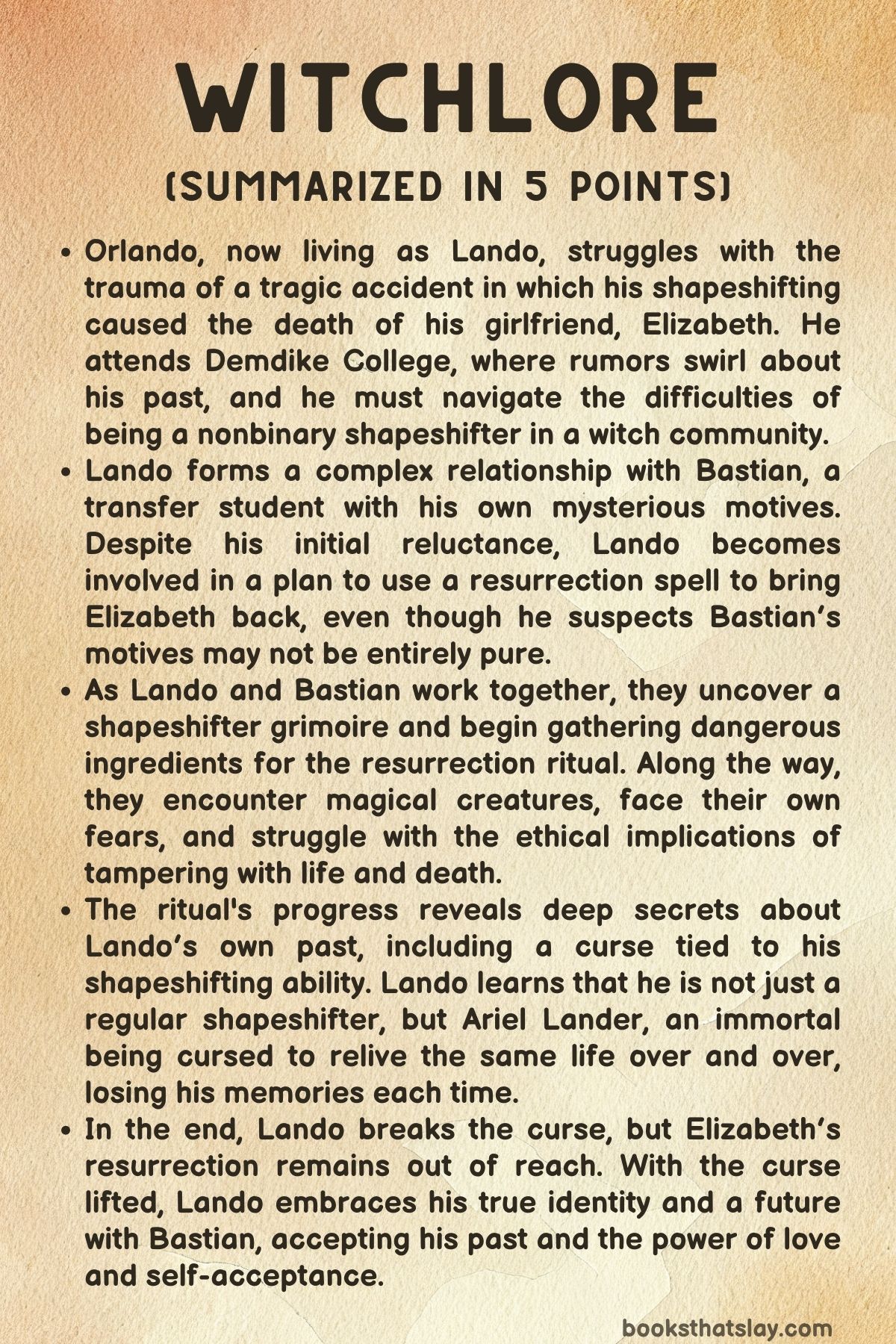
Characters
Orlando (Lando)
Orlando, who later identifies as Lando, is a deeply complex and troubled character, marked by a past steeped in both trauma and self-discovery. Initially presented as a nonbinary shapeshifter, Orlando’s journey is about reclaiming their identity after a tragic accident that resulted in the death of their girlfriend, Elizabeth.
The emotional weight of her death and Orlando’s own physical and mental scars from the incident haunt them throughout the narrative. They are forced to grapple with their past, their magical abilities, and the suffocating expectations placed upon them by their adoptive parents.
Orlando is initially distant, keeping others at arm’s length, but their interactions with Bastian reveal a deeply sensitive and conflicted soul. Their shifting abilities are a source of pain and isolation, making them reluctant to embrace their true self.
Over the course of the story, Orlando transforms—finding solace in Bastian’s companionship, reclaiming their magic, and ultimately reconciling with their identity. The tragic loss of Elizabeth and the overwhelming weight of their grief serve as catalysts for Orlando’s growth, pushing them to confront the darkness in their past and embrace the possibility of a future where they can be truly themselves.
Bastian Chevret
Bastian Chevret is a character whose motivations are driven by grief and a desire for redemption. His backstory is one of loss, with the death of his brother, Shasta, two years prior, causing a rift in his family and pushing him to seek dangerous means to bring Shasta back.
Bastian’s relationship with Orlando begins on a somewhat manipulative note as he initially presents himself as someone who can help Orlando resurrect Elizabeth, all while harboring personal ambitions tied to his academic future. However, as the story progresses, Bastian reveals more of his vulnerability, especially when it comes to his fractured family life and his deep emotional attachment to Orlando.
Bastian’s actions are often driven by a blend of personal desires and guilt, leading him to make questionable decisions, such as his previous attempts to use the resurrection spell with another student, Cameron. Despite these mistakes, Bastian’s feelings for Orlando become genuine, and his motivations shift from ambition to a sincere desire to support Orlando.
Bastian’s complexity lies in the tension between his desire to fix the past and his growing love for Orlando, culminating in a transformative arc where he learns to embrace truth, vulnerability, and a future that doesn’t rely on resurrecting the dead.
Elizabeth Toppings
Elizabeth is a pivotal yet tragically absent character in Witchlore. Although she is no longer alive by the time the story begins, her presence looms large throughout Orlando’s journey.
Elizabeth’s death is the catalyst for Orlando’s transformation and the central emotional conflict of the narrative. As Orlando’s girlfriend and confidant, Elizabeth’s relationship with him was marked by an intense bond, one that was cut short when an ill-fated magical experiment went awry.
Elizabeth’s death is shrouded in complexity, with Orlando holding the burden of guilt, though they never intended to harm her. Her role in the story is less about her actions and more about the way she shaped Orlando’s life and decisions.
Elizabeth’s importance lies in how she represents Orlando’s past—a past that Orlando must come to terms with in order to move forward. Though she is not physically present in the story, Elizabeth’s influence is felt in every interaction Orlando has, particularly with Bastian, as their shared history of grief and loss brings Orlando closer to understanding their own needs and desires.
Kira Tavi
Kira Tavi, a peer mentor assigned to Orlando, is a character driven by a desire to protect and understand, though her approach is often intrusive and filled with an air of judgment. Initially, she appears as a figure of authority who is more concerned with checking off boxes and probing Orlando’s emotional and mental state than with offering genuine support.
However, as the narrative unfolds, Kira’s motivations become clearer: she is deeply affected by the death of her best friend, Elizabeth, and her interest in Orlando stems partly from her lingering grief. Her knowledge of witchcraft and her family’s history with shapeshifters add an additional layer of complexity to her role.
Kira’s insistence on the truth about Bastian’s past and the dangerous magic he has used is a key turning point in the story, forcing Orlando to confront not just their own emotions but also the darker aspects of their companions’ pasts. Despite their differences, Kira and Orlando find common ground in their shared trauma, and by the end of the story, Kira becomes a source of support rather than opposition.
Her role in the ritual and her willingness to help Orlando in the most dangerous of circumstances signify her evolution from a figure of judgment to one of true friendship.
Carl Lord
Carl Lord serves as a foil to Orlando throughout the story, embodying the cruelty and judgment that Orlando feels from the world. A popular and openly hostile student at Demdike College, Carl constantly taunts Orlando about their past, particularly the death of Elizabeth and Orlando’s status as a shapeshifter.
Carl’s character is one-dimensional in many respects, as he represents the societal rejection that Orlando fears. His mockery and use of magic to belittle Orlando are a source of immense pain, but they also push Orlando to confront their own fears and insecurities.
Carl’s behavior is driven by a need to assert dominance and power, often at the expense of those more vulnerable than him. His cruelty is not just limited to Orlando, as he uses his influence to manipulate others, including his boyfriend, who later stands up to Carl after Orlando exposes his abusive behavior.
While Carl’s role is antagonistic, his presence in the story highlights the struggles that Orlando faces with self-acceptance and societal rejection. His eventual downfall, when confronted by Orlando, is a moment of personal triumph for Orlando, symbolizing their growth and the reclaiming of their narrative.
Eric Chevret
Eric Chevret, Bastian’s father, plays a relatively small but significant role in the story. A man marked by disappointment and detachment, Eric’s relationship with Bastian is strained, particularly after the death of Bastian’s brother, Shasta.
Eric’s treatment of Bastian reflects the emotional distance that has formed between them, with Eric focusing more on career and practicality than on emotional connection. His attitude toward Orlando is dismissive, further emphasizing the sense of alienation and isolation that both Bastian and Orlando feel in their respective family dynamics.
Eric’s presence in the narrative is a reminder of the ways in which family can shape one’s identity, often in ways that lead to feelings of inadequacy and the desire to escape. Bastian’s strained relationship with his father is a crucial part of his character arc, highlighting his struggle to reconcile the past with his present desires.
Themes
Grief and Loss
Grief is a powerful and central theme in Witchlore. The trauma of loss pervades Orlando’s journey, beginning with the death of Elizabeth, his close companion and lover, who dies as a result of a failed spell.
The grief is not only about Elizabeth’s death but also the guilt Orlando feels for being involved in the accident that led to it. This grief manifests in Orlando’s depression, his feelings of being an outcast, and his struggle with identity.
He is haunted by the memory of Elizabeth’s death and feels responsible, even though the accident was not intentional. Orlando’s grief is compounded by the lack of support from his adoptive parents, who view him as a mere tool for their ambitions in shaping him into a powerful shapeshifter, rather than as an individual with emotional needs.
This sense of isolation makes Orlando’s grief even more pronounced, as he lacks the emotional safety net that could have helped him process his loss.
The theme of loss also extends to Bastian, who is driven by the grief of his brother Shasta’s death. His decision to pursue dangerous magic in an attempt to bring Shasta back to life stems from the same kind of emotional turmoil that Orlando experiences.
Bastian’s grief is complicated by the failure of his family to understand his connection to witchcraft, further deepening his sense of alienation. Both Orlando and Bastian grapple with how to move forward after a deep loss, yet their responses are different.
Orlando, after many months of pain, is gradually starting to come to terms with Elizabeth’s death by the novel’s end, whereas Bastian continues to pursue resurrection even at the risk of his own safety. This ongoing struggle with grief drives much of the emotional conflict in the novel, highlighting how loss can push individuals to extremes and influence their decisions in profound ways.
Identity and Self-Acceptance
The theme of identity plays a crucial role in Witchlore, particularly in Orlando’s journey towards self-acceptance. As Orlando navigates life after his shift into a male-presenting body, they also grapple with their nonbinary identity, feeling both estranged from their past self and unsure of how to move forward.
Orlando’s struggle with their identity is compounded by the constant external pressure from their adoptive parents and society to conform to predefined norms, especially in a world where magic and shapeshifting complicate the notion of fixed identity. The transformation Orlando experiences, both physically and emotionally, challenges their understanding of who they are, leading to moments of self-doubt and frustration.
Throughout the novel, Orlando’s evolving sense of self is mirrored by their relationship with Bastian, who also has his own struggles with identity, though his are rooted in his family’s rejection of witchcraft and his failure to reconcile with his past. Bastian’s initial desire to use the resurrection spell to undo his own past mistakes becomes an expression of his own internal conflict—he is trying to bring back the version of his life that he lost when his brother died, but in doing so, he risks repeating past mistakes.
The interplay between Orlando’s search for identity and Bastian’s personal battles with his past serves to underscore the complexity of self-acceptance, particularly when the individual is caught between societal expectations and their own desires.
In the context of magic, identity takes on an even deeper meaning. The use of spells, particularly the resurrection spell, forces Orlando and Bastian to confront who they are at their core.
For Orlando, this is further complicated by the ability to shift forms, making it difficult to reconcile their internal sense of self with the external changes that occur through magic. Ultimately, Orlando’s journey becomes not just about coming to terms with the loss of Elizabeth but also about embracing their nonbinary identity and finding a sense of inner peace that transcends external labels.
Power and Control
The theme of power and control is intricately explored in Witchlore, where magic is a tool that can be both a source of immense strength and devastating destruction. Orlando’s early experiences with magic, particularly the violent and uncontrollable shift that leads to Elizabeth’s death, highlight the dangers of having power without control.
This theme is mirrored throughout the story as Orlando grapples with the consequences of being a shapeshifter—someone with the ability to change forms but also someone who can lose control over their own body and magic. The inherent danger of power, particularly when it is not fully understood or harnessed, is a driving force behind Orlando’s emotional and physical struggles.
Bastian, too, struggles with power, particularly his use of magic to manipulate the resurrection spell. His belief that he can control the magic to bring back his brother Shasta reflects the theme of wanting to harness power to reverse the past, but it also speaks to the dangers of playing with forces beyond one’s understanding.
Throughout the novel, the characters’ pursuit of power—whether it is to alter their circumstances, resurrect the dead, or heal themselves—demonstrates the fine line between control and chaos. The exploration of power in Witchlore serves as a reminder of the consequences of attempting to wield too much control over forces that are inherently unpredictable, especially when driven by emotions like grief or guilt.
In the end, the characters learn that true power does not come from trying to control everything, but from accepting what cannot be changed and finding a way to live with the consequences of their actions. The eventual acceptance of Orlando’s identity and the dismantling of Bastian’s desire to resurrect his brother both serve as acknowledgments that power must be tempered with humility and respect for the forces at play.
Consequences and Redemption
The theme of consequences and redemption is central to the emotional arc of Witchlore. The novel explores the idea that every action has consequences, especially when dealing with powerful and uncontrollable forces like magic.
Orlando’s role in Elizabeth’s death serves as a constant reminder that the consequences of one’s actions can never be fully escaped. Orlando’s journey is one of redemption, though not in the traditional sense of seeking to undo past wrongs.
Instead, Orlando’s path to redemption involves accepting responsibility for the role they played in Elizabeth’s death and learning to live with the consequences of that event. Their eventual acceptance that they cannot bring Elizabeth back represents a form of personal redemption, where healing comes not from reversing the past but from understanding and embracing it.
Bastian’s story also reflects a quest for redemption, albeit in a different form. His use of magic to resurrect Shasta and the subsequent death of Cameron Mackay highlight the tragic consequences of pursuing power without fully understanding its implications.
His redemption arc is intertwined with Orlando’s, as both characters learn that the pursuit of redemption must be tempered by an understanding of the limits of their control over the past. In the end, Bastian’s realization that he cannot undo the past, much like Orlando’s acceptance of Elizabeth’s death, marks a key moment of emotional growth and maturity.
The ultimate redemption for both characters comes not from achieving their magical goals but from recognizing that their actions have consequences, and that true healing comes from accepting responsibility and moving forward with integrity.