Women of a Promiscuous Nature Summary, Characters and Themes
Women of a Promiscuous Nature by Donna Everhart is a historical novel set in North Carolina during the early 1930s and then the wartime early 1940s, when “reform” institutions and public-health crackdowns gave authorities wide power over girls and women. The story centers on Dorothy Baker, a superintendent whose strict control is shaped by fear and ambition, and on two young women caught in the system: Stella Temple, a poor teenager trying to survive her home, and Ruth Foster, a working woman hauled in under the banner of public safety.
Their lives collide inside the State Industrial Farm Colony for Women, where rules, labor, and medical authority decide what freedom looks like.
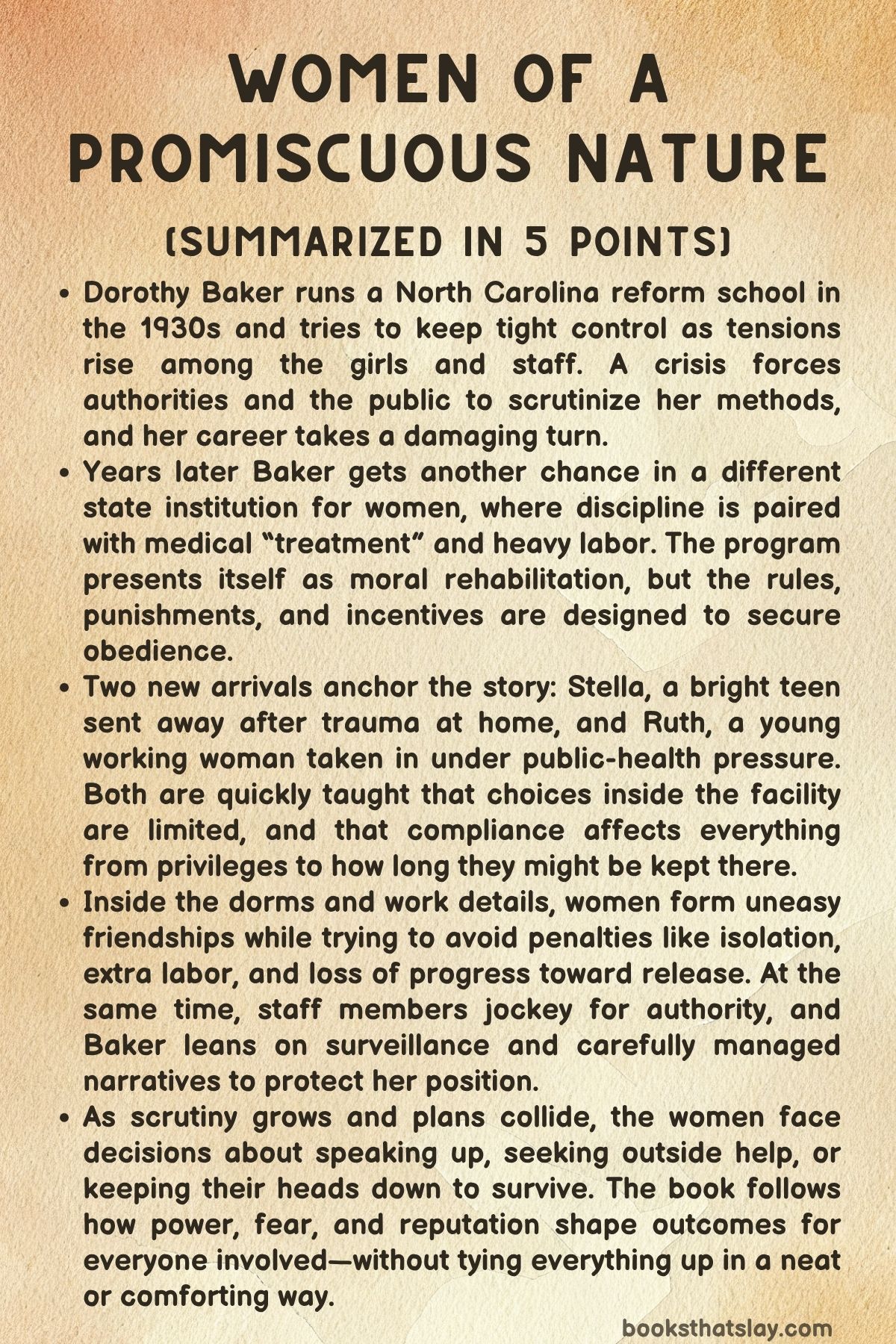
Summary
Dorothy Baker runs Samarcand Manor, a reform school in Eagle Springs, North Carolina, in 1931. She prides herself on order and results, even as staff complaints reach her about harsh discipline: girls locked away, whipped, denied meals, and worked until they drop.
When Baker finds matches, newspapers, and lighter fluid hidden in a closet, she reads it as a threat. She lines the girls up, questions them, and presses for a confession, but no one gives her what she wants.
That night, the threat becomes real. Chamberlain Hall catches fire, and the blaze spreads fast.
Baker, shaken and exposed by the scars on her legs from an old childhood accident, tries to keep control while the staff waits for firetrucks that are far away. When she demands to know who did it, more than a dozen girls step forward at once, including Millie Wilson, who had denied everything earlier.
They say plainly why they did it: they were tired of being treated like animals, tired of pain used as punishment, tired of being trapped. The sheriff arrests the confessing girls.
As newspapers and letters circulate, the institution becomes a public scandal. The board removes Baker and replaces her, and Baker returns home in disgrace to care for her sick mother.
Her professional identity collapses, and she clings to the idea that she was enforcing necessary discipline, not cruelty.
Years pass. Baker’s mother dies, and Baker’s life narrows further.
Then a friend offers her an opening that sounds like redemption: superintendent of the State Industrial Farm Colony for Women in Kinston. Baker takes the job, certain she can succeed if she is smarter, firmer, and more careful than she was at Samarcand.
In 1941, the Colony fills with women pulled in by poverty, rumor, and authority. Fifteen-year-old Stella Temple lives in Deep Creek with almost no protection.
Her mother, Alice, is mentally unwell and often absent from reality; her father, Cordell, works but drifts into violence at home. Stella is bright and loves school, but she is hungry, lonely, and shamed by other students.
At night, Cordell begins lingering in her doorway, then assaults her repeatedly. Stella endures in silence until she becomes pregnant.
When Alice discovers it, she blames Stella, calling her immoral. Cordell insists on taking her to a doctor to “fix” the problem.
The doctor treats Stella like an object to be corrected. With Cordell’s approval, Stella is transferred to the Colony, believing she is going there for a procedure that will let her restart her life far from home.
Stella undergoes surgery under anesthesia and hears hints of “alteration.” When she wakes, she is in a plain recovery room. Soon she is put into a brown uniform and told she is “good as new.” She meets Dorothy Baker during intake, where Baker lays out the world Stella has entered: strict schedules, rulebooks, demerits, and punishments.
Baker presents the Colony as a place that improves women, but her focus is control, compliance, and protecting her own position.
Around the same time, Ruth Foster, twenty-four and working in La Grange, is stopped by Sheriff Luther Wright on her way to work. He claims she must be taken for a health exam “for public safety.” When she resists, he threatens arrest.
Ruth is examined at a public health office, humiliated, and told she has syphilis. Dr. Tyndall gives her a choice designed to trap her either way: go to the Colony for treatment, or be quarantined at home with a public sign that will ruin her and shame her mother.
Ruth agrees to go, not because she believes the diagnosis, but because she cannot survive the stigma.
At the Colony, Ruth tries to leave immediately. Baker warns her that running will make everything worse.
Ruth runs anyway. Baker initiates “Code R” for runners, and the sheriff returns with Ruth in handcuffs.
Baker then orders Ruth into the basement meditation room—solitary confinement meant to break resistance. Ruth is locked in a dark, damp, filthy space with almost no comfort and no clear sense of time beyond the meal trays slid through the door.
She begs to write her mother. No one answers.
She counts days, clinging to Baker’s mention of “seven,” only to discover that the end of the seventh day changes nothing.
On the eighth morning, the food suddenly improves, and Baker appears to demand a new story from Ruth: meditation is not punishment, it is “purification.” Ruth understands the bargain. If she repeats the language Baker wants, she can leave the basement.
Ruth gives in, says what Baker requires, and is moved to quarantine instead. Quarantine is still confinement, but it has a window, a bath, and clean clothes—proof that even small comforts are treated as rewards.
Ruth is examined by Dr. Graham and begins injections that make her ill and weak. She learns the drugs used include Neosalvarsan and mercury.
She asks why men are not treated the same way. Nurse Crawford avoids the question.
Baker promises Ruth that obedience and coursework can lead to parole, but offers no clear timeline. Ruth’s letters home are censored.
When she writes honestly, Nurse Crawford makes her tear it up and replace it with a harmless note.
Stella is moved into the main dormitory and assigned labor. The dorm is a long ward lined with beds, watched and managed by Mrs. Maynard.
Stella is put to work in the laundry under Lucy Griffin, an experienced inmate who runs the place with harsh precision. Lucy talks openly about her past and mocks Baker’s authority.
Stella is exhausted by the endless cycle of washing, sorting, wringing, and hanging. Yet Stella’s intelligence stands out.
She memorizes the rules and recites them flawlessly, which does not earn Baker’s warmth so much as her interest.
Baker recruits Stella for a secret task: to watch other inmates, listen for plans, note rule-breaking, and report. Baker frames it as a privilege and hints it could shorten Stella’s time.
The offer carries an unspoken threat—refusal will make Stella’s situation worse. Stella agrees, wanting any advantage that might keep her from being sent back home.
Ruth eventually joins Building A under Mrs. Maynard and learns the daily machinery of the Colony: indoor labor, outdoor fieldwork, and vocational classes used as carrots for parole. The women speak of being “Bakered” when discipline turns cruel.
Ruth befriends Josephine and hears how easily women are swept in under accusations that would never be tested in court. She watches the long-term effects on inmates—dullness, swelling, hair loss, loose teeth, vacant stares—and worries what the drugs and years might do to her.
Escape attempts show the cost of defiance. A woman nicknamed Freaky Frances tries to cross the barbed-wire ditch called the Clap Trap, gets tangled, and disappears for weeks.
When she returns, she is changed—quieter, emptied out. The message is clear: the institution can remove a person’s will.
Stella takes her informant role seriously, keeping a notebook of what she hears. She reports a brewing dining-hall fight, and staff intervene.
She grows closer to Baker, who begins treating her like a chosen project. Baker pressures both Stella and Ruth to write letters praising the Colony.
Ruth refuses. Stella complies eagerly, writing that she feels safe and helped.
Baker rewards Stella with small privileges and new duties, including tutoring Frances Platt, a resident treated as mentally deficient.
When Ruth does not produce her praise letter, Baker retaliates. Ruth is forced into new testing, thrown back into quarantine, and told her time credit is erased—she is reset to “Day One.” While waiting for results, she is assigned punishing work varnishing floors, inhaling fumes and scrubbing on raw knees.
Mrs. Maynard adds humiliations. Ruth learns that in this place, time is a weapon, and progress can be erased with a signature.
Stella’s tutoring assignment turns strange. Frances Platt seems vacant, then suddenly reveals she understands far more than anyone claims.
She threatens Stella into silence. A page of writing appears—rows of letters—suggesting Frances is not what the staff believes.
Mrs. Maynard accuses Stella of faking it, and Baker’s trust wavers. The power struggle between Baker and Maynard becomes open.
Baker hears that the board is considering changes in leadership at the Colony, and her fear of being removed returns.
Ruth’s situation shifts when Lucy’s outside friend, Stanley Newell, appears near the toolshed. He says Lucy sent him and asks Ruth to tell him what is happening inside.
He explains that wartime “social hygiene” efforts give officials broad authority to confine women suspected of disease near military bases, framed as national security. Stanley looks for legal options and asks if Ruth would go to court.
Ruth agrees, even though she knows how stacked the system is.
Stella’s own truth finally hits. She notices she has not had her monthly cycle since arriving and panics that something is wrong.
When she tries to reach Nurse Crawford, Baker intercepts her and, instead of offering care, explains the decision that has already been made about Stella’s body. Stella’s local doctor and her parents approved “extra measures” to prevent future pregnancies.
Stella has been sterilized. The loss is immediate and permanent.
Stella is furious and devastated, but Baker frames it as protection and a “new start,” insisting Stella would have been harmed again at home. Stella, trapped between a dangerous home and a controlled institution, clings to the only stability she can see: staying near Baker.
The board arrives for an inspection led by Dr. Woodall. Complaints include Baker’s conflict with staff and the severity of isolation punishments.
Baker expects to be fired. Instead, Woodall keeps her as superintendent but places her on probation and promotes Mrs. Maynard to assistant superintendent with new authority.
Baker’s power is reduced, and she becomes more desperate to control the narrative.
Then the institution repeats its own history. Frances Platt begins sneaking out at night, and soon a fire erupts—Dorm A burns.
Roll call reveals two missing: Dorothy Baker and Frances. Baker reaches the grounds and recognizes the signs of deliberate arson.
She sees Frances with a gasoline can and realizes Frances set the blaze. Frances tells Baker to pass a message to Stella and disappears.
Stella drags Baker to safety as crews arrive.
In the aftermath, Baker performs competence: organizing food and shelter, turning classrooms into sleeping areas, and calling Dr. Woodall. With housing destroyed, women are discharged.
Baker uses the crisis as her exit plan. She contacts Winnifred DeLong, who offers her a position at a facility in Chalkville, Alabama, and agrees Baker can bring her “niece.” Baker decides to take Stella with her, both to save Stella from being sent home and to keep her own chosen companion close.
Before dawn, Baker and Stella leave by train and arrive at the new facility, where they are admitted under the cover story Baker has built.
Ruth is released and returns to her mother, carrying the aftermath in her body and in the way people look at her. Stanley tells her he found a similar court case that failed, and he also uncovers news about the earlier Samarcand fire and how that ended.
Ruth understands how long the system has been protected by law, shame, and official language. Still, she refuses to let the story be controlled by the institution.
While rumors paint Baker as a hero after the Dorm A fire, Ruth writes her own account and mails it to the newspaper, choosing to speak plainly about what happened and to move forward with her life on her own terms.
Characters
Dorothy Baker
Dorothy Baker is the novel’s central engine of control and contradiction, a woman who sincerely believes she is serving a moral and civic good while repeatedly choosing cruelty, coercion, and image-management over human care. In Women of a Promiscuous Nature, she is introduced as a disciplined superintendent whose calm exterior masks vigilance and paranoia; the hidden arson materials trigger not only professional alarm but also a deep personal terror rooted in “The Incident,” the childhood fire that left her scarred and physically vulnerable.
That private vulnerability becomes one of her most telling traits: she hides it, manages it, and uses authority to ensure no one can truly see her, which mirrors how she treats the women in her custody—objects to be managed rather than people to be understood. After Samarcand burns and she’s removed, Baker’s bitterness hardens into a more sophisticated form of institutional manipulation at the Colony: she learns to maintain plausible righteousness while enforcing compliance through isolation, medical intimidation, and bureaucratic rituals like “Day One” resets.
Her pattern is consistent—she reframes coercion as reform, calls punishment “purification,” and converts public scrutiny into a performance of order. Yet Baker is not written as a simple monster; her need for a second chance and her fear of losing power are profoundly human, even as they lead her to rationalize sterilization, blackmail letters, and psychological breaking.
Her relationship with Stella reveals her most dangerous capacity: she can offer tenderness and mentorship, but only when it serves loyalty and control, turning intimacy into another tool of governance.
Millie Wilson
Millie Wilson functions as an early emblem of open defiance and collective rage, a girl who refuses to give Baker the confession she wants and then later steps forward with a smirk when the fires begin, as if daring the institution to finally acknowledge what it has created. Her presence highlights the gap between Baker’s self-image as a reformer and the girls’ lived reality of punishments, hunger, and humiliation.
Millie’s boldness is important because it refuses the story of individual “bad behavior” and instead frames rebellion as political protest: she and the others articulate that the fire is a response to being treated “worse than dogs.” Even in the limited view provided in the summary, Millie reads as someone who understands power dynamics early—she knows fear is the institution’s currency, and her smirk suggests a moment where that currency has flipped. She is less a fully individualized portrait than a sharp, memorable representation of the kind of resistance Baker cannot psychologically tolerate: defiance that does not ask to be forgiven.
Sandra Haynes
Sandra Haynes appears alongside Millie as one of the two fourteen-year-olds who were whipped for running away, and she helps establish the culture of sanctioned violence inside Samarcand—punishment administered not just by staff but by other residents, normalized as “deterrence.” Sandra’s significance lies in how her situation reveals institutional design: when children are made to punish children, authority becomes diffuse and deniable, and cruelty can be described as routine rather than scandalous. Even though Sandra’s inner life isn’t explored at length in the summary, her inclusion signals how the system produces desperation and flight, then uses the attempted escape to justify greater harshness.
Sandra represents the kind of girl Baker claims to “correct,” yet the methods used on her underline that the institution is far more committed to obedience than to care.
Mrs. Libby
Mrs. Libby is one of the most socially astute figures early on, and her key role is that she understands reputations are survival. In the fire chaos, she protects Baker from the girls seeing her burn scars, a gesture that looks compassionate but also serves the institution’s hierarchy: if Baker appears physically weakened, her authority could crack.
Later, Libby “turns” on Baker as outrage rises, and that pivot reads less like moral awakening and more like self-preservation in a system where proximity to power is safety until it becomes liability. She embodies the staff member who knows how to read the wind, and she exposes a bleak institutional truth: loyalty is conditional, and righteousness is often retrospective.
Her arc reinforces that Baker is not undone only by inmates; she is undone by the staff ecosystem that enables her until it must scapegoat her.
Ed
Ed, Baker’s ex-husband, appears mostly through Baker’s reflection, yet his absence is meaningful because it frames what Baker gave up—or lost—in pursuit of professional identity. Baker’s thought that not having children is “a grim blessing” reveals a core psychological thread: she interprets life through duty, control, and prevention of vulnerability.
Whether the marriage failed because of Baker’s temperament, social pressures, or other reasons, Ed’s presence in memory highlights Baker’s isolation and hints that her need to dominate institutions may compensate for personal emptiness. He is less a character who acts and more a mirror that makes Baker’s emotional austerity visible.
Eloise Belle
Eloise Belle functions as Baker’s bridge back into power, and her significance is how she demonstrates the social networks that protect authority figures even after scandal. By defending Baker’s role in the Samarcand fire and smoothing her path to the superintendent role at the Colony, Eloise is effectively an enabler of Baker’s second act.
At the same time, she is not depicted as malicious; she seems to believe in Baker’s competence or at least in the idea that Baker deserves redemption. Eloise represents how institutions recycle leaders, especially when the surrounding culture prioritizes order and propriety over accountability, and her invitation to lunch becomes a quiet hinge on which many later abuses turn.
Stella Temple
Stella Temple is the emotional heart of Women of a Promiscuous Nature and one of its most complex studies of survival under coercion. She begins as a neglected, intelligent girl who clings to learning as her only stable refuge, and her isolation at school parallels her isolation at home, where her father’s predation and her mother’s instability make “family” feel like a trap.
Stella’s pregnancy is treated by the adults around her as proof of her immorality rather than evidence of violence, and that social reflex teaches Stella a devastating lesson: truth does not protect you when power wants you silent. At the Colony, Stella’s sharp mind becomes both protection and vulnerability; she memorizes rules, performs obedience, and is lured into becoming an informant because it offers what she has never had—attention, safety, and a path away from home.
The tragedy is that her “choice” to cooperate is shaped by threats and incentives, and her reward is betrayal at the level of her body: sterilization framed as a “new beginning.” Stella’s later reactions—devastation, rage, then a pressured surrender to Baker’s logic—show how trauma can compress a person into accepting the unacceptable as long as it postpones returning to worse danger. Stella’s arc is not a straight line from victim to hero; she becomes implicated in harm, too, as her longing for protection and status helps Baker manage the population.
Yet Stella also retains a moral pulse: her horror at sterilization, her fear of what the system does to women, and her eventual involvement in the chaos around the final fire all underline how unstable her manufactured loyalty is. She ends as someone still searching for agency in a world that keeps redefining her body and future without consent.
Alice Temple
Alice Temple is depicted as mentally unwell, bedridden, and unable to protect her daughter, and she represents a particular kind of tragedy: the parent whose incapacity becomes an accomplice to harm, not by intent but by absence. Her discovery of Stella’s pregnancy becomes an accusation of immorality, which shows how deeply shame and patriarchal narratives have colonized her thinking; instead of recognizing signs of assault, she reinforces the social script that blames girls.
Alice is not portrayed as a villain so much as a person broken by poverty, illness, and limited social understanding, and her presence underscores how systems of abuse often rely on the silence or incapacity of bystanders inside the home.
Cordell Temple
Cordell Temple is one of the clearest embodiments of predatory power in the story: a father who moves from ominous presence in the doorway to repeated assault, then attempts to “manage” the consequences by taking Stella to a doctor to erase the pregnancy. He weaponizes both paternal authority and social credibility, knowing that institutions will more readily treat him as a responsible guardian than Stella as a truthful child.
Cordell’s cruelty is amplified by how effectively it blends with respectability; he is a working man at a mill, not an outsider, and that normalcy is precisely what allows him to act with impunity. His role makes the institutional critique sharper: the state intervenes aggressively in Stella’s life, but not to punish the man harming her—rather to control the girl’s sexuality and reproduction.
Mrs. Todd
Mrs. Todd, the caseworker who transports Stella, represents the bureaucratic face of “help” that is indistinguishable from removal and containment. She is not shown as physically cruel, yet her function is to move Stella from one controlling environment to another, and Stella’s hope that the pregnancy removal will let her “start over” shows how thoroughly the system sells confinement as rescue.
Todd’s role illustrates how coercion often arrives with polite language, paperwork, and a car ride rather than overt violence, which can make it harder for victims to even name what is happening to them.
Dr. Tyndall
Dr. Tyndall embodies the medical authority that legitimizes moral judgment with clinical vocabulary. His declaration that Ruth is “salvageable” and can be “fixed” shows how medicine is being used not just to treat disease but to classify women’s worth and enforce conformity.
He positions himself as an expert while reducing Ruth to a social hazard, and his power is multiplied by the fact that the state and law enforcement treat his judgment as sufficient for confinement. Tyndall’s role is crucial because it demonstrates how a diagnosis—accurate or not—becomes a gate that closes behind a woman, turning her body into evidence against her.
Ruth Foster
Ruth Foster is the story’s clearest lens on unjust confinement and the psychological warfare of “reform.” She begins as a working young woman with responsibilities—job, rent, mother—who is abruptly kidnapped into bureaucracy through a sheriff’s threat and a humiliating exam. Ruth’s defining quality is her insistence on reality: she keeps returning to the facts of what happened, refusing to accept the narrative that she is there “for public safety” or by choice.
That insistence makes her dangerous to Baker, because Ruth’s clarity punctures institutional theater, which is why Ruth is immediately punished with “meditation,” designed to break her timeline, her dignity, and her sense of self. Ruth’s inner resistance evolves from explosive defiance to strategic endurance—memorizing rules, choosing when to speak, surviving forced labor—without ever fully surrendering her moral judgment.
Her relationship to other inmates deepens her character: she listens, compares experiences, and becomes more aware of how the system systematically degrades women through medical treatments, confinement, and fear. Ruth’s willingness to speak with Stanley Newell, and her eventual decision to write her own account to the newspaper, positions her as someone who turns survival into testimony.
She does not win a clean victory, but she refuses erasure, and that refusal is her most powerful act.
Sheriff Luther Wright
Sheriff Luther Wright is a direct conduit between wartime “public safety” rhetoric and individual violation. He uses the badge to transform suspicion into force, threatening Ruth with arrest and delivering her into medical humiliation, then returning her in handcuffs when she runs.
His behavior shows how law enforcement becomes an instrument of social hygiene ideology, operating with broad discretion and little accountability. Wright’s menace is not only physical; it is symbolic, because he represents the state’s ability to rewrite a woman’s story—worker becomes “threat,” citizen becomes “quarantine”—with a single car ride.
He is also a reminder of the gendered double standard Ruth explicitly questions: the system mobilizes quickly against women, while men remain largely untouched.
Nurse Crawford
Nurse Crawford is the institutional gatekeeper of information and bodily control, and her authority is built on routine, secrecy, and compliance. She controls Ruth’s access to her own medical reality by withholding results, enforcing quarantine, administering painful and toxic treatments, and censoring correspondence under the claim that “all mail is read.” Crawford often speaks in a tone of clinical inevitability, using disease narratives like “the Great Pretender” to shut down questions and redirect responsibility back onto the patient.
What makes her particularly chilling is how normalized her role is; she appears less like an individual sadist and more like a professional who has accepted the system’s ethics as standard practice. In that way, she represents how ordinary work can become machinery for harm when institutional goals are framed as moral necessity.
Dr. Graham
Dr. Graham represents medical power as procedure and consequence. His examinations and injections are presented as routine “treatment,” yet the substances and side effects emphasize that treatment here is also discipline—an experience that weakens the body and reinforces dependence.
He is not characterized as emotionally cruel in the same way as some others, but his role is still ethically fraught because he participates in a system that does not rely on informed consent, transparency, or true patient autonomy. He embodies the theme that expertise can become a weapon when aligned with coercive policy.
Mrs. Maynard
Mrs. Maynard is a rival authority figure whose ambition and resentment reveal the politics inside the Colony. She runs daily discipline, assigns labor, and enforces the social order, but her primary driver appears to be status—she wants recognition, advancement, and insulation from blame.
Her clashes with Baker expose a hierarchy that is constantly negotiating control: Maynard resents Baker’s dominance, Baker fears Maynard’s proximity to the board, and both use inmates as leverage in their power struggle. Maynard’s cruelty often feels petty and targeted, such as punitive assignments meant to humiliate Stella or retaliatory punishments that force Ruth into degrading compliance.
Yet she also occasionally shows practical concern for the institution’s functioning, which makes her dangerous in a different way than Baker: she can present herself as the reasonable alternative while still operating within the same punitive framework. Her promotion to assistant superintendent underscores the bleak point that leadership change does not necessarily mean ethical change; it can simply shift who holds the keys.
Lucy Griffin
Lucy Griffin is the story’s most overtly outspoken inmate voice, using blunt truth, dark humor, and provocation to expose the hypocrisy of “reform.” She names herself without shame, mocks Baker openly, and refuses to perform the sanitized repentance that the system demands, which makes her both inspiring and precarious. Lucy’s meticulous control of the laundry contrasts sharply with her disdain for institutional control—she will enforce standards in work because competence gives her a kind of dignity, but she rejects the moral framework imposed on her body and history.
Her repeated escapes and her connection to outside help through Stanley Newell position her as a bridge between the trapped community and the world beyond the fences. Lucy also understands how parole and confinement function as permanent social branding, using literary comparison to articulate what others only feel.
She is not romanticized as purely heroic; her survival includes manipulation, sharp edges, and sometimes reckless risk, but she remains a vital force of awareness in a place designed to dull it.
Josephine Littles
Josephine Littles operates as a crucial peer anchor for Ruth, offering shared understanding that counters the institution’s attempt to isolate women from one another. Her story about being arrested for a supposedly “dirty” boardinghouse expands the story’s view of how easily women can be swept into the system on suspicion and moral policing rather than proven harm.
Josephine’s practical knowledge—how people talk, how punishments work, what “getting Bakered” means—helps Ruth orient herself, making Josephine a guide to surviving the Colony’s unwritten rules. She represents the inmate community’s informal support network, fragile but persistent, where empathy becomes a quiet act of resistance.
Freaky Frances Platt
Frances Platt is one of the novel’s most unsettling and fascinating figures because she embodies the way institutions weaponize labels like “deficient” to strip people of credibility and agency. Initially she appears damaged, impulsive, and easily controlled, especially after the failed escape and her return “hollow,” which signals some form of extreme punishment or medical harm.
Yet Frances’s later revelation to Stella—that she can speak, understand, and perform vacancy intentionally—reframes her as a strategist playing a dangerous game of perception. That double performance culminates in the final fire, where Frances becomes the agent of chaos the institution most fears, turning the tools of containment against the structure itself.
Frances’s message—“Tell Stella her wish came true”—connects personal grievance, manipulation, and collective consequence, suggesting she absorbs others’ desires and repurposes them into action. She is not depicted as simply “mad” or simply “brilliant”; she is a person shaped by punishment into something volatile, whose agency returns in the form of destruction rather than liberation.
Stanley Newell
Stanley Newell is the primary vehicle for the legal and political critique of confinement under the American Plan and wartime social hygiene efforts. As Lucy’s friend and a lawyer, he offers Ruth something the Colony tries to erase: the possibility that what is happening is not normal, not lawful, and not inevitable.
His careful approach—seeking precedents, weighing the odds of court, explaining how “national security” rhetoric expands state power—shows both commitment and limitation; he is not a savior who can simply extract people, because the legal landscape is stacked against them. Stanley’s presence emphasizes that injustice can be fully visible and still persist, and his discovery of a similar case that lost reinforces the story’s realism: truth alone does not guarantee remedy.
Still, he matters because he helps Ruth translate personal violation into public testimony, shifting her from isolated victimhood toward deliberate resistance.
Dr. Woodall
Dr. Woodall represents institutional oversight that is more concerned with manageability and public risk than moral repair. He arrives as an inspector and lists serious complaints—excessive “meditation,” strained staff relations—yet his decision is not to remove Baker outright but to place her on probation, a move that protects the institution from scandal while keeping experienced control in place.
By promoting Maynard and freezing funding requests, he also reshapes power dynamics in a way that increases internal competition rather than accountability. Woodall illustrates how oversight often becomes optics: he corrects visible issues, such as ordering shoes for Josephine, while leaving the foundational coercion intact.
He is the embodiment of reform that preserves the system.
Opal
Opal functions as part of the inmate chorus that reveals normalized bodily coercion, especially around sterilization. Her confirmation that sterilization is common at the Colony helps reframe Stella’s personal devastation as systemic practice rather than isolated cruelty.
Opal’s role is important because she shows how repeated violations become “known facts” inside confinement—shared quietly, accepted with exhaustion—while remaining hidden or denied outside. She reflects the way women build knowledge networks under surveillance, passing truth hand to hand when formal channels are controlled.
Sally
Sally deepens the theme of medical coercion by sharing that sterilization happened to her too, presented as something pressured and transactional, tied to promises of reduced time. Her disclosure clarifies the institution’s tactic of converting hope into consent: offering parole, relief, or privilege in exchange for irreversible bodily control.
Sally’s character underscores that the Colony’s harm is not only about confinement; it is about the permanent reshaping of futures, carried out through persuasion that is impossible to refuse freely.
Winnifred DeLong
Winnifred DeLong appears as Baker’s lifeline and the embodiment of institutional continuity across state lines. By offering Baker an administrator position in Alabama and agreeing that she can bring her “niece,” DeLong shows how easily authority figures can relocate rather than face consequences.
She represents the professional network that absorbs scandal and converts it into quiet reassignment, allowing the same philosophies to persist in new settings. DeLong’s role reinforces the novel’s critique that systems protect administrators more reliably than they protect inmates.
Clara Stiles
Clara Stiles serves as the receiving authority at the Alabama facility, and even in brief mention she symbolizes the open door of the next institution—the next set of rules, the next hierarchy, the next place where “reform” language may mask control. Her presence at the endpoint leaves a lingering unease: Baker’s story does not end with accountability, but with continued access to power, now coupled with Stella, whose future remains shaped by decisions made without her consent.
Miss Perkins
Miss Perkins, associated with the budget office, represents the administrative side of confinement that often appears benign but is essential to sustaining the system. By moving Stella into office work, Baker is not only rewarding her but repositioning her closer to the institution’s operational heart, where records, resources, and narratives are managed.
Perkins’s role underscores that behind the visible discipline—fields, laundry, quarantine—there is paperwork that enables control and shields it from scrutiny.
Mrs. Rutherford
Mrs. Rutherford appears briefly, but her intervention about the exact time Stella woke up matters because it shows how petty power struggles play out in rule-bound spaces. Her correction undermines Maynard’s attempt to punish Stella and reveals that staff authority is not monolithic; it is contested, and rules can be wielded as weapons by both sides.
Rutherford represents the staff member who may not oppose the system itself, yet still disrupts individual acts of domination when it suits her sense of order or fairness.
Mr. Lumley
Mr. Lumley oversees farm operations and represents the economic backbone of the Colony: inmate labor as institutional function. His controlled burn becomes a point of conflict with Baker, revealing Baker’s belief that exhaustion is an intentional tool—hard fieldwork is not merely work but a method to reduce resistance.
Lumley’s presence shows that men in operational roles can carry practical power even under a female superintendent, and it highlights the gendered irony of the Colony: women are policed and contained, while male staff retain authority in the areas that produce value, food, and external legitimacy.
Themes
Institutional Power and the Machinery of Control
Dorothy Baker’s authority is presented less as a personal trait than as a system with procedures, language, and routines that make coercion feel ordinary. From the moment she treats a cache of matches and lighter fluid as an existential threat, her response is not to ask what conditions might have produced desperation but to tighten the perimeter: lineups, silence, interrogations, separation, and punishment.
The same logic becomes more refined at the Colony, where control is built into schedules, demerits, uniforms, restricted movement, and the constant reminder that a woman’s future depends on compliance. “Meditation” is especially revealing because it converts cruelty into vocabulary that sounds corrective.
The room is not a spontaneous outburst of anger; it is a designated space designed to break a person’s sense of time, dignity, and agency until the only exit seems to be agreement. That transformation—turning deprivation into “purification,” confinement into “treatment,” and obedience into “rehabilitation”—shows how institutions protect themselves by controlling the meaning of what they do.
The system also depends on a loop of surveillance. Staff read mail, filter communication, choreograph family visits, and use the threat of public shame or legal trouble to keep women compliant.
Even “help” arrives as enforcement: doctors speak of women as objects to be fixed; sheriffs transport them like evidence; caseworkers deliver them as if removal is care. Under the American Plan framework described in Women of a Promiscuous Nature, public health language provides moral cover for confinement, especially when wartime urgency and “public safety” are invoked.
What makes the theme unsettling is that the institution does not need to be consistently truthful to function. It only needs enough authority to make resistance costly and enough paperwork and protocol to make its choices appear inevitable.
The women’s labor, the promise of parole, and the threat of restarting “Day One” turn time itself into a weapon: your past effort can be erased, your future withheld, and your present filled with work that keeps you too exhausted to organize. Control becomes self-sustaining because the institution trains everyone inside it—staff and inmates alike—to treat suffering as evidence that the process is working.
Gendered Double Standards and the Policing of Female Sexuality
The story’s central conflict is not simply about individual wrongdoing; it is about who society chooses to brand as dangerous. Women are singled out as the carriers of moral and medical threat, while men who exploit, assault, diagnose, and arrest remain largely protected by their roles.
Stella’s father commits repeated sexual violence, yet the consequences fall on Stella’s body, her reputation, and her freedom. Ruth is pulled off the road for a “health check,” coerced into an exam, and forced into confinement based on a diagnosis she cannot verify and cannot contest.
The institutions present these interventions as prevention and safety, but the pattern is consistent: female sexuality is treated as a public hazard requiring containment, and the state’s remedies focus on restricting women rather than confronting male behavior.
This standard is reinforced through humiliation as a tool of governance. Examinations are not framed as healthcare in any humane sense; they become rituals of judgment where the subject is expected to accept shame as proof of guilt.
The doctor who calls Stella “salvageable” exposes the underlying moral ranking: some girls are deemed fixable, others disposable, and the criteria is obedience and perceived sexual purity rather than harm endured. Even when women have not engaged in sex by choice, the system’s categories still apply, because the label is less about truth than about social control.
The question Ruth asks—whether men are sent to similar facilities—lands as a quiet indictment, because the narrative repeatedly shows male authority operating without equivalent scrutiny. Men can be the source of infection, violence, or corruption, yet women are the ones quarantined, monitored, and made to perform gratitude.
The theme is sharpened by how language manufactures consent. Women are pressured to write commendation letters praising the Colony as if endorsement can retroactively justify coercion.
Public narratives are shaped through curated correspondence, staged impressions for families, and institutional storytelling that turns victims into beneficiaries. Here, “promiscuous” functions less as a description and more as a social sentence that authorizes the removal of rights.
Once a woman is placed in that category, everything that happens to her can be explained as necessary, even permanent bodily alteration. The result is a world where women are punished for male violence, punished for poverty, punished for rumor, and punished for refusing to perform gratitude for their punishment.
The double standard is not merely hypocrisy; it is a structure that keeps men’s power intact by locating disorder in women’s bodies.
Bodily Autonomy, Medical Violence, and Permanent Consequences
A defining horror of the narrative is how easily the women’s bodies are treated as property of the state and of medical authority. Stella enters the system believing a procedure will remove a pregnancy and offer escape, only to learn that “a complete alteration” means something far more final.
The revelation of sterilization is not staged as a single shocking twist; it is presented as the logical endpoint of a worldview that sees certain women as problems to be managed rather than people to be protected. Consent is reduced to signatures secured from guardians, local doctors, and officials, while the person whose body is altered is kept uninformed until after the fact.
The emotional devastation Stella experiences comes not only from the loss of future children but from the realization that her future was negotiated by others while she was unconscious, frightened, and dependent.
Ruth’s “treatment” operates in a similar register: injections of Neosalvarsan and mercury are delivered with warnings about sickness, but without transparency, shared decision-making, or meaningful recourse. Her inability to see results, challenge diagnoses, or leave confinement exposes medicine functioning as enforcement.
The bodily toll becomes part of the institution’s grip. Weakness, nausea, fevers, and long-term symptoms make resistance harder, and visible deterioration among long-term inmates signals what happens when a person is kept under medical control for months or years.
The fear Ruth develops—watching women with hair loss, swelling, loose teeth, and vacant stares—turns the body into a timeline of captivity. Even the quarantine that seems “better” than the basement is still a mechanism of isolation and compliance, framed as care.
What makes this theme especially severe is that the narrative links medical decisions to moral judgment and economic convenience. The Colony extracts labor from inmates while presenting itself as reform; medical procedures and treatments help justify confinement and extend it.
Sterilization, in that context, is both punishment and prevention: it removes the possibility of future “problems” in the eyes of authorities, while also severing a woman’s claim to an ordinary life trajectory that might threaten institutional control. Bodily autonomy is not violated only through overt force; it is violated through paperwork, professional language, and the quiet assumption that some lives are best managed by limitation.
The women’s bodies become sites where fear, shame, and policy meet, producing consequences that outlast any sentence. Even when release comes, the body carries the story forward—through infertility, illness, scars, and the knowledge that what happened was not an accident but a sanctioned choice made by people with titles.
Resistance, Complicity, and the High Cost of Survival
Acts of resistance in the story range from collective defiance to private refusal, and the narrative refuses to romanticize any of them. The fires at Samarcand and later at the Colony are not framed as senseless destruction; they are framed as desperate speech in a place designed to silence.
When girls immediately step forward after the blaze and describe mistreatment, their confession reads like a calculated reversal of power: the institution’s fear has become visible, public, and impossible to deny. Yet even that resistance carries consequences.
Arrests, investigations, reputational ruin, and institutional reshuffling follow, and the system adapts. Baker loses her position but finds another, suggesting that personnel changes can preserve the underlying structure rather than transform it.
The institution learns, rebrands, and continues.
At the Colony, resistance is more fragmented because surveillance and punishment make collective action dangerous. Lucy’s repeated escapes, Frances’s attempt to clear the barbed wire ditch, and Ruth’s refusal to write a praise letter reveal different strategies: flight, endurance, and noncompliance.
Each carries a price. Runners are returned in cuffs; “rehabilitation” becomes harsher; time is reset; privileges vanish.
The narrative also shows how survival pressures can create complicity. Stella accepts an informant role not because she is cruel but because the offer is framed as her only route to safety and a future.
The institution exploits her intelligence, poverty, and fear of home to recruit her into policing others. Her reporting prevents some immediate harm, yet it binds her to Baker and isolates her from peers.
The more Stella is rewarded, the more she risks becoming a tool of the system that harmed her. That tension—between self-preservation and moral injury—runs through her arc.
Baker embodies a different kind of complicity: a person who believes in order and reform yet repeatedly chooses methods that reduce people to problems. Her fear of losing status and being exposed encourages escalation, secrecy, and manipulation.
Even her moments of apparent care for Stella are contaminated by the reality that Baker benefits from Stella’s dependence and silence. In this story, the cost of survival is often paid in truth.
Letters are rewritten to satisfy censorship. Family visits become performances managed by authority.
Public stories turn administrators into heroes while burying what women endured. Ruth’s final decision to write her own account challenges that pattern by insisting that survival without testimony lets the institution win twice—first through confinement, then through control of memory.
Resistance, then, is not only escape or fire; it is the insistence on naming what happened in plain terms, even when the world prefers a cleaner story.