Worse than a Lie Summary, Characters and Themes
Worse than a Lie by Ben Crump is a legal drama about race, police violence, truth, and the cost of standing against a corrupt system. The story follows Beau Lee Cooper, a civil rights lawyer shaped by childhood memories of racial injustice, as he takes on the case of Hollis Montrose, a Black police officer nearly killed by white officers during a traffic stop.
What begins as a shooting case grows into a wider battle over planted evidence, official lies, and the hidden culture protecting abusive officers. The book is about law, family, courage, and the fight to prove that the truth still matters.
Summary
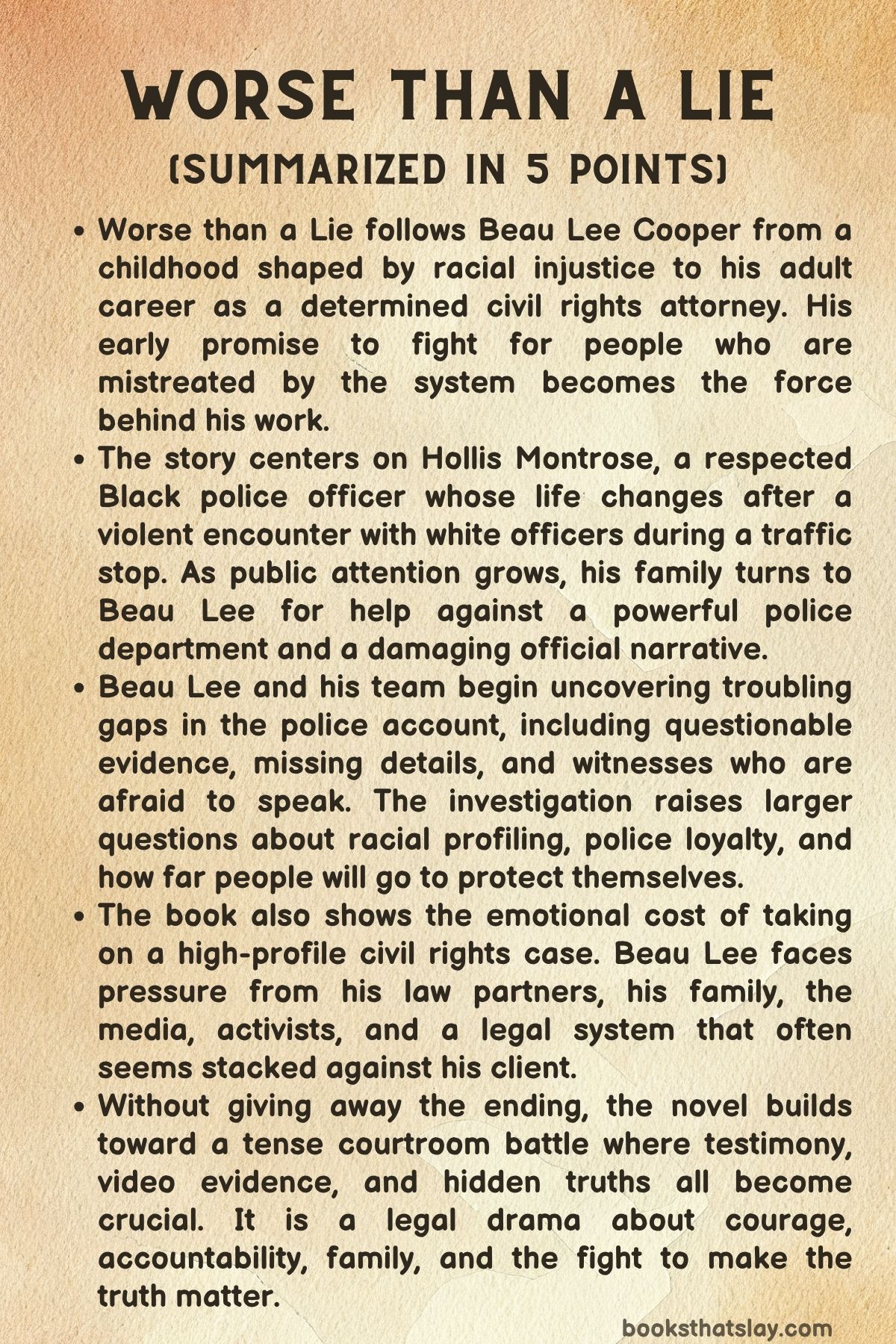
Worse than a Lie begins in Houston in September 1978, where young Beau Lee Cooper lives with his mother, Ella Mae, and his siblings. Beau Lee is not like his brothers, who are more interested in sports and play.
He is serious, thoughtful, and drawn to stories of justice. He admires Thurgood Marshall and keeps an old issue of Jet magazine featuring him.
He also reads To Kill a Mockingbird again and again, especially when he feels troubled by unfairness.
One evening, Beau Lee learns that police officers are searching for Mr. Porter, an elderly Black neighbor accused of stealing from a store. The accusation is false, and even the white store owner says Mr. Porter did nothing wrong.
Still, the police continue looking for him. When an officer comes to Ella Mae’s door, she protects her family by saying she does not know Mr. Porter.
Beau Lee is shaken by the fear his mother must live with. That moment stays with him, and he promises himself that he will become a lawyer and fight for people like Mr. Porter.
Thirty years later, on November 4, 2008, Hollis Montrose, a Black Metra police officer in Chicago, is working a second job as a security guard. He listens happily to Barack Obama’s victory speech after Obama becomes president-elect.
Hollis speaks with his wife, Raquel “Rocky” Montrose, who is celebrating at home. After his shift, Hollis leaves to pick up sanding equipment from a friend so he can continue working on a playroom for his grandchildren.
On the road, Hollis is stopped by two white Chicago police officers, Jack Dunham and Chaz Rossi. Hollis remains calm and tells them he is also a police officer.
He offers to show his badge, but the officers pull him from his vehicle and force him to the ground. Two more officers arrive.
The officers claim his SUV matches a robbery suspect’s vehicle and accuse him of possibly being under the influence. When they find his service weapon, Hollis explains that he is legally carrying it.
The officers panic, claim he is reaching for the gun, and shoot him several times while he is on the pavement. Afterward, they handcuff him and place his gun in his hand to support their false account.
The next morning, Beau Lee Cooper is now a respected civil rights attorney in Houston. He travels to Chicago with his law partner Nelson “Nellie” Rivers and investigator Capes for a settlement conference against Guaranty National Bank.
They represent three Black women who were falsely arrested after trying to cash legitimate checks. The bank’s lawyer, Princess Alvarez, first offers one million dollars, but Beau Lee refuses to accept less than what the case deserves.
Capes obtains police and jail footage showing the women’s public humiliation, fear, and mistreatment. Faced with the evidence, the bank agrees to Beau Lee’s ten-million-dollar demand.
As Beau Lee leaves Alvarez’s office, he meets activist Brother Harpo, Rocky Montrose, and Hollis’s pregnant daughter, Jamillah. Hollis has survived but is critically injured after being shot ten times.
Rocky asks Beau Lee to take the case because she believes his experience and public strategy are necessary. Beau Lee agrees.
He plans to file a fifty-million-dollar civil lawsuit against the Chicago Police Department, even though Nellie worries their firm is already under pressure.
Beau Lee, Capes, and Nellie begin investigating. They meet Officer Finn Doyle, Hollis’s longtime Metra partner.
Finn brings a leaked police report claiming Hollis acted aggressively, failed to identify himself, drew his gun, fired two shots, and was shot in response. Beau Lee immediately doubts the report because Rocky says Hollis always identified himself during police encounters.
Finn also believes the report is false. He explains that the robbery suspect’s vehicle was a blue minivan, not Hollis’s gray SUV, and that Hollis’s holster would have made it difficult to draw his gun from the ground.
A news broadcast later shows grainy footage of the shooting. Beau Lee notices that the officers appear to remove the gun from Hollis’s waist, not from his hand.
This contradicts the official report. Beau Lee realizes the person who recorded the video is a vital witness.
Capes and Finn visit the scene and identify a house where the video may have been recorded. They speak with Mrs. Gaither, who says Joey Henderson left suddenly for Philadelphia with luggage and food.
Capes later learns Joey worked at the same security company as Hollis, but because Joey was seen speaking with Hollis around the time of the incident, he could not have recorded the video. Capes concludes that Joey’s girlfriend likely filmed it.
Beau Lee, Capes, and Finn track down Joey and his girlfriend, Darian King, at a diner during a snowstorm. Joey admits he uploaded the video, but Darian recorded it.
She says she began filming because she sensed something was wrong and feared the officers would kill Hollis. Though terrified of police retaliation, Darian agrees to return to Chicago and give a statement.
At the hospital, Finn sees Rory Caruthers, one of the officers involved in the shooting. Rory privately admits that Hollis did not fire his gun.
He says Jack Dunham took Hollis’s wallet and that the officers are trying to keep a false story alive. Rory agrees to help, though he fears the consequences.
Soon after, Rocky announces that Hollis has awakened.
Beau Lee files the lawsuit and holds a press conference with Alvarez, Rocky, Jamillah, Capes, and others. He accuses the officers of racial profiling, lying, and covering up an unjustified shooting.
Alvarez confirms that Hollis already had a discrimination case against the Chicago Police Department. Beau Lee demands charges against the officers and makes clear that the civil lawsuit will seek justice for Hollis and his family.
The story then shows Jack Dunham’s mind and history. Drunk and angry after being thrown out of a bar for racist remarks about Obama’s election, Jack visits the grave of Theodore Briscoe, an older officer who mentored him.
Briscoe was a racist veteran who believed white officers were losing control of the city and the department. After Briscoe’s death, Jack inherited a lockbox filled with reports, photos, complaints, and a letter urging him to continue Briscoe’s methods of controlling Black citizens and training younger officers to do the same.
Prosecutors DaSilva and Dillard question Jack about the shooting, especially his claims that Hollis had no identification and that his license plate was unreadable. Jack denies knowing Hollis, though Hollis had previously filed complaints and lawsuits involving racial harassment in the department.
Jack later hides Hollis’s wallet in a shoebox, confirming he stole it.
Beau Lee and his team examine police records and find complaints against Jack and the other officers. Jack’s file includes claims of improper force and anger issues.
Chaz Rossi’s file connects him to Jack in earlier abusive conduct. Beau Lee sees Jack as central to the case, but he senses there is a deeper pattern behind him.
Hollis slowly improves, though he is frail and struggles with memory loss. He cannot remember whether he had his wallet.
Beau Lee returns his laptop, hoping family photos may help. Meanwhile, the legal case becomes more difficult.
At a bail hearing, Alvarez argues Hollis should be released because he has no criminal history, is paralyzed, and poses no flight risk. The prosecution claims gunshot residue was found on Hollis’s hand.
The judge orders Hollis transferred from the hospital to Cook County Jail. Later, bail is set at two and a half million dollars, effectively keeping him locked up.
Beau Lee launches a national Free Hollis Montrose bail campaign. Churches, activists, and community members raise money through rallies, food sales, and public events.
Rocky remains strong, supported by her family and the movement growing around Hollis.
At trial, the courtroom is packed with reporters, activists, police officers, and Hollis’s loved ones. The prosecution argues that Hollis fired at officers and forced them to shoot.
Beau Lee argues that Hollis was a veteran officer with no criminal history and that the official account does not match the evidence.
Captain O’Keefe defends the investigation, but Beau Lee exposes weaknesses. The police ignored video evidence, failed to take Hollis’s statement, and could not properly explain the missing wallet.
An impound clerk testifies about Hollis’s SUV, and Beau Lee shows there is no proof the license plate was damaged when it arrived. He also proves that Dunham and Rossi visited the impound lot alone for about twenty minutes, after which the SUV was later destroyed.
A forensic analyst says gunshot residue on Hollis’s hands proves he fired, but Beau Lee forces him to admit residue can transfer and does not prove how it got there. The lack of residue on Hollis’s clothing makes the prosecution’s theory even weaker.
Rossi and Dunham repeat the official story, but Beau Lee uses the video audio to show that only ten shots were heard, matching the ten casings recovered from officers’ guns. If Hollis had fired twice, more casings should have existed.
Darian testifies that Hollis was lying still, empty-handed, and that an officer removed the gun from his waist. She also saw Dunham take something from Hollis’s pocket.
The defense suffers a blow when Rory Caruthers dies in a suspicious motorcycle accident before he can testify. The judge refuses to admit his affidavit.
Beau Lee then calls Hollis, who testifies that he had his wallet and police ID, identified himself, obeyed commands, was kicked, and was shot after moving instinctively to protect himself. He denies reaching for or firing his gun.
Finally, Beau Lee calls Corrine Dunham, Jack’s bruised wife. She testifies that after Jack assaulted her, she opened a safe and found Hollis’s wallet, along with Briscoe’s letter about protecting the “blue wall.” The courtroom erupts.
Jack is taken into custody, and the judge dismisses the case. Hollis is declared free.
Three months later, Hollis and his family celebrate at a backyard cookout after Chicago agrees to a forty-five-million-dollar settlement. Surrounded by his family, friends, and legal team, Hollis is alive, free, and vindicated.
The truth has finally overcome the lie.
Characters
Beau Lee Cooper
Beau Lee Cooper is the moral center of Worse than a Lie, and his character is shaped by a lifelong sensitivity to injustice. As a child, he is serious, observant, and unusually aware of the racial fear surrounding his family and community.
The incident involving Mr. Porter becomes a defining moment for him because he sees how easily an innocent Black man can be treated as guilty, and he also sees how even a protective lie from his mother comes from fear rather than freedom. His admiration for Thurgood Marshall shows that Beau Lee does not simply want success; he wants to use the law as a weapon against unfairness.
As an adult, he becomes the kind of civil rights attorney his younger self dreamed of being: bold, strategic, emotionally invested, and unwilling to accept weak settlements or comfortable compromises when people have been publicly humiliated or violently wronged.
Beau Lee’s greatest strength is also one of his greatest vulnerabilities. He cares deeply, and that emotional intensity makes him powerful in court, in negotiations, and before the media.
He understands that legal cases involving racial injustice are not fought only with documents and arguments; they are also fought through public attention, community pressure, and moral clarity. However, his anger sometimes pushes him close to recklessness, especially when he chases the attackers who throw eggs at Rocky’s vehicle.
Through Beau Lee, the story presents a lawyer who is brilliant not because he is detached, but because he refuses to detach himself from the suffering of his clients. His journey shows the difficulty of fighting injustice without being consumed by it.
Young Beau Lee Cooper
Young Beau Lee is important because he reveals the roots of the adult attorney’s mission. He is different from his brothers because he is inward-looking, intellectual, and drawn to stories of law and justice rather than games or sports.
His attachment to the magazine featuring Thurgood Marshall and his repeated reading of a justice-centered novel show that he is already forming a vision of what courage should look like. When Mr. Porter is hunted by police despite being innocent, young Beau Lee experiences a painful awakening.
He learns that truth alone does not always protect Black people from suspicion, and that the adults around him often survive by making careful, fearful choices.
This childhood version of Beau Lee gives emotional depth to the adult character. His promise to become a lawyer is not a casual childhood dream; it is a response to helplessness.
He cannot protect Mr. Porter, and he cannot remove the fear from his mother’s voice, but he can imagine becoming someone who challenges that fear in the future. The boy’s seriousness becomes the man’s purpose, making his later fight for Hollis feel like the continuation of a promise made decades earlier.
Ella Mae Cooper
Ella Mae Cooper is a protective mother whose brief but powerful role shows the pressure Black families face when authority becomes dangerous. When the police come looking for Mr. Porter, she lies and says she does not know him.
Her lie is not presented as cowardice or betrayal; it is an act of survival. She understands that even knowing an accused Black man can put her family at risk, especially when the police are already ignoring the truth.
Ella Mae’s fear teaches Beau Lee that injustice harms more than the direct victim. It spreads into homes, silences neighbors, and forces decent people into impossible choices.
Ella Mae represents the generation that had to balance dignity with caution. She knows the world is unfair, but she also knows that open defiance can bring consequences to her children.
Her character helps explain why Beau Lee becomes so determined to use the law publicly and forcefully. Where Ella Mae must protect her family through silence, Beau Lee grows up wanting to protect people through speech, evidence, and confrontation.
Mr. Porter
Mr. Porter is an elderly neighbor whose wrongful accusation becomes the first clear example of injustice in Beau Lee’s life. He does not need to appear extensively to matter deeply.
His innocence is recognized even by the white store owner, yet the police continue to pursue him. That contradiction exposes one of the central concerns of the story: truth can be obvious and still be ignored when racial suspicion controls the situation.
Mr. Porter’s role is symbolic as well as personal. He represents vulnerable Black citizens who can be turned into suspects without evidence and whose dignity depends on whether others are willing to defend them.
His situation plants the seed of Beau Lee’s legal calling. Through Mr. Porter, the book shows how one act of injustice can echo across decades and shape the life of someone who witnesses it.
Beau Lee’s Brothers
Beau Lee’s brothers create a contrast with him during the childhood section. They are more playful, physical, and focused on ordinary childhood activities, which makes Beau Lee’s seriousness stand out.
Their rush home with the news about Mr. Porter also shows how quickly fear and rumor move through a community when police are involved. They are not developed as deeply as Beau Lee, but they help establish the family environment that surrounds him.
Their presence also reminds the reader that Beau Lee is still a child when he begins thinking about injustice in adult terms. While his brothers seem closer to the everyday world of youth, Beau Lee is already being pulled toward the burden of moral awareness.
This contrast makes his future as a civil rights lawyer feel natural rather than sudden.
Hollis Montrose
Hollis Montrose is one of the most tragic and dignified figures in the book. He is a Black police officer, a husband, a father, and a grandfather who believes in work, family, and duty.
His joy during Barack Obama’s victory speech shows that he feels part of a historic moment of hope. That hope is brutally interrupted when he is stopped, humiliated, shot, and falsely accused by white officers.
The cruelty of his situation lies in the fact that even his identity as a police officer does not protect him. His badge, discipline, and calmness cannot overcome the racial assumptions placed on him during the traffic stop.
Hollis’s character is especially powerful because he survives physically but is forced to fight for his innocence while wounded and vulnerable. His memory gaps, paralysis, jail transfer, and public criminalization show how victims can be punished even after surviving violence.
Yet Hollis is not portrayed only as a victim. His testimony gives him back his voice, and his insistence that he identified himself, obeyed commands, and never fired his gun becomes central to restoring the truth.
His final freedom and family celebration give emotional weight to the justice Beau Lee seeks, though the story also makes clear that no settlement can erase what was done to him.
Raquel “Rocky” Montrose
Rocky Montrose is Hollis’s wife and one of the emotional anchors of the story. She is loving, faithful, determined, and strong under unbearable pressure.
From the moment Hollis is shot, she refuses to let the official version define him. Her decision to seek Beau Lee’s help shows both desperation and judgment; she understands that this case needs someone who can fight legally, publicly, and strategically.
Rocky’s grief never becomes passive. She prays, advocates, stands before cameras, supports her family, and continues believing in Hollis when the system treats him as dangerous.
Rocky’s strength is rooted in love, but it is not soft or simple. She must watch her injured husband be accused, denied meaningful freedom, and transferred from medical care to jail.
Her pain shows the family cost of state violence and false prosecution. At the same time, she becomes a symbol for community resistance.
When churches, activists, and supporters rally around the Free Hollis Montrose campaign, Rocky’s endurance helps give the movement its heart.
Jamillah Montrose
Jamillah Montrose, Hollis and Rocky’s pregnant daughter, deepens the family stakes of the story. Her pregnancy reminds the reader that Hollis is not only fighting for his own name but also for his family’s future.
The violence against him affects multiple generations, including a grandchild who has not yet entered the world. Jamillah’s presence at key moments, especially when the family seeks Beau Lee’s help and later appears publicly, reinforces the idea that injustice does not remain isolated around one person.
Although Jamillah is not as central as Rocky or Hollis, she helps humanize the case. She is part of the family circle that the legal system threatens to break.
Through her, the book emphasizes that Hollis’s survival matters not just legally but emotionally, spiritually, and generationally.
Nelson “Nellie” Rivers
Nellie Rivers is Beau Lee’s law partner and a necessary counterbalance to his intensity. He is cautious, practical, and aware of the limits of their firm’s time, resources, and emotional capacity.
His concerns about taking on Hollis’s case do not mean he lacks compassion; they show that he understands the cost of major civil rights battles. Nellie often sees risks that Beau Lee, driven by instinct and outrage, may overlook.
His skepticism toward police officers also reveals the distrust created by repeated institutional betrayal. Nellie does not easily accept that any officer can be helpful, which makes his reactions to Finn and others understandable.
In the story, Nellie represents disciplined caution. He may not always move with Beau Lee’s urgency, but his presence helps show that justice work requires both passion and restraint.
Capes
Capes is the investigator whose careful work turns suspicion into evidence. He is observant, direct, and willing to follow leads into uncomfortable places.
His importance comes from his ability to notice what others miss and to connect details that become decisive. Whether he is securing footage in the bank case, investigating the shooting scene, questioning neighbors, or tracking the source of the video, Capes helps transform moral outrage into a usable legal case.
Capes also has a strong instinct for people. He recognizes when Mrs. Gaither is uncomfortable around Finn and adjusts the situation so she can speak more freely.
He also challenges questionable methods, such as Finn’s use of surveillance resources, showing that he values results but not at any ethical cost. Capes is less publicly dramatic than Beau Lee, but his investigative discipline is essential to exposing the lie surrounding Hollis.
Princess Alvarez
Princess Alvarez is a sharp, proud, and capable attorney whose relationship with Beau Lee begins with tension but develops into cooperation. At first, she is irritated by his involvement because Hollis and Rocky were already connected to her.
Her frustration is understandable, since Beau Lee’s arrival could be seen as a challenge to her authority. However, Alvarez proves that she cares more about justice than ego.
She shares files, supports the larger legal strategy, and eventually becomes an important partner in the case.
Alvarez’s character also shows professional strength in a hostile legal environment. She argues forcefully for Hollis’s release and brings important knowledge of his prior discrimination case against the police department.
Her role is especially meaningful because she helps connect the shooting to a larger history of harassment and racism within the CPD. She is not merely assisting Beau Lee; she is part of the legal force that makes the truth harder to bury.
Brother Harpo
Brother Harpo represents grassroots activism and community pressure. His presence with Rocky and Jamillah shows that Hollis’s case is not only a private family crisis but also a public civil rights struggle.
He helps bridge the gap between the courtroom and the streets, reminding the legal team that public outrage can become a source of strength when institutions resist accountability.
Though he is not developed as extensively as the attorneys or family members, Brother Harpo plays an important social role. He stands for the organizers, protesters, and local leaders who refuse to let Hollis disappear into a false police narrative.
His character helps show that justice is rarely won by lawyers alone; it also requires community attention and collective insistence.
Jack Dunham
Jack Dunham is the clearest embodiment of corruption, racism, and violent entitlement in the story. He is not simply a bad officer who makes a mistake during a tense stop.
He lies, helps shape a false narrative, tampers with evidence, steals Hollis’s wallet, hides it, abuses his wife, and treats people of color with open contempt. His behavior after the shooting reveals that he is more concerned with preserving power than confronting truth.
He sees himself as a heroic victim of changing times, which makes his cruelty even more dangerous because he interprets accountability as persecution.
Jack’s connection to Theodore Briscoe gives his racism a lineage. He has inherited not only a lockbox but also an ideology of control, intimidation, and loyalty to the blue wall.
His violence at home mirrors his violence in public, showing that his need to dominate is not limited to police work. Jack is frightening because he combines institutional authority with personal hatred.
His downfall comes when Corrine exposes the wallet and Briscoe’s letter, proving that the truth he tried to bury was always physically close to him.
Chaz Rossi
Chaz Rossi is Jack Dunham’s partner in both the shooting and the cover-up. While Jack appears to be the more dominant figure, Chaz is still morally responsible for what happens.
He participates in the traffic stop, supports the false version of events, goes with Jack to the impound lot, and testifies in a way that protects the official lie. His character shows how corruption survives through cooperation.
Even when one person leads, others must agree to look away, repeat falsehoods, or help manipulate evidence.
Chaz is important because he demonstrates that institutional injustice is rarely the work of one villain alone. His testimony attempts to make the shooting seem reasonable, but Beau Lee’s questioning exposes the weaknesses in the story.
Chaz represents the officers who may hide behind procedure, fear, loyalty, or prejudice, but who still help turn violence into an official narrative.
Captain Brady O’Keefe
Captain Brady O’Keefe is a figure of institutional protection. His anger at Jack and Chaz is not primarily moral outrage over Hollis being shot; it is frustration that they failed to create a cleaner justification for their actions.
This makes him deeply troubling. He understands the procedural mistakes, but his concern appears connected to preserving the department’s position rather than uncovering the truth.
On the stand, O’Keefe defends the investigation and supports the claim that the officers acted properly. His role shows how leadership can strengthen a false narrative by giving it official weight.
He represents the part of the system that does not necessarily pull the trigger but helps protect those who do.
Finn Doyle
Finn Doyle is Hollis’s longtime Metra partner and one of the more morally conflicted police figures in the story. Unlike the CPD officers involved in the shooting, Finn is loyal to Hollis and willing to help expose the truth.
He provides the leaked police report, explains why the official account does not make sense, and helps locate key witnesses. His knowledge of police procedures and Hollis’s habits makes him valuable to Beau Lee’s investigation.
At the same time, Finn’s methods raise ethical concerns. His willingness to use surveillance resources and force entry into Rory’s apartment shows that he can cross lines when he believes the cause is right.
This complexity makes him more than a simple good officer. He is useful, loyal, and brave, but he also carries the habits of policing that make Capes uneasy.
Finn’s character shows that even allies within law enforcement can be complicated.
Mrs. Gaither
Mrs. Gaither is a minor but important witness figure because she helps point the investigation toward Joey Henderson and Darian King. Her cautiousness around Finn shows how ordinary citizens may distrust police even when those officers claim to be helping.
She becomes more open when Capes creates a safer space for her to speak, which reinforces the story’s larger point about fear and power.
Her role may be brief, but it is meaningful. She shows how community knowledge can become crucial in exposing the truth.
Without people like Mrs. Gaither, legal teams may never find the witnesses who can challenge official lies.
Joey Henderson
Joey Henderson is initially important because he appears to be the likely source of the video. His sudden trip to Philadelphia makes him seem suspicious, but his fear is understandable once the stakes become clear.
He knows that possessing or sharing evidence against police can invite danger. His decision to upload the video, however, makes him an important part of the truth coming to light.
Joey’s character represents ordinary people pulled into extraordinary danger because they witnessed injustice. He is not a lawyer, activist, or officer.
He is someone whose life intersects with the case because of proximity and circumstance. His fear does not erase his contribution; instead, it makes his role more believable.
Darian King
Darian King is one of the most important witnesses because she records what the officers hoped would remain unseen. Her decision to film comes from instinct; she senses that something is wrong and fears the officers may kill Hollis.
That instinct proves crucial. Her video contradicts the police report, especially by showing that Hollis was on the ground and that the gun was removed from his waist rather than his hand.
Darian’s courage is not effortless. She is frightened of retaliation, and the prosecution later tries to attack her motives by suggesting she and Joey benefited from the viral video.
Still, her testimony gives the courtroom a direct account of what happened. Darian represents the power of civilian witness in an age when official stories can be challenged by recorded evidence.
Her character shows that truth sometimes survives because someone ordinary chooses not to look away.
Martin
Martin, the supervisor at Gunderson Security, plays a small but useful role in clarifying Hollis’s movements before the shooting. His confirmation that Hollis appeared normal before and after his shift helps weaken the suggestion that Hollis was intoxicated, erratic, or unstable.
He also reveals Joey Henderson’s connection to the workplace, which helps Capes redirect the investigation toward Darian.
Martin’s function is practical, but he contributes to the gradual dismantling of the police narrative. In a case built from many pieces of evidence, his observations matter because they help establish Hollis’s calm and ordinary behavior shortly before the violent stop.
Rory Caruthers
Rory Caruthers is a tragic figure because he appears ready to tell the truth but dies before he can do so in court. His private admission that Hollis did not fire his gun and that Jack took Hollis’s wallet could have changed the case earlier.
His fear is also believable. He knows that breaking ranks could cost him his career, his freedom, and perhaps his safety.
Rory’s character shows the crushing pressure placed on officers who witness wrongdoing from inside the system.
His suspicious death intensifies the sense that the cover-up is larger and more dangerous than a few false statements. Because his affidavit is excluded as hearsay, the legal system’s rules prevent his truth from being directly heard.
Rory represents the silenced witness: someone who knows enough to expose corruption but is destroyed or removed before accountability can happen.
Theodore “Teddy” Briscoe
Theodore Briscoe is dead during the main events, but his influence is alive through Jack Dunham. He represents an older, openly racist model of policing built on resentment, control, and hostility toward Black advancement.
His anger at being passed over for police chief in favor of a Black officer reveals how deeply he connects authority with racial entitlement. The lockbox he leaves Jack becomes a physical symbol of inherited corruption.
Briscoe’s importance lies in how he turns racism into a tradition. He does not merely hold hateful beliefs; he teaches them, preserves them, and instructs Jack to continue them.
His letter about protecting the blue wall becomes crucial evidence because it connects Jack’s actions to a broader ideology. Through Briscoe, the story shows that injustice is often passed down through mentorship, memory, and institutional culture.
Corrine Dunham
Corrine Dunham is one of the most decisive characters in the final movement of the story. At first, she appears trapped inside Jack’s private world of lies, suspicion, and violence.
She senses that he is hiding something, and his attack on her reveals the danger she faces within her own home. Her bruises make visible the domestic abuse that parallels Jack’s public brutality.
Corrine’s testimony is courageous because she chooses truth over loyalty to her husband. By opening the safe and revealing Hollis’s wallet and Briscoe’s letter, she breaks the cover-up at its strongest point.
Her role is powerful because the case turns not only on legal brilliance but also on a personal act of moral courage. Corrine exposes the hidden evidence that Jack believed he could control forever.
Prosecutor DaSilva
DaSilva represents the prosecutorial side of the system that insists on treating Hollis as a threat despite serious contradictions in the evidence. His opening argument frames Hollis as dangerous and the officers as justified, giving the official police story the authority of the State.
During cross-examination, he attacks Hollis by using his discrimination lawsuit and PTSD claims to suggest motive, anger, and instability.
DaSilva is not portrayed as emotionally chaotic like Jack, but his role is damaging because he gives legal force to a false narrative. His decision not to question Corrine after her explosive testimony suggests that the truth has become impossible to deny.
Through DaSilva, the book shows how prosecutors can either challenge police misconduct or reinforce it, depending on what they choose to believe and present.
Prosecutor Dillard
Dillard works alongside DaSilva and is especially significant in the effort to keep Hollis framed as dangerous. She blindsides the defense with the gunshot residue claim during the bail hearing, helping justify the continued restriction of Hollis’s freedom.
Later, she attacks Darian King’s credibility by implying that Darian and Joey profited from the video. This approach shows how witnesses who challenge police narratives can be made to seem selfish, unreliable, or opportunistic.
Dillard’s character reflects the adversarial nature of the courtroom, but also the moral problem of using technical arguments to support an unjust case. She is skilled and aggressive, yet her strategy contributes to the larger injustice against Hollis.
Her role adds pressure to the defense and shows how the truth can be attacked from multiple angles.
Gigi Cooper
Gigi Cooper, Beau Lee’s wife, represents the personal cost of his legal mission. She sees the danger in his emotional involvement and demands that he return home after the egg-throwing incident and chase.
Her concern is not a rejection of justice; it is a reminder that Beau Lee has a family and a life beyond the courtroom. She understands that his passion, while admirable, can place him and others at risk.
Gigi gives Beau Lee a necessary emotional boundary. Her presence shows that civil rights work affects not only clients and lawyers but also the families of those who take on public battles.
She helps bring Beau Lee back from recklessness and pushes him toward a more disciplined form of courage.
Judge Lambert
Judge Lambert represents the court’s power to shape a defendant’s life even before guilt or innocence is decided. His decisions regarding Hollis’s custody and bail are devastating because they keep a gravely wounded man trapped in the criminal system.
By ordering Hollis transferred from the hospital to jail and later setting bail at an extremely high amount, he makes freedom technically possible but practically unreachable.
His role highlights how judicial decisions can appear procedural while carrying enormous human consequences. Judge Lambert’s courtroom becomes one of the places where Hollis’s suffering is prolonged.
He is important not because he is outwardly villainous, but because his authority helps maintain the pressure against Hollis.
Santiago Garcia
Santiago Garcia, the impound clerk, becomes important because his testimony exposes weaknesses in the police account about Hollis’s vehicle. Through him, Beau Lee shows that there is no footage proving the SUV arrived with a damaged plate and that Jack and Chaz had private access to it.
Garcia’s testimony also reveals the suspicious destruction of the vehicle after it was mistakenly marked for dismantling.
Garcia is not personally central to the conflict, but his role demonstrates how bureaucratic details can become crucial in a trial. His testimony helps Beau Lee show that the physical evidence surrounding the vehicle cannot be trusted.
In a case built on alleged police procedure, the absence of proper documentation becomes deeply significant.
Detective Fowler
Detective Fowler is the forensic analyst who presents the gunshot residue evidence against Hollis. At first, his testimony seems damaging because it appears to support the claim that Hollis fired a weapon.
However, Beau Lee’s cross-examination forces him to admit the limits of the test. Gunshot residue can transfer, and its presence cannot prove exactly how it got onto someone’s hands.
Fowler’s character represents the danger of forensic evidence being treated as more certain than it really is. His testimony is not useless, but it is vulnerable when examined carefully.
Through him, the book shows how scientific-sounding evidence can mislead a courtroom if its limitations are not clearly exposed.
Themes
Racial Profiling and Institutional Injustice
The traffic stop exposes how racial profiling can turn an ordinary moment into a life-threatening encounter. Hollis is not treated as a fellow officer, a husband, or a grandfather, but as a threat before the facts are known.
His calm explanation, legal weapon, police identity, and obedience do not protect him because the officers have already decided what kind of man he is. The injustice becomes even more disturbing because it does not end with the shooting.
The police report, damaged license plate, missing wallet, and false claims about gunfire show an institution trying to protect itself rather than search for truth. Beau Lee’s childhood memory of Mr. Porter connects this injustice to a longer history of Black people being suspected, hunted, and forced to fear authority even when innocent.
In Worse than a Lie, racism is not shown only through individual prejudice, but through systems that give dishonest officers power, protection, and credibility.
The Power of Truth Against False Narratives
Truth in the story is fragile because powerful people keep trying to bury it under official language, staged evidence, and courtroom performance. Hollis’s innocence is almost erased by a police report that presents lies as fact.
The officers rely on badges, procedure, and public trust to make their version seem believable, even when the physical evidence does not support it. The video, Darian’s testimony, Corrine’s discovery, and Beau Lee’s cross-examinations slowly break that false version apart.
This theme shows that truth does not always appear on its own; it has to be protected, argued for, and carried by people willing to take risks. The title Worse than a Lie reflects this idea because the officers’ actions are not just dishonest words.
Their lies are weapons used to imprison a wounded man, frighten witnesses, and preserve a system that rewards silence. Truth becomes a form of justice only when people refuse to let fear control them.
Courage in the Face of Fear
Many characters are afraid, but the story values what they choose to do despite that fear. Ella Mae lies to protect her family because she understands the danger of challenging police power directly.
Darian is terrified of retaliation, yet she records the shooting and later agrees to speak. Rory wants to tell the truth but is trapped between conscience and the threat of punishment from the same system he serves.
Corrine’s courage is especially important because she breaks from her abusive husband and exposes evidence that changes the case. Beau Lee also shows courage, but the story does not present him as fearless.
He becomes emotionally shaken, angry, and reckless at times, which makes his bravery more human. Courage here is not loud confidence; it is the decision to act when silence would be safer.
The theme suggests that justice depends on ordinary people making difficult choices at moments when fear feels completely reasonable.
Law as a Tool for Justice and Resistance
The law is shown as both dangerous and necessary. Courts, police reports, bail rulings, and forensic claims are used against Hollis, proving that legal systems can be shaped by bias and institutional self-protection.
At the same time, Beau Lee’s work shows that the law can also become a tool of resistance when handled with skill, persistence, and moral purpose. He does not rely only on speeches or anger.
He studies evidence, challenges testimony, exposes contradictions, builds public pressure, and uses the courtroom to force hidden truths into view. His childhood admiration for Thurgood Marshall explains why he sees law as more than a profession.
For him, it is a way to defend people who are easily dismissed by authority. The theme becomes powerful because victory is not simple or guaranteed.
Hollis survives, but he suffers deeply before the truth is recognized. The settlement matters, yet the greater victory is the public defeat of a false story designed to destroy him.