Woven From Clay Summary, Characters and Themes
Woven From Clay by Jenny Birch is a contemporary fantasy novel that blends the mystery of identity with the struggle between humanity and creation. Set in the quiet town of North Heights, it follows Terra Slater, a seemingly ordinary high school senior whose life changes when she meets Thorne Wilder, a strange new student with unexplained powers.
What begins as an unsettling encounter spirals into a revelation that Terra herself may not be human but a magical being formed from the earth. As she uncovers the truth about her existence, she must confront ancient magic, corrupt power, and questions of what it truly means to be alive.
Summary
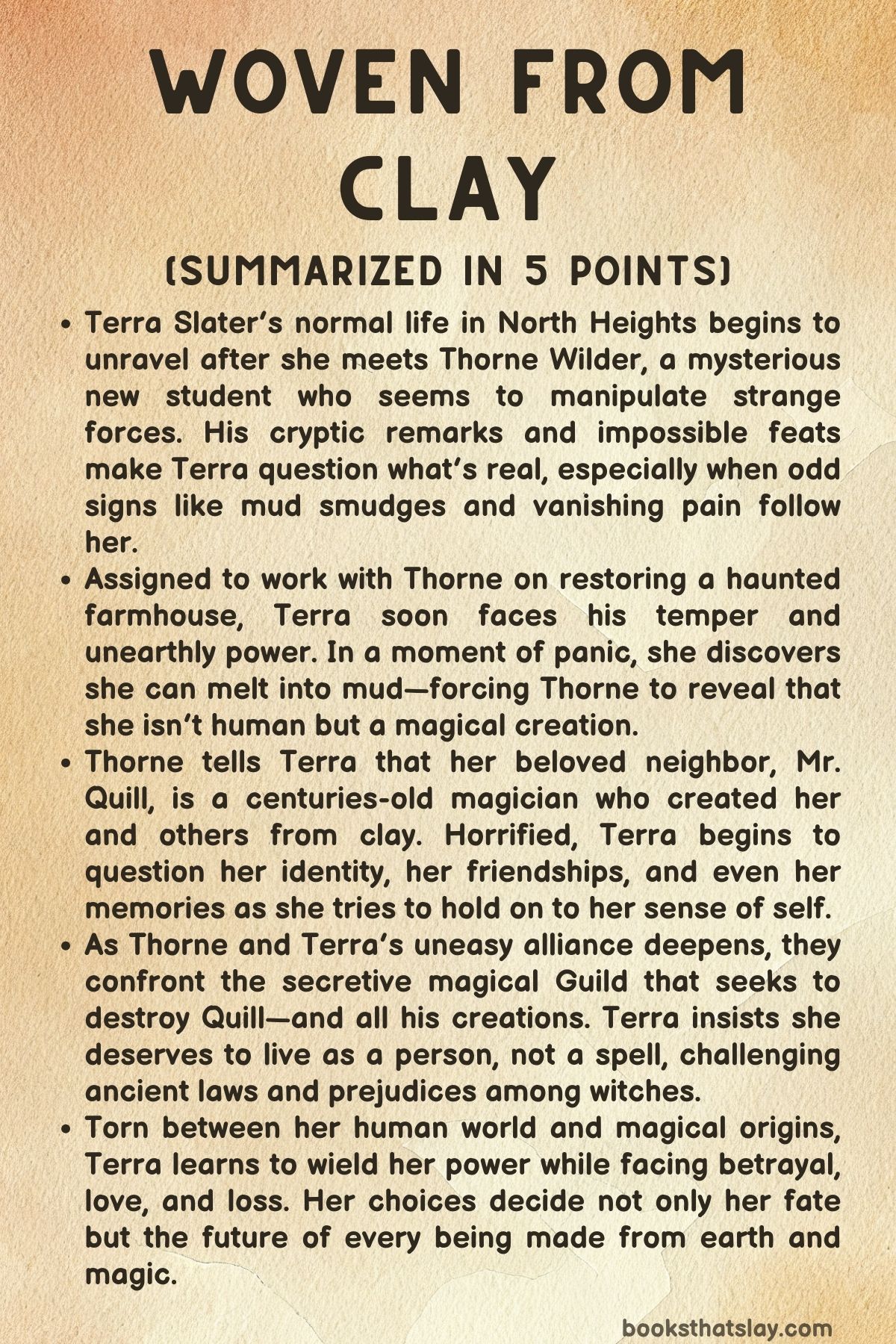
In North Heights, Terra Slater enjoys the last days of summer with her friends, unaware that her life is about to change forever. At the town’s Labor Day parade, a mysterious boy with blue-tinted hair, Thorne Wilder, confronts her with strange questions about “where he is” and “creatures,” then vanishes, leaving her unsettled.
When school begins, she’s shocked to see him again—this time as the new transfer student assigned to her care. From the start, Thorne behaves oddly, making cryptic remarks about Terra being “one of them.
” A series of small, magical disturbances—mud appearing on her clothes, a student dancing uncontrollably, and the wind moving unnaturally—confirm that something beyond logic is at play.
Thorne eventually manipulates their teacher into pairing them for a school project, forcing them to restore an abandoned farmhouse once owned by the reclusive Mr. Quill, a beloved old man who recently disappeared.
When Terra confronts Thorne at the property, the truth begins to unfold. A violent storm erupts, seemingly obeying Thorne’s command, and when she’s injured, her wound heals instantly.
Terrified, she imagines melting away—and actually does, transforming into mud before reforming again. Thorne confesses that she’s not human but a magical creation like himself, made from the earth and energy.
He explains that he belongs to a hidden world of witches governed by guilds that regulate magic. Each witch draws power by manipulating invisible energy threads connecting all things.
However, using magic drains life itself. Thorne reveals that Mr.
Quill, or Cyrus Quill, is not the kind man Terra knew but a dangerous sorcerer who created life unnaturally—crafting beings from clay and bone. To prove it, Thorne performs a spell, forming a living rabbit from mud and a bone fragment.
Terra realizes with horror that she is one of Quill’s creations, a golem animated by his power.
Struggling to process her identity, Terra tries to return to normal life but can’t ignore the signs—her shared traits with her best friend Brick, her strange connection to the land, and her uncontrollable powers. When Brick asks her to the Fall Ball, she refuses, fearing they are magically related.
Meanwhile, Thorne reveals his true mission: he is a witch sent by his guild to find and eliminate Quill. However, Quill’s death would also mean the end of all his creations, including Terra.
Despite his orders, Thorne sympathizes with her and agrees to help her plead their case before the Guild.
Thorne opens a portal to the underground realm of the Guild, where Terra meets his mother, Willow, the High Witch. Willow and the council regard Terra as an abomination, not a person.
Defying them, Terra insists that she has a soul and deserves to live. Her courage impresses a few members but infuriates Willow, who views her as a threat to magical order.
Thorne’s loyalty to Terra begins to divide him from his family, especially his rival Jett, Willow’s protégé and Thorne’s old acquaintance.
As tensions rise, Terra begins training with Thorne to control her abilities. He teaches her to see the invisible energy threads that bind all living things, revealing one that links her to Brick.
The thread is vibrant but frayed, a sign that their lives are magically connected through Quill. When she touches it, it burns, showing the cost of meddling with creation itself.
Despite her fear, Terra’s training strengthens her bond with Thorne, and affection grows between them.
Jett, resentful and power-hungry, starts attacking the golems secretly. During a football game, she casts destructive spells that cause several of them—including Brick—to partially dissolve into mud.
Thorne struggles to counter her, leaving himself drained. Determined to stop Jett, Terra confronts her but becomes the target of humiliation and magical sabotage.
When Thorne vanishes afterward, she believes he’s been captured or betrayed. Days later, he reappears and reveals he was training under Shailesh, a wise witch who discovered that Terra’s magic stems from her will to protect those she loves.
With this revelation, Terra learns to focus her magic and begins to perceive the vast network of threads connecting every golem to Quill’s essence. She understands that his weakening power endangers them all.
Meanwhile, Thorne uncovers a darker truth: his mother, Willow, has manipulated memories and history itself to hide her crimes. With Shailesh’s help, he gathers evidence and prepares to expose her before the Court of witches, called the Scrutiny.
Thorne and Terra’s relationship deepens, culminating in a kiss and a shared resolve to face the coming trial together. At the Fall Ball, however, Jett attacks again, tethering Brick’s life force to her own and tormenting him.
Terra intervenes, repairing the magical thread and freeing him, but this act of defiance leads to her arrest for using forbidden magic. Imprisoned in darkness until the Scrutiny, Terra is visited secretly by Shailesh and Ailani, who advise her to remain calm and prove her sentience before the Court.
At the Scrutiny, before the Guild, multiple covens, and the overseeing Judge, Willow accuses Terra and Quill of magical crimes. The Judge demands Quill’s presence, and Terra uses her connection to guide them to him.
When confronted, Quill admits his guilt but claims his creations are his redemption. Willow defies the Court, channeling forbidden power to kill both Quill and Terra.
In the ensuing battle, Terra shields Quill and begins dissolving under Willow’s attack. Quill uses his final strength to bless her, declaring she was his greatest creation, before dying and collapsing into dust.
Desperate to save her, Thorne gives Terra his own life force. She refuses to let him die and instead draws upon the energy threads linking her to the golems and the spirits of witches whose power Quill had stolen.
United by that collective force, she stabilizes and turns Willow’s destructive storm into light, exposing her deceit and breaking her domination. Willow is ultimately cast into a rift, vanishing into oblivion.
In the aftermath, Thorne is accepted into the Guild, and peace returns to North Heights. Terra awakens in Shailesh’s cabin, where Thorne tells her she is now the anchor sustaining the golems’ lives.
Though he invites her to join the Guild, she chooses to remain in the human world, seeking a balance between what she was made to be and what she has become. They share a final kiss before parting.
Weeks later, Terra resumes her life, restoring Quill’s farmhouse and rebuilding friendships. A secret donation—clearly from Thorne—helps her finish the project.
Though she leads a normal life, she continues to sense the magical threads around her, protecting the other golems. One night, she follows the glowing link that connects her to Thorne, and he returns through the wind.
Together, they propose forming an alliance between witches and humans, a bridge between two worlds once divided by fear. In that moment, as Thorne wraps her in his Guild robe, Terra finally feels complete—no longer a creation or an outcast, but someone who has truly chosen her own life.
Characters
Terra Slater
Terra Slater, the protagonist of Woven From Clay, begins as an ordinary high school senior who values order, tradition, and morality. Her deep respect for rules and her protective nature toward her town immediately mark her as conscientious and grounded.
However, the moment she encounters Thorne Wilder, her sense of reality begins to unravel. The revelation that she is not human but rather a golem created by Cyrus Quill shatters her self-concept.
Terra’s journey is one of identity and agency—she evolves from a girl defined by human expectations into a being who defines her own purpose beyond human or magical categorization. Her initial disbelief and horror at her origins give way to courage and empathy, especially when she learns that the destruction of her creator would mean her own death.
Through immense emotional and moral struggle, Terra’s character embodies the conflict between creation and creator, choice and destiny. By the novel’s end, she transforms into a powerful mediator between two worlds, proving that humanity is measured not by birth but by compassion and will.
Thorne Wilder
Thorne Wilder is a paradoxical figure—both antagonist and ally, hunter and protector. As a witch of the Hunters Guild, his mission is to find and eliminate Cyrus Quill, yet his path collides with Terra’s in a way that redefines his understanding of morality and power.
Thorne is initially depicted as arrogant, cryptic, and emotionally distant, his demeanor a shield for the burden of his lineage and the manipulation of his mother, Willow. Beneath this exterior lies a deep sense of guilt and a longing for justice that transcends blind loyalty to the Guild.
His powers over wind and energy reflect his volatile nature—capable of both destruction and healing. His growing affection for Terra challenges his allegiance to his mother and the institution he serves.
Over time, Thorne becomes a symbol of rebellion against inherited dogma, choosing empathy over obedience. His evolution from executioner to equal partner underscores the story’s central theme of love’s redemptive defiance against imposed destiny.
Cyrus Quill
Cyrus Quill, the enigmatic old man whose secrets form the spine of Woven From Clay, embodies the duality of creator and sinner. Once a dark magician hunted for misusing his powers, he has spent decades masquerading as a kindly adoption attorney, redeeming himself through service to others.
Yet beneath this façade lies his greatest transgression—creating life from mud and bone, blurring the line between compassion and hubris. Quill’s creations, including Terra and Brick, are simultaneously his legacy and his burden.
His paternal love for Terra is genuine, yet it is built upon manipulation and secrecy. In death, Quill attains a kind of grace; his final acknowledgment that Terra is “the best thing he’s done” grants both of them a bittersweet absolution.
He stands as the story’s most morally complex figure—a tragic craftsman whose desire to give life became both his damnation and his redemption.
Brick
Brick is the emotional heart of Terra’s human life, the boy whose steady friendship and gentle affection represent everything she stands to lose. He is kind, loyal, and earnest, the anchor to Terra’s ordinary world.
However, his character gains profound depth once Terra suspects he, too, might be a golem. Brick’s identity crisis mirrors hers, though he remains unaware of his origins for most of the story.
His love for Terra is both romantic and brotherly, complicated by their possible shared creation. When Jett manipulates him, turning his body to sludge and binding his essence through magical threads, Brick’s suffering becomes the catalyst for Terra’s awakening.
Through him, the novel explores how love endures even when origins are unnatural. Brick’s resilience and forgiveness emphasize that humanity is an act of choice, not birth.
Willow Wilder
Willow Wilder, Thorne’s mother and the High Witch of the Guild, serves as the principal antagonist—a representation of authoritarian control within the magical world. Cold, calculating, and consumed by ambition, Willow sees magic as hierarchy and creation as violation.
Her disdain for Terra and her obsession with maintaining order lead her to manipulate her son, erase memories, and rewrite truth itself. Willow’s power is immense, drawn from her mastery of energy manipulation, but it is her emotional detachment that makes her dangerous.
Her eventual downfall is not due to lack of strength but lack of empathy—she underestimates the emotional and moral power of those she deems inferior. Willow’s fall into the rift symbolizes the collapse of an old order governed by fear and dominance, giving way to a new vision of coexistence that Terra embodies.
Jett
Jett is one of the most volatile and intriguing characters in Woven From Clay. Initially introduced as a member of the Guild loyal to Willow, Jett’s actions are driven by jealousy, ambition, and a need for approval.
Her manipulation of Brick and her cruel torment of Terra expose her as vindictive, yet her motives are rooted in insecurity and devotion to a mother figure who has never truly valued her. Jett’s mastery of transformation magic—turning limbs to sludge, corrupting energy threads—makes her a formidable adversary.
However, her cruelty masks deep loneliness. Even when defeated, Jett’s fear of irrelevance humanizes her, revealing that she is as much a product of control and expectation as Terra is of creation.
Her eventual exposure and loss of power mark her as a cautionary echo of what Terra could have become under different circumstances.
Kate and Avani
Kate and Avani serve as emotional counterpoints to the novel’s heavier themes. Kate, Terra’s outspoken and loyal friend, represents the grounding force of normalcy and unconditional support.
Her relationship with Avani adds warmth and inclusivity, portraying love free of the mystical turmoil surrounding Terra and Thorne. Kate’s faith in Terra, even when she doesn’t fully understand her struggles, becomes a silent testament to friendship’s power to withstand secrecy and transformation.
Avani, though less central, complements Kate’s energy with steadiness and humor. Together, they represent what Terra fights to preserve—a world where authenticity, acceptance, and choice prevail over control and fear.
Shailesh and Ailani
Shailesh and Ailani, members of the Guild who ultimately aid Terra and Thorne, bring wisdom and integrity into a world dominated by manipulation. Shailesh’s role as mentor and moral compass contrasts sharply with Willow’s tyranny; he values balance and truth over politics.
His willingness to risk himself to expose the Guild’s corruption underscores his quiet heroism. Ailani, more spiritual and introspective, acts as a bridge between the mystical and the emotional, helping Terra harness her power responsibly.
Together, they represent the possibility of reform within the magical order—proof that not all tradition must be destroyed, only purified.
Themes
Identity and Creation
The question of identity in Woven From Clay moves beyond the usual coming-of-age uncertainty into a confrontation with the origins of one’s very existence. Terra Slater’s discovery that she is not human but a golem fashioned by Cyrus Quill transforms the traditional search for self into something existential.
Her identity, once rooted in family, friendship, and school routines, becomes destabilized when she realizes that her memories and emotions may not be her own but echoes of her creator’s will. Yet, rather than succumbing to despair, Terra redefines identity as something shaped not by birth or biology but by moral choice and lived experience.
Her compassion for others, her refusal to view herself as an experiment, and her insistence on being recognized as sentient and worthy of love elevate the novel’s treatment of personhood. Through Terra, the book suggests that identity is not bestowed but earned through consciousness and empathy.
The revelation that Brick and other townspeople share similar origins blurs the boundaries between human and construct, forcing readers to question whether the essence of humanity lies in flesh or in the ability to love, feel, and protect others. Terra’s defiance of both Quill’s paternal control and the Guild’s moral arrogance embodies the triumph of self-definition over design, affirming that creation does not preclude autonomy.
Power and Responsibility
Magic in Woven From Clay functions as both gift and burden, mirroring the ethical dilemmas of real-world power. Thorne and the Guild embody institutional control, where authority is justified by tradition and hierarchy, while Terra’s spontaneous, emotional magic represents the unregulated power of instinct and empathy.
The tension between them exposes the dangers of unexamined authority: Willow’s willingness to destroy entire lives to preserve her dominance shows how easily ideals of order can corrode into tyranny. Terra’s growth into her abilities becomes a moral education in restraint and accountability.
Her powers, drawn from earth and life itself, link her to the natural world and emphasize interdependence rather than domination. By contrast, the Guild’s system of Trials, ranks, and magical regulation reveals a bureaucratic detachment from the lives their decisions affect.
The novel positions true strength not in control but in understanding the consequences of action. When Terra finally channels collective energy to stop Willow, she transforms magic from a weapon into an act of preservation.
Power, in this context, becomes meaningful only when used to sustain rather than to subjugate.
Humanity and the Soul
The novel’s most philosophical question—whether artificial beings can possess souls—runs through every conflict in Woven From Clay. Terra’s existence challenges theological and metaphysical boundaries, forcing both humans and witches to reconsider what makes a life sacred.
Her emotions, relationships, and capacity for moral reasoning contradict the Guild’s doctrine that creations are soulless. The narrative undermines the binary between natural and artificial life by portraying emotion, memory, and consciousness as emergent phenomena rather than divine privileges.
Cyrus Quill’s role as both creator and sinner complicates this debate: though his actions were ethically abhorrent, his motives arose from loneliness and longing for connection. Through him, the novel argues that the desire to create life stems from the same impulse that drives love and art—a need to leave a piece of oneself in the world.
Terra’s defiance of her origins, however, reframes the soul as something earned through empathy and free will, not inherited from a maker. Her eventual recognition as an ambassador between humans and witches symbolizes a moral evolution of creation itself, where being “made” no longer diminishes the sanctity of one’s existence.
Love, Connection, and Loss
Relationships in Woven From Clay are the emotional core of the story, serving as both anchor and catalyst for transformation. Terra’s bond with Brick, rooted in childhood affection and later complicated by the revelation of shared creation, embodies love’s ability to persist even under the heaviest truths.
Thorne’s connection to Terra introduces a different kind of love—one grounded in shared suffering and mutual discovery. Their partnership defies the rigid laws of the Guild and demonstrates that compassion can bridge even the most unnatural divides.
Yet, love is also depicted as a force that exacts sacrifice: Quill’s paternal affection leads to destruction, Thorne’s devotion nearly costs him his life, and Terra’s empathy continually places her in danger. The story portrays love not as mere emotion but as a moral compass guiding characters through chaos.
In moments of loss—particularly Quill’s death—love becomes redemptive, transforming grief into purpose. Terra’s final act of channeling collective energy through bonds of affection affirms that connection is life’s sustaining force.
Love, therefore, becomes the truest form of magic—one that neither creation nor destruction can extinguish.
Morality and the Nature of Creation
At its heart, Woven From Clay is an inquiry into the ethics of creation—the right to give or take life and the responsibilities that accompany such power. Cyrus Quill’s actions expose the hubris inherent in creation without consent or foresight.
His golems, though capable of love and loyalty, are born of manipulation and secrecy, reflecting the moral ambiguity of playing god. The Guild’s rigid moralism serves as the other extreme: a system that justifies cruelty in the name of order.
Between these poles stands Terra, who insists that morality must include compassion and choice. Her insistence that creations deserve agency reframes the creator-creation relationship as one of mutual recognition rather than hierarchy.
The book suggests that morality cannot be codified by ancient laws or divine authority; it must evolve with empathy and understanding. When Terra inherits Quill’s role as the new anchor of life energy, she transforms the act of creation into one of care and accountability, symbolizing the maturation of moral thought—from dominance to stewardship, from making life to nurturing it.
Rebellion and Transformation
Transformation in Woven From Clay operates on multiple levels—physical, emotional, and ideological. Terra’s literal ability to melt and reform mirrors her psychological evolution from ignorance to empowerment.
Her rebellion against both her creator and the Guild represents the broader struggle against systems that define identity through control. Every act of resistance she commits—refusing to accept Quill’s sins as her own, rejecting Willow’s decree of nonexistence, and asserting her right to live—marks a metamorphosis of self and society.
Rebellion here is not destruction but renewal; it clears space for a more just understanding of existence. Thorne’s journey parallels hers, as he too breaks from his mother’s oppressive legacy to redefine his own purpose.
By the novel’s conclusion, rebellion has given birth to transformation: Terra and Thorne envision a world where creation and freedom coexist, where the human and the magical can sustain each other. The closing image of Terra embracing both her human life and magical heritage encapsulates the story’s ultimate transformation—the evolution of being from what one was made to what one chooses to become.