Wreck by Catherine Newman Summary, Characters and Themes
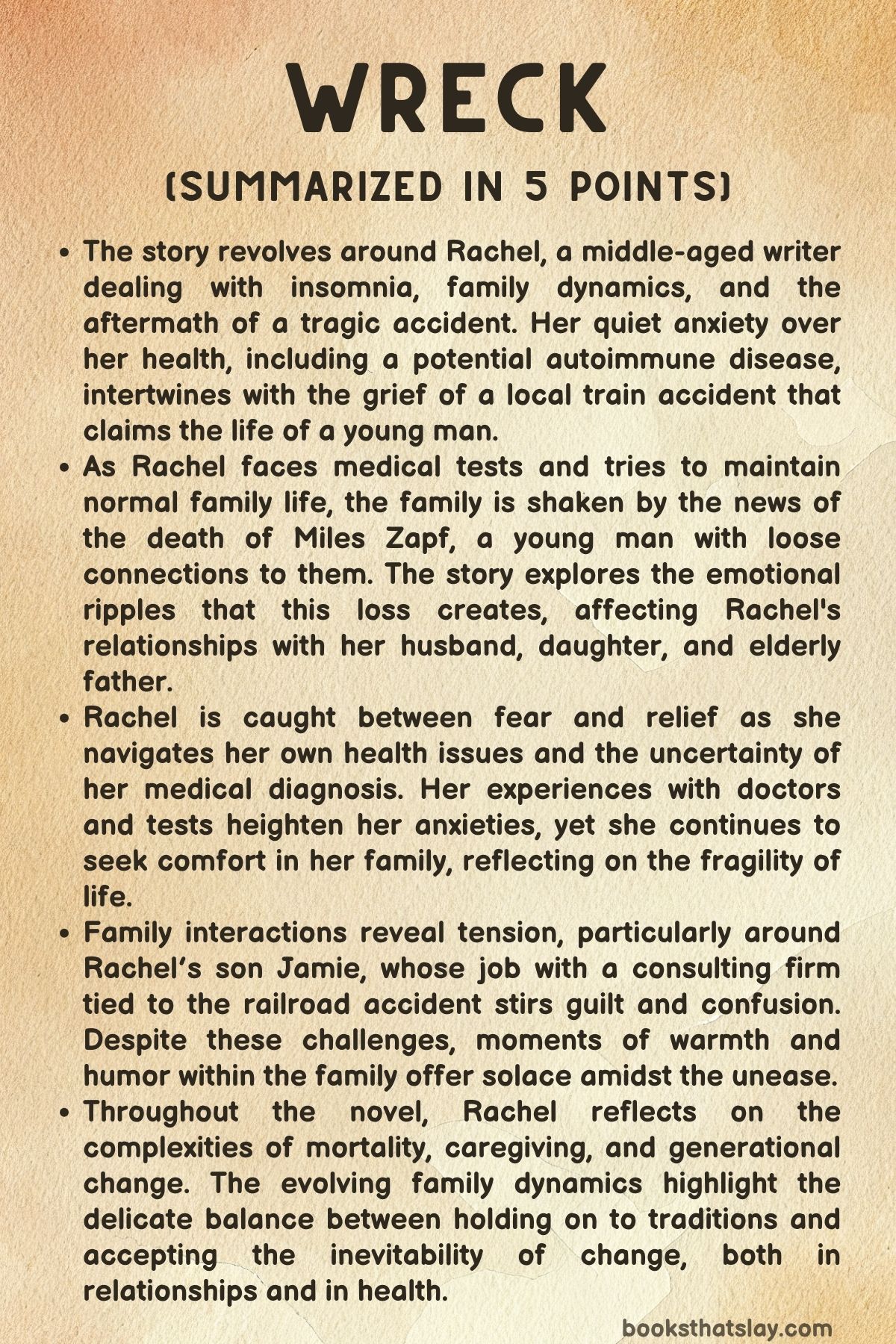
Wreck by Catherine Newman is a deeply reflective and emotional exploration of family, mortality, and the struggles that come with aging, illness, and loss. The protagonist, Rachel (nicknamed Rocky), is a middle-aged writer navigating her own anxieties about her health while managing complex family relationships.
As she faces the looming uncertainty of a potential autoimmune disease, her personal struggles intertwine with the tragic death of a local young man, Miles Zapf, who was killed in a train accident. This event serves as a catalyst for Rachel’s emotional journey, revealing the deep, often unresolved tensions within her family, particularly her relationships with her son, Jamie, and her aging father. Wreck weaves together themes of fear, grief, and the fragility of life, offering a poignant portrayal of a family trying to cope with their challenges and stay connected in the face of overwhelming circumstances. It’s the 2nd book in the Rocky series by the author.
Summary
The story opens with an unsettling scene of a car and a train heading towards a collision, ending in the death of a man, Miles Zapf. The protagonist, Rachel, is a middle-aged insomniac writer, unable to sleep one night due to an itchy rash on her arm.
In her restless state, she stumbles upon a local news story detailing the fatal crash that took place nearby. The news brings her immediate anxiety, as she realizes the accident might have been a suicide, but also reflects on her own fears of death and losing her loved ones.
The next morning, Rachel continues with her usual routine, dealing with family matters—her husband Nick attempts to fix a ceiling fan, and their daughter Willa lounges in the kitchen while Rachel’s elderly father, who lives in their guesthouse, joins them for breakfast. The family learns of the accident’s victim, Miles Zapf, who was a former classmate of Rachel’s son, Jamie.
Rachel is struck by the news and finds herself deeply unsettled by the accident, imagining the grief of Miles’s mother, Christine.
As Rachel’s thoughts continue to revolve around the crash, she experiences a series of medical appointments concerning a rash on her arm. After a visit to her dermatologist, she learns that her rash is not cancer, but a condition called granulomatous dermatitis, which might be autoimmune-related.
This revelation brings temporary relief, but the uncertainty about her health lingers, especially as she faces the possibility of more serious autoimmune diseases, such as lupus.
In the midst of her health concerns, Rachel becomes increasingly obsessed with the story of Miles’s death. She follows updates online, reading tributes from his family and angry posts from his grandmother, blaming the railroad company for the accident.
The train’s safety systems, including the possibility of mechanical failure or human error, become a constant source of speculation. Rachel’s anxiety about the situation deepens as she contemplates the possibility that the railroad’s cost-cutting measures might have led to the tragedy.
Rachel’s own health issues continue to weigh on her. After undergoing further blood tests, she finds disturbing results, with one indicator suggesting an autoimmune condition.
Despite reassurances from Nick, Rachel cannot stop herself from researching her symptoms online, which leads her down a path of fear and uncertainty. She struggles to balance her worries about her own health with the needs of her family, especially her daughter Willa, who is preparing to leave for college.
The complex dynamics between mother and daughter—both dealing with their own anxieties—become a central part of the narrative.
Rachel also reflects on her aging father, who is still living independently but shows signs of memory loss and vulnerability. Their interactions are often filled with humor, but there is a sadness in Rachel’s awareness of his declining health.
This relationship becomes even more poignant as Rachel deals with her own fears of mortality.
As Rachel spends more time thinking about Miles’s death, she attends a family dinner where her son Jamie, who works as a consultant, confesses that his firm had been involved in advising the railroad company. This admission shakes Rachel, causing her to confront her conflicted feelings about her son’s role in the tragedy.
Despite her love for Jamie, she struggles to reconcile the family’s connection to the accident with her protective instincts as a mother.
The family’s emotional tension comes to a head when they learn that Jamie’s consulting firm had advised the railroad on cost-cutting measures that may have contributed to the accident. Rachel feels betrayed and heartbroken by this revelation, but Jamie explains the nature of his work, which often involves making difficult decisions that prioritize profits over safety.
This discussion only deepens Rachel’s emotional turmoil, as she grapples with the moral implications of Jamie’s involvement in a tragedy that has affected so many lives.
As Rachel continues to cope with these family tensions, her health worsens. She undergoes a series of medical tests, including biopsies and scans, each one more stressful than the last.
The uncertainty of her condition, combined with the emotional strain of the family drama, leaves her feeling overwhelmed. However, despite the mounting challenges, she tries to hold onto moments of joy, whether through small family gatherings or time spent with friends.
The holidays serve as a backdrop for many of the family’s interactions. During Thanksgiving, Rachel reflects on her late mother and the traditions that continue to hold the family together, even as they face significant change.
Willa’s impending departure for college symbolizes a larger shift in the family dynamic, as Rachel contemplates what it means to let go and navigate the next phase of life.
The emotional weight of the story culminates in a family outing to watch the aurora borealis, where Rachel, Jamie, Willa, and Nick experience a fleeting moment of beauty and togetherness. Despite the looming uncertainties in their lives, the family is able to find solace in each other’s presence, if only for a brief moment.
The novel ends with a sense of resignation but also a recognition of the fragility and preciousness of life, love, and family.
Wreck is a narrative that explores the intersections of personal health, familial ties, and societal issues through the lens of an ordinary family facing extraordinary circumstances. Rachel’s journey is one of reflection and acceptance, as she learns to navigate the complexities of aging, illness, and grief, while maintaining her connection to the people she loves most.
The story ultimately emphasizes the importance of living fully, despite the challenges that come with an unpredictable and often uncontrollable world.
Characters
Rachel (Rocky)
Rachel is the protagonist of Wreck, a woman in the midst of a personal and familial crisis. As a middle-aged insomniac writer, her days are often overshadowed by her mounting health concerns, including a potential autoimmune disease that looms over her life.
Rachel’s anxiety is a constant presence in the story, as she oscillates between worrying about her own well-being and her fear of losing those closest to her. Her interactions with her family—husband Nick, daughter Willa, and elderly father—are filled with a mixture of love, humor, and tension.
Despite the strain of her health worries, Rachel is portrayed as a deeply caring individual, concerned with the minutiae of everyday life and the emotional complexities that come with it. She is reflective and prone to moments of existential anxiety, often contemplating the fragility of life and the weight of impending death.
The tragedy of the train accident involving Miles Zapf serves as a backdrop to Rachel’s musings on grief, family, and the randomness of life’s most challenging moments.
Nick
Nick is Rachel’s supportive yet somewhat distant husband, who serves as a grounding presence throughout the narrative. While he is often depicted as pragmatic and calm, he is not entirely immune to the stress of the family’s circumstances.
His role in the story is less about his own emotional journey and more about providing stability for Rachel. Nick’s main concern is his wife’s health, and he does his best to reassure her during her anxious episodes.
Though he is occasionally preoccupied with everyday tasks, such as fixing the ceiling fan or picking tomatoes, Nick’s relationship with Rachel is marked by mutual affection and humor. He serves as a foil to Rachel’s more anxious and introspective nature, offering a balance to her emotional turbulence.
Willa
Willa, Rachel’s daughter, is an essential part of the family dynamic, and her presence adds both a sense of continuity and generational tension. Willa is a neuroscience researcher, and her intellectual approach to life sometimes clashes with the emotional undercurrents of her family.
She often provides comic relief through her interactions with Rachel and her grandfather, but there is a deeper layer to Willa’s character. She is deeply affected by the tragedy of Miles Zapf’s death, and her emotional response to the incident highlights her sensitivity and the weight she feels about the unpredictability of life.
Willa’s relationship with Rachel is one of both love and understanding, though it also involves moments of tension, particularly around the impending changes in their family structure as Willa prepares to leave home. She is portrayed as an adult on the cusp of her own journey, balancing her intellectual pursuits with the emotional challenges of supporting her family.
Jamie
Jamie, Rachel’s son, represents a source of tension in the family, particularly for Rachel, as his professional life becomes intertwined with the tragedy surrounding Miles Zapf’s death. As a consultant for the railroad industry, Jamie is indirectly linked to the events that led to the train accident, and this complicates his relationship with his mother.
Rachel’s internal conflict about Jamie’s role in the accident underscores the story’s exploration of moral ambiguity and personal responsibility. Jamie’s conversations with Rachel reveal his own discomfort with his work, particularly the ethical implications of profit-driven decisions that affect public safety.
Despite this, Jamie remains a caring and supportive figure for his family, and his relationship with Rachel is ultimately one of love, though it is clouded by the larger, more troubling circumstances that he finds himself in. His attempts to navigate the fine line between career obligations and personal values add depth to his character, making him a multifaceted and relatable figure within the family dynamic.
Miles Zapf
Although Miles Zapf is not a central character in the traditional sense, his presence looms large over the entire narrative. His tragic death in the train accident serves as the catalyst for many of the emotional and psychological shifts that the characters experience, particularly Rachel.
Through the lens of Rachel’s obsession with the crash and her online research into Miles’s life and death, the reader learns about his vibrant, albeit short, life. His family’s grief, especially that of his mother Christine, becomes a mirror for Rachel’s own maternal fears and anxieties.
Miles’s death also symbolizes the randomness of life and the harshness of untimely loss, adding an element of existential reflection that pervades much of the story. Though we never fully know Miles beyond the images and posts that Rachel encounters online, his death underscores the narrative’s focus on grief, family, and the complexity of human emotions in the face of tragedy.
Jo
Jo is Rachel’s close friend, providing a much-needed outlet for humor and levity in the narrative. Her playful interactions with Rachel, especially during their shared moments of intoxication at a campsite, offer a contrast to the more serious tones of the story.
Jo represents the emotional support system outside of Rachel’s immediate family, a necessary figure who helps Rachel escape, even if briefly, from the weight of her health and familial worries. Her friendship with Rachel serves as a reminder that amidst life’s complexities, the bonds we form with others can provide solace and relief.
Jo’s role is secondary, but her contributions to the story provide a sense of balance and respite from the more intense emotional turmoil Rachel faces.
Themes
Grief and Loss
The exploration of grief and loss in Wreck takes on multiple forms, illustrating how it affects individuals differently. The sudden death of Miles Zapf in the train crash acts as a catalyst for reflection on the nature of loss.
While the family is not directly related to Miles, the tragic event stirs up complex emotions and forces Rachel, and the others, to confront their own fears of mortality. This is particularly evident in Rachel’s reactions, where she obsessively follows the news of the accident, feeling connected to the grieving mother and reflecting on the fragility of life.
The grieving process is subtly examined through the family dynamic, as Rachel’s father reminisces about his late wife, while Rachel herself wrestles with her own potential diagnosis of a terminal illness. The loss of loved ones, whether through death or impending illness, underscores the story’s broader meditation on human vulnerability.
This sense of loss is not just physical, but emotional and existential, as characters reflect on what it means to live with the knowledge that time is finite. Grief is interwoven with the way family members try to maintain normalcy and comfort each other, showing how personal suffering is often mirrored in the way people relate to others.
Health and Mortality
The theme of health and mortality permeates Wreck, focusing not only on the physical symptoms and diagnoses but also on the psychological toll of illness. Rachel’s health anxiety, stemming from her autoimmune condition and the possibility of a serious illness, brings a sense of dread and helplessness throughout the narrative.
Her constant search for answers, whether through online research or doctor visits, highlights the fear of an unknown fate and the struggle to accept the inevitability of death. This theme is further complicated by Rachel’s tendency to detach emotionally from her health issues, joking and deflecting the severity of her condition with humor.
This coping mechanism shows how people often try to make light of their fears in an attempt to regain control over their lives. At the same time, Rachel’s fear of death brings about reflections on the generational passage of life, as she observes her father’s decline and Willa’s growth and independence.
Health and mortality are not just concerns of the individual but impact family dynamics, as Rachel’s illness creates tension, worry, and even guilt within the family. The ongoing uncertainty about her health reflects the broader theme of how mortality looms over everyone, influencing their choices, relationships, and personal reflections.
Family Dynamics
The dynamics within Rachel’s family are complex and shifting, capturing the tensions that arise as family members face their own challenges. The interactions between Rachel, her husband Nick, their daughter Willa, and Rachel’s elderly father show a blend of love, support, and unspoken conflicts.
A major focus of the story is Rachel’s relationship with her son, Jamie, especially in the wake of the tragic train accident. Rachel grapples with her instinct to protect Jamie, who works for the consulting firm involved in railroad industry cost-cutting, while also struggling with the realization that she cannot control his actions.
This creates a deep emotional conflict within Rachel as she balances her desire to keep her family safe with the acknowledgment that her children are growing up and making their own decisions. The relationship between Rachel and her father also adds a layer of tension, especially as he becomes increasingly frail and begins to show signs of memory loss.
There is an underlying sadness in their interactions, as Rachel reflects on her mother’s passing and the emotional gaps that exist between family members. The dynamics shift when Willa, too, begins to prepare for her departure, signaling the inevitable changes in the family structure.
Despite these challenges, love and care remain at the core of their interactions, showcasing the resilience of familial bonds even as they face personal trials and existential shifts.
The Impact of External Forces
Wreck also touches on how external forces, such as societal pressures, economic instability, and systemic failures, affect individual lives. The train crash that kills Miles Zapf is not just a random event; it is tied to broader issues within the railroad industry, including cost-cutting measures and insufficient safety precautions.
The involvement of Jamie’s consulting firm in these decisions adds another layer of complexity to the situation, as Rachel grapples with her son’s professional role and the moral implications of his work. The tension between personal responsibility and corporate interests is a key element of the story, illustrating how individuals often find themselves caught in the web of larger, impersonal forces beyond their control.
The family’s sense of helplessness is exacerbated by these external realities, such as the bureaucratic inefficiencies Rachel faces while seeking medical treatment or the societal pressure to meet expectations, whether through gathering community-shared grapes or navigating complex healthcare systems. These external forces shape the family’s actions and emotional states, creating a backdrop of societal critique that frames their personal struggles.
The story illustrates that while individuals may try to maintain a sense of control over their own lives, they are often at the mercy of larger systemic and societal systems, highlighting the tension between individual agency and external circumstances.
Anxiety and Fear of the Unknown
Anxiety is a pervasive theme in Wreck, especially in the form of health-related worries, existential fears, and the uncertainty of the future. Rachel’s constant worry about her health and the potential for a life-threatening illness consumes much of her time and energy, driving her to obsessively search for answers online and overanalyze her symptoms.
This anxiety is not just about the immediate concern of her own health but about the broader fear of mortality and the unknown. As Rachel grapples with her own diagnosis and the potential consequences, she is faced with the anxiety of what lies ahead—what her future may hold and whether her family will be left to cope without her.
This fear of the unknown is mirrored by the characters’ experiences with the train accident, where the cause of Miles’s death remains shrouded in mystery. The uncertainty surrounding both the accident and Rachel’s health creates a sense of existential dread that permeates the narrative, making every moment feel fragile and uncertain.
Anxiety also manifests in the family’s relationships, where moments of joy are often tinged with underlying fears of loss, change, and the passage of time. The theme of anxiety reflects the universal human condition of confronting the unknown, whether in terms of personal health, the safety of loved ones, or the uncontrollable forces that shape our lives.