X’s and O’s Summary, Characters and Themes
X’s and Os by Elle Thorpe is a dark romantic thriller that explores the intersection of trauma, love, and obsession. The story follows Violet Garrisen, a young woman trying to rebuild her life after a horrifying encounter with a predatory client, and Levi Griffin, an ex-convict seeking redemption after years behind bars.
Their bond, born through handwritten letters, becomes the emotional core of a violent and morally gray world filled with vigilantes, murderers, and broken souls searching for connection. Thorpe crafts a dangerous and tender narrative that questions what it means to be loved, saved, and truly seen.
Summary
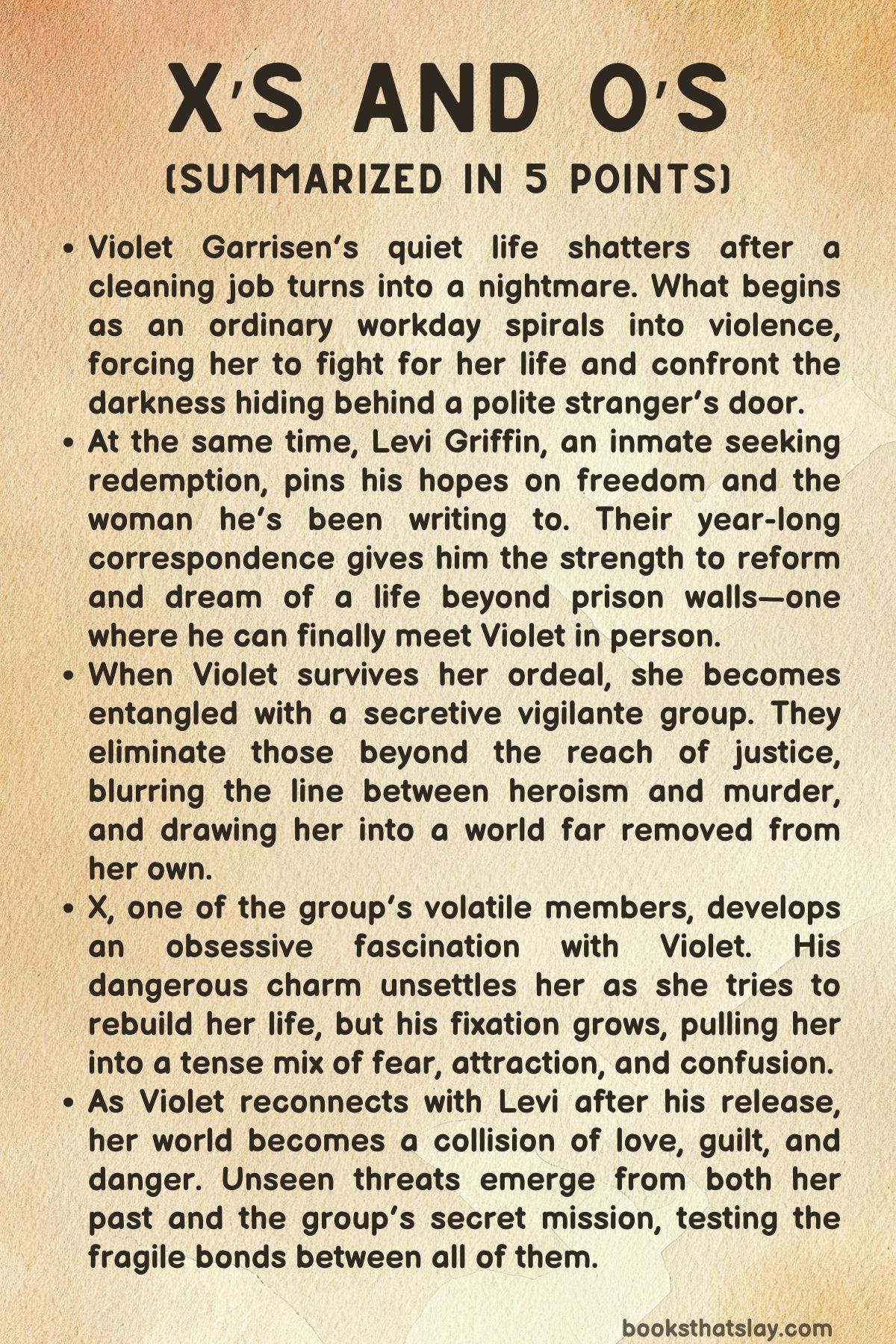
Violet Garrisen begins her day writing a letter to her mysterious pen pal, a man she knows only through his handwriting. After mailing it, she heads to her cleaning job at a luxurious house, expecting a routine task.
Instead, she encounters Paul, the homeowner, whose demeanor shifts quickly from awkward to menacing. His inappropriate comments escalate to physical assault, and before Violet can escape, he subdues her with a chemical-soaked rag.
At the same time, Levi Griffin sits in a prison cell, thinking about the woman who has kept him sane through a year of correspondence. Once a member of the Slayers motorcycle club, Levi has worked hard to reform—taking art classes, earning praise from teachers, and preparing for his upcoming parole hearing.
His only real connection is Violet, whose kindness through letters became his anchor and hope for a better life.
Violet wakes up bound and gagged in Paul’s house, terrified and confused. Before he can harm her, two men posing as pizza delivery workers arrive.
They aren’t there for food—they’re assassins. Their group, known as the Murder Squad, targets unpunished criminals.
The men force Paul to confess to murder before killing him in front of Violet. Horrified, she tries to escape but finds herself face-to-face with the killers, one of whom calls himself X.
The team’s leader, Grayson, arrives and decides Violet should live since she’s innocent. X, fascinated by Violet’s courage, declares that she’s the woman he will marry.
Grayson dismisses the comment and allows Violet to leave, but X’s obsession begins that night.
Shaken and covered in blood, Violet runs home. She hides the trauma from her best friend Toby, afraid of dragging him into danger.
The only thing keeping her grounded is the thought of Levi and his promise to meet her after his parole hearing. That letter—her simple “Yes”—is the thread tying her to hope.
Meanwhile, Levi faces the parole board, supported by letters from his teachers and his art portfolio. His remorse and transformation are evident, and the board grants him release.
Free at last, Levi dreams of meeting Violet, unaware of the violence she’s endured. But freedom isn’t easy—his past with the motorcycle club shadows him, and he refuses to return to their criminal lifestyle.
Violet tries to return to work, but her employer informs her that Paul has canceled his cleaning service—an impossible claim since he’s dead. The voicemail left by “Paul” is actually from X, mocking her and letting her know he’s still watching.
His obsession deepens as he stalks her, finding her through her workplace database. To his family, he’s a charming man with a job running an ice cream truck.
To Violet, he’s a haunting presence who appears everywhere she goes.
Levi’s first days of freedom are difficult. He writes to Violet, but when they finally meet, insecurities cloud their reunion.
She misreads his nervousness as rejection and leaves heartbroken. Levi, filled with regret, tattoos her name over his heart, a permanent reminder of the woman who gave him purpose.
As Violet tries to recover, she crosses paths with Wyatt “Whip” DeLeon, a sex instructor who moonlights as part of Grayson’s vigilante team. Their world collides again when Whip and his allies receive cryptic threats—poems suggesting someone knows about their secret operations and intends to punish them.
The threats mention Violet’s name, hinting she may be in danger.
While Violet attempts to move forward, X continues invading her life. One night, he sneaks into her apartment, teasing and confessing his feelings.
Though terrified, Violet feels conflicted—part of her recognizes his twisted devotion. Her boss cuts her hours, forcing her to seek work at a bar called Psychos, which turns out to be owned by Grayson’s group.
There, she encounters X again, along with Whip and Levi, forcing her to navigate a minefield of danger, lust, and unresolved emotions.
Against all reason, Violet’s relationship with X becomes strangely intimate. He’s protective yet unhinged, violent yet tender.
During one tense night, he gives her the knife he used to kill Paul, trying to prove his loyalty. Their attraction builds until fear overtakes them both.
Violet finds herself entangled in a chaotic triangle involving X, Whip, and Levi—all men drawn to her for different reasons.
Meanwhile, Whip, X, and Levi receive more threatening messages. The unknown sender’s poems predict death and mention Violet by name.
Realizing she’s the target, the men vow to protect her at all costs. Levi takes the first watch, trying to earn back her trust, while X’s fixation only grows.
X’s past is revealed to be one of abuse and instability. His violence stems from compulsion rather than malice, but even he fears losing control.
When he sneaks into Violet’s apartment and ends up in a charged moment with her in the shower, his dark impulses nearly overwhelm him. Panicked by what he might do, he flees, leaving Violet devastated.
Whip arrives and comforts her, and their connection deepens into a night of physical and emotional closeness.
Soon after, Violet receives a strange, typed letter—apparently from Levi—inviting her to meet him at a deserted warehouse. Toby insists on accompanying her, and they sneak past X, who’s waiting outside.
Inside the warehouse, they find another man, Adam Dickson, who also received an invitation. A recorded voice begins reciting a poem, trapping them in a deadly game that forces them to face their worst fears.
The rules are simple and horrifying: two must die for one to go free. As panic rises, Dickson tries to escape but is killed by a booby trap.
The countdown begins, forcing Violet and Toby to make an impossible choice. When survival instinct overtakes reason, Toby turns violent, and Violet realizes that the trap was designed to destroy them both.
Simultaneously, Levi learns about the setup from X and rushes to rescue Violet, unaware of the bloodbath already in motion. The story ends on a cliffhanger—Violet’s fate uncertain, Levi racing against time, and the group’s enemies closing in.
Xs and Os unfolds as a story about love born in impossible circumstances, the price of redemption, and the fine line between protector and predator. It explores how broken people find one another in the shadows and whether true affection can survive obsession, trauma, and revenge.
Characters
Violet Garrisen
Violet Garrisen serves as the emotional center of Xs and Os, embodying resilience, vulnerability, and the pursuit of safety and love in a world that continuously violates both. Introduced as a compassionate yet isolated woman, Violet’s decision to write letters to a prisoner hints at her deep yearning for connection and trust, both of which stem from her lonely upbringing in foster care.
Her innocence is shattered early when her cleaning job leads her into the clutches of Paul Jeddersen, whose assault leaves lasting trauma. Yet Violet’s strength lies in her refusal to be defined by victimhood—she fights, escapes, and carries the weight of that horror without surrendering her empathy.
Her correspondence with Levi becomes her emotional lifeline, offering her a sense of belonging and faith in goodness amid chaos. Throughout the novel, Violet’s journey transforms from that of a frightened survivor to a woman discovering her own agency.
Her interactions with the men around her—Levi, Whip, and X—force her to confront conflicting desires: safety versus danger, tenderness versus obsession, and self-preservation versus surrender. Violet’s character arc ultimately traces the evolution of a woman learning that love can coexist with pain but must never erase her autonomy.
Levi Griffin
Levi Griffin represents redemption personified—a man scarred by his past yet determined to rebuild himself through art, discipline, and love. Once a biker and criminal, Levi’s years in prison force him to confront his moral failures.
His letters to Violet reveal a man capable of tenderness and introspection, his affection filtered through the humility of someone who has truly repented. Levi’s parole hearing scenes underscore his internal conflict: shame over his past, gratitude for the chance at freedom, and fear that he might not deserve happiness.
After his release, Levi’s struggle deepens when real-world rejection and insecurity make him doubt his worthiness. His initial distance from Violet stems not from disinterest but from self-loathing—a belief that a man like him could taint the woman who believed in his redemption.
Levi’s artistry and tattooing become metaphors for his rebirth, with the violet tattoo over his heart symbolizing his devotion to her and his effort to transform scars into beauty. As the story progresses, Levi’s protective instincts emerge not just from love but from guilt—he sees in Violet’s trauma a reflection of the brokenness he once embodied.
Levi’s complexity lies in his quiet strength, his restrained emotion, and his continuous internal battle between the man he was and the man Violet deserves.
Knox (“X”)
Knox, known by his chilling alias “X,” is perhaps the novel’s most volatile and magnetic figure—a paradox of childlike innocence and predatory violence. As a member of a vigilante murder squad, X operates in moral grayness, killing criminals yet doing so with alarming zeal and lack of remorse.
When he meets Violet, his obsession transcends logic; he sees her as purity incarnate, a fixation that blurs the line between protection and possession. X’s mannerisms—his unpredictable humor, impulsive violence, and unsettling tenderness—illustrate the duality within him: a killer who yearns for love but doesn’t understand how to express it without control.
His infatuation with Violet awakens emotions he cannot process, leading to moments of both startling gentleness and near-fatal aggression. The infamous knife scene encapsulates his internal conflict: he hands her the power to kill him, as if seeking absolution or submission through her fear.
X is not a typical romantic antihero but a tragic study of fractured humanity—a man molded by chaos, capable of affection yet bound by violence. His relationship with Violet becomes both his salvation and his undoing, revealing that even monsters crave love, though their touch often destroys what they adore.
Wyatt DeLeon (“Whip”)
Wyatt DeLeon, known by his alias “Whip,” is the story’s steadying force—a man who masks emotional depth beneath sensuality and wit. As both a sex instructor and a vigilante, Whip bridges the divide between physicality and morality.
His approach to intimacy is rooted in respect and communication, contrasting sharply with the predatory energy of men like Paul or the obsessive dominance of X. When Violet enters his orbit, Whip becomes her teacher not only in pleasure but in self-worth.
His care for her—tender, deliberate, and devoid of judgment—helps her reclaim agency over her own body after trauma. Yet beneath his confidence lies exhaustion; Whip carries the emotional burden of his dual life, torn between the desire to protect others and the loneliness of his profession.
His bond with Levi and X often acts as comic relief but also exposes his role as mediator within their chaotic trio. Through Whip, the novel explores the healing power of trust and consent, positioning him as the emotional anchor in a narrative crowded by extremes.
While Violet’s relationships with Levi and X hinge on passion and danger, her connection with Whip embodies acceptance—a reminder that love can be gentle without being weak.
Toby
Toby, Violet’s best friend and roommate, offers levity, loyalty, and tragedy in equal measure. At first, he appears as comic support—the teasing confidant who mocks Violet’s pen-pal romance and offers protective affection.
Yet beneath his humor lies deep devotion and unspoken complexity. Toby functions as Violet’s moral compass and emotional guardian, stepping into the family role she never had.
His protectiveness, however, verges on possessiveness, subtly suggesting his own insecurities and possible unacknowledged feelings for her. As the story progresses, Toby’s cheerful façade crumbles under pressure, particularly when violence touches their lives again.
His tragic end in the warehouse—caught between fear and survival instinct—marks a devastating moment of transformation, showing how trauma can corrode even the most steadfast loyalty. Toby’s arc encapsulates the novel’s central theme: that love, in all its forms—romantic, platonic, or fraternal—can drive both salvation and destruction.
His death becomes the emotional fulcrum around which Violet’s courage crystallizes, turning her pain into the will to survive once more.
Grayson (“Doc”)
Grayson, often called “Doc,” serves as the ethical backbone of the vigilante group. A physician by profession and the leader of their “Murder Squad,” Doc embodies the paradox of healer and killer.
His presence grounds the chaos that characters like X and Whip unleash. For him, justice is not vengeance but equilibrium—the moral correction of a world that continually fails the innocent.
Through his measured calm, Grayson functions as both mentor and moral judge, ensuring the group’s killings adhere to a twisted but consistent code: no innocents, no chaos for pleasure. His interactions with Violet reveal his humanity beneath the stoicism, offering her compassion and safety after trauma.
Yet even Doc is haunted by doubt, aware that his brand of justice skirts the very evil he seeks to erase. In Xs and Os, Grayson represents conscience within corruption—a reminder that morality, like love, is fragile when wielded by flawed hands.
Themes
Healing from Trauma and Rediscovering Self-Worth
Violet’s journey throughout Xs and Os is anchored in her process of healing from profound trauma and reclaiming the sense of agency that life has repeatedly stripped from her. The assault at the beginning of the novel acts as a brutal manifestation of the violence and vulnerability that define her existence.
However, Violet’s trauma runs deeper—it is rooted in abandonment, neglect, and a lifelong battle to believe she is worthy of love. Her decision to write letters to an anonymous prisoner speaks to her yearning for connection and safety, both emotional and physical.
Through Levi’s correspondence, she finds a rare space where honesty is not punished and where her voice is heard without judgment. Yet, when Paul’s attack shatters her fragile sense of control, her journey becomes one of rebuilding herself from the wreckage of fear.
The narrative captures this healing not as a linear process but as one marked by setbacks, confusion, and contradictions—Violet oscillates between vulnerability and defiance, tenderness and self-protection. The presence of characters like X and Whip complicates her healing, forcing her to confront parts of herself she has buried—her desires, her fears, and her moral limits.
Her growing ability to assert boundaries, despite danger and emotional chaos, signals her gradual reclamation of identity. By the end, Violet’s courage lies not merely in surviving trauma but in daring to live authentically, even when her world is fraught with unpredictable violence and passion.
Redemption and the Struggle for Moral Renewal
Levi’s storyline embodies the search for redemption against a backdrop of guilt and self-loathing. Once a member of the Slayers motorcycle club, Levi’s imprisonment serves as both punishment and opportunity.
Through art and education, he attempts to cleanse himself of the moral stains of his past, yet the narrative makes clear that true redemption cannot be granted by a parole board—it must be earned internally. His relationship with Violet becomes the emotional compass guiding this pursuit.
In her letters, he finds not only empathy but a reason to envision a life beyond crime and confinement. However, upon release, Levi is confronted by a harsh reality: society’s distrust of ex-convicts and his own internalized shame.
The distance he places between himself and Violet during their first meeting reflects this insecurity, illustrating that self-forgiveness is far more difficult than earning external approval. Levi’s redemption is further tested through his involvement with the vigilante “Murder Squad,” where questions of justice and morality blur.
By participating in a group that kills criminals the law cannot touch, he faces the paradox of seeking atonement through violence. This conflict encapsulates the novel’s meditation on whether one can truly change while still navigating a corrupt, unjust world.
Levi’s evolution is slow, fragmented, and deeply human—a reflection of how redemption often coexists with the ghosts of one’s past, never fully erasing them but learning to live in their shadow.
Obsession, Power, and the Thin Line Between Love and Possession
X’s fixation on Violet is a disturbing yet psychologically rich exploration of obsession and control disguised as affection. His violent tendencies, masked by moments of childlike playfulness, reveal the dangerous fusion of love and power that defines his worldview.
To X, love is synonymous with possession—his vow to “marry” Violet after saving her from Paul exposes a warped perception of intimacy shaped by violence. Yet, the narrative complicates this dynamic by showing flashes of vulnerability within him; his obsession is rooted not in pure malice but in a desperate need for connection and belonging.
The contrast between his homicidal acts and his tenderness toward Violet blurs moral boundaries, forcing both her and the reader to confront the complexity of human darkness. Violet’s reluctant attraction to him is equally unsettling, illustrating how trauma can distort perceptions of safety and love.
Her simultaneous fear and fascination reveal the psychological scars left by abuse and loneliness. The novel refuses to offer a neat moral resolution—X’s love is toxic, yet it exposes truths about control, intimacy, and the human longing to be seen.
Through this dynamic, Xs and Os challenges readers to confront the uncomfortable reality that love, when intertwined with obsession, becomes a weapon as much as a refuge, capable of both salvation and destruction.
Justice, Morality, and the Ethics of Violence
The “Murder Squad” introduces a central moral tension within Xs and Os—the blurred line between justice and vengeance. By targeting those who have escaped legal punishment, the group positions itself as an extrajudicial moral authority.
Grayson, Whip, X, and Levi each embody a different relationship to violence: Grayson acts as the rational conscience, Whip as the conflicted mediator, Levi as the penitent seeking balance, and X as the unrestrained force of chaos. Through their interactions, the novel raises difficult questions—does righteousness justify murder if the victims are evil?
Can killing ever be a means of moral repair? Violet’s encounter with this world destabilizes her belief in absolute morality.
Having been failed by institutions meant to protect her, she understands the impulse behind vigilantism, yet remains disturbed by its cost. The narrative’s refusal to romanticize their killings underscores its moral complexity: violence may deliver closure, but it perpetuates cycles of trauma.
By the story’s later stages, as threats against the group surface, their brand of justice becomes self-destructive, suggesting that moral corruption is inevitable when individuals assume the role of judge and executioner. The theme ultimately portrays justice as an evolving struggle—one that demands accountability but also compassion, restraint, and acknowledgment of human imperfection.
Xs and Os thus becomes a meditation on the cost of taking morality into one’s own hands, questioning whether retribution can ever coexist with redemption.
Isolation, Connection, and the Human Need for Belonging
Throughout Xs and Os, isolation functions as both a prison and a survival mechanism for its characters. Violet, Levi, and even X exist on the margins of society—each disconnected from the world in distinct ways.
Violet’s loneliness stems from a childhood devoid of love, while Levi’s isolation is physical and psychological, shaped by years behind bars. X, despite his violence, suffers from emotional alienation, unable to communicate love in socially acceptable forms.
The letter-writing program symbolizes the fragile thread of connection that binds them together. Through words, they construct an emotional intimacy that transcends their circumstances, revealing the human yearning to be known and understood.
However, the novel exposes how easily such connections can turn volatile when built on secrecy, fantasy, or desperation. Violet’s relationships with Levi, X, and Whip reflect her oscillation between safety and danger, craving belonging yet fearing the vulnerability it demands.
The friendships she builds with Rebel and Bliss at Psychos, and her renewed courage to face life, show her slow integration into a chosen family—a stark contrast to her earlier solitude. The narrative suggests that healing and identity are found not in isolation but in authentic connection, even if those connections are messy, imperfect, and sometimes born from darkness.
Ultimately, Xs and Os portrays belonging as a fragile but essential part of the human condition—a force that redeems, destroys, and redefines every person touched by it.