Yesteryear Summary, Characters and Themes
Yesteryear by Caro Claire Burke is a dark, satirical domestic thriller about performance, faith, motherhood, and control. The book follows Natalie Heller Mills, a famous lifestyle influencer who sells an image of old-fashioned Christian womanhood through her brand, Yesteryear Ranch.
To her millions of followers, she appears serene, obedient, fertile, disciplined, and devoted to a simpler life. Behind that image, however, lies a world of staff, staged labor, political calculation, resentment, violence, and emotional neglect. As Natalie’s carefully built life collapses, the story turns into a disturbing account of how fantasy can become a prison when a person refuses to admit it was false.
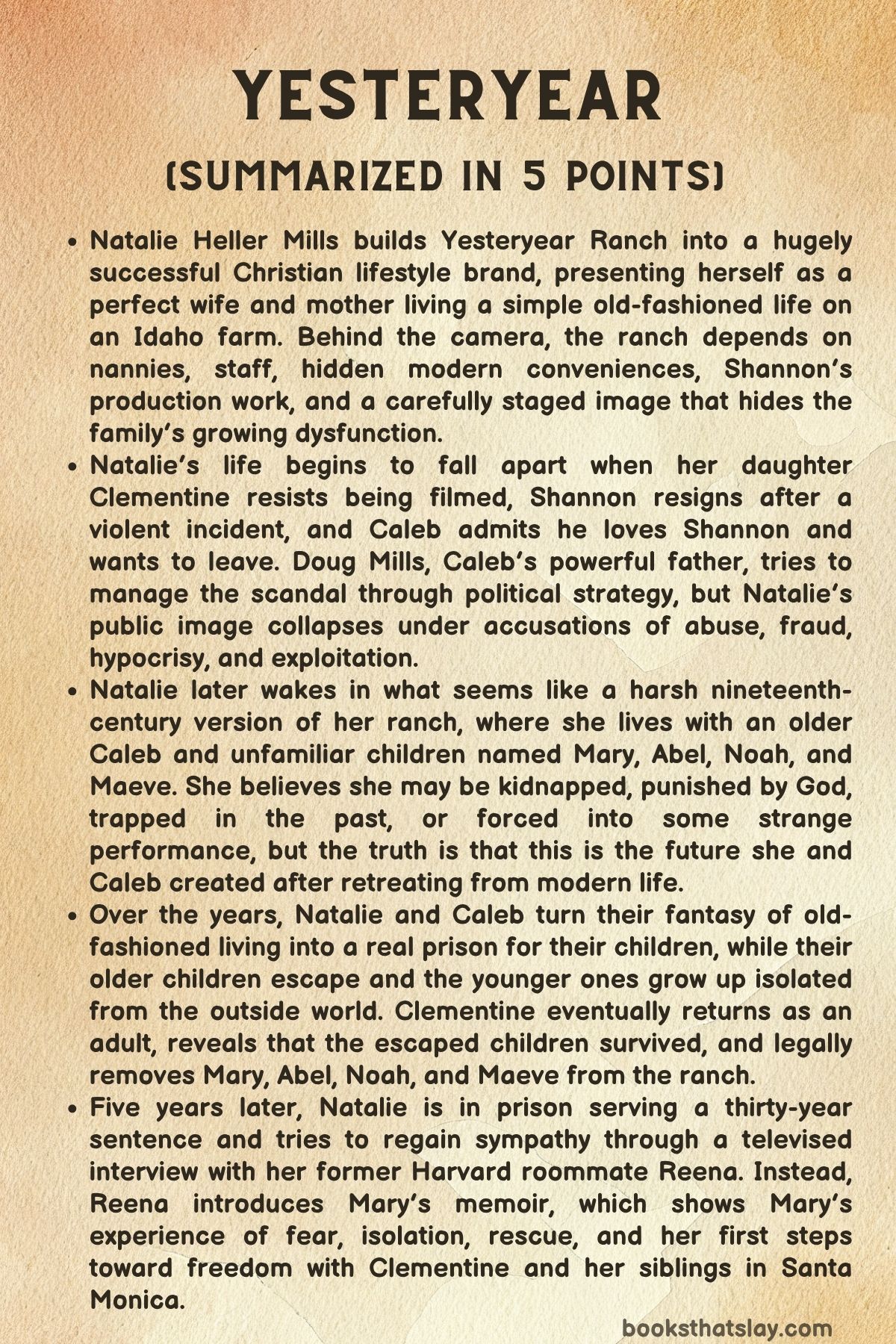
Summary
Natalie Heller Mills has built her life around the image of perfection. She is the face of Yesteryear Ranch, a remote Idaho farm where she presents herself as a devout Christian wife, mother, homemaker, and model of old-fashioned living.
Her followers see her baking bread, raising children, praying, dressing modestly, tending to domestic chores, and living as though modern convenience has not touched her home. She has turned this persona into a profitable brand that sells not only products but an entire vision of life: handmade aprons, salt blends, cutting boards, paint colors, and a fantasy of obedience, discipline, and rural purity.
Yet almost everything about that image is arranged. Natalie lives with her husband Caleb and their children Clementine, Samuel, Stetson, Jessa, Junebug, and an unborn daughter they intend to name Mary.
In public, she seems to manage motherhood and farm life with effortless grace. In private, she depends on two nannies, ranch hands, hidden appliances, modern systems, and a producer named Shannon who helps shape the content that followers consume.
The farm is less self-sufficient than it appears. Natalie’s calm online voice is a role.
Her home is not a return to the past so much as a set designed to look like one.
The last day of Natalie’s familiar life begins with small cracks in the performance. Clementine, her twelve-year-old daughter, asks what “tradwife” means.
The question unsettles Natalie because it proves Clementine has seen online commentary about her mother. Natalie suspects the nannies or Shannon have allowed the children too much access to the outside world.
Later, Natalie takes the girls to Target and runs into Vanessa, an old acquaintance. The encounter humiliates her because Target exposes the plain, ordinary side of her life that she tries to hide from her audience.
Afterward, when Natalie attempts to film the girls in the car, Clementine refuses and tells her to stop.
That same day, Shannon sends an email resigning from her job. Her message is not just professional; it carries accusation and fear.
She says the job has damaged her mental health, refers to something that happened over the summer, and announces that she is leaving by bus. Around the same time, Caleb tells Natalie that his father, Doug Mills, wants him to run for office.
Doug is a powerful senator with presidential ambitions, and Natalie understands that this sudden political push is not innocent. It is meant to protect the Mills family from a scandal that is about to become public.
The story then moves into a strange, frightening present. Natalie wakes in what appears to be an older, ruined version of her own ranch.
The electricity is gone, the house is freezing, the kitchen is lit by fire, and the children around her are not the ones she remembers. They call her Mama, but their names are Mary, Abel, Noah, and Maeve.
Caleb is there too, but he is harsher and older. When Natalie panics, runs, and begs to be taken home, he strikes her unconscious.
As she tries to understand where she is, she finds markings that suggest the year is 1855, and the place is called Yesteryear.
Natalie cannot decide what has happened to her. She wonders if she has been kidnapped, forced into some elaborate production, sent into the past, trapped in a test from God, or punished for her sins.
The house feels like the extreme version of the life she once performed online. There is no comfort, no hidden staff, no modern help, and no audience she can charm.
The labor is real. The obedience is real.
The isolation is real. She tries to escape but steps into a steel trap and badly injures herself.
Mary, the older girl in the house, stitches the wound with calm skill, revealing that she has been forced into adult responsibility far too young.
As Natalie struggles in Yesteryear, the book reveals her past. She grew up in a strict religious household in Idaho after her father abandoned the family.
Her upbringing gave her both resentment and hunger: resentment toward instability and hunger for a life that looked ordered, righteous, and admired. At seventeen, she went to Harvard but felt alienated by the wealthy, secular world around her.
Her roommate Reena represented everything Natalie felt judged by and excluded from. After a fight with Reena, Natalie moved into a single room, joined a Christian group, and met Caleb Mills.
Caleb came from wealth and political power, but he lacked direction. He was charming, handsome, and careless, the youngest son of a dynasty that expected usefulness from its members.
Natalie married him after her first year at college, became pregnant with Clementine, and left Harvard. At first, Caleb seemed like a doorway into a grander life, but Natalie soon realized he had little discipline or ambition of his own.
Doug, however, saw political possibility in him. Natalie decided that if Caleb would not naturally become the man he was meant to be, she would shape him herself.
The ranch becomes the project through which Natalie tries to build that life. She pushes Caleb toward the fantasy of farm living, and they buy land in Idaho.
The old farmhouse is renovated to appear historically authentic while preserving hidden modern comforts. Caleb enjoys the idea of being a farmer, though he avoids the hardest work.
Natalie creates the online identity of Yesteryear Ranch, and when a family photo goes viral, her platform grows rapidly. Followers adore the image of a beautiful mother with many children, a handsome husband, religious conviction, and a home that seems untouched by modern disorder.
With attention comes hostility. Many viewers accuse Natalie of hypocrisy, child exploitation, extremism, and false advertising.
Natalie learns that admiration and anger both increase her reach. She builds “Online Natalie,” a serene and smiling version of herself who can absorb criticism while turning every accusation into profit.
The more people watch, the more money the brand earns. The more they argue about whether she is admirable or dangerous, the more powerful she becomes.
As the family grows, Natalie’s private dependence on help grows with it. Nanny Louise, Nanny Aimee, and Shannon become essential to keeping the operation alive.
Shannon, in particular, sees how artificial the public image is. She notices the staged simplicity, the hidden workers, and the gap between what Natalie sells and how she actually lives.
Shannon stays anyway, becoming close to the children and eventually close to Caleb. This closeness becomes the emotional center of the coming disaster.
Caleb eventually tells Natalie that he loves Shannon and wants to leave her. He imagines going to New York with Shannon, abandoning the ranch and the performance that has defined their marriage.
For Natalie, this is not merely betrayal; it is destruction. Caleb is part of the brand, part of the political plan, and part of the image she sacrificed everything to create.
Natalie confronts Shannon, and the confrontation turns violent. In her rage, Natalie nearly strangles Shannon.
Shannon survives, but the incident threatens to expose the truth behind the ranch.
Natalie turns to Doug Mills for help. Doug responds not with concern but with strategy.
He understands scandal as a problem to be managed through money, lawyers, contracts, silence, and distraction. Caleb’s possible political run becomes part of that effort.
If the family can shift public attention toward ambition and respectability, perhaps the damage can be contained. But the scandal does not disappear.
Shannon speaks out, the public image collapses, and Natalie’s life becomes the very spectacle she once tried to control.
In Yesteryear, Natalie continues to live under Old Caleb’s authority. She suspects there are hidden cameras or microphones and imagines America watching her suffering.
Sometimes she behaves as though she is still performing and only needs to play the role well enough to be rescued. At other times, she thinks God is punishing her.
Slowly, she adapts to the brutal routines of the house. She cooks, cleans, sews, obeys, and cares for the children.
She bonds especially with little Maeve and with Mary, who seems to know lessons Natalie supposedly taught her even though Natalie remembers none of it.
The truth finally becomes clear: Yesteryear is not the past. It is the future Natalie created.
After Shannon’s revelations, the ranch was destroyed by lawsuits, public fury, accusations of abuse and fraud, and Doug’s political efforts to protect himself. Caleb told Natalie that Doug had even considered arranging her death in a staged car accident.
Natalie, already unstable, took old pills, fought with Caleb, and retreated further into delusion. Over the years, she and Caleb gave up modern life almost completely, not because they had traveled into history, but because they chose the fantasy until it consumed them.
When Clementine turned sixteen, she escaped with the older children. Natalie and Caleb remained on the ranch, still trapped in the world Natalie had once sold as paradise.
They had more children: Mary, Abel, Noah, and Maeve. Samuel and Stetson, now adults living nearby, secretly supplied the household with store-bought food while Caleb pretended to provide through old-fashioned labor.
Even the survival of Yesteryear is another lie. Caleb is not the rugged provider he pretends to be, and Natalie is not the holy mother she once claimed to be.
The children are the ones paying the price for the illusion.
Clementine eventually returns as an adult. She comes back not as the rebellious girl Natalie feared, but as someone determined to rescue her younger siblings.
She reveals that the escaped children survived and live nearby. She has stayed in contact with Shannon and has spent years planning a way to get Mary, Abel, Noah, and Maeve out.
With Doug’s money gone and Stetson finally cooperating, Clementine obtains legal authority to remove the children.
Natalie wants to go with them, but Clementine refuses. She tells Natalie that she built this prison and can leave it herself.
The words strip away Natalie’s last excuse. The children are taken away, and Natalie and Caleb are left alone in the empty ranch.
For the first time, Natalie admits that she hates him, and Caleb says he may hate her too. Their marriage is revealed as a long partnership of resentment, cowardice, ambition, and mutual ruin.
They decide to leave the ranch together, but the damage has already been done.
Five years later, Natalie is in custody, serving a thirty-year sentence for aggravated child abuse and other crimes. She agrees to a televised interview with Reena, her former college roommate, hoping once again to shape the public’s opinion of her.
Even in disgrace, Natalie wants control over the story. But Reena confronts her with Mary’s forthcoming memoir, The Book of Mary.
Through Mary’s prologue, the reader sees Yesteryear from the child’s side. Mary grew up isolated, frightened of the outside world, trained to obey, and taught that danger existed beyond the borders of the ranch.
Mary remembers meeting Clementine in the woods as something almost miraculous. Clementine becomes the figure who opens the door to escape.
After leaving, Mary lives in Santa Monica with Clementine, Maeve, Noah, and Abel. She learns to read and write, works, attends church, and begins to understand a world that had been denied to her.
Her account ends with the moment Clementine drove the children onto the highway, away from Yesteryear. Mary was terrified, but she was also free for the first time.
Characters
Natalie Heller Mills
Natalie Heller Mills is the central figure in Yesteryear, and she is written as both creator and victim of the false world she builds. She begins as a woman obsessed with order, image, faith, motherhood, and admiration.
Her public identity depends on presenting herself as a serene Christian wife who has rejected modern chaos for rural discipline, but the book steadily shows that her peace is artificial and her values are bound up with control. Natalie’s deepest flaw is not simply hypocrisy; it is her refusal to separate performance from truth.
She turns marriage, childbirth, homemaking, religion, and even her children into parts of a brand. When the brand collapses, she cannot accept ordinary failure, so she retreats into a harsher version of the fantasy.
Her later life in Yesteryear exposes the ugliness hidden beneath her curated image. She wants sympathy, but she rarely gives real freedom or safety to others.
Her tragedy comes from the fact that she can recognize suffering only when it is her own.
Caleb Mills
Caleb Mills is weak in a quieter but equally damaging way. He comes from money and political power, but he lacks the inner force to build a life honestly.
In the early years, Caleb lets Natalie shape him into the image of a rugged husband and future public figure because it gives him identity without requiring real discipline. He enjoys the appearance of farm life but avoids its hardest responsibilities.
His affair with Shannon shows both his hunger for escape and his cowardice, because he wants a new life without fully facing the destruction already caused by the old one. As Old Caleb, he becomes brutal, controlling, and bitter.
His violence toward Natalie and his domination of the younger children show how easily passivity can turn into tyranny when a person has power inside a closed household. Caleb is not merely Natalie’s victim or partner; he is an adult who repeatedly chooses comfort, secrecy, and cruelty over responsibility.
Clementine Mills
Clementine is one of the strongest moral forces in the book because she sees through the family performance before the adults are ready to admit it. As a twelve-year-old, her refusal to be filmed marks an important break in Natalie’s control.
She understands, at least instinctively, that her childhood is being used for public consumption. Her escape at sixteen is an act of survival, but her later return proves that she is not only trying to save herself.
As an adult, Clementine becomes the person who rescues the younger siblings from the prison her parents created. She is clear-eyed about Natalie’s guilt and refuses to let her mother fold herself into the role of fellow victim.
Her decision not to take Natalie with the children is harsh but necessary. Clementine represents the child who grows strong enough to name the harm, reject the false story, and protect those who cannot yet protect themselves.
Mary Mills
Mary is the emotional counterweight to Natalie because she reveals what life inside Yesteryear looks like to a child raised entirely within it. Unlike Clementine, Mary does not begin with memories of the outside world.
She has been taught fear, obedience, duty, and isolation as though they are natural laws. Her competence in the household is disturbing because it shows how much adult responsibility has been placed on her.
She stitches wounds, manages routines, and cares for younger siblings, but beneath that strength is a girl deprived of education, freedom, and ordinary childhood. Mary’s later memoir changes the reader’s understanding of the story.
It takes the narrative away from Natalie’s self-justifying perspective and gives voice to the child who endured the consequences. In Yesteryear, Mary’s movement toward literacy, work, church, and life with her siblings becomes a quiet but powerful sign that freedom can begin even after years of confinement.
Shannon
Shannon is crucial because she sees the machinery behind Natalie’s public image. As the producer of the ranch content, she understands how the brand is built through staging, editing, and concealment.
She notices the staff, the hidden modern comforts, and the difference between the fantasy sold online and the actual conditions inside the home. Her closeness to the children makes her more than an employee; she becomes someone emotionally attached to the family but also aware of its damage.
Her relationship with Caleb complicates her role, yet it does not erase the danger she faces from Natalie. The confrontation in which Natalie nearly strangles her becomes the turning point that exposes the violence beneath the brand.
Shannon’s decision to leave and later speak out helps bring down the false structure. She represents the witness who cannot remain safely inside the lie once the cost becomes unbearable.
Doug Mills
Doug Mills is the embodiment of institutional power, political calculation, and moral emptiness. As Caleb’s father, he sees family not primarily as a private bond but as an asset to be protected or sacrificed depending on political need.
When scandal threatens Natalie and Caleb, Doug does not respond with concern for Shannon, the children, or even the truth. He thinks in terms of legal pressure, money, silence, and public distraction.
His desire for Caleb to run for office reveals how politics can be used to redirect attention from private harm. The later revelation that Doug considered arranging Natalie’s death in a staged accident makes his ruthlessness even clearer.
He is not the source of every wrong in the family, but he creates the atmosphere in which image matters more than human life. His influence helps teach Natalie and Caleb that appearances can always be managed, until the damage grows too large to hide.
Reena
Reena begins as Natalie’s Harvard roommate and later returns as the interviewer who confronts her in prison. In Natalie’s youth, Reena represents the secular, wealthy, confident world that makes Natalie feel judged and displaced.
Their conflict at Harvard helps push Natalie toward the Christian group and toward Caleb, making Reena an early symbol of everything Natalie rejects. Years later, Reena’s role changes.
She becomes the person who sits across from Natalie when Natalie is still trying to shape public sympathy. Instead of allowing Natalie to control the conversation, Reena introduces Mary’s memoir and shifts attention toward the children’s experience.
Her presence completes a long circle in Natalie’s life. The woman Natalie once saw as an enemy of her values becomes the one who helps expose the final truth: Natalie’s story is not the only story that matters.
Samuel Mills
Samuel is one of the older children who escapes with Clementine, and his role shows the long-term damage caused by being raised inside a performative household. Though he is not explored as deeply as Clementine or Mary, his presence matters because he belongs to the group of children who remember the public version of the ranch and the private reality behind it.
His escape indicates that the older children understood the home as dangerous enough to leave behind. Later, he is part of the wider evidence that Natalie’s authority over the family has broken.
Samuel’s character helps show that the children were not passive props, even though Natalie treated them as part of her brand. His survival outside the ranch challenges the fear-based world Natalie and Caleb maintain for the younger siblings.
Stetson Mills
Stetson occupies a complicated position because he is both one of the children harmed by the family system and later someone connected to the rescue effort. As an older child who escaped, he carries knowledge of what Yesteryear truly was.
Yet he and Samuel secretly supply the remaining family with store-bought food, which shows how the old fantasy continues through hidden support. Caleb’s claim of self-sufficient survival depends partly on the silence and involvement of others.
Stetson’s eventual cooperation helps Clementine gain the authority needed to remove the younger children. This makes him part of the process that finally breaks the isolation.
His character shows how escape from an abusive family can be uneven and morally difficult, especially when the people left behind are still siblings in need.
Maeve
Maeve is the youngest child in Yesteryear, and her bond with Natalie reveals one of the few soft places left in Natalie’s damaged inner life. Natalie’s affection for Maeve is real, but it is not enough to undo the harm of the world she created.
Maeve’s innocence heightens the horror of the ranch because she has no power to understand or reject the rules around her. She depends entirely on the adults and older children, which makes her vulnerability especially painful.
Natalie’s growing attachment to Maeve also complicates the reader’s view of her, showing that she is not incapable of love. However, the book does not confuse love with safety.
Maeve still has to be taken away because affection without freedom, protection, and truth cannot save a child.
Abel and Noah
Abel and Noah represent the younger children whose lives have been shaped by Yesteryear’s isolation before they are old enough to question it. Like Maeve, they grow up inside a closed world where their parents’ delusions define reality.
Their role in the story is less individually detailed, but they are essential to the stakes of Clementine’s rescue. Through them, the book shows that Natalie and Caleb’s choices are not only past mistakes; they are ongoing acts of harm affecting another generation of children.
Abel and Noah’s removal from the ranch is therefore not just a plot resolution but a moral necessity. Their future remains less defined than Mary’s, but their escape offers the possibility of education, normal relationships, and a life not governed by fear.
Nanny Louise and Nanny Aimee
Nanny Louise and Nanny Aimee expose the gap between Natalie’s public image and private reality. Natalie sells herself as a mother who manages a large household through faith, discipline, and old-fashioned domestic skill, but the presence of nannies proves that this performance depends on hidden labor.
Their work allows Natalie to appear superhuman online while concealing the support that makes the brand possible. They also represent the broader system of workers who maintain the illusion while remaining outside the frame.
Though they are not the central emotional figures in the novel, their presence is important because it undercuts one of Natalie’s core claims: that her life is a model other women should be able to follow through devotion alone. The nannies show that the fantasy is not only false but unfair to the followers who believe it.
Vanessa
Vanessa’s brief appearance at Target is important because she brings ordinary reality crashing into Natalie’s controlled self-image. Natalie has built her identity around being seen in a certain way, and Vanessa sees her in a place that feels embarrassingly normal.
The encounter reveals how fragile Natalie’s sense of superiority is. She is not disturbed because anything terrible happens at Target; she is disturbed because being seen outside the curated world threatens the distance between her brand and everyday life.
Vanessa functions as a reminder that Natalie cannot fully escape the ordinary world, no matter how carefully she frames herself online. Her presence helps trigger Natalie’s anxiety on the day everything begins to break.
Themes
Performance as a Way of Life
Natalie’s life shows how performance can stop being a public act and become a private prison. At first, Yesteryear Ranch is a brand, a set of images, videos, products, captions, and values arranged for an audience.
Natalie knows what she is hiding: staff, modern comforts, staged labor, resentment, ambition, and fear. Yet the longer she performs old-fashioned virtue, the more she depends on the performance to understand herself.
Her public identity becomes more powerful than her private reality. This is why exposure feels like death to her.
She has not simply lied to followers; she has built a self that cannot survive being contradicted. The ranch’s later transformation into an actual place of deprivation shows the danger of turning fantasy into doctrine.
What began as content becomes a household system. What began as image becomes law.
The book argues that when a person treats life as a brand, other people are reduced to props, witnesses, enemies, or threats.
Motherhood, Control, and Exploitation
Motherhood in the story is not shown as automatically pure or selfless. Natalie uses motherhood as proof of virtue, but her treatment of her children is often possessive and exploitative.
Clementine’s refusal to be filmed reveals the central conflict clearly: Natalie sees the children as part of the family story she has the right to tell, while Clementine recognizes that her own privacy and personhood are being violated. The younger children suffer even more severely because Natalie and Caleb’s fantasy becomes the only world they know.
Mary is forced into responsibility far beyond her age, while Maeve, Abel, and Noah grow up inside fear and isolation. The book does not deny that Natalie feels love, especially toward Maeve, but it separates love from ownership.
A mother’s affection cannot justify confinement, public exposure, or emotional control. Clementine’s rescue of her siblings becomes a different model of care: protective, honest, and willing to confront the parent who caused the harm.
Faith, Image, and Moral Evasion
Religion in Yesteryear is tied closely to image, discipline, and self-justification. Natalie’s Christian identity gives structure to her brand, but it also gives her language for avoiding responsibility.
When she suffers, she imagines tests, punishments, and divine trials, but she is slower to consider the harm she has done to others. Faith becomes dangerous when it is used to protect the self from accountability rather than to deepen humility or compassion.
The ranch’s old-fashioned rituals and rules appear holy from the outside, yet inside they become tools of control. Natalie’s audience sees prayer, modesty, obedience, and family order; the children experience fear, isolation, and deprivation.
Mary’s later life complicates this theme because she still attends church after escape, suggesting that faith itself is not the enemy. The problem is faith turned into branding, authority, and denial.
The story draws a sharp line between sincere belief and a religious performance that excuses cruelty.
Escaping the Story Others Write for You
The children’s escape gives the book its strongest movement toward hope. Natalie tries to write everyone’s role: Caleb as husband and future public figure, Clementine as obedient daughter, Mary as dutiful helper, the younger children as proof of a righteous household, and Shannon as disposable employee.
The central act of resistance is refusing the role assigned by Natalie’s fantasy. Clementine does this first by rejecting the camera, then by leaving, and finally by returning to rescue her siblings.
Mary’s memoir continues that resistance by giving language to a life that had been controlled by silence. Learning to read and write becomes more than education; it becomes the power to record her own reality.
Reena’s interview also shifts control away from Natalie by placing Mary’s account before the public. Escape, then, is not only physical departure from the ranch.
It is the act of naming what happened, rejecting the false version, and building a life outside another person’s story.