You Are Fatally Invited Summary, Characters and Themes
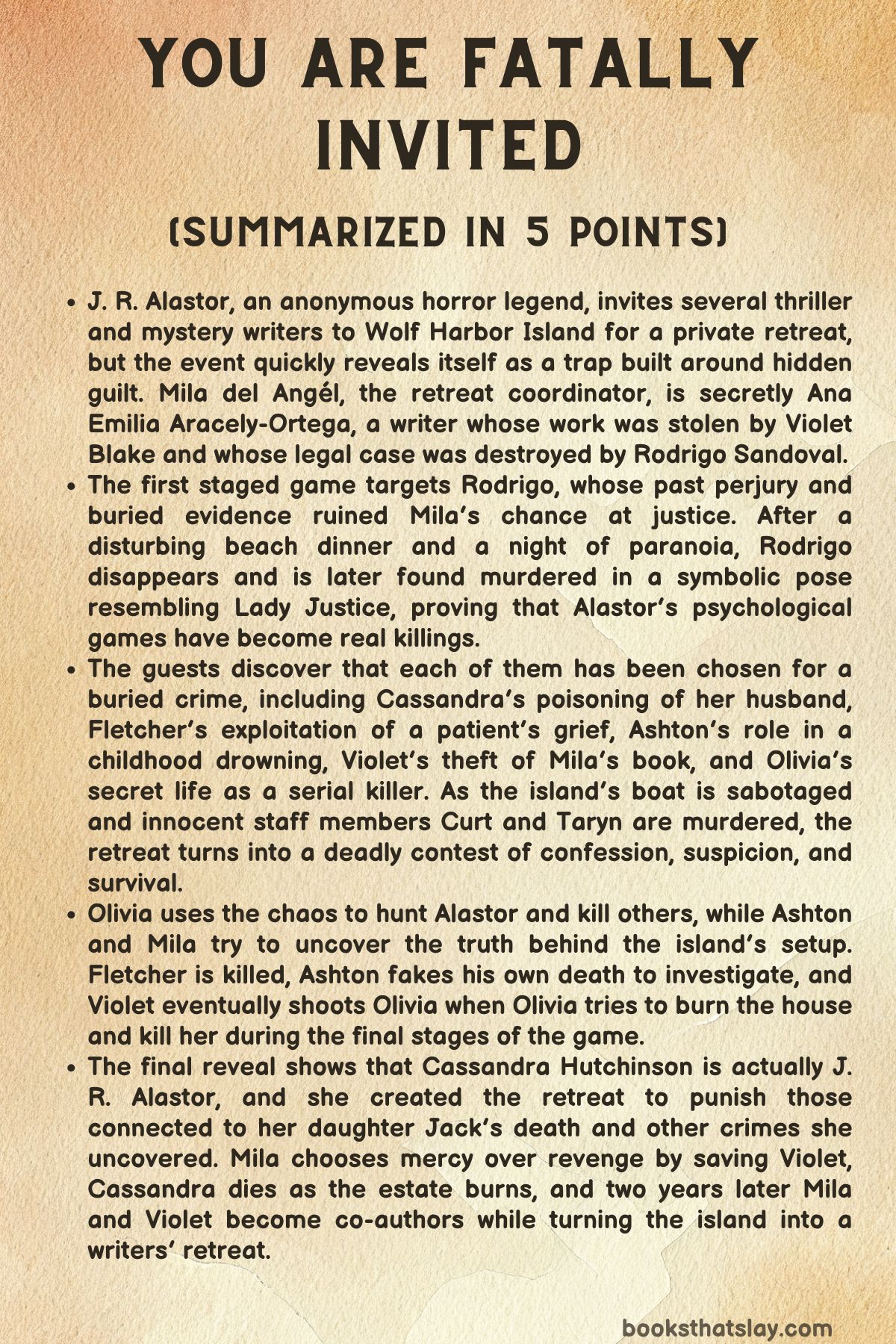
You Are Fatally Invited by Ande Pliego is a locked-island mystery about writers, secrets, revenge, and murder. The novel gathers several crime and thriller authors at a private retreat hosted by the famously unseen horror writer J. R. Alastor.
What begins as a prestigious literary event quickly becomes a staged judgment, with riddles, personal artifacts, hidden crimes, and deaths that mirror the guests’ own fiction. The story uses the writers’ careers against them, turning their plots, reputations, and buried sins into weapons. At its center is a question of whether guilt can be punished cleanly, or whether revenge only creates more damage.
Summary
The story begins through selections from J. R. Alastor’s writing guide, where horror is presented as a force that pushes people into the truth of their guilt. Alastor is a legendary horror author who has never shown his face publicly, and his secrecy has only increased his power in literary circles.
When he invites a small group of thriller and mystery writers to Wolf Harbor Island for a private retreat, the invitation feels both strange and irresistible. The guests are bound by NDAs and expect an unusual but important opportunity hosted by a literary icon.
The invited writers include Rodrigo and Olivia Sandoval, a married pair who write together; Ashton Carter, a successful bestselling author; Thomas Fletcher, a sharp and unpleasant writer with a background in therapy; Cassandra Hutchinson, an elderly suspense novelist; and Violet Blake, a young literary author with a rising reputation. They arrive expecting to meet Alastor, but he is not waiting at the dock.
Instead, Mila del Angél, his event coordinator, welcomes them and leads them to the estate. The house is filled with signs of careful preparation.
The guests find displays of their own books, Alastor’s work, and a Museum Room full of horror objects and literary artifacts.
Rodrigo feels uneasy from the start. He suspects that the retreat has a hidden purpose, especially when he sees people tied to his past.
Years earlier, when he worked as a lawyer, he helped destroy Mila’s chance at justice. Mila was once Ana Emilia Aracely-Ortega, a writer whose work had been stolen by Violet Blake and used as the basis for Violet’s breakthrough book, An Ecology of Scars.
When Mila tried to fight back legally, Rodrigo, as the opposing lawyer, buried evidence and lied under oath. He has lived with the memory of what he did, and the island begins to feel like a trap designed especially for him.
Mila, meanwhile, is not simply an employee. Alastor contacted her because he knew what Violet and Rodrigo had done.
He offered her a way to confront them by helping stage a retreat built around psychological games. Mila believes the plan is to expose guilt, force confessions, and create a form of moral reckoning.
She does not realize at first that Alastor’s plan is far more violent than he has allowed her to believe.
The first evening’s dinner is held on the beach. Alastor again does not appear in person.
Mila presents a disturbing riddle involving a raw fish without scales or eyes, served cold. The writers work through the clues and connect the image to justice and revenge.
Rodrigo understands that the riddle points directly at him. Mila secretly drugs him with amphetamines, increasing his fear and suspicion, while Olivia is given a sedative.
Later that night, Rodrigo leaves his room and searches Alastor’s study, hoping to uncover the host’s identity. During the key hour, the cameras go down, and Rodrigo vanishes.
The next day, Mila is alarmed when Rodrigo cannot be found. The guests begin discovering signs that the retreat has shifted into something more dangerous.
Books have been defaced, objects are missing, and each person receives a personal “cursed artifact.” Cassandra’s is a black widow spider, Violet’s is a dead blue bird, Fletcher’s is a fountain pen, Olivia’s is a preserved flower, Mila’s is a snakeskin, Ashton’s is a book, and Rodrigo’s is a map. The map leads the group to an old cemetery on the island.
There, they find a tombstone bearing Rodrigo’s name. Nearby, Rodrigo’s body is tied to a tree in the pose of Lady Justice, with scales and a knife attached to his hands.
His eyes have been removed. The murder copies imagery from a book written by Rodrigo and Olivia.
Mila realizes that Alastor’s performance has become real murder. She confronts him through the island’s private network, but he only deepens the game.
He claims that the guests can survive if they play properly and change. The retreat becomes a test in which every person’s hidden crime is turned into a clue.
Cassandra soon realizes that Alastor knows her own secret: she killed her second husband, Michael Rothchild, by using peanut oil to trigger his fatal allergy while making sure she appeared to be elsewhere. Cassandra has also been tied to other parts of the island’s web of secrets.
Soon after this, she disappears. Her room suggests she was dragged through the window, and a bloodstain below implies she was thrown out and her body taken by the sea.
The survivors try to escape, but the boat has been sabotaged, and no supply boat arrives. Alastor’s next game uses cards resembling Clue, forcing the guests to match people with professions and crimes.
The possible sins include Child Murderer, Perjurer, Poisoner, Thief, Exploiter, Accomplice, and Serial Killer. The game confirms that everyone has been selected for a reason.
Ashton begins to study the pattern more closely and reveals that he used to be a police officer. His own guilt comes from childhood.
At camp, he caused the drowning death of a girl named Jack during a cruel prank, though he nearly drowned as well and has spent his life carrying the trauma.
The violence continues. Curt and Taryn, two staff members who had no part in the island’s crimes, are found dead in Alastor’s study with their throats cut.
Mila is devastated because she had wanted to keep them safe. Alastor claims their deaths are punishment for the group refusing to obey the rules, but another hidden voice in the story reveals the real killer.
Olivia murdered Curt and Taryn because she suspected they might be Alastor. She is not the mastermind behind the retreat, but she is a killer in her own right.
She has killed before and hidden her methods inside the plots of her books. As the island collapses into fear, Olivia begins using the chaos to search for Alastor herself.
Alastor’s next command forces everyone to stay locked in their rooms from sunset to sunrise. Fletcher, whose crime involves exploiting Cassandra’s private grief through his work as a therapist and writer, tries to drug Mila under Alastor’s instructions.
Mila realizes what is happening and makes herself vomit before the drug can fully take effect. Ashton begins working with Mila, and later he fakes his own death with Olivia’s help, using a shallow wound and nail polish to make it look as if his throat has been cut.
This allows him to move secretly and investigate. Fletcher is then killed in a manner that echoes a death from his own fiction.
The final games draw the remaining women toward open confrontation. Olivia tries to force her way closer to Alastor and turns on Violet during a “Final Girls” game.
She plans to set the house on fire with gasoline, but Violet shoots her first. Before dying, Olivia says she had helped “him,” which suggests that another person is still manipulating events.
Mila and Violet are then driven toward the Museum Room for the final confession. Violet finally admits that she stole Mila’s work.
Mila reveals that she is Ana, Violet’s former critique partner, and that Alastor used Mila’s pain and desire for revenge to bring Violet to the island. The two women are trapped inside an old confessional while the house catches fire.
The game is arranged so that only one can escape unless one person chooses sacrifice. Mila decides to let Violet go and remains behind.
At this point, Cassandra appears alive and reveals herself as the real J. R. Alastor. Her identity as Cassandra Hutchinson was a disguise within a disguise.
She faked her death and designed the retreat to punish the people connected to her daughter Jack’s drowning, her husband Michael Rothchild’s corruption, and the many crimes she uncovered while following the chain of secrets. Cassandra expected the guests to act selfishly, but Mila’s willingness to save Violet changes the ending she had prepared.
Instead of leaving Mila to burn, Cassandra releases her.
As the fire spreads, Ashton is found strapped beneath the dock, left to drown with the rising tide as punishment for Jack’s death. Violet runs to save him.
Cassandra stays behind as the estate burns and explodes. Investigators later conclude that the disaster was caused by a gas leak, rather than arson or a planned massacre.
A week later, Ashton, Mila, and Violet reunite and piece together the truth. Cassandra was Alastor.
Michael Rothchild was her husband. Rodrigo helped destroy Mila’s legal case.
Fletcher exploited Cassandra’s pain. Olivia was a serial killer.
Violet stole Mila’s work. Ashton caused Jack’s death.
They decide not to expose every detail because most of the worst offenders are dead, but they also agree to anonymously help identify Olivia’s possible victims.
Two years later, Violet and Mila have become co-authors of a bestselling book called A Deadly Invitation. Mila is publicly recognized for her role in the work that first made Violet famous, and the two have turned what remains of Wolf Harbor Island into a retreat for writers.
Ashton remains close to them. The story ends with the sense that some crimes have been answered, some relationships have been repaired, and some secrets may still remain beneath the official version of events.
Characters
Mila del Angél / Ana Emilia Aracely-Ortega
Mila is one of the central figures in You Are Fatally Invited, because the retreat is built partly around her pain, her stolen work, and her desire for justice. She begins as Alastor’s event coordinator, appearing controlled, professional, and loyal to the mysterious host, but her real identity reveals why she has agreed to take part.
As Ana, she once trusted Violet with her writing, only to have that trust betrayed when Violet used her work to build a successful career. Rodrigo’s actions as a lawyer then deepened the injury by helping bury the truth.
Mila enters the island hoping for exposure and revenge, but the murders force her to confront the difference between justice and cruelty. Her most important turn comes when she chooses to save Violet instead of letting revenge decide her actions.
That choice separates her from Alastor and proves that she is not defined only by what was taken from her.
Violet Blake
Violet is a young literary writer whose public success rests on a private betrayal. Her first major book, An Ecology of Scars, was largely built from Mila’s stolen writing, and her career has been shaped by that theft.
In the book, Violet is not presented as innocent, but she is also not a simple villain. She carries fear, shame, and defensiveness, and her time on the island forces her to face the human cost of what she did.
Her confession to Mila matters because it breaks through years of denial. Violet’s survival is tied not to being morally clean, but to her ability to accept guilt and act differently afterward.
When she shoots Olivia, she saves herself and others from immediate danger. When she later helps rescue Ashton and eventually works with Mila, she becomes part of a difficult attempt at repair, even though the damage she caused cannot be erased.
Cassandra Hutchinson / J. R. Alastor
Cassandra is the hidden architect of the island’s nightmare and the true identity behind J. R. Alastor. Her public image as an elderly suspense novelist allows her to hide in plain sight among the guests while controlling the retreat from within.
Her motive is rooted in grief, rage, and a long investigation into the people connected to her daughter Jack’s death and other betrayals. Cassandra’s intelligence is cold, theatrical, and exacting.
She understands story structure, guilt, and fear well enough to turn the entire retreat into a living horror plot. Yet her judgment is deeply corrupted by revenge.
She punishes the guilty, but her methods also endanger and destroy people beyond any lawful measure. Her staged death shows how fully she thinks like both a writer and a predator.
Still, her decision to release Mila suggests that she is capable of recognizing an ending she did not expect: one where sacrifice interrupts vengeance.
Ashton Carter
Ashton is introduced as a successful bestselling writer, but his role becomes more complicated once his past is revealed. He was once a police officer, which gives him a practical ability to read crime scenes, patterns, and behavior more sharply than most of the other guests.
His hidden guilt comes from childhood, when he caused the drowning death of Jack during a cruel prank at camp. Ashton is not a deliberate murderer in the same way Olivia is, but his actions caused a death, and the trauma has followed him into adulthood.
His near-drowning during the same incident adds another layer to his fear and guilt. On the island, Ashton becomes one of the few people trying to understand the truth rather than only protect himself.
His fake death shows courage and strategy, while his later punishment beneath the dock places him directly inside Cassandra’s revenge. His survival depends on others choosing mercy where Cassandra chose judgment.
Olivia Sandoval
Olivia is one of the most dangerous figures in the novel because she hides real violence behind the image of a successful co-author and wife. At first, she seems excited by the retreat and more open to Alastor’s strange world than Rodrigo, but this surface does not reveal her true nature.
As the killings continue, Olivia’s own secret emerges: she is a serial killer who has hidden methods and fantasies inside her fiction. Her murder of Curt and Taryn shows how quickly she turns suspicion into lethal action.
Unlike some guests, Olivia is not merely haunted by a past mistake; she actively uses the island’s disorder to continue killing and to hunt Alastor for her own reasons. Her partnership with Ashton in faking his death shows that she can be clever and useful, but it never makes her safe.
Her final attack on Violet confirms that Olivia thrives in the very chaos Alastor created.
Rodrigo Sandoval
Rodrigo’s guilt is one of the first sins exposed on Wolf Harbor Island. As a lawyer, he helped defeat Mila’s attempt to prove that Violet had stolen her work, and he did so through buried evidence and perjury.
His crime is not physically violent, but it destroys Mila’s path to justice and allows Violet’s career to rise from stolen material. Rodrigo arrives already anxious because he senses that the retreat has been designed with knowledge of his past.
The fish riddle, the map, and his eventual murder all point toward justice twisted into revenge. His death as Lady Justice is symbolic and cruel, turning the law he corrupted into the image of his punishment.
Rodrigo’s role in the story shows how professional misconduct can have lasting human consequences. He is not given much chance to redeem himself because Alastor’s plan reaches him early, making him the first major proof that the island’s games are deadly.
Thomas Fletcher
Thomas Fletcher is sharp, unpleasant, and morally compromised long before his guilt is revealed. His background as a therapist gives him access to private pain, and his crime lies in turning that trust into material for his own writing.
He exploited Cassandra’s grief and used another person’s vulnerability for personal and professional gain. In a novel full of authors, Fletcher represents one of the ugliest forms of artistic theft: not simply taking words, but taking trauma from someone who came seeking help.
His willingness to drug Mila under Alastor’s direction shows his weak moral center. He is easily drawn into harm when it serves his survival.
His death, modeled after his own fiction, fits the island’s pattern of turning each writer’s work back on its creator. Fletcher’s presence strengthens the story’s criticism of writers who treat other people’s suffering as material without care, consent, or responsibility.
Curt and Taryn
Curt and Taryn are important because they are among the few people on the island who are not part of the central chain of guilt. As staff members, they are caught inside a deadly game they did not create and do not understand.
Mila’s concern for them shows that she still has moral limits, even while working with Alastor. Their deaths mark a serious shift in the story because they prove that the island’s violence is no longer limited to targeted punishment.
Olivia kills them because she suspects they might be Alastor, and their innocence makes her brutality unmistakable. Their murders also damage Alastor’s claim that the retreat is a controlled moral test.
Once uninvolved people are dead, the idea of justice collapses further into cruelty and chaos. Curt and Taryn therefore serve as a reminder that revenge rarely remains contained to its intended targets.
Jack
Jack never appears alive in the main events, but her death shapes much of You Are Fatally Invited. She was the girl who drowned after Ashton’s childhood prank, and her death becomes the emotional center of Cassandra’s revenge.
To Ashton, Jack is a memory of guilt and trauma. To Cassandra, she is the lost daughter whose death must be answered.
Because Jack is absent, the other characters project meaning onto her: innocence, blame, punishment, and unresolved grief. Her death links the past to the present and gives Cassandra’s actions their original wound.
At the same time, the book does not allow grief to excuse everything Cassandra does. Jack’s memory is used to justify a chain of violence that consumes people beyond the original event.
Her role is therefore both personal and structural: she is the loss that begins the revenge plot and the measure by which Cassandra’s justice becomes distorted.
Michael Rothchild
Michael Rothchild is mostly important through the secrets surrounding Cassandra. He was her second husband, and she murdered him by exploiting his peanut allergy while ensuring that she appeared to be somewhere else.
His death reveals that Cassandra is not only a grieving mother seeking answers, but also someone capable of careful, premeditated killing. Michael’s corruption and his connection to the wider network of wrongdoing help explain why Cassandra’s anger expanded beyond one childhood tragedy.
Still, his murder also exposes Cassandra’s hypocrisy. She gathers others to answer for poison, theft, perjury, exploitation, and death, while she herself has committed murder and hidden behind another identity.
Michael’s place in the story complicates Cassandra’s claim to moral authority. He is part of the dark history she wants judged, but his fate also proves that she has crossed the same line she condemns in others.
Themes
Revenge Disguised as Justice
The island retreat is built on the language of judgment, confession, and punishment, but its true engine is revenge. Alastor frames the games as a way to make guilty people confront what they have done, and many of the guests truly are guilty.
Rodrigo abused the legal system, Violet stole a career, Fletcher exploited private grief, Olivia killed repeatedly, and Ashton caused a child’s death. Yet the punishments do not restore what was lost.
They create fear, confusion, and more death. Cassandra’s design shows how revenge often borrows the shape of justice to make itself look righteous.
The riddles, artifacts, and symbolic deaths seem carefully matched to each person’s sin, but the system is controlled by one wounded person who has made herself judge and executioner. Once Curt and Taryn die, the moral argument collapses even further because innocent people are pulled into the punishment machine.
The theme becomes especially clear through Mila, who enters the plan wanting revenge but ultimately chooses mercy. Her choice shows that real justice requires limits, while revenge keeps demanding more victims.
Authorship, Theft, and Ownership
The writers on Wolf Harbor Island make their living from stories, but the book repeatedly asks who has the right to tell a story and what happens when that right is violated. Violet’s theft of Mila’s manuscript is the clearest example.
She does not merely take an idea; she takes the labor, voice, and emotional truth of another writer and builds her public identity from it. Fletcher’s crime mirrors this in a different form.
As a therapist, he receives another person’s pain in confidence, then turns that pain into material for his own professional gain. Olivia’s fiction hides methods of real murder, making authorship a cover for violence rather than expression.
Even Cassandra uses storytelling as a weapon by designing the retreat like a horror plot and casting each guest in a role. In You Are Fatally Invited, writing is never treated as harmless decoration.
It can preserve truth, steal identity, expose guilt, or conceal crime. The later partnership between Mila and Violet suggests a possible repair, but only after confession and public recognition give stolen authorship back to its source.
Guilt and Confession
Nearly every major character arrives on the island carrying a secret, and the retreat is designed to force those secrets into the open. The guilty characters have survived by hiding behind success, age, marriage, professionalism, or reputation.
Rodrigo hides behind his legal career, Violet behind literary praise, Fletcher behind intellectual authority, Olivia behind charm and collaboration, and Ashton behind reinvention. Cassandra understands that guilt does not disappear simply because it remains unspoken.
Her games force the guests to name what they did, match crimes to identities, and face symbols of their own sins. However, the story separates confession from punishment.
Confession can begin change, as it does for Violet when she admits what she stole and for Mila when she acknowledges how revenge has used her. But confession under terror is unstable, and it does not automatically heal the harm.
Cassandra wants confession to serve her ending, while the survivors must find a different use for truth afterward. Their decision to help identify Olivia’s victims through anonymous tips shows that confession matters most when it leads to responsibility beyond spectacle.
Performance, Identity, and Hidden Selves
Almost everyone on the island is performing a role. Cassandra performs the part of an elderly suspense novelist while secretly being J. R. Alastor.
Mila performs the role of loyal event coordinator while hiding her identity as Ana. Violet performs the role of original literary talent while concealing theft.
Olivia performs the role of wife and co-author while hiding her life as a killer. Ashton performs the role of bestselling writer while concealing his past as a police officer and his childhood guilt.
The retreat strips away these performances by placing each person inside a controlled stage where props, riddles, costumes, and scenes reveal what lies beneath. This theatrical quality makes the island feel like both a murder scene and a performance space.
Yet the story also suggests that hidden identities are not all equal. Some masks protect pain, some protect crime, and some help a person survive until the truth can be spoken.
The final public version of events remains incomplete, which shows that identity is still partly managed after the island burns. What changes is that Mila and Violet no longer build their future entirely on concealment.