You Are Here by David Nicholls Summary, Characters and Themes
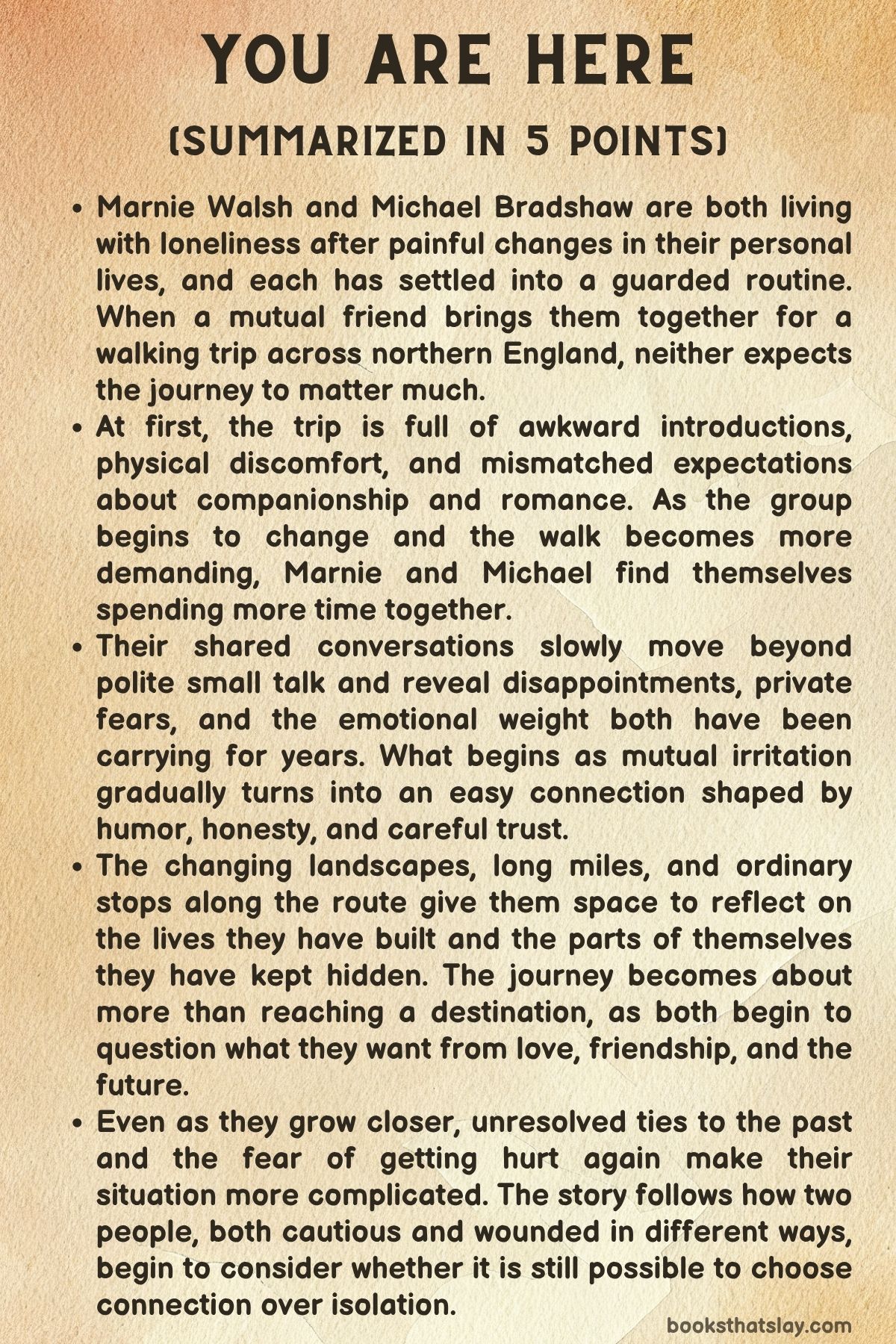
You Are Here by David Nicholls is a contemporary novel about loneliness, timing, and the quiet ways people begin again after disappointment. At its center are two middle-aged strangers who join a walking holiday across northern England, each carrying private hurt from a broken marriage and a life that has not turned out as expected.
Nicholls combines sharp observation, dry humor, and emotional honesty to show how connection can grow in small moments: shared conversation, physical effort, embarrassment, and kindness. Set against hills, lakes, pubs, and cheap hotel rooms, the novel follows two guarded people as they slowly learn to be seen, and to risk wanting more.
Summary
Marnie Walsh is thirty-eight, divorced, and living a life that has become far smaller than she ever intended. She works from home as a freelance copyeditor in London and spends most of her time alone, surrounded by routines that protect her from disappointment but also leave her isolated.
Her friendships have thinned as other people married, had children, and moved into fuller domestic lives. She has grown used to speaking to herself and putting off invitations.
Yet beneath her self-mocking wit is a painful awareness that she is lonely. When her friend Cleo pushes her to join a short walking holiday over Easter, Marnie agrees less out of enthusiasm than from a vague sense that she must break the pattern of her life.
Michael Bradshaw is forty-two, a geography teacher still reeling from the collapse of his marriage. His wife Natasha left him months earlier, after years of failed attempts to have a child and after a period in which he withdrew into depression.
He has become more comfortable with landscapes than with people, and he throws himself into walking because it gives shape to his thoughts and a problem he can solve one step at a time. Cleo, who works with him, wants him to socialize and join a mixed group for the start of the famous Coast to Coast route.
Michael agrees, though he fully expects the trip to be awkward. Secretly, he plans to continue far beyond the others and complete the full route alone.
The group gathers at St Bees on the west coast. Alongside Cleo and her teenage son Anthony are Marnie, Michael, and Conrad, a polished and confident London pharmacist whom Cleo imagines might suit Marnie.
The walk begins with self-consciousness, forced conversation, and the physical discomfort of setting off with bad weather gear, overpacked bags, and uncertain expectations. Marnie is immediately drawn to Conrad’s looks and social ease, while Michael notices the flirtation from a distance and feels both detached and oddly disappointed.
Marnie, for her part, sees Michael as serious, overly interested in rocks and topography, and faintly ridiculous in his commitment to walking customs and route markers.
The first days in the Lake District expose the differences between them. Marnie struggles with the steep climbs, the rain, and the sheer absurdity of putting herself through hardship for pleasure.
Conrad proves vain, humorless, and badly suited to the countryside. Michael, though helpful and patient, can be pedantic, correcting Marnie’s language and falling too easily into teacher mode.
Yet once bad weather strips away the group dynamic and the others begin peeling off, Marnie and Michael find themselves spending longer stretches alone together. Shared irritation becomes banter, and banter gradually becomes trust.
A failed attempt by Marnie to seduce Conrad leaves her embarrassed but also freed from the effort of trying to impress him. After Conrad departs and Cleo heads home, Marnie makes the unexpected choice to remain on the route.
What begins as stubbornness slowly turns into desire: not only to continue the walk, but to continue in Michael’s company. As they move through the lakes and valleys, stopping in pubs and hotels along the way, their conversations deepen.
They talk about literature, work, music, failed relationships, childlessness, and loneliness. They compare the stories they tell about themselves with the truths they usually hide.
Marnie is funny, sharp, and often defensive, but Michael starts to see the sadness and anger beneath her performance. Marnie sees that Michael’s seriousness is not dullness but damage, and that his reserve hides warmth, intelligence, and humor.
Marnie describes her marriage to Neil, a man whose confidence once seemed attractive but who proved selfish, unfaithful, and casually cruel. He even cheated her financially when they separated, leaving her with both practical and emotional losses.
Michael speaks about Natasha more slowly, because his grief is not settled enough to turn into story. He reveals how much the failure to have children shaped their marriage and how the pity of others has left him resentful.
Both feel marked by absence: not simply lacking partners or families, but being defined by what they do not have. In each other they find someone who understands this without turning it into advice.
The landscape begins to matter not because it transforms them into new people, but because it gives them time and space to speak honestly. They walk in sunshine and rain, through famous views and bleak stretches, through moments of beauty and boredom.
There are comic episodes involving cold-water swimming, terrible accommodations, and shared playlists. The exchange of music becomes another form of confession, with songs carrying memories of heartbreak, marriage, embarrassment, and longing.
Their chemistry becomes more obvious, especially to others they meet on the route, including an older married couple, Brian and Barbara, whose comfortable companionship offers a glimpse of what enduring love might look like.
As Marnie and Michael grow closer, physical attraction enters the open. They dance, hold hands, kiss, and begin to imagine that this accidental companionship might become something more.
But Michael has not been honest about one important thing: Natasha has contacted him and arranged to meet him in Richmond, a town further along the route. He tells himself there is no point burdening Marnie with this because she will soon leave for London anyway.
In reality, he is still emotionally divided, unable to let go of the past even while moving toward a possible future.
Before they reach Richmond, the walk takes a darker turn when Marnie and Michael come upon the aftermath of Brian’s sudden death on the trail. The shock of seeing Barbara’s devastation confronts them both with mortality, partnership, and the brutal fact that love brings the risk of loss.
Their talk that evening turns especially intimate. Michael tells Marnie about the violent attack that changed him: he and Natasha were followed by a group of boys after he tried to intervene during an incident on a bus.
He was badly beaten, left with injuries, panic, shame, and a deep fracture in his sense of self. His depression after the attack helped destroy his marriage.
Telling Marnie this makes him feel known in a way he has not allowed for a long time.
By the time they reach Richmond, Marnie is ready to believe that their connection is real and worth pursuing. She even imagines continuing the final stages of the route with him.
Instead, Michael says goodbye in a vague, unsatisfactory way and goes to meet Natasha. Marnie, sensing something wrong, returns to his hotel and discovers signs that he is expecting another woman.
When she confronts him, Michael admits Natasha is coming and that he still loves her, at least in some lingering, unresolved way. For Marnie, the revelation is humiliating and crushing.
She returns to London furious with him and with herself for having hoped.
The novel then follows them separately. Marnie goes back to her apartment and resumes work, but something has shifted.
She becomes more assertive, demands repayment from Neil, starts reentering social life, and even agrees to a date with Conrad, which only confirms that what she felt with Michael cannot be recreated by choosing someone more obviously suitable on paper. Michael, meanwhile, meets Natasha and learns that she is pregnant by her new partner.
Any fantasy of reconciliation collapses. He finishes little of the walk in spirit, even when he continues some of it physically.
He misses Marnie and realizes that what he felt for her was not a distraction but love.
Over the following months, both try to move on. Michael briefly dates Tessa, the sensible outdoorsy woman Cleo once thought would suit him, but their relationship lacks the humor and depth he had with Marnie.
Marnie becomes more open to the world, travels, and reconnects with people, yet she does not forget him. At last Michael finds a reason to contact her by arranging a school trip to London.
They meet for a walk in Hyde Park, an urban echo of the walk that first brought them together. The meeting strips away evasion.
Marnie admits she loves him. Michael says he loves her too and confesses that he never finished carrying his pebble to the end of the route.
Instead of grand declarations, he offers something more fitting for them both: the chance to go back and complete the last two days together.
This ending brings the novel’s central idea into focus. Love here is not presented as fate arriving in a blaze of certainty.
It is a decision to keep walking after confusion, hurt, and delay. Marnie and Michael do not become different people.
They remain awkward, funny, bruised, and cautious. But by the end, they are no longer entirely alone, and that change feels both modest and immense.
Characters
Marnie Walsh
Marnie is drawn as a woman whose intelligence, humor, and self-awareness exist alongside deep insecurity and long-practiced loneliness. She has built a life that appears manageable from the outside: she works steadily, keeps herself occupied, and maintains a sharp, observant mind through her copyediting.
Yet that competence covers a painful emotional contraction. After divorce and years of isolation, she has grown used to reducing her needs, lowering her expectations, and treating disappointment as something to be anticipated rather than resisted.
Her jokes are one of the clearest signs of this. She uses wit not only because she is genuinely funny, but because humor gives her control.
It lets her turn awkwardness into performance and vulnerability into something she can disguise. When she is with Conrad, that tendency becomes exaggerated, because she is trying to appear light, clever, and desirable.
With Michael, however, her humor gradually becomes less defensive and more natural, which reveals one of the most important shifts in her character: she starts to feel less like she has to manage every impression she makes.
Her loneliness is not presented as simple sadness. It has become a structure around her life.
She is socially withdrawn, physically cautious, and emotionally skeptical. She has become someone who expects other people to move forward into marriage, parenthood, and busy domestic life while she remains at the edge of things.
That is why she is so sensitive to being cast as “the one without,” the woman without husband or children, as though her identity can be summed up by absences. Her resentment toward that kind of labeling gives the character much of her emotional force.
She does not want pity, but she also does not want the false empowerment that people often assign to single women, as if freedom automatically compensates for loneliness. The novel treats her frustration seriously, and Marnie becomes a compelling figure because she can recognize the absurdity of her condition while still being wounded by it.
Her failed marriage to Neil is central to her psychology. It was not only a romantic mistake; it was a humiliating education in how charisma can conceal selfishness.
Neil’s betrayal damaged her trust in her own judgment as much as it broke her heart. She carries shame about having chosen badly, and that shame contributes to her reclusiveness.
Even years later, she is still financially and emotionally affected by what he did. Her eventual decision to challenge him over the money he owes her shows real growth.
It is not a dramatic act of revenge, but it matters because it signals that she is no longer willing to let old injuries define the limits of her behavior.
Marnie’s development is especially strong because it does not depend on sudden reinvention. She remains anxious, ironic, and occasionally defensive throughout.
What changes is her willingness to participate in life again. She keeps walking when she could easily retreat.
She allows herself to talk honestly. She admits what she wants.
Even after being hurt by Michael, she does not collapse back into passivity. Instead, she becomes more social, more active, and more open to the future.
In You Are Here, she emerges as a character whose strength lies not in confidence, but in the decision to keep moving despite embarrassment, fear, and the memory of disappointment.
Michael Bradshaw
Michael is a quieter character than Marnie on the surface, but he is just as emotionally complex. He is a man who has been hollowed out by grief, injury, and disappointment, and who has responded by narrowing his life to what feels manageable.
Teaching geography, planning routes, identifying stones, and measuring distances all suit his temperament because they offer order. Landscapes make sense to him in a way that people no longer do.
His attachment to walking is therefore about far more than exercise or scenery. It gives him a world governed by gradients, weather, terrain, and destination rather than by emotional uncertainty.
The physical discipline of walking allows him to contain feelings he otherwise struggles to express.
Michael’s marriage to Natasha left him with unresolved sorrow rather than clean anger. He is not simply abandoned; he is stranded in the aftermath of years of trying and failing to build the life they expected to have.
Their inability to have children has shaped him profoundly. He feels not only the grief of childlessness, but also the social discomfort that comes with being pitied by others.
He resents the narratives people impose on him, especially the assumption that a person without children has extra freedom that should naturally turn into a fuller or more adventurous life. Through him, the novel shows how private disappointment can become entangled with public expectation.
Michael does not dramatize this pain, which makes it more affecting. He carries it in silence, in restraint, and in the awkwardness with which he meets sympathy.
The attack he suffered adds another layer to his character. It explains his emotional withdrawal, his sense of fragility, and the shame that shadows him.
What is especially effective about this aspect of his characterization is that the damage is not limited to visible injury. He is changed by fear, humiliation, and the loss of confidence in his own body and instincts.
He is ashamed not only of being hurt, but of how badly the experience broke him afterward. His depression, panic attacks, and inability to reconnect physically and emotionally with Natasha become part of the tragedy of his marriage.
He is therefore a character for whom masculinity has become deeply unstable. He does not fit conventional ideas of masculine recovery, decisiveness, or stoicism in any triumphant sense.
Instead, he is tentative, self-conscious, and still carrying old terror. That makes him a more believable and moving figure.
At the same time, Michael is not defined only by damage. He is thoughtful, observant, dryly funny, and capable of great tenderness.
His conversations with Marnie reveal a man who can be lively and playful when he feels safe enough to relax. He responds to her wit, admires her intelligence, and begins to rediscover parts of himself that have been dormant.
Yet one of his central flaws is hesitation. He is so accustomed to emotional caution that he becomes dishonest through avoidance.
His failure to tell Marnie about his meeting with Natasha is not malicious, but it is cowardly and hurtful. He tries to postpone pain rather than confront it, and this nearly costs him the relationship that matters most.
His eventual recognition that he loves Marnie and must act with honesty gives his arc its emotional completion. He is not transformed into a bold romantic hero.
Instead, he becomes more truthful, more present, and more willing to choose a future instead of clinging to an ending.
Cleo Fraser
Cleo serves several important functions at once: she is a friend, a catalyst, a social organizer, and a voice of impatient common sense. She sees both Marnie and Michael more clearly than they see themselves at the beginning.
Her role could easily have become mechanical, the familiar figure who pushes two reluctant people together, but she feels more rounded than that because her interventions come from knowledge, affection, and frustration. She is not arranging a romantic fantasy.
She is trying to force movement into the lives of two people who have become static. Cleo understands that isolation can harden into identity if nobody challenges it, and she is unwilling to let either of them disappear into private disappointment without protest.
Her friendship with Marnie is especially revealing. She knows Marnie’s habits of avoidance and refuses to indulge them.
There is affection in the way she pushes, but also irritation. That combination matters because it makes their friendship believable.
Cleo is not endlessly patient or delicately therapeutic. She is the kind of friend who has watched someone retreat too far and has decided that kindness sometimes requires insistence.
Her decision to pair Marnie loosely with Conrad also shows that, despite knowing her well, she does not fully understand what Marnie actually needs. She thinks fun and charm are the answer, when in fact Marnie needs seriousness, emotional recognition, and a person with whom she can stop performing.
This slight misreading makes Cleo more human. She is perceptive, but not omniscient.
With Michael, Cleo plays a similarly useful role. She sees that he is stuck inside his separation and that he uses seriousness as both temperament and shield.
Her encouragement that he let someone in is one of the novel’s key social pressures. She will not allow him to hide indefinitely behind walking plans and emotional caution.
At the same time, she respects his fragility enough to know he is not ready for simplistic solutions. Her suggestion that Tessa might suit him shows her practical side: she thinks in terms of compatibility, steadiness, and plausible outcomes.
Yet the narrative ultimately demonstrates that emotional connection is messier than that.
Cleo also represents a life stage that sharpens the difficulties faced by Marnie and Michael. She has a husband, a child, a career, and the kind of busy social identity that both attracts and alienates them.
Her life is not idealized, but it is full in a way that highlights their emptier domestic lives. She brings them into contact not just with each other, but with a social world they have partly fallen out of.
In that sense, she acts as a bridge figure, one of the few people still actively trying to keep both of them connected to ordinary life.
Natasha
Natasha is one of the most important absent presences in the novel. Much of what the reader understands about Michael comes through the space she has left behind.
She is not reduced to a villain, and that restraint gives the story greater emotional maturity. Her departure hurt Michael deeply, but the narrative does not suggest that she acted out of simple cruelty.
Instead, she seems like someone who had reached the limit of what she could endure in a marriage overshadowed by infertility, trauma, depression, and emotional distance. That complexity matters because it prevents Michael’s pain from being simplified into a story of betrayal alone.
Natasha’s desire for a child is crucial to her role. Her eventual pregnancy with another man sharpens the painful reality that she has moved into the future Michael could not give her, or at least not in the form and time she wanted.
For Michael, this is devastating not merely because she is having a baby, but because it turns abstract loss into something visible and irreversible. A new life is beginning elsewhere, and he has no place in it.
The fact that she tells him in person suggests a degree of care and responsibility. She does not vanish from his life without explanation.
She understands that this news is something he needs to hear directly, which complicates any easy judgment of her.
Natasha also matters because she represents Michael’s attachment to the past. His lingering love for her is not only about Natasha herself, but about the life he thought he was building with her.
When he chooses to meet her in Richmond without telling Marnie, he is trying to test whether that past still has any claim on him. What he discovers is not renewal, but finality.
Natasha’s role, then, is to close one emotional chapter even as she unintentionally helps open another. She is the person Michael must stop orienting himself around if he is to live honestly in the present.
Because she is mostly seen through Michael’s memory and expectation, Natasha remains somewhat elusive, but that elusiveness is appropriate. She is no longer a partner in his life; she is now a figure in his unfinished emotional history.
Her power in the novel comes from that status. She is the person whose absence organizes his pain and whose reappearance forces him to choose between memory and possibility.
Conrad
Conrad is initially presented as the obvious romantic option for Marnie: attractive, polished, affluent, and socially confident. He is the sort of man who appears suitable from the outside, especially to a well-meaning friend trying to reintroduce excitement into someone’s life.
Yet he quickly becomes a revealing contrast figure. He is not monstrous or even especially cruel, but he lacks depth, curiosity, and generosity.
His conversations with Marnie expose his limitations. He misses her literary jokes, fails to respond to her playfulness, and approaches the world in a way that feels transactional and self-protective.
Where Marnie uses humor to reach outward, Conrad seems to shut things down when they do not fit his preferences.
His function in the novel is not just to provide a failed romantic possibility. He also helps clarify what Marnie has been accustomed to valuing and what no longer satisfies her.
Conrad’s good looks and urban polish recall the kind of attraction that once drew her toward Neil: confidence mistaken for substance, poise mistaken for emotional availability. Her awkward encounter with Conrad, and her later date with him in London, both make clear that she is no longer persuaded by surface appeal.
She can recognize that he is handsome and not entirely unpleasant, but she also knows that the connection is thin. The lack of chemistry on their later date confirms that she has changed.
Conrad’s discomfort in the countryside also serves a structural purpose. As the walk becomes more demanding, he peels away from the physical and emotional work of the journey.
In that sense, he embodies avoidance. He wants pleasure without inconvenience, attraction without awkwardness, and company without the unpredictability that comes with genuine intimacy.
This does not make him evil, but it makes him an inadequate partner for someone like Marnie, who needs to be met in her complexity rather than merely entertained. Conrad is important because he helps define the difference between being chosen for appearances and being known.
Neil
Neil is not physically present for most of the story, but his influence on Marnie is profound. He is the ex-husband whose selfishness and infidelity helped shrink her world.
What makes him significant is not simply that he cheated. It is that his behavior taught Marnie to mistrust her own judgment, to question what she saw in him, and to carry a sense of foolishness about her own past.
He emerges as a man who took up emotional and financial space without offering loyalty or care in return. The detail that he withheld money owed to her after their separation is especially telling, because it shows that his betrayal extended beyond romance into plain selfishness.
Neil’s personality appears to have been built on confidence, the trait that once attracted Marnie but later revealed itself as entitlement. He disliked being corrected, responded badly to her intelligence, and behaved as though his needs and desires should organize the relationship.
Marnie’s comic account of their wedding, honeymoon, and marriage gives these memories a lively surface, but beneath that surface is humiliation and grief. Neil matters because he explains why Marnie became defensive, suspicious, and prone to treating emotional hope as dangerous.
He is part of the reason she retreats into solitude and performance.
Yet one of the strongest signs of Marnie’s development is that Neil loses power over her as the novel goes on. When she contacts him and insists he repay what he owes, she is not merely settling an old practical issue.
She is reclaiming authority over a narrative in which she has too long remained the injured party. Neil therefore functions as both a source of damage and a measure of recovery.
The less control he has over her emotional life, the more clearly her future becomes her own.
Brian and Barbara
Brian and Barbara may not occupy large amounts of page space, but they are among the most emotionally significant secondary characters. Their easy companionship offers Marnie and Michael a model of long partnership that is ordinary rather than glamorous.
They are not idealized as perfect people; instead, they appear comfortable together, seasoned by time, and quietly affectionate. For two protagonists who have been wounded by failed relationships, that kind of steadiness has enormous symbolic value.
Brian and Barbara show that companionship can be durable, habitual, and deeply meaningful without needing to be dramatic.
Their presence also changes the tone of the journey. They bring warmth, sociability, and an older perspective.
Because they are a couple who have clearly spent decades building a shared life, they offer a living contrast to both the superficiality of Conrad and the broken histories of Marnie and Michael. When Barbara lightly doubts that Marnie and Michael are “just friends,” her remark carries extra force because it comes from someone whose understanding of partnership is grounded in long experience.
Brian’s sudden death is one of the novel’s most shocking moments, and its effect extends well beyond plot. It confronts the main characters with the fragility of life and the cost of loving another person fully.
Barbara’s grief becomes a silent but powerful image of what deep attachment means. Love is not only pleasure, wit, and desire; it is also the possibility of devastating loss.
This moment intensifies Marnie and Michael’s awareness of time, mortality, and emotional risk. Brian and Barbara therefore serve as both an image of enduring partnership and a reminder that such partnership is precious precisely because it is finite.
Anthony
Anthony plays a quieter role, but he contributes to the emotional landscape of the novel in useful ways. As Cleo’s teenage son, he represents a stage of life that Marnie and Michael stand outside of, especially Michael, given the painful history of his and Natasha’s attempts to have children.
Anthony’s awkwardness, sulkiness, and physical growth remind the adults around him that time moves on regardless of emotional readiness. He is no longer a child, and his changing relationship with the adults reflects that shift.
For Marnie, seeing him older than she expects emphasizes how withdrawn she has become from ordinary rhythms of family life.
Anthony is also one of the few people with whom Michael seems naturally at ease at the beginning. That ease reveals something gentle in him.
Around adults, he is often careful, self-conscious, or too formal. With Anthony, he can settle into something less strained.
Their prior connection, especially during the painful period when Michael and Natasha were trying for a baby, adds quiet emotional depth. Anthony stands near a wound in Michael’s life without being reduced to a symbol of it.
Later, when Marnie asks Anthony about Michael, he becomes a small but important link between their separate lives. In that sense, he helps sustain the thread between them after the walk has ended.
He is not a major dramatic force, but he belongs to the network of ordinary human ties that the novel values so strongly.
Themes
Loneliness as a Way of Living
Loneliness in You Are Here is not treated as a dramatic state of abandonment, but as a slow condition that reshapes habits, self-image, and expectations. That is what makes its portrayal so convincing.
Both central characters are lonely long before they admit it, and their loneliness has become ordinary to them. It shows up in routines, in what they no longer attempt, in the way they think about invitations, and in how they imagine other people see them.
Marnie’s isolation has become domestic and repetitive. She works from home, speaks mostly through text or edited manuscripts, and has become accustomed to a life with very little physical presence from others.
Michael’s loneliness is structured differently, because his is the loneliness that follows the collapse of a marriage rather than the long afterlife of divorce and retreat. Even so, he too has narrowed his world.
He prefers walking alone, does not know how to reenter social life, and has come to trust terrain more than conversation.
What the novel understands especially well is that loneliness does not always appear as visible misery. It can be funny, disciplined, efficient, and disguised by competence.
Both characters continue functioning. They work, travel, speak politely, and make plans.
Yet under that competence lies the ache of not being witnessed in daily life. The novel repeatedly emphasizes ordinary forms of absence: empty homes, meals eaten alone, the lack of anyone to tell small things to, the strange pressure of being left alone with one’s own thoughts for too long.
This gives loneliness a social dimension as well. It is shaped not only by private feeling but by age, class, divorce, childlessness, and friendship patterns.
People around Marnie and Michael often assume they should adapt, cope, or make the best of things, but the emotional truth is that human beings are not easily built for such prolonged emotional self-containment.
The walking journey matters because it interrupts this condition without curing it through fantasy. Company first arrives as inconvenience rather than salvation.
Shared meals, bad weather, and awkward conversation slowly reintroduce both characters to the experience of being accompanied. Their connection grows because loneliness has made them sensitive to the value of attention.
A person who notices your jokes, listens to your history, and shares a silence without making it uncomfortable becomes emotionally significant very quickly. The novel suggests that loneliness is not solved by mere sociability; it is answered by recognition.
That is why the relationship between Marnie and Michael feels so important. Each begins to restore the other to the world of the living, not through grand declarations, but through presence.
Shame, Damage, and the Difficulty of Starting Again
A great deal of the emotional power in the novel comes from the fact that both central figures are carrying shame. They are not only hurt; they are embarrassed by their hurt.
Marnie feels foolish for having married badly, for having been cheated on, for having become so withdrawn, and for still being vulnerable to rejection. Michael feels ashamed of his depression, his fragility after the attack, his failed marriage, and his inability to recover neatly.
This shared burden shapes nearly everything they do. It affects how they speak, what they conceal, and how slowly they move toward honesty.
The book is deeply interested in how damaged people continue to perform normality while privately feeling diminished.
Michael’s experience after the attack is one of the clearest expressions of this theme. The physical violence he suffered is terrible enough, but the more enduring injury is psychological.
He is ashamed of fear, ashamed of pleading, ashamed of being treated differently afterward. The result is that recovery becomes harder because it is contaminated by self-disgust.
He does not simply have to heal; he has to live with a changed idea of himself. Marnie’s shame works differently, but it is equally corrosive.
Her failed marriage has made her doubt the reliability of her own judgment. She covers this with humor and irony, but beneath that lies a painful sense of wasted time and misplaced trust.
Starting again under these conditions is difficult because new hope reactivates old humiliation. To risk another attachment is to risk once again being the person who chose wrongly, trusted too much, or wanted something that was not returned.
That is why both characters move in fits and starts. Even when intimacy develops between them, they do not become straightforwardly brave.
Michael avoids hard truth when he withholds the meeting with Natasha. Marnie uses jokes to soften moments that might require direct emotional exposure.
Their progress is uneven because emotional history does not vanish when a new possibility appears.
What gives the novel its force is the refusal to make recovery clean or triumphant. Starting again is shown as awkward, compromised, and sometimes unfair.
It involves mistakes, silences, regressions, and missed chances. Yet the story insists that shame does not have to be the final frame through which a person understands their life.
Marnie’s decision to challenge Neil, Michael’s recognition that he must let go of Natasha, and their eventual willingness to speak plainly to each other all suggest that beginning again is possible, but only when they stop treating their own damage as disqualifying. The novel’s faith lies not in perfect healing, but in the idea that damaged people are still capable of love, humor, and renewal.
Landscape, Walking, and Emotional Movement
The long walk across northern England is far more than a scenic backdrop. It gives the novel its rhythm, its structure, and much of its meaning.
Walking imposes time. It slows thought, stretches conversation, and creates a sequence of small shared experiences through which emotional intimacy can develop.
The changing landscapes are important not because they constantly mirror the characters’ feelings in a neat symbolic way, but because they alter mood, effort, and perspective. Rain, mud, lakes, roads, moors, inns, and summits shape what can be said and felt.
The physical journey becomes the condition that makes emotional movement possible.
For Michael, walking begins as a private discipline and a controlled challenge. He values route, custom, and completion.
The journey promises catharsis through endurance, and at first he imagines finishing it alone, as though solitude combined with effort might settle what he cannot yet articulate. Marnie enters this landscape as someone much less persuaded by nature, hiking culture, or ideas of personal renewal through outdoor hardship.
Her skepticism is essential because it saves the novel from sentimentality. She does not suddenly become a transformed worshipper of hills and weather.
Instead, the landscape becomes meaningful because it is shared. Views matter when there is someone beside her to notice them with.
Walking also strips away social performance. The group begins with ordinary concerns about appearance, flirtation, class signals, and self-presentation.
But rain, exhaustion, blisters, cheap rooms, and physical discomfort make such performances harder to sustain. This is one reason the bond between Marnie and Michael becomes possible.
On the path, they are reduced to motion, conversation, and endurance. The route eliminates many of the distractions and social props that usually organize adult life.
What remains is how people speak, listen, help, annoy, and accompany one another.
At the same time, the journey is not a simple metaphor for linear progress. The novel is careful about that.
There are wrong turns, pauses, buses that tempt, detours, reversals, and a crucial failure to finish. The title itself points toward location rather than destination.
To know where one is matters as much as knowing where one is going. This is emotionally true for both protagonists.
They spend much of the story trying to identify their own position within grief, desire, memory, and possibility. The final importance of the unfinished route lies in exactly that tension.
Completion is delayed because emotional understanding is delayed. When Michael later suggests returning to finish the final stretch together, the gesture matters because it acknowledges that meaning lies not in solitary endurance, but in shared continuation.
Love, Timing, and the Fear of Choosing the Present
Romantic love in this novel is shaped less by fantasy than by timing, hesitation, and the difficulty of recognizing what matters before it is almost lost. The central relationship grows in a way that feels modest and credible.
Marnie and Michael do not fall in love through instant certainty. They arrive there through conversation, shared embarrassment, humor, attraction, and the gradual realization that each feels more fully themselves in the other’s company.
This makes the love story persuasive, but it also makes the conflict sharper, because the obstacle is not lack of feeling. It is the inability to act clearly at the right moment.
Michael’s attachment to Natasha is central to this theme. He does feel drawn toward Marnie, but he has not fully accepted that his marriage belongs to the past.
His meeting with Natasha in Richmond is therefore not just an emotional loose end; it is a test of whether he can leave behind the life he imagined and choose the uncertain present instead. His failure lies not in still having feelings, which is understandable, but in wanting to postpone the consequences of those feelings.
He tries to preserve both possibilities for a little longer. In doing so, he injures Marnie and proves that love alone is not enough if it is not matched by honesty and timing.
Marnie’s side of this theme is equally strong. She is not simply waiting to be chosen.
She reaches a point where she knows what she feels and is willing to say it. That is significant because it runs against the emotional self-protection she has relied on for years.
When Michael fails her, the pain is intense precisely because she had allowed herself to move beyond irony and self-defense. Yet the novel does not punish her openness.
Instead, it treats that openness as courage, even though it leads first to humiliation rather than reward.
The eventual reunion works because it does not erase the earlier failure. Time has passed, other possibilities have been tested, and both characters have had to confront their own evasions.
Love becomes meaningful here not as irresistible fate, but as the thing that remains after confusion has been clarified. The question is not whether they are attracted to each other, but whether they can choose each other honestly in the present instead of comparing every feeling to old versions of themselves.
The answer, by the end, is cautiously yes. That caution is one of the novel’s strengths.
Love is shown not as perfect certainty, but as a willingness to stop living in memory, fantasy, or fear and to walk forward with another person while accepting that nothing guaranteed ever truly is.