You Belong Here Summary, Characters and Themes | Megan Miranda
You Belong Here by Megan Miranda is a psychological mystery about guilt, inherited secrets, parental fear, and the lasting consequences of a single reckless decision.
The novel follows Beckett Bowery as her daughter enrolls at the same Virginia college where Beckett’s roommate disappeared after two men died twenty years earlier. When history appears to repeat itself, Beckett must return to the place she escaped and confront the people who never forgot what happened. Suspense grows through hidden tunnels, revived traditions, anonymous messages, family deception, and conflicting accounts of the past, leading Beckett toward a truth that threatens both her freedom and her relationship with her daughter.
Summary
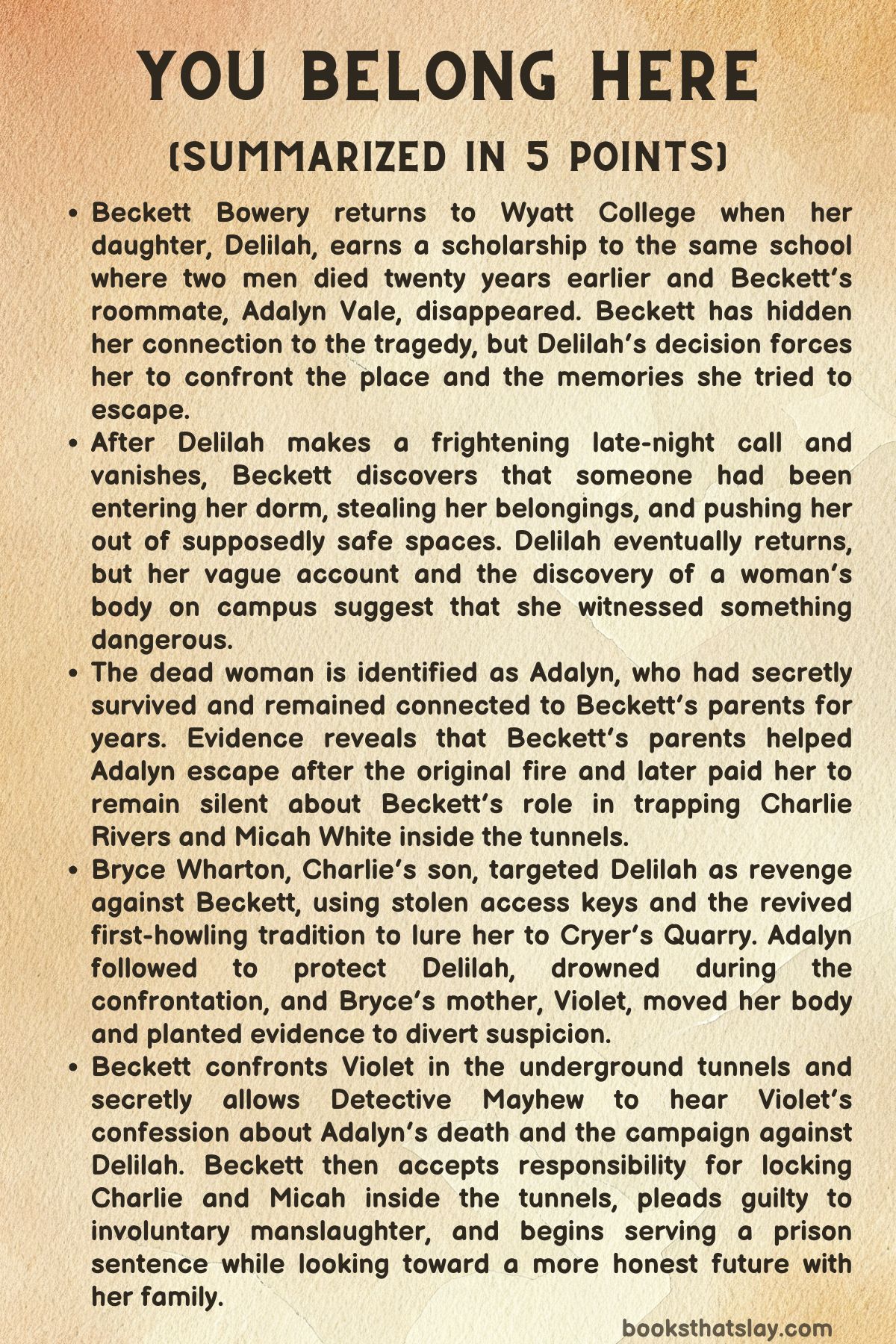
Twenty years after a deadly incident at Wyatt College, Beckett Bowery remains haunted by the disappearance of her former roommate, Adalyn Vale. During the college’s traditional first-howling game, a building burned and local men Charlie Rivers and Micah White died from smoke inside the underground steam tunnels.
Adalyn was first reported missing, then identified as a person of interest and eventually accused of murder. Beckett initially defended her closest friend, but Adalyn’s unexplained escape left her facing police suspicion, hostile townspeople, and the frightening possibility that she had misunderstood someone she believed she knew completely.
In the present, Beckett drives her eighteen-year-old daughter, Delilah, to Wyatt College for her freshman year. Delilah secretly applied, earned a full scholarship, and chose the one place Beckett had always avoided discussing.
Returning to Wyatt Valley forces Beckett to confront familiar streets, campus buildings, wooded paths, and the concealed tunnels she once explored. Delilah looks so much like her mother that Beckett fears older residents will immediately connect her with the unresolved tragedy.
Beckett and Delilah stay with Beckett’s retired professor parents, who are preparing to leave for a semester in Peru. A nearby house has recently burned, supposedly because of faulty wiring, but Beckett finds discarded belongings that suggest the property was occupied when the fire occurred.
At the bottom of a dumpster, she notices a freshly struck match fading into darkness. The discovery suggests that someone is nearby and intentionally drawing attention to the burned property.
During orientation, Beckett shows Delilah a hidden entrance to Wyatt’s steam tunnels. She also encounters Violet Wharton, whose son Bryce is beginning college alongside Delilah, and learns that students now tell stories about Adalyn’s ghost appearing during the first howling.
Beckett soon discovers that Cliff Simmons, her former high-school boyfriend, works as Wyatt’s associate dean of student life. Cliff once joined local teenagers in sneaking into campus traditions, making his respectable position difficult for Beckett to accept.
After helping Delilah settle into her dormitory, Beckett returns to Charlotte. An anonymous message welcomes her home, but she dismisses it as an automated communication from the college.
Seven weeks later, Beckett receives a silent late-night call from Delilah. She hears the first-howling wind, a possible gasp, and then nothing before the connection ends.
Unable to reach her daughter, Beckett drives through the night to Wyatt. She discovers that Delilah has moved out of her assigned dormitory without telling her and that no one will reveal where she has been staying.
Bryce emerges breathlessly from a hidden trail through the woods, repeatedly glancing behind him. Beckett follows the trail toward Cryer’s Quarry, where she finds a wet cloth mask like those once worn during the forbidden first-howling chase.
The mask proves that the old tradition has survived despite Wyatt’s attempts to erase it from public memory. Beckett begins to suspect that Delilah participated in a dangerous reenactment of the same game that preceded the deaths of Charlie and Micah.
At her parents’ house, Beckett discovers signs that someone has recently stayed there. Food has been eaten, a towel is damp, a bed has been disturbed, and new writing on her childhood wall warns Delilah that she is being watched.
Beckett wonders whether her daughter has secretly been using the house, but an intruder enters while she hides upstairs. She later sees Cliff nearby, although he explains that he lives next door after the fire destroyed the residence intended for him.
Using his administrative access, Cliff learns that Delilah’s identification card entered Beckett Hall shortly before midnight. No record shows her leaving, and the building contains an entrance to the closed steam tunnels.
Beckett questions Bryce, but he lies about spending the entire night in his dormitory. His mother protects him, while college officials and local residents repeatedly suggest Beckett is behaving like an irrational parent.
Trevor, Delilah’s father, arrives to help with the search. Beckett and Trevor have never been a conventional couple, but eighteen years of shared parenting have created trust, affection, and a strong commitment to protecting their daughter.
A mysterious group also offers Beckett a large payment to ghostwrite a memoir about an old unresolved crime. The sender’s knowledge and timing make it clear that the offer has been designed to force Beckett to revisit the Wyatt tragedy.
Security footage shows a hooded figure carrying Delilah’s phone into Beckett Hall. Because the person’s face is hidden, the recording proves only that the phone entered the building, not that Delilah carried it.
An organized search begins, but Beckett returns to her parents’ house and discovers someone has entered again. A sound in the basement leads her to Delilah, who is alive but bruised, exhausted, and reluctant to explain where she has been.
Delilah claims she lost her phone, became disoriented in the woods, and hid until morning. Her account contains several unexplained gaps, but Beckett and Trevor initially focus on the relief of having her safely home.
Soon afterward, Wyatt College enters lockdown because a young woman’s body has been discovered in a construction pit. A local girl named Carly reveals that her sister Sierra found the victim, confirming that Delilah’s previously unverified friend is a real person from town rather than a Wyatt student.
Police now view Delilah as a possible witness because she disappeared during the same period in which the unidentified woman died. Beckett and Trevor refuse to let officers question her informally, creating tension with Delilah, who insists she is old enough to speak for herself.
Delilah eventually admits that someone repeatedly entered her dormitory, moved her possessions, and stole her laptop. After her request for help was not properly resolved, she began sleeping secretly in the campus theater rather than tell Beckett she was struggling.
She feared that admitting the truth would allow Beckett to remove her from Wyatt. Her secrecy exposes the damage created by Beckett’s refusal to explain why the college frightened her so deeply.
A noise from the house’s old dumbwaiter leads Beckett to Delilah’s shattered phone. The device was not lost in the woods but deliberately hidden inside a feature known mainly to the Bowery family.
Detective Fred Mayhew then identifies the dead woman as Adalyn Vale. Adalyn had survived her disappearance, lived under another identity for years, and returned to Wyatt shortly before her death.
The revelation connects the current danger directly to the old case. Adalyn may have been the person staying in the Bowery house, and her return suggests that she knew Delilah was being watched.
Beckett retrieves Delilah’s phone and finds the original skeleton key to Wyatt’s tunnels hidden beside it. She had stolen that key from her father twenty years earlier and believed Adalyn had taken it when she escaped.
Testing the key, Beckett confirms that it still opens the tunnel entrance. She also discovers that her father replaced it in Wyatt’s archive with a false copy, proving her parents knew it had disappeared and concealed the theft.
Cliff reveals that Beckett’s parents may also have fabricated the college transfer letter that sent her to London after the fire. Rather than being expelled by Wyatt, Beckett may have been removed by her family to prevent further questioning.
Police determine that Adalyn drowned at Cryer’s Quarry before someone transported her body to the campus construction site. Because Beckett visited the quarry trail and Delilah returned wearing wet clothing, both women appear connected to the death.
Searching the attic, Beckett finds Adalyn’s clothes, toiletries, lipstick, and fifteen thousand dollars. Her parents had secretly remained in contact with Adalyn and had allowed her to stay in their house.
Trevor admits that he found Delilah’s phone and tried to hide it because he feared it would implicate their daughter. Delilah then gives a fuller account of her missing night.
She explains that she tracked the phone to the quarry after receiving directions that seemed connected to the first-howling game. She saw a body in the water, heard someone approaching, fled into the woods, and remained hidden until she could find her way back.
Beckett finally admits that she helped lure Charlie and Micah into the steam tunnels twenty years earlier. She and Adalyn planned to trap and humiliate them after the men repeatedly threatened and harassed them, but Beckett never intended anyone to die.
Beckett’s mother returns from Peru and confesses that she found Adalyn after the fire. Believing Beckett could be charged, she hid Adalyn in the house, used the dumbwaiter to conceal evidence, changed her clothing, and helped her escape.
Over the following years, Adalyn demanded money in exchange for continuing to protect Beckett. Beckett’s parents mortgaged their house, sold cultural artifacts, lost their college positions, and sacrificed their financial security to maintain the secret.
However, the anonymous threats continue after Adalyn’s death. Beckett realizes another witness saw what happened twenty years earlier and has been waiting for her to confess.
New information reveals that Bryce is Charlie Rivers’s biological son. He inherited money from the settlement after Charlie’s death and grew up believing that Beckett and Adalyn were responsible for taking his father away.
Bryce obtained access to campus keys, entered Delilah’s dormitory, removed her belongings, and drove her out of every secure space. He then directed her to Cryer’s Quarry as part of a plan to frighten or punish her.
Adalyn found Delilah’s phone and followed Bryce, apparently intending to protect Beckett’s daughter. During the confrontation, she fell into the quarry and drowned.
Believing Cliff may be the anonymous witness, Beckett visits his house and finds him unconscious after an attack. She follows the fleeing culprit into Beckett Hall and enters the underground tunnels.
The attacker is Violet, Bryce’s mother and Charlie’s former fiancée. Violet reveals that she drove Charlie and Micah on the night of the original tragedy and recognized Beckett beneath her mask because of the tattoo on her wrist.
Violet has known for twenty years that Beckett participated in trapping the men. She created the false memoir offer and anonymous messages to pressure Beckett into admitting what she had done.
Violet also confesses that Bryce lured Delilah to the quarry and confronted Adalyn. After Adalyn drowned, Violet moved the body to the construction site, took Delilah’s phone, and planted evidence to make Delilah appear responsible.
Beckett secretly leaves a call connected to Detective Mayhew while Violet speaks. When Violet threatens to recreate the tunnel fire, Beckett reveals that the police have heard the confession, and Violet is arrested.
Beckett then accepts responsibility for her own actions. Although she did not set the fire and attempted to rescue Charlie and Micah, she knowingly lured them underground and locked the door that prevented their escape.
In the conclusion of You Belong Here, Beckett refuses to hide behind another family lie. She is arrested, later pleads guilty to involuntary manslaughter, and receives a three-year prison sentence.
After serving 423 days, Beckett continues to imagine the choices that could have changed the tragedy. She also recognizes that those events led indirectly to her life in London, her relationship with Trevor, and the birth of Delilah.
Beckett accepts that guilt cannot be erased simply because many years have passed. As she counts toward her possible release, she understands that home is no longer Wyatt Valley but the family waiting for her beyond the prison gates.
Characters
Beckett Bowery
Beckett is the central narrator and moral focus of You Belong Here, carrying the unresolved burden of a decision she made as a college student. She has spent twenty years presenting herself as someone who survived another person’s crime, even though she knows that she played a direct role in creating the deadly situation.
Her strongest quality is her fierce devotion to Delilah, but that devotion is repeatedly shaped by fear rather than openness. Beckett believes silence will protect her daughter from Wyatt, yet withholding the truth makes Delilah curious about the college and prevents her from recognizing the dangers connected to their family.
Beckett is also observant, persistent, and willing to challenge powerful institutions when officials dismiss her concerns. Once Delilah disappears, she notices contradictions that others overlook, follows physical evidence, questions long-standing accounts, and refuses to accept convenient explanations.
At the same time, her investigation exposes her habit of concealing evidence whenever someone she loves appears threatened. She hides Delilah’s phone, enters restricted areas, withholds facts from police, and instinctively repeats the protective behavior that trapped her family in secrecy.
Her final decision to confess marks genuine growth because she stops treating accountability as something that can be delayed indefinitely. Prison is not presented as a simple punishment imposed on an innocent woman but as the consequence of Beckett finally acknowledging that intention does not erase the damage caused by her actions.
Delilah Bowery
Delilah is intelligent, independent, determined, and deeply curious about the part of her mother’s life that has always been hidden from her. Choosing Wyatt is not merely an academic decision; it is also an attempt to understand why Beckett abandoned the college, rejected her hometown, and refused to discuss her past.
Her resemblance to Beckett makes her a visible symbol of history repeating itself. Older residents immediately connect her with her mother, while Bryce targets her not for anything she has done but because she represents the person he blames for his father’s death.
Delilah’s refusal to report the full extent of the harassment in her dorm reflects both pride and fear. She wants to prove that she can manage college independently, and she suspects that any admission of weakness will confirm Beckett’s belief that she never belonged at Wyatt.
Her secrecy creates danger, but it also mirrors the behavior she has learned from her family. Delilah has grown up surrounded by carefully controlled information, partial explanations, and emotional subjects that are never addressed directly.
Throughout the book, Delilah moves from resisting her mother’s protection to understanding its source. Her embrace when Beckett is arrested shows that learning the truth does not destroy their bond, although it permanently changes the way she sees both her mother and her family history.
Adalyn Vale
Adalyn is absent for much of You Belong Here, yet her influence shapes every major conflict. As Beckett’s college roommate, she was charismatic, daring, manipulative, and capable of turning resentment into dangerous games.
Her friendship with Beckett was intense because both young women felt trapped at Wyatt for different reasons. Adalyn was pressured by her wealthy family, while Beckett felt tied to the institution through her professor parents and her lifelong connection to the town.
Adalyn’s treatment of Charlie and Micah shows her tendency to respond to hostility by escalating it. Rather than retreat when the men threaten her, she vandalizes property, provokes them publicly, and creates a plan intended to humiliate them.
Her escape allowed the community to treat her as the sole villain, but the later revelations complicate that reputation. Beckett’s parents helped her disappear, and she spent years demanding money for her silence, making her both a protected fugitive and an exploiter of the Bowery family’s guilt.
Her final actions offer a partial form of redemption. After discovering that Bryce was targeting Delilah, Adalyn followed him to the quarry and appears to have placed herself in danger to protect the daughter of the friend she abandoned.
Trevor
Trevor is Delilah’s father and Beckett’s most reliable emotional partner, even though they never formed a conventional romantic relationship. Their connection began during Beckett’s year in London, and an unexpected pregnancy permanently joined their lives.
His early fear about parenthood wounded Beckett and convinced her that she would raise Delilah independently. Nevertheless, Trevor became a devoted father and gradually developed a cooperative, trusting relationship with Beckett.
When Delilah disappears, Trevor acts immediately and offers the practical partnership Beckett usually denies herself. He joins the search, investigates leads, challenges police pressure, helps manage Delilah’s recovery, and remains focused on protecting their daughter.
Trevor’s decision to hide Delilah’s damaged phone reveals that he is not morally untouched by the family’s pattern of concealment. Like Beckett and her parents, he believes that removing dangerous evidence may shield someone he loves, even when the act risks worsening the situation.
His relationship with Beckett carries unresolved affection, shown through their emotional closeness and near kiss. More importantly, Trevor represents the stable future awaiting Beckett after prison, grounded not in secrecy or shared guilt but in years of loyalty and responsible parenting.
Violet Wharton
Violet initially appears as a polished local mother whose familiarity with Beckett produces uncomfortable but seemingly harmless interactions. Beneath that controlled exterior, she has spent twenty years consumed by grief, anger, and the belief that Beckett escaped responsibility for Charlie’s death.
She was Charlie’s fiancée and was pregnant with Bryce when the tunnel fire occurred. As the driver who brought Charlie and Micah to campus, she witnessed enough to recognize Beckett beneath her mask but remained silent while waiting for a confession.
Violet’s grief gradually becomes a justification for manipulation and violence. She creates the FordGroup identity, constructs the false memoir offer, monitors Beckett, attacks Cliff, moves Adalyn’s body, and plants evidence that could make Delilah appear responsible.
Her treatment of Delilah reveals how thoroughly revenge has distorted her morality. Although Delilah had no involvement in the original deaths, Violet accepts her son’s decision to target her and then exploits the frightened young woman as part of a larger plan against Beckett.
Violet is not wrong to demand accountability, but she chooses punishment without boundaries. By protecting Bryce from the consequences of Adalyn’s death while condemning the Bowery family for similar protection, she becomes an extension of the same destructive cycle she claims to oppose.
Bryce Wharton
Bryce is a young man shaped by inherited grief and a version of the past that defines him primarily as Charlie Rivers’s son. Although raised within the Wharton household, his biological connection to one of the dead men gives him a personal motive for targeting Delilah.
His revenge begins through invasion and psychological pressure rather than direct physical confrontation. He obtains access to campus keys, enters Delilah’s room, moves or steals her possessions, and makes her feel unsafe in a place where she should have been protected.
Bryce then uses the revived first-howling tradition to direct Delilah toward Cryer’s Quarry. His plan transforms an old campus game into an instrument of punishment against someone who had no responsibility for his father’s fate.
His encounter with Adalyn leads to her drowning, whether through a deliberate push or reckless intimidation. Instead of accepting responsibility, Bryce allows Violet to move the body, hide evidence, and redirect suspicion toward Delilah.
Bryce demonstrates how unresolved adult conflicts can be passed to children until they become personal identities. He does not seek a complete understanding of Charlie’s death; he seeks a target who can be made to suffer for it.
Cliff Simmons
Cliff is Beckett’s former boyfriend and a figure who initially seems suspicious because his present authority conflicts with his reckless teenage behavior. As a young man, he entered college events without permission, moved easily between social groups, and treated Wyatt as a place where rules could be tested.
His position as associate dean suggests that he has converted his familiarity with campus systems into professional responsibility. Although Beckett distrusts him, he repeatedly uses his access to help trace Delilah’s movements and uncover information withheld by the institution.
Cliff also carries consequences from the original tragedy. He knew Charlie and Micah planned to confront Beckett and Adalyn, warned the police about their intentions, and was treated by members of the town as someone who betrayed his friends.
His presence forces Beckett to reconsider the story she constructed after leaving Wyatt. Cliff reveals inconsistencies in her transfer records, explains how her parents influenced her departure, and shows that the past was manipulated by more people than she understood.
The attack against Cliff proves that his knowledge places him in danger rather than making him the mastermind. He ultimately serves as a bridge between the old town-college conflict and the institutional systems surrounding Delilah’s disappearance.
Beckett’s Mother
Beckett’s mother is intelligent, controlled, critical, and willing to make extreme moral compromises for her daughter. Her distant manner initially makes her seem unsympathetic, especially when she responds to Beckett’s fear with impatience and treats Delilah’s decision to attend Wyatt as a deserved confrontation with the past.
Her emotional restraint hides decades of sacrifice. After the fire, she found Adalyn, recognized the threat to Beckett, concealed physical evidence, helped the young woman change clothes, and arranged her escape.
She continued protecting Beckett by paying Adalyn for years. The payments forced the family to mortgage the house, sell valuable objects, damage their professional reputations, and structure their lives around the possibility of exposure.
Her choices show the danger of parental protection without accountability. She saved Beckett from immediate prosecution but also prevented her from confronting the consequences of her actions when the truth was fresh and evidence was available.
The mother’s confession finally breaks the family’s oldest silence. Although she remains responsible for obstruction and concealment, her actions arise from desperate love rather than personal gain, making her both morally compromised and deeply human.
Beckett’s Father
Beckett’s father is an academic whose influence can be seen in the family’s close connection to Wyatt, the naming of Beckett after a campus building, and the collection of cultural artifacts inside the family home. His professional identity once gave the Bowery family status within both the college and the town.
He participates in the effort to help Adalyn escape and later replaces the stolen skeleton key in Wyatt’s archive with a false version. This act transforms the college’s official record into another constructed narrative designed to protect Beckett.
His willingness to sell artifacts while using Wyatt’s name eventually costs him his position. The dismissal reveals that the consequences of the original fire affected the family long before Beckett learned the truth.
Like his wife, he treats sacrifice as a substitute for confession. He accepts financial and professional ruin but does not give Beckett the information she needs to understand why their lives have changed.
His behavior demonstrates how educated and respected people can use institutions, records, and authority to hide wrongdoing. The false key and fabricated transfer story show that official documents are no more reliable than the people who create them.
Detective Fred Mayhew
Mayhew represents both Beckett’s fear of institutional judgment and the possibility of patient accountability. As a young officer connected personally to Charlie and Micah, he questioned Beckett aggressively and believed she might be helping Adalyn escape.
His suspicion remained with Beckett for twenty years, shaping her belief that any renewed police involvement would automatically turn against her. When Delilah disappears, Mayhew’s presence makes the new investigation feel like a continuation of the old interrogation.
In the present, however, he behaves with greater restraint. He listens to Delilah, examines conflicting evidence, identifies Adalyn, and repeatedly gives Beckett opportunities to explain what she knows.
Mayhew remains persistent because the evidence surrounding the Bowery family is genuinely troubling. Beckett and Trevor conceal a phone, Delilah withholds her movements, Beckett visits the quarry, and the family house contains evidence connected to Adalyn.
His open telephone connection during Violet’s confession becomes essential to ending the immediate threat. Mayhew ultimately arrests Beckett, but the arrest follows her own admission and reflects legal responsibility rather than the personal vendetta she feared.
Maggie
Maggie is Beckett’s estranged childhood friend and one of the few people in Wyatt Valley whom Beckett approaches for help. Their long separation reflects how completely Beckett cut herself off from her hometown after the fire.
Despite the distance between them, Maggie agrees to serve as Delilah’s emergency contact. She also provides local information, confirms the continuation of the first-howling tradition, and supports Beckett during the search.
Maggie’s presence highlights the relationships Beckett abandoned when she decided that escape was the only way to survive. Unlike Adalyn, who represented Beckett’s intense college identity, Maggie represents the ordinary local life Beckett might have retained.
Her willingness to assist without demanding explanations offers a quieter form of loyalty. She does not solve the mystery, but she helps Beckett reconnect with a community that contains more than accusation and resentment.
Charlie Rivers and Micah White
Charlie and Micah are dead before the present action begins, but the entire conflict grows from what happened to them. They were local men who resented the college students, harassed Adalyn, took her pearl necklace, and planned to confront the two young women during the first howling.
Their behavior was threatening and cruel, yet it did not justify the punishment Beckett and Adalyn designed. Luring them into the tunnels and locking the door placed them in a dangerous environment where escape depended on someone else.
The novel refuses to reduce them either to innocent symbols or deserving victims. Their actions help explain why Beckett and Adalyn felt threatened, while their deaths demonstrate how retaliation can produce consequences far beyond what anyone intended.
Charlie’s death shapes Violet and Bryce, while both families spend decades without a complete explanation. The silence surrounding the men prevents their relatives from grieving truthfully and allows anger to harden into revenge.
Joseph Wharton
Joseph Wharton appears as Violet’s wealthy husband and Bryce’s social father. His ownership of College Lane properties and Cryer’s Quarry places his family close to several major locations connected with the current crimes.
Although he is not revealed as an active participant in Violet and Bryce’s revenge, his resources create an environment in which they possess privacy, influence, and access. The family’s financial position also helps conceal Bryce’s biological connection to Charlie from people outside the household.
Joseph’s limited awareness shows how secrets can exist even inside apparently stable families. He represents the respectable surface beneath which Violet’s grief and Bryce’s resentment have continued to grow.
Sierra and Carly
Sierra is Delilah’s local friend, while Carly is Sierra’s younger sister. Their existence initially appears uncertain because Wyatt officials cannot find any enrolled student named Sierra, causing Beckett to wonder whether Delilah invented or misunderstood the friendship.
Carly’s discovery during the campus lockdown confirms that Sierra is real and belongs to the local community rather than the college. This distinction reinforces the social divide between Wyatt students and town residents that has influenced events for decades.
Sierra and Carly also help establish that Delilah has formed relationships outside the controlled information Beckett receives through messages. Their presence reminds Beckett that a parent may know the names in a child’s life without understanding the full circumstances surrounding them.
Themes
The Inheritance of Guilt and Revenge
The consequences of the tunnel fire do not remain with the young adults who participated in it. They pass into the lives of Delilah and Bryce, two children who had no role in the original confrontation but become targets, investigators, and emotional representatives of their parents.
Bryce inherits a story in which Charlie is a victim whose death demands punishment, while Delilah inherits silence, anxiety, and a family history she senses but cannot access. Neither young person receives a complete account, leaving each vulnerable to the interpretations created by older relatives.
Violet turns grief into a lifelong mission and teaches Bryce to view Beckett’s family as responsible for his loss. Beckett takes the opposite approach by refusing to tell Delilah anything, yet her silence proves equally damaging because it leaves Delilah unable to recognize why Wyatt may be dangerous.
The renewed first howling shows how unresolved harm can reproduce itself through ritual. Bryce directs Delilah toward the quarry, Violet manipulates evidence, and Beckett once again considers concealing facts to protect her child.
The cycle ends only when Beckett accepts responsibility openly. Her confession cannot restore Charlie, Micah, or Adalyn, but it prevents another generation from being forced to live inside a false account of what occurred.
Protection, Secrecy, and Moral Complicity
Nearly every major character claims to conceal the truth for someone else’s protection. Beckett’s parents help Adalyn escape to protect Beckett, Trevor hides Delilah’s phone to protect their daughter, Violet moves Adalyn’s body to protect Bryce, and Beckett repeatedly withholds evidence to protect her family.
These actions begin as expressions of love or loyalty but quickly become forms of moral complicity. Each hidden object, altered record, false explanation, and incomplete statement makes the eventual consequences more serious.
The Bowery parents sacrifice money, employment, status, and peace of mind rather than allow Beckett to face investigation. Their suffering may appear noble, but it also denies Charlie and Micah’s families the truth and allows Adalyn to use the secret as financial leverage.
Violet condemns the Bowerys for escaping accountability while repeating their behavior for Bryce. Her hypocrisy demonstrates that people often view concealment as corrupt when practiced by an enemy but necessary when used to save someone they love.
You Belong Here ultimately separates genuine protection from avoidance. Protecting someone should involve helping that person survive the truth and accept consequences, not constructing a false reality that places others in danger.
Memory, Narrative, and Institutional Truth
The public account of the Wyatt tragedy changes repeatedly, moving from accident to disappearance, from suspicion to murder accusation, and from unresolved mystery to accepted local legend. Adalyn becomes a ghostly villain because the town and college require a simple explanation for a complicated event.
Wyatt College contributes to this process by sanitizing its traditions, emphasizing new security systems, and distancing itself from the first howling. The institution appears modern and controlled while the prohibited game continues through unofficial networks.
Official documents are equally unreliable. Beckett’s father replaces the tunnel key with a copy, her parents fabricate a transfer letter, security footage captures only partial movements, and access records create the false impression that a person entered a building without leaving.
Personal memory also changes under fear and guilt. Beckett recalls individual details but avoids assembling them into an honest account because doing so would require recognizing her responsibility.
The anonymous memoir offer uses storytelling as a weapon, promising money for a witness account while demanding confession. The novel therefore presents narrative not as a neutral record but as a source of power that can accuse, protect, distort, or finally reveal.
Accountability and the Limits of Intention
Beckett never intends for Charlie and Micah to die. She agrees to trap them temporarily, believes the plan will humiliate rather than kill them, and attempts to rescue them once she realizes the barn and tunnels are filling with smoke.
Her lack of murderous intent matters, but it does not remove responsibility. By stealing the key, participating in the plan, luring the men underground, and locking the door, she creates the conditions that prevent their escape.
For twenty years, Beckett treats intention as an internal defense. Because she did not start the fire and did not want anyone dead, she allows herself to believe that Adalyn’s disappearance, her parents’ interference, and the lack of prosecution have placed the event beyond judgment.
The present crisis destroys that belief. Bryce’s harassment may begin as an attempt to frighten Delilah, but his actions contribute to Adalyn’s death, just as Beckett’s supposedly controlled prank contributed to the deaths of Charlie and Micah.
Accountability arrives when Beckett stops defining herself solely through what she meant to happen. Her guilty plea acknowledges that people are also responsible for foreseeable risks, reckless choices, and the consequences created when they deliberately place others in danger.