Zero to One Summary and Analysis
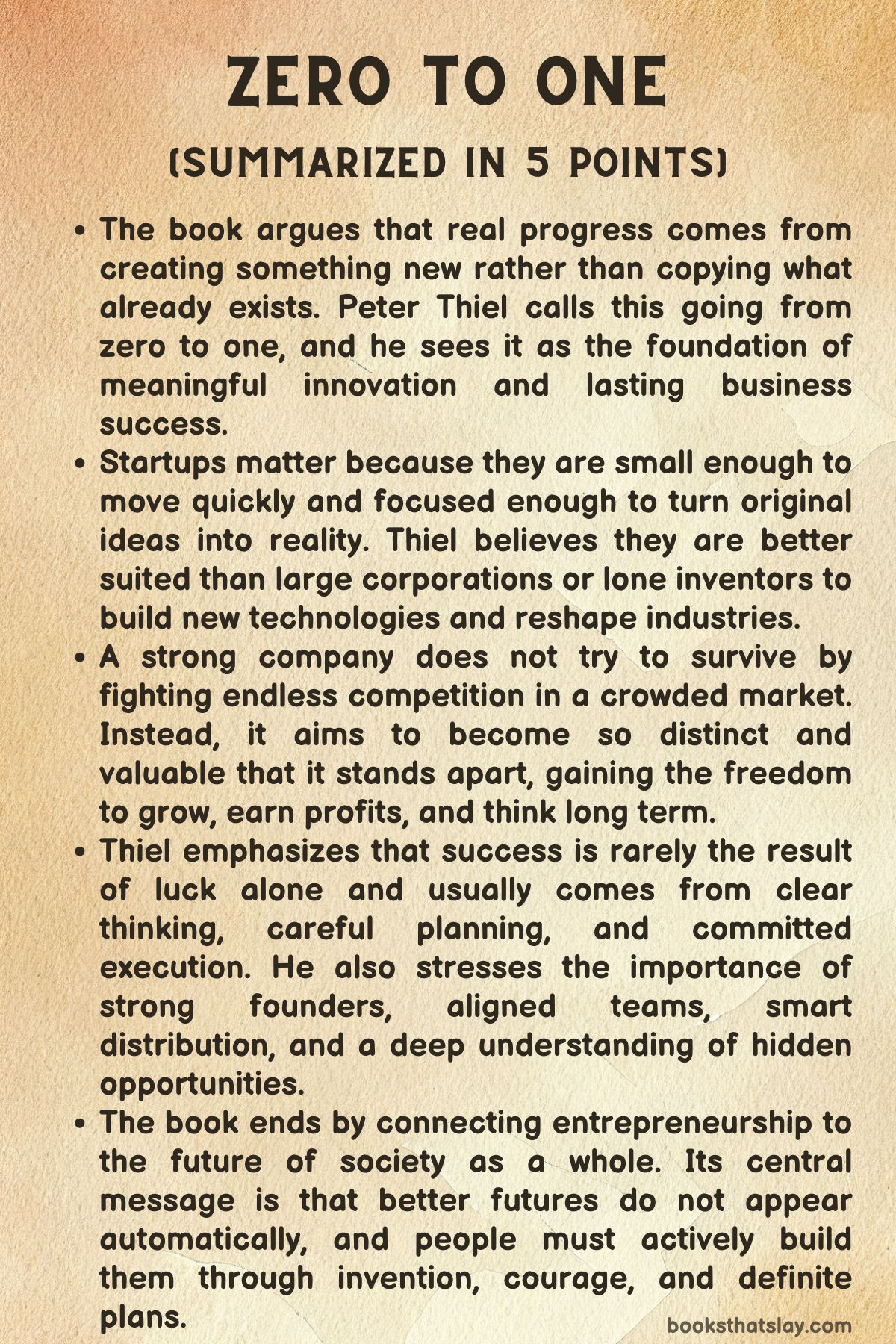
Zero to One by Peter Thiel is a book about building businesses that create something genuinely new instead of copying what already exists. Drawing on his experience as a founder and investor, Thiel argues that real progress happens when people move from familiar ideas to original solutions.
He challenges common beliefs about competition, startup culture, growth, and luck, and makes the case that strong companies are built through clear thinking, careful planning, and bold execution. Rather than offering a step-by-step manual, the book presents a way of thinking about innovation, showing why the best founders aim to shape the future instead of simply reacting to it.
Summary
Zero to One argues that the most valuable businesses do not succeed by doing the same thing slightly better than everyone else. They succeed by creating something new.
Peter Thiel begins with the idea that there are two kinds of progress. One is horizontal progress, where existing ideas spread wider and become more common.
The other is vertical progress, where a person or company brings into existence something that did not exist before. This movement from nothing to something new is what he calls going from zero to one.
For Thiel, this kind of progress matters most because it changes what is possible rather than simply extending what is already known.
He sees startups as the best vehicle for this kind of change. Large organizations often become slow, cautious, and ruled by habit.
Individual inventors may have strong ideas, but they often lack the structure and reach needed to bring those ideas into the world at scale. A startup sits between those extremes.
It can be focused enough to act quickly and organized enough to turn an original idea into a lasting business. In this sense, the startup is not just a smaller company.
It is a group of people organized around the task of building a different future.
Thiel pushes back against the popular idea that competition is always healthy. In his view, intense competition usually traps companies in sameness.
When businesses are forced to fight on price, features, and small distinctions, they spend more time reacting to rivals than creating real value. He contrasts this with monopoly, not in the usual sense of a company that bullies others, but as a business that becomes so good at solving a problem that no close substitute exists.
Such a company earns strong profits because it has built something distinctive. For Thiel, the goal is not to join a crowded field and fight for scraps.
It is to build a company so good that it stands apart.
That argument shapes his view of successful businesses. A strong company is one that can expect large future profits, not just one that looks healthy in the present.
Investors and founders should care less about short-term numbers and more about whether a business has the foundations for lasting advantage. Thiel points to several features that help create that advantage: a technology that is dramatically better than alternatives, network effects that make the product more useful as more people use it, the ability to scale efficiently, and strong branding that makes the company memorable and trusted.
These qualities help a startup move beyond survival and into a position of long-term strength.
He also argues that the best companies usually begin by dominating a small market. Starting broad can leave a startup exposed to bigger, stronger rivals and make it difficult to gain momentum.
Starting small allows a company to serve a specific group extremely well, establish control, and then expand outward into related markets. This pattern appears in many of Thiel’s examples.
A company wins a narrow space first and then grows from that base. The lesson is that scale should come after focus, not before it.
A major theme of the book is the importance of definite plans. Thiel criticizes the modern habit of treating the future as something vague that will somehow improve on its own.
He calls this mindset indefinite optimism: the belief that tomorrow will be better even when no one is clearly building that better world. In contrast, definite optimism means believing the future can improve and then making concrete plans to bring that improvement about.
He believes modern society often celebrates flexibility, adaptation, and optionality too much, while neglecting the value of firm direction. In his view, great companies are usually the result of people who know what they want to build and commit themselves to doing it.
From there, he turns to the idea of secrets. A valuable business often begins with an insight that other people have missed.
These secrets are not magical clues hidden in plain sight so much as truths about the world that most people overlook or dismiss. Thiel asks what important truth few people agree with, because the answer may reveal a major opportunity.
A founder who sees such a truth can build a company around it. This is why he believes original thinking matters so much.
If everyone already agrees on something, then the opportunity attached to it is usually already crowded.
The book then becomes more practical. Thiel stresses that the early structure of a company matters enormously.
Founders must choose partners carefully, because personal conflict at the top can ruin a business before it fully begins. Early employees should not simply be talented; they should believe in the mission and work well together.
Ownership, responsibilities, and authority should be clearly defined from the start. He also emphasizes that company culture is not decoration.
It is part of the operating system of the business. Teams that share a strong sense of purpose and trust can move faster and handle uncertainty better than teams held together only by salary or prestige.
Sales and distribution receive special attention because Thiel thinks many technical founders underestimate them. A great product does not automatically find its market.
Customers need to be reached, persuaded, and retained. Marketing is not an optional layer added after the product is built; it is part of how a business succeeds.
Different products require different sales approaches, and a company must identify the right channel rather than assuming that quality alone will carry it. He ties this back to his broader argument that every part of a business follows a power law, where one decision or one channel can matter far more than the rest.
Another important thread is the relationship between people and technology. Thiel rejects the idea that computers are simply replacing humans in every meaningful role.
He argues instead that the best uses of technology involve complementarity. Machines are excellent at processing data and identifying patterns at speed, while humans are better at judgment, interpretation, and dealing with complexity.
The strongest systems combine both. He uses examples from fraud detection and data analysis to show how technology can extend human ability rather than erase it.
When discussing clean technology, Thiel uses the failures of many green startups to show that good intentions are not enough. A company cannot succeed only because its mission sounds socially useful.
It still has to solve a real problem with a strong product, enter the market at the right time, establish a defendable position, build the right team, and execute effectively. In contrast, he presents Tesla as a company that succeeded because it answered these deeper business questions well, not merely because it was associated with environmental progress.
The role of the founder closes the book on a human note. Thiel sees founders as unusually important figures because they often combine originality, intensity, and risk tolerance in rare ways.
These traits can drive remarkable success, but they can also produce instability and public backlash. Founders are often admired when things go well and attacked when they falter.
Even so, he sees them as central to the creation of ambitious companies, because unusual outcomes are often produced by unusual people.
By the end, the book widens its focus beyond startups to the future of civilization itself. Thiel presents a choice between stagnation and technological transformation.
He rejects the assumption that progress will happen automatically and insists that it depends on people deciding to build new things. The central message of Zero to One is that the future is not something to wait for.
It is something to create through bold ideas, disciplined plans, and the courage to build what does not yet exist.
Key People
In Zero to One, these below figures function like intellectual characters because each one represents a way of thinking about ambition, business, risk, and the future.
Peter Thiel
Peter Thiel stands at the center of the book as both guide and example. His role is not limited to that of a narrator explaining business ideas; he presents himself as someone whose worldview has been tested through startup building, investing, and observing how technology companies rise or fail.
What makes him compelling is that he is consistently positioned as a contrarian thinker. He values answers that go against consensus, and this preference shapes his entire intellectual personality.
He is skeptical of accepted wisdom, especially the common praise of competition, the faith in globalization without invention, and the belief that success is mainly luck. His voice is direct, confident, and often provocative, which gives him the role of a challenger rather than a neutral teacher.
At the same time, he is not drawn as a romantic dreamer. He admires boldness, but he also insists on planning, structure, and disciplined thinking.
That combination makes him a distinctive presence in the book. He is idealistic about technology’s power to improve the world, yet practical about the mechanics of hiring, ownership, distribution, and market entry.
His character is shaped by this tension between vision and control. He wants founders to imagine futures that do not yet exist, but he also wants them to think clearly about cash flow, market size, and team alignment.
Another important part of his characterization is his distrust of passivity. He repeatedly opposes the mindset that the future simply arrives on its own.
His admiration goes to people who make definite plans and commit themselves to building something singular. This reveals a personal ethic beneath the business advice.
He respects agency, intention, and responsibility. In that sense, he comes across not just as an entrepreneur, but as someone making a philosophical argument about how serious people should live and work.
Blake Masters
Blake Masters has a quieter presence, but his role still matters because he helps shape how the ideas are communicated. Since the book grew out of class notes, his presence signals that the argument is not just a private reflection but a set of teachings intended to travel beyond the classroom.
He functions as a mediator between Thiel’s dense, often sharp formulations and the broader audience that the book addresses. His role suggests structure, organization, and translation.
He is less a personality within the argument and more the figure who helps make the argument legible.
That indirect role is still meaningful. A book like this depends on compression.
It turns lectures, examples, and ideas into a crisp set of principles. Masters therefore represents the act of shaping thought into a public form.
While he is not developed with personal detail, his contribution reminds the reader that ambitious ideas often require collaboration even at the stage of expression. The figure of the note-taker turned co-author also quietly echoes one of the book’s larger beliefs: valuable work often comes from seeing the potential in material that others might overlook.
Elon Musk
Elon Musk appears as one of the clearest examples of the founder figure the book admires. He is presented as someone who combines engineering focus, sales ability, long-term ambition, and intensity of execution.
That combination matters because the book repeatedly argues that a company succeeds when technical invention is paired with strong distribution and clear strategic thought. Musk is used as a living answer to that requirement.
He does not represent vision alone, and he does not represent management alone. He stands for the rare founder who can unify product, narrative, and expansion.
His importance also comes from timing and positioning. He is associated with a company that succeeded in a difficult space where many others failed.
This gives him the role of the exception that proves the rule. He does not succeed merely because the mission sounds noble.
He succeeds because the company enters through a narrow market, builds a product people desire, creates a strong brand, and grows from strength rather than from vague moral appeal. As a character, he therefore embodies disciplined ambition.
He is not shown as a safe executive but as a high-pressure builder whose force of personality helps drive outcomes.
There is also an undercurrent of severity in the way he is framed. He is associated with exacting standards and a mission-driven team environment.
This reinforces the book’s view that strong companies are not held together by comfort alone. They are often built by founders whose intensity can be difficult but productive.
Musk thus becomes a symbol of the demanding founder whose unusual temperament is tied to unusual results.
Steve Jobs
Steve Jobs represents the union of product instinct, design clarity, and long-range planning. He is important because he embodies a form of leadership that looks beyond immediate reactions and short-term criticism.
The book presents him as someone who could see the place of a product within a larger sequence of developments. This makes him a model of definite optimism: he does not merely hope the future will improve, but works from a vision of how a series of devices and decisions can create that future.
He is also used to illustrate the power of branding and coherence. Jobs is not praised only for invention in the narrow technical sense.
He is associated with turning products into complete experiences that consumers can understand, desire, and trust. This makes him distinct from the stereotype of the brilliant but isolated inventor.
His strength lies in connecting engineering, aesthetics, and market presence into a unified whole. That synthesis reflects one of the book’s deepest values: originality becomes far more powerful when it is made legible and appealing to the public.
At the same time, his characterization includes instability and conflict. He is one of the examples used to show that founders often possess extreme traits.
He can be brilliant, charismatic, and transformational, but also difficult, excessive, and vulnerable to rejection by the institutions he helped create. This complexity matters because the book does not treat founders as polished heroes.
Jobs is presented as someone whose flaws are inseparable from the intensity that made his achievements possible. He represents the idea that greatness in business often arrives in disruptive, imperfect human form.
Mark Zuckerberg
Mark Zuckerberg is presented as a founder defined by conviction and patience. His key moment in the book comes through his refusal to sell early, and that refusal becomes a sign of seriousness.
He is valuable to the argument because he embodies the ability to resist short-term reward in favor of a larger plan. That makes him an example of someone who sees a company not as an asset to flip, but as an institution with unfinished potential.
His importance lies not in dramatic personality but in strategic commitment.
He also represents the force of network effects. Through him, the book highlights how a product can become more valuable as more people use it, especially when it begins within a tightly connected community.
This gives his character a structural importance. He is not only a founder with confidence; he is attached to one of the clearest business patterns the book wants readers to understand.
His example helps demonstrate that scale often begins with a concentrated base rather than an immediate attempt at universal reach.
There is a sense of restraint in how he is framed. He does not appear mainly as a flamboyant public figure, but as someone whose quiet certainty allowed him to hold his course while others might have cashed out.
This makes him a useful contrast to more theatrical founder personalities. His character suggests that determination can look calm and still be powerful.
Sean Parker
Sean Parker appears as an example of the founder archetype in its more unstable and socially risky form. He is linked to early rebellion, legal trouble, and public controversy, which gives him a more dramatic profile than some of the other figures in the book.
His value lies in showing that entrepreneurial energy often sits close to transgression. He is not presented as a conventional builder shaped by stability and institutional approval.
Instead, he represents the outsider whose instincts run ahead of what society is comfortable accepting.
This gives Parker a symbolic role in the broader argument about founders. He shows how people who alter industries are often admired and distrusted at the same time.
His personal history, including sharp rises and public setbacks, reflects the book’s larger idea that founders are vulnerable to both idolization and condemnation. Society celebrates their originality when it creates wealth and excitement, but becomes quick to judge when their personal excesses or unconventional behavior come into view.
He therefore serves as a cautionary and explanatory figure. He is not just there to add color; he helps illustrate why founders occupy such an unstable cultural position.
Through him, the book shows that the same extremity that can produce innovation can also generate conflict, scandal, and personal vulnerability.
Bill Gates
Bill Gates appears as a case study in transformative success followed by institutional pressure and public reevaluation. He is shown first as a powerful builder whose company changed the software industry, then as someone drawn into legal and political conflict once that success became too large to ignore.
This arc makes him useful to the book because it demonstrates that exceptional business achievement often attracts resistance. The founder is not only challenged by markets but also by the social discomfort caused by concentrated influence and originality.
His character is also important because it reflects what happens when a founder steps away from active control. The discussion around him implies that founder-led intensity can be difficult to replace.
Once the original force leaves, a company may continue to operate, but it may lose some of its edge, direction, or imaginative drive. Gates therefore helps support the argument that founders matter not merely at the moment of creation but also as continuing sources of momentum.
There is also a duality in his presentation. He is at once the brilliant insider who mastered an industry and the embattled public figure whose power made him a target.
That dual image aligns with the book’s larger interest in how successful founders can move quickly from admiration to suspicion.
The Founder as a Type
Beyond the named individuals, the founder operates throughout the book as a recurring human type. This figure is unusual, intense, often difficult, and capable of seeing opportunities that others miss.
The founder is defined less by ordinary managerial competence than by a willingness to reject convention and commit to a distinctive future. This type matters because the book repeatedly suggests that new companies are shaped by the psychology of the people who start them.
Systems, markets, and teams matter, but the original vision often begins in a person with uncommon certainty.
This type is also marked by contradiction. Founders are often shown as admirable and problematic at the same time.
They may be charismatic yet abrasive, insightful yet arrogant, inspiring yet unstable. The book treats these contradictions not as accidental but as central to the founder condition.
Extreme outcomes, it suggests, are often produced by people who do not fit comfortably within average expectations.
The founder type also carries a moral burden. These individuals are not praised simply for becoming rich.
They matter because they create. Their highest purpose in the book is to bring new things into existence.
That gives the founder a near-civic function. The person is not just building a company but helping move society from imitation toward invention.
The Startup Team
The startup team acts almost like a collective character. It is presented as a small, tightly aligned group united by shared belief rather than by generic professional incentives.
This group matters because the book argues that early culture becomes destiny. A startup team is not merely a workforce assembled to complete tasks.
It is a community shaped by common purpose, trust, and clarity of roles. When this collective identity works, it gives the company unusual energy and resilience.
The startup team is characterized by loyalty and internal cohesion. People are expected to care deeply about the mission and to fit together socially as well as professionally.
This can sound intense, even exclusionary, but the book treats that intensity as necessary for building something original under pressure. The team should not look like a random collection of talented résumés.
It should look like a group of people who genuinely want to build the same future.
There is also a defensive aspect to this collective character. The team protects the company from internal confusion and outside drift.
Clear roles prevent destructive conflict, and shared ownership keeps people invested in long-term outcomes. As a result, the startup team becomes more than an operational unit.
It becomes the human structure that makes invention sustainable.
The Competitor
The competitor appears throughout the book almost as an antagonist. This figure is not a specific person but a mindset shaped by imitation, reaction, and obsession with rivals.
The competitor measures success by comparison rather than by creation. Instead of asking what new thing should exist, this figure asks how to beat someone else at an existing game.
That shift in focus is what makes the competitor limiting in the book’s worldview.
This character type is often trapped in narrow battles over small differences. It may work hard, but its effort produces sameness rather than novelty.
The competitor is therefore associated with squeezed profits, strategic anxiety, and wasted energy. In cultural terms, this figure also reflects the educational and professional systems that train people to chase prestige through ranking, selection, and comparison.
The book sees those systems as shaping adults who are very good at winning approved contests but less capable of imagining new categories.
As an opposing force, the competitor helps clarify the values of the entrepreneurial figures the book admires. By showing what happens when companies become fixated on rivalry, the text strengthens its case for originality, differentiation, and strategic independence.
Themes
Innovation Over Imitation
Creation carries more value than repetition, and that idea shapes the whole argument of Zero to One. Progress is presented not as the spread of existing models across more places, but as the appearance of something genuinely new.
This distinction gives the book its force because it challenges a common assumption that scale alone equals advancement. Copying may produce growth, but it does not produce transformation.
The text therefore treats originality as both an economic and cultural necessity. Without it, societies become efficient without becoming better.
This theme also reshapes the meaning of entrepreneurship. Building a company is not presented as entering a market and competing within known rules.
It is presented as an act of invention that changes the rules by introducing a new product, a new system, or a new way of solving a problem. That is why imitation is seen as limited even when it is profitable.
It extends the present but does not alter the future. Innovation, by contrast, creates new categories of value.
The book’s admiration consistently goes to those who resist formula and pursue ideas that bring something into the world that did not exist before.
The Future Must Be Built Deliberately
Confidence in a better tomorrow means very little unless it is joined to planning. The book keeps returning to the difference between hoping things improve and actually designing the conditions for improvement.
This theme gives the work a philosophical edge because it treats passivity as one of the great hidden dangers of modern life. People may assume that markets, institutions, or technology will somehow carry society forward on their own, yet the text argues that lasting progress depends on people deciding what future they want and then building toward it with focus.
This idea affects both individuals and institutions. Careers, companies, and entire societies are judged by whether they act with intention or simply drift with trends.
A person who keeps options open forever may appear flexible, but the book suggests that such flexibility often masks fear of commitment. The same applies to business strategy.
A company without a clear long-term plan may survive for a while, but it is unlikely to shape the world in a meaningful way. Deliberate construction becomes a moral stance here: to plan seriously is to accept responsibility for what the future becomes.
Monopoly as the Reward for Real Value
Market dominance is treated in an unusual way, not as a sign of corruption by default, but as evidence that a company may have built something so effective that rivals cannot easily match it. This theme matters because it overturns the familiar celebration of competition as the highest business good.
The book argues that constant rivalry often produces sameness, weak profits, and strategic short-sightedness. A business trapped in direct competition spends its energy defending itself rather than creating new value.
By contrast, the strong company earns room to think long term because it has differentiated itself in a meaningful way. Monopoly in this sense is creative rather than extractive.
It is tied to originality, technological advantage, branding, and scale. The theme also carries a deeper claim about freedom.
A company with strong margins and a unique position can invest in people, products, and future development more generously than one fighting for survival in a crowded field. The text is therefore not celebrating dominance for its own sake.
It is arguing that uniqueness creates the conditions under which excellence, stability, and ambition become possible.
Human Agency in a Technological World
Technology is not treated as an alien force sweeping humans aside. Instead, the book presents it as a tool shaped by choices, intentions, and collaboration.
This theme becomes especially clear in the discussion of machines and labor. Rather than describing computers as natural enemies of workers, the text argues that technology does its best work when it extends human judgment instead of trying to erase it.
Software can process patterns at enormous speed, but people still matter in interpretation, context, and decision-making. That view resists both naive optimism and mechanical fear.
The theme also broadens into a larger claim about civilization. Tools do not determine the future on their own; people determine how those tools are designed and used.
In that sense, the book treats technology as an arena of agency rather than inevitability. Human beings remain responsible for deciding whether invention serves creativity, efficiency, control, or destruction.
This is why the text keeps returning to founders, builders, and planners. Machines may increase power, but they do not replace the need for human direction.
The future remains a human project, even when technology is the medium through which that project advances.