Zorba the Greek Summary, Characters and Themes
Zorba the Greek (Original Title: Βίος και πολιτεία του Αλέξη Ζορμπά) is a 1946 novel by Nikos Kazantzakis about an unusual friendship between a thoughtful, book-centered narrator and Alexis Zorba, a man driven by appetite, instinct, labor, music, and direct experience. Set largely in Crete, the novel places philosophy beside hunger, desire, work, old age, faith, and death.
What gives the book its force is not only what happens, but the contrast between two ways of living. The narrator wants understanding; Zorba wants contact with life itself. Through their time together, the novel becomes a meditation on freedom, action, the body, and the limits of ideas when measured against living.
Summary
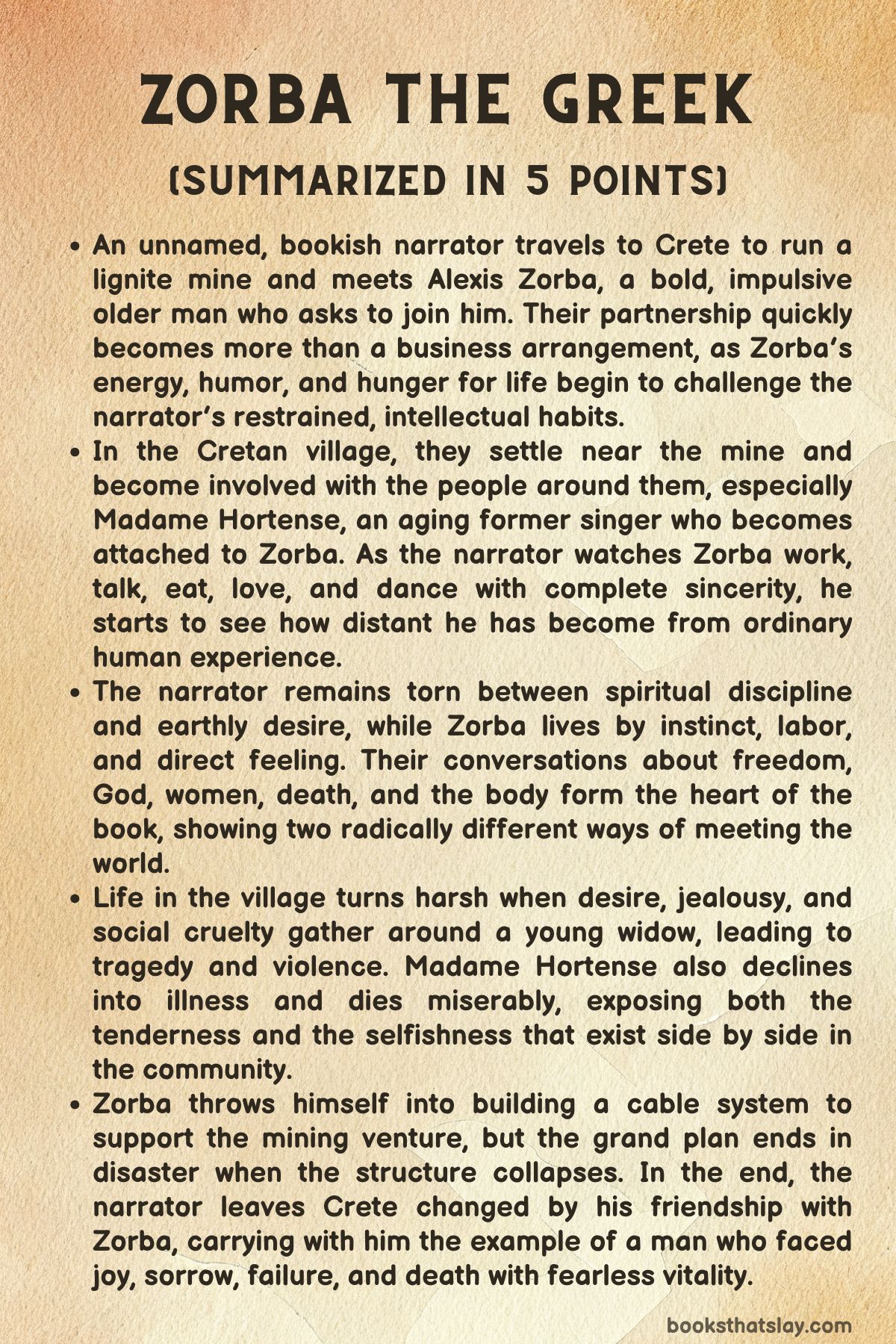
The story is told by an unnamed narrator who looks back on the man who changed him most deeply: Alexis Zorba. From the start, the narrator makes clear that Zorba did more than amuse or accompany him.
He shook him awake. The narrator had long lived among books, ideas, and spiritual questions, trying to master desire and make sense of existence through thought.
Yet he came to feel that Zorba, with his earthiness and fearless energy, taught him more about life than any philosopher.
At the beginning, the narrator is in Piraeus, preparing to travel to Crete, where he plans to reopen a lignite mine. He is grieving the departure of a dear friend who has gone off to dangerous political work, and he feels torn between action and contemplation.
While waiting to board the ship, he meets Zorba, an older man who immediately imposes himself on the scene with confidence, humor, and appetite. Zorba asks for work, speaks openly, carries his santuri, and presents himself as a man who can labor, cook, sing, and live fully.
Drawn to his vitality, the narrator hires him to help manage the mine.
During the journey to Crete, the contrast between the two men becomes clear. The narrator thinks in abstractions, reflects on religion and morality, and turns to books for calm.
Zorba speaks from experience. He has fought in wars, loved many women, worked with his hands, and made decisions with a directness the narrator both admires and cannot imitate.
Their conversations move quickly from practical matters to liberty, violence, desire, God, and the body. Zorba is often crude, but he is never lifeless.
The narrator, by contrast, begins to see how distant he has become from ordinary human pleasures and pain.
When they arrive in Crete, they settle near the mine in a coastal village and take rooms at the inn of Madame Hortense, an aging former singer and courtesan with a theatrical past. She lives on memory, vanity, and fading glamour, still attached to stories of the foreign admirals who once loved her.
Zorba at once begins courting her, half out of desire and half out of instinctive generosity toward women who long to be wanted. He gives her a heroic nickname, flatters her, and briefly restores her sense of being cherished.
The narrator watches this with a mixture of curiosity, amusement, and distance.
The mine becomes the setting in which their friendship deepens. Zorba throws himself into the work with force and invention, handling the men, the tools, and the daily problems of labor.
The narrator provides money and oversight but remains inward, still writing, reading, and trying to understand what he is seeing. Zorba teases him for his restraint, especially around food, sex, and ordinary company.
Again and again, the narrator is embarrassed by how much of life he has denied himself in the name of higher things.
Village life also draws them into the local world of gossip, ritual, poverty, and violence. The narrator meets the village elders, hears folk wisdom, and learns the rhythms of a community governed by custom more than justice.
Zorba thrives among such people because he recognizes their impulses. The narrator tries to sympathize with them but never completely belongs.
He keeps turning over questions about the soul, detachment, and the possibility of freedom, even as Zorba insists that real understanding lies in action.
At the center of the book is the narrator’s growing fascination with Zorba himself. Zorba tells stories of his past marriages and affairs, his travels, his work in many trades, his battles, and his mistakes.
He speaks openly of lust, jealousy, shame, courage, old age, and sorrow. He has danced in moments of joy and in moments of grief, even after the death of his own son.
For him, dancing becomes a language beyond argument, a way to bear what cannot be explained. The narrator sees in this a freedom that thought alone has never given him.
Zorba eventually conceives an ambitious plan to transport timber from the mountain by means of an overhead cable system, which will support the mining venture and bring in profit. The narrator agrees, partly because the idea is practical and partly because Zorba’s enthusiasm is irresistible.
Zorba travels to obtain materials, though he is easily delayed by pleasure, women, and impulse. Even when irresponsible, he remains vividly alive.
The narrator is frustrated by him and yet cannot help admiring the same qualities that make him unreliable.
Meanwhile, another drama develops in the village around a young widow. She is beautiful, isolated, and desired by many of the men, who at once lust after her and condemn her.
A young man named Pavli becomes obsessed with her and, when he cannot have her, kills himself. The village blames the widow rather than the dead youth or the social cruelty around them.
The narrator, who is drawn to the widow, hesitates for a long time, held back by timidity, scruple, and habit. Zorba urges him to act, seeing clearly that the narrator’s refusal of life is becoming another form of fear.
Eventually the narrator does go to the widow, and for a brief time he experiences a kind of release from the rigid self-control that has ruled him. But this moment of human closeness does not save her.
During a village celebration, the crowd turns on the widow in a frenzy of moral violence. She flees into the church, but the men drag her out, stone her, and finally kill her.
Zorba tries to intervene, but he is too late. The narrator is horrified, ashamed of his helplessness, and shaken by the gulf between his ideas and the brutality of communal life.
Zorba, too, mourns deeply.
At the same time, Madame Hortense declines. The narrator, in a foolish attempt to comfort her during Zorba’s absence, invents messages of love and even hints at marriage.
She embraces this fantasy and begins to act like a bride, clinging to a future that will never come. Zorba pities her and plays along more than he wants to.
When she falls gravely ill, the narrator and Zorba visit her as she dies. Her final hours are surrounded not by dignity but by greed and vulgarity, as villagers wait to seize her possessions before she is even buried.
Her death becomes one more lesson in the book’s harsh vision of human nature: tenderness exists, but so do appetite, cruelty, and indifference.
Their dealings with a monastery bring another strand of satire and disorder into the story. Seeking access to the forest for timber, the narrator and Zorba encounter monks whose lives are supposed to represent holiness but are full of fear, corruption, foolishness, and desire.
A bizarre monk named Zacharias becomes entangled with them, and the whole episode exposes religion not as pure transcendence but as another arena where human weakness appears in disguise. The narrator remains capable of spiritual wonder, but he grows less willing to confuse lofty language with truth.
In the end, all the practical hopes of the venture collapse with the cable system itself. On the day of its launch, the villagers gather, a blessing is given, and expectations rise.
Then the apparatus fails disastrously. Logs crash, the pylons collapse, and the entire scheme is ruined.
Yet this failure produces one of the novel’s most memorable responses. Instead of giving way to despair, Zorba and the narrator sit amid the wreckage, eat, drink, and then dance.
In that dance, the narrator comes closest to Zorba’s way of meeting existence: not with neat explanations, but with courage, laughter, and acceptance.
Soon after, the narrator prepares to leave Crete. Zorba tells him painful truths: that he is intelligent but not free, that reason has tied him down even when it has given him the illusion of independence.
They part with affection and sorrow, both knowing they are unlikely to share such a life again. The narrator later learns that his old friend has died, and over the years he receives scattered messages from Zorba as he moves through mines, countries, marriages, and schemes.
At last comes word of Zorba’s own death. By then, the narrator understands that what remains is not merely memory, but a permanent challenge.
Zorba stands in his mind as the image of a man who accepted hunger, work, desire, grief, failure, age, and death without surrendering his appetite for life.
Characters
In Zorba the Greek, character is revealed less through formal description than through voice, gesture, appetite, memory, and response to suffering. The people around the narrator are not arranged as neat moral examples.
They are unstable, vivid, contradictory, and shaped by hunger, loneliness, vanity, fear, pride, and desire. That is why even minor figures leave a sharp impression.
The Narrator
The narrator is an educated, reflective man who begins the novel divided against himself. He values discipline, reading, spiritual inquiry, and inner order, yet he is also haunted by the suspicion that ideas alone cannot satisfy a human life.
His central conflict is not simply between action and thought, but between embodiment and abstraction. He wants purity, self-command, and intellectual coherence, but he also envies those who seem able to surrender themselves to work, desire, laughter, and grief without first translating experience into theory.
This makes him both perceptive and limited. He sees deeply into symbols, moods, and moral contradictions, but he often fails at the moment when life demands decision.
What gives the narrator depth is that he is never merely cold or superior. He is vulnerable, ashamed of his hesitations, and painfully aware of his own incompleteness.
He admires courage in others because he senses its lack in himself. His attraction to the widow, his pity for Madame Hortense, and his fascination with Zorba all expose a man who wants contact with life but fears what such contact might demand.
He often turns to writing, philosophy, and religious images not because he is empty, but because he is trying to master experiences that unsettle him. Yet his habits of restraint can become a form of evasion.
He repeatedly interprets life instead of entering it.
By the end, he changes not by becoming identical to Zorba, but by recognizing the poverty of a life governed only by thought. He remains a man of reflection, but his understanding of freedom becomes less abstract.
He begins to see that wisdom may require participation, risk, and acceptance of contradiction. His journey is therefore inward but not passive.
He moves from distance toward contact, from self-protective detachment toward a more exposed relation to the world.
Alexis Zorba
Zorba is the animating force of the novel and one of the most memorable characters in modern fiction because he seems larger than the social categories around him. He is not civilized in the polished sense, not systematic, not reliable in bourgeois terms, and not morally consistent.
Yet he possesses an intensity of being that gives him authority. He works with total commitment, loves without embarrassment, eats with pleasure, grieves openly, improvises constantly, and treats every experience as something to be consumed fully.
He does not separate body and spirit in the way the narrator does. For him, dancing, labor, music, sex, hunger, anger, and wonder belong to the same continuum of life.
Zorba’s freedom is the trait that most overwhelms the narrator, but it is not a simple freedom. He is spontaneous, but also trapped by appetite.
He is generous, but can be selfish. He speaks with blunt wisdom, yet he is capable of foolishness, vanity, and waste.
What makes him convincing is this mixture of vitality and imperfection. He is not a sage floating above human weakness; he is immersed in it.
He lies, seduces, overspends, delays responsibilities, and moves where instinct leads him. But even his failings feel continuous with his force of life.
He is never numb, never half-committed, never content with emotional safety.
He also has a tragic side. Beneath his laughter and bravado lies an awareness of aging, death, and lost time.
His stories about women, war, labor, and family are not just comic performances; they reveal a man who has suffered and kept going by refusing paralysis. Dance, music, and storytelling are his ways of carrying what cannot be solved.
He becomes for the narrator not a moral model in the strict sense, but a living challenge: proof that a human being can confront ruin, desire, and mortality without becoming spiritually dead.
Madame Hortense
Madame Hortense is one of the novel’s most affecting figures because she stands at the crossroads of comedy, pity, illusion, and decay. She lives in the remnants of past glamour, holding on to memories of admirals, lovers, costumes, and romantic importance long after the world has ceased to grant her that status.
She performs herself because performance is the structure that remains to her. Age has taken away beauty, social power, and erotic centrality, but not the longing to be seen.
That longing defines her character. She is vain, theatrical, sentimental, and often absurd, yet these qualities arise from deep loneliness.
Her relationship with Zorba shows both her fragility and her hunger for recognition. She does not simply want sexual attention; she wants confirmation that she still matters as a woman and as a person.
This is why even false promises affect her so strongly. The fantasy of marriage gives her a renewed identity, something dignified and socially legible to replace the role of aging seductress.
Her self-presentation changes when she clings to that possibility, and the change reveals how desperately she wants legitimacy as well as affection.
At the same time, Hortense represents the brutal passage of time. Her body, her inn, and her stories all carry traces of former splendor now reduced to comic ruin.
But the novel never lets her become a mere joke. Her illness and death expose the cruelty of the village and the selfishness hidden beneath ritual sympathy.
In her final decline, she becomes less a caricature than a human being stripped bare by abandonment, greed, and mortality. Her path is sad because it shows how memory can sustain a person for years, yet cannot shield them from bodily collapse or social contempt.
The Widow
The widow is one of the most charged figures in the novel because she exists less as a socially protected person than as an object of projection. The men of the village turn her into the focus of their fantasies, resentments, frustrations, and moral panic.
Her beauty and self-possession provoke desire, but in a society that fears female autonomy, desire quickly becomes accusation. She is treated as dangerous not because of what she does, but because of what she represents: female sexuality not fully controlled by male authority.
In that sense, her character is shaped by the way others imagine her.
Yet she is not only a symbol. She has pride, reserve, and a certain quiet boldness.
She is capable of signaling desire, but she does not submit herself to public judgment. This refusal intensifies the hostility around her.
She becomes the target of collective surveillance, gossip, and blame, especially after Pavli’s suicide. The village cannot bear complexity, so it translates longing, disappointment, and masculine weakness into moral condemnation of a woman.
Her death is one of the starkest revelations in the novel. It exposes how quickly communal order can become collective violence, especially when sanctioned by custom and wounded male pride.
The widow’s importance therefore extends beyond her personal relationship with the narrator. She reveals the social cost of beauty, the vulnerability of women in patriarchal communities, and the cowardice of men who desire what they are prepared to destroy.
Uncle Anagnosti
Uncle Anagnosti embodies village endurance, fatalism, and earthy practicality. He is not an intellectual, and he has no interest in refined moral systems.
His authority comes from age, local rootedness, and the accumulated knowledge of survival. He accepts suffering as part of life and often explains events through a mix of religious belief, superstition, humor, and resignation.
This gives him a rough wisdom that can sound humane one moment and brutally indifferent the next.
He matters because he represents a stable social mentality against which the narrator’s inward complexity stands out. In him, one sees how the village digests misfortune: not through analysis, but through proverb-like judgments, habits of acceptance, and practical adaptation.
He can be warm, but his warmth does not lead to moral clarity. He participates in a world where pity and callousness exist side by side.
His reactions to the widow and to death show this clearly. He can speak in ways that seem sensible within the village order, yet that very order is implicated in cruelty.
Anagnosti is therefore not simply wise or foolish. He is the human face of a communal worldview that keeps people going, but also limits sympathy.
Through him, the novel shows how tradition can steady life while also hardening it.
Mavrandoni
Mavrandoni represents patriarchal authority sharpened by wounded family honor. As one of the leading men of the village, he carries status, pride, and the expectation that he must preserve social codes.
His role becomes especially important after the suicide of his son Pavli. Instead of confronting the emotional fragility and possessiveness that destroyed the boy, he turns grief outward into vengeance.
His violence against the widow is not a private act alone; it is an attempt to restore public order through blood.
What makes Mavrandoni significant is that he is not presented as a monster outside the community. He emerges from the same moral climate that makes the widow vulnerable and male grief possessive.
His action is horrifying, but it also reveals how honor culture can convert pain into violence while calling that violence justice. He becomes the instrument of the village’s deepest assumptions about women, shame, and ownership.
His presence also clarifies the limits of the narrator’s ethical sensibility. The narrator can condemn such brutality, but he cannot stop it.
Mavrandoni therefore stands for a form of authority that does not need philosophical justification. It acts with the confidence of custom, and that is precisely what makes it dangerous.
Mimithos
Mimithos, the errand boy, may seem small in the broader structure, but he serves an important emotional function. He moves between households, carries messages, observes adult behavior, and reflects village life in miniature.
Because he is poor and dependent, he learns early how people use one another, how desire circulates through rumor, and how quickly a child can be drawn into the emotional economies of adults. He is practical, alert, and stripped of illusion by necessity.
His significance becomes sharper in the scenes around the widow and Madame Hortense. He moves through tragedy without the protection of innocence.
He sees too much, too early. His anger and distress after the village’s acts of cruelty suggest that the moral damage of such events spreads beyond the immediate victims.
Through him, the novel shows how a harsh social world reproduces itself in the consciousness of the young.
Mimithos also helps ground the story materially. He reminds the reader that beneath philosophical conversations and dramatic passions lies a society structured by labor, poverty, and dependency.
He is a child, but he already speaks the language of scarcity.
Pavli
Pavli represents romantic obsession in its most immature and destructive form. He is consumed by the widow not as a real person, but as an impossible object of desire around which he organizes his self-worth.
His fixation reveals a masculinity unable to bear refusal or complexity. He does not know how to suffer desire without turning it into absolute personal catastrophe.
That is why his suicide feels both personal and social: it grows from emotional weakness, but also from a culture that gives men no mature vocabulary for frustration, longing, or rejection.
His death becomes a trigger for the village’s violence, which means his role extends beyond his individual psychology. He is transformed into a moral excuse.
Others use his fate to sanctify vengeance and shift responsibility onto the widow. In this way, Pavli remains tragic, but not admirable.
He is less a noble lover than a warning about how possessiveness can masquerade as passion. His inability to endure desire without self-destruction becomes one more link in the chain of communal brutality.
The Narrator’s Friend
The absent friend who has gone into political danger functions as an important counterpoint to both the narrator and Zorba. He represents action of another kind: not sensual vitality, but idealistic commitment and public struggle.
Through letters and remembered conversations, he remains a moral presence in the narrator’s mind. The narrator admires him, loves him, and measures himself against him.
This friendship reveals that the narrator’s crisis is not simply one of appetite denied, but of action deferred. He has known people who committed themselves to causes greater than comfort, yet he has not followed them.
The friend also adds a dimension of mortality and fate to the novel. The private pact between the two men about warning one another in moments of danger introduces an atmosphere of emotional and spiritual connection that the narrator cannot dismiss.
When the friend dies, the loss confirms the novel’s recurrent truth that human bonds are fragile and often preserved only in memory. Unlike Zorba, the friend is not physically present to challenge the narrator through force of personality.
Instead, he haunts him as a standard of seriousness, courage, and unfinished obligation.
Zacharias
Zacharias is one of the strangest figures in the novel, but his strangeness has thematic purpose. He is a monk split between religious identity and bodily craving, between piety and appetite, theatrical repentance and comic degradation.
His language of devils and possession expresses not supernatural depth so much as psychological fragmentation. He cannot integrate desire, so he speaks of it as something inhabiting him.
This makes him grotesque, funny, and unsettling at once.
His importance lies in what he reveals about spiritual institutions. In him, religion does not appear as serenity or holiness, but as hunger rearranged into eccentric forms.
He is ridiculous, yet he is also pathetic. His need for food, drink, and recognition strips away the grandeur of monastic life and exposes the ordinary weakness beneath religious costume.
When he later becomes entangled in destructive acts, he shows how unstable and theatrical spiritual authority can become when cut off from honest self-knowledge.
Zacharias is not a deep thinker or a central moral force, but he is unforgettable because he dramatizes the distance between sacred language and actual human behavior.
Madame Hortense’s Admirals and Former Lovers
Though they are largely figures of memory, the admirals and former lovers matter because they help define Madame Hortense’s emotional world. They exist as relics of a past in which beauty, colonial politics, erotic theater, and personal fantasy overlapped.
Whether her stories are fully reliable matters less than the role those men play in sustaining her identity. Through them she remembers herself as desired, influential, and central to history.
They are less characters in their own right than emotional scaffolding for her self-image.
Their lingering presence also sharpens the novel’s treatment of memory. The past can be both shelter and prison.
Hortense needs those men because they allow her to inhabit an earlier self, but dependence on such memories makes present loneliness even harsher. The admirals therefore function as ghosts of lost glamour, reminders that desire once gave her social power but left her with no lasting protection.
Themes
Freedom and the Weight of Self-Consciousness
Freedom in Zorba the Greek is not treated as a slogan or an abstract political ideal. It appears as a difficult condition of being fully present to life without becoming trapped by fear, theory, shame, or habit.
The narrator wants freedom, but he usually imagines it through detachment, discipline, and control. Zorba lives another version of it: impulsive, bodily, immediate, and unconcerned with self-justification.
The tension between them asks whether a person can ever be free while constantly interpreting experience instead of entering it. The novel does not pretend that instinct is pure or that reflection is worthless.
Zorba’s freedom comes with waste, irresponsibility, and pain, while the narrator’s restraint contains intelligence and moral seriousness. Yet again and again, the text shows self-consciousness becoming a cage.
The narrator hesitates before desire, before action, before grief, before joy. His mind often stands between him and existence.
Freedom finally begins where explanation no longer dominates every impulse. It requires risk, incompletion, and the courage to live without total mastery over oneself.
Body, Spirit, and the Refusal of Division
The novel keeps returning to hunger, labor, sex, fatigue, dance, sickness, and old age in order to challenge any easy separation between flesh and spirit. The narrator initially leans toward ascetic ideals.
He wants to rise above appetite, to refine himself through thought, and to treat the body almost as an obstacle to higher awareness. Zorba destroys that illusion simply by living otherwise.
For him, eating can carry reverence, work can contain joy, dancing can express grief, and sexual desire can be part of the same energy that drives song and courage. This does not mean bodily life is romanticized.
The body ages, decays, suffers, and dies. It exposes people to humiliation and loss.
Yet the novel insists that spirit cut off from the body becomes sterile. Many of its strongest moments come when physical acts carry meanings language cannot hold.
The body is not presented as the enemy of transcendence, but as one of its necessary grounds. Human beings do not become wiser by pretending they are above embodiment.
They become thinner, more frightened, and less alive.
Women, Desire, and Social Cruelty
Desire in the novel is rarely private. It is shaped by custom, gender hierarchy, gossip, and communal judgment.
Women are desired intensely, but that desire is mixed with contempt, fear, ownership, and sentimentality. Madame Hortense is wanted as long as she can flatter masculine fantasy, then left to age into ridicule and neglect.
The widow is desired because of her beauty and independence, yet those same qualities make her vulnerable to public hatred. Men project onto women their loneliness, lust, resentment, and wounded pride, then condemn them for the emotions they themselves cannot govern.
This pattern exposes a society in which female existence is constantly interpreted through male need.
At the same time, the novel is not simple in its treatment of desire. Zorba can be warm, playful, and attentive toward women, but he too often speaks in generalizations that reduce them.
The narrator is more inward and less overtly possessive, yet his hesitation does not protect women from harm. What emerges is not a neat moral contrast between good and bad men, but a wider picture of a world where women bear the cost of male fantasy and social hypocrisy.
Desire becomes dangerous when a community treats women as symbols rather than persons.
Death, Failure, and Defiance
Death and failure are never far from the surface of the novel. People die suddenly, ventures collapse, beauty fades, youth vanishes, and grief arrives without explanation.
The mine fails, the cable system collapses, Madame Hortense dies in indignity, the widow is murdered, and the narrator’s absent friend is lost. Yet the novel does not settle into despair.
Its distinctive power lies in the way it stages defiance without illusion. Zorba does not deny death.
He argues with it, curses it, dances against it, and refuses to become spiritually obedient before it. The narrator, by contrast, is drawn toward acceptance, symbol, and philosophical resignation.
Their difference gives the theme its depth. The question is not whether death can be conquered, but how one should live under its certainty.
Failure also becomes a test of character. The collapse of the great timber scheme is materially disastrous, but it produces one of the book’s most liberating moments.
Instead of reducing life to success and ruin, the novel asks whether a person can meet wreckage with laughter, appetite, and motion. Defiance here is not denial of suffering.
It is a refusal to let suffering dictate the whole meaning of existence.