10 Minutes 38 Seconds in This Strange World Summary, Characters and Themes
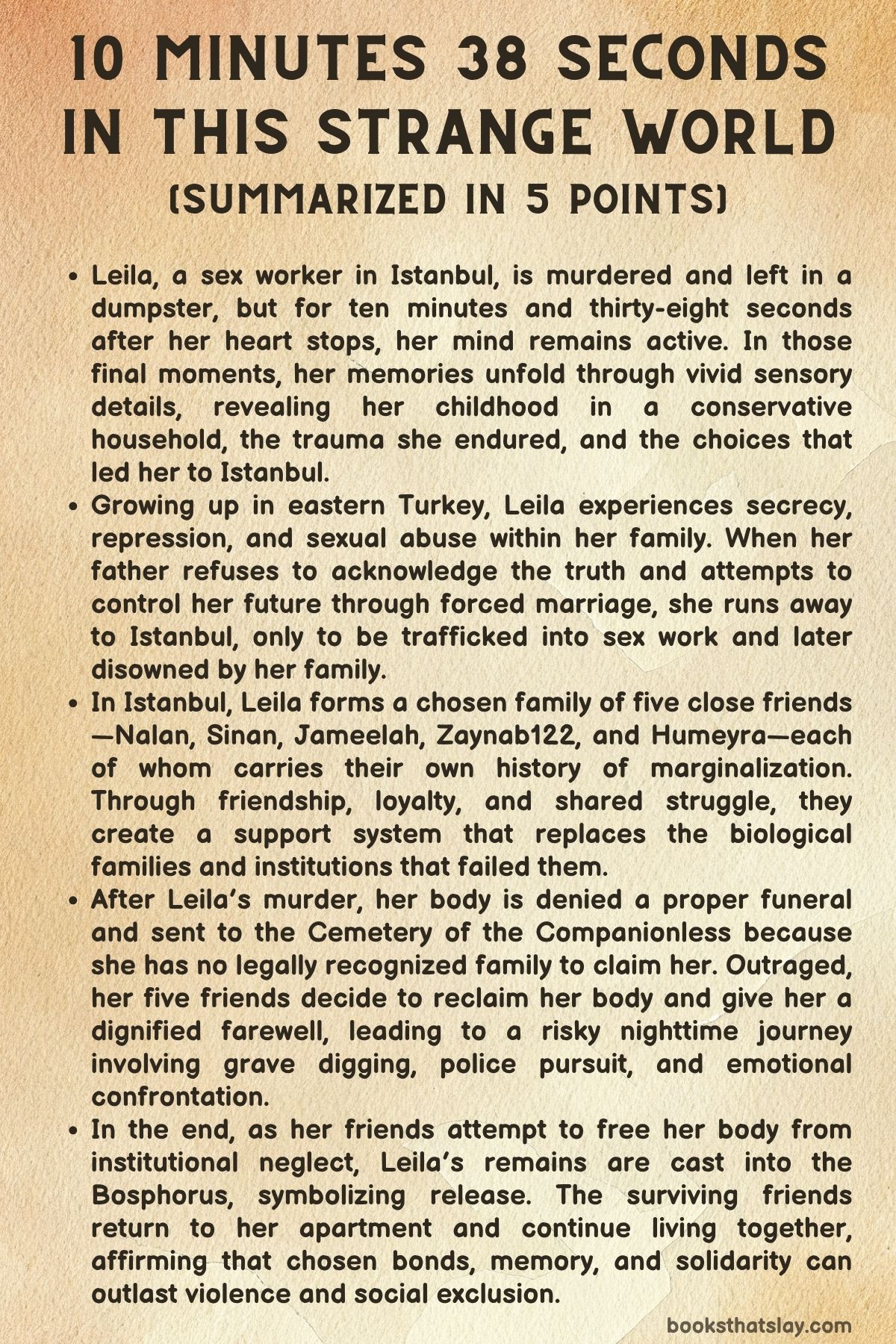
10 Minutes 38 Seconds in This Strange World by Elif Shafak is a novel set in Istanbul that begins at the instant a young woman is murdered—and then refuses to end there. As Leila’s brain keeps working for a brief time after her death, memory becomes her final shelter: tastes, scents, textures, and flashes of the life that made her “Tequila Leila” to some and simply Leila to the people who truly knew her.
Through her last minutes and the actions of the friends she leaves behind, the book questions who gets to count as family, who gets dignity in death, and how a city can both reject and sustain its outsiders.
Summary
Leila is murdered in Istanbul and dumped in a trash container near a football field. Although her body is lifeless, her mind remains active for a short while.
In that narrow span, she stays alert to the world around her—footsteps, voices, the cold air—and she worries about what will happen to the five people who mattered most to her. She wants to be found, not for the newspapers or the gawkers, but so her friends can know what happened and give her the farewell she would have chosen.
As Leila’s thoughts move, they return to the start of her life. She is born into a complicated household in eastern Turkey, where a man can have two wives and still demand obedience as if love were a debt.
Leila’s biological mother, Binnaz, is young and frightened, and the birth is tense. When the baby does not cry, the women around her resort to a rough folk remedy to force air into her lungs.
Leila lives, but the home she enters is built on secrets and control. Her father, Haroun, is determined to shape the family’s reputation, and he makes a decision that defines Leila’s childhood: he insists that Leila be raised as the daughter of Susan, his first wife.
Susan becomes the mother Leila knows, while Binnaz is pushed to the side in public, forced to swallow grief that has nowhere safe to go.
Leila grows up sensing that affection is risky. She learns early that tenderness must be hidden, not displayed, and that truth is often punished.
Family life is full of contradictions: the women can be lively and crude together in private, yet rigid and pious in public. Leila watches these shifts and understands that rules are not always about faith; they are about control and being seen in the “right” way.
A childhood holiday becomes the moment that breaks her sense of safety. Her uncle abuses her at night while everyone sleeps.
He tells her she is his favorite and then twists the violence into shame, warning her to keep quiet or be blamed. Leila returns home sick with a fever that no one can explain, and in her delirium she finally speaks what happened.
A pharmacist—an independent woman who does not fit the family’s expectations—treats Leila and, through her presence, shows Leila another kind of adulthood: one with fewer lies. The pharmacist’s son, Sinan, offers Leila a simple kindness by holding her hand.
That small comfort stays with her. Sinan becomes the first of Leila’s chosen family, later nicknamed Sabotage Sinan for his love of codes and his habit of taking risks.
As the years pass, Haroun grows stricter and more extreme in his beliefs, especially after Leila’s younger brother is born with Down syndrome and later dies. Haroun interprets life through punishment and purity.
Leila, carrying the secret of the abuse, begins to harm herself as a way to quiet panic and disgust. When she tries to talk to her father indirectly—asking what happens to someone who has done something “wrong” without wanting it—he responds with anger and denial.
The family’s loyalty is not to Leila, but to the image of the family.
In adolescence, Leila is pulled out of school and kept at home until marriage. Her father’s religious adviser supports the decision, and the world narrows around her.
When Leila realizes she is pregnant from the abuse, she becomes desperate to end the pregnancy and tries dangerous methods to trigger a miscarriage. She finally confronts her family with the truth, demanding medical confirmation, but her father refuses.
He insists that “family matters” stay private, which in practice means buried. Leila miscarries, and the message is clear: her suffering will not be acknowledged, and the man who harmed her will be protected.
A marriage is arranged as another form of containment.
Leila runs. With Sinan’s help, she leaves home and takes a train to Istanbul.
The city she once romanticized is enormous, noisy, and indifferent. At a station, a young man offers her a place to stay.
Frightened and alone, she accepts. The offer is a trap.
He and his aunt traffic her and force her into sex work. When Leila reaches out to her family, hoping for a thread back to ordinary life, her father eventually disowns her completely, cutting the last official tie.
In the world she is forced into, Leila is arrested repeatedly and treated as disposable by the system—screened, sorted, and judged. Yet, this is also where she finds people who treat her as human.
In custody, she notices an African woman separated from Turkish women by an unspoken rule of “locals” and “foreigners.” Leila speaks to her anyway. The woman is Jameelah, who has been trafficked from Somalia and refuses to surrender her sense of self.
Their friendship begins with a small exchange—a compliment, a bracelet—and becomes a bond rooted in mutual recognition.
Leila also meets Nalan, a transgender woman who fled a life that never fit her. The two connect after a police raid lands them in the same cell.
Nalan’s courage and humor become a steady presence, and she earns the nickname Nostalgia Nalan. Another friend enters Leila’s circle through work as well: Zaynab122, a Lebanese woman with dwarfism who supports herself as a cleaner and fortune teller in the brothel.
Zaynab122 speaks plainly about fate and possibility and treats Leila with a respect the outside world denies her. Later, Leila forms a close friendship with Humeyra, a singer who escaped an arranged marriage and the threat of violence.
Humeyra, called Hollywood Humeyra, understands fear and reinvention, and she and Leila keep each other standing through long stretches of loneliness.
Leila’s life in the brothel includes brutality. A violent client attacks her with acid, leaving scars that become another mark the world reads before it learns her name.
Still, Leila survives, adapts, and holds onto dreams that seem almost unreasonable in her circumstances—postcards of distant places, small routines, and the private joy of friendship. In the late 1960s, during political unrest in Istanbul, Leila shelters a young leftist protester fleeing police.
He calls himself D/Ali, a name shaped by bullying and a love of art. Unlike most men she meets, he does not demand her body.
He returns to talk, to listen, to share his way of experiencing the world through smell and taste. Their relationship grows in a space that is neither purely romantic nor purely transactional, but something made from choice.
Eventually D/Ali asks Leila to marry him. She resists at first, wary of promises, but they do marry, and for a time she experiences a life that feels newly hers: an apartment, a wedding cake, the chance to step outside the identity others assigned to her.
Yet politics and violence intrude. At a massive workers’ demonstration in Taksim Square in 1977, gunfire erupts.
Chaos scatters the crowd, and Leila loses D/Ali in the crush. After days of searching, she learns he has died.
The loss strips away the life she was trying to build, leaving her with grief and the fragile safety net of her friends.
Years later, in 1990, Leila takes a job at an upscale hotel arranged by the brothel’s madam. The job involves a wealthy family trying to “fix” their son’s sexuality by forcing a marriage and hiring a woman to “change his mind.” Leila refuses to play the role they expect.
She treats the young man with calm respect and encourages him to be honest with the person he loves. After she leaves, she is approached by men in a car.
Money is tight because Jameelah is ill, and Leila agrees to a paid encounter under conditions she tries to control. The situation turns dangerous.
In the present, as Leila lies dead, the truth becomes visible: the men are connected to a pattern of murders targeting sex workers, carried out under a warped idea of turning women into “angels.”
Leila’s consciousness fades, but the story continues with the living. In the morgue, officials deny her friends the right to claim her body because they are not “family.” The state plans to bury her in the Cemetery of the Companionless, reserved for the unclaimed and the unwanted.
Her five friends refuse to accept that ending. They gather at Leila’s apartment, argue, cry, cook halva for her soul, and stare at the humiliating newspaper coverage that reduces Leila to a stereotype.
Their grief turns into resolve: if the law won’t recognize their bond, they will act anyway.
They form a risky plan. Using a borrowed truck and digging tools, they drive to the cemetery at night, dodging police suspicion.
Among numbered graves, they search for Leila and accidentally dig up the wrong body first, a mistake that shocks them into the reality of how easily people disappear. They find Leila’s grave, lift her from the dirt, and attempt to take her to be buried beside D/Ali.
Police pressure forces them to change course again and again, until Zaynab122 suggests the sea—an ending that belongs to Leila rather than to a system that erased her.
On the Bosphorus Bridge, police catch up. In the confrontation, Sinan chooses action over fear and pushes Leila’s body into the water below.
A shot rings out, and Sinan is injured, paying a brutal price for loyalty. As Leila’s body falls, her final vision arrives: she imagines a blue betta fish released on the day she was born, guiding her into a sense of freedom she rarely had in life.
Afterward, the surviving friends return to Leila’s apartment and, in the empty space she leaves, build a new kind of household together. Istanbul keeps changing around them, but they hold onto one another, insisting—through daily life, memory, and stubborn care—that Leila was not disposable, and neither are they.
Characters
Leila (Tequila Leila)
Leila is the moral and emotional center of 10 Minutes 38 Seconds in This Strange World, even though the novel opens with her death. Born into secrecy and repression, she grows up learning that affection must be hidden and that truth is often punished.
Her childhood trauma at the hands of her uncle shapes her inner life: she carries shame that was never hers, and her silence becomes both a survival strategy and a wound. Yet Leila is not defined only by suffering.
She possesses a sharp observational mind and an ability to register the world through taste and scent, suggesting a heightened sensitivity to experience. Even when exploited and trafficked into sex work, she retains a core of dignity and curiosity.
She collects postcards of places she dreams of visiting, holds onto rituals like birthday celebrations, and forms friendships that are based on loyalty rather than transaction. Her refusal to judge others—whether it is a transgender woman, a trafficked migrant, or a conflicted young man pressured into marriage—reveals her deep empathy.
In death, her consciousness continues briefly, symbolizing how memory resists erasure. Leila’s life exposes the cruelty of social systems, but her friendships show how chosen bonds can offer a counterweight to exclusion.
Nostalgia Nalan
Nostalgia Nalan, born Osman, represents defiance against rigid gender expectations. Growing up in rural Anatolia, she senses early that her internal identity does not match the role assigned to her.
Mockery, bullying, and the humiliation of military service harden her resolve rather than breaking it. By fleeing an arranged marriage and remaking herself in Istanbul, Nalan claims authorship over her own body and name.
She is outspoken, irreverent, and skeptical of institutions, especially religion, which she sees as a tool used to shame and control. Yet beneath her brash exterior lies fierce loyalty.
She is often the loudest voice among the friends, the one who turns grief into action. Her plan to exhume Leila’s body is reckless, but it springs from love and outrage at a system that refuses dignity to the marginalized.
Nalan’s use of humor and alcohol masks vulnerability, particularly her fear of being erased or forgotten. She embodies both resilience and fragility, showing how survival often demands performance.
Through her, the novel examines transgender identity in a society that polices difference while depending on the labor of those it excludes.
Sabotage Sinan
Sinan is the bridge between Leila’s childhood and her adult life. Raised by a progressive pharmacist mother after his father’s death, he grows up in a household that values education and critical thinking.
His fascination with codes and sabotage signals a mind drawn to patterns and quiet rebellion. As a boy, he offers Leila uncomplicated kindness, and as an adult he follows her to Istanbul, unable to sever the bond formed in youth.
Sinan’s love for Leila is steady but largely unspoken, restrained by circumstance and by her marriage to D/Ali. His own life becomes conventional—marriage, children, work—but it lacks fulfillment.
He moves between worlds, belonging fully to neither. His participation in the grave exhumation shows both courage and desperation; he is willing to sacrifice stability for loyalty.
When he pushes Leila’s body off the bridge despite police threats, he chooses symbolic freedom over legal obedience. Sinan represents devotion tinged with regret, a man who understands too late how deeply he loved and how little society protects the vulnerable.
Jameelah
Jameelah’s journey from Somalia to Istanbul highlights global systems of exploitation. Once a child with a stable home and spiritual curiosity, she becomes displaced by war and economic hardship.
Trafficked under the promise of domestic work, she is forced into sex work far from home. Despite this, Jameelah maintains a quiet inner strength.
She does not surrender to bitterness; instead, she builds connection. Her friendship with Leila begins with a small gesture that defies segregation within a detention space.
Jameelah’s faith is complex—rooted in memory, loss, and adaptation rather than rigid doctrine. When she becomes ill with lupus, her vulnerability deepens the bond among the five friends.
She often brings gentleness to the group, singing lullabies and offering comfort. Jameelah embodies endurance shaped by displacement.
Through her, the narrative addresses migration, racism, and the precarious status of foreign women in a society that benefits from their labor while denying their belonging.
Zaynab122
Zaynab122, a Lebanese woman with dwarfism, carries both physical and social marginalization. Coming from an isolated village where difference is common yet limiting, she yearns for a wider world.
Her fascination with a visiting photographer symbolizes her desire for beauty and recognition beyond the confines of her birthplace. In Istanbul, she works in a brothel not as a sex worker but as a cleaner and fortune teller, occupying a liminal space within an already stigmatized environment.
Her spiritual outlook contrasts sharply with Nalan’s skepticism. Zaynab122 believes in fate, signs, and divine order, and she clings to ritual as a way of making sense of suffering.
Yet her faith is not naïve; it coexists with practical intelligence and humor. During the graveyard episode, she insists on prayer, underscoring her belief that dignity in death matters deeply.
Zaynab122 symbolizes the human need for meaning, even in unjust systems. Her presence broadens the novel’s exploration of bodily difference and the varied ways people interpret destiny.
Humeyra (Hollywood Humeyra)
Humeyra grows up near the Syrian border and is married off young, only to find herself reduced to servitude within her husband’s family. Her escape to Istanbul is both an act of theft and self-preservation.
By reinventing herself as a nightclub singer, she claims visibility on her own terms. The nickname Hollywood Humeyra suggests glamour, but beneath it lies anxiety and depression.
She fears retribution from her husband and the possibility of honor-based violence. Leila’s support becomes crucial in helping her stabilize emotionally.
Humeyra’s attachment to performance reflects both empowerment and fragility; singing allows her to inhabit identities beyond the constraints imposed on her. During the chaotic night at the cemetery and bridge, her fear is palpable, yet she remains loyal.
Humeyra represents women who refuse prescribed domestic roles and pay a psychological cost for that refusal. Through her, the narrative addresses marriage, autonomy, and the long shadow of patriarchal control.
D/Ali
D/Ali, born Ali, straddles multiple identities: the son of Turkish immigrants in Germany, a sensitive artist mocked for his creativity, and a political activist drawn to leftist movements. His nickname, inspired by Salvador Dalí, signals both ridicule and individuality.
In Istanbul, he is angry at injustice and eager for revolution, yet he is also capable of tenderness. Unlike most of Leila’s clients, he seeks conversation rather than transaction.
His understanding of the world through sensory detail mirrors Leila’s own heightened awareness, creating a bond built on perception rather than pity. His proposal of marriage challenges Leila’s belief that her past makes her unworthy of ordinary happiness.
Still, he is not without contradiction. Nostalgia Nalan suspects that he keeps Leila and her friends separate from his political circles, hinting at lingering shame.
His death during political unrest underscores the volatility of the era and the cost of ideological struggle. D/Ali embodies hope complicated by social reality—a man who loves sincerely yet cannot fully escape the prejudices of his context.
Haroun
Haroun, Leila’s father, is a man shaped by patriarchy, pride, and escalating religiosity. Initially portrayed as authoritative but not overtly cruel, he grows increasingly rigid after personal tragedies, especially the death of his son.
Rather than confronting grief, he interprets events as divine punishment or moral failure. His allegiance to his brother over his daughter reveals his prioritization of male solidarity and family reputation.
Haroun’s insistence on secrecy regarding abuse illustrates how social honor can eclipse justice. By withdrawing Leila from school and arranging her marriage, he narrows her world in the name of protection.
His eventual disowning of her cements his commitment to public image over parental love. Haroun is not depicted as monstrous but as deeply flawed, representing a system where authority is rarely questioned and where women’s voices are dismissed as threats to order.
Binnaz
Binnaz, Leila’s biological mother, lives in emotional captivity. As the second wife in a polygamous marriage, she is perpetually insecure about her status.
Her early disappointment at giving birth to a girl reflects internalized societal values. Forced to surrender Leila to Susan for public appearances, Binnaz’s maternal love becomes fragmented and private.
Her mental health struggles suggest the psychological toll of repression and lack of agency. She is neither openly rebellious nor entirely compliant; instead, she survives through quiet endurance.
Binnaz’s inability to protect Leila from abuse or forced marriage stems less from indifference than from powerlessness. Through her, the narrative examines how women can become complicit in harmful systems not by choice but by constraint.
Susan
Susan, the first wife, raises Leila as her own, complicating traditional notions of motherhood. Though she participates in maintaining the family’s façade, she offers Leila moments of care and domestic stability.
Her affection, however, is constrained by the presence of Binnaz and by the competitive structure of polygamy. Susan embodies the tension between genuine attachment and social performance.
She is part of the structure that silences Leila, yet she is also a victim of that same structure. Her character reveals how maternal love can exist within, and be limited by, patriarchal arrangements.
Leila’s Uncle
Leila’s uncle represents predatory entitlement masked by familial authority. Outwardly charismatic and successful, he uses his status to shield himself from accountability.
His abuse of Leila is accompanied by psychological manipulation, convincing her that she is complicit and “dirty.” When confronted indirectly, he is protected by his brother, illustrating how patriarchal systems often safeguard perpetrators. He symbolizes the hidden violence that thrives within respected institutions like family.
Unlike more nuanced characters, he functions primarily as an embodiment of unchecked power and the damage it inflicts.
Bitter Ma
Bitter Ma, the brothel’s madam, is pragmatic and business-minded. She operates within a harsh economy and enforces its rules without sentimentality.
Yet she is not entirely devoid of complexity. She admires audacity, as seen when she helps Leila transfer brothels and later allows her to marry D/Ali for the right price.
Bitter Ma understands survival in transactional terms; compassion is secondary to profit. Still, her interactions with the women suggest a grudging respect for resilience.
She is both exploiter and protector, reflecting how marginalized communities sometimes replicate hierarchies internally to survive external hostility.
Mr. Chaplin
Mr. Chaplin, Leila’s cat, may seem minor, yet he symbolizes constancy and uncomplicated affection. Waiting outside her apartment after her death, he embodies loyalty that does not depend on social status.
The cat’s presence softens the narrative, reminding readers that care can be simple and instinctive. In a world that categorizes and excludes, Mr. Chaplin’s attachment stands as a quiet counterexample.
Through this ensemble, 10 Minutes 38 Seconds in This Strange World constructs a portrait of individuals pushed to society’s edges yet bound together by solidarity. Each character reflects a different facet of marginalization, resistance, and the search for dignity in a city that both sustains and rejects them.
Themes
Memory, Consciousness, and the Persistence of Identity
In 10 Minutes 38 Seconds in This Strange World, the idea that consciousness lingers after physical death becomes a structural and philosophical foundation. The novel grants Leila a brief period in which her brain continues to function, allowing memory to surface in sensory fragments—taste, smell, texture, sound.
This narrative choice elevates memory from mere recollection to a final act of self-assertion. In a society that reduces her to a label—sex worker, sinner, disposable body—her mind becomes the last territory no one can invade.
The structure suggests that identity is not determined by how one dies or how others describe one’s life, but by the interior archive of lived experience.
Memory is also portrayed as selective and deeply embodied. Leila’s recollections are triggered by flavors such as lemon sugar wax, cardamom coffee, or wedding cake, indicating that the body stores emotional truths even when language fails.
Trauma, especially childhood abuse, resurfaces not as a neat narrative but as sensations and shame. This reinforces the idea that memory is not linear; it resists containment and defies official records.
The state may reduce Leila to a numbered grave, but her mind reconstructs a full existence in defiance of bureaucratic erasure.
The novel further suggests that memory is communal as well as individual. After Leila’s death, her friends continue her story through their own recollections.
In doing so, they resist the system that denies her dignity. Memory becomes a political act: to remember someone fully is to reject the narrative imposed by authority.
The persistence of Leila’s consciousness, even for a few minutes, underscores a larger claim that identity cannot be entirely extinguished by violence or social condemnation.
Marginalization and Social Exclusion
The lives portrayed in 10 Minutes 38 Seconds in This Strange World exist on the edges of respectability. Sex workers, migrants, transgender individuals, people with disabilities, political dissidents—these figures inhabit spaces that mainstream society tolerates only when convenient and condemns when visible.
The Cemetery of the Companionless stands as a stark symbol of institutionalized exclusion. Those buried there are denied ritual, family recognition, and even proper names, reduced instead to numbers.
This cemetery is not merely a physical location but a manifestation of how the state categorizes human worth.
Leila’s trajectory from a silenced daughter to a trafficked woman in Istanbul highlights how vulnerability compounds across gender, class, and geography. Her father’s refusal to acknowledge abuse reflects a cultural system that prioritizes family honor over justice.
Once she enters sex work, her legal status ensures repeated humiliation through arrests and medical examinations. The police, media, and hospital authorities treat her death as routine, reinforcing the notion that some lives are less grievable.
Other characters reinforce this pattern. Nalan’s transgender identity subjects her to ridicule and violence; Jameelah’s status as an African migrant exposes her to racial and economic exploitation; Zaynab122’s dwarfism shapes how she is perceived and limited; Humeyra’s escape from an arranged marriage leaves her vulnerable to threats of honor-based violence.
None of these identities exist in isolation. The novel demonstrates how society constructs hierarchies that overlap and intensify marginalization.
At the same time, exclusion creates alternative communities. The five friends form a family built not on blood but on shared survival.
Their solidarity challenges the rigid boundaries imposed by institutions. By centering characters typically pushed to the margins, the narrative exposes how social exclusion is maintained—and how it can be quietly resisted through collective care.
Patriarchy, Honor, and Control of Women’s Bodies
Control over women’s bodies shapes nearly every stage of Leila’s life. From the moment of her birth, her value is measured through patriarchal expectations.
Her father’s authority defines family structure, dictates education, and determines marriage prospects. The concealment of her abuse illustrates how honor culture operates: preserving male reputation outweighs protecting a girl’s safety.
Silence becomes a duty imposed on the vulnerable.
Leila’s attempt to speak indirectly about her trauma reveals the limits placed on female expression. Her father’s anger and refusal to seek medical confirmation demonstrate how patriarchal systems manipulate truth.
Even her miscarriage becomes another episode absorbed into secrecy. Marriage is presented not as partnership but as containment, a tool to restore social order.
The theme extends beyond the family into the public sphere. In Istanbul, sex work exposes women to commodification under the guise of regulation.
Clients, police, and brothel owners negotiate women’s bodies as objects of transaction. The wealthy father who arranges a wedding for his gay son seeks to use a woman’s body to correct male sexuality, treating her as an instrument rather than a person.
Violence against sex workers is rationalized through distorted moral narratives, suggesting that society both consumes and punishes female sexuality.
Yet women in the novel resist in varied ways. Humeyra flees her marriage; Nalan claims her gender identity; Jameelah refuses to surrender her inner life; Zaynab122 insists on ritual dignity; Leila ultimately chooses love on her own terms by marrying D/Ali.
These acts of resistance do not dismantle patriarchy entirely, but they expose cracks in its authority. The novel portrays honor culture not as sacred tradition but as a mechanism that sustains inequality and silences victims.
Friendship and Chosen Family
Blood ties in the novel often fail, while chosen bonds become sources of survival. Leila’s biological family prioritizes reputation over compassion, leaving her isolated.
In contrast, the five friends create a network based on loyalty, humor, and shared vulnerability. Their annual birthday celebrations for Leila symbolize more than festivity; they affirm her existence in a world that would rather ignore her.
The refusal of hospital authorities to release Leila’s body to her friends underscores how institutions privilege biological kinship. The friends’ insistence that they are her true family challenges that definition.
Their plan to exhume her body and give her a proper burial is legally reckless but morally driven. Through this act, the novel argues that family is defined by care rather than blood.
Each friendship carries distinct dynamics. Sinan’s quiet devotion, Nalan’s fierce protectiveness, Jameelah’s gentle steadiness, Zaynab122’s spiritual grounding, and Humeyra’s emotional dependence form a complex web.
They argue, tease, and disagree, yet they remain united. Their collective grief becomes a shared responsibility.
Even in the face of police pursuit and physical danger, they act together.
Chosen family also offers a counter-narrative to shame. Leila’s friends know her full story—her scars, her work, her past—and love her without qualification.
In doing so, they reclaim her identity from a society that defines her by stigma. The novel presents friendship not as secondary to romance or bloodline, but as a primary force capable of restoring dignity.
Political Turmoil and Historical Change
The backdrop of political unrest shapes the characters’ lives in subtle and overt ways. Student protests, ideological clashes, and state violence permeate the city.
D/Ali’s involvement in leftist activism situates personal relationships within broader struggles. His death during a workers’ demonstration underscores how political conflict claims individual lives, turning idealism into tragedy.
The construction of the Bosphorus Bridge symbolizes Istanbul’s dual identity, connecting continents and cultures. Celebrations of modern infrastructure coexist with persistent inequality and repression.
The bridge becomes a site of both unity and confrontation, culminating in Leila’s body being pushed into the water below. This moment fuses personal narrative with national symbolism: a woman marginalized by society finds her final release at the intersection of continents.
Political forces also influence the policing of morality. Raids on nightclubs and brothels reveal selective enforcement of law.
Authorities target visible “immorality” while ignoring systemic violence carried out by the powerful. The wealthy father and his associates operate with relative impunity, suggesting that class privilege shields wrongdoing.
The novel portrays Istanbul as a city in flux, where tradition and modernity coexist uneasily. Characters navigate this shifting landscape, adapting to new opportunities while confronting entrenched prejudice.
Political upheaval does not exist in isolation from personal lives; it shapes economic conditions, social norms, and the limits of freedom. Through these intertwined layers, the narrative examines how historical change affects those already living at society’s margins.
Death, Dignity, and the Meaning of Burial
Death in the novel is not simply an ending but a measure of social value. The Cemetery of the Companionless represents a bureaucratic solution to unwanted bodies.
Its numbered graves erase individuality, signaling that certain lives do not merit ceremony. Leila’s fate there is framed as a final injustice, compounding the indignities she endured in life.
The friends’ determination to reclaim her body transforms burial into a moral statement. Exhumation becomes an act of protest against dehumanization.
Their chaotic journey—digging up the wrong grave, fleeing police, confronting fear—reveals both the absurdity and the seriousness of their mission. They are not seeking perfection but acknowledgment.
The eventual decision to cast Leila into the Bosphorus redefines burial as release rather than containment. Water replaces soil, and the rigid numbering of graves gives way to a symbolic return to nature.
The image of the blue betta fish connecting her birth to her death frames mortality within continuity rather than annihilation. This mystical element suggests that dignity is not granted by institutions but found in memory and connection.
Through its treatment of death, the novel questions who deserves mourning and ritual. It argues that dignity is not contingent on social respectability.
By centering the afterlife of a woman deemed disposable, 10 Minutes 38 Seconds in This Strange World insists that every life carries weight, and that the measure of a society lies in how it treats its most marginalized—even in death.