10 Days That Unexpectedly Changed America Summary and Analysis
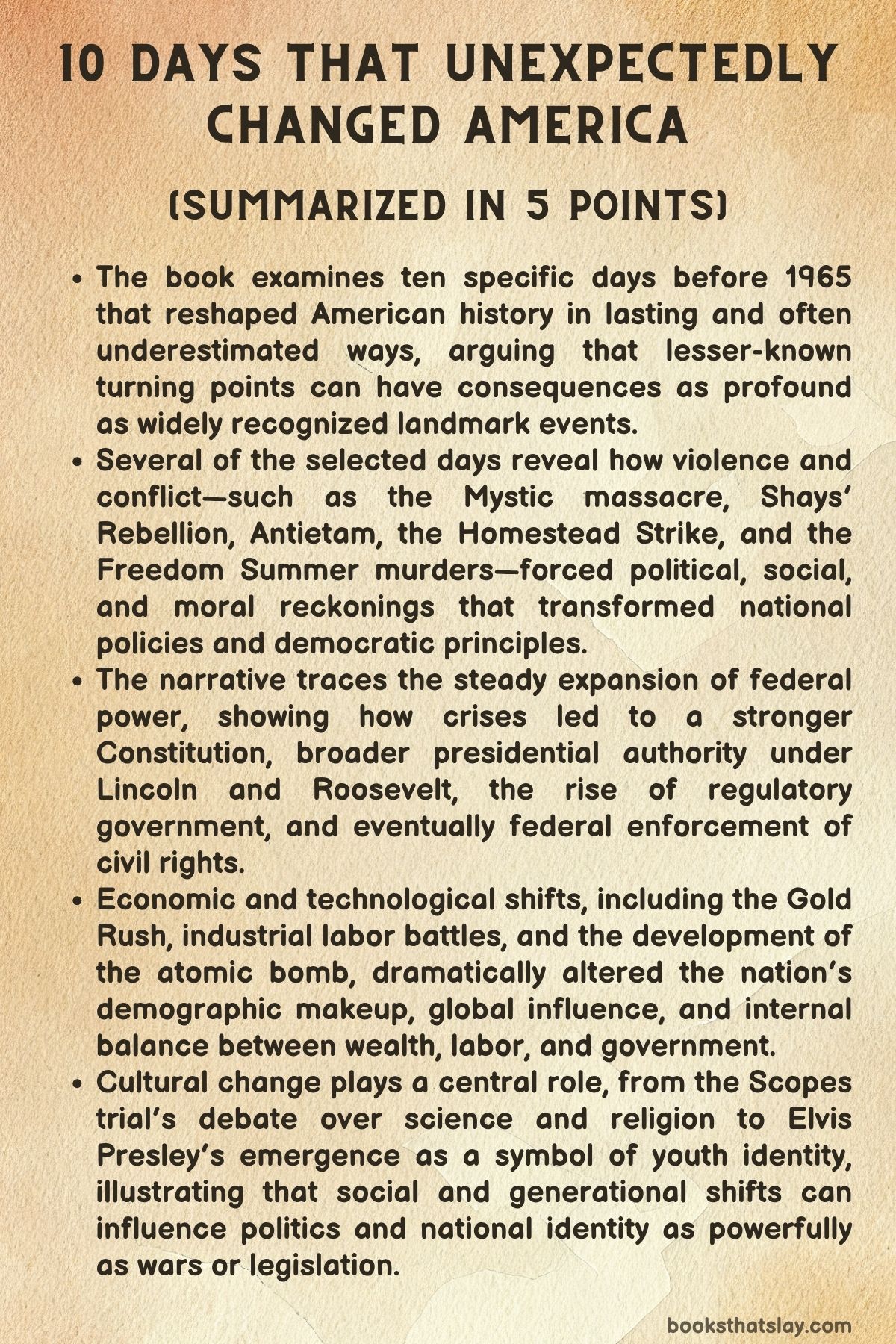
10 Days That Unexpectedly Changed America by Steven M. Gillon is a work of narrative history that revisits pivotal yet often underestimated moments in the American past. Rather than focusing on the most obvious milestones, Gillon highlights ten specific days before 1965 that reshaped the nation in lasting ways.
Originally conceived alongside a History Channel documentary series, the book argues that some of the most influential turning points were not always recognized as such at the time. Through episodes ranging from colonial conflict to the civil rights movement, Gillon shows how violence, reform, cultural shifts, and political upheaval collectively influenced the evolving meaning of American democracy.
Summary
The book begins in 1637 with the Massacre at Mystic during the Pequot War. English Puritans, joined by Native allies, attacked and burned a Pequot fort, killing hundreds of men, women, and children.
The English justified the destruction as divinely sanctioned. This event marked a turning point in relations between European settlers and Indigenous peoples.
It established a pattern of total warfare and territorial expansion that would define interactions for generations. The violence at Mystic was not an isolated clash but the beginning of a broader trajectory that culminated in further wars, including King Philip’s War.
The consequences included devastating population loss among Native communities and the consolidation of English dominance in New England. The foundations of future American expansion were laid in blood and displacement.
The narrative then moves to 1787 and Shays’ Rebellion in Massachusetts. After the Revolutionary War, economic hardship gripped farmers who faced heavy taxation and debt.
The Articles of Confederation had created a weak national government incapable of addressing economic instability. When state authorities failed to respond to grievances, Daniel Shays and thousands of farmers shut down courts and eventually attempted to seize a federal arsenal.
Though the rebellion was suppressed, it exposed the fragility of the new republic. Fear that disorder might spread convinced many leaders that a stronger central government was necessary.
The Constitutional Convention followed soon after. What appeared to be a localized uprising ultimately accelerated the drafting of the U.S. Constitution and reshaped the nation’s political structure.
In 1848, the discovery of gold in California triggered a massive migration that altered the country’s demographic and economic future. James Marshall’s discovery at John Sutter’s mill quickly became public knowledge despite attempts at secrecy.
Within months, thousands poured into California from across the United States and around the world. The population exploded, transforming the territory almost overnight.
The gold rush generated immense wealth and fueled infrastructure projects, including the transcontinental railroad. It strengthened ties between the East and West and hastened California’s admission to the Union.
Yet the prosperity came at a cost: Native populations suffered further displacement and violence, and neither Marshall nor Sutter profited significantly from the discovery. The event reshaped the nation’s economy and accelerated its westward identity.
The Battle of Antietam in 1862 stands as one of the bloodiest single days in American military history. Confederate General Robert E. Lee sought a decisive victory on Northern soil that might secure foreign recognition and force peace negotiations.
The brutal fighting resulted in staggering casualties but ended with a strategic Union advantage. Though not a crushing defeat for the Confederacy, it halted Lee’s advance.
President Abraham Lincoln used this moment to issue the Emancipation Proclamation. The war shifted from a struggle to preserve the Union to a fight against slavery.
This redefinition altered the moral and political stakes of the conflict and discouraged European powers from siding with the South. The consequences extended far beyond the battlefield.
The Homestead Strike of 1892 exposed the growing tensions between industrial capital and organized labor. At Carnegie Steel’s Homestead plant, workers protested wage cuts and the refusal to recognize their union.
Management hired Pinkerton agents to break the strike, leading to violent clashes that left several dead. Eventually, state militia intervened on behalf of the company, and the union was crushed.
The episode demonstrated that government power would align with corporate interests during labor disputes. It weakened organized labor for decades and affirmed the dominance of industrial capitalism.
The confrontation shaped the relationship between workers, corporations, and the state during a critical period of economic transformation.
In 1901, President William McKinley was assassinated, bringing Theodore Roosevelt to the presidency. Roosevelt’s leadership marked a significant expansion of federal authority.
Unlike his predecessor, Roosevelt embraced progressive reform. He pursued antitrust cases against large corporations, supported consumer protection laws, and championed conservation efforts.
His presidency redefined the role of the executive branch and laid groundwork for future federal intervention in economic and social affairs. An assassin’s act thus accelerated the rise of modern presidential power and expanded expectations of government responsibility.
The Scopes Trial of 1925 highlighted cultural tensions between modern science and religious traditionalism. Tennessee’s Butler Act prohibited teaching evolution in public schools.
When teacher John Scopes agreed to challenge the law, the resulting trial became a national spectacle. Prominent figures William Jennings Bryan and Clarence Darrow turned the courtroom into a forum for debating religion, science, and modernity.
Though Scopes was convicted, the trial exposed divisions within American society that would persist for decades. It revealed an ongoing struggle over education, morality, and the direction of cultural change.
In 1939, Albert Einstein signed a letter to President Franklin D. Roosevelt warning that Nazi Germany might develop atomic weapons. Prompted by physicist Leo Szilard, the letter encouraged American research into nuclear fission.
This correspondence led to the Manhattan Project, a vast and secret undertaking that produced the atomic bomb. The bombs dropped on Hiroshima and Nagasaki ended World War II but introduced a new era of global tension.
Nuclear weapons altered international politics and ushered in the Cold War arms race. A single letter thus contributed to a transformation in warfare and global power dynamics.
Elvis Presley’s televised appearance on The Ed Sullivan Show in 1956 symbolized a cultural shift in postwar America. Rock and roll, influenced by African American musical traditions, resonated strongly with teenagers.
Presley’s style and performance unsettled many adults while energizing youth culture. His national exposure marked a moment when generational and racial boundaries began to blur in popular culture.
The rise of a distinct teenage identity influenced social attitudes, fashion, and eventually politics. Music became a vehicle for broader cultural transformation.
The final chapter centers on Freedom Summer in 1964 and the murder of three civil rights workers in Mississippi. Efforts to register Black voters faced violent resistance from white supremacists.
The killing of Andrew Goodman, Michael Schwerner, and James Chaney drew national attention and federal involvement. Their deaths highlighted the dangers activists faced and intensified support for civil rights legislation.
The episode contributed to the passage of stronger voting protections and exposed the depth of racial injustice in the South. It underscored that the struggle for democracy required sacrifice and federal enforcement.
In the epilogue, Gillon reflects on how these ten days, though separated by centuries and differing in nature, collectively shaped the American experience. Each event altered political institutions, economic systems, cultural norms, or social relationships.
None resolved the nation’s core tensions over power, equality, and identity. Instead, they reveal that American democracy has been repeatedly reshaped by moments that were not always recognized as historic at the time.
Characters
Major John Mason
Major John Mason emerges as a defining figure in the early colonial conflict that shaped future relations between European settlers and Native peoples. A staunch Puritan military leader, he viewed the attack on the Pequot fort as both a tactical necessity and a religious duty.
His actions at Mystic reveal the mindset of English settlers who believed they were divinely authorized to claim land and eliminate resistance. Mason’s conviction that the massacre pleased God reflects the powerful fusion of faith and violence in Puritan ideology.
Through him, 10 Days That Unexpectedly Changed America – Steven M. Gillon presents the moral certainty that justified expansion and set enduring patterns of conquest and displacement.
Metacom (King Philip)
Metacom, known to the English as King Philip, symbolizes Native resistance to colonial expansion. As a Wampanoag leader, he confronted increasing land seizures and cultural encroachment by settlers.
His decision to wage war against the English was not merely an act of aggression but a desperate response to systematic erosion of Indigenous autonomy. Metacom represents the mounting frustration of Native communities facing existential threats.
His leadership in the conflict that followed Mystic underscores the long-term consequences of earlier violence and the tragic imbalance of power between Native nations and colonial settlers.
Daniel Shays
Daniel Shays appears as a reluctant revolutionary whose rebellion exposed structural weaknesses in the young republic. A former soldier of the American Revolution turned struggling farmer, he embodied the frustration of veterans burdened by debt and heavy taxation.
His leadership of armed protests against Massachusetts courts demonstrated the intensity of rural discontent. Shays was not motivated by a desire to overthrow democracy but by a belief that its promises had been betrayed by elites.
His actions forced national leaders to confront the fragility of the Articles of Confederation and ultimately contributed to the creation of a stronger federal government.
James Bowdoin
Governor James Bowdoin represents the established political elite confronted by populist unrest. His response to Shays’ Rebellion was decisive and forceful, as he authorized a privately funded militia to suppress the uprising.
Bowdoin prioritized stability, property rights, and fiscal responsibility over the grievances of indebted farmers. His actions highlight the tension between order and liberty in the early republic.
By crushing the rebellion, he reinforced the authority of the state, even as the crisis exposed the need for constitutional reform.
James Marshall
James Marshall’s discovery of gold in California made him an accidental catalyst of sweeping national change. A carpenter working at Sutter’s mill, he neither sought fame nor anticipated the consequences of his find.
Marshall’s modest background contrasts sharply with the massive migration and economic transformation that followed. Despite igniting one of the largest movements of people in history, he failed to secure lasting wealth or recognition.
Marshall’s story reflects the unpredictability of history, where ordinary individuals can trigger extraordinary consequences without benefiting personally.
John Augustus Sutter
John Sutter envisioned building an agricultural empire in California, yet the gold discovered on his land undermined his ambitions. A Swiss immigrant and entrepreneur, he sought order and prosperity but instead witnessed chaos as prospectors flooded his property.
Sutter’s inability to control events illustrates the disruptive force of sudden economic opportunity. His experience demonstrates how rapid expansion and unregulated ambition could overturn personal dreams while reshaping national destiny.
Abraham Lincoln
Abraham Lincoln appears at a critical turning point during the Civil War. His leadership following the Battle of Antietam demonstrates political patience and strategic timing.
Lincoln had long considered emancipation but understood the need for a Union victory before announcing such a measure. By issuing the Emancipation Proclamation after Antietam, he transformed the war’s purpose and reframed it as a struggle over freedom.
Lincoln’s resolve reflects both moral conviction and political calculation, solidifying his role as a leader who guided the nation through existential crisis.
Robert E. Lee
Robert E. Lee is portrayed as a determined Confederate commander seeking decisive victory on Northern soil. His invasion of Maryland aimed to shift momentum and possibly secure foreign recognition for the Confederacy.
Lee’s boldness contrasted with the Union’s caution. Although tactically skilled, his campaign at Antietam ended without the triumph he needed.
Lee represents the high stakes of Confederate ambition and the narrowing window of opportunity for Southern independence.
George B. McClellan
General George B. McClellan embodies hesitation in the face of opportunity. Despite commanding a larger Union force at Antietam, he failed to press his advantage decisively.
His cautious temperament prevented a potentially war-ending blow against Lee’s army. McClellan’s reluctance frustrated Lincoln and prolonged the conflict.
He illustrates how leadership style can influence the course of history as profoundly as battlefield outcomes.
Andrew Carnegie
Andrew Carnegie stands as a central figure in the industrial age, representing both opportunity and contradiction. Publicly sympathetic to labor, he nonetheless allowed aggressive anti-union tactics at Homestead.
Carnegie prioritized efficiency and profit, reflecting the prevailing belief in industrial capitalism’s inevitability. His distance from the violent confrontation contrasts with the profound consequences for workers.
Carnegie’s role underscores the widening gap between corporate power and labor rights in the late nineteenth century.
Henry Clay Frick
Henry Clay Frick, Carnegie’s plant manager, acted as the direct enforcer of anti-union policy at Homestead. Determined to break the Amalgamated Association, he fortified the plant and hired Pinkerton agents.
Frick’s uncompromising stance intensified the conflict and led to bloodshed. He personifies managerial authority during an era when industrial leaders asserted control with little regard for worker dissent.
His actions reveal the harsh realities of labor relations in a rapidly industrializing nation.
William McKinley
President William McKinley presided over a nation transitioning into modern industrial power. Conservative in outlook, he supported protective tariffs and business interests.
His assassination shocked the country and created an unexpected shift in leadership. McKinley’s presidency reflects continuity with nineteenth-century political priorities, making his death a pivotal break that opened the door to progressive reform under his successor.
Theodore Roosevelt
Theodore Roosevelt emerges as a transformative figure whose ascent to the presidency reshaped federal authority. Energetic and reform-minded, he challenged corporate monopolies, supported regulatory legislation, and expanded conservation efforts.
Roosevelt believed the presidency should actively address social and economic problems. His leadership expanded the scope of government involvement in daily life and set precedents for future reform movements.
Roosevelt represents the emergence of a more assertive national government in the twentieth century.
John Scopes
John Scopes became an unlikely symbol in the cultural debate over evolution and religion. A young teacher willing to challenge Tennessee’s law, he stood at the center of a national controversy.
Scopes himself was less ideologically driven than the figures surrounding him, yet his prosecution turned him into a representative of scientific freedom. His role illustrates how individuals can become focal points in broader cultural struggles.
William Jennings Bryan
William Jennings Bryan appears as a passionate defender of religious traditionalism. A seasoned politician and orator, he viewed the teaching of evolution as a threat to moral order.
Bryan’s participation in the trial reflected his commitment to faith-based values, even as it exposed him to public scrutiny and criticism. He symbolizes resistance to rapid cultural and scientific change during the 1920s.
Clarence Darrow
Clarence Darrow represented modern skepticism and legal brilliance during the Scopes trial. Known for defending controversial clients, he approached the case as a platform to challenge literal interpretations of scripture.
Darrow’s courtroom strategy aimed less at acquitting Scopes and more at questioning the intellectual foundations of fundamentalism. His presence underscored the divide between emerging scientific perspectives and established religious beliefs.
Leo Szilard
Leo Szilard was a visionary physicist whose foresight about nuclear fission propelled the United States toward atomic research. Concerned that Nazi Germany might develop a devastating weapon, he acted with urgency and persistence.
Szilard’s initiative in drafting the letter to President Roosevelt demonstrates the influence of scientific advocacy on national policy. His later regret about the bomb’s consequences reveals the moral complexity of scientific advancement during wartime.
Albert Einstein
Albert Einstein lent his global stature to Szilard’s warning, signing the letter that helped launch the Manhattan Project. Although not directly involved in building the bomb, his endorsement carried immense weight.
A pacifist troubled by fascism, Einstein faced the paradox of supporting weapons research to counter tyranny. His reflections after the war highlight the tension between scientific discovery and ethical responsibility.
Elvis Presley
Elvis Presley symbolizes cultural transformation in mid-twentieth-century America. Drawing from African American musical traditions, he captivated young audiences while alarming many adults.
His televised performance marked a turning point in the visibility of youth culture. Presley challenged racial and generational boundaries, accelerating shifts in music, fashion, and social norms.
His influence extended beyond entertainment into broader questions about identity and rebellion.
Robert Moses
Robert Moses of the Student Nonviolent Coordinating Committee was a strategic organizer during Freedom Summer. Recognizing the indifference of national media to violence against Black activists, he invited white northern students to participate, anticipating that broader attention would follow.
Moses combined pragmatism with commitment to voting rights. His leadership reveals the calculated risks and moral determination that characterized the civil rights movement.
Andrew Goodman
Andrew Goodman, a young volunteer from the North, became one of the murdered activists during Freedom Summer. His participation symbolized cross-regional solidarity in the fight for voting rights.
Goodman’s death intensified national outrage and underscored the dangers faced by civil rights workers. He represents the willingness of young Americans to confront injustice directly.
Michael Schwerner
Michael Schwerner was an experienced civil rights organizer deeply involved in community outreach in Mississippi. His commitment extended beyond symbolic participation to sustained activism.
Schwerner’s murder reflected the hostility local white supremacists directed toward those challenging segregation. He stands as a figure of courage and sacrifice in the struggle for equal rights.
James Earl Chaney
James Earl Chaney, a Black Mississippian, brought local knowledge and personal investment to the Freedom Summer effort. Unlike his northern colleagues, he faced lifelong exposure to systemic racism.
Chaney’s murder revealed the persistent brutality directed at Black citizens seeking basic political rights. His life and death highlight the enduring struggle to fulfill the democratic ideals the nation professed.
Themes
Violence as a Catalyst for Structural Change
Across the episodes examined in 10 Days That Unexpectedly Changed America – Steven M. Gillon, violence repeatedly functions as a turning point that accelerates structural transformation. The massacre at Mystic establishes a precedent for territorial conquest and racialized conflict, embedding patterns of domination into colonial society.
Shays’ armed uprising reveals how internal unrest can force political elites to reconsider foundational governing documents. Antietam’s staggering casualties provide the political opening for emancipation, redefining the purpose of the Civil War.
The Homestead Strike demonstrates how industrial violence clarifies the balance of power between corporations, laborers, and the state. The murders during Freedom Summer expose the depth of resistance to civil rights and galvanize national action.
In each instance, bloodshed does not resolve conflict; instead, it intensifies contradictions already present within American society. Violence becomes a mechanism through which latent tensions surface, compelling institutional responses.
The book suggests that American democracy has often advanced not through consensus but through crisis. Violent confrontation forces clarity, exposes injustice, and shifts public perception.
At the same time, these transformations carry moral costs, raising difficult questions about whether progress must be purchased at such high human expense. The recurring pattern indicates that upheaval has been a central, if troubling, driver of national evolution.
The Expansion and Redefinition of Federal Power
A consistent thread running through these historical moments is the gradual enlargement of federal authority. Shays’ Rebellion highlights the weaknesses of decentralized governance under the Articles of Confederation, prompting the drafting of a stronger Constitution.
The Civil War, especially following Antietam, consolidates executive power under Lincoln, who reframes the war and expands presidential authority. Theodore Roosevelt’s presidency, made possible by McKinley’s assassination, signals a further shift toward an assertive national government willing to regulate corporations and protect consumers.
The Manhattan Project illustrates the federal government’s unprecedented coordination of science, industry, and military resources. Even the response to the Freedom Summer murders shows federal intervention overriding local resistance in the pursuit of civil rights.
These developments reflect a long-term trajectory from limited governance toward an increasingly centralized state. The narrative suggests that crises often legitimize expansions of authority that would otherwise face resistance.
Over time, Americans come to expect the national government to address economic instability, protect civil liberties, regulate business practices, and ensure equality. The tension between local autonomy and national oversight remains unresolved, but the pattern reveals how pivotal moments repeatedly push power upward, reshaping expectations of what government should do.
Democracy in Conflict with Itself
The events explored reveal democracy not as a stable achievement but as a contested and evolving practice. The Puritans’ claim to divine mission coexists with the destruction of Indigenous communities.
Farmers in Massachusetts protest taxation imposed by a government they helped create. Industrial workers demand a voice in economic decision-making, only to see the state defend corporate property.
The Scopes trial pits majority rule in Tennessee against individual freedom of thought and scientific inquiry. Civil rights activists confront local systems designed to exclude Black citizens from participation.
These episodes illustrate democracy’s internal contradictions: liberty versus order, majority will versus minority rights, property versus equality. The book portrays democracy as an arena of struggle rather than a settled framework.
Each turning point forces Americans to reconsider who belongs within the political community and whose voices carry authority. The concept of self-government remains central, yet its meaning shifts depending on social context and power dynamics.
The recurring conflicts suggest that democracy’s vitality depends on confrontation and debate, even when those conflicts reveal deep fractures. Rather than presenting a linear march toward perfection, the narrative shows a nation continually renegotiating its principles.
Economic Transformation and Its Human Consequences
Rapid economic change shapes many of the selected days, revealing how material shifts influence social and political life. The Gold Rush accelerates westward expansion and injects enormous wealth into the national economy, yet it also destabilizes communities and deepens inequalities.
Industrialization at Homestead exemplifies the tension between efficiency and labor rights, showing how technological advancement can marginalize workers. Roosevelt’s regulatory reforms acknowledge that unchecked corporate consolidation threatens democratic balance.
The Manhattan Project demonstrates how economic resources and scientific innovation combine to produce unprecedented military power. Even the emergence of youth culture in the 1950s reflects prosperity and consumer expansion, as teenagers gain purchasing power and cultural influence.
These episodes emphasize that economic growth is rarely neutral. It redistributes power, creates winners and losers, and demands new political frameworks.
Prosperity can strengthen national cohesion, but it can also intensify social divisions. The narrative underscores how economic forces often operate behind dramatic events, shaping outcomes in ways not immediately visible.
Cultural Conflict and Identity
Shifting cultural values form another persistent theme. The Scopes trial dramatizes the clash between religious traditionalism and scientific modernism.
Elvis Presley’s rise signals generational change and challenges established racial and social boundaries. Immigration and urbanization during McKinley’s era create anxieties about national identity.
Freedom Summer exposes the moral divide between segregationists and advocates of equality. Even earlier events, such as colonial expansion and westward migration, reflect competing visions of who counts as American.
These cultural struggles reveal that identity is neither fixed nor universally agreed upon. Moments of conflict often crystallize broader anxieties about change.
The tension between continuity and innovation shapes debates over education, morality, race, and citizenship. Cultural transformation does not unfold quietly; it provokes backlash and resistance.
The book presents American identity as dynamic, shaped by migration, conflict, creativity, and protest. Each selected day marks a flashpoint in ongoing debates about belonging and national purpose.
The Unintended Consequences of Individual Actions
A striking pattern emerges in the outsized impact of individuals who did not fully anticipate the results of their actions. James Marshall did not foresee that finding gold would trigger mass migration.
Daniel Shays likely did not intend to inspire a constitutional overhaul. Einstein later regretted the letter that accelerated atomic research.
Roosevelt’s presidency arose from an assassin’s bullet rather than electoral design. Even Elvis Presley, pursuing a music career, became a symbol of cultural rebellion.
These examples suggest that history often turns on moments shaped by contingency. Individual decisions intersect with broader forces in unpredictable ways.
The narrative resists portraying change as inevitable; instead, it highlights how personal initiative, accident, and circumstance can redirect national trajectories. This emphasis on contingency reinforces the idea that the future remains open, shaped by choices whose consequences extend far beyond immediate intentions.