Apostles of Disunion Summary and Analysis
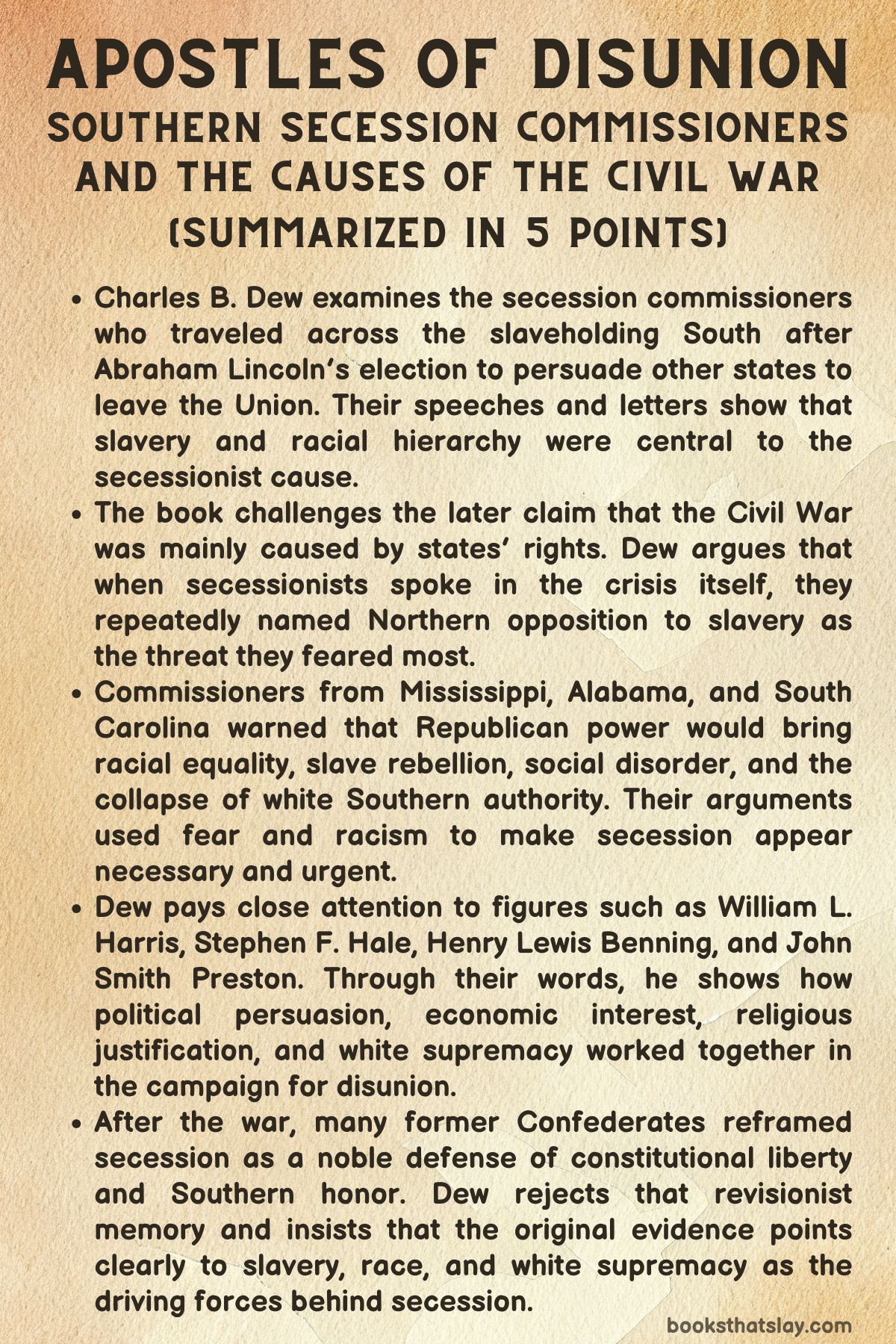
Apostles of Disunion: Southern Secession Commissioners and the Causes of the Civil War by Charles B. Dew is a concise historical study about the secession crisis that led to the American Civil War. Rather than treating secession as an abstract dispute over constitutional theory, Dew examines the speeches, letters, and public missions of Southern secession commissioners who traveled across slaveholding states after Abraham Lincoln’s election.
These men tried to persuade other states to leave the Union, and their own words reveal the central motives behind their campaign. Dew argues that slavery, racial fear, and white supremacy—not a neutral defense of states’ rights—stood at the heart of the movement to create the Confederacy.
Summary
Charles B. Dew opens with a personal reckoning. Raised in the South, he grew up surrounded by the familiar explanation that the Civil War had been fought over states’ rights.
His own family history tied him to the Confederacy, since ancestors on both sides had served in its armies. Like many white Southerners of his generation, he first accepted the Lost Cause version of history, which presented the Confederacy as noble, constitutional, and defensive.
Only later, through serious historical study, did he begin to see how much that story concealed. As a graduate student, Dew encountered the writings of the secession commissioners, and these documents forced him to confront the racial ideology that powered the secession movement.
The book grows out of that confrontation.
Dew’s purpose is not to retell the entire history of the Civil War. Instead, he focuses on a specific group of political agents who worked during the winter of 1860-61 to convince slaveholding states to leave the United States.
These commissioners were sent by states such as Mississippi, Alabama, and South Carolina to speak before conventions, legislatures, governors, and public audiences. Their mission was to build a united Southern front after Lincoln’s election.
Dew believes their speeches and letters matter because they show, in direct language, what secessionists said when they were trying to win allies. These were not private reflections written years later.
They were urgent political appeals made at the decisive moment.
The timeline of secession was rapid. Abraham Lincoln’s election in November 1860 convinced many leaders in the Deep South that the Republican Party’s opposition to slavery threatened their future.
South Carolina seceded in December. Mississippi, Florida, Alabama, Georgia, Louisiana, and Texas soon followed.
By February 1861, these states had gathered in Montgomery, Alabama, to create the Confederate States of America. Fort Sumter was fired upon in April, after which Virginia, Arkansas, Tennessee, and North Carolina joined the Confederacy.
Dew accepts that the sequence of events is well known. What remains disputed, especially in public memory, is the cause.
To answer that question, Dew looks past later justifications and turns to evidence from the crisis itself. He notes that official secession documents often spoke clearly about slavery and Northern hostility to it.
Yet figures such as Jefferson Davis and Alexander Stephens sometimes gave mixed or shifting explanations, depending on audience and moment. Davis often emphasized constitutional rights, while Stephens at times spoke plainly about slavery and race.
The commissioners’ writings, however, were remarkably open. They repeatedly warned that Lincoln’s election would endanger slavery, undermine white rule, encourage racial equality, and bring social collapse to the South.
For Dew, this evidence makes the central cause unmistakable.
After Lincoln’s victory, Southern leaders acted quickly. Mississippi and Alabama appointed commissioners to travel to other slave states and press the case for secession.
A group of Southern congressmen in Washington also issued a statement urging the South to leave the Union. Their argument was that continued membership in the United States would place slaveholding society at the mercy of a hostile Northern majority.
The aim was not merely to protest Lincoln’s election, but to turn fear into coordinated political action.
The first wave of commissioners carried this message into states where support for secession varied. In South Carolina, where secessionist feeling was already strong, visiting commissioners needed only to encourage an existing movement.
In Georgia, where Unionist feeling still had force, the argument had to be sharper. William L. Harris of Mississippi spoke in blunt racial terms, attacking Northern abolitionists and warning that Republican principles threatened the social order of the South.
His message helped push Georgia’s leaders toward condemning the North as a danger to slavery.
Other commissioners used similar arguments. In Maryland, Alexander Hamilton Handy defended slavery as morally sanctioned and portrayed Northern antislavery politics as an assault on Southern rights.
In North Carolina, Jacob Thompson warned that abolition would bring humiliation and subjugation to white Southerners. These speeches did not present secession as a distant theory about federal balance.
They described it as a necessary defense of a slaveholding society built on white control.
South Carolina, once it left the Union, became one of the most active promoters of a broader Southern confederacy. Its leaders understood that secession would be dangerous if the state stood alone.
Commissioners were sent to other slave states to urge them to follow. Their speeches described North and South as two fundamentally different societies.
The North, they claimed, had embraced dangerous antislavery ideas, while the South depended on slavery as the foundation of its economy, culture, and racial order.
In Florida and Alabama, South Carolina’s representatives argued that the conflict between free labor and slave labor could not be resolved inside the Union. They framed Lincoln’s election as proof that the federal government would soon be controlled by people hostile to Southern civilization.
They warned that the South would face degradation if it remained under Republican rule. The same themes appeared in their appeals to Mississippi, Georgia, Louisiana, and Texas: Lincoln was a threat, the North was aggressive, slavery was essential, and white Southerners had to act before it was too late.
Dew shows that these men were not careless extremists speaking outside the mainstream of secessionist politics. They were chosen because they were respected public figures.
Many had personal connections to the states they visited, making their appeals more persuasive. Their message was strategic, but it was also consistent.
Again and again, they identified slavery and racial hierarchy as the things that had to be protected. They used fears of racial equality, slave rebellion, and racial mixing to stir urgency among white audiences.
Alabama’s commissioners expanded the campaign beyond the Deep South. By early February 1861, seven states had seceded, but the future of the Upper South and border slave states remained uncertain.
Alabama sent representatives to places such as Kentucky, Missouri, Maryland, Delaware, and Virginia. These states were more divided, so the commissioners had to work harder.
Their message remained the same: if the South failed to unite, Lincoln’s government would destroy slavery and bring disaster upon white society.
Dew gives particular attention to Stephen F. Hale’s letter to Kentucky governor Beriah Magoffin. The letter serves as one of the clearest summaries of the secessionist case.
Hale argued that the South had suffered years of Northern hostility and that Lincoln’s election marked the final proof that the Union could no longer protect slaveholders. He did mention constitutional concerns and economic interests, but the emotional force of the letter lay in its racist warnings.
Hale claimed that Republican rule would bring Black equality, racial mixing, and the destruction of white supremacy. He presented secession as the only way to preserve what he called the God-given superiority of white people over Black people.
Kentucky did not secede, but Hale’s letter remains central to Dew’s argument because it exposes the logic behind the movement.
Virginia became especially important to the secessionists. Its size, resources, history, and symbolic status made it a prize.
If Virginia joined the Confederacy, the movement would gain legitimacy and strength. Yet Virginia was not eager to secede at first.
Most delegates to its convention were moderate or Unionist. Three commissioners came to persuade them: Fulton Anderson of Mississippi, Henry Lewis Benning of Georgia, and John Smith Preston of South Carolina.
Their strategy was carefully arranged. Anderson, the most moderate speaker, began by explaining how Lincoln’s government would, in his view, place slavery on the road to destruction.
He argued that the South had to protect slavery because it formed the basis of its political and social life. Benning followed with a far more alarming vision.
He warned that without secession, white Southerners would face Black political power, social equality, racial conflict, and the collapse of civilization. His speech relied heavily on fear, especially fear of Black citizenship and Black authority.
Preston then delivered a dramatic appeal to Virginia’s pride and history. He praised Virginians as heirs of the founders and portrayed Republicans as enemies of the Constitution and the South.
Yet beneath the elevated language, his claim was direct: South Carolina had left the Union because the North opposed slavery, and the South could not survive without it. He urged Virginia not to remain passive while the future of Southern society was at stake.
Although Virginia did not immediately secede, the attack on Fort Sumter and Lincoln’s call for troops shifted the political balance. Virginia eventually joined the Confederacy, fulfilling one of the commissioners’ key hopes.
In the book’s final section, Dew turns to memory and revision. After the war, many former secessionists changed the way they described the conflict.
Men who had once spoken openly about slavery and race began to emphasize constitutional liberty, Southern honor, and defense against federal overreach. Preston, for example, later gave speeches celebrating the Confederacy without naming slavery as the cause for which secessionists had fought.
Dew sees this as part of the creation of a more comfortable postwar story, one that allowed white Southerners to remember their cause as noble while ignoring its foundation in slavery and white supremacy.
Dew argues that the commissioners’ own words leave little room for doubt. Their campaign was driven by three connected fears: racial equality, racial violence, and racial mixing.
They believed that Republican victory threatened not simply slave property, but the entire racial order of the South. Their speeches repeated these claims too often, in too many places, and with too much intensity to be dismissed as exaggeration.
For Dew, the conclusion is clear: slavery and race caused secession.
In the later afterword, Dew reflects on the years after the book’s first publication. He had hoped that the election of Barack Obama might signal a major step beyond the racial legacy of slavery and the Civil War.
Instead, he saw renewed white nationalist and Neo-Confederate rhetoric, controversies over Confederate symbols, public debate over police killings of Black Americans, and the racist mass shooting at Emanuel AME Church in Charleston. These events convinced him that the history examined in Apostles of Disunion remained urgently relevant.
Dew also revisits the economic side of slavery. Though he still sees racial ideology as central, he gives greater attention to the enormous wealth tied to enslaved labor and the slave trade.
The commissioners often warned that the loss of slavery would mean financial ruin. They promised that secession would protect both racial hierarchy and material prosperity.
The value of enslaved people represented a vast concentration of wealth, and this economic reality strengthened the political drive to preserve slavery.
The book closes by connecting historical truth to public memory. Dew suggests that Americans still need a fuller reckoning with the causes of the Civil War and the continuing power of Confederate mythology.
Apostles of Disunion insists that the clearest evidence comes from the secessionists themselves. When they sought to persuade fellow Southerners to leave the Union, they did not hide behind abstract constitutional language.
They said that slavery had to be protected, that white supremacy had to be defended, and that secession was the means to do both.
Key Figures
Charles B. Dew
Charles B. Dew is the central interpretive presence in Apostles of Disunion as the historian whose personal background shapes the book’s moral and intellectual purpose. Dew presents himself as a white Southerner who grew up with inherited Confederate memory and the familiar claim that the Civil War was mainly about states’ rights.
His importance lies in the fact that he does not approach the subject from emotional distance. Instead, he openly admits that the evidence he studies challenges the stories he once absorbed.
This makes him a figure of self-correction and historical honesty. Dew’s role in the book is to guide readers away from comforting myths and toward the actual language of the men who promoted secession.
He does not write as someone seeking easy condemnation from the outside, but as someone confronting the troubling legacy of his own region and upbringing. His voice is measured, but his conclusions are firm: the secession movement was rooted in slavery, racial fear, and white supremacy.
Through Dew, the book becomes both a historical argument and a personal reckoning with inherited memory.
The Secession Commissioners
The secession commissioners are the most important collective figures in the book because their words provide the evidence on which Dew builds his argument. They were political messengers sent by seceding states to persuade other slaveholding states to join the Confederate cause.
Their significance comes from the directness of their speeches and letters. Unlike later Confederate defenders who softened or changed the explanation for secession, these men spoke at the moment of crisis, when they were trying to convince fellow Southerners that leaving the Union was necessary.
In Apostles of Disunion, they appear as advocates, propagandists, and ideological agents of the slaveholding South. Their appeals repeatedly focus on the danger they believed Lincoln’s election posed to slavery and white rule.
They warned of racial equality, slave rebellion, social collapse, and racial mixing, using fear as a political weapon. As a group, they reveal that the secessionist mind was not driven by an abstract love of constitutional theory alone.
Their mission was to defend a social order built on enslavement and racial hierarchy. Their value to the book is that they speak for the movement in its own language, leaving little space for later denial.
William L. Harris
William L. Harris, Mississippi’s commissioner to Georgia, stands out as one of the earliest and clearest voices of the secession campaign. His role is especially important because Georgia was not as firmly committed to secession as South Carolina, which meant Harris had to persuade rather than simply celebrate an existing decision.
He frames the North as a direct threat to slavery and presents the Republican Party as an enemy of Southern society. His language shows how racial ideology shaped secessionist persuasion.
Harris does not rely only on legal or constitutional complaints; he attacks abolitionist ideas of racial equality and insists that the South cannot remain safe under a government influenced by antislavery principles. In the book, Harris functions as an early model for the pattern that many other commissioners would follow.
He uses alarm, resentment, and racial fear to press his audience toward disunion. His importance is not just that he supported secession, but that he made the defense of slavery and white supremacy central to the case for it.
Alexander Hamilton Handy
Alexander Hamilton Handy, Mississippi’s commissioner to Maryland, represents the religious and moral justification that secessionists often attached to slavery. In his public address, he argues that slavery is not merely an economic arrangement or inherited institution, but something sanctioned by God and accepted by civilization.
This makes him an important figure in the book because he shows how proslavery politics could be wrapped in moral certainty. Handy’s defense of slavery reveals the depth of the Southern worldview Dew examines: slaveholders and their defenders did not necessarily see themselves as acting defensively in a narrow political dispute; many claimed they were protecting a divinely approved order.
Handy’s rhetoric also shows how secessionists portrayed Northern antislavery feeling as a moral insult to the South. By presenting slavery as righteous and abolitionism as dangerous, he helps explain why compromise became so difficult.
His character in the book reflects the confidence and blindness of a society that had turned racial domination into a moral principle.
Jacob Thompson
Jacob Thompson is significant because he links secessionist politics to warnings of humiliation and subjugation. As Mississippi’s commissioner to North Carolina, he writes with a sense of emergency, suggesting that the South will be degraded if it remains in the Union under Republican power.
Thompson’s appeal is built around the fear that Northern hostility to slavery will eventually become hostility to the entire Southern way of life. He portrays abolition not simply as the end of an institution, but as the beginning of social ruin for white Southerners.
In the book, Thompson helps show how secessionists converted the election of Lincoln into an existential crisis. His warnings are designed to make delay seem dangerous and Unionism seem naive.
Thompson’s importance lies in the way he turns political disagreement into a vision of defeat, shame, and domination. Through him, readers see how the commissioners tried to make secession appear not radical, but necessary for survival.
Leonidas Spratt
Leonidas Spratt, South Carolina’s commissioner to Florida, is one of the most ideologically forceful figures in Apostles of Disunion. He argues that North and South have become two separate societies with incompatible values, especially because one rejects the expansion and moral legitimacy of slavery while the other depends on it.
Spratt’s importance lies in his “two civilizations” argument. He does not treat the Union as a family temporarily divided by policy differences.
Instead, he describes a fundamental conflict between social systems. This makes secession appear natural and unavoidable.
Spratt’s thinking gives intellectual shape to the secessionist cause by claiming that the South cannot preserve its identity within a nation increasingly influenced by antislavery politics. His analysis is deeply racist because it assumes that Southern civilization rests on the permanent subordination of Black people.
In the book, Spratt becomes a representative of the hardline view that slavery is not a regrettable inheritance but the foundation of Southern society.
Andrew Calhoun
Andrew Calhoun, South Carolina’s commissioner to Alabama, carries forward the urgent tone of South Carolina’s campaign for a wider slaveholding confederacy. His rhetoric presents Lincoln’s election and Republican power as threats that will bring degradation to the South.
Calhoun’s role is important because he reflects South Carolina’s need to gather allies quickly. The state had already seceded, but it could not stand safely alone.
Calhoun therefore speaks not only from ideological conviction but from practical political necessity. He must help transform South Carolina’s separate action into a regional movement.
His appeals are filled with the same warnings found in the speeches of other commissioners: the North is hostile, slavery is endangered, and white Southerners must act before they lose control of their future. In the book, Calhoun is less individually complex than revealing as part of a political machine.
He shows how secessionist leaders repeated shared themes across state lines in order to create a sense of common Southern destiny.
Stephen F. Hale
Stephen F. Hale is one of the most revealing figures in the book because his letter to Kentucky’s governor gives a concentrated version of the secessionist argument. Hale discusses constitutional grievance and economic interest, but the emotional center of his message is racial fear.
He warns that Lincoln’s presidency will lead to Black equality, racial mixing, and the destruction of white authority. His letter is especially important because Kentucky was divided and did not simply follow the Deep South into secession.
Hale therefore had to make the danger seem immediate and overwhelming. He presents the South as standing before two futures: one of prosperity and racial control in a new Confederacy, and another of humiliation and collapse inside the Union.
Hale’s character matters because he shows the fusion of politics, race, economics, and fear in secessionist thought. He is not merely arguing for local self-government.
He is arguing for a society organized around the permanent superiority of white people and the continued enslavement of Black people.
Fulton Anderson
Fulton Anderson, Mississippi’s commissioner to Virginia, is important because he is chosen to speak first in a difficult political setting. Virginia’s convention contained many moderates and Unionists, so Anderson’s relatively measured tone was meant to prepare the ground before stronger appeals followed.
His role shows that the commissioners were strategic. They understood their audiences and adjusted their performances accordingly.
Anderson argues that Lincoln’s government will gradually destroy slavery and that the South must act before that process begins. Although he speaks with less emotional force than Benning or Preston, his message is still centered on the defense of slavery.
He presents secession as a protective act against a future in which Northern power will weaken and eventually abolish the institution at the center of Southern life. In the book, Anderson represents the more controlled face of secessionist persuasion.
His moderation is a matter of style, not substance, because his argument still rests on the belief that slavery must be preserved.
Henry Lewis Benning
Henry Lewis Benning, Georgia’s commissioner to Virginia, is one of the most extreme and revealing voices in the book. His speech relies heavily on images of racial panic.
He warns that without secession, white Southerners will face Black political power, social equality, and the destruction of their society. Benning’s language is meant to shock and frighten.
He imagines a future in which the racial order is reversed and white Southerners lose authority, safety, and status. His importance lies in how openly he expresses the fears that drove much of the secessionist campaign.
He does not hide behind polite constitutional phrasing. Instead, he speaks directly to white anxiety about Black freedom and citizenship.
Benning’s character reveals how secessionists used racist nightmares to push uncertain audiences toward action. In Virginia, where immediate secession was not yet assured, his speech attempted to make continued Unionism feel reckless.
He stands as one of the clearest examples of how white supremacy shaped the emotional force of the movement.
John Smith Preston
John Smith Preston, South Carolina’s commissioner to Virginia, is presented as a powerful orator whose speech appealed to pride, history, and fear. He understood the symbolic importance of Virginia and addressed the convention with a sense of drama.
Preston praised Virginia’s legacy and framed secession as a test of honor. Yet beneath the polished language, his argument remained rooted in slavery.
He declared that South Carolina had acted because the North opposed slavery and because the South could not survive without that institution. Preston is important because he shows how secessionist rhetoric could combine elegance with brutality.
He could speak of civilization, constitutional faith, and ancestral duty while defending a social order based on human bondage. Dew later uses Preston’s postwar speechmaking to show how former secessionists revised their own past.
After the war, Preston celebrated Southern honor while leaving slavery out of the story. His character therefore represents both the original clarity of secessionist motivation and the later effort to disguise it.
Jefferson Davis
Jefferson Davis appears in the book as a figure whose public explanations complicate the historical record. As Confederate president, Davis often emphasized states’ rights and constitutional principle when explaining Southern secession.
Dew does not treat him as the main source for understanding the movement’s motives, partly because Davis’s language is less direct than that of the commissioners. His importance lies in contrast.
Davis represents the more formal, official, and later more defensible explanation of the Confederate cause. His rhetoric helped create space for later generations to claim that the war was not truly about slavery.
Yet the commissioners’ words expose what Davis’s constitutional language often softened. In the book, Davis functions as a reminder that political leaders may frame causes differently depending on audience, office, and historical consequence.
His presence helps Dew show why historians must look closely at timing and context. What secessionists said while recruiting allies is often more revealing than what Confederate leaders said when presenting their cause in official terms.
Alexander H. Stephens
Alexander H. Stephens is a complicated figure because his statements about the causes of secession were not always consistent in tone, though he is famously associated with direct proslavery arguments. In the book, he matters because he illustrates the tension between constitutional explanation and racial truth.
At times, Stephens framed the conflict in terms of states’ rights; at other times, he plainly identified slavery and racial hierarchy as central to the Confederacy. This inconsistency helps Dew explain why public confusion about the Civil War’s causes has endured.
Stephens shows how the same leader could speak in different registers, sometimes making the cause sound legal and sometimes making its racial foundation unmistakable. His character is important not because Dew’s argument depends on him, but because he helps reveal the need for better evidence.
The commissioners’ speeches clarify what Stephens’s mixed record can obscure. Through Stephens, the book shows how Confederate memory became vulnerable to selective quotation and later revision.
Abraham Lincoln
Abraham Lincoln appears less as a fully developed individual than as the figure around whom Southern fear gathers. His election is the immediate trigger for secession, even though he had not yet taken office when the first states left the Union.
In the minds of the commissioners, Lincoln represents the rise of a Northern political majority hostile to slavery. They portray him and the Republican Party as threats to Southern property, racial control, and social order.
Dew’s treatment makes clear that the commissioners often exaggerated what Lincoln would do immediately, but their fear was not random. They understood that the Republican Party opposed the expansion of slavery and that this challenged the long-term power of slaveholders.
Lincoln’s character in the book is therefore largely symbolic. He becomes the imagined agent of Southern defeat, even before he acts as president.
The reaction to him reveals more about secessionist priorities than about Lincoln himself: what they feared most was not federal tyranny in general, but a future in which slavery could no longer expand or remain secure.
Jabez L. M. Curry
Jabez L. M. Curry is important in the book’s treatment of postwar memory. Like Preston, he later participated in efforts to reshape how the Confederacy was remembered.
His significance lies in the movement from secessionist advocacy to historical revision. After the war, former Confederates had strong reasons to present their cause in more honorable and less morally damning terms.
Curry’s later role as an educator and writer made him part of that broader cultural process. He represents the way Lost Cause explanations gained authority through schools, speeches, textbooks, and public commemoration.
In the book, Curry shows that the struggle over secession did not end with military defeat. It continued in the stories white Southerners told about why they had fought.
His character helps Dew connect the documents of 1860-61 to the public memory battles of later generations. Through Curry, the book demonstrates how historical distortion can become institutionalized when influential figures choose memory over evidence.
Dylann Roof
Dylann Roof appears in the later reflections as a modern reminder of the continuing danger of Confederate symbolism and white supremacist ideology. He is not part of the secession crisis, but his presence in the book’s afterword connects the past to the present.
Roof’s racist mass murder at Emanuel AME Church and his use of Confederate imagery show Dew that the symbols and ideas attached to the Confederacy still carry political and racial meaning. Roof’s role is disturbing because he demonstrates that the myths surrounding the Confederacy are not harmless relics.
They can feed modern hatred when detached from honest historical understanding. In the book, he functions as evidence that the questions Dew raises are not only academic.
The refusal to face the racial foundation of secession has consequences for public life. Roof’s presence helps explain why Dew insists on historical clarity.
Remembering the Confederacy falsely can support dangerous fantasies about race, power, and violence.
Barack Obama
Barack Obama appears in the afterword as a symbol of both hope and disappointment in America’s racial progress. Dew describes Obama’s election as a moment that seemed to suggest the country might be moving beyond the legacies of slavery and the Civil War.
In that sense, Obama functions less as a political character than as a marker of national possibility. Yet the reaction to his presidency, including racist conspiracy theories and renewed white nationalist energy, complicates that hope.
His presence in the book helps Dew show that historical memory remains active in modern politics. The backlash against Obama becomes part of Dew’s argument that the racial ideas underlying secession did not vanish after Appomattox.
They changed form, resurfaced, and continued to shape public conflict. Obama’s role therefore deepens the book’s moral frame.
He represents the promise of change, while the reaction to him reveals how unfinished the struggle over race and history remains.
Themes
Slavery as the Central Cause of Secession
Slavery stands at the center of the book’s historical argument, not as one issue among many but as the institution the secessionists were determined to protect. The commissioners’ speeches and letters repeatedly identify Northern antislavery politics as the danger that made disunion necessary.
Their concern was not simply that the federal government might become too powerful in an abstract sense. Their fear was that a Republican administration would restrict slavery’s expansion, weaken slaveholders’ political influence, and eventually threaten the institution itself.
The book shows that when secessionists spoke to one another at the moment of decision, they did not treat slavery as secondary. They described it as the foundation of Southern society, prosperity, and order.
This matters because later explanations often tried to replace slavery with states’ rights as the main cause. Dew’s analysis challenges that replacement by returning to the language used before the war, when the goal was persuasion rather than reputation.
In Apostles of Disunion, slavery is shown as the practical, political, economic, and racial core of secession. The commissioners’ words make clear that the Confederacy was created to preserve a slaveholding civilization.
White Supremacy and Racial Fear
White supremacy gives the secessionist argument its emotional force. The commissioners did not merely defend slavery as property; they defended a racial order in which Black people were permanently subordinated and white people held social, political, and economic power.
Their speeches are filled with warnings about Black equality, Black citizenship, racial mixing, and rebellion. These fears were used to make secession feel urgent.
By describing Republican victory as the beginning of racial chaos, the commissioners tried to convince white Southerners that remaining in the Union would lead to humiliation and danger. The repeated use of such language shows that racism was not incidental to secessionist politics.
It was one of its main organizing principles. The book also shows how fear can be politically useful.
The commissioners turned imagined futures into arguments for immediate action. They made compromise seem weak, delay seem dangerous, and Unionism seem like surrender.
Their rhetoric reveals a society terrified not simply of losing wealth, but of losing racial control. Dew’s analysis exposes the connection between slavery as an institution and white supremacy as the belief system that justified and defended it.
Historical Memory and the Lost Cause
The struggle over memory becomes one of the book’s most important concerns because Dew shows how the meaning of the Civil War changed in public storytelling after the Confederacy’s defeat. During the secession crisis, commissioners spoke openly about slavery and race.
After the war, many former Confederates preferred to describe the conflict as a noble defense of constitutional liberty, Southern honor, and local self-government. This shift helped create the Lost Cause tradition, which softened the Confederacy’s image and made it easier for later generations to admire Confederate leaders without confronting slavery directly.
Dew’s own upbringing shows how powerful that tradition became. He was taught a version of Southern history that minimized racism and made states’ rights seem like the central issue.
The book challenges that inherited story by showing how selective memory can distort public understanding for generations. Historical memory is not presented as harmless nostalgia.
It shapes monuments, textbooks, political arguments, and regional identity. Dew’s work insists that honest memory requires returning to original evidence, especially when later stories were designed to protect pride rather than truth.
The Link Between Past and Present
The book’s later reflections show that the history of secession still affects American public life. Dew connects the commissioners’ racial arguments to modern conflicts over Confederate monuments, white supremacist violence, and political backlash against racial progress.
This does not mean that the present is identical to the past, but it does mean that old ideas can survive in altered forms. Confederate symbols remain contested because they are tied to the cause that created the Confederacy.
When people defend those symbols without acknowledging slavery and white supremacy, they continue the work of historical denial. Dew’s reflections on recent racial violence and public controversy show why the causes of the Civil War are not merely academic questions.
They influence how Americans understand citizenship, justice, race, and national identity. The theme also makes the book’s moral purpose clear.
Dew is not only correcting a historical error; he is arguing that a nation cannot move forward while refusing to name the truth about its past. The persistence of Confederate mythology shows that historical falsehood can shape modern attitudes, and that public honesty is necessary for any meaningful reckoning.