After Virtue: A Study in Moral Theory Summary and Analysis
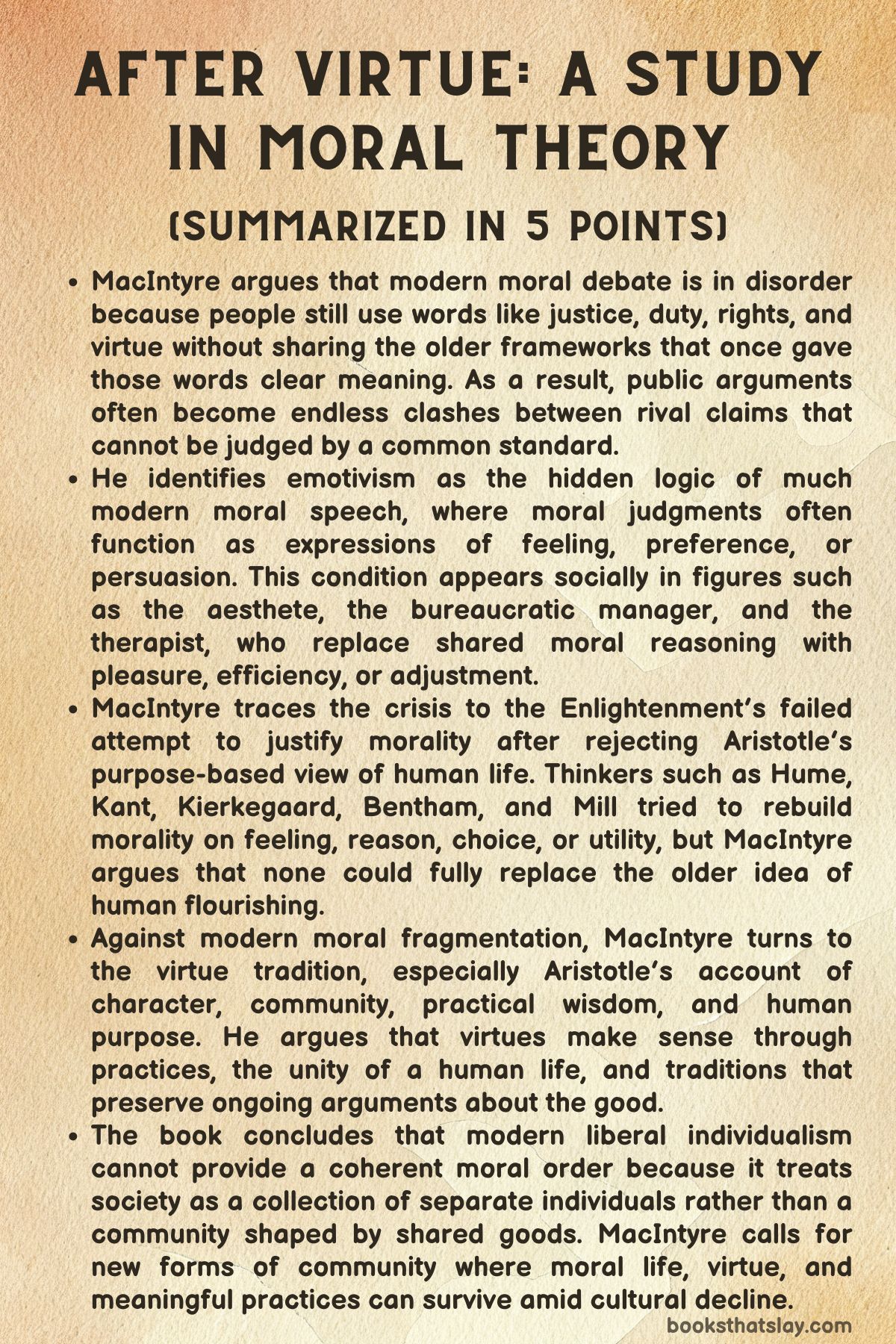
After Virtue: A Study in Moral Theory by Alasdair MacIntyre is a major work of moral philosophy that argues modern moral debate is broken because it has lost the older frameworks that once gave moral claims meaning. MacIntyre claims that contemporary arguments about justice, rights, duty, and social policy often sound rational but lack shared standards for deciding who is right.
He traces this disorder through the Enlightenment, utilitarianism, emotivism, and liberal individualism, then turns back to Aristotle and the virtue tradition as a possible remedy. The book is both a historical diagnosis and a philosophical proposal for rebuilding moral life through practices, narratives, and communities.
Summary
After Virtue begins with a striking thought experiment. MacIntyre asks us to imagine a world where the natural sciences have been destroyed by social disaster.
Later generations try to reconstruct science from surviving fragments: pieces of theories, half-remembered formulas, bits of laboratory language, and isolated technical terms. They use the language of science, but they no longer understand the structure that once made it coherent.
MacIntyre argues that modern moral culture is in a similar condition. We still use words such as justice, duty, rights, virtue, and obligation, but we no longer share the moral framework that once gave these ideas rational force.
He then turns to modern moral disagreement. Public arguments about war, abortion, health care, education, taxation, and similar issues often appear rational because each side gives reasons.
Yet these reasons usually rest on different standards that cannot be measured against one another. One person appeals to rights, another to utility, another to justice, another to freedom.
Since there is no agreed way to rank these claims, debate becomes a series of confident assertions and counter-assertions. MacIntyre calls the dominant modern attitude “emotivism,” the view that moral judgments express feelings, attitudes, or preferences rather than objective reasons.
Even when people speak as though they are arguing rationally, their moral language often functions as persuasion or manipulation.
For MacIntyre, emotivism is not only a philosophical theory; it is also a social condition. It appears in modern character types such as the aesthete, the manager, and the therapist.
The aesthete treats life as a search for private satisfaction. The manager focuses on technique, efficiency, and control, often without asking whether the goals being served are good.
The therapist aims at adjustment and psychological effectiveness rather than truth. These figures show how modern society tends to replace shared moral reasoning with personal preference, bureaucratic management, or therapeutic success.
MacIntyre traces this condition to the failure of the Enlightenment project. Thinkers such as Hume, Kant, and Kierkegaard tried to justify morality after the older Aristotelian and Christian worldview had been weakened.
Hume grounded morality in feeling and desire. Kant tried to ground it in reason and duty alone.
Kierkegaard emphasized a deep act of choice. MacIntyre argues that these attempts failed because they inherited moral rules from an older tradition while rejecting the view of human nature that had made those rules intelligible.
In Aristotle’s ethics, human beings have a nature and a purpose, or telos. The virtues help people move from what they are toward what they could become at their best.
Once modern thinkers rejected this purpose-based view, moral rules were left without their original foundation.
The results of this failure appear in later moral theories. Utilitarianism, especially in Bentham and Mill, tried to make pleasure, happiness, or usefulness the basis of morality.
But MacIntyre argues that “happiness” remains too vague and unstable to serve as a clear moral standard. Later theories moved even further away from the virtues, while modern culture increasingly relied on concepts such as rights, protest, and unmasking.
MacIntyre is especially skeptical of rights language, which he sees as powerful but philosophically unsupported. Protest becomes common because people appeal to rights that others do not recognize in the same way.
Unmasking becomes common because moral claims are treated as disguises for desire, power, or will.
MacIntyre also challenges the prestige of modern managerial expertise. Modern bureaucracies often present themselves as rational and scientific, claiming the ability to predict and control social life.
But MacIntyre argues that the social sciences cannot produce the kind of law-like predictions found in the natural sciences. Human life includes invention, chance, incomplete knowledge, and freedom.
Because of this, managerial control is often less scientific than it claims to be. The manager’s authority rests partly on a social illusion: the belief that technique can replace moral wisdom.
At the center of the book is MacIntyre’s choice between Nietzsche and Aristotle. Nietzsche saw clearly, MacIntyre argues, that modern morality had lost its rational basis.
If the Enlightenment failed, then moral claims might be only expressions of will. Nietzsche’s response was to reject inherited morality and affirm the creative power of the strong individual.
MacIntyre thinks this challenge is serious, but he rejects Nietzsche’s solution. The real question, he says, is whether it was right to reject Aristotle in the first place.
If Aristotle’s moral tradition can be recovered in a defensible form, then Nietzsche’s conclusion is not necessary.
MacIntyre therefore turns to ancient and medieval accounts of virtue. In heroic societies, such as those represented in Homeric epics, virtues were tied to social roles.
A person understood who they were through their place in a community, and qualities such as courage, loyalty, and honor mattered because they helped someone fulfill that role. In Athens, virtue became connected to citizenship and participation in the life of the polis.
The good person and the good citizen were closely related. Aristotle developed this into a philosophical account: human beings have a characteristic good, eudaimonia, often translated as flourishing or happiness.
The virtues are qualities that enable a person to achieve that good as part of a complete human life.
MacIntyre admires Aristotle’s structure but does not accept everything in Aristotle. He rejects Aristotle’s exclusionary assumptions about slaves, women, and social hierarchy.
He also thinks Greek tragedy, especially Sophocles, understood moral conflict better than Aristotle did. Tragedy shows that human life can involve real conflicts between goods, not merely errors caused by personal flaws.
This insight becomes important for MacIntyre’s later view of traditions as living arguments.
The medieval period reshaped virtue ethics by combining Greek philosophy with Christianity. Christian thinkers added ideas such as sin, will, divine law, humility, charity, and the spiritual journey of human life.
Unlike Aristotle, Christianity held that no one is excluded from the highest good because of birth or social status. Medieval thought also tried to combine law-based ethics with virtue-based ethics.
This created a richer but more complex moral inheritance, which later modern thinkers would partly preserve and partly abandon.
MacIntyre then develops his own account of the virtues. He argues that virtues can be understood through three linked ideas: practices, the unity of a human life, and tradition.
A practice is a socially established activity with standards of excellence, such as science, art, politics, games, farming, teaching, or sustaining family life. Practices produce internal goods, which can be appreciated only by participating in the practice well, and external goods, such as money, power, and fame.
Virtues such as honesty, courage, and justice are needed to achieve internal goods and protect practices from being corrupted by external rewards.
But practices alone are not enough. A human life must also be understood as a narrative unity.
People do not live as disconnected episodes; they live stories shaped by intentions, relationships, histories, conflicts, and goals. To ask “What should I do?” is connected to asking “What story am I part of?” and “What kind of life am I trying to live?” MacIntyre describes human beings as story-telling animals.
We inherit stories before we fully understand ourselves, and our lives become intelligible through the narratives we inhabit and revise.
These narratives are always located within traditions. A tradition is not a dead inheritance or blind obedience to the past.
It is an ongoing argument about goods, standards, and purposes across generations. Traditions survive through debate, criticism, and renewal.
The virtues help sustain traditions because they allow people to pursue goods honestly, recognize debts to the past, and carry moral inquiry forward.
In the final chapters, MacIntyre applies this analysis to modern justice and politics. Contemporary debates about justice, such as disputes between entitlement and need, reveal that modern society lacks a shared moral standard.
Philosophers such as Rawls and Nozick reflect this division in more systematic form. Liberal individualism treats society as a collection of separate individuals pursuing private interests, rather than as a community ordered toward common goods.
Because of this, modern politics becomes a struggle between rival claims that cannot be rationally settled.
After Virtue ends by rejecting both liberal individualism and Nietzsche’s answer to moral collapse. MacIntyre argues for a renewed Aristotelian tradition centered on virtues, practices, narratives, and communities.
He compares the modern West to the decline of Rome, when people preserved moral and intellectual life by forming new kinds of communities. His famous closing suggestion is that we are waiting not for another powerful ruler, but for another St. Benedict: someone, or some movement, capable of building forms of community where moral life can survive.
Key People
The Modern Moral Speaker
The modern moral speaker is the central human figure behind MacIntyre’s argument. This person speaks in the language of reason, justice, rights, duty, and freedom, but often lacks a shared moral framework that would allow those terms to be tested or ranked against competing claims.
In After Virtue, this speaker represents the confusion of modern ethical debate: confident, argumentative, morally serious, yet trapped in disagreement that cannot reach resolution. MacIntyre does not treat this figure as foolish or dishonest.
Instead, he presents the modern moral speaker as someone who has inherited fragments of older moral traditions without inheriting the full structure that once made those traditions intelligible. This figure is important because the book’s whole diagnosis begins with ordinary moral speech.
The problem is not that people no longer care about morality; the problem is that they care deeply while lacking a common standard for rational judgment.
The Emotivist Self
The emotivist self is the person shaped by a culture in which moral judgments are treated as expressions of preference, feeling, or attitude. This figure does not necessarily say, “Morality is only emotion,” but acts within a world where moral claims function as tools of persuasion.
When such a person says something is right or wrong, the statement often operates less as a reasoned conclusion and more as an attempt to influence others. MacIntyre presents this self as unstable because it has no fixed moral identity rooted in a shared conception of the good.
It can move between roles, preferences, and commitments without any larger purpose holding them together. The emotivist self is therefore free in one sense, but empty in another.
It has been released from older authorities, yet it has not gained a rational moral order in their place.
The Aesthete
The aesthete represents the person who treats life mainly as a field of personal experience, pleasure, taste, and self-expression. This figure is often associated with refinement, wealth, and cultivated enjoyment, but MacIntyre uses the aesthete to expose a deeper moral problem.
The aesthete sees other people and social situations in terms of what they can provide: amusement, beauty, excitement, admiration, or emotional stimulation. Because this figure lacks a serious commitment to common goods, relationships become vulnerable to manipulation.
The aesthete does not necessarily appear cruel; the danger lies in the elegance and charm with which self-interest can be disguised as sophistication. For MacIntyre, the aesthete is one of the social faces of emotivism because this figure makes personal preference the highest practical authority.
The Bureaucratic Manager
The bureaucratic manager is one of MacIntyre’s most important modern character types. This figure claims authority through efficiency, expertise, planning, and institutional control.
The manager’s language is not usually moral language but technical language: outcomes, procedures, optimization, policy, administration, and effectiveness. MacIntyre’s criticism is that the manager often treats ends as already given and focuses only on the best means to achieve them.
This allows moral questions to be hidden behind administrative processes. The manager appears rational because management uses data, prediction, and professional technique, but MacIntyre argues that this authority is partly an illusion.
Human social life is too unpredictable to be controlled with the certainty managers often imply. The manager is therefore a symbol of modern society’s attempt to replace moral wisdom with technical competence.
The Therapist
The therapist represents a different but related form of modern authority. Where the manager seeks organizational effectiveness, the therapist seeks psychological adjustment.
This figure does not primarily ask whether a person’s desires are good, whether their goals are worthy, or whether their life serves a larger moral purpose. Instead, the therapist focuses on helping the individual function, cope, adapt, or feel better.
MacIntyre is not simply attacking therapy as a practice; he is criticizing the cultural role of the therapist when therapeutic success replaces moral truth. In this role, the therapist becomes another expression of emotivism because values are treated as personal materials to be managed rather than as rational claims to be judged.
The therapist’s significance lies in showing how modern culture often avoids moral argument by translating moral distress into psychological adjustment.
Aristotle
Aristotle is the major alternative to modern moral disorder. MacIntyre presents him as the philosopher who gives the clearest classical account of virtue, human purpose, and the good life.
Aristotle’s importance comes from his belief that human beings have a telos, a natural end or fulfillment, and that the virtues are qualities that enable people to reach that fulfillment. In this view, morality is not a set of detached rules or private preferences.
It is part of a whole account of human nature, social life, education, habit, judgment, and flourishing. MacIntyre does not accept Aristotle uncritically, especially where Aristotle’s social assumptions are exclusionary or historically limited.
Still, Aristotle becomes the book’s strongest resource for rebuilding moral thought because his ethics connects character, community, action, and purpose in a rational structure.
Nietzsche
Nietzsche is Aristotle’s great rival in MacIntyre’s argument. He is treated as the thinker who best understood the failure of modern morality after the Enlightenment.
Nietzsche saw that many moral claims continued to present themselves as rational and universal even after their older foundations had been removed. His answer was to expose morality as an expression of will, power, and self-assertion.
MacIntyre respects Nietzsche because Nietzsche refuses the shallow optimism of modern moral language. He sees the crisis clearly.
However, MacIntyre rejects Nietzsche’s solution because it leaves morality dependent on the creative power of the individual will. Nietzsche therefore functions as both critic and warning.
He shows what happens if Aristotle is rejected and no rational tradition of virtue is recovered.
Hume
Hume represents one of the Enlightenment attempts to explain morality after the decline of the older teleological worldview. He places feeling, passion, sympathy, and desire near the center of moral life.
In MacIntyre’s account, Hume’s project is important because it tries to make sense of moral judgment without relying on Aristotle’s view of human purpose. Hume sees reason as limited and treats moral approval as closely connected to human sentiment.
MacIntyre’s criticism is that this approach cannot provide a strong enough rational foundation for moral rules. It may describe how certain people in a particular society feel about virtue, but it cannot establish why those feelings should command rational agreement.
Hume therefore becomes an example of the Enlightenment’s larger problem: preserving inherited moral conclusions while weakening the framework that once supported them.
Kant
Kant stands for the opposite Enlightenment strategy from Hume. Instead of grounding morality in feeling, Kant tries to ground it in reason alone.
For Kant, moral action must be guided by duty rather than inclination, and true morality requires principles that can claim universal rational authority. MacIntyre treats Kant as a powerful and serious thinker, but he argues that Kant’s project also fails.
Once morality is detached from a fuller account of human ends, rational rules become too abstract to carry the weight placed on them. Kant wants moral law without the older teleological structure, and MacIntyre sees this as an unstable position.
Kant’s role in the book is therefore crucial: he shows the ambition of modern moral philosophy at its highest, but also the limits of trying to justify morality through pure formal reason.
Kierkegaard
Kierkegaard appears as another response to the failure of rational moral justification. Rather than grounding ethics in desire like Hume or pure reason like Kant, Kierkegaard emphasizes choice.
The individual must make a fundamental commitment that determines the meaning and direction of life. MacIntyre sees this as a sign of the crisis rather than a solution to it.
If the deepest moral commitment rests on a choice without rational criteria, then morality becomes dependent on decision rather than reasoned understanding of the good. Kierkegaard’s figure is significant because he marks a movement toward the modern sovereign individual, the person who must choose values rather than discover them within a shared moral order.
In MacIntyre’s history, this contributes to the rise of the isolated self.
Bentham
Bentham represents the utilitarian attempt to replace older virtue ethics with a measurable standard based on pleasure and pain. His moral world is one of calculation, reform, and social usefulness.
Bentham’s appeal lies in his clarity: morality seems to become practical, public, and freed from inherited metaphysical assumptions. MacIntyre, however, sees Bentham’s approach as deeply limited.
Pleasure and pain cannot provide a rich enough account of human good, and the effort to calculate morality risks flattening the complexity of moral life. Bentham’s significance lies in showing how modern ethics tried to become scientific and administrative.
His utilitarianism prepares the way for later forms of managerial thinking, where moral reasoning is replaced by techniques for maximizing selected outcomes.
John Stuart Mill
Mill modifies Bentham’s utilitarianism by giving a richer account of happiness and distinguishing higher from lower pleasures. He is more humane and culturally refined than Bentham, and his version of utilitarianism is less mechanical.
Yet MacIntyre still sees Mill as caught in the same basic problem. Happiness remains too uncertain and contested to function as a stable moral foundation.
Mill wants to defend individuality, liberty, cultivation, and general welfare, but these goods do not always fit neatly into one utilitarian formula. His role in MacIntyre’s account is that of a transitional figure: he tries to rescue utilitarianism from narrowness, but in doing so reveals how difficult it is for modern moral theory to replace the older language of virtue and purpose.
The Sophist
The sophist represents a view of moral and political life centered on success. In the ancient Greek context, sophists taught skills of persuasion, argument, and public effectiveness.
MacIntyre uses this figure to show an early version of a recurring moral danger: the reduction of virtue to whatever helps someone win. When success becomes the standard, virtues lose their connection to truth and common goods.
They become techniques, advantages, or instruments. The sophist matters because this ancient figure resembles modern forms of manipulation and professionalized persuasion.
In contrast to Aristotle’s concern with human flourishing and practical wisdom, the sophist’s outlook turns moral language into a tool for achieving desired results.
Sophocles
Sophocles represents the tragic understanding of human life that MacIntyre thinks Aristotle did not fully absorb. Through tragedy, Sophocles shows that moral conflict is not always caused by simple ignorance, vice, or personal failure.
Sometimes human beings face real collisions between serious goods, duties, loyalties, and identities. This makes Sophocles essential to MacIntyre’s broader reconstruction of virtue.
A mature account of moral life must recognize conflict, suffering, and the limits of human control. Sophocles deepens the virtue tradition by showing that moral growth can come through painful recognition.
His importance lies in correcting any overly neat picture of ethics in which virtue always produces harmony.
The Heroic Warrior
The heroic warrior belongs to the older world of epic society, where identity is inseparable from role, honor, courage, loyalty, and public action. This figure does not think of morality as a private code chosen by an isolated individual.
To be good is to perform one’s role well within a known social order. Courage matters because the warrior’s society depends on it; loyalty matters because bonds of kinship and alliance define the person’s place in the world.
MacIntyre does not ask modern readers simply to return to heroic society, but he uses the heroic warrior to recover an important idea: virtues make sense within forms of social life. This figure helps MacIntyre show that morality was once embedded in shared practices rather than abstract individual choice.
The Medieval Christian Thinker
The medieval Christian thinker stands between the classical virtue tradition and later modern moral philosophy. This figure inherits Aristotle, the Bible, Roman law, Stoicism, and the lived demands of Christian community.
The result is a moral vision that combines virtue, law, sin, will, grace, humility, charity, and historical destiny. MacIntyre treats this figure as important because medieval thought preserved and transformed the virtue tradition.
Christianity changed Aristotle by insisting that moral worth is not limited by birth, status, or citizenship. It also added a stronger sense of evil, moral struggle, and spiritual direction.
The medieval thinker therefore expands the moral field while also introducing tensions between law-based and virtue-based ethics.
Benjamin Franklin
Benjamin Franklin represents a modern, practical, and success-oriented version of virtue. His virtues are disciplined, useful, industrious, and connected to self-improvement.
MacIntyre treats Franklin as an important example of how the older virtue vocabulary survived while changing its meaning. Virtues that once pointed toward human flourishing within a community now become traits useful for prosperity, reputation, productivity, and social advancement.
Franklin’s moral outlook is not empty, but it is narrower than the Aristotelian vision. It turns virtue into a program of personal management.
His role in MacIntyre’s argument is to show how virtue language can remain familiar while being redirected toward external goods such as success and efficiency.
Jane Austen
Jane Austen is one of MacIntyre’s most admired modern defenders of the virtue tradition. Her novels preserve a serious moral world in which character, judgment, constancy, self-knowledge, and social conduct matter deeply.
Austen’s importance lies in her ability to show virtue through narrative. Her characters become intelligible through the shape of their lives, their choices, their misunderstandings, and their moral education.
MacIntyre values her especially because she understands constancy as a virtue: the ability to remain faithful to the direction and unity of a life. In this sense, Austen becomes a literary ally of the argument of After Virtue.
She shows that even after philosophy had moved away from virtue ethics, the novel could still preserve its moral intelligence.
Rawls
Rawls represents a modern liberal theory of justice based on fairness, rational agreement, and principles chosen under conditions of impartiality. MacIntyre treats Rawls as a major and serious philosopher, but also as a thinker whose assumptions reflect liberal individualism.
Rawls imagines society as composed of individuals who must agree on rules despite having different interests and conceptions of the good. For MacIntyre, this already concedes too much to the modern view of persons as separate agents rather than members of a community ordered toward shared goods.
Rawls matters because his philosophy gives systematic form to one side of modern justice debates, especially the side concerned with fairness, distribution, and need. Yet it cannot, in MacIntyre’s view, restore the lost moral unity of political life.
Nozick
Nozick represents the rival liberal account of justice based on entitlement, individual rights, and legitimate possession. Where Rawls emphasizes fair distribution, Nozick emphasizes whether holdings were justly acquired and transferred.
MacIntyre presents Nozick as the philosophical counterpart to the person who resists redistribution because it violates rightful ownership. The conflict between Rawls and Nozick shows how modern moral theory reproduces the same unresolved disagreements found in ordinary political debate.
Both positions are rational within their own assumptions, but there is no shared standard for deciding between them. Nozick’s role is therefore not only to defend liberty and entitlement, but to reveal the fractured condition of modern justice.
Trotsky and the Marxist Revolutionary
Trotsky represents the Marxist alternative to liberal individualism. MacIntyre takes Marxism seriously because it offers a powerful criticism of modern capitalism, social fragmentation, and liberal ideology.
The Marxist revolutionary seeks collective transformation rather than private moral preference or bureaucratic adjustment. Yet MacIntyre ultimately argues that Marxism cannot serve as the needed alternative because it has absorbed too much from the modern individualist world it criticizes.
It also tends to place hope in political structures and historical forces that cannot restore the virtue tradition by themselves. Trotsky’s importance is that he stands for a grand revolutionary answer to modern disorder, but one MacIntyre regards as exhausted as a living political tradition.
St. Benedict
St. Benedict appears near the end as a symbol of moral preservation during civilizational decline. MacIntyre invokes him not mainly as a biographical figure, but as an image of community-building after the collapse of a wider social order.
The point is not nostalgia for the past; it is the need to create forms of life in which moral practices, virtues, learning, and shared goods can survive. St. Benedict represents patient construction rather than conquest or ideological victory.
Against the manager, the aesthete, and the isolated individual, this figure suggests another path: small communities disciplined by common purposes. His role gives the book its final direction, away from abstract theory alone and toward renewed moral forms of life.
Themes
The Collapse of Shared Moral Reasoning
Modern moral disagreement is not presented as a temporary failure of manners or communication. MacIntyre argues that the problem goes much deeper: people often argue from rival moral premises that cannot be measured by a common rational standard.
One side may appeal to rights, another to utility, another to justice, another to freedom, and each claim can sound persuasive within its own framework. The trouble begins when there is no accepted way to decide which framework should govern the case.
This is why modern debates become repetitive and unresolved. They are not empty of reason, but they lack a shared background that would allow reason to complete its work.
Moral language survives, yet its older structure has been broken apart. The result is a culture in which people continue to speak with urgency and seriousness while becoming less able to persuade one another rationally.
This theme gives After Virtue its central diagnosis: modern society has inherited moral fragments from different traditions and now uses them as though they still formed a coherent whole.
Emotivism and the Manipulation of Moral Language
Emotivism matters because it changes the function of moral speech. If moral judgments express preference or feeling rather than rationally defensible truth, then moral debate becomes less about discovering what is good and more about influencing how others feel or act.
MacIntyre’s concern is not only that some philosophers defended emotivism. His larger concern is that modern society behaves as though emotivism were true, even when it officially denies it.
In such a culture, moral claims can become instruments of pressure. People still use words like duty, justice, freedom, and responsibility, but these words often work as tools for winning agreement rather than as parts of shared reasoning.
This helps explain why MacIntyre connects emotivism to modern character types such as the manager and therapist. The manager manipulates systems in the name of effectiveness, while the therapist adjusts individuals in the name of psychological success.
Both can avoid asking what human good actually is. Emotivism therefore creates a society in which moral seriousness remains visible, but moral authority becomes unstable and easily redirected toward technique, persuasion, and control.
Virtue, Practice, and the Recovery of Human Purpose
MacIntyre’s account of virtue depends on the idea that human beings are not isolated choosers inventing values from nothing. They participate in practices, inherit standards, and pursue goods that can only be understood through disciplined activity.
A practice is not merely a hobby or profession; it is a socially established form of activity with internal goods and standards of excellence. Chess, medicine, farming, politics, scholarship, art, and family life can all become settings in which virtues are learned and tested.
Internal goods require qualities such as honesty, courage, justice, patience, and practical wisdom. External goods such as money, status, and power are not automatically bad, but they can corrupt practices when they become dominant.
This theme is central because it shows how MacIntyre moves beyond criticism into reconstruction. He does not simply say modern morality has failed; he explains where moral formation can begin again.
Virtue is not a decorative personal trait. It is the disciplined quality that allows people to pursue real goods within practices and to resist the corruption caused by ambition, vanity, and institutional pressure.
Life as Narrative and Tradition as Living Argument
MacIntyre rejects the modern habit of seeing a human life as a series of separate choices, episodes, or roles. A person’s actions become intelligible only when placed within a larger story involving intentions, relationships, inherited obligations, failures, hopes, and purposes.
To understand what someone is doing, we often need to know what story they believe they are part of. This narrative view gives moral life continuity.
It allows virtues such as constancy, justice, courage, and truthfulness to matter across time, not merely in isolated decisions. Tradition extends this idea beyond the individual.
A person’s story is always shaped by communities, histories, languages, and arguments that existed before them. MacIntyre does not define tradition as blind loyalty to the past.
A living tradition is an ongoing argument about goods, standards, and the meaning of shared life. Conflict is not a sign that a tradition is dead; it may be proof that the tradition is still active.
This theme gives MacIntyre’s ethics its historical depth. Moral reasoning does not happen outside tradition.
It happens within inherited debates that responsible people continue, revise, and carry forward.