The 7 Habits of Highly Effective People Summary and Analysis
“The 7 Habits of Highly Effective People” by Stephen R. Covey is a self-help guide that offers a framework for achieving success by aligning with what Covey refers to as “true north” principles, which he describes as universal and enduring.
Covey emphasizes that genuine effectiveness stems from striking a balance between achieving positive outcomes and valuing the processes that lead to those results. He promotes a principle-centered approach to personal and social effectiveness, highlighting the importance of focusing on self-improvement rather than attempting to change external circumstances or the actions of others.
Full Summary
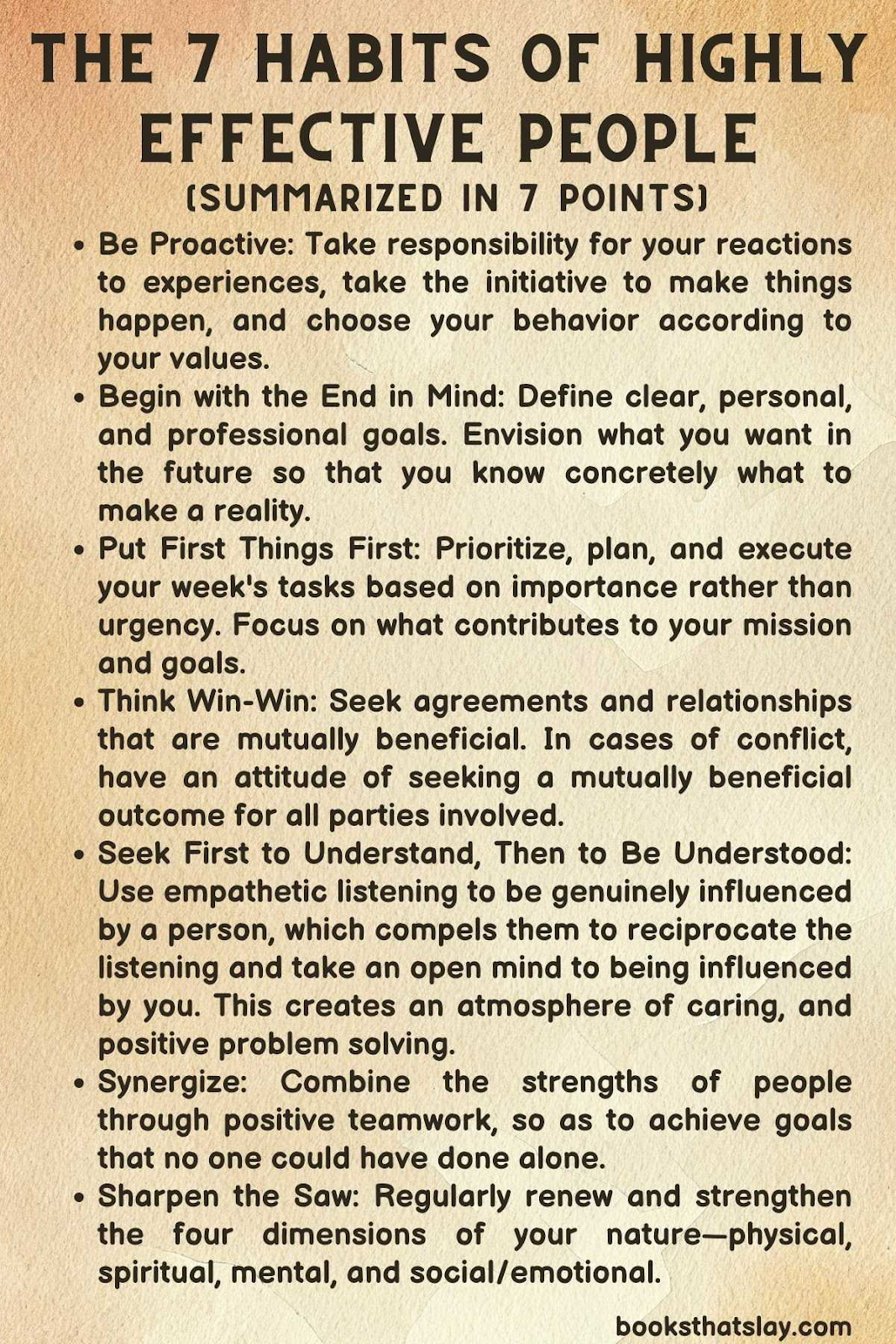
Here are the 7 habits as presented in the book:
- Be Proactive: This habit is about taking responsibility for your life. Proactive people understand they have the responsibility to make things happen, rather than just responding to events. They focus on the things they can influence and accept the things they can’t.
- Begin with the End in Mind: Covey encourages envisioning what you want in the future so you can work and plan towards it. It’s about setting goals and objectives for yourself to make that vision a reality. The concept also extends to mission statements for businesses.
- Put First Things First: This habit dictates that you should plan, prioritize, and execute your week’s tasks based on importance rather than urgency. In essence, one should focus on tasks and responsibilities that contribute to our values and high-level goals, and avoid getting distracted by less important matters.
- Think Win-Win: This is about seeking mutually beneficial solutions or agreements in your relationships. Value and respect people by understanding a “win” for all is ultimately a better long-term resolution than if only one person in the situation had gotten their way.
- Seek First to Understand, Then to be Understood: This habit emphasizes the importance of empathetic listening. By understanding others’ needs, ideas, and viewpoints, one can foster better communication and problem-solving, creating an atmosphere of respect and collaboration.
- Synergize: Covey explains that when people cooperate and work together, they can achieve more than they could individually. Synergizing is about valuing and appreciating these differences and leveraging them to create something greater.
- Sharpen the Saw: This habit involves continuous learning and self-improvement. Just as a carpenter keeps his saw sharp for effective cutting, individuals should take care of their greatest asset—themselves—by rejuvenating their bodies, minds, hearts, and souls.
Covey’s book is divided into parts, where he first explains how many individuals who have achieved a high degree of outward success still find themselves struggling with an inner need for developing personal effectiveness and growing healthy relationships with other people.
The author then reveals a step-by-step pathway for living with fairness, integrity, service, and human dignity – principles that give us the security to adapt to change and the wisdom and power to take advantage of the opportunities that change creates.
This pathway is the 7 habits.
Covey explains that effectiveness in life does not just happen, it is learned.
By moving through a sequence of maturity stages: Dependence, Independence (Habits 1, 2, 3), and then Interdependence (Habits 4, 5, 6), we develop our effectiveness.
The first three habits deal with self-mastery, termed as ‘private victories’.
One should be mature enough to take responsibility for one’s own life (be proactive), have a set of values that guides our life (begin with the end in mind), and prioritize things that are important to us (put first things first).
The next three habits talk about Interdependence or public victories. They deal with how you interact with others.
It is about creating a win-win situation (think win-win), being genuinely happy for others’ success (seek first to understand then to be understood), and leveraging each other’s strengths in teamwork (synergize).
The last habit is about continuous improvement in both personal and interpersonal life. This is the habit of renewal or continuous learning, termed as ‘Sharpen the Saw’.
It suggests that you are the greatest asset you have, and therefore you should look after your physical, mental, and spiritual health.
In the book, Covey also introduces the concept of paradigm shift and helps us understand that different perspectives exist, i.e., two people can see the same thing and yet differ from each other. He also explains that the paradigm shift is the “Aha!” or the “light bulb” moment when you understand something that you didn’t see before.
Key Figures and Metaphorical Characterizations
Stephen R. Covey
In The 7 Habits of Highly Effective People, Stephen R. Covey functions not only as the author but also as the central guiding presence. He presents himself as a teacher grounded in principle rather than personality, consistently emphasizing integrity, responsibility, and long-term growth.
His voice is calm, methodical, and instructive, reinforcing his belief that meaningful change begins within. Covey’s character is shaped by his conviction that human beings possess the freedom to choose their responses, regardless of circumstances.
He positions himself as both mentor and fellow practitioner, sharing lessons drawn from his family life, professional work, and observation of organizations. Rather than portraying himself as flawless, he models reflective growth, reinforcing his core argument that effectiveness is a continuous process rooted in character.
Viktor Frankl
Viktor Frankl appears as a powerful illustrative figure whose life embodies the principle of proactivity. Covey presents him as evidence that even in extreme suffering, individuals retain the freedom to choose their response.
Frankl’s experiences in concentration camps highlight the distinction between stimulus and response, reinforcing the book’s claim that inner freedom cannot be taken away. His character represents resilience, moral courage, and spiritual independence.
By invoking Frankl, Covey strengthens his argument that circumstances do not define a person; rather, choices do. Frankl stands as a moral anchor within the narrative, demonstrating the profound strength of internal agency.
The Farmer
The farmer in the story of the golden goose serves as a cautionary character who illustrates the imbalance between production and production capability. His impatience and greed drive him to destroy the very source of his wealth.
Though simple, his character represents a common human tendency to prioritize immediate gains over long-term sustainability. The farmer lacks foresight and discipline, qualities that Covey argues are essential for effectiveness.
Through this figure, the book warns against sacrificing enduring assets—whether relationships, health, or skills—for short-term results. The farmer’s failure underscores the importance of nurturing the systems and capacities that generate success.
The Proactive Individual
The proactive individual is a conceptual character who embodies responsibility and intentional choice. This figure recognizes the space between stimulus and response and acts according to values rather than impulses.
Instead of blaming circumstances, the proactive person focuses on areas within their control. This character demonstrates initiative, accountability, and disciplined language.
By contrast with reactive individuals, the proactive figure shows emotional steadiness and clarity of purpose. This character represents the first major transformation in the book’s maturity continuum, marking the shift from dependence on external forces to independence grounded in personal agency.
The Reactive Individual
The reactive individual serves as a contrasting character defined by emotional impulsiveness and external blame. This figure allows mood, environment, or other people’s behavior to dictate responses.
Reactive language reflects a sense of helplessness, reinforcing the belief that circumstances control outcomes. Through this character, Covey illustrates the limitations of living without conscious choice.
The reactive person tends to focus on the circle of concern rather than the circle of influence, expending energy on issues beyond control. This character represents the mindset that must be overcome to achieve independence and effectiveness.
The Individual with a Mission
The character who begins with the end in mind is defined by vision and clarity. This figure consciously designs life according to principles and long-term goals rather than drifting through circumstance.
Imagining their own funeral and reflecting on legacy, this character evaluates daily decisions through the lens of enduring values. Unlike those centered on money, work, or approval, this individual anchors identity in timeless principles.
The mission-driven character exhibits leadership over self, ensuring that management aligns with meaningful direction. This figure represents intentional living and moral coherence.
The Manager Without Leadership
This character symbolizes efficiency without purpose. Focused on organizing, scheduling, and executing tasks, the manager without leadership fails to question whether the chosen path is correct.
The metaphor of straightening deck chairs on a sinking ship captures this mindset. This figure may appear productive but lacks strategic reflection.
Through this character, Covey highlights the danger of activity without alignment. The absence of vision results in misplaced effort, reinforcing the necessity of combining leadership and management.
The Steward Leader
The steward leader emerges in the discussion of delegation and responsibility. Unlike a controlling supervisor, this character grants trust and clearly defines desired results while allowing autonomy in execution.
Stewardship reflects maturity and confidence, enabling others to grow. This character embodies the belief that effectiveness expands when responsibility is shared.
By practicing stewardship delegation, this figure strengthens relationships and fosters development in others, reinforcing the principle that leadership is rooted in trust rather than authority.
The Trust Builder
The trust builder is embodied in the concept of the Emotional Bank Account. This character invests consistently in relationships through kindness, reliability, and empathy.
By understanding individuals deeply and attending to small details, the trust builder strengthens bonds that withstand conflict. Integrity defines this figure, as promises are kept and apologies offered sincerely when needed.
This character recognizes that relationships require ongoing deposits and that trust creates resilience. The trust builder illustrates how private integrity supports public success.
The Win/Win Thinker
The Win/Win thinker represents maturity and an abundance mentality. This character rejects competition as the default mode of interaction and instead seeks outcomes beneficial to all parties.
Secure in identity and values, this individual does not fear others’ success. The Win/Win thinker approaches negotiation with openness, prepared to pursue mutual benefit or accept no agreement if fairness is impossible.
This character reflects both courage and consideration, balancing self-respect with respect for others.
The Empathic Listener
The empathic listener embodies deep understanding and emotional intelligence. Rather than filtering conversations through personal experience, this character seeks to enter another’s perspective fully.
Patience and humility define this figure, who listens before offering advice. The empathic listener builds credibility and emotional connection before presenting ideas.
Through this character, Covey illustrates that genuine communication begins with understanding. This figure strengthens trust and creates the conditions necessary for cooperation and synergy.
The Synergistic Collaborator
The synergistic collaborator values differences as strengths rather than obstacles. This character approaches disagreement with curiosity instead of defensiveness.
Secure enough to appreciate alternative viewpoints, this figure participates in dialogue that produces creative solutions beyond compromise. The synergistic collaborator trusts the collective process and believes that cooperation can generate outcomes greater than individual effort alone.
This character represents the culmination of the habits related to interdependence.
The Person Who Sharpens the Saw
This character prioritizes renewal and balance across physical, spiritual, mental, and social dimensions. Recognizing that sustained effectiveness requires maintenance, this figure invests time in health, reflection, learning, and relationships.
Rather than exhausting personal resources, this character practices disciplined self-care. The commitment to renewal reflects foresight and respect for long-term capability.
This figure sustains growth by nurturing the sources of strength that support all other habits.
The Transition Person
The transition person symbolizes generational change and moral courage. This character chooses to break harmful patterns inherited from the past and establish healthier principles for the future.
Defined by self-awareness and responsibility, this figure understands that personal transformation influences families and communities. The transition person embodies the book’s inside-out philosophy, demonstrating how individual integrity can alter the trajectory of relationships across time.
Each Habit Explained in Detail
1. Be Proactive
Covey’s first habit encourages individuals to acknowledge their ability to shape their own lives.
Rather than blaming external factors for their circumstances, effective people understand that they have the freedom to choose their response to any given situation.
For example, if you’re unsatisfied with your current career, rather than blaming the economy or job market, you can proactively seek out new opportunities or further your education to improve your prospects.
2. Begin With The End in Mind
By beginning with the end in mind, you can align your daily actions and decisions with your long-term goals. This idea encourages you to clearly define what success means to you and orient your life around that definition.
For instance, if you aim to be a successful entrepreneur, you need to identify what this entails and then align your actions accordingly – learning about entrepreneurship, networking with business owners, and perhaps starting small-scale projects.
3. Put First Things First
With the third habit, Covey teaches that effective people prioritize their responsibilities based on their importance, not their urgency.
Urgent tasks demand immediate attention but are often not important, while important tasks contribute to your long-term mission, values, and goals.
For instance, responding to a barrage of emails may seem urgent, but dedicating time to strategic planning or skill development may be more important in the long run.
4. Think Win-Win
Effective people seek mutual benefit in all interactions, aiming for solutions where everyone wins.
For instance, in a business negotiation, instead of trying to exploit the other party to gain the most profit, you might find a solution that significantly benefits both companies, fostering a long-term, fruitful business relationship.
5. Seek First to Understand, Then to be Understood
The fifth habit emphasizes understanding others before seeking to be understood yourself. This leads to better communication and mutual respect.
For instance, if a colleague is underperforming, rather than reprimanding them immediately, seek to understand their situation.
They could be facing personal difficulties affecting their work, and understanding this allows for a more empathetic and effective resolution.
6. Synergize
Synergy is about leveraging collective strengths. Recognizing that the whole is greater than the sum of its parts, effective people look for the third alternative, not my way, not your way, but a higher and better way.
For example, in a team project, encourage everyone’s input and find a solution that incorporates various perspectives, yielding a result that could not have been achieved by any single person.
7. Sharpen The Saw
Covey’s final habit is about self-renewal and continual improvement.
This applies to physical wellbeing through exercise and nutrition, mental health through reading and learning, social/emotional health through service and empathy, and spiritual health through meditation and inner reflection.
For instance, setting aside time for a daily workout, regular reading, volunteering in your community, and mindfulness practices can contribute to holistic wellbeing.
Final Thoughts
To end it all, “The 7 Habits of Highly Effective People” is not a quick-fix book or a methodology to try for a few months.
Instead, it is a guide to making a life-long commitment to live based on fundamental principles of life, which are universally applicable in personal life, family life, professional life, and beyond.
It is an approach to being effective in attaining goals by aligning oneself to what he calls “true north” principles of a character ethic that are universal and timeless.