After Tupac and D Foster Summary, Characters and Themes
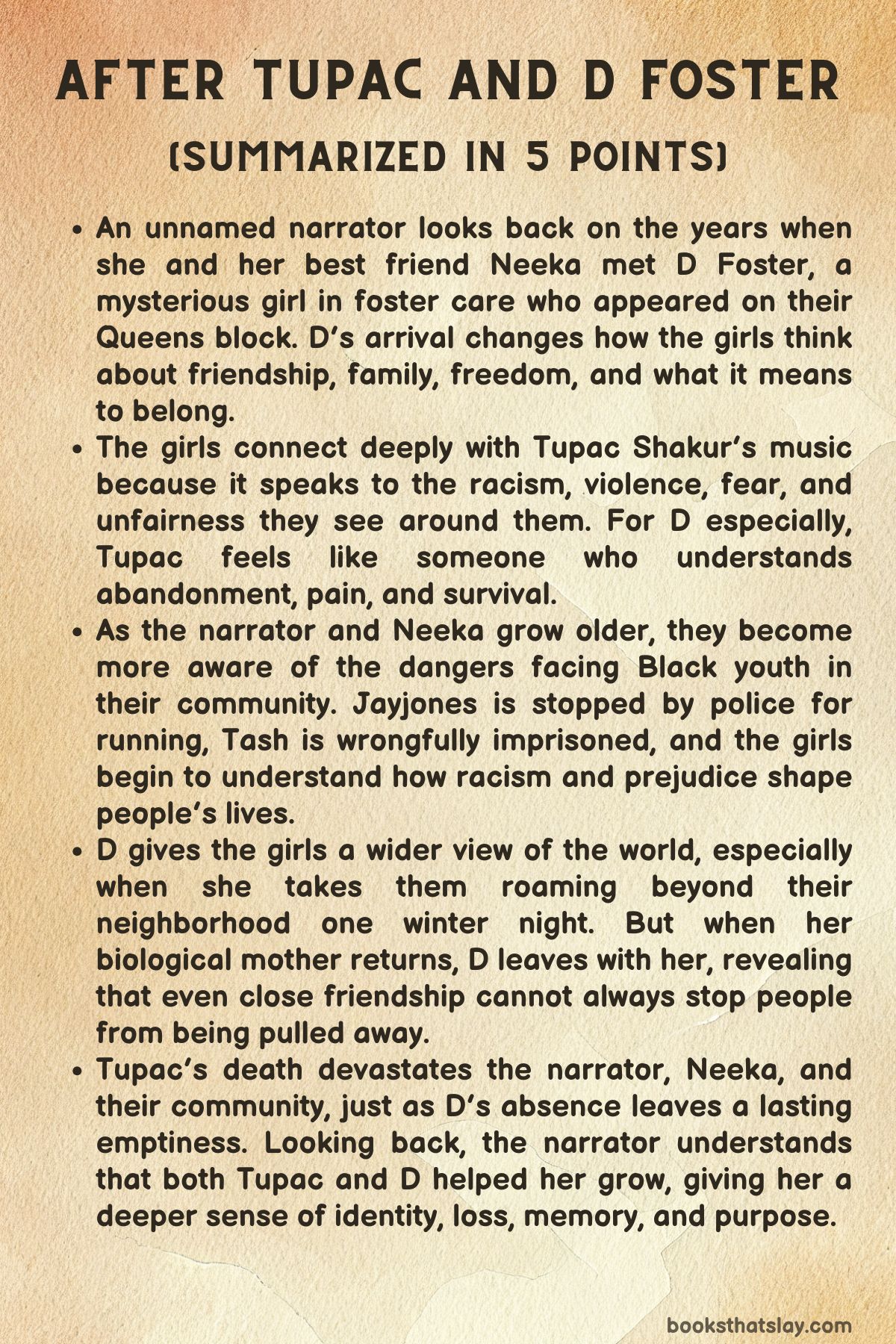
After Tupac and D Foster by Jacqueline Woodson is a coming-of-age novel about friendship, identity, loss, and the lives of Black girls growing up in Queens during the mid-1990s. The story follows an unnamed narrator, her lifelong best friend Neeka, and a mysterious girl named D Foster, whose arrival changes how they understand freedom, family, and belonging.
Tupac Shakur’s music and public life run alongside their own experiences, helping them name the racism, policing, violence, and loneliness around them. In a quiet, reflective voice, the novel shows how childhood can end gradually, through love, hard truths, and the people who leave.
Summary
After Tupac and D Foster is told by an unnamed narrator who looks back on a brief but powerful period in her youth. As an adult, she remembers the years between Tupac Shakur’s first shooting and his death, years that also marked the beginning and end of her friendship with a girl named D Foster.
For the narrator, Tupac’s life and D’s presence became part of the same memory. Both helped her understand herself, her neighborhood, and the world that Black children were expected to grow up inside.
The narrator lives in Queens and spends most of her time with Neeka, her best friend since babyhood. Their mothers are protective, their block is familiar, and their lives have the closeness and limits of a neighborhood where everyone knows everyone.
Then D Foster appears. She is taller than the other girls, with green eyes, copper-colored hair, and an air of mystery.
She does not say much about where she lives or who her family is. At first, the narrator and Neeka are curious and cautious, but when D joins them in Double Dutch, she fits into their rhythm almost naturally.
D is in foster care, and this makes her life very different from theirs. She calls her foster mother Flo, short for Foster Lady Orderly.
Flo has rules, including a curfew, and D follows them because she understands how easily a child in foster care can lose a home. Neeka sometimes envies D’s ability to ride buses and move through the city alone, but D does not see that freedom as simple luck.
She has lived through hunger, neglect, and instability. To her, a watchful mother and a safe home would be a gift.
Tupac Shakur becomes a shared language for the girls and their community. When they watch his videos or hear his music, D feels especially connected to him.
She says they are alike, though Neeka and the narrator do not fully understand at first. Tupac’s mother had been imprisoned, and D’s mother had given her up to foster care.
Both D and Tupac seem to carry wounds linked to abandonment, survival, and public judgment. His music speaks about things D has actually seen.
The narrator’s home life is steadier than D’s, though not perfect. She does not know her father well, and her mother makes it clear that life is better without him.
Neeka’s family is large and noisy, full of siblings and strong opinions. Her older brother Jayjones is a gifted basketball player, and the narrator has a crush on him.
Jayjones is talented and ambitious, but he also lives under the daily threat of racist suspicion. One day, after running home, he says a police officer stopped him because he looked like he might have stolen something.
His anger reveals one of the book’s central truths: Black boys and men are watched, judged, and threatened no matter what they do.
Neeka’s other brother, Tash, is in prison when D enters their lives. Tash is gay, and Neeka and the narrator love him deeply.
They are hurt when rap lyrics or people in the neighborhood mock gay men, because those insults are not abstract to them. Tash’s imprisonment exposes another injustice.
He was drawn into danger by Sly, a manipulative young man he loved. Sly and another person assaulted and robbed an older gay man named Randall, then blamed Tash as well.
Because Randall could not immediately remember what happened, Tash was imprisoned for a crime he did not commit.
As the girls grow older, the world around them feels more dangerous. Tupac is tried and sentenced to prison, and the narrator’s mother believes the legal system is punishing him not only for one case, but for the image he represents.
His “Thug Life” tattoo and public persona make people judge him before they know the facts. The narrator begins to understand how quickly Black men can be turned into examples by courts, police, and the media.
When Tupac is shot the first time, the whole neighborhood reacts as though someone close to them has been hurt. The narrator, Neeka, D, Jayjones, and the adults all listen for news.
They talk about what Tupac means to them. Jayjones says Tupac can say what he feels better than he can say it himself.
The narrator realizes that Tupac matters so much because he speaks to Black children who live with fear, racism, poverty, and violence while much of the country looks away.
D’s reaction is the most personal. She tells Neeka and the narrator about the pain she has known in foster care, including homes where children were starved or neglected while adults misused the money meant to support them.
Tupac’s songs make those experiences visible. D believes he will survive because she sees herself in him, and she believes both of them are still meant to live.
The girls often talk about their “Big Purpose,” an idea D introduces. She believes everyone has one, even if they do not know what it is yet.
The narrator sees herself as the thoughtful one, always reading, watching, and trying to understand people. Neeka eventually decides that her purpose might be to become a college professor, someone respected and listened to.
The narrator wonders if purpose may also mean learning who you are and growing beside the people you love.
One winter night, D invites Neeka and the narrator to roam with her. They take a bus away from their familiar neighborhood to a quiet park with a stone amphitheater covered in snow and moonlight.
At first, the narrator is afraid, but the scene becomes beautiful and freeing. The three girls make snow angels and shout into the night, feeling present and alive.
For the narrator, that night becomes a turning point. The protected girl from the block and the girl curious about the wider world seem to become one person.
As time passes, the girls’ bodies and minds change. The narrator turns thirteen and receives a framed photo of herself, Neeka, and D. Each girl’s expression seems to reveal something essential: D looks unsure whether she can trust them, Neeka looks knowing and bold, and the narrator appears to be looking toward the future.
The photo becomes a symbol of their friendship and of the moment before everything changes.
During a visit to Tash in prison, the narrator sees the pain incarceration brings to families. Tash tries to be lively and funny, but he is thinner and warns the younger boys never to end up where he is.
He asks his mother to accept him as he is, and though she struggles, she softens. Later, after his release, Tash explains that Randall eventually remembered the attack clearly and told the authorities that Tash had not been involved.
Randall’s truth freed him, but the narrator realizes how close Tash came to losing years of his life because of a lie.
D’s life also changes suddenly. Her biological mother returns and wants to take her back.
D is hurt because she has finally begun to feel safe with Flo, yet Flo seems ready to let her go. D feels that she belongs fully to no one.
Then she disappears for weeks. When she returns, she is with her mother, a woman whose hard life shows on her face but whose green eyes match D’s.
The girls learn that D’s real name is Desiree Johnson. Neeka is upset that they did not even know something so basic, but D insists that what mattered was not her name or past, but the friendship they had when she came to their block.
She leaves with her mother, promising that they will remember one another.
Soon after, Tupac is shot again. This time, the news is worse.
D calls the narrator and says she does not think he will survive. The girls try to make sense of death, distance, and helplessness.
Tupac dies on September 13, and Neeka and the narrator sit outside in the rain, devastated. They try calling D, but no one answers.
Life continues, but it is changed. Jayjones receives college offers and looks toward Georgetown, carrying hope for a future beyond the block.
Tash plays music again. Neeka and the narrator sing with him, hearing how their voices have changed into a new harmony.
The narrator understands that she and Neeka have grown through everything they have witnessed: D’s leaving, Tash’s imprisonment, Jayjones’s fear, Tupac’s death, and their own movement from childhood toward adolescence.
Looking back, the narrator cannot separate her memories of D from her memories of Tupac. Both arrived in her life as figures of survival, longing, and truth.
Both helped her see that freedom is complicated, that family can be fragile, and that growing up means learning how much pain and beauty can exist at once. Some people believe Tupac never really died, and the narrator lets herself imagine that somewhere, somehow, D and Tupac found each other and are living safely beyond the reach of all that hurt them.
Characters
The Narrator
The unnamed narrator is the reflective center of After Tupac and D Foster. She tells the story as an adult looking back on the years when she was moving from childhood into adolescence, which gives her voice both innocence and maturity.
As a girl, she is observant, thoughtful, and often quiet. She calls herself the “Brain” of the group because she likes to read, watch people, and make sense of the world through careful attention.
Unlike D, she has not lived through the foster system, and unlike Neeka, she is not part of a large, loud household, but she still knows absence through her father’s distance from her life. Her growth comes from learning that reading and watching are not always enough.
Through D, Neeka, Jayjones, Tash, and Tupac, she begins to understand racism, unfair policing, imprisonment, gender, sexuality, friendship, and loss in ways that are personal rather than abstract. She is also emotionally honest, especially in her jealousy over Jayjones’s attention to D and her fear of losing the friendship that has shaped her.
By the end, she understands that growing up does not mean finding simple answers. It means carrying memories, accepting change, and recognizing how deeply brief relationships can shape a person.
D Foster
D Foster, whose real name is Desiree Johnson, is mysterious, independent, and emotionally guarded. When she first appears on the narrator and Neeka’s block, she seems almost like someone from another world.
Her unusual appearance, her vague answers, and her habit of roaming through the city make her seem older and more experienced than the other girls. Yet beneath that freedom is deep instability.
D has been moved through foster homes, neglected by adults, and separated from her biological mother. Her independence is not only adventurous; it is also a survival skill.
She has learned to move through the world alone because she has often had no one permanent to depend on. Her connection to Tupac is one of the clearest ways she expresses herself.
She sees in him someone who knows abandonment, anger, danger, and the longing to be understood. D’s idea of a “Big Purpose” shows that she wants her life to mean something beyond pain and displacement.
Her friendship with the narrator and Neeka gives her a temporary sense of belonging, but when her mother returns, D is forced into another uncertain transition. Her departure leaves the girls with questions, but it also confirms her importance: she taught them that freedom, family, and identity are much more complicated than they once believed.
Neeka
Neeka is bold, outspoken, funny, and fiercely loyal. She has grown up beside the narrator, and their friendship has the comfort of shared history.
Unlike the narrator, who tends to observe first, Neeka speaks quickly and directly. She asks questions, argues with her brothers, challenges adults, and often reacts with frustration when she feels restricted.
Her irritation with her mother’s rules shows her desire for independence, but her family life also gives her a strong foundation. She is surrounded by siblings, parents, noise, arguments, and love.
This security makes it hard for her at first to fully understand D’s situation. She sees D’s freedom to ride buses and roam as exciting, not immediately recognizing that D would trade much of that freedom for a stable home.
Neeka’s love for Tash reveals her depth. She is protective of him and angry at the homophobia that hurts him.
She also has a sharp sense of injustice, especially when it comes to Tash’s wrongful imprisonment. Her desire to become a college professor shows that she wants authority, respect, and a voice people will take seriously.
Neeka’s growth lies in learning that speaking up matters, but so does listening carefully to pain that is different from her own.
Tupac Shakur
Tupac is not a traditional character who moves through the girls’ neighborhood, but he is one of the most powerful presences in the novel. His music, public image, trial, imprisonment, shootings, and death shape the emotional world of the narrator, Neeka, D, Jayjones, and their community.
To them, Tupac is not simply a celebrity. He is someone who says aloud what many Black young people feel but cannot always explain.
His songs name poverty, racism, violence, neglect, fear, and anger. At the same time, he is complicated.
He represents truth and resistance, but he also carries contradictions, including lyrics and attitudes that can wound people like Tash. The girls and their families do not treat him as perfect; they respond to him as real.
D’s bond with him is especially strong because she sees her own life reflected in his. Jayjones also feels that Tupac gives language to the pressures placed on Black boys and men.
Tupac’s death becomes a symbol of stolen possibility. His life helps the narrator understand how public events can become deeply personal when they speak directly to private pain.
Jayjones
Jayjones is Neeka’s older brother and one of the narrator’s early crushes. He is athletic, confident, charming, and full of promise, especially because of his basketball talent.
His future seems bright when colleges begin showing interest in him, and Georgetown becomes a dream connected to success, escape, and recognition. Yet Jayjones also carries the burden of being a young Black man in a society that treats him as suspicious.
When he is stopped by a police officer simply for running, his anger reveals how racism limits even ordinary movement. His body, which should represent strength and opportunity, becomes something watched and judged.
Jayjones’s conversations about Tupac show that he identifies with the rapper’s anger and honesty. He feels that Tupac speaks for boys like him, boys who are talented and hopeful but still vulnerable to police, prisons, and violence.
His relationship with Tash also matters. Though he sometimes speaks with the bluntness of an older brother, he cares deeply about his family.
By the end, Jayjones stands between danger and possibility. His college opportunities suggest hope, but his sadness shows that success does not erase the losses he has witnessed.
Tash
Tash is Neeka’s older brother, a gifted musician whose warmth and humor survive even after wrongful imprisonment. He is openly gay or gender-nonconforming in a community where many people still respond with discomfort, mockery, or cruelty.
His character brings attention to the harm caused by homophobia, not as a distant issue but as something that affects a beloved son, brother, and friend. Tash’s imprisonment is especially painful because he is punished for a crime he did not commit.
His love for Sly makes him vulnerable to manipulation, and Sly’s betrayal nearly destroys his future. In prison, Tash tries to remain lively, but his weight loss and warnings to the younger boys reveal how much the experience has damaged him.
His plea for his mother to accept him as he is marks one of his most important moments. He wants love without correction or shame.
His eventual release, made possible by Randall’s recovered memory, brings relief, but it does not erase the injustice. Tash represents tenderness, artistry, vulnerability, and endurance.
His return to music after prison suggests that he has been hurt but not erased.
The Narrator’s Mother
The narrator’s mother is protective, thoughtful, and politically aware. She is not simply a background parent; she helps shape the narrator’s understanding of racism, justice, and survival.
Her conversations about Tupac’s trial show that she recognizes how the legal system can punish Black men based on image, reputation, and social fear as much as evidence. She does not excuse everything Tupac represents, but she understands that he is being judged through a biased lens.
As a mother, she watches her daughter closely, especially when D enters the girls’ lives. Her caution toward D comes from concern, not cruelty.
She wants to know who her daughter is spending time with and whether that friendship will bring danger. At the same time, she allows her daughter enough space to grow, think, and form attachments.
Her birthday gift of the framed photograph shows emotional insight. She understands that friendship is central to her daughter’s life and gives her a keepsake that later becomes even more meaningful.
Her character represents the difficult work of Black motherhood: protecting a child without preventing her from becoming her own person.
Miss Irene
Miss Irene, Neeka’s mother, is strict, watchful, loving, and deeply invested in her children’s safety. Her rules often frustrate Neeka, who feels smothered by constant supervision, but Miss Irene’s protectiveness comes from knowing the dangers around them.
She understands that childhood innocence does not shield Black children from racism, violence, police suspicion, or street danger. Her large household is full of activity, arguments, discipline, and affection.
She may not always understand Tash fully, especially when his gender expression or language challenges her expectations, but she loves him. Her visit to the prison shows both her pain and her refusal to abandon her son.
When Tash asks to be accepted as he is, Miss Irene’s softening is important because it shows that love can grow past discomfort. She also represents a parent trying to keep order in a world that often feels unsafe and unfair.
Her strictness is not presented as simple control. It is a form of fear, care, and responsibility shaped by the realities her children face every day.
Flo
Flo, D’s foster mother, is a complicated figure because she gives D more stability than many of her previous homes, but she also reminds D that foster care can be temporary and uncertain. D calls her Flo rather than mother, which creates emotional distance, yet D also begins to trust her.
Flo’s rules give D structure. Her curfew may seem restrictive to Neeka, but to D it offers a kind of safety.
After years of instability, rules can feel like proof that someone is paying attention. However, when D’s biological mother returns, Flo’s willingness to let D go wounds D deeply.
D had begun to believe that Flo might be a lasting figure in her life, so Flo’s response makes her feel replaceable. Flo is not shown as cruel, but she is limited by the foster system and perhaps by her own understanding of her role.
She provides shelter and order, yet she cannot fully give D the belonging she longs for. Through Flo, the novel shows how foster care can offer safety while still leaving a child emotionally insecure.
D’s Mother
D’s mother is a shadowy but important presence for most of the story, and her return changes everything. For D, her mother represents both longing and hurt.
She is the person D has wanted, but she is also the person who left her to the foster system. When she finally appears, the narrator notices signs that her life has been hard.
She does not arrive as a perfect solution to D’s loneliness. Instead, she brings uncertainty.
D is expected to leave the life she has built with Flo and the friendship she has built with Neeka and the narrator. Her mother’s use of the name Desiree reveals a part of D’s identity that her friends never knew, reminding them that even close friendship does not always grant full access to someone’s past.
D’s mother matters because she forces D to confront the meaning of family. Biology alone does not erase abandonment, but D still chooses or is required to go with her.
Her presence closes one part of D’s life while opening another that remains unknown to the narrator.
Sly
Sly is charming, manipulative, and destructive. He represents a dangerous kind of performance, someone trying to prove toughness through cruelty.
Tash falls in love with him, which makes Sly’s betrayal even more painful. He uses Tash’s affection to gain access to Randall’s home, then participates in violence and robbery.
When the police arrive, Sly protects himself by blaming Tash, showing his willingness to sacrifice someone who cared for him. Tash later describes people like Sly as “wannabe gangstas,” suggesting that Sly’s violence comes partly from insecurity and performance.
He wants to appear hard, powerful, and feared. His actions are not only criminal; they are intimate betrayals.
He exploits love, targets a gay man, and helps send an innocent person to prison. Sly’s role in After Tupac and D Foster also reflects the dangers surrounding young people who are searching for acceptance in the wrong places.
Through him, the story shows how false love and false toughness can cause lasting harm.
Randall
Randall is an older gay man and a musician who becomes important through his relationship with Tash. He teaches Tash piano and gives him access to beauty, discipline, and artistic possibility.
His home is a place where Tash can develop his talent, which makes the attack there especially devastating. Randall is beaten during the robbery, and because he cannot immediately remember what happened, Tash remains trapped in the legal system.
Yet Randall is not simply a victim. When his memory returns, he tells the truth and helps free Tash.
His honesty restores Tash’s future, though only after Tash has already suffered. Randall’s character also shows how gay people in the story face targeted violence.
The attack against him is not only robbery but also hatred. Even though he appears mostly through other people’s accounts, Randall has a strong moral presence.
He represents mentorship, vulnerability, and the power of truth to correct injustice, even when that correction comes late.
Emmett and Neeka’s Younger Siblings
Emmett and Neeka’s younger siblings help show the fullness of Neeka’s family life. They bring noise, movement, responsibility, and humor into the story.
For Neeka, they are often a source of frustration because she has to help watch them and rarely gets quiet time for herself. Still, their presence also shows that she belongs to a household built on connection.
Emmett is especially important during the prison visit because he is young enough to need protection from harsh truths, yet old enough to hear pieces of what the older characters are saying. When Jayjones warns him about how a Black boy must act in public to avoid suspicion, the moment shows how early children are taught the rules of survival.
The younger siblings remind readers that the dangers faced by Jayjones and Tash are not isolated. They wait in the future of the younger boys too.
Their innocence makes the adults’ and older siblings’ protectiveness feel even more urgent.
Themes
Friendship as Shelter and Transformation
Friendship in After Tupac and D Foster is not just companionship; it becomes a shelter where the girls can test ideas, share fears, and begin to understand themselves. The narrator and Neeka already have a lifelong bond before D arrives, but D changes the shape of that friendship.
Her presence makes the girls look beyond the familiar safety of their block and consider lives marked by foster care, movement, secrecy, and longing. The three girls do not always understand one another perfectly.
Neeka envies D’s freedom without first seeing the pain behind it. The narrator feels jealous when Jayjones notices D. D keeps parts of herself hidden, including her real name and the full story of her past.
Yet their friendship is real because it gives each girl something she needs. D receives a temporary sense of belonging.
Neeka gains a wider view of freedom and family. The narrator gains a deeper awareness of the world and her own inner life.
Their night at the amphitheater captures this transformation clearly. Away from home, in a place both strange and beautiful, they feel seen and alive together.
Even after D leaves, the friendship remains part of who they become.
Growing Up Under Racism and Surveillance
The children in the novel grow up in a world where racism is not only an idea but a daily condition shaping movement, safety, and possibility. Jayjones’s experience of being stopped by the police for running shows how ordinary actions become dangerous when Black boys are seen as suspicious before they are seen as human.
His talent as an athlete does not protect him. His ambition does not protect him.
Even his future college opportunities exist beside the knowledge that society may still treat him as a threat. The narrator also begins to understand that Black girls face danger differently.
As she grows older, she becomes more aware of how men look at girls and how female bodies are judged, followed, and claimed by others. Tupac’s public treatment by the courts and media expands this theme beyond the neighborhood.
The community sees how his image is used against him, how a Black man can be punished not only for what he may have done but for what people believe he represents. Growing up, then, means learning the rules of a society that constantly watches Black youth.
The sadness of this knowledge is that it arrives early, before the children are ready for it.
Family, Belonging, and the Pain of Unstable Homes
Family in the story is shown as both a source of protection and a source of pain. Neeka’s family is crowded, strict, and sometimes frustrating, but it gives her a strong sense of belonging.
Her mother watches her closely, her siblings surround her, and even conflict happens within a structure of care. The narrator’s family is quieter and smaller, marked by her father’s absence but steadied by her mother’s attention.
D’s life reveals the other side of family: what happens when a child does not know where she truly belongs. Her foster homes have not always been safe, and even when Flo gives her rules and shelter, D knows the arrangement may not last.
Her biological mother’s return should seem like an answer, but it creates more confusion. D has longed for her mother, yet she barely knows her.
She has begun to trust Flo, yet Flo allows her to leave. This leaves D feeling claimed by no one completely.
Tash’s storyline also expands the meaning of family. His relatives visit him, worry over him, and eventually struggle to accept his full self.
The novel suggests that belonging is not guaranteed by blood, law, or shared address. It must be proven through care, loyalty, and acceptance.
Voice, Music, and the Search for Purpose
Music gives the characters a way to understand feelings that are otherwise hard to name. Tupac’s songs matter because they speak directly to anger, grief, injustice, and survival.
Jayjones hears his own frustration in Tupac’s words. D hears her history of abandonment and foster care.
The narrator hears the wider truth of being a Black child in America, surrounded by dangers that many people ignore. Music becomes a kind of testimony, saying what official systems refuse to say.
Tash’s music offers another form of voice. His piano playing and later his keyboard represent beauty, skill, and self-expression after trauma.
Even after prison, he can still create sound, and that matters. The girls’ singing near the end shows their own voices changing as they grow.
Their harmony becomes a sign of maturity, suggesting that purpose may not arrive as one clear answer. It may come through learning how to speak, sing, remember, and stand beside others.
D’s idea of a “Big Purpose” runs through the story because each character is trying to understand why they are here and what they are meant to do with pain. The novel does not offer one fixed answer.
Instead, it shows purpose forming through memory, friendship, art, truth, and survival.