After the Shot Drops Summary, Characters and Themes
After the Shot Drops by Randy Ribay is a young adult novel about friendship, ambition, loyalty, and the hard choices that come with trying to escape poverty without leaving people behind. The story follows Bunny, a gifted basketball player who transfers from his neighborhood public school to a private school for better opportunities, and Nasir, his former best friend who feels abandoned by that decision.
Through their alternating voices, the novel explores race, class, jealousy, guilt, and community pressure. At its center is a painful question: when someone you love is in trouble, how much are you responsible for saving them?
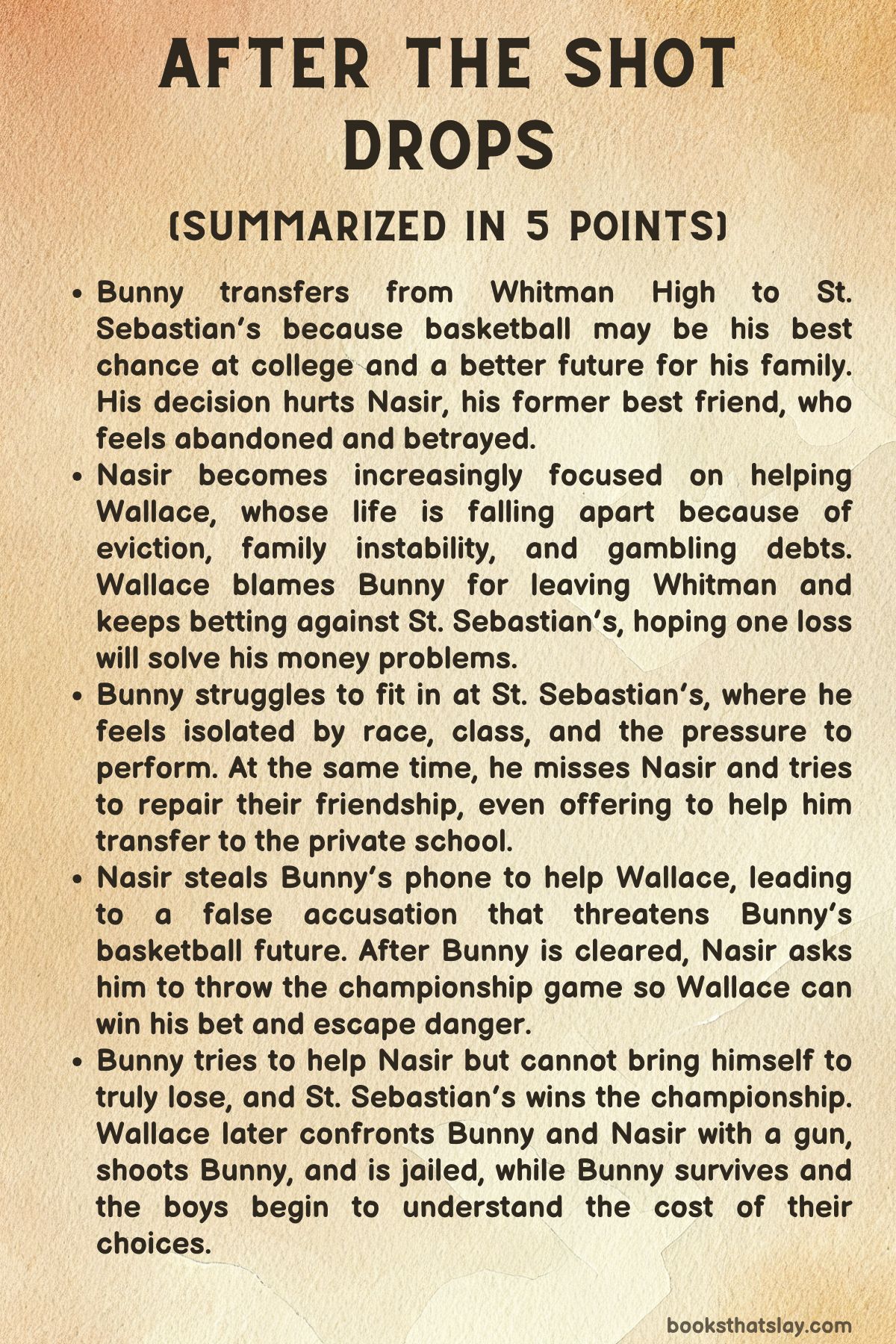
Summary
After the Shot Drops begins at a vigil for Gabe, a teenager who has been shot and killed in a public square. Bunny, one of the novel’s two narrators, attends the vigil and struggles to know what to say or feel.
Gabe was not one of his closest friends, but he had treated Bunny kindly after Bunny transferred from Whitman High to St. Sebastian’s, a wealthy private school. Bunny notices Nasir, his former best friend, with Wallace, and when Bunny and Nasir make eye contact, Nasir turns away.
The moment makes clear that Bunny’s transfer has damaged something important between them.
Nasir, the other narrator, is angry and hurt. His basketball team at Whitman has just lost badly to St. Sebastian’s, and he believes the reason is Bunny.
Bunny used to play for Whitman, and now he is helping the private school win. To Nasir, the move feels like betrayal.
He is especially upset that Bunny made the decision without talking to him first. Bunny, however, sees his transfer as a chance to change his family’s future.
His family struggles financially: their apartment has heating problems, his mother works exhausting shifts, his father’s bookstore is failing, and his sister is burdened by college debt. Basketball is Bunny’s way out, and college recruiters are already watching him.
At St. Sebastian’s, Bunny is surrounded by wealth and privilege. His teammates have money, cars, and freedom that he does not have.
He feels out of place as one of the few Black students at the school, and he often feels that people value him mainly for what he can do on the court. He tries to follow every rule because his future depends on staying eligible for college basketball.
Still, the pressure on him is heavy. He wants to succeed not only for himself, but for his whole family.
Nasir’s attention is divided between his anger at Bunny and his concern for Wallace. Wallace, who is related to Nasir through family ties, lives with his grandmother and is facing eviction.
His life has been unstable: his father is in jail, his mother is absent because of addiction, and he has little support. Nasir wants to help him, but his parents are wary of Wallace and do not want him moving in.
Nasir sees Wallace as someone the world has already given up on, and he feels guilty for having a more stable home.
Wallace’s problems soon become more serious. Instead of looking for steady work, he begins making bets against St. Sebastian’s.
Because Bunny is such a strong player, St. Sebastian’s keeps winning, which means Wallace keeps losing money. Wallace’s resentment toward Bunny grows.
He sees Bunny as someone who left their neighborhood behind and made life worse for everyone else. Nasir knows Wallace’s thinking is unfair, but he also feels pulled into Wallace’s pain.
When Wallace wants to throw eggs at Bunny’s house, Nasir goes along with it, though he feels guilty afterward.
Bunny tries to repair his relationship with Nasir. He misses their friendship and knows he hurt Nasir by leaving without discussing it.
He also feels guilty because he is dating Keyona, even though he knows Nasir once had feelings for her. Bunny considers breaking up with Keyona for Nasir’s sake, but Keyona reminds him that she has a choice in whom she dates and that Nasir’s feelings should not control their relationship.
Bunny remains torn between love, loyalty, and guilt.
The conflict deepens when Bunny offers Nasir a possible way to transfer to St. Sebastian’s on scholarship. Bunny thinks this could fix their friendship and give Nasir better opportunities too.
Nasir is stunned by the offer, but he is also conflicted. During a tour of St. Sebastian’s, Nasir sees the school’s privilege up close.
Bunny admits that the school has been lonely for him and that he wants Nasir there because they could face that outsider feeling together. Nasir begins to understand that Bunny’s life at St. Sebastian’s is not as easy as he imagined.
At the same time, Wallace’s gambling debt becomes dangerous. He loses more money betting against St. Sebastian’s and starts pressuring Nasir to find a way to keep Bunny out of upcoming games.
Nasir discovers that Wallace has a gun and learns that people are threatening him over unpaid debts. Wallace believes that if St. Sebastian’s loses, he can win enough money to save himself.
Nasir knows Wallace is acting recklessly, but he convinces himself that harming Bunny’s season is less terrible than letting Wallace get hurt or killed.
Nasir makes a terrible choice. He steals Bunny’s phone and gives it to Wallace.
Wallace uses it to send a false email claiming that St. Sebastian’s paid Bunny to transfer. The accusation threatens Bunny’s eligibility and the school’s season.
Bunny is questioned by the headmaster and forced to sit out while the claim is investigated. He realizes Nasir may have been involved but does not immediately expose him.
Bunny’s future, his team’s success, and his college hopes are suddenly at risk.
St. Sebastian’s wins without Bunny, which only makes Wallace’s situation worse because he loses another bet. Wallace is beaten by the people he owes money to, and Nasir sees how desperate he has become.
Then Bunny is cleared of wrongdoing and allowed to play in the championship game. Nasir, desperate to protect Wallace, confesses to Bunny that he stole the phone and asks Bunny to throw the championship game.
Bunny is furious. He argues that Wallace’s mistakes are not his responsibility and that no true friend should ask him to sacrifice everything.
Still, because he loves Nasir and wants to restore their bond, Bunny eventually agrees to try to lose.
Before the game, Bunny and Nasir spend a night together like old friends. They apologize for the ways they hurt each other and talk honestly about Bunny’s transfer, Whitman, family, and the future.
For a short time, their friendship feels whole again. Bunny goes into the championship planning to lose, believing he is doing it for Nasir and Wallace.
During the game, Bunny plays recklessly at first and helps put St. Sebastian’s behind. But his competitive nature takes over.
Even injured, he pushes hard and brings his team close. In the final seconds, Bunny passes the ball to a teammate, who scores.
St. Sebastian’s wins the championship. Bunny is both thrilled and horrified.
He did not mean for it to happen, and he knows what the win means for Wallace.
Later that night, Bunny goes to Nasir’s house, and the two head to the basketball courts to talk. Bunny apologizes for winning, but he also tells Nasir that it was unfair to ask him to lose.
Nasir finally admits that Bunny deserved the victory and that he should never have asked him to throw the game. Their friendship begins to heal.
Then Wallace arrives, drunk, angry, and armed. He blames Bunny for ruining him.
Nasir tries to defend Bunny and calm Wallace down, but Wallace attacks Nasir. Bunny pulls him away, and Wallace punches Bunny in his injured nose.
Then Wallace points a gun at Bunny.
Nasir steps between them and begs Wallace to stop. Bunny also tries to reason with him.
A shot is fired, and Bunny is hit. Nasir rushes to him, presses on the wound, and calls for help.
At the hospital, Bunny’s family, Nasir’s family, and Keyona wait in fear. Bunny survives, partly because Nasir acted quickly.
When Bunny wakes, he asks about Nasir and Wallace. He does not feel hatred toward Wallace, only sadness and pity.
He and Nasir apologize again, understanding that both of them made painful mistakes.
In the epilogue, Nasir visits Wallace in jail. Wallace is surprised because almost no one visits him.
Nasir says he is sorry and insists that he tried to help. Wallace suggests that maybe everyone was right to see him as a lost cause.
As Nasir leaves, he wonders what more he could have done and where responsibility truly begins and ends. After the Shot Drops closes on that difficult question, showing that friendship matters deeply, but love alone cannot fix every broken system or save every person from the consequences of their choices.
Characters
Bunny Thompson
Bunny Thompson is the emotional center of After the Shot Drops, and his character is built around ambition, pressure, guilt, and the desire to protect his family. He transfers from Whitman High to St. Sebastian’s because he sees basketball as his best chance at a better future.
His decision is practical, but it carries emotional consequences. Bunny understands that his family is struggling: his mother works hard, his father’s bookstore is failing, the apartment has problems, and his sisters and older sister all live under financial strain.
His talent is not just personal pride; it becomes a responsibility. Every practice, every game, and every college brochure reminds him that he is expected to lift himself and possibly his family out of hardship.
At St. Sebastian’s, Bunny gains access to better facilities, stronger exposure, and a path toward college basketball, but he also becomes painfully aware of class and racial difference. He is surrounded by wealthy white students whose problems do not resemble his own.
He feels that he must adjust the way he speaks and behaves in order to fit in, yet he never feels fully accepted. This makes his success complicated.
He wants the opportunities St. Sebastian’s offers, but he misses the comfort and belonging of Whitman. His character is not written as someone who simply chooses success over community.
Instead, he is someone trying to survive within systems that reward talent while isolating the person behind that talent.
Bunny’s friendship with Nasir reveals both his loyalty and his flaws. He hurts Nasir by transferring without talking to him first, and he underestimates how deeply that decision affects his best friend.
He also tries to fix the problem in a way that shows both generosity and naivety: by attempting to get Nasir into St. Sebastian’s too. Bunny wants to repair the bond, but he sometimes assumes that what seems like a solution to him will also feel like a solution to others.
His relationship with Keyona shows another side of this flaw. He cares for her, but he allows guilt over Nasir’s feelings to cloud his judgment.
Later, when he tries to kiss Brooke, his mistake exposes how lonely, confused, and emotionally overwhelmed he has become.
By the end, Bunny shows maturity through forgiveness and self-awareness. He agrees to throw the championship game because he wants to help Nasir, but the request is unfair to him.
His inability to truly lose shows how deeply basketball is tied to his identity. When Wallace shoots him, Bunny’s response afterward is not hatred.
He recognizes Wallace’s suffering, even while understanding that Wallace made destructive choices. Bunny’s growth lies in learning that loyalty does not mean carrying everyone else’s burdens alone.
He remains compassionate, but he also begins to see that his future matters too.
Nasir Blake
Nasir Blake is shaped by resentment, loyalty, insecurity, and moral conflict. At the beginning, he feels abandoned by Bunny’s transfer to St. Sebastian’s.
To him, Bunny did not simply change schools; he left behind Whitman, their friendship, and the shared life they had built. Nasir’s anger comes from hurt more than hatred.
He believes Bunny should have trusted him enough to discuss the decision before making it. Because Bunny leaves without that conversation, Nasir interprets the transfer as proof that Bunny no longer values him.
Nasir is also a character caught between two friends with very different futures. Bunny has extraordinary basketball talent and a path toward success.
Wallace, by contrast, has almost no safety net. Nasir sees Wallace’s poverty, unstable family history, and looming eviction, and he feels responsible for helping him.
His compassion is genuine, but it becomes dangerous because he allows guilt to overpower judgment. He excuses Wallace’s behavior, helps him in small ways even when he knows it is wrong, and eventually participates in a plan that threatens Bunny’s future.
Nasir wants to be loyal, but he confuses loyalty with enabling.
His moral weakness comes from his desire to save someone who may not be ready or able to save himself. Nasir knows Wallace is making reckless choices, but he keeps telling himself that the situation is unfair and that Wallace deserves help.
This belief is not entirely wrong. Wallace has been failed by family, community, and social systems.
However, Nasir’s mistake is deciding that Bunny should pay the price for Wallace’s crisis. When he steals Bunny’s phone and helps create the false accusation, he crosses a serious ethical line.
He tries to justify it by imagining that Bunny will recover, while Wallace might not.
Nasir’s growth comes through painful recognition. He eventually admits that asking Bunny to throw the championship game was wrong.
He realizes that Bunny deserved his success and that friendship should not demand that someone destroy his own future. His final visit to Wallace in jail shows that he still cares, but he is no longer able to pretend that care alone can undo consequences.
Nasir’s character arc in After the Shot Drops is about learning the limits of responsibility. He begins as someone who feels wronged, becomes someone who wrongs others in the name of helping, and ends as someone who must live with the knowledge that good intentions can still cause harm.
Wallace
Wallace is one of the most tragic characters in the novel because he is both a victim of hardship and a source of danger. His life has been marked by abandonment, poverty, and instability.
His father is in jail, his mother is absent because of addiction, and he lives with his grandmother in a situation that is constantly threatened by eviction. These details do not excuse his actions, but they explain the anger and desperation that drive him.
Wallace sees the world as unfair because, for him, it often has been.
His resentment toward Bunny grows out of class frustration and personal failure. Bunny’s transfer to St. Sebastian’s becomes a symbol of escape that Wallace cannot access.
Bunny is admired, recruited, and offered opportunity, while Wallace is trapped in debt and housing insecurity. Instead of seeing Bunny as someone also under pressure, Wallace sees him as a traitor who has joined the privileged side.
This bitterness leads Wallace to make Bunny the target of his anger, even though Bunny is not responsible for Wallace’s problems.
Wallace’s gambling reveals his desperation and his refusal to face reality. He keeps betting against St. Sebastian’s because he wants one dramatic win to solve everything.
Each loss makes his situation worse, but he continues because he has no stable plan, no trust in ordinary solutions, and no belief that hard work will save him quickly enough. His gun becomes a symbol of how cornered and dangerous he feels.
He is afraid, humiliated, and angry, and he turns those feelings outward.
Still, Wallace is not written as purely cruel. His care for the kitten shows tenderness, and his friendship with Nasir suggests that he wants connection even when he pushes people away.
His tragedy is that his pain curdles into blame. By shooting Bunny, Wallace harms someone who had become a target in his mind rather than the true cause of his suffering.
His later imprisonment leaves Nasir asking what could have been done differently, but Wallace also admits that others see him as a lost cause. He represents the damage caused when personal choices and social neglect collide.
Keyona
Keyona is intelligent, direct, and emotionally perceptive. She is Bunny’s girlfriend, but she is not defined only by that role.
She has her own sense of agency and refuses to be treated as a prize in the conflict between Bunny and Nasir. When Bunny considers breaking up with her because Nasir has feelings for her, Keyona makes it clear that her own choice matters.
This moment establishes her as someone who understands the emotional immaturity of the boys around her and is willing to challenge it.
She also functions as one of the clearest moral voices in the story. She warns Bunny that trying to arrange a scholarship opportunity for Nasir could create trouble, and she understands that success attracts jealousy and sabotage.
Her concern is not paranoia; it proves accurate when Bunny’s phone is stolen and the false email is sent. Keyona sees situations with sharper realism than Bunny does.
She understands that trust can be complicated when ambition, resentment, and pressure are involved.
Keyona’s relationship with Nasir is also important. Nasir has feelings for her, but she does not encourage him romantically.
Instead, she challenges him when he enables Wallace, especially when he lets Wallace copy homework. She sees that Nasir thinks he is helping, but she recognizes that some forms of help prevent people from facing responsibility.
This insight later applies to Nasir’s larger mistake with Wallace. Keyona understands boundaries better than most of the characters.
When Bunny confesses that he tried to kiss Brooke, Keyona’s reaction is firm and justified. She does not immediately smooth things over for the sake of romance.
Her pain matters, and she allows herself time to think. By the hospital scene, her presence shows that she still cares deeply for Bunny, but she remains a character with dignity and self-respect.
Keyona represents emotional honesty, accountability, and the importance of making choices based on self-worth rather than guilt.
Brooke
Brooke is a St. Sebastian’s cheerleader who helps reveal Bunny’s loneliness at his new school. She is friendly to him and shows interest in his emotional life, but their connection also exposes the distance between Bunny and the wealthy students around him.
When Bunny talks to her at the party, he tries to explain that her life and his life are not the same because she comes from a world of whiteness and wealth that shields her from many of his struggles. Brooke pushes back, saying he is being unfair, but the exchange shows how difficult it is for Bunny to feel understood at St. Sebastian’s.
Her role becomes especially important during the party scene. Bunny is emotionally shaken by the investigation, his conflict with Keyona, and his feelings of isolation.
When he tries to kiss Brooke, she rejects him clearly and reminds him that he has a girlfriend. This response prevents the moment from becoming romanticized.
Brooke is not there to rescue Bunny from loneliness, and she does not allow herself to be used as an escape from his problems. Her boundary forces Bunny to confront his own poor decision.
Brooke’s character also shows that kindness is not the same as full understanding. She may be friendly and sympathetic, but she cannot completely grasp the racial and class pressures Bunny carries.
Through her, the novel presents the limits of casual inclusion. Bunny can be invited to parties, spoken to warmly, and admired, yet still remain unseen in deeper ways.
Bunny’s Father
Bunny’s father is a quiet but meaningful presence. As the owner of Word Up, the bookstore that has shaped Bunny’s childhood, he represents community, culture, memory, and the value of spaces that hold people together.
The bookstore is not just a business; it is part of Bunny’s sense of home. Its decline and eventual sale show the economic pressure facing the family and the neighborhood.
Bunny’s father’s struggle is not caused by laziness or lack of care. It reflects how difficult it is for small community institutions to survive when money is tight and circumstances change.
As a parent, Bunny’s father offers emotional steadiness. He notices when Bunny is troubled, such as when Bunny wakes from a nightmare, and he tries to comfort him without pushing too hard.
He does not always have solutions, but he provides presence. His relationship with Bunny is affected by their schedules and responsibilities, yet there is clear love between them.
The fact that Bunny dreams of one day reopening Word Up after becoming successful shows how deeply his father’s work has influenced him.
Bunny’s father also helps reveal the burden Bunny carries. The family never directly demands that Bunny save them, but their struggles shape his sense of duty.
His father’s bookstore closing becomes another reminder that Bunny’s basketball future feels tied to more than personal ambition. Through this character, the story connects family love with economic vulnerability.
Bunny’s Mother
Bunny’s mother represents sacrifice, exhaustion, and practical love. She works graveyard shifts at the hospital, which means she is often absent from ordinary family moments, not because she lacks care, but because survival requires constant labor.
Her schedule shows the strain placed on working families. Bunny’s awareness of her work contributes to his pressure to succeed.
He sees her sacrifices and wants to make them mean something.
Although she is not as central in the action as Bunny or Nasir, her presence helps define Bunny’s home life. The apartment’s broken heat, the family’s financial concerns, and the demands placed on each family member create an environment where Bunny cannot treat basketball as just a game.
His mother’s labor is one reason he feels that failure is not an option. She represents the adult world of responsibility that Bunny is trying to enter too early.
Her role near the end also matters. When Bunny is hospitalized, his family gathers around him, and the fear of losing him reveals that Bunny is loved beyond his athletic promise.
His mother’s presence reminds readers that before Bunny is a star player, he is a son whose life matters far more than any championship or scholarship.
Jess
Jess, Bunny’s older sister, represents ambition shaped by financial difficulty. She is studying hard and working toward a future, but she is also accumulating student debt.
Her life mirrors Bunny’s in a quieter way: both siblings are trying to move forward, but both are doing so under economic pressure. Jess’s path through education shows that opportunity often comes with heavy costs.
She also provides a sense of family warmth and realism. She is present in Bunny’s home life, watches over the younger siblings at times, and interacts naturally with Nasir when he attends the game.
Nasir’s old crush on her adds a human detail that connects the two families’ histories. Jess is not a major driver of the plot, but she helps show the world Bunny comes from: a household full of people trying, studying, working, and hoping for better.
Her goal of becoming a social worker is significant. It suggests a desire to help people who face difficult circumstances, much like Wallace, Bunny, and others in their community.
Through Jess, the story quietly raises the idea that care can become a profession, not just a personal instinct.
Ashley and Justine
Ashley and Justine, Bunny’s younger twin sisters, are minor characters, but they are important in showing the everyday reality of Bunny’s family. When they are cold because the furnace is broken, their discomfort makes the family’s financial strain concrete.
They are not involved in Bunny’s basketball decisions, but their presence helps explain why he feels so much pressure. Bunny is not only thinking about himself; he is thinking about the people at home who deserve stability and comfort.
The twins also bring innocence into the story. While the older characters struggle with loyalty, ambition, debt, violence, and guilt, Ashley and Justine represent the younger family members affected by adult problems they did not create.
Their cold apartment shows how poverty reaches children first and how Bunny’s dreams are tied to the hope that his family might one day live with less hardship.
Mr. Blake
Mr. Blake, Nasir’s father, is one of the novel’s strongest adult voices. He is practical, protective, and morally grounded.
When Nasir wants Wallace and his grandmother to move in, Mr. Blake refuses, not because he lacks compassion, but because he understands that Wallace may not respect the boundaries of their household. This decision frustrates Nasir, but it also shows Mr. Blake’s awareness that helping someone requires more than good intentions.
His conversations with Nasir reveal wisdom about home, responsibility, and limits. He returned to Whitman after serving in the Air Force because he had history there and cared about the community.
This helps Nasir think about what it means to stay, leave, and belong. Mr. Blake also recognizes that Nasir is trying to save Wallace, but he warns him that Wallace may be beyond what Nasir can fix.
This is one of the hardest truths in the story.
Mr. Blake’s role is not to dismiss Wallace’s suffering. Instead, he helps clarify that compassion must be paired with judgment.
He loves his son and tries to guide him away from destructive loyalty. Nasir does not fully understand his father’s warnings until after great harm has already been done.
Mrs. Blake
Mrs. Blake is caring, observant, and emotionally intelligent. She sees how much Nasir is hurting after losing Bunny’s friendship, and she encourages him to attend Bunny’s game because she understands that the friendship still matters.
Her guidance is gentle but meaningful. She does not force Nasir into a confession or lecture him harshly; she nudges him toward connection.
Her background as someone who left the Philippines in search of better opportunities adds depth to Nasir’s understanding of movement and ambition. Bunny’s transfer troubles Nasir because it feels like abandonment, but his mother’s story suggests that leaving can also be an act of hope.
This complicates Nasir’s view of Bunny. Mrs. Blake’s life reminds him that people sometimes leave familiar places not because they reject them, but because they are trying to build something better.
She also represents a stable family presence, which contrasts sharply with Wallace’s lack of support. Nasir’s home is not wealthy, but it is loving and structured.
Mrs. Blake’s warmth is part of what gives Nasir the security that Wallace envies.
Coach Baum
Coach Baum represents the institutional side of Bunny’s basketball career. He sees Bunny’s talent and values his discipline, but he also exists within a system where winning, eligibility, and reputation matter greatly.
When Bunny pays close attention during team analysis while his teammates are distracted, Coach Baum highlights Bunny’s seriousness. However, this also makes Bunny feel more isolated because praise from the coach can increase resentment from teammates.
Coach Baum’s role shows how Bunny’s talent gives him opportunity but also scrutiny. Bunny cannot simply play; he must remain eligible, behave carefully, and carry the expectations of St. Sebastian’s.
The coach supports him as a player, but the athletic system around them turns Bunny into an asset whose actions affect the whole school. This pressure becomes clear when the false accusation threatens not only Bunny but the team’s season and future.
Dr. Dietrich
Dr. Dietrich, the headmaster of St. Sebastian’s, represents authority, procedure, and institutional risk. When the false email is sent, he questions Bunny but appears willing to believe that Bunny did not write it.
Still, he must suspend Bunny from play while the investigation proceeds. His response shows the tension between personal trust and official responsibility.
Even if he believes Bunny, the school must protect itself.
His warning about possible consequences reveals how fragile Bunny’s future is. A false claim can threaten his amateur status, college eligibility, and the school’s record.
Dr. Dietrich’s role makes clear that Bunny’s life is shaped by rules made by institutions with enormous power over young athletes. He is not villainous, but he is part of a system that can quickly turn a teenager’s mistake, or someone else’s lie, into a life-changing crisis.
Coach J
Coach J, Bunny’s former coach at Whitman, represents the life Bunny left behind. When Bunny returns to Whitman to watch Keyona play, seeing Coach J brings up guilt and uncertainty.
Bunny remembers that Whitman gave him belonging in a way St. Sebastian’s does not. Coach J’s presence reminds Bunny that his transfer was not emotionally simple.
He gained opportunity, but he also left a team, a coach, and a community that had helped shape him.
Coach J does not need many scenes to matter. His importance lies in what he symbolizes: loyalty, local pride, and the pain of moving on.
Bunny’s discomfort around him shows that success can feel like betrayal when it requires leaving people behind.
Eric, Drew, and Clay
Eric, Drew, and Clay show different parts of Bunny’s experience at St. Sebastian’s. Eric and Drew are teammates who live with more privilege than Bunny.
Their casual spending, access to cars, and comfort with breaking rules highlight the difference between Bunny’s world and theirs. Bunny cannot afford to make the same mistakes because the consequences would fall harder on him.
When they smoke marijuana or buy food without thinking about money, Bunny is reminded that he lives under different pressures.
Drew becomes especially important in the championship because he makes the winning shot after Bunny passes to him. That moment is painful for Bunny because it brings victory when he had promised Nasir he would try to lose.
Drew’s shot shows that Bunny cannot control everything, even when he tries.
Clay represents resentment within the team. Bunny worries that Clay dislikes him because Bunny has taken his place and received attention.
This suspicion becomes relevant when Bunny is asked who might have stolen his phone. Clay’s presence shows that Bunny’s success creates jealousy not only in Whitman, but also inside St. Sebastian’s.
Gabe
Gabe’s death frames the story with the reality of gun violence. He is not central through direct action, but his murder creates a shadow over everything that follows.
The vigil at the beginning shows a community familiar with grief and public speeches that do not seem to change anything. Gabe becomes a reminder that violence is not abstract in the characters’ world.
It has already taken someone before Bunny is shot.
The later suggestion that Gabe may have been killed by the same dangerous people connected to Wallace’s debts makes the threat around Wallace more immediate. Gabe’s death warns readers that the danger is real.
His role is brief but powerful because it places Bunny’s shooting within a wider pattern of community loss.
Themes
Friendship, Betrayal, and Forgiveness
Friendship in After the Shot Drops is not presented as simple loyalty or easy affection. Bunny and Nasir love each other like brothers, but their bond breaks because neither knows how to communicate pain honestly.
Bunny transfers without telling Nasir first, thinking mainly about opportunity and family survival, while Nasir reads the silence as abandonment. Their friendship becomes damaged not only by the transfer itself, but by everything left unsaid afterward.
Nasir’s hurt turns into resentment, and resentment makes him vulnerable to Wallace’s influence. Bunny, meanwhile, wants to repair things but often tries to fix emotional wounds with practical solutions, such as offering Nasir a chance to attend St. Sebastian’s.
The deepest betrayal comes when Nasir steals Bunny’s phone, helping create a lie that threatens Bunny’s future. Yet the novel does not end their friendship there.
Instead, it shows how forgiveness requires confession, accountability, and the painful admission that love does not erase harm. Bunny forgives Nasir, but the forgiveness is not cheap.
Nasir must face what he did, and Bunny must recognize that his own choices also hurt his friend. Their reconciliation matters because it is imperfect.
They cannot undo the damage, but they can choose honesty over pride and care over silence.
Class, Opportunity, and Unequal Pressure
Opportunity is shown as something unevenly distributed, and the characters are constantly shaped by what they can or cannot access. Bunny’s move to St. Sebastian’s gives him better facilities, stronger competition, free gear, and attention from college recruiters.
These advantages can change his future, but they also separate him from Whitman and make others see him as someone who escaped. The private school offers possibility, yet it also makes Bunny feel like an outsider because most students there are wealthy and white.
His classmates can spend money casually, break rules with less fear, and treat the future as secure. Bunny cannot.
For him, one mistake could threaten his scholarship hopes and his family’s chance at stability. Wallace stands at the other end of this unequal system.
He faces eviction, family instability, and debt, with no reliable path forward. His anger at Bunny is misplaced, but it grows from a real sense that the world gives some people ladders and leaves others with nothing.
Nasir sits between Bunny and Wallace, aware of both opportunity and unfairness. The theme becomes especially powerful because the novel refuses to pretend that talent alone solves poverty.
Bunny’s skill opens doors, but those doors come with pressure, isolation, and the fear that everything can disappear at once.
Responsibility and the Limits of Helping
The desire to help can become harmful when it ignores truth, boundaries, and consequences. Nasir’s relationship with Wallace is the clearest example of this.
He sees Wallace’s suffering and wants to be the one person who does not abandon him. That impulse is compassionate, but Nasir begins to excuse Wallace’s bad choices because he believes Wallace has already been treated unfairly by life.
He lets Wallace copy homework, goes along with the egging of Bunny’s house, and eventually helps with the stolen phone plan. Each step is small enough for Nasir to justify, until the damage becomes enormous.
His mistake is believing that because Wallace is in danger, Bunny’s future can be sacrificed. Bunny faces a similar test when Nasir asks him to throw the championship game.
Bunny agrees because he wants to save his friendship and possibly Wallace, but the request places an unfair moral burden on him. The novel asks where responsibility ends when someone we care about is destroying himself.
It does not answer with cold indifference. Wallace deserves compassion, and his circumstances are painful.
But compassion cannot mean allowing him to harm others without accountability. By the end, Nasir still wonders what more he could have done, which makes the theme honest.
Some questions about helping do not come with clean answers.
Race, Belonging, and Identity
Bunny’s experience at St. Sebastian’s reveals how success can place someone in a space where he is welcomed for his talent but not fully understood as a person. He is one of the few Black students at a wealthy private school, and he constantly notices the social and racial distance between himself and his classmates.
He changes how he speaks around them, worries about fitting in, and feels that his presence is tied to basketball more than belonging. This creates a painful split in his identity.
At Whitman, he felt more at home, but staying there might have limited his opportunities. At St. Sebastian’s, he has access to a brighter athletic future, but he often feels alone.
The party scene makes this especially clear. Bunny tries to explain to Brooke that her life and his life are not the same, but she cannot fully understand what he means.
His memory of being stopped by police in a wealthy neighborhood adds another layer to his alienation. Even near the school that celebrates him as an athlete, he can still be treated as suspicious.
Race and class shape how Bunny moves through the world, how safe he feels, and how much of himself he believes he can show. His struggle for belonging is not just about school loyalty; it is about being seen completely.