107 Days by Kamala Harris Summary and Analysis
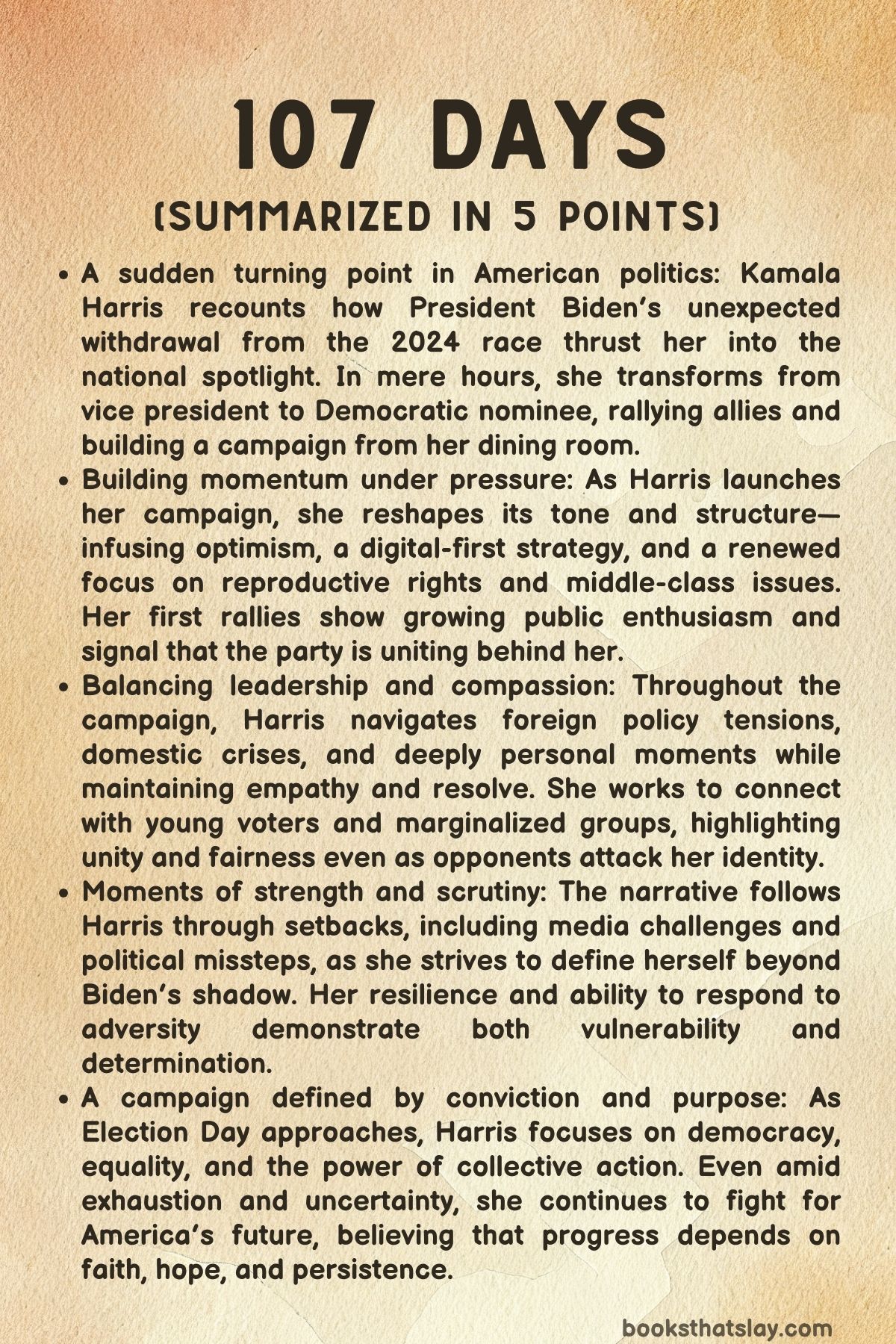
107 Days by Kamala Harris is a fast-moving political memoir about the shortest, strangest kind of presidential race: the one you don’t expect to run until you’re suddenly in it. Beginning with the moment President Joe Biden tells Harris he’s stepping aside, the book follows her through a 107-day sprint from vice president to Democratic nominee to Election Day.
Harris describes the private phone calls, public rallies, strategic missteps, and constant pressure of campaigning while still doing the job. It’s also a personal account of identity, loyalty, leadership, and how modern elections are shaped by media, money, and misinformation.
Summary
In late summer of 2024, Kamala Harris is at the vice president’s residence on an ordinary Sunday—family visiting, breakfast in the kitchen, a puzzle on the table—when her secure phone rings. President Joe Biden tells her he’s dropping out of the presidential race.
He sounds worn down and initially plans to announce his exit right away but wait to endorse her. Harris immediately recognizes the danger: any hesitation could splinter the party and invite chaos.
She pushes him to endorse her at once. The call ends, and her day flips from quiet routine to political emergency.
As word spreads, her home turns into an improvised campaign headquarters. Staff and family rush in, binders and legal pads replacing the breakfast setup.
Harris starts dialing through her contacts, reaching key Democrats and power brokers—former presidents, governors, party leaders—testing support and building unity quickly enough to prevent a vacuum. Some voices are enthusiastic; others are cautious, calculating what a Harris-led ticket could mean.
By night, she has spoken with more than a hundred people. Exhausted, still in casual clothes, she gathers her team for a photo because she wants a marker: this is the beginning of something enormous, and they will need each other.
The book then steps back to the earlier trigger for the crisis: Biden’s debate performance against Donald Trump. Harris watches with growing dread as Biden’s voice sounds weak, his answers drift, and the post-debate reaction turns brutal.
She goes on television and tries to do what she believes the moment requires—defend the administration’s record, point to Trump’s lies, and steady nervous supporters—while knowing the question hovering over everything is whether Biden can still win. She feels trapped by the reality of her role: as vice president, urging him to step aside could look like ambition disguised as concern.
Later, she admits that silence from people closest to Biden, herself included, became dangerous. Loyalty, she suggests, can become a way for institutions to avoid hard truths until the cost is higher.
Once Harris becomes the candidate, she has to transform a campaign built around Biden into something that can carry her story instead. She keeps doing the vice president’s work while also building a national operation at speed.
She flies to Biden’s campaign headquarters to address staff who have been living inside a “Joe”-centered structure, and she asks them to move with her. Money pours in almost instantly, shifting the mood from panic to possibility.
She goes to a swing state rally and introduces a central message: the country doesn’t have to accept a rollback of rights and norms. The phrase “We’re not going back” becomes the campaign’s shorthand for that argument.
Alongside the public moments, Harris includes personal snapshots that show the strain on family life. Doug Emhoff, the second gentleman, tries to shape a useful role in a political world designed for women spouses.
He travels to speak about reproductive rights and what men should understand about them. Harris recounts their relationship, the blended family they built, and the strange choreography of Washington expectations.
In the background is a harder truth: the White House often kept Harris’s work quiet, leaving her vulnerable to caricature. When she succeeds—especially on issues like reproductive rights—some insiders treat it as competition rather than reinforcement.
Harris describes repeatedly having to prove she is “loyal,” even when that loyalty is not returned with the same intensity.
Policy and politics collide constantly. Harris talks about trying to communicate climate urgency while voters are focused on rent, food prices, and daily survival.
She describes campaigning like triage: choosing what can land in people’s minds when time is short. Foreign policy intrudes too.
She meets with Israel’s prime minister and expresses support for Israel’s security while objecting to the scale of civilian suffering in Gaza. Protests follow her events, and she wrestles with how to respond—understanding the moral anger while fearing disengagement in an election she views as existential.
One of her biggest compressed decisions is choosing a running mate. The process that usually takes months must happen in days.
She interviews finalists and studies not only their politics but their character, watching how they treat staff and how they might handle pressure. Josh Shapiro impresses her, but she worries he may not accept a supporting role easily.
Mark Kelly embodies service and credibility, yet she wonders if it’s fair to thrust him into the harshest parts of national politics. Tim Walz stands out as grounded, self-aware, and attentive to people who are usually overlooked.
Harris chooses Walz, believing he will back her without making the partnership a contest.
The campaign’s rhythm becomes relentless: rallies, union meetings, travel, rapid-response messaging. Harris highlights moments of momentum—large crowds, improved polling, cultural energy at major events.
She also describes uglier currents: attacks on her identity, racist and sexist narratives, and efforts to provoke her into a defensive posture. Trump’s comments about her race and background become a recurring attempt to define her as “other.” Harris refuses to perform an identity argument on his terms, insisting that he is trying to bait her into a spectacle instead of a contest about people’s lives.
Harris tries to show governing competence as part of her case. A major prisoner swap comes together, bringing Americans home after complicated international negotiations.
She points to it as proof that alliances can be repaired and diplomacy can work. She also pushes gun violence prevention and reacts to a school shooting with fury and grief, arguing that leaders who speak only about monsters but never about weapons are choosing avoidance over responsibility.
Debate preparation becomes its own ordeal. Harris’s team builds a replica set and hires a stand-in to mimic Trump’s style so she can practice against the interruptions and bullying she expects.
Harris’s goal is not to win on technical detail but to demonstrate steadiness. On debate night, she chooses to walk over, shake Trump’s hand, and introduce herself—an assertion of normal civic behavior in an abnormal moment.
Trump throws out falsehoods and inflammatory stories; Harris counters with practiced lines and controlled anger. When it ends, she feels shocked and depleted, then sees Doug’s reaction and senses she may have cleared a major hurdle.
Afterward, Trump declines another debate, and Harris treats that as both a tactical advantage and a warning: he will fight elsewhere, through messaging and media ecosystem.
In the following weeks, the campaign runs into problems that are harder to fix. Harris gives a major interview that doesn’t land as intended, and she regrets moments where she sounds guarded.
She faces a painful reality of the job: small sound bites can become cages. One TV appearance becomes a gift to her opponents when she says she wouldn’t have changed anything from the Biden years, allowing the Trump campaign to frame her as merely an extension of an unpopular president.
Harris remains loyal to Biden but realizes voters also want separation—an explanation of what she will do differently and why.
As Hurricane Helene hits, Harris shifts into disaster response mode, traveling to damaged communities and overseeing federal action. At the same time, misinformation swarms the storm—conspiracy theories about weather manipulation, lies about FEMA, false claims about money and immigrants.
Harris describes the added burden of governing in an environment where rumor can endanger the very workers trying to help. She also brings in national security meetings, UN diplomacy, and discussions about rules for emerging technologies like AI, underscoring the split-screen reality: campaign promises on one side, real crises on the other.
Late in the race, she sees the impact of well-funded attack ads, particularly on transgender issues. Harris refuses to turn vulnerable people into targets to make politics easier, but she acknowledges the strategic damage of distortions and edited clips.
She seeks opportunities to talk to hostile audiences too, including an interview on Fox News, insisting she is running to represent people who won’t vote for her as well as those who will.
As Election Day approaches, the pace becomes punishing. Harris travels constantly, stacks multiple states into single days, and tries unusual media appearances to reach voters who tune out traditional politics.
The closing argument is a massive event at the Ellipse, deliberately reclaiming a symbolic place linked to January 6. She emphasizes inclusion, expertise, and listening—promising leadership that values disagreement without demonization.
Then a new controversy erupts when Biden’s words are interpreted as insulting Trump’s supporters, forcing Harris to restate her message that she wants to represent everyone.
On Election Day night, Harris expects a close result but believes she still has a path. Her family gathers, staff fill hotel ballrooms with data screens, and plans are made for a speech at Howard University.
Private warning signs appear when Doug and her brother-in-law receive intelligence suggesting Trump may sweep the swing states. Updates arrive in fragments: some losses, then the realization that the map is tightening beyond rescue.
The campaign team begins rewriting a planned optimistic message into something more cautious, then abandons the Howard appearance entirely. Finally, Harris is told there is no path to victory.
She repeats the news in disbelief and fear, asking what will happen to the country.
The next day, she calls Trump to concede. He is unexpectedly polite, even complimentary, and correctly pronounces her name—an irony that stings after months of contempt.
Harris then gives a concession speech designed not to collapse into sorrow but to keep supporters engaged. She comforts Walz’s family and walks onto the stage determined to signal endurance rather than defeat.
Later, as vice president, she presides over the formal certification of the election on January 6, 2025, carrying out the constitutional duty that Trump tried to disrupt in the prior cycle.
In the afterword, Harris argues that the election was decided by a narrow margin and shaped by disinformation, billionaire influence, and disengagement. She notes how many people searched basic questions after voting and describes a country vulnerable to long-planned efforts to weaken democratic norms.
She does not claim satisfaction in being right; instead, she frames the loss as a warning and a call to build something stronger—through education, investment in younger generations, and a renewed commitment to listening. She closes with uncertainty about whether change can still be made from inside existing institutions, but with certainty that the work must continue.
Key People
Kamala Harris
In 107 Days, Kamala Harris stands at the center not only as the narrator but as a leader caught between duty, ambition, loyalty, and conviction. She presents herself as disciplined, intensely prepared, and deeply conscious of history, especially as a Black and South Asian woman navigating spaces where she is often the first of her kind.
Her internal conflict runs throughout the book: she is loyal to President Biden yet increasingly aware of the political reality that his candidacy is faltering. She struggles with whether speaking up sooner would have been courageous or self-serving.
Once she becomes the nominee, her character sharpens under pressure. She is methodical in debate preparation, deliberate in choosing a running mate, and careful about message discipline.
At the same time, she reveals flashes of frustration—over media narratives, over racially coded attacks, over misinformation that spreads faster than truth. Her strength lies in composure and moral clarity; her vulnerability lies in moments when loyalty or caution limits her ability to define herself independently.
By the end, her resilience becomes the defining trait. Even in defeat, she insists on preserving democratic norms, demonstrating that for her, public service is less about personal victory and more about institutional continuity.
Joe Biden
Joe Biden appears as both mentor and complication. He is depicted as experienced, empathetic, and fundamentally decent, yet physically diminished during the campaign.
Harris portrays him as serious and focused in governing spaces, especially in national security discussions, reinforcing her belief in his capability as commander in chief. However, the campaign exposes a different dimension: exhaustion, political miscalculation, and the protective bubble of loyal advisers.
His debate performance triggers the unraveling of the ticket, and his delayed decision to step aside creates a compressed and chaotic transition. Biden’s character is shaped by pride and long-earned authority, which make it difficult for him and his circle to accept political limits.
Harris’s reflections suggest that his insistence on running too long reflects not malice but human ego and attachment to legacy. Even after stepping aside, he remains a complex presence, offering both endorsement and moments of distraction, as when he calls Harris before her debate to discuss rumors.
Ultimately, Biden represents the tension between generational leadership and the difficulty of relinquishing power, embodying both service and stubbornness.
Doug Emhoff
Doug Emhoff is portrayed as loving, protective, and often quietly struggling with the unusual demands of his role. As the first second gentleman, he occupies a space without precedent, navigating expectations traditionally assigned to women.
Harris presents him as emotionally supportive and willing to sacrifice his legal career without resentment. He advocates publicly on reproductive rights and attempts to redefine what political partnership can look like.
Yet he is not idealized. The book includes moments of strain, such as the birthday disagreement that reveals how campaign stress infiltrates personal life.
Doug’s distracted reaction on Election Night shows how deeply he feels the stakes. His arc reflects partnership under siege: he must be strong in public while managing private fear.
Through him, Harris shows the human cost of national politics on families and marriages.
Tim Walz
Tim Walz emerges as a steady, unpretentious counterpart to Harris. She is drawn to his authenticity, his background as a teacher and football coach, and his instinct to notice people who are often overlooked.
Walz is characterized by humility and emotional transparency, especially in moments involving his family. His strength lies in relatability; he connects with rural voters and working families in ways that broaden the ticket’s reach.
However, he also experiences vulnerability, particularly during his debate with J.D. Vance, where he struggles to counter calculated shifts in tone. Harris views him as loyal and free of corrosive ambition, a partner who will not treat the vice presidency as a stepping stone at her expense.
Walz symbolizes grounded Midwestern sensibility and collaborative leadership, reinforcing Harris’s desire for a ticket rooted in shared values rather than personal rivalry.
Donald Trump
Donald Trump functions as both opponent and thematic counterweight. He is portrayed as provocative, unrestrained by factual accuracy, and skilled at commanding attention through spectacle.
Harris emphasizes his use of fear-based rhetoric, racial insinuation, and misinformation as strategic tools. His refusal to engage substantively, coupled with his ability to dominate media cycles, illustrates the asymmetry she faces.
Trump’s character is defined less by introspection and more by instinct; he attacks, disrupts, and reframes narratives without apology. Yet Harris also acknowledges his political instincts, particularly his ability to tap into economic anxiety and cultural resentment.
In the debate, he avoids direct engagement with her presence, symbolizing a broader refusal to legitimize her candidacy. Trump represents volatility and grievance politics, contrasting Harris’s emphasis on stability and institutional respect.
J.D. Vance
J.D. Vance appears as a disciplined surrogate for Trump’s message, especially during the vice presidential debate. Harris initially sees him as driven by malice and pessimism, but he adapts strategically by softening his tone to appear bipartisan.
This calculated shift unsettles Walz and reveals Vance’s political agility. He leverages cultural issues, particularly around gender and identity, as wedge topics, demonstrating a keen awareness of media framing.
Vance’s character highlights the generational evolution of Trump-aligned politics: less chaotic in demeanor than Trump himself but equally committed to the same ideological framework.
Tony West
Tony West, Harris’s brother-in-law, is portrayed as pragmatic and forward-thinking. Even before the crisis, he prepares contingency plans in case Harris must assume greater responsibility, showing foresight and realism about political risk.
He is a behind-the-scenes stabilizer, helping organize early calls and offering strategic advice. Tony embodies cautious preparedness, contrasting with the reactive chaos that defines much of the campaign’s early pivot.
His presence reinforces the importance of trusted family members who operate with professional competence.
Storm Horncastle
Storm Horncastle, the residence manager and social secretary, serves as a quiet but revealing character. Harris trusts her judgment of people, especially during the vice presidential selection process.
By observing how finalists treat Storm, Harris gauges their character. Storm also steps in to repair personal moments, such as helping Doug make amends after Harris’s birthday disappointment.
Though not a political strategist, Storm represents grounded wisdom and emotional intelligence within the often impersonal machinery of national politics.
Benjamin Netanyahu
Benjamin Netanyahu appears in the context of foreign policy tension. Harris depicts him as steadfast in defending Israel’s actions but resistant to acknowledging Palestinian suffering.
Their meetings are marked by polite but firm disagreement. Netanyahu’s character reflects geopolitical calculation and long-term political positioning, particularly his anticipation of a potential Trump return to office.
Through him, Harris underscores the complexity of alliances where shared security interests coexist with moral divergence.
Volodymyr Zelensky
Volodymyr Zelensky is portrayed with respect and admiration. Harris reflects on his transformation from entertainer to wartime leader, highlighting resilience under pressure.
Their interactions reinforce Harris’s belief in international alliances and the defense of democratic nations against aggression. Zelensky’s presence in the narrative symbolizes leadership forged in crisis and the unpredictability of who rises to historic moments.
Liz Cheney
Liz Cheney represents bipartisan defense of democratic norms. Once a prominent Republican, she aligns with Harris not out of ideological alignment but shared concern over the integrity of elections and constitutional governance.
Cheney’s willingness to sacrifice her own political standing underscores a commitment to principle over party. Her presence in the campaign reflects Harris’s attempt to build a coalition that transcends traditional partisan boundaries.
Elon Musk
Elon Musk appears as a powerful external force shaping the election environment. Harris portrays him as emblematic of billionaire influence in modern politics, using wealth and platform control to amplify narratives favorable to Trump.
His role underscores the intersection of technology, money, and political persuasion. Musk is less a personal antagonist than a structural symbol of concentrated power affecting democratic processes.
Themes
Leadership Under Compressed Time
Time in 107 Days is not a neutral backdrop; it is an active force that shapes decisions, compresses judgment, and magnifies consequences. Kamala Harris inherits a presidential campaign with only 107 days before the election, a window so narrow that ordinary processes must be reengineered in real time.
The vice presidential vetting that typically stretches across months is reduced to days. Debate preparation becomes an endurance exercise rather than a gradual refinement.
Messaging must crystallize quickly enough to stabilize donors, volunteers, and voters who are disoriented by a sudden candidate switch.
This theme reveals how leadership changes under pressure. Harris cannot afford prolonged reflection or incremental coalition-building.
Every action carries amplified symbolic weight. A single interview answer becomes a defining narrative.
A delayed endorsement could fracture party unity. A debate performance might reset polling trajectories overnight.
The book suggests that leadership in such moments is less about grand ideological declarations and more about triage, prioritization, and stamina.
Compressed time also exposes fault lines in institutions. The Democratic Party must pivot instantly, media cycles accelerate speculation, and adversaries exploit any hesitation.
Harris frames this period as a stress test not only for herself but for the party apparatus and for democratic processes. Decisions that would ordinarily allow space for dissent or extended consultation instead require decisive clarity.
The speed of events forces her to rely on instinct and a small circle of trusted advisers. In this way, the theme emphasizes how modern politics often denies leaders the luxury of gradual persuasion, demanding rapid coherence in an environment designed for disruption.
Loyalty Versus Political Reality
Loyalty occupies a morally complicated space in the narrative. Harris’s long partnership with President Biden binds her to him personally and politically.
She respects his record and believes in his competence as a governing figure. Yet she also witnesses the mounting doubts after his debate performance.
The tension between supporting him publicly and confronting uncomfortable truths privately becomes one of the book’s central conflicts.
Harris reflects on whether she should have urged him to step aside earlier. She recognizes that advocating for such a move could appear self-serving, especially given that she would be the natural successor.
The risk of seeming ambitious or opportunistic restrains her. This restraint reveals how gender and power shape perceptions of leadership; a male vice president might be interpreted differently in the same scenario.
By the time Biden withdraws, the delay has already narrowed the campaign’s strategic options.
The theme extends beyond personal loyalty to institutional loyalty. Harris describes how she often felt her own accomplishments were downplayed by the White House, yet she continued to defend the administration’s record.
After becoming the nominee, she remains reluctant to criticize Biden directly, even when voters demand differentiation. A single televised comment that she would not have changed anything from his presidency becomes a political liability, underscoring how loyalty can become a rhetorical trap.
Through this tension, the book interrogates a broader question: when does loyalty strengthen a team, and when does it inhibit adaptation? Harris ultimately suggests that loyalty must be balanced with candor.
Without honest reckoning, institutions risk protecting pride at the expense of viability.
Identity, Representation, and Public Scrutiny
Harris’s candidacy carries symbolic weight as the first Black woman and person of South Asian descent to lead a major party ticket. In 107 Days, identity is not treated as abstract representation but as lived experience under constant scrutiny.
Trump’s remarks questioning her racial identity and mocking her name are not incidental insults; they are calculated strategies to cast her as foreign or inauthentic. Harris refuses to center her campaign on rebutting these provocations, aware that doing so would reinforce the framing her opponents seek.
The narrative shows how identity shapes both support and attack. Supporters see in her candidacy a generational shift and a validation of long struggles for inclusion.
Critics attempt to reduce her to stereotypes or question her legitimacy. Harris must navigate these crosscurrents while maintaining message discipline.
She acknowledges the significance of her background in moments such as her convention speech, where she speaks of her parents and her path to public service, yet she resists allowing identity alone to define her candidacy.
The scrutiny extends to gender expectations. Harris notes the persistent judgment around appearance and tone.
Displays of anger risk being labeled as aggression; caution risks being framed as evasiveness. Her refusal to engage in performative defenses of her womanhood or race reflects a strategic choice to keep the campaign focused on policy and governance.
The theme highlights the paradox of representation: symbolic breakthroughs generate hope but also intensify backlash. Harris’s experience illustrates how identity can inspire mobilization while simultaneously inviting intensified attempts at delegitimization.
The campaign becomes a case study in how race and gender continue to shape the boundaries of political discourse.
Democracy and Institutional Fragility
Throughout the book, Harris expresses deep concern about the durability of democratic norms. The election is not presented merely as a partisan contest but as a referendum on institutional guardrails.
The memory of January 6 looms in the background, and her role in certifying the election results after losing reinforces her commitment to constitutional order. Even in defeat, she performs the procedural duties required of her office, emphasizing continuity over grievance.
This theme gains urgency through episodes of misinformation and legal confrontation. Conspiracy theories about hurricanes, edited interview clips, and lawsuits against media organizations illustrate how truth can be destabilized.
Harris portrays a media environment in which distortions spread rapidly, sometimes amplified by wealthy individuals with vast platforms. The settlement of a lawsuit against a news network, leading to resignations in protest, becomes emblematic of pressures on journalistic independence.
Democracy in the narrative appears vulnerable not because of a single event but because of accumulated erosion. Rhetoric that dehumanizes opponents, financial influence that shapes messaging ecosystems, and voter disengagement all contribute to institutional strain.
Harris refuses to frame Trump’s victory as a sweeping mandate, pointing instead to narrow margins and uneven turnout. For her, democracy depends on active participation and informed citizenship, both of which are under threat.
By situating her personal loss within this broader context, Harris transforms the campaign into a meditation on civic responsibility. The theme underscores that elections are not endpoints but tests of collective commitment to rules and norms.
The Power and Peril of Media
Media functions as both conduit and battlefield. Harris must communicate through televised interviews, podcasts, town halls, and debates, each format carrying its own expectations and vulnerabilities.
A well-prepared debate can shift momentum; a poorly framed interview answer can become a persistent liability. The speed at which clips are edited, reframed, and redistributed shapes public perception more than extended policy arguments.
The narrative highlights asymmetry. Trump frequently appears in friendly media environments, reinforcing his base without challenge.
Harris chooses to enter more adversarial spaces, such as interviews on networks that lean conservative, because she believes she is running to represent all Americans. This decision reflects a belief in dialogue but also exposes her to confrontational framing.
Social media emerges as particularly volatile. Conspiracy theories about disaster relief and inflammatory rhetoric about immigrants circulate widely, often detached from fact-checking mechanisms.
Wealthy tech figures amplify narratives that align with their political preferences, blurring the line between private enterprise and civic discourse. Harris portrays this landscape as destabilizing, where perception can outrun reality and misinformation can hinder real-world relief efforts.
The theme underscores a structural challenge in modern campaigns: candidates must perform authenticity and clarity in formats optimized for brevity and controversy. Media is not merely a channel but a shaping force that can elevate, distort, or constrain political identity.
Partnership and Personal Sacrifice
The campaign’s public drama is matched by private strain. Harris’s relationship with Doug Emhoff reveals how national politics reshapes domestic life.
He relinquishes his professional identity to support her career, navigating expectations that were historically designed for women spouses. Their marriage absorbs the stress of travel, scrutiny, and constant public evaluation.
Moments such as the birthday disagreement illustrate how even small missteps are magnified when exhaustion and anxiety are constant companions. Yet these scenes also show resilience.
Doug’s effort to repair the mistake through nightly notes becomes a symbol of sustained partnership under pressure. Family members, including her brother-in-law and extended relatives, play roles in stabilizing her during crises.
This theme extends beyond the couple. Campaign staff sacrifice personal time and privacy, dedicating themselves to an intense, uncertain endeavor.
Election Night’s emotional collapse affects not only Harris but the broader community invested in the outcome. The narrative emphasizes that public leadership is rarely solitary; it rests on networks of emotional labor that are often invisible to voters.
Through these portrayals, the book challenges the myth of the solitary political hero. Leadership emerges as relational, sustained by trust, loyalty, and shared endurance.
Personal sacrifice becomes both the cost and the quiet strength behind public ambition.
Hope, Resilience, and the Refusal to Concede Values
Even after defeat, Harris frames the campaign as part of a longer arc rather than a final verdict. The narrow electoral margins, the turnout disparities, and the influence of misinformation all suggest to her that the outcome does not represent a comprehensive rejection of her vision.
Instead, it reflects structural and cultural forces that require continued engagement.
Her concession speech avoids bitterness. She does not frame the loss as illegitimate but as a call to renewed civic work.
Certifying the election results despite personal disappointment becomes an act of fidelity to democratic principles. In the afterword, she outlines concerns about economic risk and ideological agendas but resists triumphalism.
She insists that citizens must organize, educate, and participate rather than retreat into despair.
Resilience here is not blind optimism. It is a disciplined refusal to abandon core values.
Harris acknowledges uncertainty about whether change can still occur within existing systems, yet she does not advocate withdrawal. Instead, she calls for investment in younger generations, education, and skill development as pathways to a stronger democracy.
This theme situates the narrative within a broader historical continuum. Political campaigns may end in victory or loss, but the work of shaping national direction persists.
Hope becomes less about immediate success and more about sustained commitment to principles that outlast any single election.