A Hymn to Life Summary and Analysis
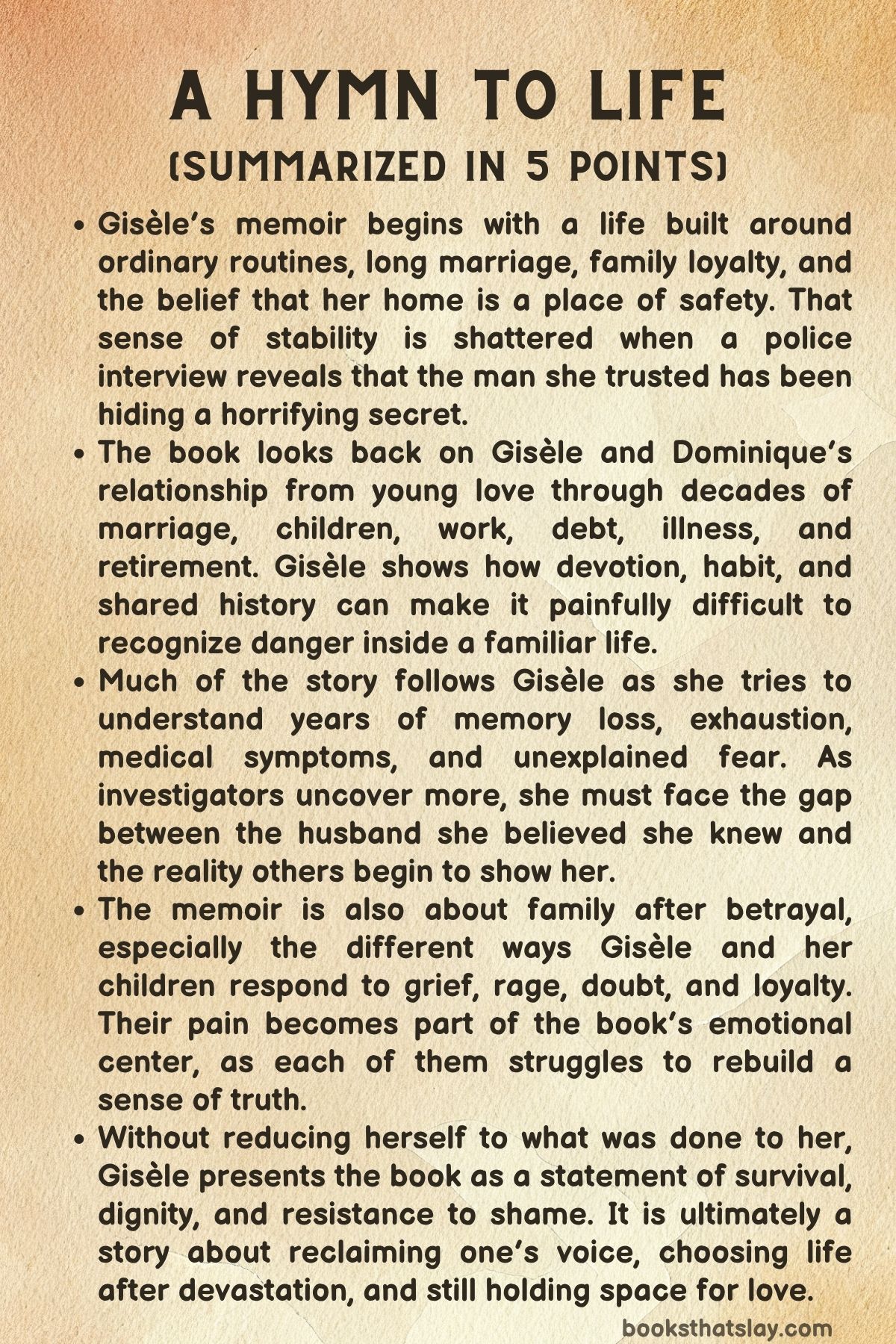
A Hymn to Life by Gisele Pelicot is a memoir of survival, truth, and self-reclamation after an almost unimaginable betrayal. Through Gisèle’s voice, the book traces the collapse of a marriage she had trusted for fifty years, when she learns that her husband, Dominique, had drugged her and arranged for men to rape her while she was unconscious.
Yet the book is not only about violence. It is also about memory, family, justice, and the difficult act of continuing to live. Gisèle presents herself not as a symbol alone, but as a woman determined to remain whole.
Summary
Gisèle begins with a small domestic ritual: setting the breakfast table the night before. For her, this habit brings order, safety, and the promise of morning.
That sense of ordinary life is shattered when she and her husband, Dominique Pelicot, go to the police station in Carpentras. Gisèle believes they are there because Dominique had recently been caught filming under women’s skirts in a supermarket.
He had confessed that incident to her with tears, and although she was disturbed, she had tried to manage the crisis privately. She had told him to apologize, seek therapy, and keep their children from suffering unnecessary pain.
At the station, Gisèle is questioned alone. The officer’s questions unsettle her.
He asks about her marriage, her social life, and whether she and Dominique were swingers. Then he tells her the truth: Dominique has been arrested for aggravated rape and for administering toxic substances.
He shows her photographs of an unconscious woman being raped by different men. Gisèle cannot accept that the woman is her, even though the room is her own bedroom.
The officer explains that many men had entered her home and raped her while she was drugged. Gisèle’s mind cannot absorb what she is hearing.
The book then turns back to her earlier life. Gisèle remembers meeting Dominique in 1971 at her aunt’s house in the countryside.
She was nineteen and still marked by the loss of her mother, Jeanne, who had died of cancer when Gisèle was a child. Her father had never fully recovered from that grief.
Dominique seemed shy and damaged, someone who needed the warmth of her family. They fell in love quickly, became lovers, and married in 1973.
Gisèle believed they could save each other from the wounds of childhood and build a stable life together.
After leaving the police station, Gisèle returns to their house in Mazan, where investigators have searched through everything. She responds by cleaning, washing, tidying, and vacuuming, as though restoring order to the house might restore meaning to her life.
She calls her friend Sylvie, then begins the terrible task of telling her children: Caroline, David, and Florian. Their reactions are immediate and devastating.
Caroline screams, David later vomits, and Florian focuses on whether his mother is safe. That night, the family begins to understand years of strange symptoms: memory gaps, blackouts, exhaustion, unexplained medical fears, and moments Gisèle could not account for.
Police find pills hidden in walking boots, including lorazepam.
When the children come to Mazan, the house becomes a place of grief and rage. Caroline destroys family photographs, paintings, and objects that once represented shared memories.
A nude painting by Dominique, titled “Coercion,” takes on a horrifying new meaning. The family also discovers that Dominique had photographs of Caroline asleep, raising fears that she too may have been harmed.
Gisèle struggles to hold together two realities: the husband and father she thought she had known, and the man revealed by the evidence. Her children see only the criminal.
Gisèle cannot yet erase fifty years of life.
She leaves Mazan for Paris with her children and her dog, Lancôme. Away from the home she had built, she feels displaced and emptied out.
She stays first with Caroline and then with Florian. She undergoes medical tests, meets psychologists and lawyers, and begins divorce proceedings.
Hair analysis confirms heavy drugging. Medical examinations reveal infections and physical harm connected to the assaults, though Gisèle has no memory of them.
She also learns that Dominique continued drugging her and arranging rapes even after he had been caught for voyeurism in the supermarket.
The memoir also examines the long history of the marriage. Gisèle and Dominique had faced debts, job losses, business failures, family pressures, illness, separations, and reconciliations.
They had divorced formally in 1999 for financial reasons but continued living together as a couple. Gisèle worked at EDF and became the steady force in the household, while Dominique moved through unstable jobs and failed ventures.
They raised three children and later became devoted grandparents. Looking back, Gisèle recognizes warning signs: Dominique’s sexual demands, interest in filming, strange moods, pornography searches, and voyeuristic behavior.
At the time, she had not understood what those signs meant.
As the investigation grows, police identify many ordinary men who raped Gisèle while she was unconscious. Some deny rape, some claim she must have consented, and some say they believed she knew what was happening.
The case file reveals that one rapist had HIV, that some men had seen her in daily life, and that Dominique had filmed and photographed the abuse in detail. Gisèle also learns that he had secretly photographed Caroline and his daughters-in-law, created degrading images, and shared material online.
Each new discovery widens the betrayal.
Dominique writes from prison and continues to manipulate those around him. Gisèle even brings him warm clothes, torn between disgust and the remains of attachment.
Her children push her to face the full truth. She insists that she had been happy and that her life cannot be reduced to his crimes.
She refuses to surrender every memory of love, family, and motherhood to the man who violated her trust.
In 2021, the press exposes the case. Gisèle uses a pseudonym and retreats to the Île de Ré, where she lives alone for the first time.
She walks, attends therapy, forms new friendships, and slowly begins to rebuild. She later meets Jean-Loup, a widower whose kindness helps her believe that tenderness and love are still possible.
Yet the investigation continues to bring new shocks. In 2022, police tell her Dominique is suspected in old cases, including the 1991 rape and murder of Sophie Narme and the 1999 attempted rape of another estate agent.
DNA evidence leads Dominique to confess to the attempted rape. Gisèle is forced to reconsider years of his absences, tears, and lies.
As the trial approaches, Gisèle first wants the hearing closed to protect herself and her family. During a walk on the Île de Ré, she changes her mind.
She decides the trial must be public so the shame falls on the accused, not on her. She also wants other women to see that silence can be broken.
This choice requires her to watch selected videos before the trial. She sees herself unconscious, bound, snoring, choking, and being raped.
She tells herself that the body on the screen is not the full truth of who she is.
The trial opens in Avignon in September 2024. Dominique admits to drugging and raping her, but many co-defendants deny responsibility.
Some claim ignorance; others suggest consent. The defence tries to discredit Gisèle by questioning her behavior, her body, her past, and even the language used to describe the crimes.
She listens with anger but keeps control. Videos are shown to contradict the accused.
She often looks away but hears enough to understand the horror.
Outside the court, women gather to support her. They applaud, write letters, and turn the trial into a public challenge to shame and silence.
Her children testify, carrying their own wounds. Caroline remains tormented by unanswered questions about the photographs and the possibility of incest.
The family’s pain does not end with legal truth.
Dominique is sentenced to twenty years in prison. All the accused are convicted of rape, attempted rape, or aggravated sexual assault.
Later, one defendant appeals, but his sentence is increased. The court process closes, though questions remain about Dominique’s possible involvement in older crimes.
Gisèle considers visiting him in prison to ask what he did, why he did it, and whether any part of the man she loved ever truly existed.
In the aftermath, Gisèle understands that her story now belongs to more than herself. Women across the world write to her and recognize in her courage a demand for justice.
She continues to love her children and grandchildren, even as the family remains wounded. She walks, accepts love from Jean-Loup, and refuses to be defined only by violence.
A Hymn to Life ends with Gisèle still alive, still searching for answers, and still determined to believe in love.
Key Figures
Gisèle Pelicot
Gisèle is the central figure of A Hymn to Life, and her character is built around survival, memory, dignity, and the painful reconstruction of truth. At the beginning, she appears as a woman who values order, routine, and emotional security.
Her habit of setting the breakfast table the night before is not just domestic detail; it shows her desire to create safety and light before morning arrives. This makes the revelation at the police station even more devastating, because the world she believed she had carefully protected collapses in an instant.
Gisèle’s first reaction is disbelief, not because she is weak, but because the truth is too violent for the mind to accept all at once. When she refuses to recognize herself in the photographs, the book shows how trauma can divide a person from her own body and memories.
Gisèle is also defined by her long attachment to Dominique and by her refusal to let his crimes erase her entire life. This is one of her most complex qualities.
Her children want her to see Dominique only as a monster, but she struggles because she remembers decades of marriage, parenthood, hardship, reconciliation, and moments of happiness. Her resistance to simplifying the past does not excuse Dominique; instead, it reveals the emotional difficulty of betrayal after fifty years of shared life.
She understands that she was deceived, abused, and violated, but she also insists that she had once experienced love, family, and joy. This makes her character deeply human, because she is not written as a symbol alone.
She is a woman trying to hold together contradictory truths.
As the story develops, Gisèle grows from a shocked victim into a public witness. Her decision to make the trial public is one of the strongest moments in the book.
She chooses not to hide, not to carry shame that belongs to the accused, and not to allow society to treat sexual violence as a private embarrassment. Her courage is not loud or theatrical; it is steady, disciplined, and moral.
Even when the defence tries to humiliate her, question her behaviour, and reduce the crimes to “sex scenes,” she remains composed. Gisèle’s strength lies in her insistence that her unconscious body was not consent, that her life is not reducible to what was done to her, and that speaking publicly can protect other women from silence.
Dominique Pelicot
Dominique is the most disturbing and morally corrupt figure in the book, because his crimes are hidden beneath the appearance of an ordinary husband, father, and grandfather. For decades, Gisèle sees him as wounded, shy, affectionate, troubled, and sometimes unstable, but not as a predator.
This gap between appearance and reality is central to his characterization. He is not presented as a stranger lurking outside family life; he is inside the home, inside the marriage, and inside the memories of those who trusted him.
That makes his betrayal especially horrifying. He turns the private space of the bedroom into a crime scene and uses intimacy, routine, and trust as tools of control.
Dominique’s character is also shaped by manipulation. Even after his arrest, he continues writing from prison and trying to influence family members emotionally.
His tears, apologies, confessions, and gestures often appear less like genuine remorse and more like attempts to preserve some power over the people he has destroyed. His earlier confession about filming under women’s skirts seems, in retrospect, not like an isolated act but like a small visible part of a much larger pattern.
The book gradually reveals that his voyeurism, pornography, filming, drugging, and arranging of assaults are connected by a desire to dominate, possess, and degrade women while avoiding accountability.
The references to Dominique’s childhood add complexity but not absolution. His violent father, damaged family environment, and possible early trauma help explain the brokenness in his background, yet they do not excuse his choices.
The book shows him as someone who may have suffered but who later became an agent of immense suffering. His ability to live a double life for years makes him chilling.
He could help raise children, play the role of a devoted grandfather, and still organize the rape of his unconscious wife. Dominique represents the terrifying possibility that evil can be ordinary in appearance, patient in method, and hidden behind the language of love.
Caroline
Caroline, Gisèle and Dominique’s daughter, is one of the most emotionally wounded characters in the story. Her reaction to the truth is immediate, physical, and furious.
When she screams after hearing what happened to her mother, the response captures not only horror but also the collapse of her entire understanding of her father. Caroline’s destruction of photographs, paintings, and family memories is a symbolic act.
She is not merely breaking objects; she is trying to destroy the false family image that Dominique created and polluted. Her rage is the rage of a daughter who realizes that the home she believed in contained secrets of violence.
Caroline’s pain becomes even more complicated when photographs of her asleep are discovered. This creates a second layer of fear: not only has her mother been violated, but Caroline herself may also have been targeted.
The uncertainty around possible incest becomes one of the most unbearable parts of her character arc. She cannot fully know what happened, and that lack of certainty becomes its own form of torment.
Her testimony and emotional struggle show how sexual violence spreads beyond the direct victim. Dominique’s crimes damage his children’s memories, identities, trust, and sense of bodily safety.
Caroline also functions as a force of confrontation. She pushes Gisèle to see Dominique without the protective haze of old love.
While Gisèle tries to preserve some distinction between the husband she loved and the criminal revealed by the investigation, Caroline finds such distinction almost impossible. For her, the loving father has been annihilated by the predator.
This tension between mother and daughter is painful but understandable. Caroline represents the part of the family that cannot forgive, cannot soften, and cannot bear any sentimental memory of Dominique after the truth.
David
David, Gisèle and Dominique’s son, is portrayed through shock, grief, and bodily revulsion. His vomiting after learning the truth is a powerful sign of how unbearable the revelation is.
He does not simply hear information; his body rejects it. This reaction shows the depth of his emotional trauma.
Like his siblings, David is forced to reinterpret years of family life, his mother’s strange symptoms, and his father’s behaviour through the lens of hidden abuse. The father he thought he knew becomes someone unrecognizable.
David’s character also reflects the helplessness of an adult child facing a parent’s victimization. He cannot undo what happened, cannot protect his mother retroactively, and cannot restore the family’s past.
His suffering comes partly from love: he is devastated because his mother was harmed in the most intimate and sustained way, and because the person responsible was his father. The book uses David to show how crimes committed inside a family create emotional consequences that do not fit neatly into legal categories.
He is not only the son of the victim; he is also the son of the perpetrator, and that double identity becomes a source of anguish.
Although David is less extensively developed than Gisèle or Caroline, his presence matters because he represents the family’s collective collapse. His reaction helps reveal the scale of Dominique’s betrayal.
The abuse was not only an attack on Gisèle’s body; it was also an attack on the family’s shared history. David’s pain shows how the truth forces every child to ask what was real, what was false, and how much of their father’s love can survive the knowledge of what he did.
Florian
Florian, the youngest of Gisèle’s children, is characterized by concern, protectiveness, and emotional shock. His first instinct is practical and urgent: he asks where his mother is and whether she is safe.
This response reveals his immediate need to locate her physically and protect her from further harm. While Caroline’s reaction is explosive and David’s is bodily, Florian’s is focused on safety.
He understands quickly that his mother’s world has become dangerous and unstable, even inside places that once seemed familiar.
Florian also becomes part of Gisèle’s early refuge after she leaves Mazan. Her stay with him shows the reversal of roles caused by trauma.
The mother who once cared for her children now needs shelter, support, and emotional protection from them. Florian’s presence helps show that Gisèle is not entirely alone, even when she feels stripped of her home and identity.
His care becomes part of her first movement away from the crime scene and toward survival.
At the same time, Florian shares in the larger family wound. Like Caroline and David, he must reconsider years of memory lapses, illnesses, and strange incidents that once seemed unexplained.
His character therefore represents the painful process of retrospective understanding. The family begins to connect details only after the truth is revealed, and Florian’s concern helps expose the terrible fact that Dominique’s crimes had been present in their lives long before anyone had the language to name them.
Jean-Loup
Jean-Loup is important because he enters Gisèle’s life after devastation and helps her rediscover tenderness without control. As a widower, he carries his own experience of loss, which allows him to meet Gisèle with gentleness rather than judgment.
His role in the book is not to rescue her, because Gisèle’s recovery belongs to herself. Instead, he represents the possibility that love can exist without domination, secrecy, or violence.
Through him, the story allows room for emotional renewal after horror.
Jean-Loup’s significance lies in the contrast between his gentleness and Dominique’s hidden brutality. Where Dominique used intimacy to conceal abuse, Jean-Loup helps Gisèle experience companionship as something honest and healing.
His presence does not erase her trauma, but it gives her a new way to imagine the future. Gisèle’s willingness to love again shows that she refuses to let Dominique define the meaning of intimacy for the rest of her life.
He also supports one of the central ideas of A Hymn to Life: survival is not only about enduring pain, but also about reclaiming joy, trust, and human connection. Jean-Loup’s character helps move the narrative beyond crime and trial toward life after trauma.
He is a quiet but meaningful figure because he shows that Gisèle’s story does not end with violation. It continues with walking, healing, companionship, and the fragile courage to believe again.
Jeanne
Jeanne, Gisèle’s mother, is a formative presence even though she dies early in Gisèle’s life. Her death from cancer leaves a wound that shapes Gisèle’s childhood and emotional development.
The loss of her mother creates an early experience of absence, grief, and instability. Gisèle grows up marked by this bereavement, and it partly explains her later longing for family warmth, loyalty, and lasting love.
Jeanne’s absence is therefore not empty; it continues to influence Gisèle’s choices and vulnerabilities.
Jeanne also represents the loving maternal world Gisèle loses too soon. Because Gisèle experiences death and grief early, Dominique’s arrival later seems to offer rescue and emotional completion.
Her desire to build a strong marriage and family can be understood partly as a response to the brokenness of her childhood. Jeanne’s death creates a background of sorrow against which Gisèle’s later hope for domestic happiness becomes especially meaningful.
Although Jeanne is not active in the later events, her role deepens the emotional history of the book. She reminds readers that Gisèle was shaped by pain before Dominique’s crimes were revealed.
This matters because Gisèle is not only a victim of one man’s abuse; she is a full person with childhood memories, family losses, work, motherhood, love, and grief. Jeanne helps establish that fullness.
Gisèle’s Father
Gisèle’s father is defined largely through grief, decline, and emotional difficulty after Jeanne’s death. His sorrow affects the atmosphere of Gisèle’s childhood and contributes to the instability she experiences while growing up.
He is a man damaged by loss, and his grief becomes part of the family environment. Through him, the book shows that childhood trauma is not always caused by cruelty; sometimes it comes from absence, mourning, and the inability of adults to recover.
His character also helps explain Gisèle’s hunger for emotional security. Growing up with a grieving father and later a difficult stepmother, she learns how fragile family happiness can be.
This makes her later investment in Dominique and their children more understandable. She wants to build what was broken in her early life.
Her father’s decline therefore becomes part of the emotional foundation of her marriage.
He is not presented as a central actor in the main crime narrative, but he matters because he belongs to Gisèle’s inner history. His grief, limitations, and decline form part of the emotional inheritance she carries.
In this way, he contributes to the book’s broader portrait of how personal history shapes the way people seek love, safety, and belonging.
Michel
Michel, Gisèle’s brother, is another figure associated with vulnerability and sorrow. His depression and early death add to the pattern of loss that surrounds Gisèle’s family background.
Like Jeanne’s death and her father’s decline, Michel’s suffering deepens the sense that Gisèle’s life has long been touched by grief. His presence in the story helps show that she entered adulthood already familiar with emotional pain.
Michel’s depression also reflects the fragility within Gisèle’s original family. He is not merely a background relative; he represents another form of human brokenness that Gisèle has had to witness.
His early death contributes to the emotional burden she carries, and it helps explain why she clings so strongly to the family she later builds with Dominique. After losing members of her first family, the family she creates becomes even more precious to her.
In the structure of the book, Michel’s character strengthens the contrast between ordinary suffering and deliberate cruelty. Illness, depression, and death wound Gisèle, but Dominique’s crimes are different because they involve sustained betrayal and choice.
Michel’s sadness belongs to the tragic fabric of life, while Dominique’s violence belongs to moral corruption. This distinction makes Gisèle’s later insistence on life even more powerful.
Aunt Andrée
Aunt Andrée is significant because her house is where Gisèle first meets Dominique. She is connected to the beginning of the love story, before the truth of Dominique’s crimes is known.
Her home in the countryside carries an atmosphere of family warmth, youth, and possibility. In that setting, Dominique appears shy and wounded, and Gisèle sees him as someone who might be healed by love and belonging.
Aunt Andrée’s role is therefore tied to memory. She belongs to the early part of Gisèle and Dominique’s relationship, when the future still seems open and hopeful.
The meeting at her house becomes painful in retrospect because readers know where the marriage will lead. What once seemed like the beginning of rescue becomes the beginning of a life built beside hidden danger.
Though she is not a major active character, Aunt Andrée helps frame Gisèle’s early emotional world. Her presence reminds us that Gisèle’s love for Dominique did not begin in suspicion.
It began in an ordinary family setting, with youthful hope and the belief that two wounded people could comfort each other. This makes the later betrayal more devastating.
Sylvie
Sylvie is Gisèle’s friend and one of the first people she contacts after the police revelation. Her role is important because she represents the first movement from isolation toward support.
After Gisèle returns to the house in Mazan and tries obsessively to clean and restore normality, calling Sylvie becomes a way of reaching outside the unbearable privacy of shock. Sylvie’s presence shows that friendship can become a lifeline when family reality collapses.
Sylvie also helps emphasize Gisèle’s need to speak. Trauma initially silences and fragments Gisèle, but telling another person begins the process of making the truth real.
The call does not solve anything, but it marks an important emotional step. Gisèle is no longer alone with the images shown by the police.
She has begun to share the burden.
Although Sylvie is not developed as deeply as the family members, her role is meaningful because she belongs to Gisèle’s support network. In a story where trust has been catastrophically violated inside marriage, friendship offers a different kind of human connection.
Sylvie stands for the ordinary but necessary presence of someone who can receive pain without exploiting it.
Deputy Sergeant Perret
Deputy Sergeant Perret plays a crucial role as the person who reveals the truth to Gisèle. His questioning at the police station begins in a way that seems strange and confusing to her, especially when he asks about her marriage, social life, and whether she and Dominique were swingers.
These questions create unease before the full horror is disclosed. Perret’s role is difficult because he must guide Gisèle from ignorance into an almost unimaginable truth.
He functions as a messenger of reality. Until his revelation, Gisèle believes the police visit concerns Dominique’s supermarket voyeurism.
Perret’s explanation completely changes her understanding of her marriage, her body, her memory lapses, and her home. His presence marks the dividing line between Gisèle’s old life and the life that begins after knowledge.
Perret is not emotionally central in the same way as the family characters, but he is structurally important. Through him, the hidden crimes enter language.
The photographs, questions, and legal terms force Gisèle to confront something her mind initially rejects. His character represents the official discovery of truth and the beginning of the legal process that will eventually lead to public reckoning.
Denis Pelicot
Denis Pelicot, Dominique’s father, is presented as violent and damaging. His role helps explain the brutal environment from which Dominique came.
As a father figure, Denis represents inherited violence, fear, and emotional deformation. His presence in Dominique’s childhood suggests that Dominique was shaped by cruelty long before he became a perpetrator himself.
However, Denis’s importance lies in context, not excuse. The book may explore how violence moves through families, but it does not allow Dominique’s background to cancel his responsibility.
Denis helps readers understand that Dominique’s early life contained suffering, yet Dominique later made choices that caused extraordinary harm. The existence of a violent father explains damage but does not justify evil.
Denis also broadens the story beyond one marriage. He places Dominique within a generational pattern of male violence and domination.
Through him, the book suggests that private family brutality can echo across time unless confronted. Denis is therefore a shadow behind Dominique’s character, part of the darkness that shaped him but not the final explanation for what he became.
Juliette Pelicot
Juliette, Dominique’s mother, is associated with suffering inside the Pelicot family. Her character reflects the damage caused by Denis’s violence and the atmosphere of fear within Dominique’s childhood home.
She appears as a woman marked by hardship, and her suffering helps explain the emotional poverty and instability of Dominique’s early life.
Juliette’s role also mirrors, in a distant and tragic way, the theme of women harmed within domestic spaces. Although her experience is different from Gisèle’s, both women are connected to homes where male violence distorts family life.
Juliette’s suffering belongs to the earlier generation, while Gisèle’s violation becomes the central crime of the present story. This parallel adds depth to the book’s exploration of how women endure and survive private forms of domination.
At the same time, Juliette remains more contextual than central. She helps build the background of Dominique’s formation, but she does not determine his actions.
Her character invites compassion for the suffering inside his family without shifting blame away from him. She is part of the tragic history surrounding Dominique, but not the cause of Gisèle’s victimization.
Sophie Narme
Sophie Narme is a haunting figure because her story connects Dominique to violence beyond his marriage. The suspicion that Dominique was involved in her 1991 rape and murder expands the horror of the book.
Gisèle is forced to reconsider not only what happened to her but also what Dominique may have done to other women during the years when she believed she knew him. Sophie’s presence therefore widens the moral darkness around Dominique.
Sophie is important even though she does not appear directly in the living action of the story. She represents the possibility that Dominique’s violence had a longer and broader history than Gisèle initially understood.
Her case forces Gisèle to revisit the 1990s, Dominique’s absences, tears, and lies. What once seemed like personal marital difficulty becomes potentially connected to criminal violence.
As a character in the book’s larger moral landscape, Sophie gives voice to the dead and the unanswered. Her story reminds readers that some victims cannot testify, rebuild, or reclaim public identity.
In contrast to Gisèle, who survives and speaks, Sophie represents the silenced victim whose fate continues to demand truth. Her presence intensifies the need for accountability.
Antoine Camus
Antoine Camus, one of Gisèle’s later lawyers, represents steadier legal support after her dissatisfaction with her first lawyer. His role becomes important as Gisèle moves toward the trial and prepares to face public exposure, hostile defence arguments, and the emotional burden of watching evidence.
He helps guide her through a legal process that is both necessary and traumatic.
Antoine’s importance lies in his professional protection of Gisèle’s dignity. The trial is not only a courtroom event; it is also a battle over language, shame, and interpretation.
The defence attempts to minimize the crimes and question Gisèle, while her legal team helps maintain the truth that rape remains rape even when the victim is unconscious and unable to remember. Antoine’s role supports this moral clarity.
He also contributes to Gisèle’s transformation into a public witness. By preparing her for the coming trial, he helps her face what she has long feared.
His character shows the importance of advocates who understand that legal representation in such a case is not only technical. It is also emotional, ethical, and symbolic.
Stéphane Babonneau
Stéphane Babonneau, working alongside Antoine Camus, is another key figure in Gisèle’s legal journey. He helps prepare her for the trial and for the public nature of the proceedings.
His role is significant because Gisèle’s decision to open the trial requires enormous courage and careful support. The lawyers become part of the structure that allows her to turn private victimization into public testimony.
Stéphane’s character is associated with steadiness and advocacy. In a case where the accused and their lawyers attempt to distort the meaning of the crimes, his role helps protect the truth.
He stands on the side of naming the violence accurately and ensuring that Gisèle’s dignity is not surrendered to the tactics of the defence.
Like Antoine, Stéphane is not central as an emotional character, but he is central to the pursuit of justice. He helps Gisèle move from shock and private grief into the public courtroom where her story becomes larger than herself.
His role reflects the importance of legal allies when a survivor chooses not to hide.
Lancôme
Lancôme, Gisèle’s dog, has a small but emotionally meaningful role. When Gisèle leaves Mazan for Paris with her children and Lancôme, the dog becomes part of what remains of her personal life after everything else has been shattered.
Pets often carry emotional continuity, and Lancôme represents a familiar presence during displacement, fear, and grief.
Lancôme’s importance lies in comfort rather than action. After Gisèle loses the safety of her home, the truth of her marriage, and the stability of her daily routines, the dog remains with her.
This kind of companionship matters in a story filled with betrayal. Lancôme offers a form of attachment untouched by manipulation or cruelty.
The presence of Lancôme also helps humanize Gisèle’s recovery. Survival is not made only of courts, lawyers, evidence, and testimony.
It is also made of ordinary companionship, walking, breathing, and continuing to care for living beings. Lancôme quietly belongs to that gentler side of the story.
Themes
Betrayal Hidden Inside Domestic Trust
The breakfast table, the shared home, the long marriage, and the ordinary habits of family life all become painful symbols of betrayal. Gisèle’s world is not destroyed by a stranger but by the person who was supposed to protect her most closely.
Dominique’s crimes are horrifying because they happen inside spaces associated with safety: the bedroom, the home, the marriage, and the family routine. The betrayal is also psychological, because he does not merely harm her body; he controls what she knows about her own life.
Her memory lapses, exhaustion, illness, and confusion are made to seem like medical problems, while he quietly hides the truth. This makes the betrayal long-lasting, because Gisèle must look back across decades and question what was real.
Yet the analysis of betrayal in A Hymn to Life is not simple. Gisèle refuses to erase all the years of affection, children, work, and shared history.
Her pain comes partly from the fact that love and violence occupied the same life, leaving her to mourn both the husband she believed in and the truth she discovers.
The Theft and Recovery of Selfhood
Gisèle’s body is used while her mind is deliberately removed from the experience, making the central violence not only rape but the theft of personal presence. She is denied memory, consent, speech, and participation in her own reality.
This loss of selfhood is shown most powerfully when she sees photographs and videos of herself but cannot recognize the woman in them as herself. The body on screen has suffered, but Gisèle’s conscious self was forced out of the moment through drugs.
Her recovery begins when she starts reclaiming ownership over the story. Medical tests, legal testimony, therapy, walking, and public speech all become ways of rebuilding a self that Dominique tried to reduce to an object.
She repeatedly insists that she is more than what was done to her. That insistence is crucial because it prevents the crimes from becoming her whole identity.
Her selfhood returns not through forgetting, but through naming the truth while refusing to let it define the full meaning of her life.
Shame, Silence, and Public Truth
The decision to make the trial public turns private suffering into a wider moral challenge. Gisèle understands that silence would protect the comfort of the accused more than the dignity of the victim.
By choosing openness, she reverses the usual direction of shame. Instead of hiding because she was violated, she forces the men who harmed her to face public judgment.
The courtroom becomes a place where language itself is contested. The defence attempts to soften the violence by calling the crimes “sex scenes” or by implying that her unconscious body somehow signified consent.
Gisèle’s presence rejects this distortion. Her calm endurance, anger, and refusal to look away from the truth give other women a model of resistance.
Public truth also exposes how ordinary many of the accused appear, making the case more disturbing. In A Hymn to Life, shame is not treated as something the victim must carry.
It belongs to the people who abused her, denied responsibility, and tried to make violence sound ordinary.
Survival Without Surrendering Love
The memoir’s final movement is not toward easy healing, but toward survival with emotional complexity. Gisèle does not become untouched by trauma, nor does she pretend that justice repairs everything.
Her children remain wounded, Caroline’s fears remain unresolved, and Dominique’s possible earlier crimes leave more questions. Still, Gisèle continues to live.
Walking, friendship, therapy, family bonds, and her relationship with Jean-Loup show that survival is built through repeated acts of choosing life again. What makes this theme powerful is that Gisèle does not reject love simply because love was used as a cover for betrayal.
She separates Dominique’s crimes from the possibility of tenderness itself. This is not naïve forgiveness; it is a refusal to let violence decide the emotional limits of her future.
Her survival also includes solitude. Living alone no longer means emptiness, but strength.
By the end, she remains marked by what happened, yet she is not frozen inside it. She keeps loving, questioning, walking, and living.