A Little Buzzed Summary, Characters and Themes
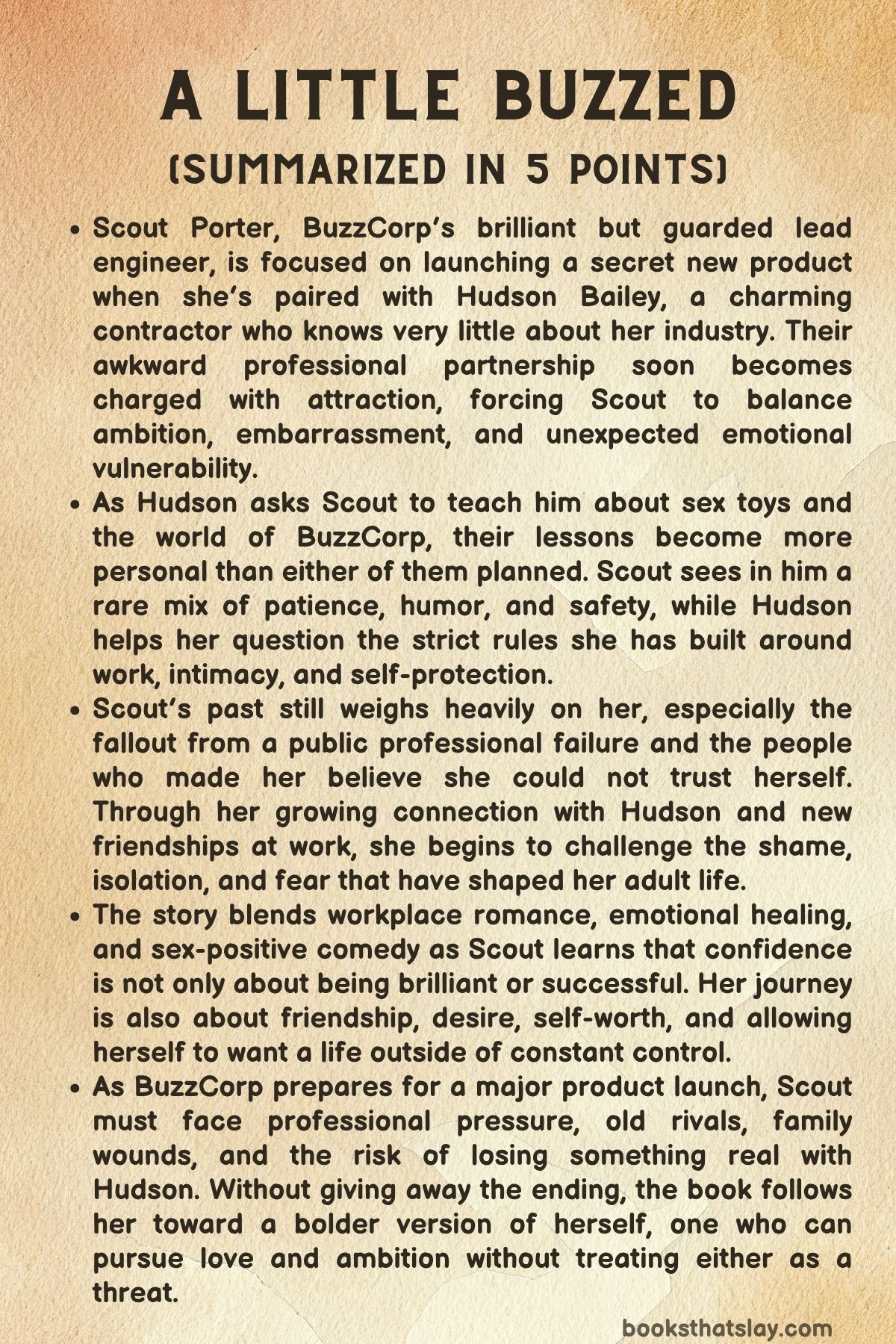
A Little Buzzed by Alys Murray is a contemporary workplace romance about Scout Porter, a brilliant engineer whose life has been shaped by professional pressure, public failure, and emotional isolation. At BuzzCorp, a women-first sex toy company, Scout is focused on launching a major new product when Hudson Bailey, a charming contractor with little industry knowledge, enters her orbit.
Their connection begins as irritation and attraction, then becomes a private arrangement that forces both of them to face shame, desire, ambition, and old wounds. The book blends humor, intimacy, and self-discovery with a story about learning to trust love without giving up oneself.
Summary
Scout Porter is BuzzCorp’s lead engineer, a gifted but guarded woman whose professional life revolves around the company’s secret new product, The Fantasy. When she attends a sex toy convention in Cleveland with Hudson Bailey, a newly hired contractor brought in to help with the product’s software, she is immediately frustrated by him.
Hudson is smart, attractive, and kind, but he knows almost nothing about the sex toy industry. His awkward questions and mistakes make Scout feel exposed and embarrassed, especially because she takes the company’s mission seriously.
Still, he also shows unexpected care. He protects her from unwanted attention, makes sure she eats, and watches her technical presentation with open admiration.
That night, Scout cannot stop thinking about him. She tries to distract herself, but her attraction to Hudson breaks through, leaving her embarrassed and anxious about seeing him again.
The next day, they meet with Ichiro Ose, an important buyer. Hudson’s lack of industry knowledge nearly ruins the meeting, but Scout notices that he has a natural gift with people.
Ichiro suggests BuzzCorp may need a male perspective for The Fantasy, which insults Scout, but Hudson steps in to praise her work and keep the meeting from falling apart. Ichiro refuses to order the product without seeing a prototype and warns them that a new competitor is coming.
At the airport, Hudson feels guilty for hurting the meeting. Scout tries to comfort him, and he asks her to teach him about sex toys so he can be useful.
She refuses at first because she fears distraction. Years earlier, she was connected to a rocket disaster at GalacticSolutions, and she believes personal complications helped destroy her career.
When an airline employee tries to make Scout check a bag containing confidential company data, Hudson pretends to be her boyfriend and takes responsibility for the bag. A vibrator inside starts buzzing, and he calmly claims it as his own, saving her from humiliation.
Grateful, Scout agrees to teach him, but only professionally.
Back at BuzzCorp in Dallas, Scout’s coworkers tease her about Hudson. Jared, a crude coworker, makes suggestive comments, and Scout panics over the possibility of workplace rumors.
Hudson tells her she has never been invisible to him, which unsettles her. Their boss, Clara, encourages Scout to teach Hudson because it will help The Fantasy.
Then Clara reveals that Lloyd Exeter, Scout’s former lover and the man linked to her GalacticSolutions trauma, has bought a rival company. Scout realizes he may be the competitor Ichiro warned them about.
At a team gathering, Jared continues harassing Scout. A TV segment appears showing Lloyd lying about his past with her and implying she caused the rocket disaster.
Humiliated and drunk, Scout blurts out that she never slept with Lloyd because she has never had sex with anyone. Jared loudly exposes that she is a virgin, and Scout flees.
Hudson follows, walks her home, and listens as she explains how being a child prodigy kept her from normal relationships, while the GalacticSolutions scandal made her avoid intimacy altogether. Hudson gently suggests she may be hiding behind work.
After Jared quits because the team refuses to support his behavior, Scout begins to consider changing her life. She decides she wants to lose her virginity, but not with Hudson, since he is her coworker and her crush.
She searches for hookup options online, but Hudson finds her and handles the awkward moment with care. When he asks what kind of man she wants, she describes someone gentle, funny, nerdy, safe, thoughtful, and good with his hands.
The description clearly matches him.
Scout proposes a trade: she will teach Hudson about sex toys, and he will help her lose her virginity. Hudson admits he wants her too.
They agree on rules: one night, no strings, no workplace complications. Their first kiss is intense, but Hudson stops before things go too far in the office because he believes her first time should matter more than that.
The next day, Scout meets Leelah St. James, BuzzCorp’s new hire. Leelah is talented and wounded by her own past, and Scout finds herself opening up.
A friendship begins. Later, Scout gives Hudson his first sex toy lesson, using a full presentation and product display.
As she explains why BuzzCorp’s work matters, the attraction between them grows. They leave for Scout’s apartment, where Hudson gives her a small romantic “emergency virginity loss” jar because she had claimed she was not the type of woman who received romantic gestures.
The gift touches her. Hudson makes her feel wanted, desired, and safe, and they sleep together.
The next morning, Scout panics because the experience meant more than she expected. Hudson asks whether their agreement can change.
She worries about repeating past mistakes, but she admits she wants him. They agree to keep sleeping together until his contract ends, while maintaining secrecy and boundaries.
Scout tells Leelah, who supports her and insists that she and Hudson seem right for each other.
As their arrangement continues, Hudson pushes Scout to talk about who she is beyond work. He notices her kindness, her habits, and the small ways she cares for people.
Their bond deepens through physical exploration and emotional honesty. After a daring night at mini golf, Hudson recreates Scout’s ideal breakfast date, proving how carefully he listens.
Scout begins to see that his kindness is not casual; it is deliberate and generous.
Scout’s parents, Carrie and Bill, arrive unexpectedly and immediately make her feel inadequate. Hudson pretends to be her boyfriend to protect her.
At dinner, they belittle Scout’s job and accuse Hudson of using her. Hudson defends her, saying her work matters and that her parents have failed to see her worth.
Afterward, Scout tries to avoid the pain through emotionless sex, but Hudson stops her, refusing to use or be used by her.
Scout then shows Hudson her secret rocket workshop and tells him the full truth about Lloyd. He pursued her when she was young and inexperienced, then used the failed rocket test to shift blame onto her and protect himself.
Hudson tells her she was manipulated, not responsible, and encourages her to consider returning to aerospace if that is what she wants.
At work, Scout gains confidence. Clara praises her leadership, the team supports her, and The Fantasy nears completion.
Scout also learns that Hudson carries shame from a past relationship in which his desires were mocked. When he trusts her with something vulnerable, she responds with care, and their relationship becomes more balanced.
Scout realizes she may love him, but uncertainty frightens her. She tries to study her feelings scientifically, even using Leelah’s EEG equipment, but eventually understands that she already knows the answer.
As OFest New York approaches, Scout is happier than she has ever been, but she fears Hudson leaving when his contract ends. At the convention, they run into Lloyd and Jared, who taunt her.
Hudson defends her, and Scout stays controlled. Later, she and Hudson share an intimate moment while testing The Fantasy, and he asks her on a real date.
She hopes he will finally confess his feelings.
Then disaster hits: Jared claims he owns a patent on a key part of The Fantasy, threatening the launch. Scout blames herself because she and Hudson may have left the prototype accessible.
Panicked, she breaks up with him, saying romance distracted her from the only thing she is good at. Hudson tells her she runs from anything real because she hates herself.
Their argument ends badly.
Scout throws herself into saving the launch. At dinner with her parents, she finally recognizes how deeply they taught her to doubt herself.
Remembering Hudson’s faith in her, she confronts them and leaves feeling free. She then meets Malcolm McEwan, CEO of SkyTech, and learns more about Hudson’s past.
He was betrayed by his best friend and girlfriend after refusing to let his technology be used for unethical surveillance. Scout understands his fear of abandonment more clearly.
BuzzCorp fixes the prototype problem in time. Before her presentation, Scout confesses everything to Clara, including her relationship with Hudson and her fear of failure.
Clara comforts her and tells her she deserves love. During the launch, a video unexpectedly shows Hudson speaking openly about intimacy, fear, BuzzCorp, and the woman he loves.
His honesty inspires other men to participate, solving the marketing problem. Scout gives a brilliant presentation, then publicly stands up to Lloyd.
When Scout learns Hudson loved her all along but waited because she had asked for stability until OFest, she rushes back to find him. At BuzzCorp headquarters, Hudson is waiting.
Scout confesses her love, apologizes for pushing him away, and says she wants a real life with him. Hudson admits he has always wanted that too, but needed her to be ready.
Two years later, Scout works at SkyTech in Huntsville and is preparing for a major rocket launch she designed. She and Hudson live together with their dog, still deeply in love.
As the rocket lifts off successfully, Scout sees that she has reclaimed both her career and her ability to trust love.
Characters
Scout Porter
Scout Porter is the central character of A Little Buzzed, and her journey is built around fear, control, desire, shame, and emotional recovery. At the beginning of the book, Scout is brilliant, disciplined, and intensely capable, especially as BuzzCorp’s lead engineer.
Her intelligence is never in doubt; she understands technology, product design, and the deeper purpose of sex toys with passion and precision. However, her competence also becomes a shield.
Scout has built her life around work because work feels measurable, logical, and safer than relationships. She believes that if she stays focused enough, quiet enough, and professionally perfect enough, she can avoid repeating the mistakes that once destroyed her confidence.
Scout’s emotional conflict comes from her past at GalacticSolutions and her connection to Lloyd Exeter. She was young, gifted, and vulnerable when Lloyd entered her life, and the disaster that followed taught her to blame herself for things that were far more complicated than personal failure.
This past makes Scout terrified of distraction. To her, romance and desire are not simply personal experiences; they feel dangerous because she associates them with losing control, damaging her career, and being publicly humiliated.
This is why her attraction to Hudson unsettles her so deeply. She does not merely fear wanting him; she fears what wanting him might mean for her identity, her ambition, and her safety.
Scout’s virginity is also important, not because it defines her worth, but because it reveals how much of her life she has spent outside ordinary emotional experience. She was a child prodigy who missed normal romantic milestones, then became an adult who avoided intimacy because shame and fear had hardened around her.
When she decides to lose her virginity, the decision is partly awkward, partly scientific, and partly desperate. She wants to reclaim something that she feels has become symbolic of her isolation.
Yet the book shows that sex itself is not the real solution; what changes Scout is being seen, respected, and cared for by someone who does not reduce her to her body, her mistakes, or her usefulness.
Her relationship with Hudson forces her to confront the limits of her self-protection. At first, she tries to turn intimacy into a controlled arrangement with rules, boundaries, and an expiration date.
She wants desire without vulnerability and pleasure without emotional consequence. But Hudson’s tenderness, patience, and attentiveness make that impossible.
He notices the small things about her, encourages her to think beyond work, protects her without patronizing her, and challenges the self-hatred she has accepted as truth. Through him, Scout begins to understand that love is not the same as distraction and that being cared for does not make her weak.
Scout’s growth is also visible in her friendships and professional leadership. She begins the story isolated, trying to remain invisible at work, but gradually learns to accept support from Clara, Addie, Leelah, and the BuzzCorp team.
She becomes a stronger leader not by becoming colder or more perfect, but by delegating, trusting others, and allowing herself to belong. Her confrontation with her parents is one of her most important turning points because she finally recognizes that some of her harshest inner beliefs were taught to her by people who should have loved her better.
By the end of the book, Scout has not abandoned ambition; instead, she has reclaimed it. Her move to SkyTech shows that she can return to aerospace without being ruled by fear, and her life with Hudson shows that professional fulfillment and emotional happiness can coexist.
Hudson Bailey
Hudson Bailey begins the book as an outsider to BuzzCorp’s world. He is technically skilled and intelligent, but he knows very little about the sex toy industry, which makes him frustrating to Scout at first.
His awkwardness at the convention creates embarrassment, especially because Scout takes the industry seriously and understands how easily it can be dismissed or misunderstood. Yet Hudson’s ignorance is never presented as cruelty.
He is inexperienced, not judgmental, and one of his defining qualities is his willingness to learn. When he realizes he is out of his depth, he asks Scout to teach him instead of pretending he already knows everything.
Hudson’s warmth is central to his character. He is gentle, observant, funny, and deeply attentive.
He brings Scout snacks, protects her from unwanted attention, watches her with admiration, and pays attention to details that other people overlook. His habit of writing down facts about people he cares for reveals that his kindness is deliberate rather than accidental.
He wants people to feel remembered. This trait makes him especially meaningful to Scout, who has spent much of her life feeling misunderstood, judged, or invisible.
Hudson sees her not only as brilliant but also as kind, lonely, wounded, desirable, and worthy of tenderness.
However, Hudson is not simply a perfect romantic figure. He carries his own history of betrayal and shame.
His past involving his company, his best friend, and his girlfriend shows that he has also been punished for doing the right thing. He refused to let technology be used for unethical surveillance, and as a result, he lost both professional stability and personal trust.
This helps explain why he is careful, people-pleasing, and sometimes hesitant to state his deepest wants. He fears abandonment and rejection, just as Scout fears distraction and failure.
Their romance works because both of them are wounded, but in different ways.
Hudson’s sexuality is portrayed with vulnerability. Although he is confident in many social situations, he has shame connected to his desires because an ex once mocked him.
His confession to Scout about his kink is one of the moments that deepens their relationship beyond physical attraction. He trusts her enough to reveal something private, and her acceptance allows him to feel safe in return.
This makes their intimacy mutual. Hudson is not only the person who helps Scout discover what she wants; he is also someone who needs to be accepted, protected, and loved.
His greatest strength is his emotional courage, though that courage develops slowly. He defends Scout fiercely against her parents and Lloyd, but he also learns that love requires more than protection.
It requires honesty. His video confession during the launch becomes a public act of vulnerability, where he speaks about intimacy, fear, shame, and love in a way that helps solve BuzzCorp’s marketing problem while also reaching Scout emotionally.
By the end of the book, Hudson proves that his love is patient but not passive. He waits for Scout to be ready, but he also refuses to let her continue hurting herself without challenge.
Clara
Clara is Scout’s boss, mentor, and one of the most emotionally grounding figures in the story. She leads BuzzCorp with confidence, humor, and practicality, but her role goes far beyond workplace authority.
She understands Scout’s brilliance and trusts her leadership, yet she also sees the parts of Scout that are exhausted, lonely, and afraid. Clara’s presence gives the book a strong sense of chosen family, especially because Scout’s biological parents fail to provide warmth or support.
As a boss, Clara is direct and strategic. She knows The Fantasy matters to BuzzCorp, and she recognizes that Hudson’s male perspective could be useful without reducing Scout’s expertise.
She encourages Scout to teach Hudson because she understands that product development requires collaboration, even when Scout would rather stay guarded. Clara also handles workplace toxicity firmly.
Jared’s behavior is not excused or normalized, and after he leaves, the office becomes visibly kinder. This shows Clara’s importance as a leader who protects the culture of BuzzCorp as much as its business goals.
Clara also becomes a maternal figure for Scout. Her love is not sentimental in a shallow way; it is active, corrective, and protective.
She tells Scout hard truths when necessary, especially about being closed off and punishing herself. At the same time, she reassures Scout that her virginity, her past, and her mistakes do not diminish her value.
Near the end, when Scout confesses her relationship with Hudson and her fear of failure, Clara responds with compassion rather than judgment. Her statement that she has loved Scout like a daughter is especially powerful because it gives Scout the kind of unconditional affirmation she never receives from Carrie and Bill.
Clara’s importance lies in how she helps Scout separate accountability from self-hatred. She does not tell Scout that work does not matter; she knows it does.
But she also teaches Scout that professional excellence cannot replace a full life. Clara believes in Scout’s talent, but more importantly, she believes Scout deserves happiness.
In the book, Clara represents healthy authority: someone who leads, protects, challenges, and loves without trying to control.
Lloyd Exeter
Lloyd Exeter is one of the main antagonistic forces in the book, and his role is rooted in manipulation, ego, and public cruelty. He is connected to Scout’s trauma at GalacticSolutions, where he pursued her when she was young, inexperienced, and emotionally vulnerable.
Their relationship was not simply a failed romance; it became a weapon used against Scout after the rocket disaster. Lloyd’s behavior shows how powerful people can twist narratives to protect themselves while placing blame on someone with less social and institutional power.
Lloyd’s cruelty is especially damaging because he attacks both Scout’s professional reputation and her private dignity. His public comments about supposedly sleeping with her are not just lies; they are attempts to humiliate her and define her through sexual gossip.
He understands that Scout already carries shame, and he exploits that shame. His appearance as the head of a competing company makes him a threat not only to BuzzCorp’s launch but also to Scout’s emotional stability.
He brings the past directly into her present, forcing her to face the fear she has tried to outrun.
As a character, Lloyd represents the false authority that once shaped Scout’s self-image. He wants her to feel small, guilty, and unstable because that version of Scout is easier to control.
His taunts at OFest reveal that he still depends on intimidation and reputation rather than genuine moral strength. Yet his power weakens as Scout grows.
The more Scout accepts the truth about what happened to her, the less effective Lloyd becomes. Her eventual public insult of him is not merely a funny moment of revenge; it is a symbolic rejection of the story he forced onto her.
Lloyd is important because he clarifies the difference between desire and exploitation. Where Hudson’s attraction to Scout is based on care, patience, and consent, Lloyd’s interest in her was tied to power and self-protection.
The contrast helps the book show why Scout’s healing is not about forgetting the past, but about understanding it accurately. Lloyd harmed her, but he does not get to define the rest of her life.
Jared
Jared is a workplace antagonist whose behavior exposes the casual sexism and cruelty Scout has tried to avoid by staying invisible. He makes suggestive comments, humiliates Scout after her drunken confession, and later becomes connected to the crisis involving the patent claim against The Fantasy.
His role in the story is not emotionally complex in the same way as Scout or Hudson, but he is important because he embodies the kind of everyday hostility that makes workplaces unsafe for women, especially women who are already trying not to be noticed.
Jared’s harassment matters because it shows why Scout has learned to protect herself through silence and distance. She is not simply socially awkward for no reason; she exists in an environment where one careless revelation can become gossip, mockery, or professional vulnerability.
When Jared loudly exposes her virginity, he turns a painful private confession into public entertainment. That moment deepens Scout’s humiliation, but it also reveals the character of the people around her.
The team’s refusal to support Jared afterward becomes a turning point in the office culture.
His later patent claim raises the stakes from personal misconduct to professional sabotage. Whether motivated by resentment, opportunism, or ego, Jared becomes a threat to the product Scout has poured herself into.
This crisis briefly confirms Scout’s worst fear: that intimacy with Hudson distracted her and endangered her work. But the team’s successful response also proves something more important.
Scout is not alone, and one man’s sabotage cannot erase the collective strength she has helped build.
Jared functions as a contrast to Hudson. Both are men in Scout’s professional world, but Jared objectifies and embarrasses, while Hudson listens and protects.
Jared uses vulnerability as ammunition; Hudson treats it as something sacred. Through Jared, the book shows what Scout has reason to fear.
Through the team’s rejection of him, it also shows that toxic behavior can be challenged rather than tolerated.
Leelah St. James
Leelah St. James enters the book as Jared’s replacement, and her arrival marks an important shift in Scout’s social world. She is intelligent, energetic, and emotionally open, but she is also recovering from her own professional and romantic betrayal.
Her medtech startup collapsed because of her ex-boyfriend’s embezzlement, which means she understands what it is like to have ambition damaged by someone close. This shared experience helps her connect with Scout, even though their personalities are different.
Leelah’s friendship with Scout is significant because she gives Scout a safe place to be honest. Scout has spent much of her life hiding embarrassing or painful truths, but with Leelah she begins to experience the relief of being known without being judged.
When Leelah discovers Scout’s relationship with Hudson, she reacts with excitement and support rather than condemnation. This matters because Scout expects exposure to lead to shame.
Leelah helps teach her that vulnerability can also lead to closeness.
Leelah also brings humor and liveliness into the story. Her involvement in the EEG experiment reflects both her scientific ability and her willingness to participate in Scout’s strange, anxious attempts to understand love through data.
She does not mock Scout for trying to measure emotion; instead, she joins the experiment, making the situation both funny and affectionate. Her presence softens Scout’s isolation and helps create the feeling that BuzzCorp is becoming not just a workplace, but a community.
As a character, Leelah represents the possibility of friendship after failure. She has been hurt, but she is not closed off in the same way Scout is.
Her warmth encourages Scout to imagine a life where she can have friends, secrets, jokes, and emotional support. In the book, Leelah is part of Scout’s recovery because she helps Scout practice trust outside romance.
Addie
Addie is one of Scout’s coworkers and later becomes an important friend. At first, she appears as part of the BuzzCorp team that teases Scout and reacts to the tension between Scout and Hudson.
However, Addie’s role becomes more meaningful as the story develops. She is socially perceptive, emotionally expressive, and willing to push Scout toward a fuller life.
Her drunken encouragement for Scout to make friends and live outside work may come in a messy moment, but it contains real truth.
Addie helps show Scout that connection does not always have to be formal, controlled, or earned through usefulness. She brings a casual warmth that Scout is not used to receiving.
Along with Leelah, Addie becomes part of the friendship circle that allows Scout to talk about Hudson, love, sex, and fear in a way she previously would have avoided. Her support helps normalize Scout’s desires and mistakes, making them feel less catastrophic.
Addie’s presence also strengthens the portrayal of BuzzCorp as a women-centered environment where professional collaboration and emotional care overlap. She is not merely comic relief; she contributes to the sense that Scout is surrounded by people who want her to succeed as a person, not only as an engineer.
When Scout begins growing more confident, Addie is part of the social foundation that makes that growth possible.
In the book, Addie represents the everyday warmth of friendship. She does not carry the same dramatic weight as Hudson, Clara, or Lloyd, but she is essential to Scout’s movement away from isolation.
Through Addie, Scout learns that being known by others does not always lead to humiliation. Sometimes it leads to laughter, loyalty, and belonging.
Ichiro Ose
Ichiro Ose is an important buyer whose meeting with Scout and Hudson becomes an early professional test. He is direct, observant, and difficult to impress.
His refusal to place an order without seeing The Fantasy raises the stakes for BuzzCorp and reminds Scout that talent alone does not guarantee success. He also warns them about new competition in the industry, which foreshadows Lloyd’s return as a professional threat.
Ichiro’s conversation with Scout is uncomfortable because he suggests that BuzzCorp’s women-first brand may need a male perspective. Scout experiences this as an insult, especially because she has dedicated herself to designing products that center women’s pleasure and autonomy.
Yet the scene is more complicated than simple dismissal. Ichiro notices something useful in Hudson’s ability to charm, connect, and translate ideas for different audiences.
This becomes important later when the team must figure out how to market The Fantasy to men without betraying the company’s values.
Ichiro functions as a business realist in the story. He does not exist to comfort Scout or validate her immediately.
Instead, he forces her and BuzzCorp to confront the market beyond their own internal confidence. His skepticism contributes to Scout’s pressure, but it also pushes the team toward a stronger launch strategy.
In that sense, Ichiro is not a villain; he is a demanding external figure who exposes weaknesses that must be addressed.
Carrie Porter
Carrie Porter, Scout’s mother, is one of the most emotionally damaging figures in Scout’s life. She is cold, critical, and condescending, and her interactions with Scout reveal years of emotional invalidation.
Rather than celebrating Scout’s brilliance or supporting her growth, Carrie makes Scout feel inadequate, childish, and foolish. Her cruelty is not always explosive; often, it appears through belittling remarks, dismissive assumptions, and the steady refusal to see Scout as a whole person.
Carrie’s treatment of Scout helps explain why Scout struggles so deeply with self-worth. Scout’s belief that she must be perfect, invisible, and useful did not come from nowhere.
It was reinforced by parents who valued achievement while withholding tenderness. Carrie’s criticism of BuzzCorp, Hudson, and Scout’s choices reveals that she does not understand or respect the life Scout has built.
She treats Scout’s career in sex technology as embarrassing or lesser, even though Scout’s work is meaningful, innovative, and successful.
The dinner scenes with Carrie are especially important because they show Scout being pulled back into an old emotional role. Around her parents, Scout becomes smaller, more defensive, and more ashamed.
Hudson’s defense of her helps interrupt this pattern, but Scout’s true growth comes when she finally confronts her parents herself. By telling them how much they damaged her, Scout rejects the authority Carrie has held over her inner life.
Carrie represents conditional love distorted into control. She may be Scout’s mother, but she does not provide the safety that Clara, Hudson, and Scout’s friends eventually offer.
In the book, Carrie’s role is to show that family can be a source of harm and that healing sometimes requires naming that harm directly.
Bill Porter
Bill Porter, Scout’s father, works alongside Carrie as part of the emotional pressure that has shaped Scout’s self-hatred. He is dismissive and judgmental, and although Carrie may often feel more sharply critical, Bill contributes to the same atmosphere of coldness.
He does not protect Scout from Carrie’s cruelty, nor does he offer warmth of his own. Instead, he reinforces the idea that Scout’s choices, career, and relationship are disappointing or foolish.
Bill’s attitude toward Hudson and BuzzCorp reveals his narrow understanding of success and worth. He fails to recognize the intelligence and purpose behind Scout’s work, and he assumes the worst about Hudson.
By implying that Hudson may be using Scout professionally, he shows how little faith he has in Scout’s judgment. This is deeply painful because Scout already fears that desire makes her naïve or vulnerable.
Bill’s comments press directly on that wound.
As a father, Bill’s failure is emotional absence disguised as authority. He participates in the belittling of his daughter rather than seeing her clearly.
His presence at dinner helps create the environment that pushes Hudson to defend Scout and later pushes Scout to confront the deeper roots of her self-loathing. Bill is not as theatrically cruel as Lloyd, but his harm is intimate and long-term.
In the book, Bill represents the quiet damage caused by parents who refuse to nurture. His relationship with Scout shows that intelligence and achievement cannot protect a child from the pain of not being loved well.
Scout’s eventual rejection of his judgment is part of her liberation.
Malcolm McEwan
Malcolm McEwan, the CEO of SkyTech, plays a smaller but crucial role in Scout’s professional rebirth. Hudson gives Scout his contact information because he wants her to consider returning to aerospace if that is what would make her happy.
Malcolm therefore becomes associated with possibility. He represents a path back to the field Scout once loved but believed she had lost forever.
When Scout meets Malcolm, he gives her important insight into Hudson’s past. Through him, Scout learns that Hudson was pushed out of his company after refusing to let security technology be used for unethical surveillance.
This revelation helps Scout understand Hudson more fully. She sees that he, too, has suffered betrayal and professional loss after trying to act with integrity.
Malcolm’s information deepens Hudson’s character while also helping Scout recognize the parallels between their wounds.
Malcolm also sees Scout’s engineering talent. His meeting with her is not merely a plot device; it validates that Scout’s aerospace abilities are still alive.
She is not permanently defined by GalacticSolutions or Lloyd’s accusations. Her insight impresses him, and this opens the door to her future at SkyTech.
By the epilogue, Scout’s work there confirms that Malcolm’s role was part of her return to a larger dream.
In the story, Malcolm represents professional renewal. He is connected to the world Scout feared she could never reenter, and his presence helps prove that her past did not destroy her talent.
He gives her a bridge back to the sky.
Themes
Self-Worth Beyond Achievement
Scout’s sense of identity has been built almost entirely around intelligence, discipline, and professional usefulness. Because she was treated as exceptional from a young age, she never developed a steady belief that she could be valued simply as a person.
Her past failure at GalacticSolutions makes this worse, convincing her that any emotional need or personal desire is dangerous because it might distract her and lead to disaster. In A Little Buzzed, her journey shows how damaging it can be when someone measures their worth only through success.
Hudson challenges this belief by noticing her kindness, humor, care, and vulnerability rather than only her technical skill. Clara, Leelah, and Addie also help Scout see that being loved, supported, and accepted does not make her weaker.
By the end, Scout does not abandon ambition; instead, she learns that achievement becomes healthier when it grows from confidence rather than fear. Her professional success matters, but it no longer has to be her only proof that she deserves respect.
Healing From Shame and Past Manipulation
Scout’s fear is rooted in shame that was placed on her by people who used her vulnerability against her. Lloyd manipulated her trust, turned a professional failure into a personal attack, and helped create the public story that she was reckless and responsible.
Her parents deepen this wound by treating her as naïve, disappointing, and emotionally incapable. As a result, Scout begins to believe that her own desires are unsafe and that she must remain controlled at all times.
The emotional power of the story comes from watching her slowly question that false version of herself. Hudson’s role is important because he does not simply comfort her; he names the unfairness of what happened and refuses to let her accept blame that does not belong to her.
Scout’s healing is not instant. She still panics, pushes love away, and blames herself when problems arise.
However, her final confrontation with her parents and Lloyd shows that recovery begins when she stops accepting other people’s lies as truth.
Love as Safety, Choice, and Courage
The romance between Scout and Hudson begins with attraction and a practical arrangement, but it becomes meaningful because it creates emotional safety. Scout initially wants sex to be a controlled experiment: limited, private, temporary, and free of consequences.
This reflects her larger fear of uncertainty. Hudson, however, keeps asking what she actually wants, not just what she can justify logically.
He gives her room to choose, stops when she is using intimacy to avoid pain, and shares his own fears instead of pretending to be perfectly confident. Their relationship becomes a space where both characters can be honest about shame, desire, and past hurt.
Love is not shown as a distraction from Scout’s life but as something that asks her to be braver within it. In A Little Buzzed, love matters because it does not rescue Scout from responsibility; it helps her face herself without punishment.
By choosing Hudson openly, Scout also chooses a life where tenderness and ambition can exist together.
Reclaiming Desire and Personal Freedom
Scout’s sexual awakening is not only about losing her virginity; it is about reclaiming ownership of her body, choices, and wants. At first, she treats desire as a problem to solve because she is embarrassed by inexperience and afraid of being judged.
Her work at BuzzCorp gives her intellectual confidence around sexuality, yet she struggles to apply that acceptance to herself. This contrast makes her development more layered: she can defend pleasure as meaningful for others while still feeling unworthy of it personally.
Hudson’s patience helps her separate genuine desire from panic, performance, or self-punishment. The sex toy lessons, their experiments, and their honest conversations all become ways for Scout to learn that pleasure does not make her foolish or less serious.
Her growing friendships with Leelah and Addie also support this freedom, giving her a world beyond isolation. By the end, Scout’s desire is no longer something hidden or feared.
It becomes part of a fuller life where she can want love, friendship, work, and joy without apology.