A Practical Guide to Dating a Demon Summary, Characters and Themes
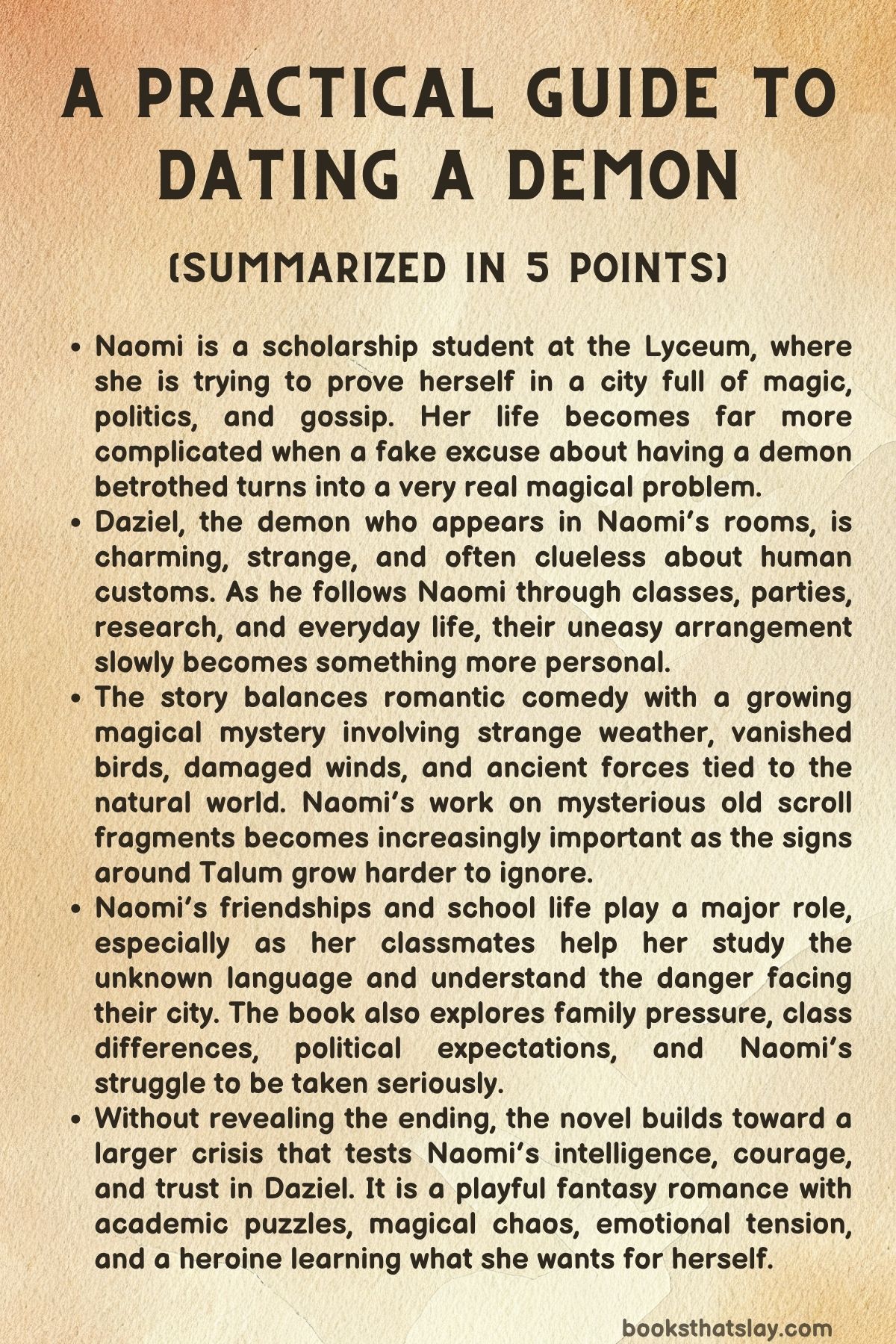
A Practical Guide to Dating a Demon by Hannah Reynolds is a romantic fantasy about Naomi, a scholarship student whose small lie creates a very real magical problem. After claiming she is betrothed to a demon named Daziel, Naomi accidentally brings him into her life, complete with charm, secrets, and an inconvenient magical bond.
The story mixes school life, city politics, ancient languages, strange weather, and a slow-burn romance. Beneath its playful premise is a larger crisis involving the Great Beasts who shape natural magic, forcing Naomi to balance scholarship, trust, love, and responsibility.
Summary
Naomi bat Yardena is a scholarship student at the Lyceum in Talum, a city shaped by wind, magic, class divisions, and political rumor. She comes from a rural plains village and is still trying to prove herself among wealthier and more confident students.
At home, Naomi had been exceptional; at the Lyceum, she often feels ordinary. Her connection to her aunt Tirtzah, a powerful member of the Great Sanhedrin, also draws unwanted attention from boys who want access to political influence.
To stop their invitations, Naomi invents a lie: she says she is already betrothed to a jealous demon named Daziel.
The lie becomes real when Naomi returns to her rooms and finds an actual shayd, Daziel, waiting for her. He acts as though their betrothal is genuine, calls her darling, and refuses to leave.
Naomi tries protective songs, a shofar, tricks, and help from her floormates, but nothing removes him. Daziel gives her a pomegranate, and when she accepts it, she unknowingly confirms part of a demon betrothal.
Her protective red string also disappears, a sign that she may have met her future spouse.
Daziel begins following Naomi through Talum and the Lyceum. He is curious, dramatic, and deeply unfamiliar with human customs, which leads to embarrassing incidents, such as trying to leave a bakery without paying or offering strange magical objects as currency.
Naomi is frustrated, but she also sees that he is not cruel. He is young, bored with his life, and eager to explore the human city.
Their arrangement becomes uneasy but practical: he will stay with Naomi for now, help her avoid suitors, assist with chores, and tutor her, while she tries to figure out how to end the betrothal.
At the same time, Talum is troubled by strange changes in natural magic. Birds flee the city in enormous numbers, winds behave unpredictably, rain falls in odd patterns, and the seasons seem wrong.
Naomi’s friend Leah worries that the chaotic winds may damage her family’s silk harvest. Daziel explains that shedim do not control natural magic; the primordial beasts do.
The Ziz rules the birds and winds, the Leviathan is tied to waters, and the Behemoth to the earth. These disturbances suggest something much larger than bad weather.
Naomi spends much of her time in the Keep, working with Professor Altschuler and a small group of students on damaged ancient scroll fragments written in an unknown Language X. Daziel is fascinated by her dedication, though the professor initially refuses to let a demon near the confidential work. Naomi’s progress is slow until Daziel’s way of thinking helps her consider the fragments differently.
He shows her how he can encourage objects toward the forms they “want,” and Naomi realizes the parchment fragments might be restored not as scrolls but by awakening their memory as calfskin. She develops a new spell, and after collaboration with Yael, Gidon, and Stefan, the fragments are restored into complete scrolls.
The restored scrolls become the center of intense study. Naomi’s team begins cataloging words and symbols, searching for a key to the language.
They realize that a proper noun that has remained unchanged for thousands of years could unlock sounds. Daziel suggests looking for visible patterns, and Naomi thinks of “Ziz,” a three-letter palindrome.
The group finds a matching repeated word in the scrolls, giving them a major breakthrough. Their discovery brings celebration and a growing sense that the scrolls may hold answers to the crisis affecting Talum.
As Naomi and Daziel spend more time together, their relationship shifts. He attends political parties with her, sometimes against her wishes, but later apologizes and tries to do better.
He helps her manage Society Hill gatherings, dances with her, makes pancakes after upsetting her, and gives her a handmade scarf during the Lumière Festival. Naomi begins to see his loneliness and kindness, while Daziel becomes more attached to her life and friends.
Their connection deepens, though Naomi remains wary because the betrothal began through confusion and magical accident.
The dangers in Talum intensify during a party at the Rocks, a hidden beach on the southern coast. A violent storm strikes without warning, breaking a floating bridge and stranding students, including Birra.
Naomi begs Daziel to help. He warns that it is dangerous, but he finally agrees.
Away from the others, he reveals wings and uses a blood-magic binding with Naomi, giving her access to his power while she supplies human precision. Through painful and overwhelming magic, Naomi calms the water and creates a glasslike bridge, saving the stranded students.
The rescue changes everything. Officials arrive the next morning and take Daziel before the Sanhedrin, calling him “Lord Daziel.” Naomi goes to Aunt Tirtzah for help and learns that the council suspects Daziel is not a wild shayd but a high shayd, a far more powerful being whose hidden presence could violate treaties and threaten negotiations.
Naomi testifies that he saved lives, and the Sanhedrin releases him into Tirtzah’s custody. In the carriage afterward, Daziel’s reaction reveals the truth: he has been lying about who he is.
Naomi confronts him. Daziel admits he is a high shayd and that he had a reason for staying near her.
His real name is Cathmeus, and he used Naomi’s accidental betrothal claim as a way to reach the scroll project. He believes the scrolls contain knowledge about how to cure the Ziz, which may be sick or injured.
The failing winds, vanished birds, strange waters, and trembling earth all suggest that the Great Beasts are weakening. Naomi is hurt by his deception, but she understands that the stakes are enormous.
Naomi, Daziel, and the other students tell Professor Altschuler, the Lyceum president, and eventually the Sanhedrin. The council debates funding the translation, questions Daziel’s trustworthiness, and refuses to search for the Ziz until the spell is translated.
Then an earthquake strikes Talum, confirming that the crisis reaches beyond wind. Naomi and her friends form their own search council, gathering information about the Ziz from sailors, rabbis, wind patterns, bird movements, maps, and ancient texts.
Daziel path-jumps to Sorae and brings back a trunk of old scrolls from a preserved ship library. These texts include recognizable words and what appears to be a navigator’s handbook.
With help from Gilli, whose family knows sailing traditions, the group identifies prayers invoking Leviathan, Ziz, and Behemoth. These clues help them translate enough of Language X to understand that one scroll contains a restoration spell for the Ziz.
The spell requires four casters, the Ziz’s name carved into bone, and a vast amount of neshem.
Daziel suggests that completing the betrothal bond could allow Naomi to draw on his power without enslaving either of them. Naomi is hesitant because he lied, but they begin rebuilding trust.
Before they can act on their plan, Daziel’s father, Lord Khasmodai, appears before the Sanhedrin and announces that the Ziz is already dead. Daziel is crushed, believing he failed.
Khasmodai orders him to return home, warning that Ena-Cinnai will become unlivable within five years.
Naomi refuses to accept that all is lost. After seeing a bird, she realizes the Ziz may have left an egg.
She remembers the caves beneath Talum, the city’s crater-like shape, and the mysterious wind that once led her underground. She concludes that a Ziz egg may be hidden beneath the island.
Daziel gives Naomi his ring, completing their betrothal, and they confess their love.
Naomi, Daziel, Yael, Gidon, Stefan, Élodie, and their friends enter the cave system beneath the Rocks. They swim through flooded tunnels and find a vast crystal cavern holding a huge blue egg.
The egg begins to hatch. The group carves the restoration spell onto the shell, and Naomi uses her bond with Daziel to draw enough power to remove the cavern roof, let the river in, shield everyone, and float the egg to the surface.
The magic nearly overcomes her, but she succeeds.
On the islet above, the four casters perform the spell and strengthen the hatchling. A baby Ziz emerges, and thousands of birds gather around it, lifting it into the sky and carrying it away.
The city is spared major flooding, birds begin to return, and the natural order starts healing.
Daziel must leave for the shedim lands. Naomi chooses not to go with him yet because she wants to finish her work on the scrolls and remain at the Lyceum.
They agree he will return in two months. Naomi also learns he is a demon prince and had been expected to marry someone else, though he insists he loves only her.
After he disappears, Naomi returns to the Lyceum heartbroken but hopeful. As she sits with Leah, the Maestril finally arrives, bringing spring and the first clear sign that the winds are recovering.
Characters
Naomi bat Yardena
Naomi bat Yardena is the central emotional and intellectual force of A Practical Guide to Dating a Demon. At the beginning of the book, she is defined by a mixture of ambition, insecurity, and homesickness.
As a scholarship student from a rural plains village, she arrives at the Lyceum with a strong sense of who she used to be: capable, intelligent, and exceptional. Talum challenges that identity because she is suddenly surrounded by brilliant students, powerful social networks, and political families whose confidence seems effortless.
Her lie about being betrothed to a demon begins as a defensive performance, a way to escape boys who are more interested in her aunt’s influence than in her as a person. This small lie reveals one of Naomi’s central traits: she is quick-thinking, but not always careful about the consequences of her words.
Naomi’s relationship with Daziel forces her to grow beyond fear and embarrassment. At first, she sees him as an intrusion into her life, reputation, studies, and privacy.
Yet her reactions are not purely selfish; she is also trying to survive in a world where scandal can damage her future. As the book develops, Naomi becomes more honest with herself about her loneliness, her desire to be seen, and her attraction to someone who treats her intelligence as fascinating rather than merely useful.
Her feelings for Daziel grow gradually through shared danger, domestic intimacy, intellectual collaboration, and emotional vulnerability. This makes her romance convincing because it is rooted not only in enchantment or betrothal magic, but in the way they challenge and comfort each other.
Naomi’s strongest quality is her mind. Her work on the Language X scrolls shows patience, originality, and scholarly discipline.
She does not solve problems through brilliance alone; she keeps returning to difficult material, revising her approach, and learning from others. Her breakthrough about restoring the scroll fragments by awakening their memory as calfskin shows her ability to think beyond standard academic methods.
Later, her recognition of the “Ziz” palindrome and her theory about the egg beneath Talum show that she is capable of making intuitive leaps when emotional urgency and intellectual evidence come together. She is not simply the romantic heroine of the story; she is one of the people most responsible for saving the natural world.
Naomi also has a strong moral center. When Professor Altschuler gives her most of the credit for the restored scrolls, she refuses to accept praise that erases Yael, Stefan, Gidon, and Daziel.
This moment is important because it shows that Naomi’s ambition is not hollow. She wants achievement, but not at the cost of fairness.
Her leadership later grows from this same quality. She does not dominate the group; she gathers people, recognizes their strengths, and insists that they all matter.
By the end of the book, Naomi has changed from a student trying to protect her place at the Lyceum into someone capable of challenging councils, trusting friends, performing dangerous magic, and choosing her own future.
Her decision not to leave immediately with Daziel is one of her most mature choices. She loves him, but she also understands that love cannot require her to abandon her work, education, or identity.
Naomi’s ending is hopeful because she does not have to choose between romance and selfhood. She chooses patience, purpose, and trust.
In that sense, Naomi’s arc is about becoming large enough for all parts of her life: scholar, friend, niece, beloved, and protector of a changing world.
Daziel / Cathmeus
Daziel, later revealed to be Cathmeus, is one of the most charming and morally complicated figures in A Practical Guide to Dating a Demon. He first appears as a mischievous, bewildering shayd who behaves as if Naomi’s invented betrothal is entirely real.
His early actions are comic and disruptive: he tries to pay with strange objects, misunderstands ordinary human customs, bites glass, coughs up an emerald, and treats Talum as a place of wonder. These moments make him entertaining, but they also conceal how much he is hiding.
His childish curiosity is partly genuine, yet it is also a mask that allows him to avoid explaining who he really is and why he has come.
Daziel’s central contradiction is that he is both sincere and deceptive. His affection for Naomi becomes real, and many of his tender gestures are not calculated.
He cooks for her, tutors her, improves her rooms, gives her a handmade scarf, protects her, and pays close attention to her moods and talents. At the same time, he lies about his status, his name, and his purpose.
He uses the accidental betrothal as an opportunity to reach the scroll project because he believes the Ziz may be in danger. His motives are urgent and even noble, but his methods damage Naomi’s trust.
This makes him more interesting than a simple romantic hero because the book does not excuse his deception merely because he has good reasons.
His relationship with power is another important part of his character. As a high shayd and later revealed demon prince, Daziel carries far more authority and magical strength than he first admits.
Yet he is also trapped by that power. His family can track him, political treaties restrict him, and his father expects obedience.
The fake name and betrothal become ways for him to escape expectations placed on him by birth. His desire to explore Talum, attend operas, play knockball, and spend ordinary time with Naomi is not merely comic rebellion; it is a longing for a life not completely defined by rank.
Daziel’s love for Naomi is tested most strongly in moments where he must choose between control and trust. The binding magic during the storm is dangerous because it gives Naomi access to immense power while risking domination by the stronger being.
Daziel’s fear in that scene reveals that he understands the danger, but his willingness to stop when Naomi commands him shows that he is not seeking to enslave or overpower her. Later, completing the betrothal bond becomes meaningful because it depends on trust after betrayal.
The romance works because Daziel must become more honest, not merely more affectionate.
By the end of the book, Daziel is no longer just the dazzling stranger who enters Naomi’s room and overturns her life. He is a young prince who has tried, imperfectly but bravely, to save a dying magical order.
His departure is painful because it confirms that love does not erase duty. Still, his promise to return shows growth: instead of trapping Naomi in his world or demanding that she choose him immediately, he accepts her need to finish her own work.
His character is ultimately defined by the tension between mischief and responsibility, secrecy and devotion, freedom and duty.
Councilor Tirtzah
Councilor Tirtzah begins as a figure of authority, social pressure, and political calculation, but she gradually becomes one of the warmer and more layered adults in the story. As Naomi’s aunt and a member of the Great Sanhedrin, she represents the world Naomi both depends on and fears.
Tirtzah understands reputation, public behavior, and political consequences with great clarity. When she learns that Naomi has accidentally become entangled with Daziel, her first instinct is alarm, but her response is not chaotic.
She immediately thinks in terms of scandal management, public presentation, and institutional risk. This makes her seem intimidating, but it also shows her competence.
Tirtzah’s relationship with Naomi is shaped by affection that often expresses itself as control. She wants Naomi protected, but she also wants Naomi to behave in ways that preserve family standing.
Her expensive gift for the party and her insistence on social appearances show that she sees Naomi partly through the lens of political life. Yet the Lumière Festival reveals another side of her.
When Naomi and Daziel spend the evening with her, Tirtzah appears less like a distant councilor and more like a lonely woman who has built her life around duty. This softens her character and helps explain why she can be both demanding and deeply caring.
Politically, Tirtzah is pragmatic. She recognizes that Daziel is dangerous as a scandal, but also useful as leverage.
Her willingness to involve him in public events shows that she is not above using unusual circumstances to advance her goals, especially when natural magic begins to fail. However, she is not portrayed as heartless.
When the Sanhedrin detains Daziel, Tirtzah helps Naomi navigate the council and argues from within the system rather than dismissing Naomi’s concerns. Her political skill becomes a form of protection, even if it is never sentimental.
Tirtzah’s importance lies in the way she bridges private affection and public power. She is not the kind of adult who automatically believes the younger characters, but she is also not closed to evidence.
As the crisis deepens, her willingness to listen matters. She gives the book a realistic sense that institutions are slow, cautious, and self-protective, but not made entirely of villains.
Through Tirtzah, the story explores how love can be stern, how politics can be useful, and how adults can change when forced to see young people not as children, but as witnesses to the truth.
Leah
Leah is one of Naomi’s closest emotional anchors and one of the first characters to make the disturbances in natural magic feel personal. Her worries about her family’s silk harvest connect the strange winds, missing birds, and unstable weather to ordinary livelihoods.
Through Leah, the environmental crisis becomes more than a magical mystery; it becomes a threat to families, work, and the rhythms of seasonal life. She understands the Maestril wind not as an abstract force, but as something tied to soil, river movement, harvest, and survival.
As a friend, Leah is steady, observant, and emotionally intelligent. She gives Naomi space to speak about Daziel while also helping her think clearly when her feelings become tangled.
Leah’s role is not to solve the ancient language or perform spectacular magic, but to keep Naomi connected to human consequences. Her conversations often help Naomi process what she already knows but has not yet fully admitted.
When Naomi is hurt by Daziel’s deception, Leah helps her reason through the situation without simply dismissing Naomi’s feelings or romanticizing Daziel’s actions.
Leah also represents the wider community beyond the Lyceum’s academic and political circles. Her family’s vulnerability reminds the reader that Talum’s elite debates have real costs.
The failing winds are not only a subject for scholars and councilors; they affect farmers, harvesters, sailors, and families outside the halls of power. Leah’s presence gives the book moral grounding.
She helps ensure that the crisis never becomes merely an intellectual puzzle.
Gilli
Gilli is one of Naomi’s dorm friends and becomes increasingly important as the story expands from social comedy into collective problem-solving. Early on, she is part of Naomi’s immediate support system, reacting to Daziel’s arrival with surprise, curiosity, and loyalty.
She helps establish the lively social world of Testylier House, where gossip, friendship, fear, and practical help all overlap. Her presence makes Naomi’s life feel communal rather than isolated.
Gilli’s most significant contribution comes from her background as a navigator’s daughter. When the group discovers texts that may be connected to seafaring traditions, Gilli recognizes the structure and purpose of the material.
Her knowledge of ship prayers invoking Leviathan, Ziz, and Behemoth becomes crucial to the decipherment of Language X. This moment is important because it shows that expertise does not always come from formal academic hierarchy. Gilli’s lived knowledge, inherited through family and maritime culture, helps unlock something scholars alone could not easily interpret.
As a character, Gilli broadens the book’s idea of intelligence. She may not be centered in the scroll project from the beginning, but when her specific knowledge is needed, she becomes indispensable.
Her role supports one of the story’s strongest themes: saving the world requires many kinds of knowledge, including friendship, scholarship, practical tradition, and trust.
Jelan
Jelan is part of Naomi’s dorm circle and contributes to the sense of companionship surrounding Naomi’s early struggles with Daziel. When Naomi first seeks help, Jelan is one of the people she turns to, which shows that Naomi has built meaningful relationships even while feeling insecure at the Lyceum.
Jelan’s presence helps create the atmosphere of student life: shared rooms, whispered crises, attempts at magical solutions, and the rapid spread of gossip.
Although Jelan does not play as large a role in the decipherment or final rescue as some of the other students, her character is still important because she belongs to Naomi’s first line of emotional defense. She helps normalize the absurdity of Daziel’s arrival by becoming part of the group that reacts, questions, and tries to help.
In a book where Naomi often feels out of place, Jelan is part of the evidence that Naomi is not as alone as she thinks.
Élodie
Élodie begins as a socially intimidating figure whose wealth and skepticism make Naomi feel exposed. She is one of the people who doubts Naomi’s invented story, and her presence increases the pressure on Naomi to maintain the appearance of a real betrothal once Daziel appears.
At first, Élodie seems positioned as a rival or judgmental observer, someone who can turn Naomi’s embarrassment into public humiliation.
However, Élodie becomes more complex as the story develops. Her desperate concern for Birra during the storm at the Rocks reveals loyalty and emotional depth.
She is not merely a wealthy student interested in gossip; she is capable of fear, love, and urgency. When Birra is stranded, Élodie’s panic helps push the rescue from a distant danger into an immediate moral demand.
Through her, the storm scene becomes personal.
Élodie also shows perceptiveness. After the rescue, she recognizes that something unnatural has happened, and she does not easily accept simple explanations.
This makes her more than a background social figure. Her skepticism, which initially threatens Naomi socially, later becomes a sign of intelligence.
By the time she joins the group entering the cave system beneath the Rocks, Élodie has shifted from outsider to participant. Her arc suggests that first impressions in the book can be misleading, and that people who begin as social obstacles may become allies when the stakes become real.
Birra
Birra is a smaller but meaningful character whose importance is most visible during the storm rescue. Earlier, she appears alongside Élodie in scenes connected to social questioning and the public uncertainty around Naomi’s engagement.
Her presence helps establish the social environment in which Naomi’s lie becomes impossible to quietly erase. Birra belongs to the world of student scrutiny, where rumors and appearances matter.
During the storm, Birra becomes one of the stranded students, and her danger gives the rescue emotional urgency. She is important less because of extensive personal development and more because of what her peril reveals in others.
Élodie’s fear for her shows the depth of their connection, Naomi’s insistence on helping shows Naomi’s courage, and Daziel’s eventual action shows the scale of his hidden power. Birra’s role reminds the reader that even characters who are not central to the plot can become central to a moral choice.
Yael
Yael is one of the most important members of the scroll team, and her character adds intellectual sharpness and suspicion to the group dynamic. She works closely with Naomi, Stefan, and Gidon on Language X, contributing to the collaborative atmosphere that makes the decipherment feel earned rather than miraculous.
Yael is serious, capable, and attentive to evidence. She is not easily distracted by charm, which makes her especially important when Daziel’s identity and power become questionable.
Her skepticism after the storm is one of her defining moments. She doubts that an ordinary wild shayd could have performed such powerful magic, and this suspicion points toward the truth of Daziel’s hidden status.
Yael’s intelligence is therefore not limited to languages or scrolls; she reads situations and inconsistencies with care. This makes her a useful counterbalance to Naomi, whose emotional bond with Daziel sometimes complicates her judgment.
Yael’s willingness to keep working after learning the truth about Daziel shows her discipline and courage. She may be stunned by the revelations, but she understands the magnitude of the crisis.
Her role in the final group effort reinforces the book’s belief in collective action. Yael is not merely a supporting scholar; she is one of the people who turns fragmented knowledge into usable truth.
Stefan
Stefan is another essential member of the Language X cohort, and he brings energy, curiosity, and social liveliness to the academic group. He participates in the brainstorming that leads the students toward proper nouns, ancient names, and eventually the possibility of identifying “Ziz” in the scrolls.
His presence helps make the research scenes feel collaborative and animated rather than solitary. He is part of the reason Naomi’s work becomes a shared intellectual adventure.
Stefan also helps connect scholarship to student life. His suggestion that the group celebrate after the discovery leads them to the Rocks, where academic triumph gives way to romance, danger, and revelation.
This movement from the Keep to the party reflects Stefan’s character well: he belongs both to the world of study and the world of youthful impulsiveness. His experimentation with menthaloc at the party adds to the atmosphere of reckless celebration before the storm changes everything.
Even when he is not the central decision-maker, Stefan’s participation matters. He is one of the students willing to sign the contract and continue the work after learning Daziel’s secrets.
This shows that he can move beyond excitement and into responsibility. Like the other members of the cohort, he helps demonstrate that the solution to the crisis depends on students who are willing to take their own minds seriously before the adults fully understand the danger.
Gidon
Gidon is part of the core scroll team and contributes to the academic collaboration that drives much of the book’s middle and final movement. Alongside Naomi, Yael, and Stefan, he works through the difficult process of identifying sounds, patterns, and possible meanings in Language X. His importance lies in being part of the collective intelligence that the story values so strongly.
The scrolls are not solved by one chosen genius; they are solved through shared labor, repeated attempts, and mutual recognition.
Gidon’s response to Naomi’s spell breakthrough shows that he can recognize promise even in failure. When the first attempt to restore the scrolls does not fully succeed, he and the others understand that the idea is still valuable.
This matters because it contrasts with academic environments that only reward finished success. Gidon helps create a research culture where experimentation is possible.
He also remains involved when the stakes become dangerous. After the truth about Daziel and the Ziz emerges, Gidon agrees to continue and later participates in the journey beneath the Rocks.
His role reinforces the book’s emphasis on loyalty formed through work. He is not merely Naomi’s classmate; he becomes one of the people willing to risk himself because the knowledge they have uncovered demands action.
Professor Altschuler
Professor Altschuler represents the strengths and flaws of formal scholarship. He is knowledgeable, demanding, and capable of recognizing a major breakthrough when he sees one.
His praise for Naomi’s idea about restoring the scroll fragments shows that he values genuine intellectual innovation. He understands the importance of the Language X project and, once the possible meaning of the scrolls becomes clear, responds with scholarly excitement and institutional urgency.
At the same time, Altschuler is limited by hierarchy and academic bias. His refusal to allow Daziel near the scrolls at first reflects caution, but also prejudice and rigidity.
Later, when the restored scrolls are successfully reassembled, he gives Naomi most of the credit and criticizes the others, failing to honor the collaborative nature of the work. This makes him a realistic mentor figure rather than an ideal one.
He can support brilliance while still misunderstanding the social and emotional conditions that make discovery possible.
His character becomes more useful when the crisis demands institutional recognition. Once the students bring him the truth, he moves toward the Lyceum president and the Sanhedrin, helping transform student research into a public emergency.
Altschuler’s role shows that institutions may be slow and imperfect, but they still matter. His authority gives the students’ findings a path into official action, even if the students themselves remain the true heart of the discovery.
Lord Khasmodai
Lord Khasmodai, Daziel’s father, is a powerful figure whose arrival changes the scale of the story. Until he appears, Daziel’s hidden identity is serious, but Khasmodai reveals the full political and familial weight behind it.
He represents the shedim world’s authority, urgency, and fatalism. His announcement that the Ziz is already dead devastates Daziel and seems to close off hope.
In that moment, Khasmodai functions as a messenger of despair.
Khasmodai’s attitude toward Daziel also reveals the pressures that have shaped his son. He expects Daziel to return home and resume his place within a political order facing catastrophe.
His concern is not tenderly expressed; it is bound up with command, duty, and survival. He says Ena-Cinnai may become unlivable, which shows that his harshness comes from fear as well as authority.
He is not simply cruel, but he is deeply accustomed to making decisions from a position of power.
His presence also exposes Daziel’s royal status and the expectations surrounding marriage, including the mention of Kaisa. This complicates Naomi and Daziel’s romance by placing it within dynastic and political realities.
Khasmodai’s character reminds the reader that love between Naomi and Daziel does not exist in a private bubble. Their relationship crosses worlds, treaties, families, and obligations.
Even when the Ziz hatchling brings hope, Khasmodai remains a symbol of the larger conflicts waiting beyond the book’s ending.
Kaisa
Kaisa is not directly developed through scenes, but she is important because of what her existence reveals. She is the person Daziel had apparently been expected to marry, which places his relationship with Naomi in a broader political and dynastic context.
Kaisa represents the life Daziel was supposed to accept: a planned future shaped by family expectation rather than personal choice.
Her role also complicates the ending emotionally. Naomi learns about Kaisa shortly before Daziel leaves, which means her hope is mixed with uncertainty.
Daziel insists that he loves Naomi and wants only her, but Kaisa’s existence reminds Naomi that trust must continue to be rebuilt. As a character, Kaisa functions less as a rival in action and more as a symbol of the obligations waiting for Daziel in the shedim lands.
Ephraim
Ephraim is one of the suitors Naomi rejects, and his role is small but structurally important. His interest in Naomi is tied to the social advantage of meeting her aunt, which helps explain why Naomi invents the demon betrothal in the first place.
He represents the unwanted attention Naomi receives because of her connection to power rather than because of who she is.
Through Ephraim, the book establishes Naomi’s frustration with being treated as a route to political access. His presence helps set the plot in motion because Naomi’s lie about Daziel emerges from this social pressure.
Although Ephraim himself does not dominate the story, he belongs to the pattern of expectations Naomi is trying to escape: polite courtship that is not truly personal, social performance disguised as romance, and the constant awareness that her aunt’s position changes how people see her.
Paz
Paz is a minor but memorable presence in Naomi and Daziel’s domestic life. The interruption caused by Paz chasing a beetle breaks a charged romantic moment, adding humor and reminding the reader that intimacy in the book often develops amid ordinary messiness.
Paz helps soften the atmosphere around Naomi’s rooms, making them feel lived-in rather than merely a stage for magical conflict.
Although Paz does not shape the larger plot, the character contributes to the warmth of the story’s domestic scenes. In a narrative filled with ancient beasts, political councils, and dangerous magic, small interruptions like Paz’s create balance.
They show that Naomi and Daziel’s relationship grows not only through crisis, but through shared space, awkwardness, and everyday companionship.
Themes
Trust, Betrayal, and the Slow Work of Repair
Naomi and Daziel’s relationship is built on accidents, half-truths, and emotional risk. At first, Naomi sees him as a problem she must manage, while Daziel treats the false betrothal as a chance to escape his own world and reach the scrolls.
His charm, kindness, and loyalty make Naomi feel safe, but that safety is shaken when she learns he has hidden his status, his real name, and his true purpose. The betrayal hurts because his feelings were not false, yet his honesty was incomplete.
A Practical Guide to Dating a Demon uses their bond to show that trust is not only about affection; it also requires consent, openness, and respect. Naomi does not forgive Daziel simply because she loves him.
She questions him, confronts him, and forces him to face the damage caused by secrecy. Their repair begins only when he admits the truth and lets Naomi choose whether to stand beside him.
Individual Ambition and Collective Achievement
Naomi begins as a student desperate to prove she belongs at the Lyceum. Her scholarship status, rural background, and aunt’s political importance all make her feel watched and judged.
Her work on the scrolls becomes a way to prove her intelligence, but the story gradually challenges the idea that success belongs to one brilliant person alone. Naomi has major breakthroughs, yet those discoveries depend on Daziel’s perspective, Yael’s sharpness, Stefan and Gidon’s collaboration, Gilli’s knowledge, and the wider effort of students and scholars.
When Professor Altschuler gives Naomi most of the credit, she rejects the praise because it erases the group’s labor. This moment is important because it shows her growth from private insecurity to public fairness.
Achievement becomes less about personal glory and more about shared responsibility. The ancient language can only be understood when different kinds of knowledge are respected, including academic skill, practical experience, friendship, and trust.
Natural Magic and Human Responsibility
The damaged winds, vanished birds, strange rain, earthquakes, and failing seasons create a crisis that reaches far beyond Naomi’s personal life. Nature is not a distant background in the story; it reacts, suffers, warns, and demands attention.
The Ziz’s illness and the death of the old Great Beast reveal that natural balance depends on forces humans and shedim do not fully control. Yet the crisis also shows how dangerous delay can be.
Adults in power debate, postpone, and protect political interests, while students respond with urgency because they see the danger directly. Leah’s worry about her family’s harvest makes the problem personal and material, not abstract.
A Practical Guide to Dating a Demon presents environmental responsibility as both magical and moral. The characters cannot command nature into obedience, but they can listen to signs, study old knowledge, take risks, and act before damage becomes irreversible.
Love as Choice, Not Possession
Naomi and Daziel’s betrothal begins as a magical mistake, which makes the romance unusual because the relationship appears fixed before either person truly chooses it. The story carefully separates magical connection from emotional consent.
Daziel may call Naomi his betrothed, and the bond may give them power, but love only becomes meaningful when both of them are free to decide what they want. Naomi’s growing feelings come through small acts: noticing his loneliness, attending his interests, valuing his handmade gift, and trusting him in moments of danger.
Daziel’s love is tested by whether he can respect her choices, especially when she refuses to follow him immediately at the end. That decision matters because Naomi does not give up her studies, friendships, or future simply because she loves him.
Their relationship matures when love becomes support rather than control. The ending leaves them separated but committed, showing that real love can wait without demanding surrender.