The Emperor of Gladness Summary, Characters and Themes
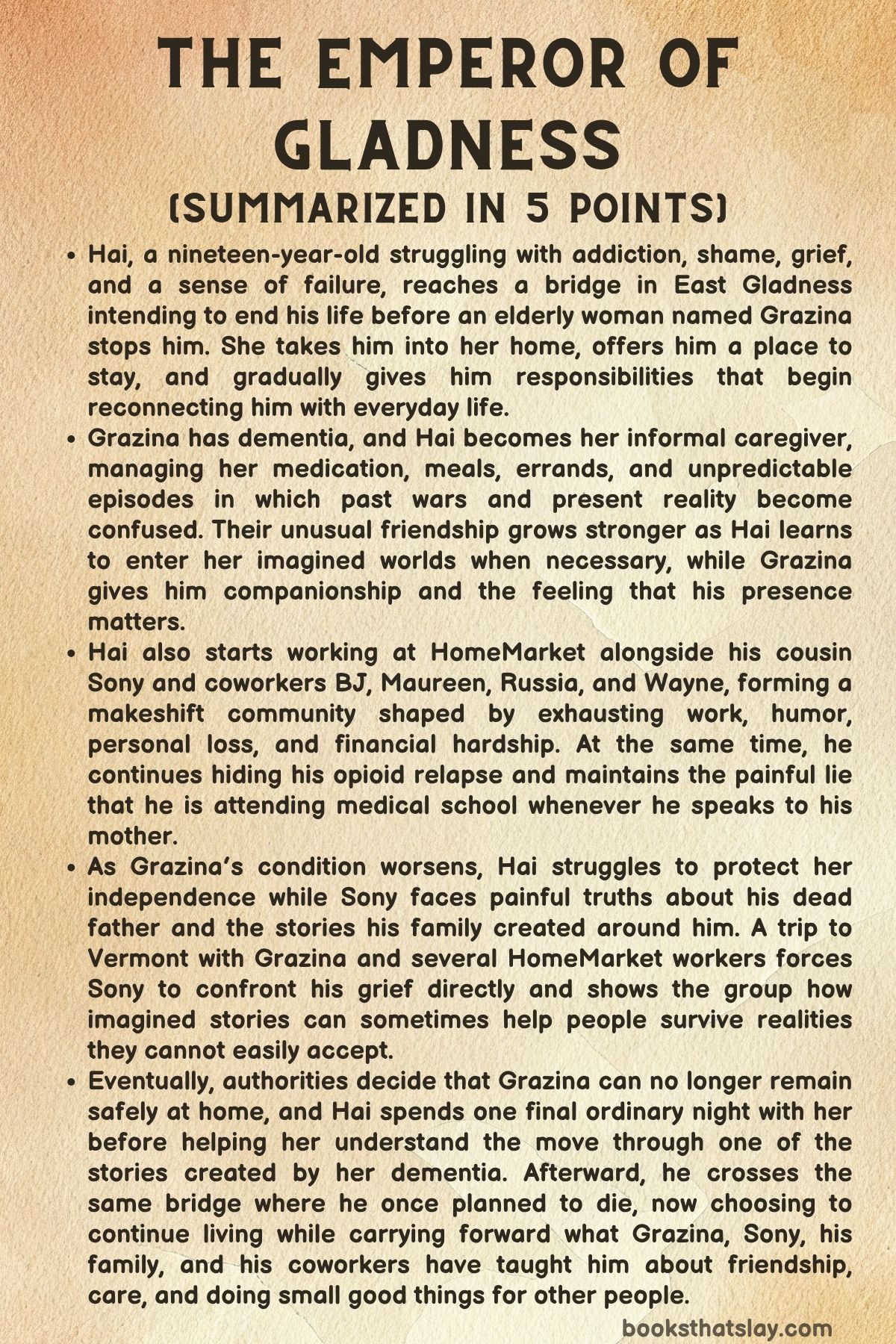
The Emperor of Gladness by Ocean Vuong is a literary novel that explores loneliness, addiction, family expectations, and the unexpected relationships that help people survive difficult circumstances. Set in the struggling Connecticut town of East Gladness, the story follows Hai, a nineteen-year-old Vietnamese American man whose life changes after an elderly Lithuanian immigrant named Grazina prevents him from taking his own life.
As their unusual friendship develops, the novel examines the experiences of immigrants, working-class communities, and people carrying painful memories. Through moments of humor, suffering, compassion, and uncertainty, Vuong presents an intimate exploration of human connection and the search for meaning.
Summary
East Gladness is a small Connecticut town marked by economic decline, abandoned industrial buildings, struggling families, and generations of forgotten suffering. Although poverty and neglect have shaped the community, the surrounding river, changing seasons, and natural landscape preserve a beauty that contrasts with the difficulties of everyday life.
In September 2009, nineteen-year-old Hai stands on King Philip’s Bridge, contemplating suicide. A Vietnamese American young man burdened by addiction, grief, and personal disappointment, he believes that disappearing into the river might offer an escape from a life he no longer knows how to manage.
Before he can jump, an elderly woman living nearby notices him and demands that he climb down. Hai attempts to disguise his intentions by claiming that he is studying the bridge for an engineering project, but the woman refuses to accept his explanation and insists that he accompany her home.
Her name is Grazina, a Lithuanian immigrant who lives alone in a deteriorating house filled with old possessions, books, and owl figurines. She mistakenly interprets Hai’s name as Labas, a Lithuanian greeting, and continues calling him by that name.
Their first conversation is awkward, amusing, and unexpectedly comforting. Grazina introduces him to her peculiar household rituals, including the symbolic destruction of bread, and offers him a place to stay without rent in exchange for assistance with daily responsibilities.
Hai accepts because he has nowhere secure to live and has become estranged from his family. Soon he begins preparing meals, organizing medications, helping Grazina bathe, and managing household tasks that have become increasingly difficult for her.
He discovers that Grazina suffers from serious physical ailments and cognitive deterioration. Her confusion occasionally causes her to confuse present circumstances with memories of the Second World War, while Hai struggles with an opioid addiction that continues to threaten his fragile stability.
Searching for employment, Hai visits HomeMarket, a restaurant specializing in inexpensive comfort food. There he unexpectedly encounters his cousin Sony, an autistic young man fascinated by military history, particularly the American Civil War.
Through Sony, Hai meets BJ, the outspoken restaurant manager, and employees including Maureen, Russia, and Wayne. Despite the demanding work, constant disagreements, and chaotic atmosphere, Hai gradually discovers a sense of acceptance among people whose own lives are marked by financial insecurity and disappointment.
The narrative reveals that Hai immigrated from Vietnam during childhood and grew up surrounded by his mother, grandmother, and Aunt Kim. His family endured substantial hardships, and his mother invested enormous hope in his education, believing that professional success would justify their sacrifices.
Hai attended Pace University in New York but abandoned his studies as his addiction intensified. Unable to admit his failure, he invented a story about gaining admission to medical school in Boston, allowing his mother to believe that he was pursuing a prestigious career.
Instead of studying medicine, he entered a rehabilitation facility in Connecticut, continuing to describe imaginary university experiences during conversations with his mother. Even after leaving treatment, he remains trapped by the deception and fears the consequences of revealing the truth.
At Grazina’s house, Hai discovers books belonging to her deceased husband, Jonas, including a copy of The Brothers Karamazov. The novel reminds him of Noah, a young man from his past whose death remains an unresolved source of grief.
Meanwhile, Grazina’s wartime memories increasingly intrude upon her understanding of reality. When fireworks convince her that enemy soldiers are approaching, Hai invents a rescue operation in which he becomes Sergeant Pepper, an American soldier guiding her toward safety.
Instead of contradicting her beliefs, he uses imagination to calm her and protect her dignity. Their imaginary journeys become a shared language through which Grazina can confront frightening memories while Hai discovers that caring for another person gives his life a sense of purpose.
Life at HomeMarket exposes Hai to other forms of suffering. Maureen, who believes that reptilian beings secretly control humanity, eventually reveals that her unusual theories reflect her anguish over losing her son to leukemia.
When Cookie, a homeless woman who regularly visits the restaurant, suffers a drug overdose in the bathroom, Hai confronts the danger of his own dependence. Nevertheless, he continues using opioids, including Dilaudid he discovers among the medications left behind by Grazina’s husband.
The relationship between Hai and Grazina grows stronger through ordinary experiences. She celebrates his birthday with a homemade cake, while he helps her regain some independence by repairing her mobility scooter and attending to her increasingly demanding personal needs.
At Thanksgiving, Hai invites Sony to Grazina’s house, where the three share an unconventional meal made partly from restaurant food. Their celebration provides temporary comfort, although Sony remains deeply distressed by the imprisonment of his mother, Aunt Kim.
Through childhood recollections, the novel explores Hai and Sony’s complicated relationship. A family trip to a museum devoted to Confederate general Stonewall Jackson reveals how historical narratives can conceal injustice, while Hai remembers failing to defend Sony against childhood bullying.
Sony’s fascination with history offers structure and comfort, but his emotional difficulties become increasingly serious. Hai accompanies him to a psychiatric appointment and attempts to reassure him about treatment despite his own uncertainty about medical authority.
Meanwhile, Hai develops an attraction to Russia, a coworker whose younger sister, Anna, is receiving addiction treatment. Their conversations expose shared experiences of financial hardship, family responsibility, and emotional vulnerability, although Hai conceals his own history of rehabilitation.
A temporary job at a pig-slaughtering operation forces Hai and several coworkers to participate in disturbing work. The experience reveals how economic necessity can compel vulnerable people to accept tasks that conflict with their compassion.
Another moral crisis develops when Grazina, during an episode of wartime confusion, reveals a hidden supply of money. Hai considers using it to help secure Aunt Kim’s release from prison, but he recognizes that accepting money from someone who cannot fully understand the situation would betray her trust.
When Hai and Sony visit a bail bonds office, Hai deliberately produces less than the required amount. Sony is devastated by their apparent failure, while Hai remains unable to explain why he has withheld money that might have reunited his cousin with his mother.
Christmas brings additional difficulties when Grazina visits her son Lucas and his prosperous family. Lucas and his wife, Clara, regard Grazina’s deteriorating condition as a problem requiring institutional care, and Lucas announces plans to move her into a residential facility.
Grazina fears losing her home and independence, while Hai realizes that affection alone may not allow him to protect her. Their companionship becomes even more meaningful as he assists her with intimate daily tasks and reassures her that aging has not diminished her worth.
The restaurant employees experience disappointments of their own. BJ’s attempt to establish a professional wrestling career ends in embarrassment, although her coworkers support her, and the group later rescues a homeless man suffering from exposure to the winter cold.
Hai’s addiction worsens as his guilt accumulates. After visiting Aunt Kim in prison and continuing to deceive his mother during Lunar New Year, he eventually breaks down outside Grazina’s house and admits that he cannot stop using drugs.
Grazina later suffers a fall and is hospitalized. During a visit, Hai tells her about Noah, revealing that their close friendship developed into a romantic relationship and that Noah’s death from an overdose contributed profoundly to his grief, addiction, and withdrawal from university.
Sharing this history allows Hai to acknowledge feelings he has concealed for years. Grazina responds with imperfect but genuine acceptance, demonstrating that emotional understanding can survive even when memory and language become unreliable.
After Grazina returns home, Lucas attempts to arrange her removal with the assistance of social services. Hai defends her wishes, and the two stage an imaginary military resistance that temporarily prevents the authorities from taking her away.
At HomeMarket, corporate management demands layoffs, and BJ reluctantly announces that Sony must lose his job. Devastated by the loss of the workplace that gave him purpose, Sony runs away, intending to travel to Vermont.
Hai discovers that Aunt Kim has been sending Sony letters pretending to be his deceased father. Although Sony knows the letters are fictional, he has accepted their imagined connection because they offer comfort, and he now hopes to visit the place where his father died in a car fire.
Hai follows Sony and agrees to accompany him, eventually joined by BJ, Maureen, and Grazina. Their journey becomes an improvised expedition through Vermont, filled with conversations, shared shelter, strange experiences, and moments of mutual understanding.
At Devil’s Leap State Park, Sony discovers a burned automobile headrest near the site of his father’s death. He mourns openly, searching unsuccessfully for a legendary diamond supposedly connected to his father’s wartime experiences, while his companions gather around him with compassion.
The journey allows Sony to express grief that he has carried for years, even though it cannot restore his father or resolve his family’s difficulties. The group returns to East Gladness with a deeper understanding of one another’s losses.
At Grazina’s house, Hai discovers that the authorities intend to transfer her to residential care the following day. Knowing that their companionship is nearing its end, the two spend time together performing familiar activities before making an unexpected nighttime trip to a diner.
During their final outing, Grazina reflects on motherhood, regret, and the passage of time. Outside, Hai witnesses hundreds of salamanders crossing a parking lot during their spring migration, an image of fragile creatures persisting despite danger.
When the authorities arrive, Hai once again becomes Sergeant Pepper, presenting Grazina’s departure as the successful conclusion of their imaginary wartime escape. Believing that she has finally reached safety in America, Grazina leaves with Lucas and the care workers.
Overwhelmed by the separation, Hai wanders through town and consumes his remaining pills. Before withdrawing into isolation, he secretly gives Sony money hidden inside Maureen’s unfinished R2-D2 sculpture, combining his savings with money from Grazina’s house to help secure Aunt Kim’s release.
Hai eventually climbs into a dumpster behind an abandoned building, where his mother unexpectedly calls. Still unaware of his invented medical career, she speaks about his future and reminds him that the meaning of life lies in the good people do for one another.
The narrative offers glimpses of the other characters’ futures: Sony reunites with Aunt Kim, BJ achieves success in wrestling, Russia helps his sister recover, and Maureen faces serious illness. Grazina dies seven months after leaving her home.
Hai’s ultimate fate remains uncertain. Rather than providing a simple resolution to his addiction and suffering, the novel closes by emphasizing the significance of ordinary kindness, shared memories, and the relationships that make survival meaningful.
Characters
Hai
Hai is the nineteen-year-old Vietnamese American protagonist of The Emperor of Gladness, whose experiences reveal the devastating consequences of addiction, unresolved grief, shame, and impossible family expectations. His emotional difficulties arise not from a single failure but from years of struggling to reconcile his own identity with the successful future his mother has imagined for him.
Raised in an immigrant family shaped by war and financial hardship, Hai grows up believing that education and professional achievement are the principal ways to repay his family’s sacrifices. When his addiction contributes to his departure from university, he becomes so frightened of disappointing his mother that he invents an entirely different life in which he is attending medical school.
His dishonesty becomes a form of emotional imprisonment. Although he desperately wants his mother’s approval, maintaining her belief in his success prevents him from expressing the vulnerability and suffering that might allow them to understand one another.
Noah’s death also shapes Hai’s personality, leaving him with profound grief over a relationship that he has never been able to acknowledge openly within his family. His continuing opioid use reflects his attempts to escape painful memories, but the temporary relief offered by drugs ultimately increases his isolation and self-destructive behavior.
His relationship with Grazina introduces a different dimension of his character. Despite struggling to protect himself, he demonstrates remarkable patience, imagination, and tenderness while caring for a woman whose mental and physical health is deteriorating.
Hai’s ability to enter Grazina’s imagined wartime world reveals his sensitivity to emotional suffering. Rather than insisting on factual accuracy, he recognizes that reassurance and companionship sometimes matter more than correcting another person’s confused understanding of reality.
However, his compassion does not eliminate his moral contradictions. His temptation to use Grazina’s hidden money exposes how addiction, desperation, and concern for family can place even a caring person in ethically troubling situations.
His affection for Sony, attraction to Russia, and memories of Noah also reveal his longing for intimacy, although shame frequently prevents him from expressing his feelings directly. By the conclusion, Hai remains a deeply vulnerable person whose future is unresolved, yet his actions demonstrate that a person can offer genuine kindness even while struggling to survive.
Grazina
Grazina is one of the most influential characters in The Emperor of Gladness, representing the relationship between aging, memory, displacement, and human dignity. An elderly Lithuanian immigrant who survived the traumatic circumstances of the Second World War, she carries an enormous personal history that frequently becomes inaccessible to those around her.
Her deteriorating cognitive condition causes her to confuse different periods of her life, particularly memories of wartime danger. Although these episodes can make her behavior appear irrational, they reflect experiences of fear and loss that remain emotionally powerful decades after the events themselves.
Grazina’s decision to save Hai from suicide establishes her fundamental generosity. Even though she requires substantial assistance herself, she immediately recognizes another person’s desperation and offers him shelter, companionship, and an opportunity to begin again.
Their living arrangement becomes a relationship based on mutual dependence rather than conventional charity. Hai helps her manage practical responsibilities, while Grazina gives him affection, a sense of belonging, and opportunities to experience himself as someone capable of being useful.
Her eccentric humor, fascination with owls, and willingness to participate in elaborate imaginary situations prevent her from being defined solely by illness. These qualities suggest a distinctive personality that remains visible even as her memory becomes unreliable.
Her relationships with Lucas and Lina reveal the emotional loneliness that can accompany old age. Lucas’s decision to arrange institutional care highlights the conflict between protecting a vulnerable parent and respecting that person’s desire for independence.
Grazina’s conversations with Hai about her changing body expose her fear of becoming undesirable or burdensome. His reassurance allows her to experience moments of dignity that she often lacks in her interactions with other people.
Her eventual removal from home represents the loss of autonomy, familiarity, and companionship. Although her life ends several months later, her influence on Hai continues through the lessons she teaches him about kindness, imagination, and the human need to be recognized.
Sony
Sony is a distinctive and emotionally significant character in The Emperor of Gladness, offering an examination of neurodivergence, loneliness, family loyalty, and the human desire for certainty. As Hai’s autistic cousin, he possesses an exceptional interest in military history, especially the American Civil War, and frequently uses historical knowledge to understand his surroundings.
His fascination with dates, battles, military figures, and historical narratives provides order in a world that often feels unpredictable. His knowledge also gives him a sense of competence and identity, particularly when social situations become difficult.
Sony’s relationship with Hai contains both affection and unresolved pain. Childhood experiences of bullying, together with Hai’s failure to defend him on one occasion, demonstrate how even close family relationships can carry memories of abandonment.
The imprisonment of his mother, Aunt Kim, leaves Sony emotionally vulnerable. His longing for his deceased father becomes especially important because the imagined possibility of reunion allows him to preserve a connection that reality has taken away.
His willingness to accept letters supposedly written by his father is not simply evidence of gullibility. He recognizes their fictional nature but chooses to participate in the comforting illusion because it preserves something he desperately needs.
His employment at HomeMarket provides structure, independence, and social belonging. Consequently, his dismissal represents more than financial insecurity; it threatens the stability and dignity that his workplace has helped him establish.
The journey to Vermont allows Sony to confront his father’s death in a way that ordinary conversation cannot achieve. Although he fails to discover the legendary diamond, he receives genuine emotional support from people who have become an alternative family.
Sony’s development demonstrates that emotional truth cannot always be measured by factual accuracy. His eventual reunion with Aunt Kim suggests the possibility of building a future without completely surrendering the memories and stories that have sustained him.
BJ
BJ is the unconventional manager of HomeMarket and an important source of humor, resilience, and solidarity in The Emperor of Gladness. Her energetic personality and outspoken manner create a workplace culture that often feels more personal than the impersonal corporate system governing the restaurant.
Although BJ must enforce demanding working conditions, she recognizes that her employees need more than wages. Her understanding of comfort food reflects her belief that customers are purchasing an emotional experience associated with family, security, and belonging.
Her management style is frequently chaotic, but she demonstrates considerable affection for her workers. Rather than treating them as interchangeable labor, she allows their eccentricities and individual personalities to shape the restaurant’s atmosphere.
BJ’s ambition to become a professional wrestler reveals her desire for recognition beyond the limitations of working-class employment. Her wrestling persona, Deez Nuts, gives her an opportunity to present herself as powerful, entertaining, and memorable.
Her humiliating performance and the disappointment that follows expose the vulnerability beneath her confidence. The support offered by her coworkers becomes important because it allows her to experience failure without completely losing her sense of worth.
Her position becomes particularly difficult when corporate management demands layoffs. The decision to dismiss Sony demonstrates how individuals with genuine compassion can still be forced to participate in systems that harm the people they care about.
BJ ultimately represents the stubborn persistence of ambition under discouraging circumstances. Her later success in wrestling suggests that dreams dismissed by others may still become meaningful achievements.
Maureen
Maureen is one of the most unusual and psychologically revealing characters in The Emperor of Gladness, combining eccentric humor with substantial personal suffering. Her conviction that reptilian beings secretly control humanity initially appears absurd, but the story gradually reveals the grief beneath her elaborate explanations.
The death of her son from leukemia has profoundly damaged her trust in the world. Her conspiracy theories offer a way to imagine that suffering results from identifiable forces rather than accepting the frightening possibility that innocent people can experience terrible losses without any understandable reason.
Her peculiar beliefs therefore become a form of psychological protection. By transforming suffering into part of a larger hidden system, she attempts to impose order on experiences that otherwise seem unbearable.
At HomeMarket, Maureen expresses herself through strange conversations, unconventional gifts, and unexpected behavior. These eccentricities contribute to the restaurant’s humor while emphasizing how individuals frequently disguise distress through habits that other people find amusing.
Her participation in the pig-slaughtering work reveals a practical side that contrasts with her extravagant theories. She understands the demands of physical labor and participates in difficult tasks despite their disturbing nature.
Her discovery of a possible breast tumor introduces another confrontation with suffering and uncertainty. Having already experienced the loss of her child, she must now face the possibility of serious illness affecting her own body.
Despite her fears, Maureen participates in the collective efforts to support Sony and the other workers. Her character challenges the assumption that unconventional beliefs or behavior prevent someone from possessing compassion, emotional intelligence, or genuine loyalty.
Russia
Russia is a HomeMarket employee whose quiet vulnerability, working-class responsibilities, and developing connection with Hai make him an important figure in the novel. His character demonstrates how affection and emotional understanding can develop through ordinary labor rather than dramatic declarations.
Hai becomes attracted to Russia during their conversations after demanding restaurant shifts. His attraction is rooted partly in Russia’s physical presence, but it is also strengthened by the exhaustion, uncertainty, and personal difficulties they share.
Russia’s dedication to his younger sister, Anna, reveals his strong sense of responsibility. He works long hours across multiple jobs to support her addiction treatment, demonstrating how one person’s illness can place enormous emotional and financial demands on an entire family.
This experience creates an unspoken connection between Russia and Hai. Although Hai recognizes the similarities between Anna’s struggles and his own dependence, he remains unwilling to reveal his history of rehabilitation.
Russia also reflects on the experiences of military veterans, including a former soldier whose psychological suffering contributed to addiction. His willingness to discuss damaged lives reveals an awareness of the vulnerability that exists beneath conventional expectations of strength.
His stories about disappearance and uncertainty suggest that he understands how easily people can become separated from those they love. For Hai, these conversations offer rare moments of intimacy without the pressure of having to present himself as successful.
Russia’s eventual assistance in his sister’s recovery reflects the persistence of his commitment. He represents a form of love expressed through sustained work, practical sacrifice, and loyalty.
Hai’s Mother
Hai’s mother embodies the enormous emotional expectations that can develop within immigrant families shaped by sacrifice, displacement, and financial insecurity. Her determination to secure a successful future for her son arises from a desire to protect him from the hardships that have defined her own life.
She regards education as a means of achieving economic stability and social respectability. Hai’s supposed acceptance into medical school therefore becomes much more than an individual accomplishment; it appears to confirm that the family’s years of struggle have produced something meaningful.
Her ambitions, however, create considerable pressure. Hai comes to believe that admitting failure would destroy his mother’s hopes, so he constructs an elaborate deception rather than revealing his addiction and withdrawal from university.
Their conflict exposes the difference between parental sacrifice and a child’s emotional needs. Although she genuinely loves her son, her disappointment and frustration sometimes make him feel valued principally for the successful future he is expected to provide.
Hai’s inability to communicate openly with her is equally important. By hiding his grief over Noah, his sexuality, and his continued substance use, he prevents his mother from understanding the experiences that have shaped his behavior.
Their final telephone conversation complicates the reader’s understanding of their relationship. Her belief that life acquires meaning through the good people do for one another suggests a philosophy of love that extends beyond professional success, even though she remains unaware of Hai’s circumstances.
She is therefore neither a cruel parent nor an uncomplicated source of support. Her character illustrates how genuine love can coexist with damaging expectations, cultural pressures, and serious failures of communication.
Aunt Kim
Aunt Kim is Hai’s aunt and Sony’s mother, whose imprisonment creates one of the novel’s central family conflicts. Her experiences reveal how difficult economic circumstances, early parenthood, and lost opportunities can shape a person’s understanding of family and personal achievement.
Becoming a mother at seventeen significantly altered the future she once imagined for herself. During her prison visit, she reflects on missed opportunities and reveals how the responsibilities of motherhood became connected to her own disappointed ambitions.
Her expectations for Sony resemble those Hai’s mother places upon him. Both women regard their sons’ futures as opportunities to accomplish what their own circumstances prevented them from achieving.
Aunt Kim’s relationship with Sony is complicated by his desire to understand his father. Her bitterness when discussing the past suggests that unresolved adult conflicts have become emotional burdens for a young man who needs reassurance and clarity.
Her decision to write letters pretending to be Sony’s deceased father is particularly revealing. Although the deception is dishonest, it emerges from an attempt to give her son comfort and maintain an emotional connection with him despite imprisonment.
The letters ultimately demonstrate the limitations of protecting someone through invented stories. Sony understands more than his mother realizes, and his awareness makes the emotional situation more complicated than a simple case of parental deception.
Aunt Kim’s eventual reunion with Sony offers the possibility of repairing their relationship. Her character demonstrates how parental love can produce both protective behavior and unintended harm.
Noah
Noah is Hai’s deceased friend and romantic partner, whose absence shapes much of the protagonist’s emotional life. Although he appears primarily through memories, he remains one of the most significant influences on Hai’s struggles with grief and addiction.
Their relationship begins in the environment of a small town where openly expressing their sexuality is difficult. Their affection develops into love, offering Hai an experience of closeness and recognition that he cannot fully share with his family.
Noah’s interest in literature also becomes an important part of their connection. Hai’s discovery of The Brothers Karamazov among Jonas’s books recalls their plan to read the novel together, demonstrating how ordinary objects can preserve powerful emotional associations.
Noah’s death from an overdose leaves Hai with grief that he struggles to communicate. His loss contributes to Hai’s withdrawal from university and worsening dependence on opioids, making the consequences of addiction painfully personal.
Because Hai has concealed important aspects of their relationship, he lacks opportunities to mourn openly. His eventual decision to tell Grazina about Noah becomes an important moment of emotional acknowledgment.
Noah represents the enduring presence of people who are no longer alive. His character shows how love continues to influence identity and behavior long after the possibility of a shared future has disappeared.
Wayne
Wayne is a HomeMarket employee whose character becomes especially important during the temporary work at the pig-slaughtering operation. His experiences draw attention to the economic pressures that force people into difficult and sometimes morally disturbing forms of employment.
By recruiting coworkers for the slaughterhouse job, Wayne introduces Hai to an environment where earning money requires direct participation in animal suffering. The work exposes the uncomfortable distance between prepared food and the violence involved in its production.
Wayne’s discussions of family and financial necessity reveal the practical considerations behind such choices. His willingness to undertake unpleasant labor reflects a world in which survival often demands accepting jobs that offer little personal fulfillment.
He also broadens the novel’s portrayal of working-class experience by showing how physical endurance becomes part of everyday economic responsibility. His character suggests that judging people’s choices without understanding their circumstances can conceal the systems limiting their alternatives.
Lucas
Lucas is Grazina’s adult son, whose relationship with his mother exposes the emotional conflicts surrounding aging, caregiving, and institutional responsibility. His comfortable suburban household contrasts sharply with the deteriorating home where Grazina has spent her later years.
He views his mother’s declining condition as evidence that she can no longer safely live independently. His decision to place her in the Hamilton Home reflects concerns about supervision and medical care, but his handling of the situation gives insufficient weight to her feelings and wishes.
Lucas’s tendency to discuss Grazina’s condition as a practical problem makes her feel increasingly powerless. His criticism of Hai after her hospitalization also reveals the tension between formal family authority and the everyday responsibilities of someone providing direct care.
Nevertheless, the possibility that Grazina genuinely requires additional supervision prevents Lucas from being understood simply as an uncaring son. He represents the difficult boundary between necessary protection and the removal of another person’s independence.
His character raises questions about whether security alone constitutes adequate care. Through his decisions, the novel examines how relatives can fulfill practical responsibilities while failing to recognize the emotional meaning of home, familiarity, and personal choice.
Clara
Clara is Lucas’s wife and part of the prosperous family household that Grazina visits during Christmas. Although her role is smaller than her husband’s, her behavior contributes to Grazina’s discomfort and sense of exclusion.
Alongside Lucas, Clara treats Grazina’s confusion as an embarrassing disruption to the family’s celebration. This response reveals the distance between the orderly domestic environment they have established and the unpredictable needs of an elderly relative experiencing cognitive decline.
Clara’s presence also reinforces the contrast between social success and emotional understanding. Her household possesses material comfort, yet it struggles to accommodate vulnerability in a manner that preserves Grazina’s dignity.
Her character demonstrates that a secure family environment is not necessarily an emotionally welcoming one, especially for someone whose needs challenge the family’s preferred routines.
Bà ngoại
Bà ngoại, Hai and Sony’s grandmother, represents the older generation of their Vietnamese immigrant family. Her presence connects the younger characters to a history of migration, cultural displacement, and traditions that continue to influence their understanding of identity.
She becomes particularly memorable during the family’s childhood trip to Virginia, where her unfamiliarity with American customs creates moments of humor and embarrassment. These interactions reveal the difficulties immigrants can experience when navigating social environments shaped by unfamiliar expectations.
Her presence during the visit to Stonewall Jackson’s former home also highlights the distance between official American historical narratives and the experiences of immigrant families. While the museum presents a carefully organized interpretation of the past, Bà ngoại’s behavior and perspective resist easy assimilation into that narrative.
She represents the persistence of family history beneath the pressures of adaptation. Through her character, the novel recognizes the importance of older relatives whose experiences remain influential even when younger generations do not fully understand them.
Jonas
Jonas is Grazina’s deceased husband, whose presence survives through the books, medications, and possessions remaining in their home. Although he does not participate directly in the present-day events, these objects establish his continuing influence on Grazina’s surroundings.
His extensive collection of literature suggests an intellectual and cultural life that Hai gradually discovers while exploring the basement. The books become an unexpected connection between Grazina’s family history and Hai’s memories of Noah.
The prescription medication left behind after Jonas’s death also has a darker significance. Hai’s discovery of Dilaudid among his belongings provides another opportunity for substance misuse, connecting the remnants of one person’s illness to another person’s ongoing addiction.
Jonas demonstrates how the belongings of deceased family members can acquire new meanings for those who inherit them. His absence remains visible in both the comforting and dangerous objects he has left behind.
Lina
Lina is Grazina’s daughter, whose presence is primarily established through her mother’s memories and attempts at communication. Although the available account provides limited information about her personal circumstances, Lina remains important to understanding Grazina’s attachment to her family.
Grazina recalls her daughter while discussing earlier periods of her life, demonstrating how parenthood remains central to her identity despite advancing age and deteriorating memory.
During the nighttime diner visit, Grazina attempts to telephone Lina but mistakenly calls her own empty house. The incident illustrates the painful distance between her desire for family connection and her declining ability to manage ordinary actions.
Lina’s largely indirect presence emphasizes one of the novel’s quieter observations about old age: family members can remain emotionally important even when communication and physical closeness have become difficult.
Marta
Marta is Grazina’s childhood friend from Lithuania, remembered during one of the elderly woman’s episodes of confusion. Her significance comes from the intimate connection she shared with Grazina before war, displacement, and aging transformed their lives.
The discovery of childhood possessions associated with Marta provides a glimpse of Grazina’s earlier identity. Before becoming an elderly woman dependent on assistance, Grazina was a young person whose world contained friendship, imagination, and expectations of ordinary happiness.
Marta’s place in these memories challenges the tendency to understand older people primarily through their present limitations. Her friendship reminds readers that Grazina’s life extends far beyond the period witnessed by Hai.
Through Marta, childhood companionship becomes something that survives in memory even when much of the surrounding world has disappeared. She represents the personal relationships that historical violence cannot completely erase.
Filip
Filip is a young man remembered through Grazina’s recollections of her Lithuanian childhood. His drowning introduces the experience of sudden death into memories otherwise associated with friendship, youth, and possibility.
The loss of Filip demonstrates how an ordinary life can end unexpectedly before its potential has been realized. His death also establishes that Grazina encountered suffering beyond the events of wartime occupation.
Although his role is brief, Filip contributes to the novel’s recurring examination of interrupted futures. His fate echoes the later deaths of Noah and Sony’s father, connecting different generations through experiences of grief.
Filip’s importance lies in the emotional space his absence occupies. He reminds readers that even people who appear only briefly in another person’s recollections can remain part of that person’s understanding of life.
Anna
Anna is Russia’s younger sister, whose struggle with substance addiction creates significant emotional and financial responsibilities for her family. Although she does not participate extensively in the central action, her circumstances help explain Russia’s behavior and priorities.
Her rehabilitation requires considerable financial support, prompting Russia to maintain exhausting working hours. His efforts reveal that addiction affects not only the individual experiencing dependence but also relatives who reorganize their lives around treatment and recovery.
Anna’s situation provides an important parallel to Hai’s difficulties. Whereas Hai conceals his addiction from many people around him, Anna’s condition has become a central concern within her family.
Her eventual progress toward recovery introduces a measure of hope into the novel’s treatment of substance dependence. Anna represents the possibility of improvement while acknowledging the sacrifices and sustained support that recovery may require.
Cookie
Cookie is a homeless woman who regularly visits HomeMarket to obtain hot water and use the restroom. Her presence reveals how commercial spaces sometimes function as informal shelters for people who have nowhere else to meet basic needs.
When a customer complains about her, the employees attempt to protect her from unnecessary humiliation. Their response demonstrates that ordinary workers may recognize the dignity of vulnerable people more readily than customers concerned primarily with convenience.
Cookie subsequently suffers a drug overdose inside the restaurant’s restroom. The incident exposes the life-threatening consequences of addiction and confronts Hai with a possible outcome of his own dependence.
Her character brings broader social problems into the restaurant’s daily routine. Through Cookie, the novel shows how homelessness, addiction, and public judgment can converge in the experiences of people who lack stable support.
Sony’s Father
Sony’s deceased father occupies an unusually powerful position in the novel because his son knows him largely through memories, stories, and imagined possibilities. His absence has become central to Sony’s understanding of family, identity, and personal history.
Sony believes in a story about a diamond supposedly embedded in his father’s hand during wartime. The legend transforms his father into an almost heroic figure, offering Sony a tangible symbol through which to imagine courage and protection.
The revelation that important parts of the story were misunderstood or invented complicates this idealized image. It demonstrates how family histories can become mixtures of fact, exaggeration, and emotionally necessary invention.
His death in a car fire leaves Sony with questions that cannot be answered through ordinary conversation. The journey to Devil’s Leap State Park allows his son to confront the physical location of that loss.
Although the legendary diamond is never discovered, Sony’s mourning gives the journey meaning. His father’s character therefore illustrates how the dead continue shaping the identities and decisions of those who survive them.
Randy
Randy is an acquaintance from Hai’s old neighborhood who provides him with drugs during a period of increasing dependence. His appearance reveals how easily Hai can return to familiar patterns of substance use even after attempting rehabilitation.
The encounter occurs as Hai prepares to confront his mother, connecting his need for chemical relief with the anxiety surrounding family expectations. Randy’s availability demonstrates that the social environment surrounding addiction can remain accessible even when a person tries to change.
The narrative provides limited information about Randy’s personal motivations, so he functions primarily as part of Hai’s unresolved relationship with drugs. His presence emphasizes the difficulty of escaping destructive habits when familiar contacts continue enabling them.
Vogel
Vogel is the regional corporate manager who arrives at HomeMarket to inspect its operations. His behavior reveals the distance between those who exercise institutional authority and the employees responsible for performing exhausting, low-paid work.
During his inspection, he humiliates BJ, criticizes the restaurant’s performance, and dismisses aspects of the workplace culture that employees consider meaningful. His destruction of Sony’s decorations is especially revealing because it demonstrates how easily corporate judgment can disregard individual effort.
Vogel’s authority also introduces the possibility of layoffs, threatening the economic and emotional stability of the workers. His decisions have consequences extending far beyond the immediate financial calculations used to justify them.
He functions as a representation of institutional indifference rather than a fully explored private personality. Through him, the novel examines how organizational power can damage communities that workers have created within otherwise impersonal workplaces.
Nacho
Nacho is an acquaintance whom Maureen encounters during the food exchange at Panetta, HomeMarket’s more fashionable competitor. His brief appearance introduces an unexpected personal connection into an otherwise uncomfortable workplace assignment.
The encounter occurs while Maureen and Hai experience the social differences between the two restaurants. Against the dismissive atmosphere of Panetta, Maureen’s moment of recognition offers a reminder that personal relationships exist beyond professional hierarchies.
Although little is revealed about Nacho’s individual history, his appearance supports the novel’s interest in everyday social connections. He demonstrates how brief encounters can provide moments of familiarity within environments shaped by status and competition.
Miss Magician
Miss Magician is the experienced wrestler who competes against BJ during her attempt to establish a professional wrestling career. Her presence situates BJ’s ambitions within an actual competitive environment, where enthusiasm alone cannot guarantee recognition.
The awkward match contributes to BJ’s humiliation and exposes the difference between the confident identity she has imagined for herself and the difficult reality of performing before an audience.
Miss Magician’s limited role emphasizes the challenges confronting people who attempt to enter unfamiliar professional worlds. Through the match, BJ must experience the vulnerability of pursuing a dream without any assurance that her efforts will be rewarded.
The Iraq War Veteran
The Iraq War veteran whom Hai encounters in a motel room is a relatively brief but meaningful figure. His physical injuries and emotional vulnerability extend the novel’s examination of the consequences of military violence.
His intimate encounter with Hai suggests that companionship can emerge between people carrying different forms of psychological damage. Their connection offers temporary tenderness without resolving the difficult circumstances either person faces.
The veteran also creates a parallel between historical and contemporary suffering. Grazina’s memories of the Second World War and the veteran’s experiences in Iraq demonstrate that the consequences of armed conflict persist across generations.
His character contributes to the novel’s refusal to define people exclusively by their injuries. Even within a short encounter, vulnerability and the desire for closeness remain essential parts of his humanity.
The Veteran in Russia’s Story
The former soldier described by Russia is another figure associated with the psychological consequences of military service. His experiences in Iraq have left him emotionally damaged, contributing to drug dependence and erratic behavior.
Russia’s account emphasizes how military service can continue affecting individuals long after their return to civilian life. The veteran’s difficulties challenge the assumption that surviving combat necessarily means successfully returning to ordinary existence.
His situation also draws a connection between traumatic experience and addiction without suggesting that every person’s dependence has identical causes. Through this character, the novel broadens its examination of suffering beyond Hai’s immediate circumstances.
The Bail Bondsman
The bail bondsman whom Hai and Sony visit represents the financial and procedural barriers standing between Aunt Kim and her family. His role becomes especially important when the cousins attempt to gather sufficient money for her release.
When Hai deliberately presents an insufficient amount, the bondsman determines that the arrangement cannot proceed. This response establishes the immediate practical consequences of Hai’s private moral conflict.
The bondsman is not developed as a deliberately cruel individual. Instead, his function emphasizes how institutional systems operate through financial requirements that can remain inflexible regardless of a family’s desperation.
His presence demonstrates the difference between wanting to help someone and possessing the resources necessary to do so.
The Social Services Representative
The social services representative who accompanies Lucas to Grazina’s house represents the formal procedures involved in transferring an elderly person into residential care. The visit introduces institutional authority into a home where Hai and Grazina have established an unconventional but emotionally meaningful arrangement.
The representative’s presence makes Grazina’s loss of independence an immediate possibility rather than a distant family discussion. Her resistance, supported by Hai’s imaginary military defense, demonstrates the conflict between professional intervention and personal choice.
The character is not presented with enough individual detail to establish personal motives beyond the professional task. Nevertheless, the encounter raises difficult questions about how care decisions should balance safety, dignity, and autonomy.
The Pizza Restaurant Employee
The young employee from the neighboring pizza restaurant briefly confronts the HomeMarket workers, accusing their business of threatening her family’s livelihood. Her anger reveals the competitive pressures faced by small businesses operating alongside corporate chains.
Although her hostility is directed toward HomeMarket employees, those workers are themselves economically vulnerable. The confrontation demonstrates how people with relatively little power can become opponents because larger commercial systems place their interests in competition.
Her character broadens the novel’s portrayal of economic insecurity beyond a single workplace. She represents families struggling to preserve their livelihoods in communities where employment and business survival are increasingly uncertain.
The Homeless Man Rescued by the Employees
The homeless man discovered outside the restaurant initially appears to the employees to be an injured animal. Their realization that he is a person suffering from exposure to freezing weather becomes an important moment in the novel’s portrayal of social invisibility.
His condition illustrates the severe dangers faced by people without secure housing, particularly during winter. The employees respond by bringing him inside, warming him, and offering food.
Although the narrative reveals little about his personal history, the encounter demonstrates the significance of practical kindness. His presence gives the employees an opportunity to act on their compassion rather than simply express concern about suffering.
The incident also exposes a striking contradiction: workers who possess limited financial security are willing to share the modest resources available to them with someone whose situation is even more precarious.
Themes
Care, Compassion, and the Meaning of Family
When Grazina prevents Hai from jumping from King Philip’s Bridge, her intervention establishes a relationship that challenges conventional understandings of family and responsibility. Two strangers who initially appear to have little in common gradually become essential sources of emotional support for one another.
In The Emperor of Gladness, care is presented not as a simple act of generosity but as a demanding, imperfect relationship involving patience, sacrifice, and personal vulnerability. Hai assists Grazina with bathing, medication, meals, and household responsibilities, while she offers him shelter, affection, and an opportunity to experience belonging.
Their relationship is particularly significant because neither person possesses the stability usually associated with caregiving. Hai struggles with addiction and depression, while Grazina experiences cognitive deterioration and physical weakness, yet each possesses qualities that help the other survive.
The HomeMarket employees extend this understanding of family beyond the domestic environment. Their willingness to comfort BJ after her wrestling disappointment, support Sony during his grief, and rescue a homeless man demonstrates how shared hardship can produce genuine solidarity.
These relationships contrast with the emotional distance between Grazina and Lucas, as well as the misunderstandings separating Hai from his mother. Biological relationships remain important, but they do not automatically guarantee acceptance, companionship, or understanding.
The novel also resists presenting compassion as a complete solution to suffering. Hai cannot prevent Grazina’s institutionalization, and the employees cannot eliminate the economic difficulties threatening their lives.
Nevertheless, their efforts acquire significance because kindness remains possible even when circumstances cannot be changed. Through these relationships, the story suggests that family can emerge wherever people consistently recognize and respond to one another’s needs.
Addiction, Shame, and the Struggle for Self-Acceptance
Hai’s dependence on opioids is inseparable from his struggle with grief, social expectations, and personal identity. His addiction provides temporary relief from emotional suffering while gradually destroying the stability and honesty necessary for recovery.
His fabricated medical career reveals the complicated relationship between shame and self-destructive behavior. Because he believes that his mother’s love is closely connected to professional achievement, admitting his academic failure becomes almost as frightening as acknowledging his substance dependence.
The deception creates a cycle in which guilt encourages further escape, while continued drug use produces additional reasons for guilt. Even when Hai finds employment and establishes meaningful relationships, his addiction remains an unresolved threat.
Noah’s death gives this struggle an additional emotional dimension. Hai’s inability to mourn their relationship openly leaves him carrying painful memories without the support that might accompany public acknowledgment of a loved one’s death.
Other characters demonstrate that addiction extends beyond individual weakness or poor judgment. Cookie’s overdose exposes its life-threatening consequences, while Anna’s rehabilitation shows the substantial emotional and financial responsibilities carried by affected families.
The experiences of military veterans introduce another connection between trauma and dependence. Their difficulties suggest that substance misuse can emerge within lives already damaged by circumstances that individuals cannot simply overcome through determination.
The novel also examines the relationship between recovery and honesty. Hai’s difficulty acknowledging his suffering prevents him from fully accepting the support available through his relationships.
His confession to Grazina that he cannot stop using drugs represents a moment of vulnerability, although it does not provide an immediate solution. By leaving his future uncertain, the story recognizes recovery as a difficult and unpredictable process rather than a single act of personal transformation.
Memory, Storytelling, and the Uncertainty of Truth
Grazina’s wartime memories repeatedly transform ordinary surroundings into landscapes of danger, creating situations in which the distinction between past and present becomes unstable. Her experiences suggest that memory is not merely a record of previous events but a continuing emotional force capable of shaping present reality.
In The Emperor of Gladness, storytelling becomes both a means of survival and a source of ethical uncertainty. Hai’s imaginary military operations help Grazina endure episodes of confusion, demonstrating that an invented narrative can offer genuine comfort when literal explanations would produce distress.
Sony’s relationship with his deceased father develops through a similarly complicated relationship with truth. Although he understands that Aunt Kim’s letters are fictional, he preserves their imagined connection because they allow him to experience a form of parental closeness otherwise unavailable to him.
The legendary diamond associated with his father’s military history also demonstrates how family memories can acquire symbolic importance independent of factual accuracy. Its absence does not invalidate Sony’s grief or the emotional significance of his journey.
However, the novel does not suggest that every invention is harmless. Hai’s false medical career isolates him from his mother, while the stories constructed around Sony’s father expose him to further confusion and disappointment.
The family’s childhood visit to the Stonewall Jackson museum introduces a broader political dimension. The museum’s selective presentation of slavery demonstrates how institutions can construct reassuring historical narratives by minimizing uncomfortable realities.
These examples raise questions about who controls stories and whose experiences are excluded from accepted accounts of the past. Memory can preserve love and identity, but it can also conceal suffering or sustain damaging illusions.
Ultimately, storytelling becomes valuable when it allows people to acknowledge experiences that might otherwise remain unspoken. Its moral significance depends less on imagination alone than on whether the stories people create protect dignity, encourage understanding, or prevent honest communication.
Economic Inequality, Invisible Labor, and Human Dignity
East Gladness reflects the consequences of industrial decline, limited employment opportunities, and the neglect of communities excluded from broader economic prosperity. Its abandoned buildings and struggling neighborhoods establish a world in which financial insecurity influences nearly every major relationship.
HomeMarket becomes a concentrated representation of these conditions. Employees perform exhausting work preparing meals associated with domestic comfort, even as their own lives remain marked by instability, grief, and limited opportunities.
The restaurant’s corporate identity depends upon selling customers a reassuring image of family and happiness. Behind that image, workers must manage demanding schedules, difficult customers, uncertain wages, and personal difficulties that cannot be separated from their employment.
Vogel’s inspection exposes the imbalance between corporate authority and working-class vulnerability. His criticism of BJ and destruction of Sony’s decorations demonstrate how managerial decisions can disregard the emotional investments employees make in their workplaces.
Sony’s dismissal is especially revealing because employment provides him with dignity, structure, and social belonging. The decision reduces him to a financial consideration, ignoring the broader importance of work within his life.
The pig-slaughtering operation presents another troubling dimension of economic necessity. Hai and his coworkers participate in disturbing labor because earning money can require people to accept conditions that conflict with their values.
Aunt Kim’s imprisonment and the difficulty of gathering bail money demonstrate how financial disadvantage also affects family relationships. The inability to produce sufficient funds prolongs separation, showing how economic restrictions can shape experiences that appear primarily personal.
Yet the novel consistently portrays working-class characters as possessing emotional resources that cannot be measured through wealth or professional achievement. Their humor, generosity, and practical acts of compassion challenge the assumption that economic success determines human worth.
By recognizing the dignity of people whose work and suffering are frequently overlooked, the story argues that ordinary lives deserve attention, respect, and remembrance regardless of social status.