Too Old For This Summary, Characters and Themes
Too Old For This by Samantha Downing is a dark crime novel built around Lottie Jones, a seventy-five-year-old woman whose quiet retirement conceals decades of murder.
What makes the story distinctive is the contrast between Lottie’s ordinary concerns about arthritis, family, church, finances, and aging and her cold competence when dealing with bodies, police suspicion, and people who threaten her secrecy. The novel also examines how older people are underestimated, how easily judgment can define someone’s identity, and how technology has changed both crime and privacy. Beneath the violence is a story about control, legacy, family loyalty, and the frightening awareness that age eventually limits even the most determined person.
Summary
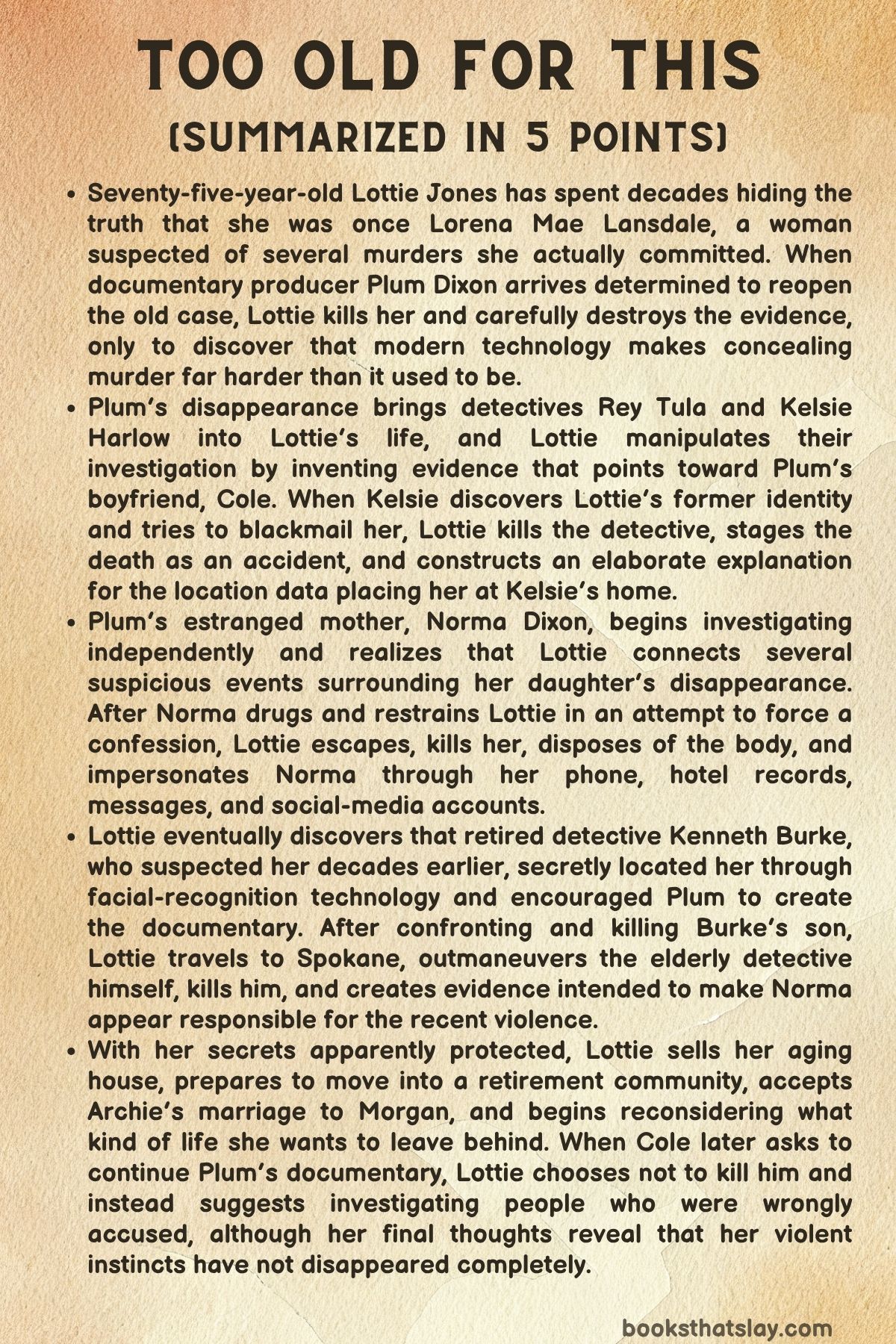
Seventy-five-year-old Lottie Jones has spent decades living quietly in Baycliff, Oregon, after escaping a notorious chapter of her past. Her carefully controlled life is disrupted when Plum Dixon, a young documentary producer, arrives at her house despite Lottie repeatedly refusing to participate in a series about Lorena Mae Lansdale, the woman Lottie used to be.
Plum believes Lorena was unfairly suspected of a series of murders in Spokane in 1985 and wants to restore her reputation. Lottie knows the central assumption behind Plum’s project is false because she really did commit those murders, so when Plum makes it clear that the documentary will proceed with or without her cooperation, Lottie kills her with an umbrella.
Lottie immediately returns to skills she has not used for years. She cleans the scene, drives Plum’s car to Salem airport to create a misleading digital trail, destroys Plum’s phone and laptop, dismembers the frozen body, burns the remains, and hides Plum’s research file concerning her former identity.
The physical strain reminds Lottie that she is no longer the woman she once was. She had effectively retired from murder more than a decade earlier because stalking victims, moving bodies, destroying evidence, and managing the fear afterward had become tiring rather than exciting.
Her ordinary family life continues alongside these events. Lottie’s son Archie tells her that his much younger girlfriend Morgan is pregnant and that they plan to marry, creating tension with Archie’s former wife Stephanie and raising concerns throughout the family.
Plum’s boyfriend, Cole Fletcher, soon contacts Lottie because Plum has disappeared. Lottie acts like a sympathetic elderly witness and learns that Plum’s electronic location history shows she visited Lottie before apparently traveling to Salem airport, where her abandoned car was found.
Detectives Rey Tula and Kelsie Harlow eventually question Lottie. She deliberately appears physically frail and forgetful, using a walker and pretending to struggle with details, then invents bruises and burns on Plum’s body to encourage the detectives to suspect that Cole might have abused her.
At the same time, memories reveal the truth about Lottie’s past. Her first killing occurred when Archie’s father, Gary, humiliated her after they slept together; she pushed him, caused a fatal fall, cleaned the scene, and discovered that she felt relief rather than guilt.
Other murders followed people who humiliated, judged, or angered her. The victims included people such as Marilyn Dobbs, Paul Norris, and Walter Simmons, whose treatment of Lottie or Archie activated the resentment she had carried since childhood, when her father’s arrest caused her entire family to become targets of public judgment.
Kelsie becomes increasingly suspicious. She discovers that Lottie is actually Lorena Mae Lansdale, but instead of officially arresting or investigating her, she uses the information for extortion and demands fifty thousand dollars to keep the secret.
Unable and unwilling to pay, Lottie begins following Kelsie and eventually kills her with a claw hammer. She stages the death as an accidental fall in the bathtub, deletes incriminating material from Kelsie’s phone, and retrieves the envelope containing her fingerprints.
Then Lottie realizes she accidentally carried her smartphone to Kelsie’s house. Its location history can place her at the murder scene, and the mistake terrifies her because it suggests that her judgment and memory are deteriorating.
She ultimately turns the mistake into part of her cover story. Lottie tells Tula that Kelsie had secretly been investigating a pearl earring supposedly connected to Plum and claims she visited Kelsie only to deliver another piece of that evidence.
With Tula redirected, Lottie starts confronting another problem: aging itself. She investigates retirement communities because her large house has become physically demanding, financially burdensome, and increasingly dangerous for someone who is beginning to make mistakes.
A new threat appears when Norma Dixon, Plum’s estranged mother, comes to Baycliff. Norma has investigated Lottie’s past and recognizes inconsistencies in the claims about Plum’s supposed injuries, correctly suspecting that Lottie has manipulated the investigation.
Lottie initially tries to destabilize Norma by anonymous calls, cryptic messages, and psychological pressure. She uses prerecorded voices and fake warnings designed to exploit Norma’s guilt about abandoning Plum and push her toward theories involving Cole or the police.
Instead of retreating, Norma becomes more determined. She eventually drugs Lottie, searches her house, finds Plum’s research file, ties Lottie to a chair, and demands to know what happened to her daughter.
Lottie escapes by exploiting Norma’s impatience and intoxication. Rather than fleeing once she is free, she retrieves her brass-handled cane, hunts Norma through the unusual circular layout of the house, and beats her to death.
She then dismembers Norma and begins impersonating her electronically, maintaining hotel reservations, answering messages, manipulating social media, and even using one of Norma’s severed fingers to unlock the woman’s smartphone. This strategy allows Lottie to create the impression that Norma remains alive while she disposes of the body.
During this period Morgan unexpectedly stays with Lottie while preparing for the wedding. Their relationship changes considerably as Lottie learns that Morgan is more independent and sincere than she assumed and recognizes that Morgan, like Lottie herself, has been judged according to a story other people constructed about her.
Morgan also gives Lottie a stun gun for self-defense. The gift later becomes extremely important, although it first creates another crisis when Morgan discovers a severed finger that Lottie accidentally left in the kitchen freezer.
Lottie claims it is a theatrical prop connected with a church production and then has to invent increasingly complicated explanations when Morgan visits the church and nearly discovers there is no such play. The incident reinforces Lottie’s growing awareness that she is becoming careless.
Norma’s messages reveal something even more dangerous. Kenneth Burke, the detective who spent decades convinced that Lorena was a murderer, is still alive and had secretly been communicating with Norma.
Burke had encouraged Norma to investigate Lottie and had given her a hidden cellular camera to place inside Lottie’s home. Rather than destroy the device, Lottie activates it herself and carefully stages scenes of physical weakness so Burke will believe Norma successfully planted it.
Meanwhile, Lottie learns that Archie secretly installed location-tracking software on her smartphone because he worries about her living alone. She feels betrayed, both because of the invasion of privacy and because his actions confirm that he has begun thinking of her as someone who needs supervision.
She literally tapes the phone to her kitchen counter to prevent it from creating further evidence. Her growing concern about independence strengthens her intention to sell her house and move into senior living.
Lottie eventually decides to lure Burke to Oregon. In view of his hidden camera, she performs an elaborate scene in which an imaginary Norma appears to attack and apparently kill her, knowing Burke will believe the woman he has been manipulating has finally committed murder.
Burke responds by announcing that he is coming to Baycliff. Lottie goes to the cheap motel where she has been maintaining Norma’s false presence and prepares for him, but the man who breaks into the room is much younger than expected.
The intruder is Kenneth Burke Jr., the detective’s son. Lottie uses Morgan’s stun gun to overpower and restrain him, then learns that the entire crisis began much earlier than she realized.
The elder Burke had never stopped searching for Lottie. Facial-recognition software eventually identified her from an old photograph that Morgan innocently posted online, and Burke then approached Plum, supplied her with information about Lorena Mae Lansdale, and encouraged her documentary.
Plum therefore did not independently rediscover Lottie. Burke created the chain of events that led Plum to Baycliff and indirectly brought Kelsie, Norma, and Junior into Lottie’s life.
After extracting this information, Lottie kills Junior and stages a motel fire around his body. She then drives to Spokane to confront Kenneth Burke personally.
Burke is now physically frail, wheelchair-bound, and dependent on oxygen, but intellectually he remains formidable. He catches Lottie entering his house because he has been tracking his son’s phone and immediately understood that something was wrong when its movement became inconsistent.
Their confrontation reveals that Burke does not simply want Lottie dead. He wants a confession and public proof that the obsession defining much of his life was justified.
Lottie refuses to give him that victory. She questions the weak evidence he once used against her, recognizes that at least some of it was bluff, and uses Burke’s desire to talk about legacy and accomplishment to lower his guard.
When his attention slips, Lottie takes his gun and kills him. She then constructs an electronic trail intended to make it appear that Norma killed Junior and later traveled to Burke’s house, where Lottie leaves Norma’s teeth among the remains before setting the property on fire.
Returning to Baycliff, Lottie finds that her elaborate crisis has apparently ended. Tula accepts a version of events in which Norma became unstable and violent, while Lottie’s true history remains concealed.
Lottie turns her attention toward Archie and Morgan’s wedding, selling her house, and negotiating for a place at Oak Manor. Instead of accepting the facility’s listed price, she makes different retirement communities compete for her business and begins viewing her age not only as a limitation but also as a source of leverage.
At the wedding, she sees that Archie genuinely loves Morgan and becomes more willing to accept the new shape of his life. She also reluctantly accepts that hip surgery and senior living may be practical decisions rather than admissions of defeat.
After the wedding, Cole unexpectedly returns and announces that he intends to complete Plum’s documentary. Lottie instinctively considers killing him with the same umbrella she used on Plum but stops herself.
Instead, she suggests that they transform the project into a series investigating people who have been wrongly accused. The idea gives Lottie a way to remain close to crime, secrecy, and investigation without necessarily continuing to kill.
Her final thought, however, makes clear that her violent instincts have not disappeared. While considering Cole’s height, she automatically calculates the physical difficulty of fitting his body into her freezer, leaving her future uncertain even as she begins a new phase of life.
Characters
Lottie Jones / Lorena Mae Lansdale
Lottie is the center of Too Old For This, a character whose pleasant elderly exterior exists alongside decades of calculated violence. She can chat about church food, grandchildren, retirement communities, and arthritis while simultaneously planning murders, disposing of bodies, manipulating detectives, and creating false digital trails.
Her defining quality is not simply violence but an intense desire for control. Lottie reacts most strongly when people judge, humiliate, threaten, or attempt to define her, and many of her murders originate in moments when she feels someone has crossed that boundary.
Age complicates that identity. Physical pain, forgotten objects, location tracking, and the severed-finger mistake force her to recognize that intelligence cannot completely protect her from declining strength and memory.
Her love for Archie and his family is genuine, even though it exists beside extraordinary selfishness and cruelty. That contradiction makes Lottie more than a conventional villain: she is capable of affection, loyalty, humor, tenderness, manipulation, resentment, and murder without experiencing those qualities as incompatible parts of herself.
Plum Dixon
Plum is the catalyst for everything that follows. She arrives believing that a documentary can correct an injustice done to Lottie, unaware that the woman she wants to defend actually committed the crimes.
Her persistence is both admirable and fatal. Plum refuses to let Lottie control whether the old case returns to public attention, which immediately makes her dangerous in Lottie’s eyes.
Later revelations also give Plum a tragic position in the story because her investigation was not entirely independent. Kenneth Burke deliberately encouraged the project and provided the material that led her toward Lottie, effectively placing a young filmmaker in the path of someone he believed was a serial murderer.
Plum therefore represents both investigative idealism and the danger of treating another person’s unresolved past as material for a public project.
Archie Jones
Archie is Lottie’s son and the person toward whom she feels her strongest loyalty. His childhood was permanently shaped by the accusations against Lorena Mae Lansdale, forcing him to endure bullying, relocation, and a completely new identity.
Despite that experience, Archie never turned against his mother. His childhood confidence in her innocence became a source of emotional security for Lottie and helped create the unusually intense bond between them.
As an adult, Archie becomes protective to the point of intrusion. Secretly installing tracking software on Lottie’s phone comes from genuine concern, but it also violates the independence she values more fiercely than almost anything else.
His relationship with Morgan also forces Lottie to recognize that Archie is not simply an extension of herself. He can make decisions she dislikes, build a new family, and imagine his mother’s future differently from how she imagines it.
Morgan
Morgan initially appears through Lottie’s suspicious perspective as Archie’s extremely young pregnant girlfriend. Lottie assumes that the age difference, Archie’s divorce, and Morgan’s glamorous appearance must conceal a questionable story.
Time with Morgan steadily overturns those assumptions. Morgan proves confident, practical, generous, capable of defending herself against Archie, and sincere about loving him.
Her experience of being judged creates an unexpected connection with Lottie. Once Lottie realizes that everyone has decided who Morgan is without truly knowing her, she recognizes a pattern similar to the public judgment that once defined Lorena.
Morgan also unknowingly influences the criminal plot twice. Her social-media post allows Burke’s facial-recognition search to locate Lottie, while the stun gun she gives Lottie later enables her to overpower Burke Jr.
Detective Kelsie Harlow
Kelsie initially appears to be the most dangerous investigator in Plum’s disappearance because she notices inconsistencies and repeatedly tests Lottie’s stories. She recognizes that Lottie’s physical helplessness may be exaggerated and eventually uncovers her old identity.
Her credibility changes dramatically when she abandons legitimate police work and demands fifty thousand dollars to keep that identity secret. The extortion transforms her from investigator into criminal and gives Lottie a practical reason to eliminate her.
Kelsie remains dangerous precisely because she is observant. She sees through more of Lottie’s performance than almost anyone before her, which makes her corruption particularly consequential.
Her murder also becomes one of Lottie’s clearest demonstrations of how quickly she can turn a serious error into another deception, especially after her phone places her at Kelsie’s house.
Detective Rey Tula
Tula is considerably more straightforward than Kelsie. He genuinely wants to solve Plum’s disappearance and continues retracing her supposed route long after easy explanations become available.
His persistence makes him dangerous to Lottie, but his willingness to interpret evidence rationally also makes him susceptible to her carefully manufactured clues. She rarely gives him a complete false story; instead, she supplies fragments that encourage him to reach incorrect conclusions himself.
After Kelsie’s death, Lottie gradually turns Tula into an unwitting ally. By the wedding, he believes Norma was responsible for the violent events surrounding Plum and even develops a friendly relationship with Lottie.
Tula therefore illustrates how effective manipulation can be when it works through another person’s reasoning rather than simply asking that person to believe an obvious lie.
Norma Dixon
Norma is Plum’s estranged mother and one of Lottie’s most formidable opponents. Unlike Cole, she distrusts Lottie almost immediately and recognizes that the stories surrounding Plum’s disappearance do not fit together.
Her guilt over abandoning Plum gives her investigation emotional intensity. Lottie cruelly exploits that guilt through anonymous warnings and a prerecorded child’s voice, hoping to make Norma appear unstable.
Norma nevertheless identifies the essential truth: Lottie is the common connection between Plum, the fabricated abuse story, Kelsie’s death, and the increasingly strange investigation. Her decision to drug and restrain Lottie shows how far she is willing to go for answers.
Her weakness is that anger and desperation override caution. Once she allows Lottie room to maneuver, the balance of power changes, and she becomes another person whose certainty that she has finally cornered Lottie proves fatal.
Kenneth Burke
Kenneth Burke is Lottie’s great long-term adversary and the character who gives Too Old For This much of its larger structure. His suspicion of Lorena Mae Lansdale began in 1985, but his inability to prove the murders prevents him from ever psychologically leaving the case behind.
His obsession eventually becomes more important than normal professional boundaries. He uses facial-recognition technology to locate Lottie, recruits Plum into producing the documentary, manipulates Norma, supplies illegal surveillance equipment, and later involves his own son.
Burke and Lottie resemble one another more than either would willingly admit. Both are elderly, intelligent, obsessive, manipulative, and deeply concerned with how their lives will be remembered.
Their final confrontation becomes less about immediate survival than about legacy. Burke wants a confession that validates forty years of obsession, while Lottie understands that denying him that proof is more damaging than simply killing him.
Kenneth Burke Jr.
Junior enters the story as a surprise because Lottie expects the retired detective and instead encounters a younger man secretly entering Norma’s motel room. His connection to the old investigation comes entirely through his father.
Junior is defined by obedience. Lottie quickly understands that Kenneth has sent his son into a dangerous situation while keeping himself physically distant, and she uses Junior’s frustration with that relationship to pressure him for information.
His disclosures finally explain how Burke located Lottie and why Plum came to Baycliff. Junior therefore becomes the person who gives Lottie the missing piece of the entire conspiracy.
His death also shows that useful information does not purchase mercy from Lottie. Once she has what she needs, she sees no reason to allow someone who knows her identity to leave alive.
Cole Fletcher
Cole is Plum’s boyfriend and initially appears vulnerable to being framed because Lottie invents evidence suggesting Plum may have been abused. His concern for Plum, however, appears sincere throughout the story.
Unlike Norma, Cole approaches Lottie with trust. That makes him useful to her, but it also gives his character a quiet sadness because he unknowingly confides in the person responsible for Plum’s disappearance.
His return at the end becomes important to Lottie’s development. When he announces that he wants to finish Plum’s documentary, Lottie briefly considers killing him but instead proposes a new investigative project.
Cole therefore becomes the test of whether Lottie can redirect her fascination with crime into something that does not automatically require another body.
Sheila
Sheila is one of Lottie’s closest church friends and represents the ordinary community Lottie fears losing if her identity becomes public. Cooking, bingo, gossip, and shared complaints about their children give Lottie a social life completely removed from her criminal past.
Sheila genuinely cares about Lottie and becomes worried when Lottie begins using a cane, dressing casually, and considering retirement communities. Her concern reveals how convincingly Lottie has maintained the role of an ordinary aging friend.
Sheila also unknowingly helps destroy evidence when Lottie gives her a tin containing Plum’s ashes for use on the lawn. The moment captures the strange overlap between Lottie’s domestic friendships and her criminal behavior.
Bonnie
Bonnie forms the other major part of Lottie’s church friendship circle. Like Sheila, she provides companionship, humor, gossip, and the emotional stability of a life that appears ordinary.
Her frequent concerns about her daughter Danielle also provide a recurring background story that Lottie initially treats as normal family drama. That subplot becomes unexpectedly relevant when Lottie later recognizes Danielle at the Dew Drop during preparations for Burke.
Bonnie also becomes one of the people Lottie manipulates most casually. When questions arise about the severed finger, Lottie subtly encourages Bonnie to believe she may have forgotten an earlier explanation, exploiting the very fear of cognitive decline that Lottie herself finds terrifying.
Stephanie
Stephanie is Archie’s former wife and the mother of Olive and Noah. Her anger about Archie’s relationship with Morgan initially reflects the emotional damage of the divorce and her suspicion that Morgan played a role in ending the marriage.
Lottie cares about Stephanie but remains clear that her ultimate loyalty belongs to Archie. That distinction reveals one of Lottie’s strongest emotional principles: family relationships matter, but her attachment to her son overrides almost every competing concern.
Stephanie also participates in conversations about Lottie’s future care, showing that the people around Lottie are gradually preparing for changes that she wants to control herself.
Olive
Olive is Archie and Stephanie’s daughter and one of Lottie’s two grandchildren. Her presence connects Lottie to a younger generation that knows nothing about the history behind their grandmother’s identity.
By the wedding, Olive is largely concerned with preparing for college rather than becoming consumed by her father’s remarriage. Her ordinary priorities reassure Lottie that Archie’s complicated family changes do not have to define the children permanently.
Olive therefore represents continuity. The secrecy surrounding Lorena Mae Lansdale matters intensely to Lottie partly because she does not want Olive or the other grandchildren to inherit the scandal that once damaged Archie’s childhood.
Noah
Noah is Olive’s younger brother and another important source of emotional connection for Lottie. She worries that he may be indifferent to her efforts but still sends him a birthday gift and homemade cookies because she wants him to remember that she consistently cared.
His later voicemail thanking her and saying that he loves her deeply affects Lottie. The message arrives while she is maintaining multiple deceptions and briefly makes ordinary family affection more important than murder or survival.
Like Olive, Noah helps explain why Lottie protects her identity so aggressively. She does not merely fear punishment; she fears having her grandchildren’s understanding of her replaced by a public story about a serial killer.
Danielle
Danielle is Bonnie’s daughter and initially exists mostly through Bonnie’s complaints about problems in her life. Lottie unexpectedly discovers her working around the Dew Drop motel in a role that appears connected with managing disputes and communicating discreetly with law enforcement.
The recognition is alarming because Lottie has deliberately chosen the motel as part of her plan involving Norma and Burke. Danielle is one of the few people in the area who might recognize Lottie beneath her disguise.
Her presence demonstrates how difficult it has become for Lottie to construct perfectly isolated crime scenes. Even carefully chosen locations can contain unexpected personal connections.
Glenda
Glenda is the demanding church organizer whose criticism and controlling habits frequently irritate Lottie. She has little direct influence on the central criminal plot, yet she plays an important tonal role.
Lottie repeatedly imagines violence against Glenda without acting on those fantasies. That makes Glenda a useful indicator of the difference between homicidal thoughts and actual murder.
Near the end, suspicion that Glenda may have taken money from the church raffle delights Lottie because she can finally enjoy a mystery in which nobody is looking at her. The small scandal represents the kind of harmless intrigue she hopes might replace murder in retirement.
Gary
Gary is Archie’s biological father and Lottie’s first victim. His death begins as an impulsive act after he insults Lottie’s age, career, relationship status, and life choices.
The most important part of the incident is what happens afterward. Lottie does not panic morally or confess; she cleans the scene, creates the appearance of an accident, and discovers that she feels relief rather than remorse.
Gary’s death therefore establishes the psychological pattern that later killings repeat. Humiliation activates long-suppressed rage, violence produces a temporary sense of release, and successful concealment makes future murder imaginable.
Paul Norris, Marilyn Dobbs, and Walter Simmons
These three victims are central to the 1985 investigation that nearly exposed Lottie. Each became associated with moments of humiliation, judgment, or mistreatment that Lottie interpreted as serious personal offenses.
Marilyn criticized Lottie’s parenting and suggested Archie needed a father, while Paul treated her suspiciously during a grocery-store incident. Walter humiliated young Archie at baseball tryouts, causing an experience Lottie neither forgot nor forgave.
Their murders reveal how Lottie converts ordinary cruelty into private justification for extreme retaliation. Detective Burke recognized enough connections to suspect her, but the available evidence never became sufficient for an arrest.
Jax
Jax is a telemarketer associated with a predatory financial product aimed at homeowners such as Lottie. His contempt becomes explicit when he complains that older people should die and free their houses for younger buyers.
Lottie immediately feels the old attraction toward violence after speaking with him. Unlike Kelsie, Norma, or Burke, however, Jax is not a serious threat; he simply irritates and insults her.
That makes him symbolically important. By the end, he represents the kind of manageable target for violent fantasy that Lottie imagines enjoying without necessarily returning to actual murder.
Delia Crane
Delia is the real-estate agent who helps Lottie confront the practical reality of selling her aging house. Her assessment is unsentimental, focusing on outdated systems, repairs, redevelopment value, and what buyers will actually pay.
Although Lottie initially dislikes the lower valuation, she learns from Delia’s strategy of creating competition among investors. She later applies the same logic when negotiating with retirement communities.
Delia therefore contributes indirectly to Lottie’s evolving approach to age. Instead of simply accepting whatever choices institutions offer an elderly woman, Lottie begins treating herself as a customer whose money gives her bargaining power.
Kelvin
Kelvin is a wealthy property investor interested in buying Lottie’s house largely for its redevelopment potential. His lack of sentimental attachment contrasts strongly with Lottie’s memories of raising Archie there and rebuilding her life after Spokane.
His eventual high offer helps make Oak Manor financially possible. The sale therefore turns the house from a symbol of compensation and survival into the resource that finances Lottie’s next phase of independence.
Kelvin’s role also reinforces the story’s practical treatment of aging. Emotional attachment matters, but money, property value, repairs, and long-term affordability remain unavoidable realities.
Tom Wallace
Tom Wallace represents Oak Manor during Lottie’s negotiations for senior living. He initially insists that the facility does not negotiate its rates.
Lottie changes the conversation by emphasizing that Serenity Village and Tranquil Towers can also provide suitable accommodation. Once she makes it clear that the facilities are competing for her money, Tom becomes willing to discuss price.
His brief appearance marks an important shift in Lottie’s attitude. She begins to see aging not only in terms of dependency but also in terms of consumer choice and financial leverage.
Pastor Doug
Pastor Doug helps define the stable church community Lottie has built around herself. He knows her as a longstanding member rather than as Lorena Mae Lansdale, which makes the possibility of public exposure particularly frightening.
His interactions with Norma also unintentionally help Lottie identify who the stranger investigating her really is. Later, Morgan’s innocent questions about the nonexistent church production nearly expose one of Lottie’s improvised lies.
Pastor Doug therefore represents the normal social world that Lottie constantly has to protect from collisions with her secret one.
Themes
Aging, Independence, and Control
Aging in Too Old For This is presented as a gradual negotiation between independence and unavoidable limitation. Lottie does not fear death as intensely as she fears losing control over where she lives, what she does, what information others possess about her, and whether someone else will eventually make decisions on her behalf.
Her physical deterioration initially appears through arthritis, painful movement, difficulty handling bodies, and discussions about hip surgery. The more disturbing change comes when she forgets her smartphone during Kelsie’s murder and later leaves Norma’s severed finger in the wrong freezer, because these mistakes threaten her belief that her mind remains completely dependable.
The retirement-community storyline gives the subject practical weight. Lottie must calculate savings, house value, future medical needs, and the unknowable question of how many years she still has to finance.
Her eventual choice is therefore not simple surrender. By selling her house, negotiating with Oak Manor, considering surgery, and choosing a smaller living environment before she is forced into one, she attempts to preserve control by accepting certain limitations voluntarily.
Judgment, Reputation, and Social Identity
Lottie’s hatred of judgment begins long before anyone suspects her of murder. As a child, she watches her father’s arrest transform the way teachers, neighbors, classmates, and other families see her even though she has done nothing wrong herself.
That experience teaches her that reputation can become more powerful than fact. Once people decide what someone represents, innocence may matter far less than the story circulating around them.
The 1985 investigation repeats that childhood experience on a larger scale. Lottie loses her job, Archie is bullied, reporters portray her as dangerous, and ordinary features of her life as an unmarried single mother become evidence in the public imagination.
Her later sympathy for Morgan grows from recognizing the same mechanism. Morgan has been judged as a young opportunist or presumed participant in an affair largely because people have constructed a convenient explanation from her age and relationship with Archie.
The theme becomes morally complicated because Lottie truly is guilty. The novel therefore separates the unfairness of public judgment from the question of factual innocence, showing that a person can be genuinely wronged by assumptions while still hiding terrible truths.
Technology, Surveillance, and the Loss of Privacy
Modern technology transforms almost every stage of Lottie’s return to murder. Location sharing, smartphones, airport records, social media, facial-recognition software, hidden cellular cameras, encrypted messaging, fingerprint locks, and family tracking applications repeatedly create dangers that did not exist during much of her earlier criminal life.
Lottie is painfully aware that murders she once concealed with physical cleanup and simple misdirection would be far more difficult in the present. Gary’s death, for example, happened in a world without the dense network of cameras, phone histories, digital identities, and permanent records that surrounds her later crimes.
Technology is not simply an enemy, however. Lottie learns to use prepaid phones, synthetic voices, online research, social media, smartphones belonging to the dead, and Burke’s own surveillance camera as tools of deception.
The most personal violation comes from Archie rather than the police. His secret tracking application demonstrates that surveillance can arise from love and concern rather than hostility, making the loss of privacy more complicated than straightforward institutional control.
Legacy, Memory, and the Desire to Matter
Lottie and Kenneth Burke ultimately discover that they are both preoccupied with what remains after a person dies. Burke has spent decades trying to prove Lottie guilty partly because he wants his career to contain one defining achievement that survives him.
Lottie initially dismisses that ambition, yet she gradually recognizes a similar anxiety in herself. Selling her house, confronting aging, watching Archie remarry, imagining a new grandchild, and thinking about how Olive and Noah will remember her force her to consider what identity she will leave behind.
This concern explains why exposure frightens her beyond the possibility of legal punishment. She does not want her family’s memories to be replaced by headlines about Lorena Mae Lansdale, particularly after seeing how accusations once damaged Archie’s childhood.
The final encounter with Cole creates a possible alternative legacy. Instead of killing him when he proposes finishing Plum’s documentary, Lottie suggests helping investigate other people who were publicly accused.
That decision offers her a way to turn decades of knowledge about suspicion, police tactics, hidden motives, and human dishonesty into something potentially constructive. Her final violent calculation about Cole makes clear that transformation is incomplete, but for the first time she can imagine being remembered for something other than the secret life she has spent decades protecting.