The Truth About Ruby Cooper Summary, Characters and Themes
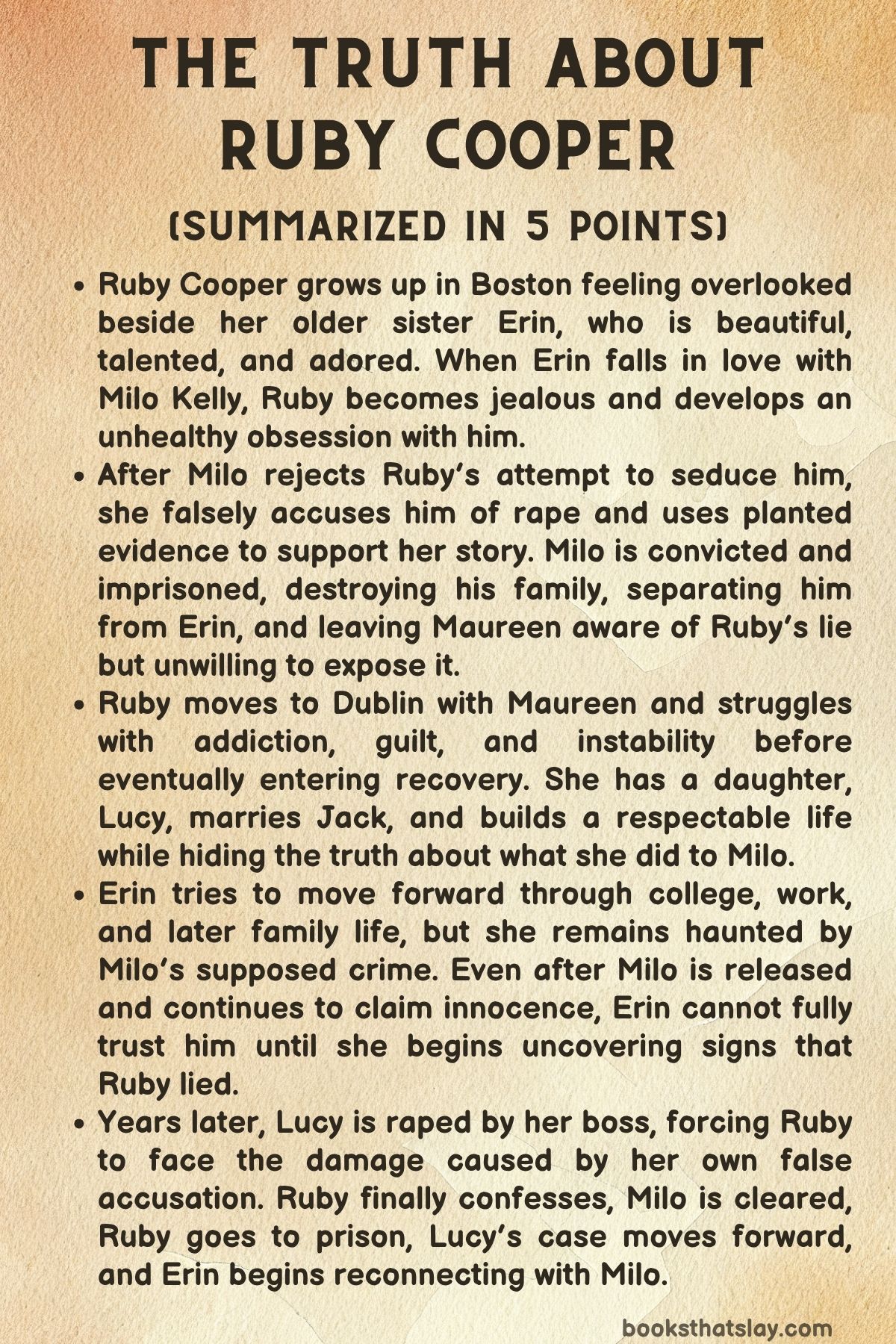
The Truth About Ruby Cooper by Liz Nugent is a dark psychological family drama about envy, lies, guilt, and the damage one false accusation can cause across generations. The story follows Ruby Cooper, a girl who grows up feeling lesser than her admired older sister, Erin.
Her jealousy turns dangerous when she falsely accuses Erin’s boyfriend, Milo, of rape, destroying his life and reshaping her family’s future. Years later, when Ruby’s own daughter becomes a victim of assault, the buried truth begins to rise. The novel examines shame, denial, loyalty, and the painful cost of delayed honesty.
Summary
Ruby Cooper grows up in Boston in a family that looks respectable from the outside but is full of quiet tension. Her father, Douglas Cooper, is both a pastor and an investment broker, a man admired by his church community and trusted by those around him.
Her mother, Maureen, is Irish and deeply homesick, never fully settled in America. Ruby’s older sister, Erin, is everything Ruby believes she is not: beautiful, clever, talented, and adored.
Erin shines in school, wins praise for her writing, and seems to move through life with a confidence Ruby cannot match.
Ruby’s insecurity hardens into jealousy. She watches Erin closely, measuring herself against her sister and always finding herself lacking.
When Milo Kelly enters their lives, Ruby’s jealousy becomes something more dangerous. Milo is from South Boston, poor but intelligent, gifted, and charming.
He joins the family’s church and wins Douglas’s approval. Erin falls in love with him, and the Coopers welcome him into their home.
To Erin, Milo is her great love. To Ruby, he becomes an obsession.
Ruby begins spying on Erin and Milo through a hole in the wall between the sisters’ bedrooms. She watches their private moments and convinces herself that she understands Milo in a way Erin does not.
Her desire for him is mixed with envy, resentment, and a need to prove that she can take something from Erin. Ruby wants Milo to want her, not because she truly loves him, but because winning him would mean defeating her sister.
During the summer, Ruby has sex with Kenny Carter, an older volunteer at Bible Camp. The encounter leaves her with a condom, which she later keeps.
This becomes central to the lie that changes everyone’s life.
In September 1999, Erin and Maureen are away celebrating Erin’s story being accepted by a literary journal. Ruby comes home from school and waits for Milo.
She has planned the moment carefully and intends to seduce him. When Milo arrives, Ruby throws herself at him.
Milo rejects her immediately. He is shocked, uncomfortable, and tries to get away from her.
In the struggle to remove himself from the situation, he accidentally injures her.
Ruby is humiliated. She had imagined power and victory, but instead she has been rejected.
Her embarrassment quickly turns into rage. Rather than accept what happened, she stages the scene to look like an assault.
She uses Kenny Carter’s semen as false evidence and tells her father that Milo raped her.
The accusation destroys Milo’s life almost instantly. He is arrested, and the Cooper family is thrown into crisis.
Erin refuses to believe Ruby at first. She reacts with fury, unable to accept that the boy she loves could have attacked her sister.
But the evidence appears to support Ruby’s claim. The DNA seems to prove that Ruby is telling the truth, and Erin is forced into the terrible position of choosing between her sister and Milo.
Eventually, she accepts that Milo must be guilty.
At the trial, Milo insists he never touched Ruby. He says he is innocent, but the evidence is too strong.
He is convicted and sentenced to thirteen years in prison. His future is taken from him.
His family is devastated. His mother, broken by the disgrace and loss, later dies by suicide.
Erin loses the person she loved and is left emotionally damaged. Ruby’s lie spreads pain far beyond the moment in which she created it.
Maureen takes Ruby to Dublin after the scandal, presenting the move as a way to help her daughter recover. But before Milo is sentenced, Maureen discovers the truth from Ruby.
She learns that Milo did not rape her daughter. Still, Maureen hides what she knows.
Her silence is partly an attempt to protect Ruby, but it is also selfish. She wants to remain in Ireland, the place she has long missed, and exposing the truth would force the family to face everything they have escaped.
In Dublin, Ruby does not find peace. She becomes isolated and unstable.
Her guilt follows her, though she tries to bury it. She drinks heavily, uses drugs, and struggles through college.
Her life becomes chaotic, shaped by secrecy and self-destruction. After a suicide attempt in the River Liffey, Ruby enters rehab.
There, she begins the long process of getting sober, but she still does not publicly confess what she has done.
Ruby privately tells her grandmother that Milo was innocent. The confession is too much for the older woman, and the shock causes her to have a stroke.
Even this does not push Ruby into full honesty. She continues to live with the secret.
Ruby later discovers she is pregnant. The pregnancy becomes a turning point.
She gets sober and gives birth to a daughter, Lucy. Motherhood gives Ruby a reason to rebuild herself.
She returns to acting and begins creating a respectable life. She also forms a relationship with Jack, a recovering alcoholic and actor.
Jack becomes devoted to Lucy and raises her as his own. Ruby and Jack eventually marry, and to the outside world, Ruby appears to have survived her troubled past and built a stable family.
But her guilt never disappears. Beneath her sober, orderly life is the knowledge that Milo spent years in prison for something he did not do.
Ruby carries fear, shame, and a constant awareness that her life rests on a lie.
Meanwhile, Erin builds a life of her own. She goes to Harvard and later works in publishing, but she remains marked by what happened to Milo.
She receives threatening anonymous messages and believes they are from Milo’s sister, Margie. The harassment keeps the past alive and makes Erin feel unsafe.
Later, she learns that the threats and a violent abduction are connected not to Margie, but to Principal Bermingham, a figure who had become obsessed with Milo and the case.
When Milo is released from prison, he still insists that he is innocent. His return unsettles Erin.
She cannot easily face him, and she cannot trust him because she still believes Ruby’s accusation. Yet Milo’s actions after prison complicate her certainty.
He helps Erin’s troubled stepson, Nick, showing kindness and patience. Erin begins to see the man she once loved again, but the old accusation stands between them.
The truth remains hidden, and so does the possibility of repair.
Years later, the past returns through Ruby’s daughter. Lucy is raped by her boss, Simon Perry.
Jack believes Lucy immediately and supports her. Ruby, however, reacts in a way that shocks and wounds her daughter.
Overwhelmed by her own guilt, and terrified that Lucy’s assault is some kind of punishment for Ruby’s lie, she refuses to believe Lucy. Her denial is not based on evidence.
It comes from fear, shame, and the unbearable connection she sees between Lucy’s truth and her own false accusation.
Ruby relapses, and Jack throws her out. Her family begins to collapse under the weight of her failure to support her daughter.
Ruby eventually tells her AA sponsor, Nasrin, the truth about Milo. Nasrin understands the seriousness of what Ruby has done and warns her that she must confess publicly.
Ruby can no longer hide behind recovery, marriage, or motherhood. Sobriety without honesty is no longer enough.
At the same time, Erin begins to uncover the truth herself. She visits the old family house and discovers the hole Ruby used to spy on her bedroom years earlier.
This discovery changes everything. Erin finally understands that Ruby knew more than she ever admitted and that the story Ruby told about Milo was false.
Erin confronts Maureen, who admits that she knew Milo was innocent and chose to stay silent.
Ruby first tries to escape. She plans to flee to Australia, hoping to outrun the consequences as she has done before.
But after attending an AA meeting, she changes course. Instead of disappearing, she flies to Boston and goes to the police.
There, she confesses that Milo did not rape her and that she framed him.
The confession clears Milo’s name, but it cannot restore the years he lost. Ruby is prosecuted and sent to prison.
Her public life collapses, but for the first time, she is living without the central lie that shaped her adulthood. In prison, she remains sober, though she is not transformed into a saint.
She still shows flashes of jealousy toward Erin, especially as Erin reconnects with Milo.
Milo and Erin begin to find their way back to each other after years of pain and misunderstanding. Their reunion is not simple, because the damage Ruby caused cannot be erased.
Still, the truth gives them a chance to rebuild something that was stolen from them. Maureen returns to Boston, hoping to repair the relationships she damaged through silence and selfishness.
Lucy’s case against Simon Perry moves forward, supported by Jack and other victims. Unlike Milo, Lucy is not left alone.
Jack stands by her, and more women come forward. Ruby’s failure as a mother remains one of the story’s deepest wounds, but Lucy’s truth is no longer buried.
The Truth About Ruby Cooper ends with justice arriving late and imperfectly. Milo is cleared, but his lost years remain lost.
Erin gets the truth, but only after decades of grief. Lucy is believed by those who matter most, though her mother failed her when she needed support.
Ruby finally confesses, but her honesty comes only after immense damage has already been done. The novel shows how one lie can spread through families, courts, relationships, and generations, and how truth, even when delayed, still has the power to change what comes next.
Characters
In The Truth About Ruby Cooper, the characters are shaped by jealousy, silence, guilt, loyalty, and the long damage caused by one false accusation. Each major character carries a different part of the book’s moral weight, and together they show how one lie can destroy families, distort love, and continue harming the next generation.
Ruby Cooper
Ruby Cooper is the central and most morally complex character in the book. She grows up feeling overshadowed by Erin, whose beauty, intelligence, and talent make Ruby feel invisible inside her own family.
Ruby’s jealousy is not simple sibling rivalry; it becomes a deep emotional wound that shapes the way she sees herself and others. Her obsession with Milo grows out of envy, desire, and resentment.
Because Milo loves Erin, Ruby sees him not only as someone she wants but also as another person who confirms Erin’s superiority. Her secret spying through the hole in the wall shows how far her envy has already moved into obsession before the main tragedy occurs.
Ruby’s false accusation against Milo is the defining act of her life. It is impulsive, cruel, and devastating, but it also comes from humiliation and panic rather than careful long-term planning.
When Milo rejects her, Ruby cannot bear the shame of being unwanted, especially by someone who belongs emotionally to Erin. Her decision to use Kenny’s condom as false evidence shows both desperation and frightening calculation.
From that moment, Ruby becomes trapped inside her own lie. She ruins Milo’s life, breaks Erin’s heart, destroys Milo’s family, and forces her own family into a permanent state of secrecy and denial.
As an adult, Ruby is not presented as purely evil. Her guilt follows her into Dublin, where she becomes isolated, drinks heavily, uses drugs, and nearly destroys herself.
Her suicide attempt and later recovery show that the lie has damaged her too, even though she is responsible for causing the original harm. Motherhood gives her a chance to rebuild herself, and her love for Lucy appears genuine.
Her marriage to Jack and her sobriety suggest that she wants to become a better person, but her respectable adult life rests on an unrevealed crime. This makes Ruby tragic in a complicated way: she is both victim of her own emotional damage and perpetrator of a terrible injustice.
Ruby’s reaction to Lucy’s rape reveals the deepest consequence of her guilt. Instead of supporting her daughter, she sees Lucy’s suffering through the distorted lens of her own past lie.
She fears that Lucy’s accusation may mirror what Ruby once did to Milo, and this fear makes her fail as a mother at the moment Lucy needs her most. Ruby’s confession at the end is important because it finally breaks the silence that has protected her for years.
However, the book does not completely cleanse her character. Even in prison, her jealousy toward Erin still flickers, showing that Ruby’s remorse is real but incomplete.
She accepts punishment, but the emotional flaws that began the tragedy have not entirely disappeared.
Erin Cooper
Erin Cooper is Ruby’s older sister and one of the most wounded characters in the story. At the beginning, she appears to have everything Ruby wants: beauty, intelligence, confidence, talent, and Milo’s love.
Yet Erin is not simply the privileged sister. She is also a young woman whose life is shattered by a lie she is forced to believe.
Her love for Milo is sincere, and her first reaction to Ruby’s accusation is violent disbelief because she knows Milo deeply enough to feel that the accusation does not match him. This initial refusal to believe Ruby shows Erin’s loyalty, but the DNA evidence traps her emotionally and morally.
She eventually accepts Milo’s guilt because the evidence seems impossible to deny.
Erin’s tragedy lies in being separated from the truth for years. She loses the person she loves, but she also loses her ability to trust her own instincts.
Her emotional damage follows her into adulthood. Although she studies at Harvard and works in publishing, her outer success does not erase the wound left by Milo’s conviction.
Erin’s life becomes shaped by uncertainty, fear, and unresolved grief. The anonymous threats and later abduction deepen her trauma because she believes they are connected to Milo’s family and the past scandal.
This keeps her emotionally imprisoned long after Milo is physically imprisoned.
Erin’s relationship with Milo after his release is painful because love and distrust exist together. She is drawn to him, and his kindness toward Nick reminds her of his goodness, but she cannot fully return to him while she still believes he raped Ruby.
This conflict makes Erin a deeply sympathetic character. She is not cruel for doubting Milo; she is a person who has been manipulated by false evidence, family loyalty, and years of emotional conditioning.
Her discovery of the hole in the wall is a turning point because it finally allows her to see the past clearly. The physical evidence of Ruby’s spying gives shape to something Erin may have sensed but could never prove.
By the end, Erin becomes a figure of painful survival and delayed justice. Her reconnection with Milo is not simply romantic closure; it is the restoration of a truth stolen from both of them.
Erin’s strength lies in her ability to face what her family hid from her, confront Maureen, and allow herself to believe Milo again. She represents the innocent person who was not directly accused but was still deeply punished by the lie.
Her life shows that falsehood does not damage only the person legally condemned; it also destroys love, memory, and trust.
Milo Kelly
Milo Kelly is one of the most tragic figures in the book because he is punished for a crime he did not commit. He begins as a poor but gifted boy from South Boston who earns the trust of the Cooper family and becomes part of their church circle.
His relationship with Erin is sincere and tender, and his acceptance into the family seems to offer him a path toward belonging and hope. This makes Ruby’s accusation especially devastating because Milo’s closeness to the family becomes the very thing that allows the lie to destroy him.
Milo’s rejection of Ruby is morally important. He does not exploit her vulnerability or respond to her advances.
Instead, he refuses her and tries to leave. The accidental injury that occurs while he is trying to get away becomes the opening Ruby uses to accuse him.
His innocence makes the trial especially painful because the evidence appears to speak louder than his truth. His insistence that he never touched Ruby cannot overcome the staged physical proof, and he is sentenced to thirteen years.
Milo becomes a victim not only of Ruby’s lie but also of a justice system that depends on evidence without understanding the deception behind it.
The consequences of Milo’s conviction extend beyond imprisonment. His mother’s suicide shows how completely the accusation destroys his family.
Milo loses his freedom, his reputation, his relationship with Erin, and the future he might have had. Even after release, he remains marked by the crime attached to his name.
His continued insistence on innocence shows emotional endurance, but it also reveals the loneliness of someone whose truth has been rejected for years. When he helps Nick, the book reminds readers that Milo’s essential decency has survived prison and public disgrace.
Milo’s eventual exoneration restores his name but cannot restore the years stolen from him. His character represents the human cost of false accusation: the lost youth, the broken family, the damaged love, and the permanent suspicion that follows even after release.
His reconnection with Erin is moving because it suggests the possibility of healing, but it cannot erase what happened. Milo is innocent, but he is not untouched.
His life has been permanently shaped by Ruby’s lie.
Maureen Cooper
Maureen Cooper is one of the most morally compromised characters in the book. As Ruby and Erin’s mother, she should protect both daughters and uphold the truth, but she chooses silence when she discovers Ruby lied.
Her decision is partly rooted in maternal protection, but it is also selfish. She wants to stay in Ireland and escape the public disgrace surrounding the family in Boston.
By hiding Ruby’s confession, Maureen allows Milo to remain condemned and Erin to remain emotionally devastated.
Maureen’s Irish identity and homesickness are important to her character. Before the scandal, she already longs for home, and Ruby’s supposed trauma gives her a reason to return to Dublin.
This makes her choice even more troubling because she uses the situation to satisfy her own desire for escape. Her silence is not a momentary failure; it becomes a years-long betrayal.
She protects Ruby from consequences, but in doing so she helps preserve a lie that continues to poison everyone’s life.
Maureen’s relationship with Ruby is complicated by knowledge and denial. She knows the truth, yet she continues to live as though the lie can be contained.
This makes her a symbol of family secrecy. She may believe she is protecting her child, but she is really helping Ruby avoid moral responsibility.
Her silence also betrays Erin, who builds much of her adult pain around a false belief. When Erin confronts Maureen, the emotional force of that moment comes from the fact that Maureen did not merely fail to see the truth; she saw it and chose to hide it.
Maureen’s later return to Boston suggests an attempt at repair, but the damage caused by her silence is enormous. She is not as directly guilty as Ruby, but she becomes an accomplice after the truth is revealed to her.
Her character shows how love without courage can become destructive. By choosing family protection over justice, Maureen helps turn one lie into a lifetime of suffering.
Douglas Cooper
Douglas Cooper, Ruby and Erin’s father, represents public respectability and private failure. As a pastor and investment broker, he holds positions associated with morality, trust, guidance, and authority.
This makes the family scandal especially powerful because it strikes at the heart of his public image. When Ruby accuses Milo, Douglas responds as a father who believes his daughter and wants justice for her.
From one perspective, his reaction is understandable. A parent’s instinct is to protect a child who claims to have been harmed.
However, Douglas’s authority also contributes to the weight of the accusation. Because he is respected, his belief in Ruby strengthens the case against Milo socially and emotionally.
He becomes part of the machinery that condemns an innocent young man, even though he does not know Ruby is lying. His tragedy is different from Maureen’s because he appears to act from ignorance rather than concealment.
Still, his position in the church and community means that his trust in Ruby has serious consequences.
Douglas also reflects the fragility of moral certainty. As a pastor, he likely believes in truth, justice, and righteousness, yet his family becomes built around falsehood.
The scandal exposes the limits of his ability to guide or protect those closest to him. He cannot save Erin from heartbreak, cannot see through Ruby’s deception, and cannot prevent the destruction of Milo’s life.
His character is important because he shows how a respected moral figure can still be powerless inside his own home.
Lucy
Lucy, Ruby’s daughter, is crucial because her suffering forces the past to return. She is born after Ruby’s darkest period and becomes part of Ruby’s attempt to rebuild her life.
For Ruby, Lucy represents hope, sobriety, motherhood, and a second chance. Yet Lucy also becomes the person most harmed by Ruby’s unresolved guilt.
When Lucy is raped by Simon Perry, she needs belief, protection, and emotional safety. Jack gives her that support immediately, but Ruby fails her.
Lucy’s role in the book is not simply to repeat Ruby’s past. Instead, her experience exposes the difference between a false accusation and a real one.
Ruby once lied about being assaulted, and Lucy later tells the truth about being raped. The moral force of Lucy’s character comes from this contrast.
Her pain is real, but Ruby’s guilt prevents her from seeing it clearly. Ruby’s refusal to believe Lucy is one of the most painful consequences of the original lie because it shows that Ruby’s crime has damaged her ability to respond morally even to her own daughter.
Lucy also represents generational harm. She did not know the full truth of Ruby’s past, yet she suffers because of it.
Ruby’s secret creates emotional blindness, and that blindness wounds Lucy at a moment of extreme vulnerability. Lucy’s case against Simon, supported by Jack and other victims, gives her a path toward justice that Milo was denied for many years.
Her character therefore helps bring the story’s moral structure full circle: the truth must be faced, not buried.
Jack
Jack is one of the most decent and stabilizing characters in the book. As a recovering alcoholic and actor, he understands weakness, relapse, and the long process of rebuilding a life.
His relationship with Ruby gives her a chance at love and respectability after addiction and self-destruction. He becomes a devoted father to Lucy, not merely a stepfather or guardian figure, and his commitment to her is one of the clearest signs of goodness in the story.
Jack’s most important moral quality is that he believes Lucy immediately. Where Ruby hesitates because of her own guilt, Jack responds with trust and protection.
This contrast reveals the difference between someone who has faced his past honestly and someone who has built her life around concealment. Jack’s recovery gives him humility, but it also gives him clarity.
He knows that denial is dangerous, and he refuses to let Ruby’s denial harm Lucy further.
When Jack throws Ruby out, his action is harsh but morally understandable. He is protecting Lucy from a mother who has failed her.
Jack’s love for Ruby does not make him excuse her behavior. This makes him an important counterweight to Maureen, who protected Ruby at the expense of justice.
Jack chooses the vulnerable victim over the person he loves romantically, and that choice makes him one of the strongest moral figures in the book.
Milo’s Mother
Milo’s mother is a smaller character, but her fate gives emotional depth to Milo’s suffering. Her suicide shows that Ruby’s lie does not harm only Milo and Erin; it devastates an entire family.
For a mother to see her son publicly accused, convicted, and imprisoned for a terrible crime would be unbearable, especially when he insists he is innocent. Her death becomes one of the clearest examples of collateral damage.
She also represents the voiceless victims of scandal. The legal case focuses on Ruby and Milo, while the emotional destruction spreads outward.
Milo’s mother carries shame, grief, helplessness, and public judgment until she can no longer survive it. Her role reminds readers that falsehood can kill indirectly, through despair and social ruin.
Kenny Carter
Kenny Carter is important because he becomes part of the mechanism Ruby uses to frame Milo. He is the older Bible Camp volunteer with whom Ruby loses her virginity.
His relationship with Ruby reveals her vulnerability before the accusation, but it also gives her the physical evidence she later uses. The kept condom becomes the tool that makes her lie believable.
Kenny’s presence also complicates Ruby’s character. Her sexual experience with him is hidden, and the secrecy surrounding it gives her a way to manipulate the truth.
Although Kenny is not the central villain of the story, his role exposes the risky and confused emotional world Ruby inhabits before Milo’s rejection. He is connected to Ruby’s desire to be seen, desired, and treated as adult, even though her actions reveal immaturity and emotional instability.
Margie Kelly
Margie Kelly, Milo’s sister, is important because she becomes a symbol of Erin’s fear and guilt. Erin believes the threatening anonymous messages are from Margie, which shows how the past continues to haunt her.
Even when Margie is not responsible for everything Erin imagines, the suspicion makes emotional sense within the damaged world created by the trial. Erin expects hatred from Milo’s family because, from their perspective, the Coopers helped destroy Milo.
Margie’s role also shows how families are pulled into the consequences of accusation and conviction. Like Milo’s mother, she belongs to the circle of people harmed by Ruby’s lie.
Her imagined anger is believable because the Kelly family has every reason to feel betrayed and ruined. Even when the harassment is later connected elsewhere, Margie remains important as a figure of the bitterness and grief left behind by the case.
Principal Bermingham
Principal Bermingham is a disturbing character because his obsession with Milo and the case adds another layer of danger to the story. Erin believes the threats and violence are connected to Margie, but the truth reveals something more unsettling.
Bermingham’s involvement shows how public scandals attract unhealthy fascination from outsiders who twist other people’s suffering into private obsession.
His character expands the book beyond the immediate family tragedy. Ruby’s lie creates a public narrative around Milo, and that narrative becomes something others consume, distort, and act upon.
Bermingham’s obsession suggests that once a person is publicly marked by scandal, their identity can be taken over by the fantasies and judgments of others. He is not responsible for the original injustice, but he feeds on the world that injustice created.
Nick
Nick, Erin’s troubled stepson, plays an important role in revealing Milo’s character after prison. Through Nick, the book shows that Milo has retained compassion and patience despite what happened to him.
Erin’s reaction to Milo helping Nick is emotionally significant because it forces her to confront the possibility that Milo is still the good person she once loved.
Nick also reflects the theme of damaged young people needing guidance. His troubles give Milo a chance to act with kindness rather than bitterness.
For Erin, this creates emotional conflict. She sees evidence of Milo’s goodness, but she is still trapped by the belief that he harmed Ruby.
Nick therefore becomes a bridge between past and present, helping expose the gap between Milo’s supposed crime and his actual character.
Simon Perry
Simon Perry is the clearest predatory figure in the book because he rapes Lucy and abuses his position as her boss. Unlike Milo, who is falsely accused, Simon is truly guilty.
This contrast is central to the book’s moral design. The story does not suggest that accusations should be dismissed; instead, it shows the terrible damage caused both by false accusation and by disbelief toward real victims.
Simon’s role forces Ruby’s hidden guilt into the open. Lucy’s accusation should receive immediate support, but Ruby’s past makes her respond with suspicion and fear.
Simon therefore becomes the trigger that exposes the unresolved consequences of Ruby’s lie. His abuse also connects Lucy to other victims, showing that predatory behavior often exists within a wider pattern.
The case against him offers a form of justice that Milo was denied for years.
Nasrin
Nasrin, Ruby’s AA sponsor, is a voice of moral clarity. As someone connected to Ruby’s recovery, she understands confession, accountability, and the danger of secrets.
When Ruby tells her the truth about Milo, Nasrin does not allow her to hide behind guilt or fear. She tells Ruby that the truth must be revealed, and this makes her one of the few characters who responds to Ruby’s confession with direct ethical firmness.
Nasrin’s role is important because she represents the recovery principle that sobriety cannot be separated from honesty. Ruby may have stopped drinking, but her life is still spiritually and morally unstable because it rests on concealment.
Nasrin sees that Ruby’s secret is not merely a private burden; it is an ongoing injustice. Her guidance helps push Ruby toward confession, making her a quiet but essential force in the final movement toward truth.
Ruby and Erin’s Grandmother
Ruby and Erin’s grandmother is a minor but emotionally important character. When Ruby privately confesses that Milo was innocent, the shock causes her grandmother to have a stroke.
This moment shows how unbearable the truth is when it finally surfaces, even in a private setting. The grandmother’s body reacts to the moral horror that the family has buried.
Her character also represents an older family conscience. Ruby’s confession to her is not a public act of justice, but it is one of the first times Ruby allows the truth to leave her own mind.
The grandmother’s stroke shows that truth has consequences even before it reaches the legal system. Her suffering adds another layer to the book’s pattern of innocent people being harmed by Ruby’s lie.
Themes
Jealousy and the Damage It Creates
Ruby’s jealousy begins as a private emotion but grows into the force that destroys many lives. Her resentment toward Erin comes from feeling less admired, less beautiful, and less valued within her own family.
Instead of accepting these feelings or expressing them honestly, Ruby lets them harden into bitterness. Her obsession with Milo is also tied to this jealousy, because he represents something Erin has that Ruby wants to take for herself.
When Milo rejects her, Ruby’s humiliation turns into revenge, and her lie becomes a way to punish both him and Erin. What makes this theme powerful is that jealousy is shown not as a passing weakness but as something that can become morally dangerous when it is fed by insecurity.
Even after years have passed, Ruby still measures herself against Erin, proving that her confession and punishment do not fully erase the emotional pattern that began in childhood. Jealousy damages Ruby most of all because it traps her in comparison and prevents real peace.
Guilt, Silence, and Moral Responsibility
Guilt follows Ruby through almost every stage of her life, but for a long time it does not lead to truth. She knows Milo is innocent, yet she protects herself by staying silent and allowing others to suffer the consequences of her accusation.
Her guilt appears in addiction, fear, emotional instability, and her inability to fully trust the life she has built. Maureen’s silence deepens this theme because she also knows the truth but chooses comfort, protection, and escape over justice.
The novel shows that guilt without action is not enough; feeling bad does not repair harm. Ruby’s private suffering cannot balance Milo’s imprisonment, Erin’s grief, or the damage done to both families.
Only when Ruby finally confesses does guilt become responsibility. In The Truth About Ruby Cooper, silence is presented as an active moral choice, not a neutral absence of speech.
By hiding the truth, Ruby and Maureen help the lie survive for years, proving that responsibility belongs not only to the person who commits harm but also to those who allow it to continue.
Belief, Doubt, and the Search for Truth
The story repeatedly questions how people decide what to believe, especially when evidence, emotion, and loyalty conflict. Erin initially refuses to accept Ruby’s accusation because she knows Milo intimately and trusts his character.
However, the DNA evidence forces her to accept a version of events that feels impossible to her heart but undeniable to her mind. This conflict shows how truth can be buried when false evidence appears more convincing than personal knowledge.
Ruby’s lie succeeds because it fits into a system that relies on proof, testimony, and public trust, even when those things are manipulated. Years later, Lucy’s assault creates a painful reversal.
Ruby’s guilt makes her doubt her own daughter, not because Lucy is unreliable, but because Ruby sees the situation through the shadow of her own lie. The theme becomes especially complex because the story does not suggest that accusations should be dismissed; instead, it shows how one falsehood can poison trust and make real victims suffer further.
Truth finally emerges through courage, confrontation, and the willingness to face painful evidence.
Addiction, Recovery, and the Possibility of Change
Addiction in the story is closely connected to shame, trauma, avoidance, and the need to escape memory. Ruby drinks and uses drugs because sobriety forces her to face what she has done.
Her suicide attempt, rehab, and later recovery show that addiction is not treated as simple weakness but as part of a larger emotional collapse. Jack’s recovery also adds depth to this theme because he represents a steadier version of change, built through honesty, discipline, and daily responsibility.
Ruby’s sobriety allows her to become a mother, return to acting, and create a stable family life, but the hidden lie means her recovery remains incomplete. When Lucy is assaulted, Ruby’s relapse reveals how fragile healing can be when it rests on secrecy.
The story suggests that true recovery requires more than avoiding substances; it demands moral honesty. Ruby’s final confession does not make her innocent, but it does mark a real step toward change.
Her imprisonment shows that transformation does not remove consequences, yet it can begin when denial finally ends.