American Rust Summary, Characters and Themes
American Rust by Philipp Meyer is a bleak, character-driven novel set in a declining steel town in Pennsylvania’s Mon Valley. The book follows Isaac English, a brilliant but trapped young man, and Billy Poe, his loyal but impulsive friend, after one violent moment in an abandoned machine shop changes both their lives.
Around them are parents, lovers, and local officials who are also caught between duty, shame, survival, and old mistakes. American Rust is about poverty, broken industry, family obligation, and the hard choices people make when hope has almost run out.
Summary
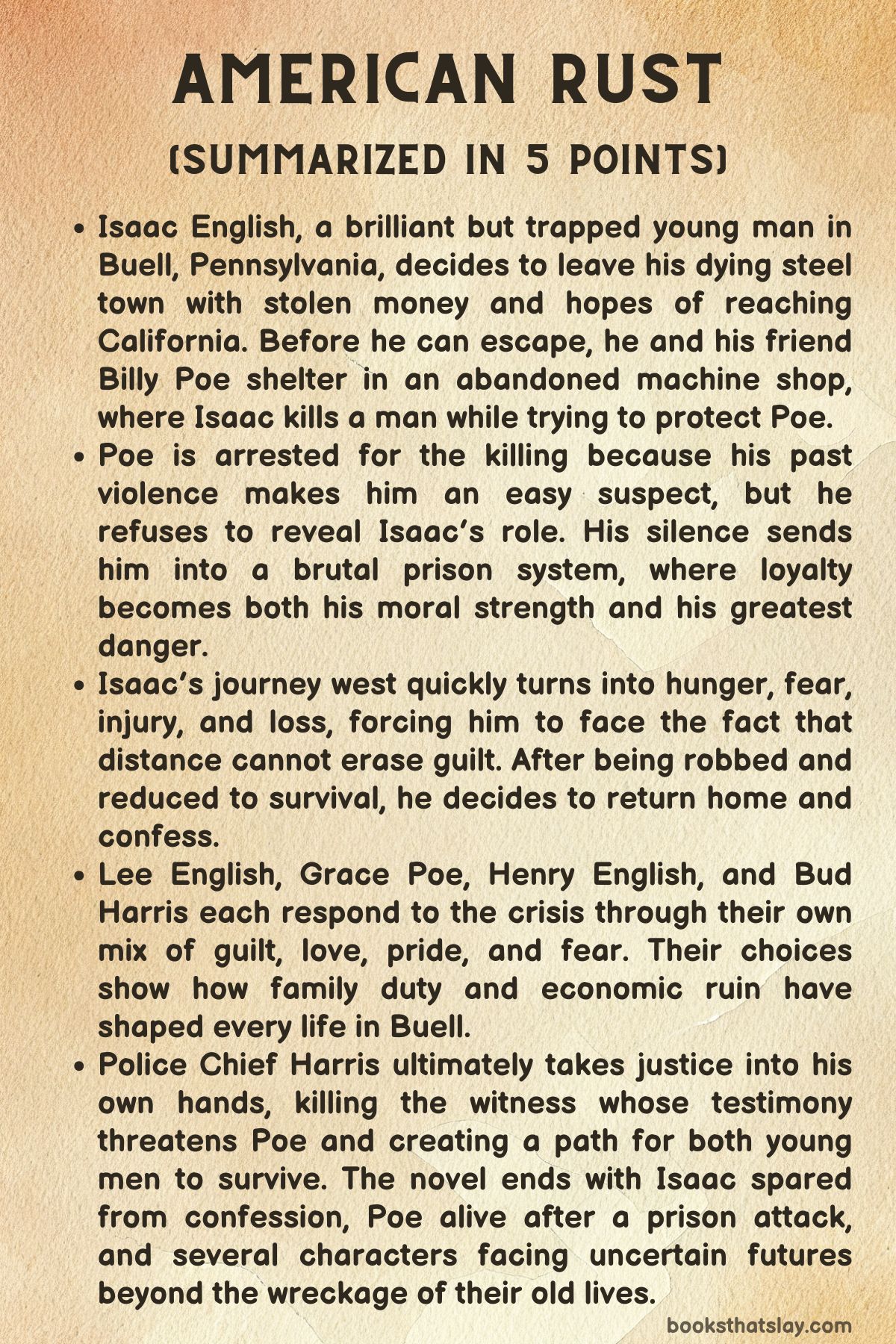
The book begins in Buell, Pennsylvania, a town shaped by the collapse of the steel industry. Isaac English, a gifted twenty-year-old who once seemed destined for a larger life, decides to leave.
He has stolen money from his disabled father’s pension and plans to reach California, where he imagines getting an education and starting over. His father, Henry, has a broken spine and depends on Isaac for care, but Isaac feels that staying has slowly destroyed him.
His mother’s suicide years earlier still haunts him, and his sister Lee’s escape to Yale and marriage into wealth make his own stalled life feel even smaller.
Before leaving, Isaac goes to see his best friend, Billy Poe. Poe was once a star athlete, but his future has narrowed to drinking, odd jobs, and memories of what he might have been.
Isaac wants Poe to come west with him. Poe thinks the plan is foolish but agrees to walk with him to the rail yard.
On the way, they shelter from rain in an abandoned machine shop. Three men arrive, and the situation turns dangerous.
One of them threatens Poe with a knife and assaults him. Isaac finds a heavy ball bearing and throws it at another man, Otto, striking him in the face.
Otto collapses, and Isaac and Poe flee, believing Isaac may have killed him.
The two young men separate in fear and confusion. Poe returns home freezing, ashamed, and shaken.
His mother, Grace, finds him nearly unconscious under a tree and brings him inside. Poe remembers that his letter jacket, marked with his name, is still in the machine shop.
He decides to return and remove the evidence. Isaac also returns home, terrified of what he has done and unable to face Lee, who has come back to help arrange care for Henry.
When Isaac and Poe go back toward the machine shop, they find Police Chief Bud Harris already watching the area.
Harris has discovered Poe’s jacket and hidden it. He suspects Poe was involved, partly because Poe has a history of violence and past trouble with the law.
Harris has known Grace for years and has often protected Poe and his father Virgil from the full consequences of their actions. He is not a simple officer of the law; he believes judgment matters more than strict rules.
He questions the boys but lets them go, hoping to control the situation. Isaac grows convinced the police will eventually discover the truth.
Lee drives Isaac and Poe home, and Poe’s old attraction to her returns. Lee is married to Simon, a wealthy man from Connecticut, but her marriage is strained.
She and Poe sleep together, both aware that their bond belongs to a past she has tried to leave. Isaac hears them and feels more alone than ever.
He decides to continue his escape, retrieves his backpack and money, and leaves Buell on foot.
As Isaac travels along rail lines and through dying towns, he is forced into the roughness of life outside his home. He is beaten by teenagers, goes hungry, washes in public bathrooms, hides from police, and struggles to keep moving west.
He reaches trains, rides through industrial landscapes, and meets a drifter called the Baron. The Baron seems helpful at first, but Isaac knows he is dangerous.
When the Baron steals Isaac’s money, Isaac chases him with a knife. A police officer sees them, and Isaac runs, abandoning his backpack and most of what he has.
His dream of escape breaks down into hunger, cold, exhaustion, and guilt.
Back in Buell, Poe is arrested. Harris tries to get him to explain what happened, warning that the district attorney may seek the harshest possible punishment.
Poe tells only part of the truth, refusing to name Isaac as the man who struck Otto. This loyalty becomes the center of Poe’s ordeal.
He knows he could save himself by giving Isaac up, yet he cannot bring himself to do it. He is sent to prison, where he quickly learns that survival depends on strength, alliances, and fear.
After fighting another inmate in the cafeteria, he is taken under the protection of white prison leaders, but that protection comes with a cost. They eventually demand that he attack a guard.
Poe is trapped: refusing could get him killed by inmates, while obeying could ruin any chance of release.
Grace, Poe’s mother, is devastated by his arrest. She blames herself for years of bad decisions, especially her repeated attachment to Virgil, Poe’s unreliable father.
She reaches out to Harris, hoping his affection for her will help save her son. Harris and Grace begin a strained romantic connection, but both know Poe’s case stands between them.
Grace wants Harris to act, though she never clearly states how far she wants him to go. Harris, already uneasy about the justice system, local politics, and the decline of the town, begins to believe that both Poe and Isaac may be worth saving outside the law.
Lee, meanwhile, tries to understand what happened. Poe tells her the truth about Isaac’s role, and she considers hiring lawyers and a private investigator.
Her loyalty is split between her brother, her marriage, her father, and the life she built away from Buell. Henry, proud and bitter, refuses easy help from Simon’s family but slowly realizes how much he used Isaac.
He once believed Isaac was strong enough to carry the burden of caregiving, but he now sees that he trapped his son. Near the end, Henry reflects on his wife’s death, his accident in the mill, and his failures as a father.
In prison, Poe is attacked after refusing to fit neatly into the system that demands violence from him. He is beaten and stabbed badly, ending up in the hospital, handcuffed to the bed but alive.
His refusal to betray Isaac nearly costs him his life.
Isaac, after suffering through his failed escape, decides to return to Buell and confess. He throws away his knife, rejecting the person he has become during his flight.
He walks back toward home, intending to tell Harris the truth and accept the consequences.
Before Isaac arrives, Harris takes drastic action. He tracks Murray Clark, a witness whose testimony threatens Poe, and goes to confront him.
The encounter turns violent. Harris kills Clark and another man, then disposes of evidence and returns injured but determined to shape the official story.
When Isaac reaches the police station and tries to confess, Harris stops him. He tells Isaac that the men from the machine shop have been found dead and that these new events may clear Poe.
Harris also tells Isaac that Poe never gave him up.
Isaac leaves the station with the chance to begin again, likely in Connecticut with Lee. Harris watches him go, believing he has saved both young men, though by committing crimes of his own.
Grace is told to leave Buell for her safety, and later Poe and Grace appear to be moving toward a different future after the destruction of their trailer. American Rust ends without simple justice.
Instead, it leaves its characters marked by guilt, loyalty, class, violence, and the uneasy hope that survival may still be possible after ruin.
Characters
Isaac English
Isaac English is one of the central figures in American Rust, and his character is defined by intelligence, guilt, fear, and a desperate need for escape. He is brilliant in a way that has never been properly nourished.
His success in school science fairs suggests a mind capable of serious achievement, but his life in Buell has turned that promise into frustration. He has spent years caring for his disabled father after his mother’s suicide and his sister’s departure, and this responsibility has left him emotionally trapped.
His decision to steal his father’s pension money and leave for California is morally wrong, but it also comes from a young man who believes he has no other path left.
Isaac’s violence in the machine shop is impulsive but not cruel. He acts to save Poe, and yet the result terrifies him because he cannot separate intention from consequence.
After striking Otto, Isaac’s mind turns inward, circling guilt and fear. His flight west becomes less a journey toward freedom than a test of endurance.
He is beaten, robbed, starved, and stripped of the romantic idea that leaving town will instantly make him new. His imagination often sustains him, but it also isolates him from practical judgment.
By the time he returns to confess, Isaac has changed. He is still afraid, but he has gained a harder understanding of responsibility.
His choice to come back shows that he is not only running from guilt; he is capable of facing it.
Billy Poe
Billy Poe is physically strong, emotionally loyal, and deeply damaged by his own sense of pride. He once had the possibility of a future through sports, but he allowed that future to fade.
His life after high school is marked by drinking, passivity, and a half-conscious belief that failure was always waiting for him. Poe is not unintelligent, but he does not trust himself in the world beyond Buell.
He understands cars, hunting, strength, and immediate action, but college and long-term planning feel distant to him.
Poe’s greatest virtue is loyalty, and his greatest flaw is the same quality when mixed with pride. After Isaac kills Otto while defending him, Poe refuses to reveal Isaac’s role.
He knows that telling the truth could save him from prison, but he cannot bring himself to trade Isaac’s life for his own. This silence gives him moral weight, even though his past violence makes it easy for others to believe he is guilty.
In prison, Poe’s body becomes both his protection and his curse. His strength helps him survive, but it also draws him into conflicts and gang politics.
He sees himself as trapped by fate, yet his refusal to betray Isaac is an active moral choice. Poe is a tragic figure because he is better than many people think, but not disciplined enough to save himself easily.
Lee English
Lee English represents escape, ambition, and unresolved guilt. She has done what Isaac wants to do: leave Buell and build a life elsewhere.
Her education at Yale and her marriage into wealth place her in a different social world, but she remains emotionally tied to the Valley. She understands the ugliness of the town’s decline, yet she also carries memories of family, youth, and desire that make her return complicated.
Lee’s character is full of contradictions. She wants to see herself as independent and morally serious, especially through her interest in law and social justice, but she also benefits from money and privilege through Simon’s family.
She feels guilty about leaving Isaac to care for Henry, but she has spent years protecting herself from the full weight of that guilt. Her affair with Poe reveals both nostalgia and selfishness.
Poe is part of the life she left behind, and being with him allows her to briefly recover an earlier version of herself. At the same time, she knows she cannot truly build a future with him.
Lee’s strongest quality is her willingness to act once she understands the danger Isaac and Poe face. She begins looking for lawyers and considers how to use her resources, showing that her guilt can become responsibility rather than mere regret.
Grace Poe
Grace Poe is shaped by exhaustion, poverty, frustrated desire, and fierce maternal devotion. She has spent much of her life accepting less than she wanted.
Her job sewing wedding dresses is physically painful and poorly paid, but it allows her to preserve some pride. Her trailer, her failed relationship with Virgil, and her anxiety over Poe all reflect a life where compromise has become survival.
Grace’s love for Poe is intense, but it is also tangled with guilt. She blames herself for his failures, believing that her choices in men and her inability to create stability helped shape his troubles.
Her relationship with Harris shows her longing for safety and tenderness, but also her willingness to use emotional intimacy as a way to protect her son. She never openly commands Harris to remove the threat against Poe, yet her desperation pushes him toward violence.
Grace is not simply a suffering mother; she is morally complicated. Her pain is real, but it can make her manipulative and blind to consequences.
By the end, she is broken by fear, hunger, and grief, yet her movement away from Buell with Poe suggests that survival may require leaving behind not just a place, but an entire pattern of dependence.
Bud Harris
Bud Harris is the lawman whose belief in flexible justice eventually carries him outside the law altogether. In American Rust, he stands between official order and private judgment.
He has spent years deciding which offenses matter, which people deserve mercy, and which rules can be bent. This makes him compassionate in some cases and dangerously arrogant in others.
He sees the damage caused by economic collapse, and he understands that many people in Buell are trapped by conditions larger than themselves. Because of this, he often believes strict punishment is useless.
Harris’s attachment to Grace and his sympathy for Poe and Isaac push him into a moral crisis. He knows Poe has been protected too often, yet he also sees that the present case is not as simple as it appears.
His decision to kill Murray Clark and another man is both an act of protection and an abuse of power. Harris convinces himself that he is saving two young men, but he does so by taking justice into his own hands.
His character raises difficult questions about whether mercy can remain moral when it depends on secrecy, violence, and personal preference. Harris is experienced, lonely, and perceptive, but he is also capable of rationalizing terrible acts when they fit his private code.
Henry English
Henry English is a proud, wounded father whose physical disability has hardened into emotional dependence. After the mill accident that breaks his spine, he becomes reliant on Isaac, though he rarely admits the cost of that reliance.
His bitterness comes partly from pain and partly from the collapse of the world he understood. The steel mill once gave men like Henry purpose, identity, and wages.
When that world fails him, he becomes trapped in his house and in his resentment.
Henry’s relationship with Isaac is central to his character. He knows his son is gifted, yet he keeps him close because he fears loneliness and helplessness.
He allows Lee to leave because he believes Isaac can bear more, but this belief becomes a form of exploitation. Near the end, Henry begins to understand that he has sacrificed Isaac’s future for his own survival.
His reflections on his wife’s suicide and his accident reveal a man who has avoided emotional truth for years. He is not without love, but his love is often buried under pride, self-pity, and silence.
His late recognition of Isaac’s worth is painful because it arrives after much damage has already been done.
Virgil Poe
Virgil Poe is a symbol of failed masculinity in a town where work, pride, and authority have eroded. He is charming enough to keep reappearing in Grace’s life, but he is unreliable, evasive, and selfish.
His unpaid child support and lack of steady responsibility show how often he has let Grace and Poe carry the burden of his choices. Yet Virgil is not presented as a grand villain.
He is more ordinary than that: a man who has learned to survive through avoidance.
His presence matters because Poe measures himself against him. Poe fears that trouble may be inherited, that his father’s weakness and his grandfather’s roughness have marked him in advance.
Virgil’s failure as a father leaves Poe without a stable model of adulthood. Grace’s repeated willingness to take Virgil back also teaches Poe that love and disappointment are often linked.
Virgil’s role is not large, but his influence is strong. He helps explain the emotional climate in which Poe grows up: unstable, proud, affectionate at moments, but never dependable.
Simon
Simon, Lee’s husband, represents the wealthy world beyond Buell, but he is not a simple image of rescue. His money gives Lee access to comfort, legal help, and distance from her family’s poverty.
Yet his marriage to Lee is strained by entitlement and infidelity. He offers a form of security that comes with emotional compromise.
Lee’s thoughts about him reveal how uncomfortable she is with the privileges she has accepted.
Simon matters because he sharpens Lee’s internal conflict. Through him, she can help Isaac and Henry in ways she could not manage alone, but accepting that help makes her feel dependent and morally compromised.
Her marriage also contrasts with her relationship with Poe. Simon offers status and stability; Poe offers memory, desire, and connection to her old life.
Neither relationship gives Lee a fully honest sense of herself. Simon is less emotionally central than Isaac, Poe, Grace, or Harris, but he helps expose the class tension at the heart of Lee’s choices.
Murray Clark
Murray Clark is important because he becomes the witness whose version of events threatens Poe. He is present at the machine shop and survives the original violence, making him a dangerous figure for everyone trying to control the story.
His testimony helps turn suspicion toward Poe, and because Poe refuses to name Isaac, Murray’s account gains power.
Murray’s role is less psychological than structural, but he is still morally significant. He stands for the unstable nature of truth in a desperate community.
What happened in the machine shop was chaotic, frightening, and morally unclear, yet the legal system requires a clean story with a clear guilty party. Murray helps provide that story, whether complete or not.
Harris’s later decision to confront and kill him shows how far the desire to protect Poe has moved beyond lawful action. Murray becomes a target not because he is the only guilty person, but because his existence threatens the fragile falsehood others need.
Otto
Otto is the man Isaac strikes with the ball bearing, and his death sets the entire crisis in motion. He appears only briefly, but his role is decisive.
To Isaac, Otto becomes less a person than an image of guilt. After the machine shop, Isaac repeatedly sees or remembers him, turning him into a figure of moral consequence.
Otto’s death forces Isaac to confront the difference between defending a friend and killing a man.
Because Otto is not deeply developed, the reader experiences him mostly through the fear and guilt of others. This is important.
The novel does not allow Isaac to escape responsibility simply because Otto seemed threatening. Isaac’s act may have saved Poe, but it also ended a life.
Otto’s limited presence makes him almost ghostlike afterward, haunting Isaac’s journey and shaping the choices of Poe, Harris, and Lee.
Steve Ho
Steve Ho, Harris’s deputy, acts as a contrast to Harris’s older, instinct-based approach to policing. Ho is more procedural, more militarized, and more visibly shaped by modern law enforcement habits.
Harris sometimes sees him as heavy-handed, but Ho also represents the pressure placed on police in communities where poverty and crime are rising while budgets shrink.
Ho’s role becomes especially important near the end, when he visits Grace and tells her she must leave. His action suggests loyalty to Harris, but also participation in the hidden machinery Harris has set in motion.
Ho is not developed as deeply as Harris, yet he helps show how institutions operate through people who may not fully understand or question the larger moral stakes. He is part of the system, but also part of Harris’s personal network of favors, warnings, and quiet interventions.
The Baron
The Baron is a drifter Isaac meets while trying to ride trains west. He seems at first like a guide to the world Isaac wants to enter, someone who understands movement, risk, and survival outside ordinary rules.
Yet he quickly becomes a threat. He watches Isaac’s money, pressures him, and eventually steals from him.
His presence destroys Isaac’s remaining illusions about escape.
The Baron functions as a test of Isaac’s judgment. Isaac wants to be independent, but he is inexperienced, physically weakened, and too trusting in some moments.
The Baron exposes how unprepared Isaac is for the life he imagined. When Isaac chases him with a knife and is seen by police, the scene marks the collapse of Isaac’s westward fantasy.
The Baron is not merely a thief; he is the figure who forces Isaac to see that running away can turn him into someone he does not want to become.
Themes
Economic Collapse and the Loss of Dignity
The ruined steel towns are not just background; they shape nearly every choice the characters make. In American Rust, the decline of industry has stripped Buell of more than jobs.
It has damaged pride, family structure, public trust, and the ordinary belief that effort will lead somewhere. Poe’s lost athletic future, Grace’s painful low-paid work, Virgil’s failure to provide, Henry’s broken body, and Harris’s shrinking police budget all belong to the same social wound.
People are not poor only because they lack money; they are poor because the systems that once gave them purpose have disappeared. The closed mills and decaying houses create a world where ambition feels almost foolish.
Isaac’s dream of leaving is powerful because staying seems like a slow surrender. Yet the novel does not romanticize escape either.
The outside world is also harsh, indifferent, and dangerous. Economic collapse becomes a moral pressure: it narrows choices until people mistake survival for freedom.
The characters make bad decisions, but those decisions grow from an environment where legal, emotional, and financial options have already been reduced.
Loyalty, Sacrifice, and Moral Debt
Loyalty in the novel is rarely clean. Poe’s refusal to expose Isaac is noble, but it also places him in extreme danger.
Isaac’s return to confess is honorable, but it comes only after Poe has already suffered for him. Grace’s loyalty to Poe is fierce, yet it pushes Harris toward violence.
Harris’s loyalty to Grace and the two boys leads him to commit murder while telling himself he is protecting the innocent. The story asks whether loyalty remains moral when it requires silence, deception, or harm to others.
Poe’s sacrifice is especially complex because it gives his life a purpose he has not found elsewhere. By protecting Isaac, he becomes the kind of man he wants to believe he can be.
Yet this same act nearly destroys him. Isaac owes Poe a moral debt that cannot be easily repaid.
Harris also sees himself as settling debts: to Grace, to Poe, to his own private idea of justice. The novel treats loyalty as both beautiful and dangerous.
It can save people from abandonment, but it can also blind them to truth and consequence.
Justice, Law, and Private Judgment
The legal system in the story is shown as necessary but deeply flawed. A court wants a clear offender, a clear motive, and a usable witness, but the truth of the machine shop incident is messy.
Isaac acted to protect Poe, Poe appeared more likely to be guilty because of his past, and Harris knew enough to distrust the official path. Harris’s character turns the theme of justice into a moral problem.
He believes that strict law often fails people in damaged communities, so he relies on instinct and personal judgment. At times, this makes him merciful.
He understands context, poverty, history, and fear. But his private code also becomes dangerous because it places too much power in one man’s hands.
Once Harris decides he knows who deserves saving, he gives himself permission to hide evidence, manipulate outcomes, and kill. The novel does not offer a simple answer.
Poe may be spared because Harris breaks the law, but that rescue is built on violence and lies. Justice becomes unstable when official systems are cruel, yet private judgment can become its own form of corruption.
Escape, Responsibility, and the Burden of Home
Isaac’s desire to leave Buell is not selfish in a simple sense. Home has become a place of illness, grief, and arrested growth.
His father needs him, his mother’s death haunts him, and Lee’s absence reminds him that escape was possible for someone else. Yet the novel questions whether leaving without responsibility can truly free a person.
Isaac steals from Henry and runs after Otto’s death, imagining distance as a solution. Instead, the road exposes him to hunger, violence, and fear.
The farther he goes, the more clearly he understands what he carries with him. Guilt cannot be left behind in a town.
Family cannot be erased by crossing state lines. Poe also dreams of escape through college, Lee, or a different life, but he remains bound by pride and loyalty.
Lee has physically escaped, yet emotionally she is still tied to Isaac, Henry, Poe, and Buell. Home is both prison and obligation.
The novel suggests that real freedom requires more than departure. It requires an honest reckoning with the people one has harmed, the duties one has accepted, and the truths one has avoided.