An Echo in the Bone Summary, Characters and Themes
An Echo in the Bone by Diana Gabaldon is the seventh novel in the Outlander series. It follows Claire and Jamie Fraser as their lives are shaped by war, family duty, old grief, and the pull of different centuries.
The story moves between the American Revolution and 1980s Scotland, where Brianna and Roger try to build a safe life while reading letters from the past. The novel expands the Fraser family story through William, Lord John Grey, Young Ian, Rachel Hunter, and others, showing how blood, loyalty, and history create hard choices across time.
Summary
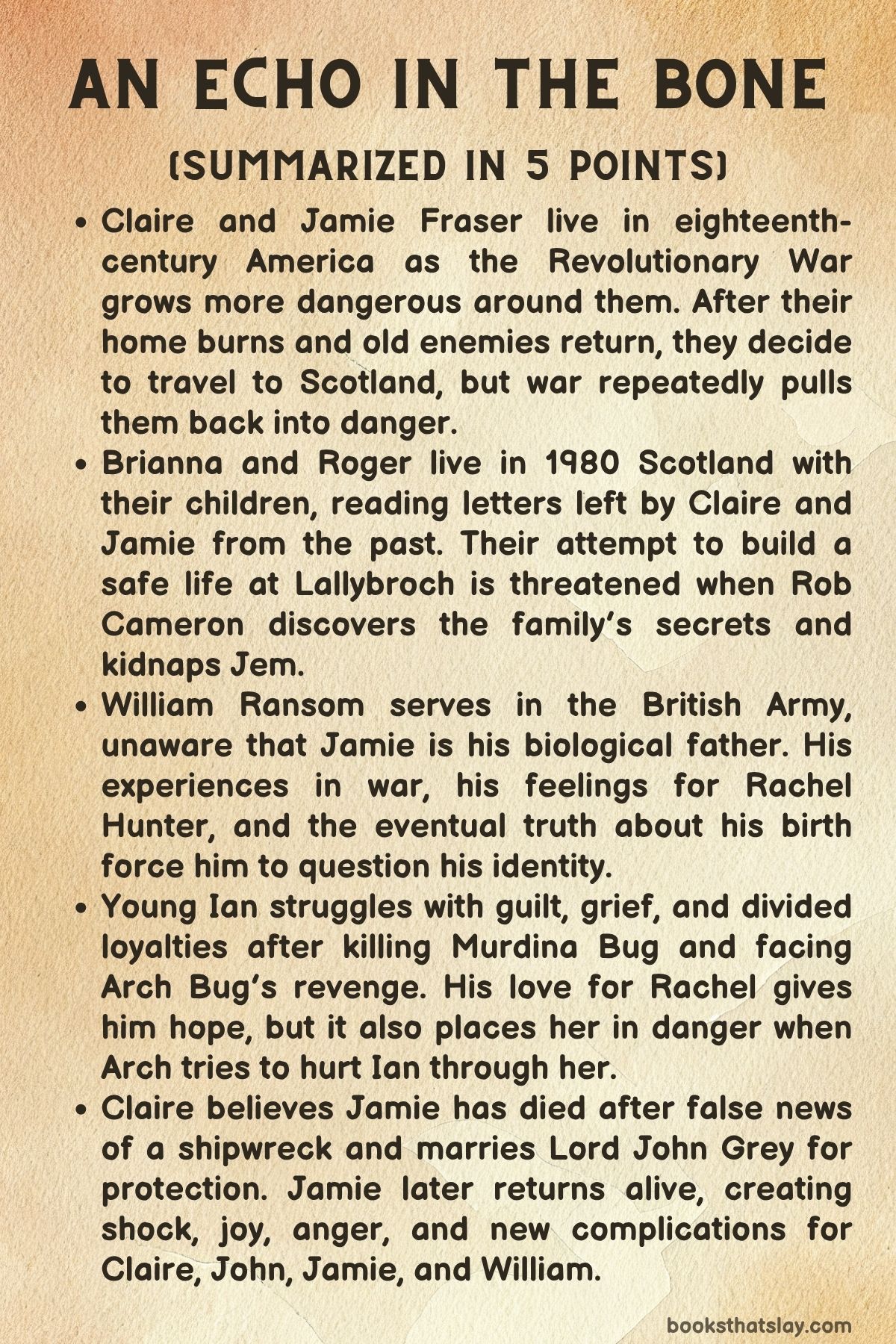
Claire and Jamie Fraser are living on Fraser’s Ridge in North Carolina during the early years of the American Revolution. Their home has burned, and although they survived, the fire destroyed much of what Claire needs for her medical work.
Their daughter Brianna, her husband Roger, and their children Jem and Mandy are back in 1980 Scotland, living at Lallybroch. Through a box of letters left by Claire and Jamie, Brianna and Roger learn what happened after they left the eighteenth century.
The first major crisis on the Ridge comes when Murdina Bug, wife of Arch Bug, tries to retrieve hidden Jacobite gold from beneath the ruins of the burned house. Jamie and Young Ian catch her, but she shoots Jamie, and Ian kills her with arrows.
Her death devastates Ian, who once saw Murdina as family. Arch Bug arrives later and, rather than accepting Ian’s offer of vengeance against himself, promises to wait until Ian has something worth taking.
This threat follows Ian through the novel.
Jamie wants to return to Scotland to recover his printing press, and Claire hopes the journey will also help Ian heal. Before they leave, Claire delivers Lizzie Beardsley’s baby and says goodbye to the Ridge.
Jamie, Claire, and Ian begin their journey, but their path soon becomes part of the war. In New Bern, they meet Tom Christie again.
Tom had once confessed falsely to murder to save Claire, and he reveals that he placed the false death notice about Claire and Jamie in the newspaper after believing they had died in the fire. That notice had helped bring Brianna and Roger back to the past, so even the mistake has lasting consequences.
Meanwhile, William Ransom, the young Ninth Earl of Ellesmere, serves in the British Army. He does not know that Jamie Fraser is his biological father, nor that Brianna is his half-sister.
Raised by Lord John Grey, William wants honor, rank, and a chance to prove himself. He joins military missions, sees the cruelty and confusion of war, and begins to understand that glory is not simple.
He witnesses Nathan Hale’s execution, gets lost in dangerous territory, and later survives the Great Dismal Swamp with help from Young Ian. Ian brings him to Denzell and Rachel Hunter, Quaker siblings who support the American side despite their pacifist background.
William is drawn to Rachel, though Ian also comes to love her.
Lord John Grey has his own complicated path. In London and later America, he investigates Percy Beauchamp, his former lover, who is involved in French political schemes.
Percy claims that Fergus Fraser may actually be Claudel, the lost son of the Comte St. Germain, and therefore heir to a French fortune. This possible inheritance could help support the American cause, but it also places Fergus and his family in danger.
John also worries over William and later over his wounded nephew Henry, who may die unless Claire can operate on him.
Jamie, Claire, and Ian’s voyage to Scotland is interrupted when their ship is stopped by a British vessel. Claire takes a desperate risk to avoid being separated from Jamie, and the conflict leads to a battle involving smugglers, privateers, British sailors, and American interests.
Jamie is badly wounded, but the group eventually reaches Fort Ticonderoga instead of Scotland. There, Claire works as a doctor despite resistance from male surgeons, while Jamie becomes involved with Continental forces.
At Ticonderoga, the American army prepares for a British attack. Claire meets Denzell Hunter and respects his medical skill.
Ian leaves to visit his former Mohawk wife, Emily, and learns that she has children with another man. This knowledge helps him release part of his old sorrow, especially when Claire explains that their childlessness was likely no one’s fault.
Ian names Emily’s young son, honoring the bond that still exists between them.
The war intensifies. The Americans evacuate Fort Ticonderoga, and Claire is captured for a time by the British.
William recognizes her from Fraser’s Ridge and quietly sends her supplies. Ian later comes to rescue her, reminding William that he owes him a life.
Jamie creates a diversion, and Claire escapes. As the campaign moves toward Saratoga, Jamie joins Daniel Morgan’s riflemen.
In battle, Jamie performs bravely and saves many men, but he is wounded and loses a finger. Claire operates on him and struggles with fear, anger, and love as she treats him.
William’s military experience grows darker. He sees the British army’s failures, the role of Indigenous fighters, the cost of defeat, and his own first killing.
At one point Jamie is ordered to shoot General Simon Fraser, a British officer and Jamie’s distant kinsman. Jamie aims away, unwilling to kill him, but accidentally shoots William’s hat off.
Another man mortally wounds General Fraser. On Fraser’s deathbed, Jamie and William are both present, though William still does not understand their connection.
Jamie gives William his own hat, shaken by how close he came to killing his son.
After Burgoyne’s surrender, Jamie is ordered to escort Simon Fraser’s body back to Scotland. This gives him the passage he wanted.
Ian, still in danger after killing a blackmailer who threatened Jamie, sneaks aboard. In Scotland, Jamie, Claire, and Ian return to Lallybroch and find Jamie’s brother-in-law, the elder Ian, dying.
The visit brings old pain to the surface. Jenny, Jamie’s sister, is furious that Claire cannot cure her husband.
Claire understands the limits of her knowledge, but Jenny’s grief makes forgiveness difficult.
Claire also faces Laoghaire, Jamie’s former wife, whose resentment still affects the family. When Marsali’s son Henri-Christian needs surgery in Philadelphia, Claire makes a hard bargain: she will help the boy if Laoghaire gives up her claim to Jamie’s alimony, marries the man she loves, and allows her daughter Joan to become a nun.
Claire leaves for America with Young Ian, while Jamie stays until the elder Ian dies. After Ian’s death, Jenny decides to go to America with Jamie.
In 1980, Brianna and Roger’s life at Lallybroch becomes dangerous. Roger struggles with faith and purpose, while Bree begins work as an engineer at a hydroelectric plant.
Their son Jem senses strange things around the estate, and the supposed monster he sees turns out to be William Buccleigh MacKenzie, Roger’s ancestor, who has accidentally traveled from the eighteenth century. Rob Cameron, a man connected to Bree’s workplace and Roger’s Gaelic class, discovers the family’s time-travel secret through Roger’s notes and Claire and Jamie’s letters.
He kidnaps Jem because Jamie’s letter says Jem knows where the hidden gold is. Roger and Buck travel through the stones to find him, while Bree learns that Rob has not gone through time at all.
Jem is locked in a dark hydroelectric tunnel, trying to survive and find his way out.
Back in 1778 Philadelphia, Claire reunites with Lord John and operates on Henry Grey and Henri-Christian. She also distributes revolutionary pamphlets.
Then John receives news that Jamie’s ship, the Euterpe, has sunk with no survivors. Believing Jamie dead, Claire is devastated.
When Richardson threatens to arrest her for sedition, John marries her to protect her and her family. Their grief over Jamie leads to a night of intimacy, born from shared loss rather than romance.
But Jamie is alive. He and Jenny missed the doomed ship and sailed on another vessel.
Jamie reaches Philadelphia and finds Claire at John’s house. At the same moment, William sees Jamie clearly and realizes that “Mac,” the man from his childhood, is his true father.
The revelation shatters his sense of identity. British soldiers arrive to arrest Jamie, and Jamie escapes by taking John hostage.
John admits to Jamie that he and Claire slept together while believing Jamie dead, leaving Jamie hurt, confused, and forced to face the strange bonds among the three of them.
The novel closes with several lives unsettled. William is furious and lost after learning the truth of his birth.
Claire remains bound to Jamie but changed by grief. Ian and Rachel finally confess their love after Arch Bug tries to kill Rachel in revenge; William kills Arch, ending that long threat.
Fergus’s possible noble inheritance remains unresolved. Brianna and Roger’s family is split by Rob Cameron’s greed and the danger of time travel.
An Echo in the Bone ends with love, blood ties, war, and time itself pulling the Fraser family into new crises.
Characters
Claire Fraser
Claire Fraser stands at the emotional and moral center of the book. She is a physician, a wife, a mother, a survivor, and a time traveler whose knowledge of the future gives her unusual power but also heavy limits.
Her medical skill allows her to save lives in situations where most people would be helpless, yet the book repeatedly shows that she cannot save everyone. This makes her both capable and vulnerable.
She treats soldiers, children, prisoners, and family members with the same fierce attention, but her work also exposes her to blood, death, and guilt. Claire’s modern mind often clashes with the eighteenth-century world around her, especially when men dismiss her medical authority or when war reduces people to bodies on beds and fields.
Her relationship with Jamie remains one of the strongest forces in the novel. Claire is not simply Jamie’s wife; she is his equal, his witness, and often his only safe place.
Their marriage has passion, tenderness, fear, anger, and long memory. When she believes Jamie has died, her grief nearly destroys her.
Her marriage to Lord John Grey is an act of survival, but the emotional aftermath shows how complicated love can become when loss, loyalty, and protection meet. In An Echo in the Bone, Claire is shown as a woman who has lived through more than one lifetime, yet still feels every wound freshly.
Jamie Fraser
Jamie Fraser is defined by loyalty, responsibility, and a deep awareness of what violence costs. He is a warrior, but he is not a man who takes war lightly.
His support for the American Revolution comes from his belief that people must fight for a future where their children can live with more freedom. At the same time, the book shows his discomfort with being forced into battles that may put him near his own secret son, William.
Jamie’s courage is not shown as simple fearlessness. It is shown through endurance, restraint, sacrifice, and the burden of making decisions that may cost other men their lives.
Jamie’s private self is just as important as his public one. He prays, doubts, grieves, and carries old trauma in silence.
His bond with Claire is the foundation of his emotional life, and his fear of not being enough for her reveals the insecurity beneath his strength. His return to Scotland exposes another side of him: the son, brother, friend, and kinsman who must face aging, death, family resentment, and the changed home of his youth.
His relationship with William is one of the most painful parts of the book. Jamie loves him but has no rightful place in his life, and when William finally learns the truth, Jamie cannot soften the shock.
He is a man of enormous feeling, but the world often gives him only harsh ways to express it.
Brianna MacKenzie
Brianna MacKenzie carries both her parents’ force of will. In the twentieth-century sections, she is trying to build an ordinary life at Lallybroch, but ordinary life is almost impossible for someone who knows that time is unstable and that her parents are living through the American Revolution.
Bree is practical, intelligent, and emotionally tough. Her work as an engineer shows her need for identity beyond motherhood and marriage, and her refusal to accept sexist treatment at the hydroelectric plant makes her one of the book’s clearest examples of modern confidence placed inside old systems of power.
Bree’s role as a daughter is equally important. Through Claire and Jamie’s letters, she maintains a relationship with parents who are alive in the past but absent from her daily life.
This creates a strange grief: she can read their words, worry about their dangers, and still be unable to reach them easily. As a mother, Bree becomes even more intense.
When Jem is taken, her strength shifts into survival mode. She is frightened, but she is not passive.
Her intelligence, anger, and courage make her a character who refuses to be treated as secondary, whether by men at work, danger at home, or history itself.
Roger MacKenzie
Roger MacKenzie is one of the book’s most inwardly conflicted characters. He is a husband, father, historian, musician, and former minister-in-training, but none of these identities fully settles him.
After the trauma of his near-hanging in the eighteenth century, he is physically and spiritually altered. His damaged voice affects his relationship with music, while his crisis of faith affects his understanding of vocation.
He wants to protect his family, but he also struggles with feeling useful in a life where Bree often seems more certain of her place.
Roger’s work on a guide to time travel shows his need to turn danger into knowledge. He wants to prepare his children for a reality they may one day have to face, but he is troubled by the moral questions that come with that knowledge.
His encounter with Buck MacKenzie forces him to confront ancestry not as an abstract historical idea, but as a living, flawed, alarming presence. When Jem is kidnapped, Roger’s protective love becomes urgent and physical.
His decision to go through the stones again shows that, despite doubt and fear, his deepest identity is rooted in family. Roger’s arc is about rebuilding faith, not only in God, but in himself.
Young Ian Murray
Young Ian Murray is caught between worlds. Born Scottish, shaped by his years with the Mohawk, and now moving through war-torn America, Ian carries multiple identities without fully belonging to any single one.
His killing of Murdina Bug wounds him deeply because it is both justified and emotionally unbearable. She was not simply an enemy; she was someone tied to his life at Fraser’s Ridge.
Arch Bug’s threat hangs over Ian afterward, making the idea of vengeance personal and unavoidable.
Ian’s emotional life is marked by loss and renewal. His visit to Emily, his former Mohawk wife, allows him to confront the grief of their failed marriage and the children they never had together.
Claire’s explanation that their losses were likely caused by biology, not blame, frees him from a burden he has carried for years. His love for Rachel Hunter becomes a new test of identity.
Rachel’s Quaker faith and Ian’s violent life seem impossible to reconcile, yet their bond grows through honesty, respect, and danger. Ian is one of the book’s most moving figures because he is both gentle and deadly, spiritual and practical, wounded and still open to love.
William Ransom
William Ransom begins as a young aristocratic soldier eager for honor, advancement, and a clear place in the world. He has been raised as Lord John Grey’s son and the Ninth Earl of Ellesmere, but his true parentage links him to Jamie Fraser.
Much of his story is about the slow collapse of certainty. He wants war to prove him, but war gives him confusion, moral discomfort, humiliation, fear, and guilt.
He is often sent on missions without fully understanding how he is being used, especially by Richardson. His pride makes him want importance, but his experiences keep showing him how little control he has.
William’s best qualities appear in moments of instinctive decency. He helps Claire when she is a prisoner, assists Ian in rescuing Denny, protects Rachel from Arch Bug, and struggles seriously with the meaning of killing.
His attraction to Rachel reveals his longing for moral clarity, though he is drawn to a woman whose values challenge his entire military life. The revelation that Jamie is his biological father is shattering because it changes not only his family history but his idea of himself.
In An Echo in the Bone, William becomes a young man forced to ask whether blood, upbringing, title, or action defines who he is.
Lord John Grey
Lord John Grey is honorable, controlled, intelligent, and emotionally burdened. His love for Jamie remains one of the most complicated facts of his life.
He does not expect Jamie to return that love, but it still shapes his loyalty to Jamie, Claire, William, and the wider Fraser family. John’s political position places him on the British side of the war, yet his personal attachments often cross enemy lines.
He is a man of duty, but the book shows that duty is never simple when love and secrecy are involved.
John’s care for William is central to his character. He has raised William and protected the secret of his birth, but he knows the truth may eventually cause pain.
His investigation into Percy Beauchamp and the mystery around Fergus shows his skill with intelligence, social networks, and guarded conversation. His marriage to Claire after the false report of Jamie’s death is one of the most revealing choices he makes.
It is practical, protective, and deeply loyal to Jamie’s memory. His later intimacy with Claire is not ordinary desire; it comes from shared grief and their mutual love for Jamie.
John is a character whose restraint hides enormous feeling.
Rachel Hunter
Rachel Hunter brings moral seriousness, warmth, and quiet strength into the book. As a Quaker, she is committed to peace, plain speech, and conscience, but she is not naïve.
Her decision to accompany her brother Denny into war zones after being cast out by their community shows that she understands goodness may require action that others misunderstand. Rachel’s faith is not decorative; it shapes how she sees violence, love, and personal responsibility.
Her relationships with William and Ian reveal different parts of her character. With William, she sees both danger and vulnerability.
She challenges his assumptions about killing and honor, refusing to let him romanticize violence. With Ian, she recognizes a man who has done violent things but is not ruled by cruelty.
Her love for Ian is brave because it asks her to accept a man outside the boundaries of her community and upbringing. Rachel’s compassion does not make her weak.
She faces Arch Bug with courage and tries to speak to the conscience of a man committed to revenge. Her strength lies in moral steadiness under pressure.
Denzell Hunter
Denzell Hunter is a doctor whose intelligence and conscience make him a natural ally for Claire. Like Rachel, he has been cast out by the Quaker community because of his support for the American cause.
This makes him a contradiction in the eyes of stricter pacifists: a man committed to healing who chooses to serve near an army. Yet Denny’s decision is rooted in the belief that refusing to help the wounded would be its own moral failure.
As a physician, Denny is open-minded, observant, and respectful of skill, which allows him to recognize Claire’s ability even when other men dismiss her. His assistance in difficult surgeries shows both courage and humility.
His romance with Dottie Grey adds another layer to his character. He is cautious because he understands what conversion, marriage, and war may cost her, but he is also sincere enough to accept love when it becomes clear.
Denny represents a form of goodness that is active rather than sheltered. He does not escape conflict by claiming purity; he enters suffering and tries to reduce it.
Lord William Buccleigh MacKenzie
Buck MacKenzie is a disturbing and fascinating presence because he comes from Roger’s past in more than one sense. He is Roger’s ancestor, but he is also connected to one of Roger’s worst traumas.
His sudden arrival in 1980 turns family history into something immediate and uncomfortable. He does not fully understand time travel at first, and his confusion gives him a rough vulnerability.
Yet his presence also reminds Roger and Bree that bloodlines do not guarantee trust, similarity, or safety.
Buck is not presented as a simple villain in this part of the book. He is unsettling, sometimes crude, and morally uncertain, but he is also displaced and frightened.
His existence raises questions about ancestry, inheritance, and whether people are bound by the sins or failures of those who came before them. Roger must decide how to treat a man who is both kin and reminder of harm.
Buck’s role becomes more important when Jem is taken and Roger needs help. He represents the past arriving without warning and demanding to be dealt with as a living person.
Rob Cameron
Rob Cameron appears at first as a workplace and community figure, but he gradually becomes one of the most dangerous characters in the twentieth-century storyline. He is charming enough to enter Bree and Roger’s social world, and he uses music, Gaelic, and shared local connections to make himself seem familiar.
His interest in Lallybroch and Roger’s materials is not innocent. Once he learns enough about time travel and the hidden gold, his greed turns predatory.
Rob’s kidnapping of Jem reveals a cold willingness to harm a child for profit. Unlike many characters whose violence is shaped by war, grief, or survival, Rob’s threat is rooted in selfish ambition.
He wants access to wealth he has no right to claim, and he is prepared to terrorize Bree’s family to get it. His character also shows how danger in the book does not belong only to the eighteenth century.
Even in 1980, with modern work, schools, phones, and cars, Bree and Roger’s family remains exposed to old forms of greed and coercion.
Arch Bug
Arch Bug is a figure of revenge, patience, and bitterness. After Murdina’s death, he does not seek immediate satisfaction.
Instead, he waits for a moment when Ian has something precious to lose. This makes him more frightening than a man ruled by sudden rage.
Arch’s grief hardens into a mission, and he gives himself permission to destroy an innocent person in order to wound Ian.
His pursuit of Rachel shows the moral emptiness of vengeance when it becomes detached from justice. Rachel did not kill Murdina and has no part in the old conflict, but Arch sees her value to Ian and therefore marks her as a target.
His view of vengeance as duty reveals how completely grief has corrupted him. Arch is not without human motivation; he loved his wife and suffered loss.
But the book makes clear that suffering does not excuse the choice to spread suffering. His death at William’s hands closes one line of danger while also pushing William further into the painful reality of killing.
Fergus Fraser
Fergus Fraser is central to one of the book’s political and family mysteries. Raised as Jamie’s adopted son, Fergus has built his life around family, printing, and survival.
The possibility that he may be Claudel, the lost son of the Comte St. Germain, challenges the story he has accepted about himself. Yet one of Fergus’s most important qualities is that he already knows where his true belonging lies.
When Jamie asks whether he wants to pursue the possibility of noble birth, Fergus’s answer makes clear that Jamie has already given him the fatherhood he once dreamed of finding.
Fergus’s role as a printer also places him in danger. Words matter in this novel, and printing is a political act.
His newspaper work exposes him to both Loyalist and Revolutionary suspicion. Through Fergus, the book connects identity, class, inheritance, and public speech.
He may have aristocratic blood, but his true character is shaped by loyalty, wit, resilience, and devotion to Marsali and their children.
Marsali Fraser
Marsali Fraser is practical, fierce, and family-centered. As Fergus’s wife and Claire’s stepdaughter, she belongs to the extended Fraser family in a way that is earned through years of loyalty.
Her household in Philadelphia becomes one of the places where the personal and political pressures of the war meet. She is raising children, protecting her family, and managing danger while Fergus’s printing work places them under suspicion.
Marsali’s son Henri-Christian brings out the fear and tenderness in her character. His medical needs require Claire’s help, and Marsali must endure the terror of a dangerous surgery in a world where childhood survival is never guaranteed.
Marsali is not always at the front of the action, but her presence reminds the reader that war affects families not only through battlefields, but through illness, hunger, fear, secrecy, and the daily work of keeping children alive.
Jenny Murray
Jenny Murray is one of the strongest family figures in the Scottish sections of the book. She is sharp-tongued, proud, loving, and difficult, especially when grief overwhelms her.
Her husband’s slow death breaks open old tensions with Claire. Jenny knows what Claire is capable of, and because she loves Ian so deeply, she cannot easily accept that Claire cannot save him.
Her anger is unfair, but it is emotionally understandable because it comes from helplessness.
Jenny’s relationship with Jamie is equally rich. They share childhood, loss, and the burden of family history.
Their reunion is not simple comfort; it includes old wounds, accusations, and the need for forgiveness. After Ian’s death, Jenny’s decision to go to America shows that she is not finished living.
She is a woman shaped by home, but not trapped by it. Her grief changes her, yet it does not end her capacity for movement, loyalty, or courage.
Elder Ian Murray
The elder Ian Murray represents steadiness, friendship, and quiet honor. His approaching death gives the Scottish section of the book much of its emotional weight.
As Jamie’s brother-in-law and lifelong friend, he understands Jamie in ways few people can. Their conversations near the end of his life are tender, humorous, and deeply rooted in shared history.
Ian’s acceptance of death is not empty bravery; it comes from faith, love, and a clear understanding that his life has mattered.
His relationship with Young Ian is equally important. He helps his son release guilt over Murdina’s death and encourages him to seek happiness with Rachel.
Even while dying, he remains a father who wants his child to live fully. His promise to keep Jamie’s amputated finger until they meet again is strange, funny, and moving, capturing the book’s mixture of bodily reality and spiritual hope.
Elder Ian’s death is painful because he is one of the story’s clearest examples of goodness without vanity.
Laoghaire MacKenzie
Laoghaire is shaped by bitterness, humiliation, and frustrated longing. Her history with Jamie and Claire has left her resentful, and she continues to see herself as wronged.
She clings to Jamie’s alimony not only for practical support but as a symbol of old injury. Her anger toward Claire and Jamie is often harsh, yet the book also shows that her life has not been emotionally simple.
Her relationship with Joey gives her a possible future, but she resists marriage because it would mean giving up her financial claim on Jamie. Claire’s bargain forces Laoghaire to choose between resentment and freedom.
Laoghaire is not presented as an easy person to admire, but she is understandable as someone who has allowed old wounds to become a way of life. Her arc asks whether a person can step out of grievance when doing so requires surrendering the last visible proof of being hurt.
Percy Beauchamp
Percy Beauchamp is secretive, charming, and politically dangerous. His past relationship with Lord John Grey gives their scenes emotional tension, but Percy’s present motives are difficult to trust.
He moves through networks of French influence, smuggling, espionage, and sexual politics. His claim that Fergus is the heir of the Comte St. Germain may be true, but his reasons for revealing it are tied to larger political goals.
Percy’s character is built on ambiguity. He may be helping the American cause, serving French interests, seeking power, or trying to repair something from his own past.
His assumed name also connects him uneasily to Claire’s family name, creating another layer of uncertainty. Percy is not a straightforward enemy, but he is never fully safe.
He represents the world of hidden motives operating behind public war.
Captain Richardson
Captain Richardson is one of the book’s most manipulative figures. He uses William for intelligence work while keeping him poorly informed, which places William in danger and makes him a tool of larger schemes.
Richardson’s calm, official manner hides a willingness to exploit youth, ambition, and social connection. His actions suggest that he understands how to move people like pieces on a board.
His later threat to arrest Claire for distributing revolutionary pamphlets shows his political ruthlessness. Richardson does not need to be loud or openly cruel to be dangerous.
His danger comes from access, information, and timing. He operates inside institutions, using rank and procedure as weapons.
In a novel full of battlefield violence, Richardson represents a quieter form of harm: the calculated use of people for political ends.
Tom Christie
Tom Christie is a character marked by severe faith, emotional repression, and unexpected devotion. His love for Claire is one of the more surprising emotional threads in the book.
He once saved her by falsely confessing to murder, and his reappearance confirms that his feelings were not passing or shallow. When he believed Claire dead, he placed the notice that later changed the course of Brianna and Roger’s lives.
Tom’s kiss unsettles Claire, not because he is a villain in that moment, but because touch, memory, trauma, and love are complicated for her. Tom is not Jamie’s equal in Claire’s heart, but his love has real consequences.
He represents a form of devotion that is awkward, intense, and partly impossible. His character shows how even secondary emotional bonds can alter the direction of a life.
Dottie Grey
Dottie Grey is spirited, determined, and more independent than her family initially understands. Her supposed romantic connection with William is a cover for her real attachment to Denny Hunter.
She is willing to cross an ocean and face family disapproval in order to pursue the man she loves. This makes her more than a polite aristocratic daughter; she is a young woman prepared to choose conscience and affection over convenience.
Her willingness to consider Quakerism shows seriousness rather than romantic whim. Dottie understands that loving Denny may require a change in community, identity, and expectation.
Her storyline also complicates family loyalties because marriage to Denny would connect a British aristocratic family to a rebel doctor. Through Dottie, the book shows how war disrupts not only nations but courtship, marriage, and inheritance.
Henry Grey
Henry Grey’s role is quieter but emotionally important. His terrible wound places Lord John, Dottie, William, Denny, and Claire in the same orbit.
His suffering shows the physical cost of war after the battlefield has moved on. He is not a symbol only; he is a young man in pain, dependent on others, and nearly beyond the reach of medicine.
His relationship with Mercy Woodcock also challenges the social rules around class, race, and respectability. Their bond appears tender and real, even though it exists outside the expectations of Henry’s aristocratic family.
Henry’s condition gives Claire and Denny a chance to work together and shows how healing can become a bridge between enemies. His body carries the damage of empire and rebellion, while those around him must decide what love and duty require.
Mercy Woodcock
Mercy Woodcock is a figure of devotion and quiet defiance. As a free Black woman in a relationship with Henry Grey, she occupies a socially vulnerable position, yet she cares for him with courage and tenderness.
Her home becomes a place of recovery, secrecy, and emotional truth. She does not have the institutional power of Lord John or the medical authority of Claire, but her presence matters because Henry’s survival depends not only on surgery but on care.
Mercy also broadens the book’s social world. Through her, the story acknowledges lives shaped by race, gender, and status during the Revolution.
Her love for Henry exists in a society that would judge or endanger it, making her loyalty quietly brave. She is not a large-scale political actor, but her personal courage gives the Philadelphia storyline moral depth.
Benedict Arnold
Benedict Arnold appears with the heavy shadow of future betrayal around him. Claire and Jamie know what history will say about him, but in the present moment he is still a capable American officer.
This creates tension between who he is and who he will become. Claire’s knowledge of his future makes every exchange with him uneasy, because she must decide how much history can or should be influenced.
Arnold’s presence also complicates the idea of loyalty. He is not introduced only as a traitor; he is shown before that final historical identity has fully formed.
This makes him a reminder that people live forward, while history judges backward. Jamie’s caution around him reflects the difficulty of knowing the future without being able to control it.
General Simon Fraser
General Simon Fraser is important both as a British officer and as Jamie’s kinsman. His military role places him on the opposite side of the war from Jamie, but blood and shared heritage make their connection more complex than simple enemy status.
Jamie’s refusal to shoot him intentionally shows that kinship still has power even in battle.
Fraser’s deathbed scene gives him dignity and sadness. He wants the comfort of a kinsman before death, and Jamie’s presence answers that need.
William’s presence in the same room adds another layer, though he does not yet understand the full meaning of Jamie’s nearness. Simon Fraser’s death becomes a point where war, family, and hidden identity briefly meet.
Themes
Time, Memory, and the Fragility of History
Time in An Echo in the Bone is not only a mechanism for travel; it is a force that changes how people understand love, danger, and responsibility. Brianna and Roger live in 1980 while reading letters from Claire and Jamie in the eighteenth century, which makes the past feel both finished and still alive.
The letters create intimacy across centuries, but they also create helplessness. Bree can know that her parents were in danger long after the danger occurred, yet still feel fear as if it is happening in front of her.
This makes history emotionally active rather than distant.
The book also shows that history is not as fixed as it may seem. The changed death notice, the uncertainty around time portals, and Rob Cameron’s discovery of the letters all suggest that knowledge of the past can create new threats.
Roger’s attempt to write a guide for his children turns family memory into survival instruction. Jamie and Claire try to leave records that will protect the next generation, but those records can be stolen, misunderstood, or used for greed.
Time preserves love, but it also preserves danger. The past is never safely buried; it continues to speak, warn, and sometimes harm.
War, Honor, and Moral Injury
War in the book is not treated as clean heroism. It offers moments of courage, but it also creates confusion, waste, and guilt.
Jamie understands battle better than most men around him, yet he never treats killing as easy. His answer to violence is shaped by age, experience, and loss.
He fights because he believes the American cause may give his descendants a better future, but he also knows that noble causes still require terrible acts. His near shooting of William, though accidental, shows how war can bring private love into direct contact with public duty.
William’s arc gives the theme its sharpest coming-of-age form. He enters the war hoping for distinction, but instead meets fear, failed missions, moral uncertainty, and the shock of killing.
His first real experiences do not give him the glorious identity he imagined. They leave him unsettled.
Denny and Rachel Hunter deepen the moral discussion because their Quaker beliefs challenge the logic of violence. Yet even they cannot avoid benefiting from protection when danger comes.
The book refuses easy answers. It asks whether honor can survive in war, whether killing for a cause changes the soul, and whether refusing violence is always possible in a violent world.
Family, Blood, and Chosen Bonds
Family in the novel is both biological and chosen, and the tension between those forms gives the story much of its emotional force. William is Jamie’s biological son, but he has been raised by Lord John Grey, who loves him fully.
When William learns the truth, his anger comes from more than surprise. His entire identity has rested on title, fatherhood, legitimacy, and memory.
The revelation does not erase Lord John’s love, but it does force William to face the fact that blood has shaped his life in secret.
Fergus offers a contrast. He may have noble French blood, but his deepest loyalty is to Jamie, the man who chose him and raised him.
His identity is not made meaningful by possible inheritance alone. Brianna also lives inside this theme.
She is separated from her parents by centuries, yet their letters keep family alive across time. Young Ian’s story adds another version of kinship: he belongs to the Frasers, the Murrays, and in some lasting way to the Mohawk world that adopted him.
The book shows that family can be inherited, chosen, hidden, lost, or rediscovered. What matters most is not blood alone, but the obligations people accept because love has made them responsible for one another.
Grief, Survival, and the Limits of Healing
Healing is one of the book’s central concerns, but it is never presented as complete control over suffering. Claire is a brilliant doctor, yet she cannot prevent all deaths, cure every illness, or undo trauma.
This limitation becomes especially painful when Jenny begs her to save the elder Ian. Claire’s inability to do so causes anger because hope has nowhere else to go.
The book understands grief as something that often looks like blame before it becomes acceptance.
Claire herself carries scars from assault, war, loss, and separation. When she believes Jamie has died, grief almost pulls her toward self-destruction.
Her marriage to Lord John and their night together show grief in a raw, morally complicated form: two people trying to survive the absence of the same man. Jamie’s grief is quieter but no less powerful, especially in Scotland as he faces the death of his oldest friend and the changed landscape of home.
Young Ian’s healing after Emily and Murdina comes slowly, through truth, love, and the possibility of Rachel. The book suggests that survival is not the same as being unbroken.
People continue with scars, changed bodies, altered faith, and memories that do not disappear. Healing means carrying pain without letting it end the future.