The Awakening Summary, Characters and Themes (Zodiac Academy #1)
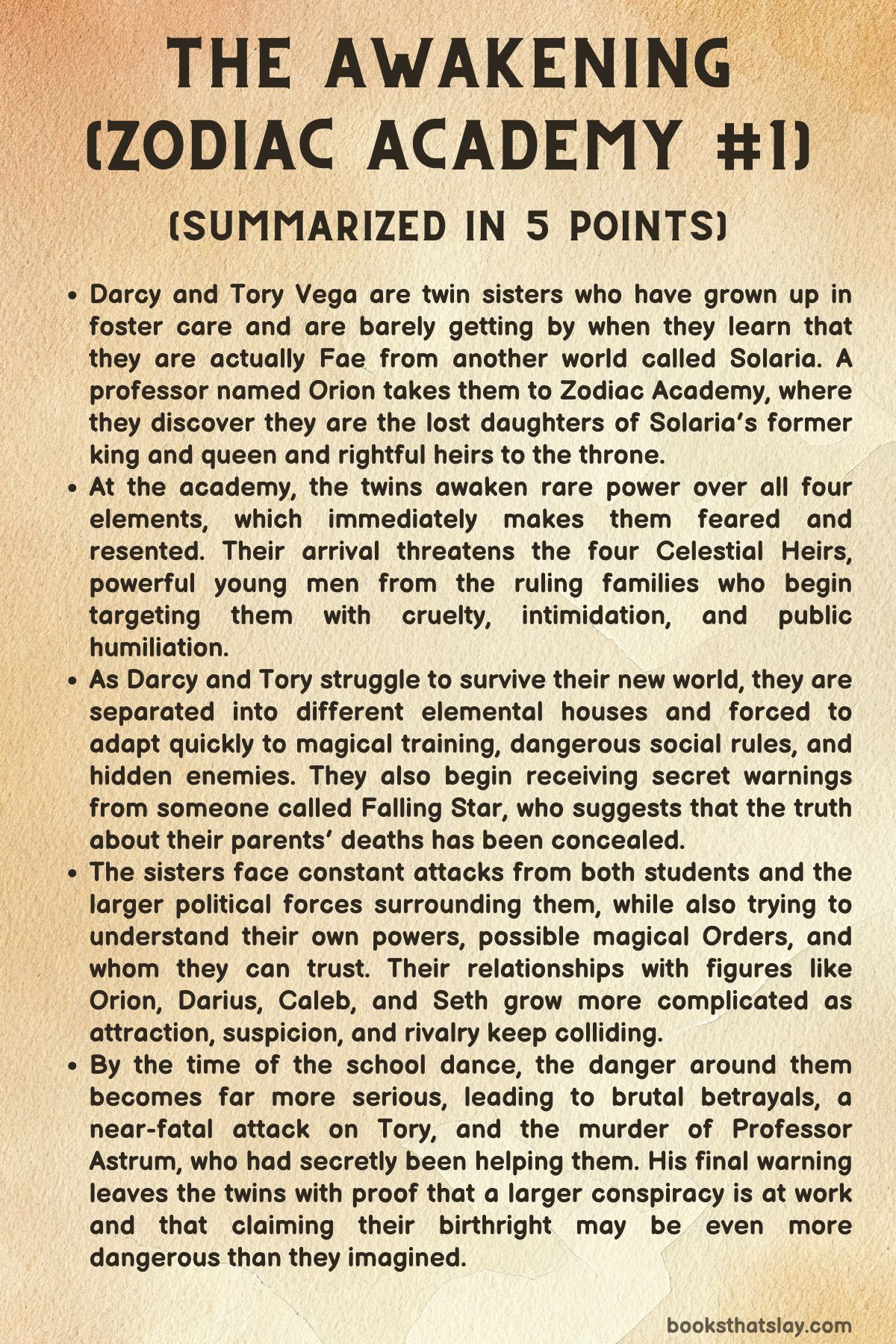
The Awakening, the first book of the Zodiac Academy series by Caroline Peckham and Susanne Valenti is a fantasy romance, that kickstarts the Zodiac Academy series, set in a dangerous magical school where power decides status, survival, and destiny. It follows twin sisters Darcy and Tory Vega, who have spent their lives in poverty and foster care, only to learn that they are not ordinary human girls at all.
They are Fae, heirs to a lost royal bloodline, and newly arrived in a world that both wants and fears them. The novel mixes academy rivalries, hidden histories, cruelty, attraction, and political struggle, building a story where every lesson comes with risk and every relationship carries a cost.
Summary
Darcy and Tory Vega have grown up in hardship, moving through foster homes and learning to rely only on each other. After turning eighteen, they are thrown out by their abusive foster father and left to survive on their own in Chicago.
They scrape by through desperation, petty crime, and stubborn resilience. Their lives change in a single night when a mysterious man named Professor Orion appears and reveals that they are actually Fae from another world called Solaria.
According to him, they were taken from their true family as infants and raised among humans while their birthright was stolen. Their real parents were the King and Queen of Solaria, and the twins are the lost heirs to the throne.
Orion takes them to Zodiac Academy, the school where elite young Fae train to master their magic. There, the sisters are awakened to their powers in front of the student body.
The event shocks everyone because Darcy and Tory do not possess only one magical element, as most Fae do. They show an affinity for all four elements: air, fire, water, and earth.
Their extraordinary power makes them impossible to ignore. It also immediately turns them into threats in the eyes of the ruling elite.
At the academy, the twins learn that Solaria has been controlled for years by four powerful families whose sons are known as the Celestial Heirs: Darius Acrux, Caleb Altair, Seth Capella, and Max Rigel. These boys are rich, influential, and brutal.
Since Darcy and Tory have a claim to the throne, the Heirs decide from the beginning that the sisters must be broken before they become strong enough to challenge them. What follows is not simple school rivalry but a campaign of intimidation, humiliation, and violence.
The sisters are forced to choose separate elemental houses, which weakens the support they can give each other. Darcy joins the air house, while Tory chooses the fire house.
Both quickly discover that academy traditions are often excuses for cruelty. Darcy is mocked during initiation and pushed toward public embarrassment, while Tory is subjected to degrading tests meant to strip away her pride.
The message is clear: they are not welcome, and their presence threatens the balance of power.
Even so, the twins refuse to give in. Darcy is quieter, thoughtful, and more emotionally open, but she is not weak.
Tory is sharper, angrier, and quicker to fight back, driven by a deep refusal to let anyone own her. Their different natures help them endure the academy in different ways.
Darcy tries to understand the world around her and find people she can trust. Tory resists domination at every turn, even when doing so puts her in greater danger.
As they adjust to life at Zodiac Academy, they learn more about Fae society. In addition to elemental magic, each Fae belongs to an Order, a supernatural lineage that shapes part of their identity and abilities.
The academy is full of vampires, sirens, werewolves, dragons, pegasi, and other powerful beings. Darcy and Tory do not yet know their own Orders, which becomes another mystery surrounding who they are.
Their ignorance marks them as outsiders, and their inability to defend themselves against mental magic such as Coercion leaves them especially vulnerable.
Professor Orion becomes a complicated presence in their lives. He is their teacher, their year head, and Darcy’s assigned tutor.
He can be harsh, invasive, and frightening, especially because as a vampire he can feed on their power. Yet he also protects them at key moments and seems to know far more than he admits.
Darcy in particular develops a tense bond with him, one shaped by suspicion, reluctant dependence, and growing attraction. She is never sure whether he is guarding her or using her.
At the same time, the twins receive secret messages from someone calling themselves Falling Star. This unknown ally warns them that Orion has not told them the full truth and suggests that powerful figures around them may have been involved in the murder of their parents.
Through these messages, Darcy and Tory begin to suspect that the official story about their family’s death is false or incomplete. They discover that their parents were not merely beloved rulers but controversial figures, and that several of the great families of Solaria may have benefited from their fall.
The danger around them grows worse as reports spread of Fae being murdered by Nymphs, shadowy enemies long feared in Solaria. The attacks are savage, and the victims are drained of their power.
Yet not everything about the crimes adds up. The twins learn from Professor Astrum, the man later revealed as Falling Star, that someone may be guiding the Nymphs from behind the scenes.
He believes the attacks are part of a larger conspiracy connected to the death of the royal family and to the current struggle over the throne. Before he can share everything he knows, he becomes a target.
Meanwhile, life at the academy remains a constant battle. Public humiliation spreads through social media.
Other students mock the twins, test them, or use them for entertainment. Caleb, a vampire, declares Tory as his Source and feeds from her repeatedly, creating a possessive dynamic she resents even as attraction complicates her reactions.
Seth alternates between tormenting Darcy and flirting with her, leaving her uncertain whether anything he says is genuine. Max uses his siren gifts to stir fear and secrets.
Darius, proud and dominant, focuses much of his energy on Tory. Their relationship becomes one of hostility, challenge, and unwanted fascination, especially after Tory learns that his Order is Dragon.
She begins to want not his approval exactly, but proof that she can stand as his equal.
The school dance becomes the turning point of the story. By then, the twins are already strained by fear, public attacks, and unanswered questions.
At the event, the people around them seem to split further into masks and motives. Darcy meets with Falling Star and learns directly from Professor Astrum that he suspects a Fae conspiracy behind the Nymph violence and the murder of the twins’ parents.
He points suspicion toward the Acrux family and warns that the truth is buried inside the power structure of Solaria.
That same night, the Heirs act with shocking cruelty. Seth lures Darcy away, pretends intimacy, and humiliates her by cutting off her carefully styled hair in front of hidden watchers.
At the same time, Darius takes Tory to a pool and uses her greatest fear against her. Knowing she is terrified of deep water because of a past near drowning, he forces her into the pool while the others trap her beneath the surface with magic.
Tory nearly dies.
Darcy hears a scream and runs toward the pool. Orion reaches Tory first and saves her, pulling her from the water and clearing her lungs.
His fury at the Heirs is real, and for once their punishment is immediate. Yet the night is not finished.
Soon after, another scream draws attention outside, where a burning body is found near The Orb. The victim is Professor Astrum.
Before the body is fully claimed by death, a tarot card marked with a final message comes into Tory’s hands. Astrum’s note tells the twins that he made a mistake, that the shadow has found him, and that the answers they seek lie hidden between Leo and Libra.
He warns them not to trust the flames and urges them to claim their throne. With his death, the twins lose their clearest ally at the academy.
They are left with fear, grief, and fragments of a truth that now seems even more dangerous than before.
By the end of the book, Darcy and Tory are still far from safe, accepted, or fully awakened to what they are. But they have survived their first brutal initiation into Solaria.
They know they are powerful. They know enemies surround them.
And they know that their family’s fall was not a simple tragedy. It was part of something larger, something still active, and something that may one day force them to decide whether they truly want the throne that was taken from them.
Characters
Darcy Vega
Darcy is the more reflective and emotionally open of the Vega twins, but that softness should not be mistaken for weakness. She enters the academy carrying years of neglect, humiliation, and abandonment, and those experiences shape the way she responds to danger.
She feels shame more deeply than Tory does, and because of that, many of the attacks against her are designed to wound her dignity rather than simply injure her body. Yet Darcy has a quiet resilience that becomes clearer with every attempt to break her.
She is observant, thoughtful, and deeply aware of emotional undercurrents, which makes her especially sensitive to betrayal, manipulation, and divided loyalties. Her instincts push her toward trust and connection, but her past keeps warning her that trust leads to pain.
This tension defines much of her arc. Her growing connection with Orion, her uncertainty around Seth, and her longing to understand her parents and her lost identity all show a young woman who wants truth and closeness while fearing the damage both can bring.
Darcy’s strength is not loud. It comes from endurance, empathy, and the refusal to let cruelty define who she becomes.
Tory Vega
Tory is sharper, harder, and more openly combative than Darcy, shaped by the same painful childhood but transformed by it in a different way. Where Darcy absorbs hurt inwardly, Tory throws her energy outward and meets aggression with defiance.
Her first instinct is survival, and she has learned to treat vulnerability as a weakness others will exploit. That gives her a fierce presence from the beginning.
She steals, bargains, lies, fights, and adapts without apology because she has lived in a world that gave her no safety net. At the academy, this becomes both her shield and her problem.
She refuses to submit, which makes her compelling, but that same refusal keeps drawing the attention of equally dominant personalities, especially Darius and Caleb. Tory’s emotional landscape is full of anger, pride, and hunger for control, yet beneath that is a deep fear of helplessness.
Her trauma around water and her hatred of being physically overpowered reveal how much she needs ownership over herself. She does not want pity, and she certainly does not want protection she has not chosen.
What makes her effective as a character is the way her hardness coexists with loyalty. Everything she does, even at her most reckless, is tied to protecting herself and Darcy.
Her ambition grows over the course of the story, and she begins to want more than survival. She begins to want power, respect, and proof that no one can decide her place for her.
Professor Orion
Orion is written as a figure of threat, authority, and contradiction. He is the one who pulls the twins into Solaria and introduces them to the truth of their birth, yet he never arrives as a comforting guide.
Instead, he is severe, invasive, and often morally ambiguous. His use of power is deeply unsettling because he does not soften reality for the girls; he forces them to see how exposed they are in this world.
That harshness makes him difficult to trust, but it also separates him from the academy’s more performative cruelty. Orion can be cold, intimidating, and controlling, especially in the way he feeds from Darcy and Tory or uses fear as instruction.
At the same time, he repeatedly acts to protect them, and that friction is central to his characterization. He seems burdened by knowledge he cannot or will not fully share, and his connection to dangerous political forces gives him an aura of secrecy that never leaves him.
His dynamic with Darcy is especially strong because it rests on tension rather than clarity. She is drawn to him despite every reason not to be, and he seems equally frustrated by and protective of her.
Orion represents a world where power and care are not cleanly divided. He is neither safe nor simple, and that complexity makes him one of the most compelling figures in the story.
Darius Acrux
Darius embodies inherited power, social dominance, and the aggression of a ruling class that feels entitled to everything it controls. He is proud, disciplined, and cruel, but his cruelty is not random.
It comes from belief. He genuinely sees the Vega twins as threats who must be neutralized before they grow into something more dangerous.
That conviction gives his actions a hard edge because he is not merely bullying for amusement; he is acting as someone raised to guard a system that benefits him. Even so, he is not flatly monstrous.
His conversations, moments of restraint, and charged connection with Tory suggest that he is wrestling with expectations placed on him by family, rank, and legacy. His dragon nature fits him well because he is possessive, dominant, and deeply attached to hierarchy.
He needs to be above others, and any challenge to that position becomes personal. Yet Tory’s refusal to fear him in the expected way unsettles him.
She interests him because she resists the order he represents. Darius is strongest when the story lets his arrogance sit beside hints of internal conflict.
He is violent, but not mindless; privileged, but not unshaped by pressure. He stands as one of the clearest expressions of how power can become identity.
Caleb Altair
Caleb’s menace comes through charm, sensuality, and entitlement. As a vampire, he treats access to other people’s bodies and power as something that can be structured through desire, ownership, and social custom.
His decision to mark Tory as his Source says a great deal about him. He is not simply feeding; he is claiming.
Caleb thrives in gray areas where attraction and domination overlap, and that gives his scenes an unsettling energy. He often appears more polished and controlled than some of the other Heirs, but that surface ease hides a predatory instinct.
At the same time, he is not only a symbol of danger. His interactions with Tory show genuine fascination, and he is capable of moments that feel intimate or even generous, though never fully separate from the imbalance of power between them.
Caleb’s character works because he blurs lines. He can be seductive and invasive in the same breath.
He can wound, provoke, and offer pleasure while still treating people as sources of gratification or fuel. He reflects one of the novel’s recurring ideas: that desire is often tangled up with control, and that attraction does not erase danger.
Seth Capella
Seth operates through mockery, theatricality, and instability, which makes him especially difficult to read. He can appear playful, flirtatious, or absurd one moment and then turn vicious the next.
That volatility is part of what makes him effective as an antagonist during much of the story. He delights in humiliation because it gives him emotional leverage, particularly over Darcy, whose feelings are easier to provoke than Tory’s.
His cruelty is frequently public, performative, and designed to leave lasting damage. The incident with Darcy’s hair captures this perfectly.
He weaponizes trust, intimacy, and spectacle all at once. Yet Seth is not written as emotionally empty.
His attention toward Darcy is too persistent and too inconsistent to be reduced to simple hatred. He appears drawn to her, but he lacks the maturity or moral stability to separate desire from domination.
In that sense, Seth represents emotional immaturity sharpened by privilege and power. He acts on impulse, seeks reaction, and treats vulnerability as something to exploit before it can be used against him.
He is one of the clearest examples of a character whose appeal and danger come from the same source.
Max Rigel
Max’s role in the story is quieter than some of the other Heirs, but he contributes a distinct kind of threat. As a Siren, he works through emotion, manipulation, and psychological access rather than overt spectacle.
He is skilled at drawing things out of people, especially fear, and that makes him dangerous in ways that are less visible but no less violating. Max often seems composed and socially aware, someone who understands exactly how to use mood, pressure, and timing to get the effect he wants.
He participates in the campaign against the twins not just through force but through emotional destabilization. His abilities allow him to turn inner experience into something available for his own use, which aligns with the broader culture of exploitation that surrounds the sisters at the academy.
He is less individually developed than Darius, Caleb, or Seth, but his presence matters because he expands the range of harm the Heirs can inflict. He is a reminder that violation is not always physical.
It can be emotional, strategic, and almost elegant in its execution.
Sofia Cygnus
Sofia brings needed warmth into the twins’ lives, though her role is shaped by vulnerability as much as kindness. She is one of the first students to approach Darcy and Tory without immediate hostility, and her friendliness helps soften the academy’s harsh atmosphere.
As a Pegasus, she carries a sense of openness and innocence that contrasts with the aggression of many other students. At the same time, Sofia is not presented as especially powerful in social terms.
She is easier to overlook, easier to dismiss, and often positioned near the edges of larger conflicts. That makes her kindness feel more meaningful because it is not backed by dominance.
It comes from choice. Her growing bond with the twins suggests the possibility of friendship in a place structured by competition and fear.
She also helps reveal that not everyone in Solaria accepts the cruelty of its elite. Through Sofia, the story shows how gentleness can survive in hostile systems, even when it remains fragile.
Diego Polaris
Diego functions as one of the twins’ earliest sources of normalcy and explanation. He helps them navigate student life, social media, classes, and the broader rules of Fae culture, which gives him an important grounding role in the narrative.
He is friendly, perceptive, and more emotionally steady than many of the dominant personalities around him. His significance lies partly in the way he offers support without trying to own or control the sisters.
In a setting where many relationships are shaped by hierarchy and threat, Diego’s decency matters. He is also attentive to danger in ways that suggest he understands more than he always says.
His concern during tense moments, especially around the dance, gives him a quiet moral intelligence. He may not command scenes through force, but he contributes stability, and that makes him valuable both to the twins and to the structure of the story.
Geraldine Grus
Geraldine initially appears comic, excessive, and socially overwhelming, but she gradually becomes more significant than her first impression suggests. Her dramatic loyalty to the Vega twins and her leadership of a royalist student group might seem exaggerated, yet beneath the performance is genuine political conviction.
She believes in the twins as rightful heirs, and that belief gives her actions emotional weight. Geraldine also reveals how public identity works in this world.
She performs allegiance loudly because politics at the academy are tied to display, spectacle, and visible affiliation. At the same time, her loyalty places her in danger.
Once she becomes associated with the twins, she is no longer simply an eccentric classmate. She becomes a target.
Her attack is important not only because it raises the stakes but because it shows that support for the sisters carries real consequences. Geraldine’s character expands the social world of the academy by showing that devotion, absurdity, courage, and vulnerability can all exist in the same person.
Professor Astrum
Professor Astrum serves as the twins’ clearest intellectual and moral ally, even before they know his identity as Falling Star. He is guided by intuition, old loyalties, and a willingness to question the official story surrounding the deaths of the royal family.
Unlike many adults in the story, he does not seem interested in controlling Darcy and Tory for institutional ends. Instead, he tries to warn them, protect them, and point them toward the truth.
His use of tarot and symbolism makes him feel spiritually attuned in a world otherwise dominated by force and rank. He represents memory, buried history, and the possibility that knowledge can resist power.
His murder matters because it removes a rare source of sincerity and insight. It also confirms that the conspiracy surrounding the twins is active and ruthless.
Astrum’s role may be brief in terms of direct presence, but his influence reaches far beyond his page time because he transforms suspicion into conviction.
Principal Nova
Principal Nova represents institutional authority stripped of warmth. She is not as openly cruel as the Heirs, but she is willing to let harsh systems stand as long as they preserve order.
Her treatment of the twins suggests someone who values control, balance, and public perception over emotional safety. She recognizes the importance of Darcy and Tory immediately and understands what their presence means politically, but that awareness does not make her protective in any maternal sense.
Instead, she seems to see them as disruptive variables in a dangerous structure. Her decisions often acknowledge the girls’ vulnerability without truly challenging the conditions that create it.
This makes her a useful example of passive complicity. She is not the source of the academy’s cruelty, but she governs within it and allows much of it to continue.
Professor Pyro
Professor Pyro helps define Tory’s development as a fire wielder by treating power as something that must be mastered, not merely possessed. His role is less emotional than structural, but it is still important.
He recognizes Tory’s strength quickly and responds by placing her in situations that force her to grow. His teaching style reflects the academy’s larger culture, where growth often comes through pressure rather than care.
Through him, fire becomes more than an element. It becomes an extension of Tory’s nature: volatile, forceful, proud, and difficult to contain.
He is one of the instructors who reinforces the idea that exceptional ability invites scrutiny as much as praise.
Professor Prestos
Professor Prestos is notable for her emotional distance. As Tory’s assigned Liaison, she treats guidance almost like bureaucracy, preferring to send materials and maintain distance rather than engage deeply.
This makes her a contrast to Orion, who is far more invasive and involved. Prestos reflects an institution that is willing to acknowledge a problem without truly investing in a person.
Her detachment does not make her cruel, but it does make her ineffective as emotional support. In a school where the twins are under constant pressure, her minimal effort highlights how alone they really are.
Milton Hubert
Milton is not among the central power players, but he matters because he shows how ordinary cruelty spreads through a social system. His decision to post humiliating images of Tory online is petty, invasive, and opportunistic.
He takes advantage of a culture that already treats the twins as public targets. Characters like Milton demonstrate that oppression at the academy is not limited to elite antagonists.
It is reproduced by bystanders and lesser students who gain status by joining in. He helps show how humiliation becomes communal entertainment.
Kylie and Marguerite
Kylie and Marguerite function as extensions of the academy’s gendered cruelty. Their hostility toward Darcy and Tory is shaped by jealousy, insecurity, and proximity to male power.
They direct much of their anger at the twins rather than at the boys who actually humiliate, discard, or manipulate them. That makes them useful examples of displaced aggression within a competitive social order.
They are not especially deep characters, but they help reveal how the academy encourages girls to police and punish one another instead of questioning the structure that hurts them all. Their attacks add another layer to the twins’ isolation by showing that hostility comes not just from powerful men but also from peers invested in preserving their own rank.
Pete
Pete’s role is brief but foundational. As the abusive foster father who throws Darcy and Tory out the moment they turn eighteen, he belongs to the human world the twins leave behind, but his impact travels with them.
He represents the earliest form of power abuse in their lives: petty, domestic, cruel, and entirely unearned. His treatment of them explains much about how they move through the world.
From him, they learned that authority is often hostile, that security can vanish overnight, and that survival depends on each other more than on any system meant to protect them. Even after the story shifts into magical politics, the emotional reality of Pete’s abuse continues to shape the sisters’ instincts.
Lionel Acrux
Lionel Acrux remains more of a looming force than a fully present character in this stage of the story, but his importance is unmistakable. He exists in the background as a name associated with power, ambition, and possible betrayal.
The suspicion surrounding his role in the deaths of the royal family gives him the weight of a political shadow over the entire narrative. He represents old power that may have shaped the present order through violence and manipulation.
Even without direct page dominance, he influences how readers understand Darius, the Heirs, and the system the twins are entering. He is the kind of figure whose absence becomes a form of presence because everyone moves in the space his power helped create.
King Hail Vega and Queen Merissa Vega
The twins’ parents are largely known through stories, records, and fragments, but they still function as important characters in absentia. They are not idealized simply as lost royalty.
Instead, they are surrounded by contradiction. Their deaths are tragic, but their legacy is politically contested.
Hail is remembered as a powerful and divisive ruler, while Merissa’s memory carries loyalty, elegance, and mystery. Together they become symbols of inheritance in its fullest sense: bloodline, power, burden, and unresolved history.
Darcy and Tory do not merely miss them as parents they never knew; they inherit the consequences of their lives and deaths. That makes the twins’ search for truth also a search for what kind of legacy they have been born into.
In The Awakening, the royal couple matter because they are both memory and question.
Themes
The Awakening builds its themes through conflict, humiliation, secrecy, and power struggles rather than through abstract statements. Its ideas emerge from what characters do to survive, dominate, and protect what they believe belongs to them.
Power as Inheritance and Burden
Power in the novel is never treated as a simple gift. It is social, magical, political, and deeply tied to bloodline.
Darcy and Tory do not enter Solaria as blank students discovering hidden talents; they arrive carrying a legacy that others have feared, denied, and tried to replace. Their strength makes them important, but it also makes them targets.
The story shows that inherited power creates obligation before it creates freedom. The twins are expected to prove themselves worthy of a throne they never asked to lose, while the Celestial Heirs defend authority they believe they were raised to preserve.
This turns power into a burden on both sides. It shapes identity, relationships, and even desire.
Characters do not compete only for status but for legitimacy. The academy becomes a training ground for this larger contest, where every lesson and every humiliation carries political meaning.
The theme gains force because power here is never neutral. It attracts violence, suspicion, and loyalty in equal measure, and it asks whether birthright alone is enough to justify rule.
Cruelty as Social Control
Cruelty in the story is not random misbehavior. It functions as a method of discipline within a world built on hierarchy.
The Vega twins are mocked, assaulted, exposed, and publicly degraded not only because certain characters are vicious, but because humiliation is used to remind them where others think they belong. Much of the abuse they face is theatrical.
It happens in front of crowds, through social media, or in rituals disguised as tradition. That public quality matters because the goal is not merely pain.
The goal is submission. By making the twins objects of ridicule, the academy’s dominant figures try to weaken their claim to authority before it can fully form.
This theme also shows how institutions can normalize harm by absorbing it into culture. Teachers do not always create the violence, but many fail to prevent it.
Other students repeat it for entertainment or advantage. The result is a social order where cruelty becomes a language of rank.
The novel suggests that oppression survives most effectively when it is treated as ordinary, expected, or deserved.
Identity as Discovery and Construction
The twins’ arrival in Solaria begins a process of identity formation that is far more complicated than learning they are secretly royal. They must figure out what it means to be Fae, which elements define them most strongly, what Orders they belong to, and how much of their human upbringing still shapes who they are.
The story presents identity as something partly inherited and partly built through choice, pain, and resistance. Darcy and Tory are told who they are by teachers, enemies, horoscopes, rumors, and history, yet none of those explanations fully captures them.
Their identities remain unstable because the truth around them is incomplete. They are heirs, outsiders, sisters, students, threats, and survivors all at once.
Other characters struggle similarly, though in different ways. The Heirs are trapped inside roles assigned by family power.
Orion moves through conflicting positions of protector, predator, and suspect. This gives the theme a strong emotional center.
Identity is never presented as a neat revelation. It is contested ground, shaped by memory, body, class, desire, and fear.
Trust Under Conditions of Danger
Trust is one of the hardest and most unstable forces in the novel because nearly every bond carries some element of risk. Darcy and Tory trust each other completely, and that bond becomes the emotional center that helps them survive.
Outside of that relationship, however, trust is fractured almost everywhere. Orion protects them while also violating their boundaries.
Seth and Caleb blur attraction with manipulation. Darius is both enemy and source of charged recognition.
Falling Star offers guidance from the shadows but cannot fully shield them from harm. This constant uncertainty makes trust feel costly.
To believe in someone is to hand them a weapon they may later use against you. The theme becomes especially strong because both twins have already been shaped by abandonment and exploitation before arriving at the academy.
Their past has taught them that promises are temporary and authority is dangerous. The magical setting intensifies this emotional truth rather than replacing it.
In such a world, trust is not innocence. It is a risk taken despite evidence that betrayal is always possible.