Zofloya Summary, Characters and Themes
Zofloya by Charlotte Dacre is a Gothic novel first published in 1806, set in a world shaped by desire, vanity, betrayal, and moral collapse. The story follows Victoria di Loredani, a beautiful and headstrong young woman whose life is marked early by family disgrace and emotional neglect.
As she grows older, her hunger for admiration and power turns increasingly destructive. The novel combines aristocratic scandal, revenge, seduction, murder, and supernatural influence, building a dark portrait of a woman who repeatedly chooses self-interest over conscience. Fierce, extreme, and unsettling, Zofloya stands out for its bold treatment of ambition, corruption, and evil.
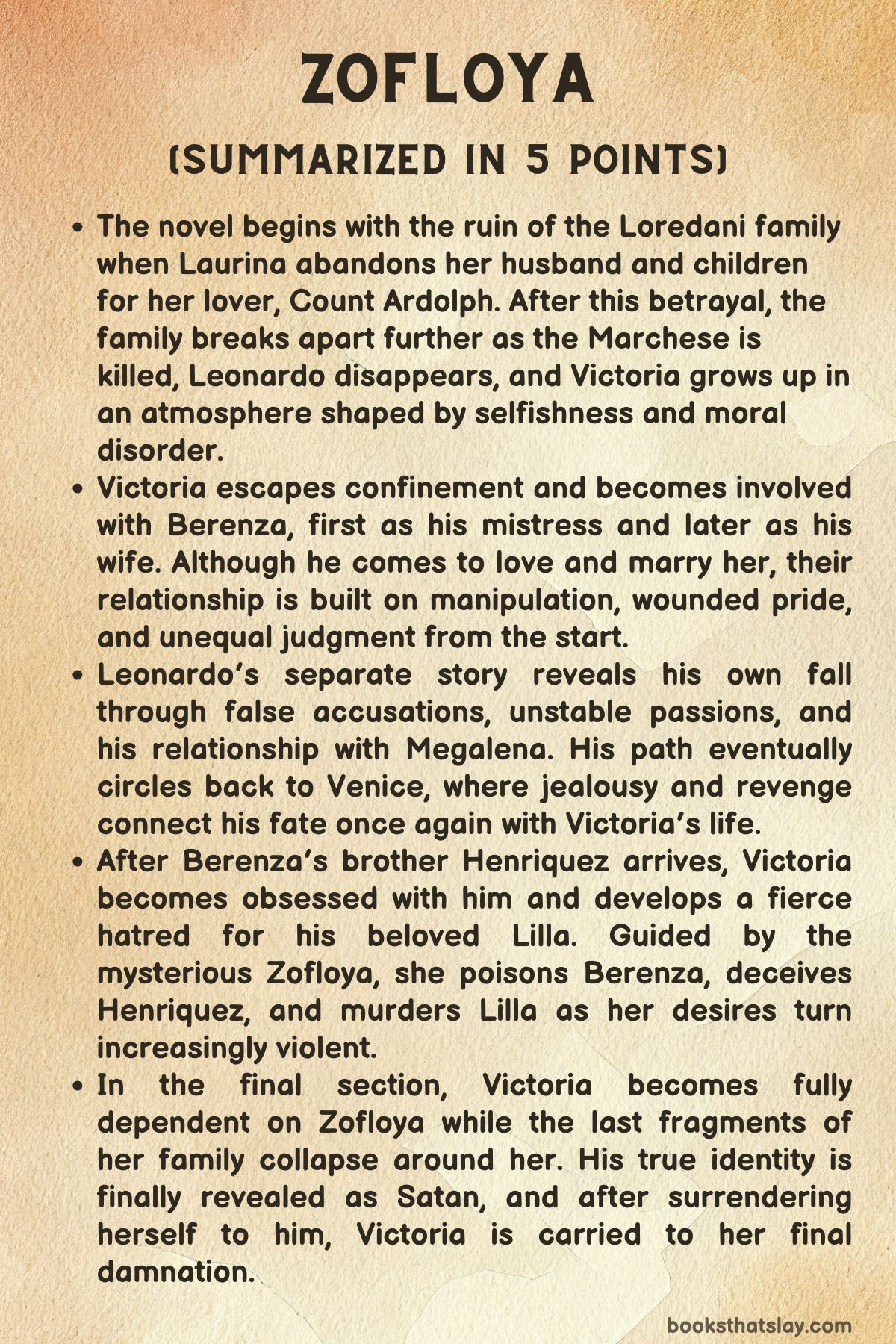
Summary
The story opens in Venice, where the noble Loredani household seems secure and prosperous. The Marchese di Loredani lives with his wife, Laurina, and their children, Leonardo and Victoria.
This stability is shattered when Count Ardolph, a charming and morally corrupt nobleman, enters their circle. He sets out to seduce Laurina and succeeds.
What begins as an affair soon becomes a complete break with her family. Laurina abandons her husband and children to live with Ardolph, bringing shame and sorrow upon the household.
The Marchese is devastated by his wife’s betrayal, and the damage spreads quickly through the family. Leonardo, unable to bear the disgrace, leaves home.
The Marchese remains with Victoria, but he sees in her an alarming selfishness and lack of feeling for others. About a year later, he encounters Ardolph and fights with him.
Ardolph kills him. As he dies, the Marchese pleads with Laurina and Victoria to reform their lives, recover Leonardo, and live quietly and honorably.
They promise, but the promise is quickly broken.
Laurina returns to Ardolph and becomes more devoted to him than before. Victoria, now growing into adulthood, thrives in the loose and pleasure-seeking atmosphere of Ardolph’s villa.
There she meets Berenza, a nobleman attracted by her beauty but doubtful of her worth. Victoria is excited by his pursuit and is willing to become his mistress, but Laurina intervenes and prevents the match.
To control Victoria, Laurina and Ardolph deceive her and leave her in the care of an elderly relative, Signora di Modena, a harsh guardian who treats her as already corrupted. Victoria outwardly submits, but she is calculating an escape.
With the help of a servant named Catau, Victoria finds a way out of the villa grounds. She gradually tests the route, then finally escapes in disguise.
Reaching Venice, she unexpectedly finds Berenza, who takes her in. Berenza does not rush into a sexual relationship.
He wants complete emotional possession and insists that if Victoria is to belong to him, she must love him entirely. Victoria, uncertain of her own feelings but eager to secure his devotion, performs the role of a sorrowful and faithful lover until he is convinced.
They become lovers, and she begins living as his mistress.
Their relationship appears settled until violence erupts again. One night, an intruder enters their chamber intending to murder Berenza.
Victoria throws herself into danger and is wounded while saving him. The attacker escapes, but she recognizes him as her brother Leonardo.
She keeps this knowledge hidden. Soon afterward, Berenza receives a letter from Megalena Strozzi, another woman linked to him, who admits she arranged the attack out of jealousy.
Victoria begins to wonder how Leonardo became involved with Megalena.
The narrative then turns to Leonardo’s past. After fleeing Venice, he found refuge in Florence with Signor Zappi.
Trouble followed when Zappi’s wife desired him. Leonardo rejected her because he loved her daughter, and the enraged woman falsely accused him of attempting to violate her.
Forced to flee again, Leonardo later lived simply with a peasant woman named Nina. Eventually he made his way back toward Venice, where Megalena encountered him, desired him, and drew him into her life.
They became lovers. Once in Venice, Leonardo began another flirtation with a young woman named Theresa.
Megalena discovered it and demanded proof of his submission. Later, when she saw Berenza openly with Victoria, her jealousy returned in full force.
She ordered Leonardo to kill Berenza. Leonardo attempted the deed, but Victoria was wounded instead.
When Megalena realized the weapon could identify her, she and Leonardo fled.
Back in Venice, Victoria recovers, and Berenza, moved by her apparent devotion, marries her. Though this marriage secures her social standing, she is bitter when she realizes he had once judged her unfit to be his wife.
Years pass. Berenza’s brother Henriquez arrives, hoping finally to marry Lilla, a virtuous young woman he has long loved.
Victoria becomes obsessed with Henriquez almost at once. Seeing his devotion to Lilla only deepens her desire and envy.
Around this time, Henriquez’s servant Zofloya enters Victoria’s thoughts with disturbing force. After strange dreams involving him, Victoria becomes convinced that he is connected to her future.
His apparent death and sudden return make him seem even more uncanny. He seeks her out, listens to her complaints, and learns of her passion for Henriquez.
Rather than condemning her, he offers assistance. He gives her poison and persuades her that Berenza’s death would free them both from an unhappy bond.
Victoria hesitates only briefly before accepting his logic.
She begins poisoning Berenza little by little. As his health fails, she urges him to move with a small group to a remote castle in the Apennines, where scrutiny will be less intense.
There she continues her work. Henriquez and Lilla are present, which keeps Victoria’s hopes alive, but Berenza’s death comes too slowly for her liking.
Zofloya supplies stronger means and involves her in another killing first, using Lilla’s elderly companion as a test. When the woman dies, Victoria lies easily.
Soon after, Berenza drinks poisoned wine and collapses. He dies without a public accusation, though Henriquez quietly blames Victoria’s negligence for his brother’s end.
Victoria now believes she is free to claim Henriquez. She confesses her love and proposes marriage, expecting grief and admiration to give way before her beauty and determination.
Instead, Henriquez is disgusted. He remains faithful to Lilla and rejects Victoria completely.
His refusal turns her desire into fury. Zofloya proposes another plan.
Lilla is abducted and hidden in a cave near the castle, where she is kept secretly alive. Henriquez falls into despair at her disappearance.
Victoria nurses him while waiting for her chance.
Zofloya then gives Victoria a potion that confuses Henriquez’s mind. Under its influence, he mistakes Victoria for Lilla.
Dressed in Lilla’s clothes, Victoria allows the delusion to continue. Henriquez believes he is united with the woman he loves, while Victoria finally gets what she wants through fraud.
When he wakes and discovers the truth, he cannot bear what has happened. In horror and self-loathing, he kills himself.
Victoria’s rage does not end there. She goes to the cave, drags out Lilla, and murders her.
Returning to the castle, she learns from Zofloya that her crimes are close to being exposed. Berenza’s hidden remains and Henriquez’s death will soon lead directly to her.
She begs Zofloya to save her, and he does. When she wakes, she is no longer at the castle but in the Alps, carried away into outlaw territory under his protection.
Among the bandits, Victoria becomes more dependent on Zofloya, though she also grows restless and degraded by her surroundings. At moments she is offered the possibility of repentance, but she resists it.
Then the last remnants of her family return in terrible form. Captives are brought in: Ardolph and Laurina.
The bandit chief is revealed to be Leonardo, who kills Ardolph in revenge for ruining their family. Laurina, beaten and dying, begs her children for forgiveness.
Leonardo grants it, but Victoria refuses. Even at this final meeting, she chooses cruelty.
Soon the bandits are surrounded by soldiers. Leonardo and Megalena end their own lives rather than face capture.
Zofloya carries Victoria to a high precipice and demands that she fully surrender herself to him. When she consents, he reveals his true identity: he is Satan.
With that revelation, the story ends in total ruin. Victoria, who repeatedly rejected pity, restraint, and repentance, is dragged down to hell by the being whose influence she accepted long before she understood his name.
Characters
Victoria di Loredani
Victoria stands at the center of Zofloya, and her character is defined by appetite without restraint. She is intelligent, beautiful, proud, and intensely self-regarding, but what makes her memorable is the way those qualities harden into a sustained refusal of sympathy, accountability, and moral limit.
As a young woman, she learns to treat desire as a form of entitlement. She wants admiration, possession, and emotional dominance, and she grows enraged whenever reality denies her what she thinks her beauty and will should command.
Her early experiences matter: she grows up in a household shattered by adultery, abandonment, and violence, and she absorbs corruption before she is mature enough to resist it. Yet the novel never presents her simply as a victim of circumstance.
Again and again, she is offered moments in which she might choose humility, patience, pity, or repentance, and she repeatedly rejects them.
What is striking about Victoria is the cold clarity with which she moves from fantasy into action. Her passion for Berenza is shallow and self-serving, but even there she learns how useful performance can be.
She can imitate vulnerability, tenderness, and devotion when those emotions help her secure control over another person. Once she becomes obsessed with Henriquez, the gap between feeling and action collapses almost completely.
Jealousy becomes murderous intent, and desire becomes a justification for fraud, poisoning, imprisonment, and killing. She does not simply fall into evil by accident; she repeatedly rationalizes it.
Her attraction to Zofloya is therefore not just supernatural temptation but recognition. He offers the logic she already wants: that her wishes are sufficient grounds for destruction.
By the end, Victoria has become a study in moral self-annihilation, not because she lacks feeling altogether, but because she allows vanity, resentment, and appetite to govern every feeling she has.
Zofloya
Zofloya is the most enigmatic and symbolically charged figure in the novel, operating at once as servant, tempter, conspirator, and finally open embodiment of diabolic power. His social position appears subordinate at first, but the emotional and psychological power he exerts is immense.
He enters Victoria’s life as a figure of fascination before he becomes a direct agent in her crimes. That gradual movement matters because it allows him to seem less like an abrupt supernatural intrusion and more like the external form of Victoria’s hidden will.
He rarely forces her. Instead, he listens, observes, and offers exactly the means that match her strongest impulses.
He understands that influence is most effective when it sounds like permission.
His methods reveal a deep knowledge of human weakness. He flatters Victoria not with empty praise but with recognition of her grievances, ambitions, and frustrations.
He reframes murder as justice, adultery as rightful fulfillment, and manipulation as liberation. This is what makes him dangerous: he does not merely suggest evil acts, he reorganizes their moral meaning.
His calmness contrasts with Victoria’s volatility, giving him an air of authority that strengthens his hold over her. Even his apparent loyalty is part of the trap.
He rescues her, protects her, and solves practical problems, so she begins to trust dependence itself. When he is finally revealed as Satan, the disclosure confirms what the narrative has been building all along, but it also clarifies that he has never been important only as a supernatural villain.
He is the force that converts self-deception into damnation by making Victoria feel that surrender is freedom.
Berenza
Berenza is one of the novel’s most interesting studies in compromised refinement. He is not a simple libertine, because he possesses genuine intelligence, discernment, and at times even generosity.
He sees Victoria’s beauty immediately, yet he also senses the moral danger surrounding her. His hesitation about making her his wife reveals class prejudice and ethical caution at the same time.
He is willing to make her his mistress long before he is willing to recognize her as an equal partner, and that contradiction exposes the limits of his apparent nobility. He wants emotional exclusivity from her, but he begins from an arrangement that already places her in a vulnerable and socially diminished position.
In this sense, he contributes to the very corruption he later appears to regret.
At the same time, Berenza is not presented as malicious in the way Ardolph is. He values sincerity and wants to be loved wholly, not merely desired.
This makes his relationship with Victoria unstable from the beginning, because he is seeking depth from someone whose emotional habits are rooted in vanity and performance. His eventual marriage to her suggests growth, gratitude, and a desire to honor her, but by then the relationship rests on false foundations.
Victoria has already learned to manipulate his trust, and the marriage only deepens her resentment when she realizes he once judged her unworthy. Berenza therefore becomes tragically vulnerable not only because he loves badly, but because he mistakes visible devotion for moral truth.
His death by poison is horrifying in itself, yet it is made even darker by the fact that he dies still believing in the wife who has turned his care into opportunity.
Henriquez
Henriquez functions as the object of Victoria’s destructive fixation, but he is more than a romantic ideal. He is marked by sincerity, constancy, and a kind of moral straightforwardness that makes him stand apart from the world of appetite surrounding him.
His love for Lilla is not opportunistic or theatrical; it is patient and socially honorable, shaped by long attachment rather than sudden impulse. That depth is exactly why Victoria wants him.
He is not merely handsome or desirable. He represents a form of love that is not available to her through manipulation alone, and that difficulty intensifies her obsession.
His relation to Victoria is defined by misreading at first and revulsion later. He does not initially grasp the scale of her passion or the danger it poses.
When she confesses herself, he reacts with moral disgust, but also with a degree of pity once he thinks she is ashamed. That response shows his decency, but it also reveals his blindness.
He cannot imagine the full force of her vindictiveness because he judges by ordinary standards of feeling. Once he is drugged and deceived into believing Victoria is Lilla, his character becomes central to one of the novel’s most brutal scenes of violated identity.
His suicide is not only despair at sexual betrayal; it is the collapse of a moral self that cannot live with what it believes it has done. Henriquez represents an ideal of honorable love placed within a world designed to destroy innocence through deceit.
Lilla
Lilla is constructed as Victoria’s opposite and as an embodiment of gentleness, modesty, and patient virtue. Her presence creates a moral contrast that the novel insists upon repeatedly.
She is loved for qualities Victoria lacks: calmness, humility, sincerity, and self-command. Yet Lilla is not important merely as an abstract symbol of goodness.
She also shows how vulnerability operates in a world shaped by predatory desire. Her softness, trust, and emotional openness make her deserving of protection, but they also make her easy prey for those without conscience.
What gives Lilla weight in the story is the effect she has on others. Henriquez’s love for her appears deepened by her character rather than by beauty alone, and Victoria’s hatred of her is sharpened because Lilla achieves affection without force or calculation.
Lilla does not compete aggressively, does not scheme, and does not seek power, yet she becomes the center of a deadly rivalry. Her abduction, confinement, and murder reveal how innocence can be made to suffer not because it has failed, but because it stands as a rebuke to corruption.
Lilla’s role is therefore tragic in a very specific way: she does not drive the action through choice so much as absorb the violence of others’ desires. In a novel full of extremes, her suffering measures the scale of Victoria’s moral collapse.
Laurina di Loredani
Laurina is the first major agent of family ruin, and her choices shape nearly everything that follows. She begins as a respected wife and mother, yet she abandons domestic responsibility for adulterous passion.
The novel makes clear that her fall is not momentary but sustained. Even after the Marchese’s dying plea, even after promising reform, she returns to Ardolph and resumes the pattern that has already destroyed her household.
Her weakness lies in the fact that desire consistently overrides memory, duty, and remorse. She can feel guilt, but not steadily enough to act on it.
At the same time, Laurina is not portrayed as purely monstrous. Unlike Victoria, she retains the capacity for regret and emotional pain.
She suffers from the consequences of her dependence on Ardolph, and her final appearance is marked by exhaustion, injury, and a desperate need for forgiveness. Her tragedy lies in her inability to convert remorse into reform until it is too late.
As a mother, she fails catastrophically. She exposes Victoria to corruption, abandons her when convenience demands it, and never provides the steady moral structure her daughter needs.
Yet the novel also suggests that Victoria’s hardness exceeds Laurina’s failures. Laurina sins through weakness and surrender; Victoria sins through active, deliberate cruelty.
That distinction matters. Laurina helps create the conditions of disaster, but she does not become its most terrible expression.
Ardolph
Ardolph represents seductive corruption in aristocratic form. He is attractive, socially polished, and experienced in manipulating emotion for pleasure and conquest.
From the start, he treats intimacy as a game of domination, and Laurina is one more target in a long pattern of seductions. What distinguishes him from a merely superficial rake is his combination of appetite and brutality.
He does not simply take what he wants and move on; he draws others into dependency, then governs them through instability, charm, and force.
His murder of the Marchese exposes the violence beneath his cultivated exterior. Later, his treatment of Laurina reveals another dimension of his character: he is fundamentally incapable of faithful attachment or humane responsibility.
Gambling, cruelty, and physical abuse become central to his decline, and the relation that once looked passionate becomes openly degrading. Ardolph matters thematically because he initiates the chain of disorder through adultery, yet he also demonstrates that selfish desire eventually consumes even the pleasures it seeks.
He ruins a family, kills a husband, corrupts a household, and ends as a broken man destroyed by the very history he helped make. His death at Leonardo’s hands gives the narrative a form of revenge, but not restoration.
By then the damage he set in motion has spread too far.
Leonardo di Loredani
Leonardo is driven by family shame, wounded pride, and unstable desire. His first major action is flight: he leaves home after his mother’s betrayal, unable to endure the dishonor.
That departure marks him as emotionally intense and deeply vulnerable to public disgrace. Unlike Victoria, whose selfishness hardens inward, Leonardo’s turmoil throws him outward into a series of dramatic attachments and reversals.
He is repeatedly desired, displaced, and manipulated, which gives his life a restless and reactive quality.
His story is shaped by false accusation, erotic entanglement, and moral weakness. He rejects one corrupt advance, but later falls into dependence on Megalena and proves susceptible to vanity and sexual instability.
His willingness to carry out her wishes, even when they involve violence, reveals that he shares the family tendency toward passion ungoverned by principle. Yet he is not wholly emptied of feeling.
His forgiveness of Laurina and his outrage at Victoria’s cruelty suggest that he retains a moral instinct his sister has almost entirely lost. As bandit chief, he becomes a dramatic emblem of fallen nobility, a man shaped by grievance until revenge feels like justice.
His final suicide with Megalena confirms the exhaustion of his path: he cannot return to lawful society, and he cannot build a stable self outside violence. In Zofloya, Leonardo serves as a parallel ruin to Victoria, less radical than hers but still born from the same shattered family world.
Megalena Strozzi
Megalena is possessive desire sharpened into vindictiveness. She is proud, sensual, jealous, and deeply invested in control over the lovers she claims.
Her connection first to Berenza and then to Leonardo shows how she treats love as territory to defend and dominate. She does not tolerate rivalry, and insult matters to her as much as abandonment.
That combination makes her especially dangerous, because wounded vanity quickly turns into retaliation.
Her relation to Leonardo reveals her appetite for mastery. She seduces him, draws him into her world, then tests and disciplines him when his attention wanders.
Even when she herself is unfaithful in spirit, she cannot bear his disloyalty. Asking him to kill Theresa and later Berenza shows how thoroughly she converts emotional injury into violent demand.
Yet Megalena is not simply a duplicate of Victoria. She acts from jealousy and pride, but she does not pursue destruction with the same absolute indifference to every other bond.
Her influence over Leonardo is intimate and coercive rather than metaphysical. She helps push events toward bloodshed, yet she remains recognizably human in her passions, unlike the larger moral extremity represented by Zofloya and Victoria’s final descent.
Her suicide closes a life driven by rage and possession, but it also reflects the inability of such a character to survive exposure, defeat, or loss of power.
The Marchese di Loredani
The Marchese represents injured domestic authority and the ethical order broken at the novel’s start. He is not developed with the same intensity as Victoria or Zofloya, yet his role is crucial because he embodies the standard against which the family’s later degeneration can be measured.
He is loving, dignified, and committed to household stability. Laurina’s betrayal devastates him not only emotionally but structurally, because it destroys the moral unity of the family he has tried to preserve.
His deathbed scene is central to his characterization. Even after being wronged by both wife and fate, he uses his final moments not to curse but to counsel.
He asks for reform, reunion, and retirement from vice. That appeal shows his faith that conscience can still act, even after disgrace and violence.
In narrative terms, he becomes the lost possibility of order. Once he dies, there is no authoritative force left strong enough to redirect Victoria’s development.
His murder by Ardolph also signals that the old codes of honor and domestic protection have already failed. The Marchese therefore remains less a fully evolving character than a moral reference point, but he is an essential one.
Signora di Modena
Signora di Modena appears only for part of the narrative, yet she plays an important role in shaping Victoria’s sense of persecution and resistance. She is rigid, bitter, moralizing, and punitive.
Unlike Laurina, who fails through indulgence, Signora di Modena attempts control through confinement and severity. She sees Victoria as already tainted and responds with surveillance, restriction, and harsh judgment rather than guidance or emotional understanding.
Her treatment of Victoria reveals the limitations of coercive morality. She may be correct in perceiving danger in the girl’s character, but she lacks the wisdom to reach her.
Instead of awakening conscience, she provokes cunning. Victoria learns to conceal rebellion, manipulate appearances, and escape through strategy.
Signora di Modena therefore becomes another adult failure in the chain of failed guardianship. She stands for virtue emptied of charity, discipline without tenderness, and correction without insight.
Her presence helps explain why Victoria becomes so adept at deception: she develops in response not only to seduction and indulgence, but also to cold repression that treats reform as imprisonment.
Catau
Catau occupies a minor social position, but her role in Victoria’s escape is significant. As a servant, she exists close to power without possessing it, and this makes her susceptible to persuasion, bribery, and emotional pressure.
She is not presented as deeply calculating; rather, she seems ordinary, impressionable, and responsive to immediate incentives. When Victoria offers her a ring and demands assistance, Catau yields.
That moment illustrates how easily loyalty can be unsettled in a world where hierarchy is unstable and moral commitment weak.
Catau’s importance also lies in how she reflects Victoria’s skill in reading others. Victoria recognizes that Catau’s desire for reward and adventure outweighs obedience, and she uses that weakness effectively.
The servant is less a developed psychological portrait than an example of the human instruments through which more forceful personalities act. Her compliance helps move Victoria out of confinement and back into the social field where much greater destruction will occur.
Themes
Desire Without Moral Restraint
Desire in Zofloya is not treated as a passing emotion but as a force that expands until it consumes judgment, loyalty, and identity. Characters do not merely want; they grant their wants final authority.
Laurina abandons her family because passion feels more compelling than duty. Ardolph pursues gratification without regard for consequence.
Victoria carries this logic further than anyone else, treating longing as a license to destroy any obstacle in her path. What makes this theme powerful is the way the narrative shows desire changing form while keeping the same structure.
Sexual attraction becomes jealousy, jealousy becomes resentment, resentment becomes murder. The original feeling does not stay private or inward.
It reorganizes the character’s entire relation to the world.
The novel also insists that desire becomes most dangerous when joined to self-justification. Characters rarely admit that they are simply selfish.
They reinterpret their cravings as necessity, injury, destiny, or even fairness. This is why temptation works so effectively.
Zofloya does not invent Victoria’s wishes; he teaches her to call them rightful. The theme therefore is not only that passion can be destructive, but that destruction becomes easier once desire is made to sound morally deserved.
Female Agency and Corruption
The novel presents women as intensely active forces within the plot, but that agency is often exercised through manipulation, erotic influence, secrecy, and revenge rather than through socially sanctioned power. Laurina, Megalena, and Victoria all act decisively, altering lives and driving events forward.
This matters because the narrative does not confine women to passive suffering alone. It allows them will, strategy, and appetite.
At the same time, that agency is frequently portrayed as catastrophic when detached from ethical discipline. The result is a disturbing and complicated representation of female power: it is real, effective, and world-shaping, yet often depicted through transgression and violence.
Victoria especially complicates easy moral categories. She is not simply seduced into wrongdoing by stronger men.
She plans, chooses, lies, poisons, and kills with increasing initiative. Her actions challenge any reading that would reduce her to helpless victimhood.
Yet the novel also places her within structures of corruption formed by adultery, objectification, and social hypocrisy. She inherits a damaged moral world and then exceeds it in ferocity.
The theme therefore is not a simple warning against female desire, but a wider examination of what happens when agency emerges in a setting that offers women beauty, sexuality, and manipulation as forms of power while denying healthier forms of selfhood and autonomy.
Appearance, Performance, and Deception
Public behavior in this novel is rarely a reliable guide to inward truth. Characters survive and dominate by acting roles, disguising motives, and manipulating the perceptions of others.
Victoria excels at this. She can appear innocent, devoted, ashamed, or tender whenever the situation requires it, and this theatrical control becomes one of her most dangerous abilities.
Berenza mistakes displayed feeling for genuine love. Henriquez mistakes costume and illusion for Lilla.
Household life, courtship, and even mourning become stages on which inner corruption hides behind socially legible gestures.
This theme extends beyond individual lies into a broader instability between surface and reality. Nobility does not guarantee honor.
Beauty does not signal virtue. Servitude does not mean weakness.
Death itself is obscured, displaced, or concealed. Again and again, the narrative shows social forms breaking down as trustworthy signs.
The effect is deeply Gothic, but it is also psychological. Characters are ruined because they believe what they can see, while the truth is being managed elsewhere.
Deception is not an occasional tactic; it is a governing condition of the world. The novel suggests that once appetite and ambition dominate human relations, performance becomes more useful than honesty, and reality itself grows difficult to recognize until catastrophe makes concealment impossible.
Damnation, Choice, and the Refusal of Repentance
The movement toward damnation is shaped less as sudden punishment than as a sequence of chosen refusals. The supernatural ending gives the novel its most dramatic image of judgment, but the moral trajectory is established long before that revelation.
Victoria is repeatedly placed near moments of possible retreat. She feels fear, anxiety, and at times even the pressure of conscience.
She receives warnings in dreams, in consequences, in human suffering, and in direct visions that urge escape. Yet none of these warnings become transformation because she does not want transformation enough to surrender her desires.
That pattern makes the final descent feel earned within the logic of the story, not merely imposed from outside.
This theme is strengthened by the contrast between remorse and repentance. Several characters experience regret, horror, or distress, but those feelings do not always produce moral change.
Laurina regrets but delays reform. Victoria fears exposure more often than she fears evil.
Even supernatural intervention does not erase responsibility; instead, it clarifies it. Zofloya can tempt, guide, and rescue, but he cannot make Victoria innocent.
The novel’s darkest claim is that damnation becomes possible when a person continually chooses self over conscience until conscience itself loses force. The final revelation of Satan therefore confirms an inward truth already visible in conduct: the soul is lost by repeated consent before it is ever openly claimed.