Zoobreak Summary, Characters and Themes
Zoobreak, by Gordon Korman, the sequel to Swindle and the 2nd book in the Swindle series, is a fast-moving middle-grade adventure about friendship, loyalty, and a group of kids who decide they cannot stand by while animals are treated badly. At the center of the story is Griffin Bing, a boy known for making complicated plans, even when adults think kids should stay out of serious problems.
When Savannah Drysdale’s pet monkey is stolen and displayed in a shabby floating zoo, Griffin and his friends take matters into their own hands. The book mixes humor, suspense, and teamwork, while also showing how good intentions can lead to trouble when children try to solve big problems without help.
Summary
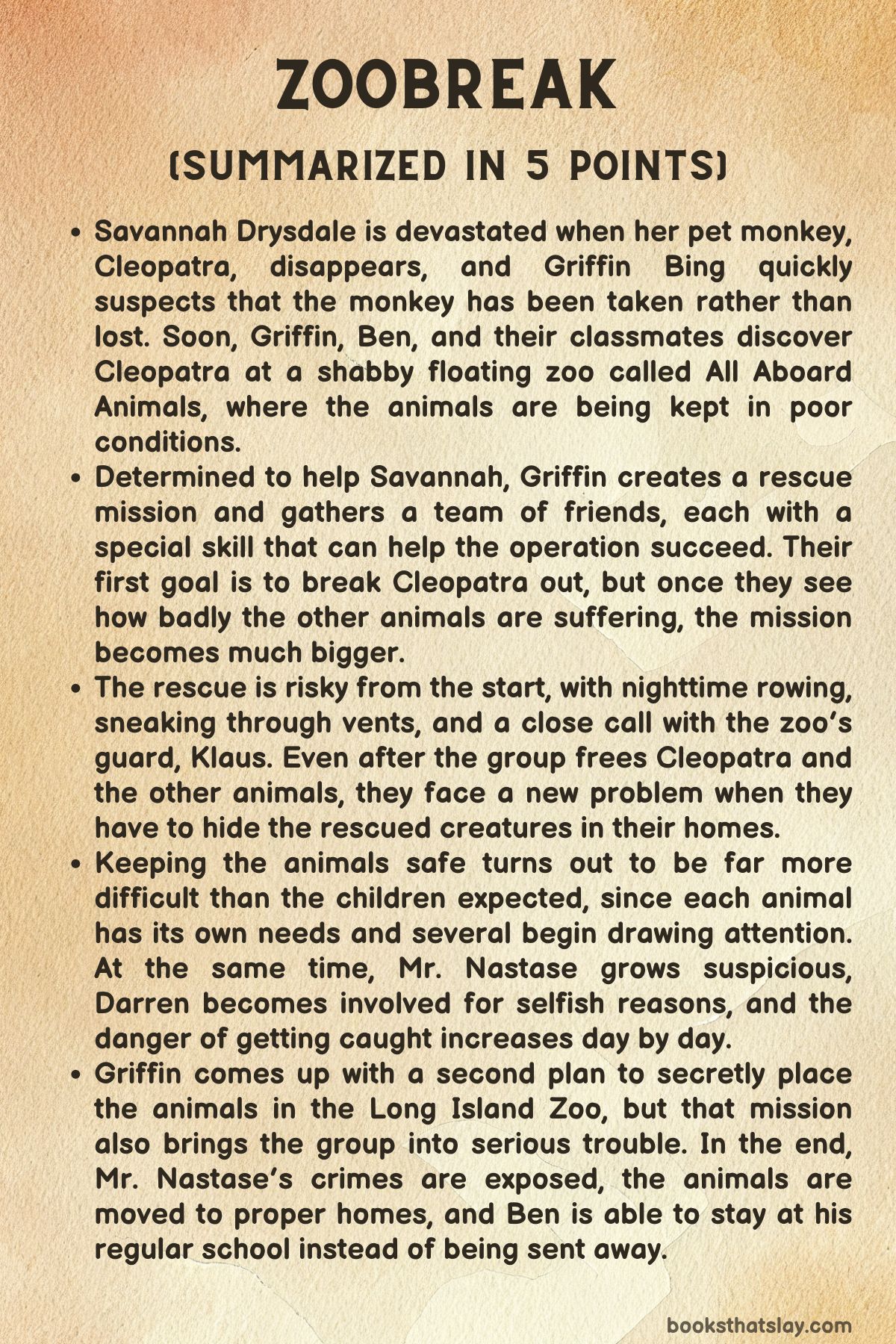
The story begins when Griffin Bing and his best friend, Ben Slovak, are dealing with two upsetting problems at once. Savannah Drysdale’s pet monkey, Cleopatra, has disappeared, and Ben is about to be sent away to a boarding school that specializes in sleep disorders because his narcolepsy has become too difficult to manage at home.
Griffin hates the thought of losing Ben and feels frustrated by how often adults make decisions that leave kids powerless. When Savannah discovers that Cleopatra has not simply wandered off but has likely been taken, the problem becomes even more urgent.
Savannah is deeply attached to Cleopatra and knows the monkey’s habits well. After searching some familiar places, the group finds signs that make Savannah certain Cleopatra was kidnapped.
Soon after, Griffin, Ben, and their classmates visit a strange floating zoo called All Aboard Animals on a school field trip. The zoo is run by a polished but suspicious man named Mr. Nastase.
Inside, the children see that the animals are being kept in poor conditions. The cages are cramped, the setting is gloomy, and the animals do not look healthy.
Then Savannah gets the shock of her life when she sees Cleopatra in one of the exhibits. She immediately accuses Mr. Nastase of stealing her monkey, but he denies everything and has the class removed.
Savannah is crushed because she knows Cleopatra is right there, yet she has no easy way to prove ownership or force Mr. Nastase to give her back. Griffin, who has a reputation for making plans, feels the pressure of both Savannah’s desperation and Ben’s coming departure.
That is when he comes up with a rescue mission to break Cleopatra out of the floating zoo. He calls the operation Zoobreak and gathers a team of friends whose skills can help.
Savannah brings her knowledge of animals. Ben is small enough to squeeze into tight places.
Antonia Benson, known as Pitch, is a strong climber. Melissa Dukakis is skilled with electronics and computers.
Logan Kellerman has a gift for acting and improvisation.
The group begins by studying the zoo. Melissa sets up wireless cameras to watch what happens there.
Pitch examines the fences and access points. Griffin and Ben go aboard and secretly communicate with Cleopatra, letting her know help is coming.
Ben checks whether he can crawl through the ventilation system, because that may be the best way to get inside after hours. Logan distracts the security guard, Klaus, and learns useful information about how the zoo is guarded at night.
The team also discovers obstacles that make the mission harder than expected, including difficult terrain around the fence and the fact that Klaus sleeps close enough to respond quickly if anything goes wrong. Griffin refuses to abandon the plan.
He adapts it and decides the team can reach the zoo by water instead.
On the night of the rescue, things start badly. Darren Vader, a boy the group reluctantly asked to help because he has access to a boat, does not show up.
The friends are angry and disappointed, but they improvise and take an old rowboat instead. After a long effort, they reach the floating zoo.
Ben crawls into the ventilation shaft as planned, but almost immediately things go wrong. He shines his flashlight into the wrong place and lands practically on top of Klaus.
A chase follows through the vents, with Klaus unable to fit where Ben can go. Ben manages to escape, let his friends inside, and reach Cleopatra.
Once the monkey is freed, the team expects to leave quickly, but Savannah realizes the other animals are terrified and miserable. The reason soon becomes clear.
One of the zoo’s owls has been trained to frighten the other creatures so they will be too scared to try escaping. Savannah cannot bear to leave the rest behind, and the group decides to free all the animals, not just Cleopatra.
This turns their already risky mission into something much bigger. They work fast, carrying and guiding a strange assortment of animals out of the zoo.
But after all that effort, they discover their rowboat has drifted away because Griffin failed to secure it properly.
Even then, Griffin does not give up. He finds a life raft on the zoo and uses it to get everyone and the animals back to shore.
From there, the children secretly divide the rescued animals among their homes. This creates a second challenge: keeping the animals safe, hidden, and fed without their parents or neighbors figuring out what is going on.
Savannah contacts a friend at the Long Island Zoo, hoping for professional help, but the woman is away in Africa for two weeks. Until she returns, the kids must somehow manage the animals on their own.
What follows is a chaotic period in which each family’s home becomes a temporary shelter. Griffin keeps a meerkat in his mother’s greenhouse.
Logan turns his basement into a watery habitat for a beaver. Melissa manages to hide a prairie dog among her belongings.
Ben ends up especially attached to a ferret that starts sleeping with him and even helps keep him awake during the day, which unexpectedly improves his sleep at night. Other placements are less successful.
Some animals attract attention, others behave unpredictably, and the strain of secrecy grows. Griffin begins to understand that even a clever plan cannot control everything once living creatures are involved.
Meanwhile, danger is building from several directions. Darren figures out the group went through with the rescue and wants a share of the action.
He thinks the animals could be sold for money. He also becomes interested in the escaped owl and starts trying to track it.
At the same time, Mr. Nastase is not simply angry about losing his animals. He is also worried because Cleopatra was stolen property to begin with, purchased through an illegal animal ring.
If the truth comes out, he faces serious trouble. Klaus starts to suspect the monkey really did belong to Savannah, and Mr. Nastase becomes increasingly desperate to regain control of the situation without involving the police too much.
As the days pass, the children realize they cannot keep the animals hidden much longer. Their families are beginning to notice strange signs, and the animals need proper care.
Griffin comes up with another bold idea: they will move all the rescued animals into the Long Island Zoo after hours, placing each one in a suitable enclosure until Savannah’s zoo contact returns. This second operation is larger and riskier than the first, but it seems like the only way to protect the animals and end the chaos.
Before the mission can happen, Ben receives terrible news. A place has opened up at the boarding school, and he is expected to leave in only ten days.
The timing makes the coming mission even more emotional for Griffin and Ben, since they fear it may be one of their last adventures together. Ben accidentally loses the written plan for the operation, and Darren finds it.
He gives it to Mr. Nastase, who now knows exactly what the children are going to do.
The children go ahead with the mission anyway. They transport the animals using one of Griffin’s father’s awkward but useful apple-picking machines.
At the zoo, Melissa gains access to the security system from a computer in the administration building, while the others carry the animals to appropriate enclosures. For a while, the plan works smoothly.
Some of the animals quickly settle when they see members of their own kind. Ben’s ferret is hard to part with, but eventually it joins another ferret.
Savannah uses her knowledge to safely place even the reptiles.
Then the danger they feared arrives. Mr. Nastase and Klaus appear.
Through a walkie-talkie, Griffin’s friends hear the confrontation as it unfolds. Mr. Nastase reveals that he plans to restock his own zoo by stealing new animals and then blaming the children for another breakout.
He tries to keep control by threatening them with a tranquilizer gun. Klaus, whose doubts about his boss have grown, finally acts on his conscience and jumps in the way, taking the shot meant for Griffin.
Melissa cuts the lights, and in the confusion the children try to escape. Mr. Nastase loses control of a baby alligator, which adds to the panic.
When the lights come back and the police arrive, the scene is a mess. Mr. Nastase is trapped and terrified, Klaus is unconscious, and Ben has fallen asleep right in the middle of the chaos.
The children are taken to the police station, where Griffin finally admits that he made a mistake by building one secret plan after another instead of bringing adults in sooner. He realizes that his need to fix everything himself put his friends at risk.
Savannah tries to take the blame, insisting the others only acted because she wanted Cleopatra back, but the police focus on the adult criminal in the case rather than the children.
In the end, Mr. Nastase is charged for animal cruelty and other crimes, and his connection to a stolen-animal ring is exposed. Klaus leaves and takes a job at the Long Island Zoo, showing he is not a bad man after all, just someone who followed the wrong person for too long.
Savannah’s zoo contact helps place the rescued animals in proper homes. Ben is allowed to stay at his regular school because the ferret has unexpectedly helped him manage his condition.
Griffin and Ben unpack the bags that would have gone to boarding school, relieved that they will not be separated after all.
The novel closes on a warm and funny note, but it also leaves an important lesson. The children’s courage and loyalty save the animals, yet Griffin learns that leadership is not only about making plans.
It is also about knowing when to trust others, especially responsible adults, before a bad situation grows bigger.
Characters
Griffin Bing
Griffin is the driving force of the story and the character through whom the novel examines intelligence, confidence, and the limits of control. Known as “The Man with the Plan,” he approaches problems as if every obstacle can be solved through strategy, timing, and careful use of each person’s strengths.
In Zoobreak, this quality makes him impressive because he sees possibilities that others miss, especially when adults are passive, dismissive, or too slow to act. He is loyal to Savannah, determined to save Cleopatra, and deeply shaken by the idea of losing Ben to boarding school.
His plans are not only about action; they are also his way of fighting fear, helplessness, and change. Griffin believes that if he can organize events well enough, he can prevent loss.
At the same time, Griffin’s greatest strength is also his main flaw. He becomes so committed to solving problems on his own that he starts stacking one risky plan on top of another.
He trusts his own judgment more than the wisdom of involving adults, and this pushes both him and his friends into danger. What makes him a strong character is that he does not remain frozen in that mindset.
By the end, he understands that leadership is not the same as control. He learns that protecting people sometimes means asking for help, accepting limits, and recognizing that even a brilliant plan can go wrong when real lives are involved.
His growth gives the story much of its emotional depth.
Ben Slovak
Ben brings warmth, vulnerability, and quiet courage to the story. His narcolepsy shapes much of his daily life, and the possibility of being sent away to a special boarding school creates one of the novel’s strongest emotional pressures.
Ben is not loud or commanding, and he does not dominate scenes through force of personality, yet he remains central because he is the person whose friendship most deeply affects Griffin. His presence reminds the reader that the story is not only about rescuing animals but also about holding onto human connections that feel threatened by circumstances beyond a child’s control.
Ben often seems more hesitant than Griffin, and he recognizes the danger in many of the plans long before Griffin does.
What makes Ben admirable is that fear never stops him from helping. He crawls through vents, enters dangerous spaces, and keeps going even when his condition makes everything harder.
He is often the one who voices doubt, but that doubt is not weakness; it shows realism and emotional honesty. His relationship with the ferret becomes especially meaningful because it creates a surprising improvement in his life.
The animal helps him stay awake during the day, which allows him to sleep better at night, and this development changes his future. Ben’s role shows that gentleness and courage can exist together.
He also acts as a moral balance to Griffin, because his uncertainty often reveals the true risk of what the group is doing.
Savannah Drysdale
Savannah is the emotional center of the rescue mission because Cleopatra’s disappearance is what sets the main action in motion. Her attachment to animals is not casual or decorative; it defines her way of seeing the world.
She understands animal behavior, notices signs others overlook, and reacts with intense anger when she sees creatures being mistreated. Her outrage at the floating zoo comes from more than personal pain.
Even before the full rescue expands, she responds strongly to the bad conditions in which the animals are being kept. This makes her a character driven by both love and moral conviction.
She is not simply trying to get her monkey back; she cannot accept cruelty as something to be tolerated.
Savannah’s emotional intensity makes her both powerful and impulsive. She can be demanding, and she often presses Griffin to come up with solutions, which shows how much she depends on him when adults fail her.
Yet she is not passive. Her knowledge becomes essential once the rescue begins, especially when the children need to understand how the animals are behaving and where they can be placed safely.
She also helps turn the mission from a personal recovery effort into a broader act of liberation. By the end, her willingness to take responsibility and even try to shoulder the blame for the others reveals maturity.
She begins as a frightened girl desperate to save her pet and ends as someone ready to stand up publicly for what she believes is right.
Antonia “Pitch” Benson
Pitch represents physical courage, steadiness, and practical usefulness. In a group filled with planners, talkers, and improvisers, she contributes through action.
Her climbing ability makes her important to Griffin’s operations, but her role is larger than a technical skill. She is one of the team members who helps make Griffin’s ideas real in the physical world.
Plans need people who can carry them out, and Pitch is one of those people. She is not portrayed as sentimental or overly dramatic, which gives her a grounded quality that strengthens the group dynamic.
Her character also reflects the novel’s idea that teamwork depends on difference. Pitch is not the emotional voice of the group, nor is she the intellectual center, but she matters because group success depends on many forms of competence.
She joins the mission because of loyalty rather than personal gain, and that willingness says a great deal about her moral character. Even in situations that become increasingly absurd, such as managing hidden animals in homes, she remains part of the team effort.
Her presence shows that heroism is not always flashy. Sometimes it comes through reliability, nerve, and the willingness to do difficult work without needing attention for it.
Melissa Dukakis
Melissa is the team’s technical thinker, and her role shows how intelligence can function quietly but decisively. She handles surveillance, cameras, and computers, which makes her essential during both rescue operations.
She is often the person who turns Griffin’s broad ideas into something workable by helping gather information and control details. Her strengths suggest patience, concentration, and a habit of solving problems through observation rather than force.
She does not command the group socially, but her abilities make much of their success possible.
Beyond her technical skill, Melissa also brings caution and level-headedness. She is one of the characters most likely to sense when something is off, and she reacts seriously when the camera feed reveals signs of danger.
That responsiveness gives her an important role as a stabilizing presence in a story full of risk. During the later crisis, when she takes control of the lights and responds under pressure, she shows she can act decisively rather than remaining just the person behind the screen.
Her character suggests that intelligence is not merely knowledge; it is also timing, judgment, and the capacity to stay effective when events become chaotic. She helps prove that quiet competence can be as heroic as dramatic action.
Logan Kellerman
Logan brings humor, flexibility, and social performance to the group. His talent for acting makes him the natural choice for distraction, deception, and improvisation, especially when the children need to gather information without raising suspicion.
He is the kind of character who understands people well enough to invent identities and respond quickly when a situation changes. This gives him an unusual value within the team, because not every problem can be solved by planning or technology.
Some require confidence, quick lies, and the ability to make others believe a role.
At the same time, Logan is not presented as shallow simply because he is theatrical. His contribution depends on nerve, and he takes risks that could easily have gone wrong.
His interactions with Klaus show that performance can sometimes create access where direct questioning would fail. Later, when he notices unexpected figures on the security feed, he proves he is observant as well as entertaining.
He also brings balance to the group dynamic, because his energy offsets the more serious moods created by fear, secrecy, and stress. Logan’s role suggests that adaptability is one of the group’s greatest assets.
He understands how appearances work, and in a story full of disguise, suspicion, and hidden motives, that makes him especially valuable.
Darren Vader
Darren begins as an antagonist shaped by selfishness, mockery, and opportunism. He is the kind of boy who sees weakness as something to exploit, whether through teasing Griffin or trying to profit from other people’s problems.
His decision to bargain hard for boat help and later his desire to sell animals show that he measures situations in terms of personal advantage. Unlike the main group, he is not motivated by loyalty or concern for animals.
He is motivated by what he can get. This makes him an effective contrast to Griffin’s team, because he reveals what action looks like when it is detached from responsibility.
Yet Darren is not a flat villain. He is also insecure and shortsighted, which makes him believable.
Once he gets involved with Mr. Nastase, he quickly discovers that selfish choices can trap the person who makes them. His fear grows when he realizes no one may believe his innocence, and the story uses that fear to expose the weakness behind his swagger.
When he finally confesses everything to his parents, it is not an act of heroism in the purest sense, but it does show that pressure cracks his performance. Darren helps move the plot toward resolution, but more importantly, he functions as a moral warning.
He shows how greed and cowardice can pull someone into danger just as easily as reckless courage can.
Mr. Nastase
Mr. Nastase is the clearest adult villain in the novel and represents exploitation hidden behind polish and performance. He presents himself as a respectable zoo owner, but beneath that surface he is dishonest, cruel, and willing to profit from suffering.
The condition of his animals exposes his character before his crimes are fully known. He treats living creatures as property and spectacle, not as beings deserving care.
His possession of Cleopatra, his connection to illegal animal trading, and his plan to manipulate events for money all reveal someone who sees morality as an inconvenience rather than a limit.
What makes him especially threatening is that he combines greed with calculation. He lies confidently, falsifies records, and tries to frame children for crimes in order to protect himself.
He is not merely careless; he is actively predatory. His authority as an adult initially gives him an advantage, because children are less likely to be believed against him.
That imbalance strengthens his role in the novel. He represents the corrupt use of power, where status and presentation are used to disguise abuse.
At the same time, his eventual collapse shows the instability of that kind of power. Once his control starts slipping, his fear becomes visible, and the image of competence he has built around himself falls apart.
In Zoobreak, he serves as the strongest example of cruelty joined to selfish ambition.
Klaus
Klaus is one of the more interesting secondary characters because he exists between obedience and conscience for much of the story. As the security guard of the floating zoo, he first appears as an obstacle to the children’s mission.
He is physically imposing, watchful, and committed to doing his job. From the children’s perspective, he is a threat, especially during the break-in when his presence creates real danger.
However, he is not written as malicious in the same way as Mr. Nastase. Even early on, there are hints that he is more simple and dutiful than truly cruel.
As the truth about the monkey and the zoo becomes harder to ignore, Klaus begins to question the man he works for. His uncertainty adds moral complexity to the adult side of the story.
He has participated in a harmful system, but he is not fully comfortable with it. His turning point comes when he protects Griffin from the tranquilizer shot, placing himself in danger rather than allowing Mr. Nastase to harm a child.
That action redefines him. He becomes someone capable of moral choice, even after long complicity.
His final move to work at the Long Island Zoo suggests the possibility of redemption. He is a reminder that not every person inside a bad system is beyond change, but change matters only when it is followed by action.
Cleopatra
Although Cleopatra is a monkey, she functions as more than a pet or plot device. She symbolizes loyalty, innocence, and the emotional truth that drives the entire conflict.
Savannah’s connection to her gives the story its first urgent purpose, and Cleopatra’s visible distress in captivity confirms that Savannah is right to fight for her. The monkey’s behavior also helps shape the children’s understanding of the wider problem.
Once freed, Cleopatra remains agitated, which leads Savannah to realize that something larger is wrong inside the zoo. In that sense, Cleopatra is not just the one being rescued; she helps reveal the suffering of the others.
Her role also matters because she exposes the contrast between two ways of seeing animals. To Savannah, Cleopatra is family.
To Mr. Nastase, she is merchandise. That difference is central to the book’s moral structure.
Cleopatra’s reunion with the dog at Savannah’s house adds warmth and relief after intense danger, reinforcing the sense that some bonds are genuine and worth protecting. Even without human speech, she influences decisions, emotions, and the direction of the story in major ways.
She is the spark that turns private pain into collective action.
The Ferret
The ferret becomes one of the most memorable animals because it affects the plot and Ben’s development in a direct, surprising way. At first, it seems like one more rescue problem, an energetic animal that creates inconvenience and disorder.
Yet it gradually becomes something much more meaningful. The ferret clings to Ben, follows him, and refuses to separate easily, creating moments of humor but also moments of emotional attachment.
Unlike some of the other rescued creatures, it does not remain only a temporary responsibility.
Its importance deepens because it changes Ben’s life. By keeping him awake during the day, it helps regulate his sleep in a way that affects the question of whether he must leave home for special schooling.
This gives the animal symbolic weight. It represents the unexpected forms help can take and the idea that care can work in both directions.
Ben rescues the ferret, but the ferret also rescues Ben from a future he does not want. That mutual relationship gives the ending extra emotional force.
In a story full of plans, the ferret stands for the good that arrives without planning at all.
Themes
Friendship and Loyalty
Friendship in Zoobreak is shown as active commitment rather than simple affection. The children do not just say they care about one another; they repeatedly take risks, sacrifice comfort, and endure fear for the sake of someone else’s need.
Griffin’s determination to help Savannah rescue Cleopatra is tied closely to his pain over Ben’s possible departure, so the rescue mission grows from a larger emotional refusal to accept separation and helplessness. The group works because its members trust one another’s strengths, but the deeper point is that they stay involved even when the situation becomes messier and more dangerous than they expected.
Loyalty here is not clean or convenient. It means showing up at night, hiding animals, covering for one another, and continuing even after the original plan has changed.
At the same time, the theme is not presented as sentimental perfection. Loyalty can lead the children into trouble when it is not balanced with judgment.
That tension makes the theme richer, because it suggests that friendship is powerful precisely because it pushes people to act, but action taken for friends still carries responsibility.
Responsibility and Consequences
The story treats responsibility as something far larger than good intentions. The children begin by believing that rescuing mistreated animals is clearly the right thing to do, and morally the reader is meant to sympathize with them.
Yet once they act, they discover that doing one right thing does not erase the consequences of how it is done. Freeing the animals leads to a chain of complications involving secrecy, hiding places, family disruption, danger, and the possibility of blame falling on the wrong people.
Griffin especially must confront the fact that cleverness is not the same as wisdom. He can design operation after operation, but each new solution creates another layer of risk.
The novel therefore treats responsibility as practical as well as moral. Caring means thinking ahead, accepting limits, and recognizing when a problem has grown beyond what children should manage alone.
This theme reaches its clearest form when Griffin understands that he should have involved adults sooner. The lesson is not that action is wrong, but that responsible action requires humility, foresight, and accountability when things do not go as planned.
Freedom, Captivity, and the Treatment of Animals
The contrast between freedom and captivity runs through the entire story, not only in the physical sense of cages and escape but also in the moral sense of who has the right to control another living being. The floating zoo represents confinement at its ugliest: cramped spaces, fear as a management tool, and animals reduced to objects for display and profit.
Savannah’s horror at those conditions turns the rescue from a private mission into a larger ethical response. Once the children understand that the owl has been used to terrify the other animals into submission, the idea of captivity becomes even harsher.
The problem is no longer simple ownership; it is systematic cruelty. Against this stands the children’s belief that animals deserve care suited to their nature.
Even when they struggle to hide the rescued creatures, the narrative makes clear that their failures come from inexperience, not from indifference. The theme therefore asks readers to think about the difference between possession and stewardship.
It suggests that real care respects the needs of the animal rather than the desires of the owner, and that freedom has value because living creatures are not meant to exist only for human convenience.
Growing Up and Knowing When to Ask for Help
Much of the story is built on the energy of children acting for themselves in a world where adults often seem ineffective, unfair, or unaware. That spirit gives the novel much of its excitement, but it also supports a more thoughtful theme about maturity.
Growing up is not presented as becoming more rebellious or more independent at all costs. Instead, it is shown as learning where self-reliance ends.
Griffin begins with enormous confidence in his own ability to solve problems. He sees adult involvement as a threat to action, and in some cases that view seems justified because adults do move slowly or misunderstand what matters.
However, the longer the crisis continues, the more obvious it becomes that determination alone is not enough. The children are dealing with criminal behavior, endangered animals, and increasing physical danger.
Real maturity appears when Griffin finally recognizes that insisting on total control has put others at risk. This gives the novel a thoughtful coming-of-age dimension.
The children do not become mature by abandoning courage; they become mature by understanding that asking for help can also be an act of strength.