Zoo City Summary, Characters and Themes
Zoo City by Lauren Beukes is a sharp, inventive urban fantasy set in a version of Johannesburg where guilt leaves visible marks. People who have committed serious crimes become linked to animal companions and often develop strange abilities, while society pushes them to the margins.
At the center is Zinzi December, a damaged but resourceful woman trying to survive with her Sloth, her gift for finding lost things, and a long list of debts. The novel mixes crime, magic, music culture, and social satire to build a world that feels harsh, surreal, and immediate. It is a story about blame, survival, power, and the cost of trying to outrun the past.
Summary
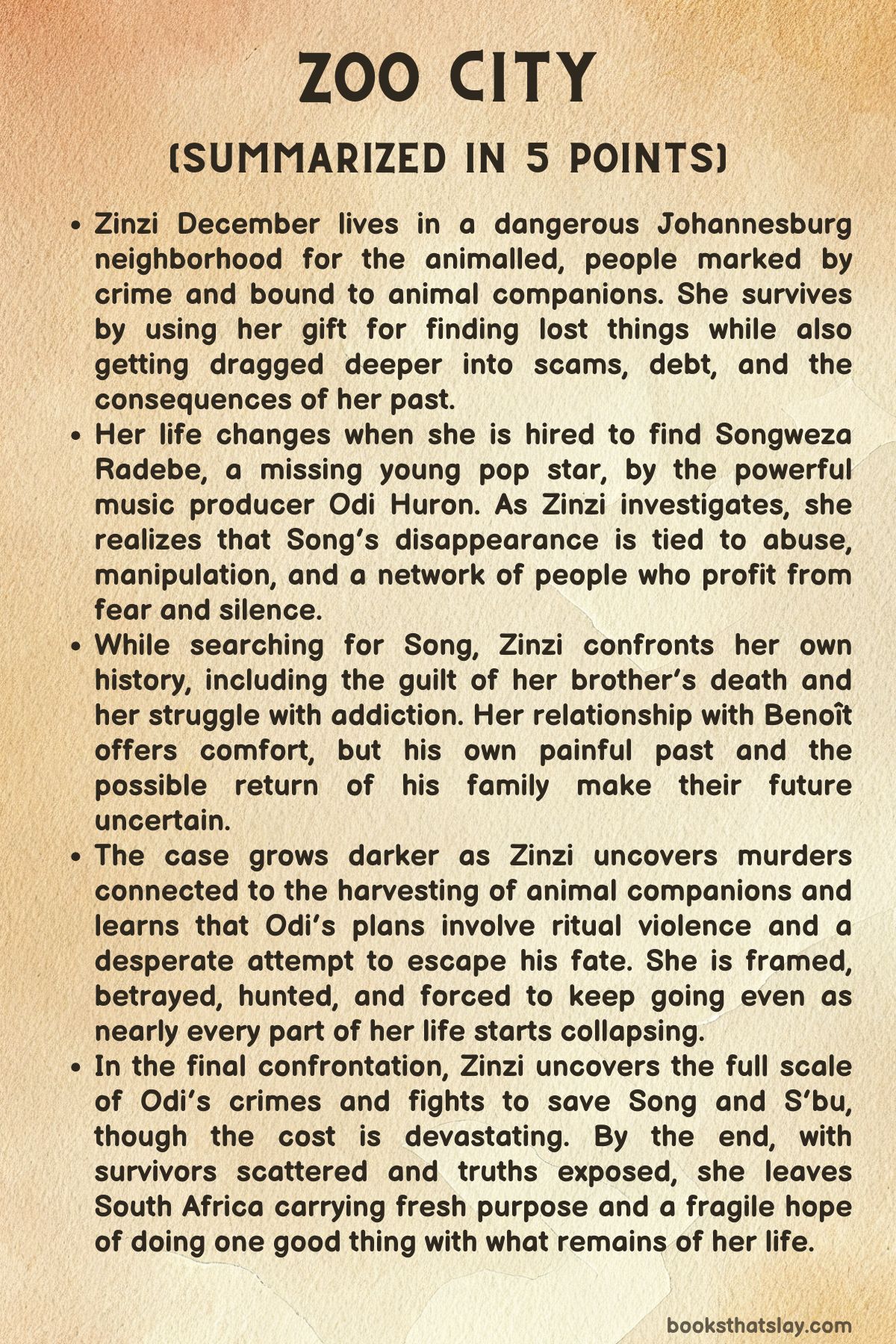
Zinzi December lives in Zoo City, a rough part of Johannesburg filled with people who are “animalled,” each bound to an animal companion after taking part in a death. Her own companion is a Sloth, and along with him she carries a reputation, an old addiction, and the memory of her brother’s killing, which happened because of information she passed on while trying to settle drug debt.
Zinzi survives by using her strange talent for finding lost things. She follows emotional and psychic traces that connect people to what they have misplaced, and she takes small jobs for cash while also helping run phishing scams to pay off what she owes dangerous men.
At the start, she recovers a ring for an elderly woman named Mrs. Luditsky, only to arrive and learn the woman has been murdered. The police quickly treat Zinzi as suspicious because of her record and because her fingerprints are in the apartment.
Inspector Tshabalala makes it clear that Zinzi’s past will always be used against her. At the crime scene, Zinzi also meets two unsettling figures, Mark and Amira, who work as fixers and claim they need her help finding something lost.
They offer her a job, and although she refuses at first, money and pressure eventually push her to accept.
Zinzi’s private life is already unstable. She is involved with Benoît, a refugee from the Congo whose companion is a Mongoose.
Their relationship gives her rare comfort, but even that is fragile. Benoît has spent years searching for the wife and children he thought he had lost during wartime violence, and he suddenly learns they may still be alive.
This news puts distance between them. Zinzi knows from the beginning that any sense of safety with him is temporary.
The job from Mark and Amira comes from Odi Huron, a famous music producer who lives like a recluse in a decaying mansion. Odi wants Zinzi to find Songweza Radebe, one half of the teenage music duo iJusi.
Song has vanished, and Odi insists he wants her brought back safely. Zinzi soon senses that something is wrong.
Odi carries the atmosphere of a man rotting from the inside, and the usual ties to lost objects around him look corrupted and blackened. Still, she takes the case because she needs the money and because she is good at tracing what others miss.
Her investigation begins with Song’s twin brother, S’bu, and the people around them. She visits their home, talks her way into their confidence, and learns that the twins came from poverty, became famous young, and have been badly handled by the adults around them.
Song appears troubled, medicated, and rebellious; S’bu seems quieter, more vulnerable, and increasingly overshadowed by his sister. Zinzi finds signs that Song packed voluntarily rather than being abducted.
She also learns that Odi sent the twins to rehab, that Song had a boyfriend named Jabu, and that there may be tensions involving drugs, secrecy, and control.
Because she used to be a journalist, Zinzi works her contacts for information. She reconnects with Gio, an ex-lover now working in media, even though their history is tangled with her descent into addiction.
Through reporters, club workers, industry people, and gossip, she hears dark stories around Odi. There are rumors about his past protégé Lily Nobomvu, who died under questionable circumstances, and whispers that Odi’s business empire has always had a rotten underside.
Zinzi also learns that Odi carries insurance policies on both Song and S’bu, which turns the missing-girl case into something much more sinister.
As she follows the trail, the novel broadens its view of the world around her. Newspaper articles, blog posts, academic writing, and scam emails reveal a society obsessed with animalled people, fearful of them, eager to exploit them, and hungry for sensational stories about them.
Some treat them as cursed. Some see them as fashionable.
Some harvest their bodies and animals for magic medicine. Underneath all the noise is the constant terror of the Undertow, the dark force that comes for an animalled person when the bond is broken or the animal dies.
Zinzi’s own guilt remains close throughout. Encounters with healers and visions force her to relive the truth about her brother’s death.
She had thought she could solve one disaster without causing another. Instead, her actions led killers to him, and his murder became the event that marked the rest of her life.
This memory shapes how she sees Song and S’bu. She recognizes young people trapped by adults, bad systems, and impossible choices.
The case becomes more dangerous when Zinzi discovers that Song was not kidnapped at first. She ran.
Odi had been abusing her, controlling her, and possibly eliminating people connected to her, including Jabu. When Zinzi finally finds Song hiding in a high-rise, Mark and Amira appear and take over, insisting that Zinzi is no longer needed.
Song accuses them of trying to kidnap her. From that moment, Zinzi fully understands that Mark and Amira are not just couriers or fixers.
They are active partners in something violent and carefully planned.
Meanwhile, Zinzi’s life starts collapsing from every side. Gio betrays her by posting humiliating sexual images and cruel gossip online.
Benoît discovers the extent of her phishing work and prepares to leave to search for his family. Her sobriety gives way and she falls back into drugs and self-destructive behavior.
At the same time, she starts receiving eerie email responses that seem to come from the dead or dying. These messages, together with strange visions, push her toward a second line of inquiry: someone is murdering animalled people and taking their animals for the muti trade.
Zinzi begins connecting bodies, missing companions, and shadowy signs that suggest organized ritual killing rather than random street crime.
Her search uncovers links between the recent murders, the death of Mrs. Luditsky, and the machinery around Odi. Evidence is planted to frame Zinzi.
Vuyo, the man tied to her scam work, turns on her. Song’s home is attacked and burned, leaving dead bodies meant to be mistaken for the twins.
Zinzi realizes that the conspiracy is larger than one missing singer. Odi, Mark, and Amira have been arranging murders, staging scenes, and preparing a ritual involving the transfer of an animal bond.
Odi is terrified of losing his own animal and being taken by the Undertow. He believes he can shift the burden onto someone else.
In the final movement, Zinzi and Benoît go to Odi’s estate to stop what is happening. They find proof of the murders and signs of butchery prepared for harvesting animal parts.
Beneath the house is a hidden chamber linked to the pool, where Odi keeps a huge albino Crocodile. Song and S’bu are drugged and forced into a ritual meant to transfer Odi’s bond to S’bu after Song’s death.
The scene becomes chaotic and brutal. Benoît is attacked by the Crocodile.
Bodies surface, including Ronaldo’s, confirming that Odi has been killing people connected to Song. Song is stabbed to death by her own brother while both are under chemical and psychological control.
Odi uses the moment of death and terror to force the bond away from himself and onto S’bu. Then Amira kills S’bu as well.
Zinzi survives gunfire, the water, and the ritual chamber, trying to save Benoît and expose the truth. In the confusion, the Crocodile turns on Odi.
Mark and Amira abandon their plan and flee. Investigators later uncover many bodies on Odi’s property, including remains connected to older disappearances.
The scandal spreads outward, taking down others in the network, including Gio through the scam trail. But the ending is not clean or triumphant.
Benoît survives badly injured. Zinzi remains under suspicion.
The city is still dangerous, corrupt, and ready to swallow people whole.
At the end, Zinzi takes forged papers and heads toward the Zimbabwe border in her battered car. Instead of running only for herself, she carries the names and identity details of Benoît’s wife and children.
Her next goal is to find them. The novel closes with motion rather than peace.
Zinzi is still marked by guilt, still bound to Sloth, and still living in a world that punishes the vulnerable. Yet for once she is moving toward something other than escape.
Characters
In Zoo City, characterisation works through damage, memory, and survival. The people at the center of the story are not arranged into simple roles of hero and villain.
They are shaped by guilt, fear, need, and the social pressure of living in a world that watches, judges, and profits from suffering. Each major figure carries a private history that affects every choice, and the novel gives even its secondary players enough tension and texture to feel tied to the wider moral atmosphere of the story.
Zinzi December
Zinzi is the emotional and moral center of the novel, but she is not presented as noble in any easy sense. She is sharp, cynical, funny, wounded, and often selfish, yet she never becomes emotionally flat because her hardness is clearly a survival mechanism.
Her life is structured by debt: financial debt to criminals, emotional debt to her dead brother, and the constant spiritual burden that comes with being animalled. Her gift for finding lost things is not only a supernatural skill but also an extension of her mind.
She is drawn toward what is missing, damaged, hidden, or discarded because she herself lives as someone who has been pushed to the edge of respectable society. That makes her both an effective investigator and a deeply haunted person.
What makes Zinzi compelling is the gap between how she sees herself and how she acts when pressure rises. She insists that she is compromised, unreliable, and interested mostly in survival, yet again and again she moves toward danger when someone more vulnerable is trapped.
Her work in scams, her return to drugs, and her manipulation of people reveal how damaged she is, but they do not erase her instinct to resist cruelty. She lives with shame rather than innocence, and that gives her moral texture.
Her journey is not about becoming pure. It is about deciding, in a corrupt world, not to surrender completely to corruption.
Her relationship with Sloth also reveals her deepest emotional truth. Sloth is not merely a sign of punishment but a constant witness to her failures, cravings, fear, and tenderness.
Through that bond, Zinzi’s inner life becomes visible. She may lie to others and sometimes to herself, but her connection with Sloth keeps exposing what she cannot fully bury.
By the end, she remains damaged and uncertain, but she has recovered a sense of direction. That matters because her growth comes not through redemption in a grand sense, but through choosing responsibility over numbness.
Benoît
Benoît represents one of the novel’s clearest examples of endurance shaped by violence. He is gentle in manner, practical in daily life, and capable of offering Zinzi a kind of safety she cannot find elsewhere.
Yet that quietness sits on top of extreme trauma. His history as a child soldier and as a man brutalised by war gives his character a grave seriousness.
He has survived events so terrible that they resist ordinary language, and his way of living reflects that. He is measured, observant, and emotionally guarded because he knows how quickly life can be broken.
His relationship with Zinzi is moving because it is built on mutual incompleteness rather than fantasy. He does not rescue her, and she does not heal him.
Instead they create a temporary space of honesty, physical comfort, and companionship in a world that offers little security. At the same time, Benoît’s unresolved attachment to his missing family always stands between them.
That history gives the relationship its sadness. He wants connection, but he also belongs to another story that did not end when his family disappeared.
When news arrives that they may still be alive, he cannot ignore that possibility, even though it hurts Zinzi.
Benoît’s Mongoose adds another layer to his character. The animal is not just a supernatural feature but part of how he manages danger and intimacy.
His shavi dampens the influence of others, which helps explain why Zinzi feels calm around him. This makes Benoît not only a lover but also a counterforce to the emotional noise and predation around her.
In the final sections, his presence in the confrontation with Odi confirms his courage. He is not driven by spectacle or revenge.
He acts because decency requires action, and that quiet courage defines him.
Sloth
Sloth is one of the most unusual and important presences in the novel because he works on several levels at once. He is Zinzi’s animal companion, her punishment, her witness, and in a strange way her conscience.
His slow, heavy, often irritable presence creates a constant physical reminder that she cannot escape what she has done. At the same time, Sloth is not a passive symbol.
He reacts, resists, protects, and judges. His moods register shifts in Zinzi’s moral and emotional state before she admits them to herself.
Sloth’s importance lies in how he makes guilt intimate. Zinzi cannot treat the past as an abstract burden because it sits on her shoulder, scratches her, recoils from her worst decisions, and responds when danger is near.
He gives the supernatural system of the novel emotional force. Instead of guilt becoming a simple idea, it becomes a relationship that must be lived with every day.
This turns punishment into companionship and companionship into a source of discomfort. That contradiction gives the book much of its originality.
He also changes the way readers understand care. Zinzi feeds him, carries him, worries about him, and depends on him.
In return, he offers protection and unspoken recognition. Their bond is uncomfortable but real.
Sloth does not forgive her in sentimental terms, yet he remains with her, which suggests that living with guilt is not the same as being destroyed by it. His reactions during key moments, especially when Zinzi slips toward self-destruction, make him a moral barometer inside the narrative.
Odi Huron
Odi Huron is a figure of decayed power. He begins as a distant music mogul and ends as the center of a system built on abuse, greed, and spiritual panic.
What makes him effective as an antagonist is that he is not chaotic. He is controlled, manipulative, and deeply invested in preserving himself.
His house, his reputation, and his treatment of younger talent all reflect a man who has turned influence into a private empire. Yet beneath the cultivated surface is terror.
He is consumed by the fear of loss, especially the fear of the Undertow, and that fear drives his crimes.
His corruption is both personal and institutional. As a producer, he profits from young talent while controlling bodies, careers, and access.
Song and S’bu are not artists to him so much as assets that can be managed, exploited, and sacrificed. His treatment of Song reveals sexual and psychological domination, while his use of insurance, drugs, and hired enforcers shows how carefully he turns people into instruments.
He is frightening because he uses money, secrecy, and influence to make violence seem procedural rather than dramatic.
Odi also embodies the theme of power collapsing inward. He has spent years trying to master his world, but the more he tries to escape consequence, the more grotesque he becomes.
The corruption around him appears physically in the blackened distortion of his lost ties and in the hidden horror beneath his property. He is a man trying to outwit mortality and guilt by transferring cost onto others.
In that sense, he is not only a villain but a portrait of power stripped of any ethical center.
Amira
Amira is one of the most difficult figures to read at first, and that uncertainty is central to her effect. She presents herself as polished, efficient, and controlled, with a cultivated aura of danger.
Her story about trafficking invites sympathy, yet the novel gradually exposes how unstable her self-presentation is. She appears as someone shaped by violence, but also as someone who has learned to use the language of victimhood, professionalism, and worldly competence to conceal her role in ongoing cruelty.
What makes Amira interesting is the way she converts survival into predation. She knows how power works, how fear works, and how to move through criminal networks without appearing chaotic.
Her relationship to missing objects, especially the things Zinzi senses tied to her, hints at a history full of force and secrecy. She seems to have reworked suffering into armor.
That does not excuse her actions, but it does make her more than a simple criminal assistant. She represents the hardening of a self that has decided vulnerability is intolerable.
Her presence also sharpens the novel’s interest in performance. Amira understands that identity can be constructed through story, clothing, bearing, and selective revelation.
She is good at appearing credible, and that makes her especially dangerous. In the final acts, when her role in violence becomes clear, the earlier ambiguity around her does not disappear; instead, it becomes tragic in a cold way.
She is someone who may once have had to survive systems of exploitation and has now become one of their operators.
Mark
Mark functions as a smiling mask over brutality. Compared with Amira, he can seem lighter, more decorative, even absurd, especially with the dyed poodle and cultivated style.
But this surface is deceptive. His charm is strategic.
He softens the scene while making violence easier to stage. He is the kind of man who can joke, flatter, and kill without changing tone, and that emotional smoothness makes him deeply unsettling.
His role in the plot shows how violence often depends on people who do not look monstrous in any obvious way. Mark is not presented as wild or uncontrollable.
He is organised, useful, and socially legible. That makes him a good intermediary between criminality and polite surfaces.
He can move through upscale spaces, professional arrangements, and lethal operations without seeming out of place. His shavi, which amplifies the powers of others, also gives him symbolic importance.
He strengthens what is already present, and in narrative terms he amplifies corruption itself.
Mark’s participation in ritual murder and deception reveals his emptiness at the core. He has style, wit, and competence, but almost no moral interiority.
That absence matters because the novel is interested not only in openly broken people but also in people who have erased conscience through adaptation. Mark is one of the clearest examples of that kind of emptiness.
Songweza Radebe
Song is central to the novel’s critique of exploitation, fame, and control. She first appears through absence, rumor, and other people’s projections.
Everyone seems to have a version of her: rebellious teenager, unstable celebrity, difficult client, talented twin, sexualised young woman, troubled patient. As Zinzi investigates, the gap between those labels and Song’s reality becomes more painful.
Song is a teenager under enormous pressure, commodified by the music industry, controlled by adults, treated as unstable when she resists, and denied ownership of her own body and future.
Her anger is one of her most important qualities. She does not behave like a passive victim, and that is part of why so many people around her dismiss or pathologise her.
She runs, lies, hides, lashes out, and makes risky choices, but these actions come from confinement and fear. Her attempts to escape are fragmented because the systems around her are stronger than she is.
That gives her character a tragic force. She can imagine a life beyond Odi, but she cannot secure it.
Song also reflects the cruelty of fame when it lands on someone still forming a self. She is visible everywhere and understood nowhere.
The music industry profits from her image while ignoring her distress. Even her illness and medication become part of how others manage her rather than understand her.
By the end, her death is horrifying not only because it is violent, but because it completes a process in which a young person has been treated as expendable for so long that others assume they can decide how and when she matters.
S’bu Radebe
S’bu is one of the saddest characters in the novel because he exists in a state of emotional dependence and erasure. He is the quieter twin, the one people view as less gifted, less visible, and less central.
That judgment shapes his identity. He is made to feel secondary in his own partnership and vulnerable in ways he cannot easily express.
His sensitivity is repeatedly noted by others, and that sensitivity leaves him exposed to manipulation.
His bond with Song is complicated by love, resentment, and shared history. They are family, collaborators, survivors, and rivals at once.
Because they entered fame together, separation is both necessary and terrifying. S’bu wants agency, yet he also fears being left without the role that has defined him.
This emotional dependence makes him easy to control in a system built on pressure, medication, and authority. He is not simply weak; he is a young person whose need for recognition has never been met in a healthy way.
His ending gives his character tragic weight. Forced into ritual violence while drugged and manipulated, he becomes both victim and instrument.
That dual role matters because it captures one of the novel’s harshest ideas: damaged systems do not only destroy the innocent from outside; they also force the vulnerable to participate in destruction. S’bu’s fate is terrible because it is shaped by love, confusion, coercion, and the hunger to matter.
Inspector Tshabalala
Inspector Tshabalala represents institutional judgment, but she is more than a simple hostile cop. She is hard, suspicious, and relentless, and she treats Zinzi with open contempt.
Yet that contempt grows out of a world in which guilt has become visible, measurable, and socially codified. Tshabalala believes in order, evidence, and consequences, but she also works within a system that easily converts prejudice into investigation.
Her treatment of Zinzi reflects both professional instinct and moral certainty.
She is effective because she refuses the romantic framing of the damaged outsider. To her, Zinzi is not a misunderstood protagonist but a woman with a violent past and access to dangerous spaces.
In that sense, Tshabalala acts as a corrective to any attempt to sentimentalise criminality. At the same time, the novel shows the limits of her perspective.
She is so ready to see Zinzi as guilty that she risks missing the larger machinery at work. Her certainty narrows her vision.
Even so, Tshabalala contributes something important to the moral landscape. She reminds readers that suffering does not automatically produce innocence.
She is not warm, but she is not frivolous either. Her presence keeps pressure on the narrative and forces Zinzi to confront how impossible it is to separate oneself from one’s record in a society built on suspicion.
Vuyo
Vuyo embodies the everyday machinery of exploitation that surrounds Zinzi long before the central mystery reaches its climax. He is not grandly villainous in the way Odi is.
Instead, he is practical, parasitic, and always calculating advantage. He manages phishing operations, debt, and information with a businessman’s tone, which makes him feel ordinary in a frightening way.
He thrives by keeping damaged people dependent and by turning desperation into income.
His relationship with Zinzi shows how debt can function as a form of soft imprisonment. He does not need total control over her life because partial control is enough.
Interest rates, threats, and favours keep her tied to him. He understands exactly how much fear to apply.
That knowledge makes him one of the most realistic predators in the book. He is not powered by fantasy or ideology.
He is powered by opportunity.
Vuyo also helps define Zinzi’s early moral state. As long as she keeps working with him, she remains tied to cycles of fraud, deceit, and self-disgust.
Paying him off becomes more than a financial act. It marks a break, however unstable, from one of the systems that has kept her spiritually trapped.
His violence later in the story confirms what has been true all along: beneath the administrative surface, coercion is always waiting.
Gio Conti
Gio is important not because he dominates the plot but because he represents one of the most corrosive forms of betrayal in the novel. He belongs to Zinzi’s former life, when she was a journalist moving in a more respectable world.
As an ex-lover, former enabler, and media insider, he stands at the border between intimacy and exploitation. He knows Zinzi’s vulnerabilities and presents himself as someone who understands her, but he repeatedly uses that access for his own advantage.
His significance lies in how he turns cultural capital into cruelty. Gio is witty, connected, and superficially sophisticated, yet those qualities collapse into pettiness when his ego is bruised.
The revenge post he publishes about Zinzi is not just a personal betrayal. It demonstrates how media spaces convert private humiliation into public spectacle, especially when the subject is already socially stigmatised.
He weaponises image, gossip, and class-coded disgust in order to regain control.
Gio’s character also highlights the novel’s distrust of coolness detached from ethics. He belongs to a world that talks intelligently, consumes trends, and treats damage as content.
That makes him an ideal contrast to Zinzi. She has done terrible things, but she still feels the cost of them.
Gio, by contrast, often appears most heartless when he is performing intelligence and style.
Mrs. Luditsky
Mrs. Luditsky appears briefly, yet she matters because her death sets the novel’s central movement in motion and exposes the atmosphere of fear surrounding the animalled. She is presented as an elderly woman whose lost ring initially seems like a minor case, an ordinary job for Zinzi.
But her anxiety during the robbery and the circumstances of her murder show how deeply suspicion shapes social life. She is not just an individual victim; she stands for a wider class of people who fear the criminalised margins and yet remain vulnerable to the networks operating around them.
Her murder also reveals how easily Zinzi can be pulled into narratives created by others. Because she was present in Mrs. Luditsky’s life, she becomes convenient material for police suspicion and later for attempts at framing.
In structural terms, Mrs. Luditsky functions as the first sign that the world of small survival jobs is connected to something larger and more organised. Her presence is short, but her death opens the story’s moral and investigative field.
D’Nice
D’Nice adds another shade to the social world around Zinzi. He is loud, opportunistic, and often unpleasant, but he is not written as a simple caricature.
He belongs to the everyday ecosystem of Zoo City, where envy, hunger, performance, and brief pleasures all mix together. His shavi, which feeds on moments of happiness, suits him perfectly.
He lives close to other people’s joy without generating much of his own, and there is something parasitic in how he moves through relationships and information.
He is important partly because he helps show how vulnerability produces petty cruelty among the marginalised as well as cruelty from outside. He gossips, intrudes, and helps transmit damage.
Yet he also feels real because he is not exceptionally evil. He is ordinary in the way many socially bruised people can become ordinary agents of harm.
He survives by feeding off proximity, mood, and weakness.
Carmen
Carmen is one of the more tragic side characters because she shows what happens to people orbiting power without controlling it. At first she seems like an employee, gatekeeper, or decorative presence in Odi’s household.
Later, it becomes clear that she too has been drawn into the machinery of manipulation. Mark’s description of her as a potential animalled star suggests that she has been turned into a project rather than treated as a person.
By the time she appears in the final confrontation, drugged and made to injure herself, her body has become a stage for other people’s intentions.
Her role underlines the way exploitation in the novel often works through aspiration. Carmen is not central enough to be protected and not powerful enough to resist.
She exists in the gap where dreams of fame, proximity, and usefulness become forms of entrapment. That makes her one of the quieter but more disturbing examples of how people get consumed by systems built on image and appetite.
Naisenya
Naisenya offers a brief but important contrast to many of the more predatory adults in the novel. As a former patient at the rehab facility, she speaks from experience rather than authority, and that gives her observations a grounded honesty.
She notices emotional fragility in S’bu and instability in Song without turning those traits into spectacle. Her perspective is valuable because it lacks the hungry opportunism found in the music industry, the media, and criminal networks.
She also contributes to the novel’s interest in institutions that may help and harm at once. Rehab is not presented as simple salvation, yet Naisenya’s presence suggests that damaged people can sometimes become witnesses for one another rather than exploiters.
She is a small but meaningful figure in the moral landscape.
Arno
Arno begins as an irritating teenage presence, but he gradually becomes more sympathetic because his emotional attachments make him less superficial than he first seems. His love for S’bu gives his actions urgency and vulnerability.
He is not brave in a heroic sense, yet he tries to intervene, calls for help, and becomes one of the young people caught in the violent network surrounding the twins. That emotional sincerity matters because it cuts through the noise of gossip, image, and performance.
His death is one of the moments that confirms how little value predatory systems place on ordinary vulnerable lives. He is not a star, not a criminal mastermind, not a major threat.
He is simply disposable to those who want to erase evidence. That makes his fate especially painful.
Mandlakazi Mabuso
Mandlakazi functions as a counterpoint to sensationalist media culture because, although she works in tabloid journalism, she is willing to follow uncomfortable truths. She does not appear as idealised, but she has curiosity and a practical courage that matter once Zinzi starts connecting the murders.
Her interest in the story of stolen animals and muti killings helps move private suspicion into the realm of public record.
She represents journalism at its most useful in the novel: not clean, not perfectly noble, but capable of forcing hidden violence into visibility. In a narrative full of exploitative storytelling, that role matters.
She helps demonstrate that telling a story can be an act of exposure rather than violation.
Baba Ndebele
Baba Ndebele occupies the uncertain territory between performance, insight, tradition, and danger. He is theatrical, modern, manipulative, and spiritually perceptive all at once.
His scenes matter because they reveal how the novel refuses a simple division between rational modern life and supernatural belief. Ndebele operates in both worlds easily.
He uses contemporary objects, speaks with confidence, and still channels forms of knowledge that cut into Zinzi’s hidden guilt.
His potion-induced visions force Zinzi into confrontation with truths she has evaded. Whether one reads him as healer, opportunist, or something in between, his function is clear: he tears open the narrative of denial.
He does not redeem Zinzi, but he strips away some of the lies that help her endure. In that sense, he acts as a catalyst for moral recognition.
Themes
Guilt as a Permanent Companion
Guilt in Zoo City is not treated as a passing emotion or a moral lesson that can be neatly absorbed. It becomes structure, identity, and daily reality.
The animal companion makes guilt impossible to privatise because it gives wrongdoing visible form. For Zinzi, this means that remorse is not only internal memory but a living bond she carries through every room, conversation, and decision.
The novel is interested in what happens when guilt cannot be hidden behind manners, success, or reinvention. Some characters become more humane because they feel the weight of what they have done.
Others become harder, more evasive, or more cruel because they cannot bear that weight. This makes guilt morally unstable.
It does not automatically improve anyone. It can push people toward responsibility, but it can also produce denial, appetite, and violence.
The story repeatedly asks whether living with guilt is enough, or whether people must do something with it. Zinzi’s arc suggests that guilt has value only when it leads to a choice not to keep harming others.
Exploitation of the Vulnerable
Power in the novel works through unequal need. Young artists, addicts, migrants, the poor, and the animalled all become easy targets because they already live in conditions of insecurity.
The story shows exploitation as a system rather than a set of isolated cruelties. Odi exploits talent, Vuyo exploits debt, Gio exploits humiliation, and others exploit bodies for profit or status.
Even institutions and media spaces that appear respectable often feed on the vulnerable in softer but still damaging ways. Song and S’bu are central to this theme because they reveal how fame can become another mechanism of control.
Their value attracts adults who claim to guide them while stripping them of autonomy. The same pattern appears across the city in scams, trafficking, gossip, and ritual violence.
The novel makes a harsh point: people already marked as damaged are treated as usable. Their suffering becomes material for business, entertainment, or spiritual commerce.
Against this, the story values acts of protection that do not seek ownership in return.
The Struggle Between Reinvention and the Past
Many characters attempt to build new selves, but the past remains stubborn. Zinzi wants to survive beyond the woman who got her brother killed.
Benoît wants to build a life after war. Song wants to escape the identity made for her.
Even Odi tries to escape consequence by rewriting the terms of his fate. The novel insists that reinvention is possible only in partial, fragile ways.
No one simply becomes new. History clings through memory, trauma, debt, records, bodies, and relationships.
This does not mean change is impossible. Instead, it means that change requires facing what has happened rather than constructing a polished false version of the self.
Characters who try to erase the past altogether become monstrous or emotionally hollow. Characters who accept that the past remains present, however painfully, have a better chance of acting with honesty.
The ending supports this idea. Zinzi does not achieve freedom through forgetting.
She moves forward while still marked, still watched, and still carrying the consequences of what came before.
Society’s Hunger to Judge, Label, and Spectacle Suffering
The novel presents a culture fascinated by visible guilt and public damage. The animalled are feared, mocked, fetishised, politicised, and turned into trend objects depending on who is looking.
This unstable social gaze creates a world where suffering is rarely allowed privacy. Tabloids, blogs, gossip, music culture, and public mythology all compete to define what the animalled mean.
Some call them cursed. Some market them as rebellious and stylish.
Some treat them as evidence of moral collapse. What matters is that very few people simply let them exist as human beings.
Zinzi’s life is shaped by this pressure. She is never only herself; she is always being read as criminal, curiosity, warning, or fantasy.
The same dynamic affects Song, whose pain is transformed into rumor and branding. By filling the narrative with articles, scams, commentary, and public noise, the novel shows how modern culture often consumes trauma as content.
The problem is not only prejudice. It is the appetite to turn damaged lives into stories that flatter the people doing the watching.