A Court This Cruel and Lovely Summary, Characters and Themes
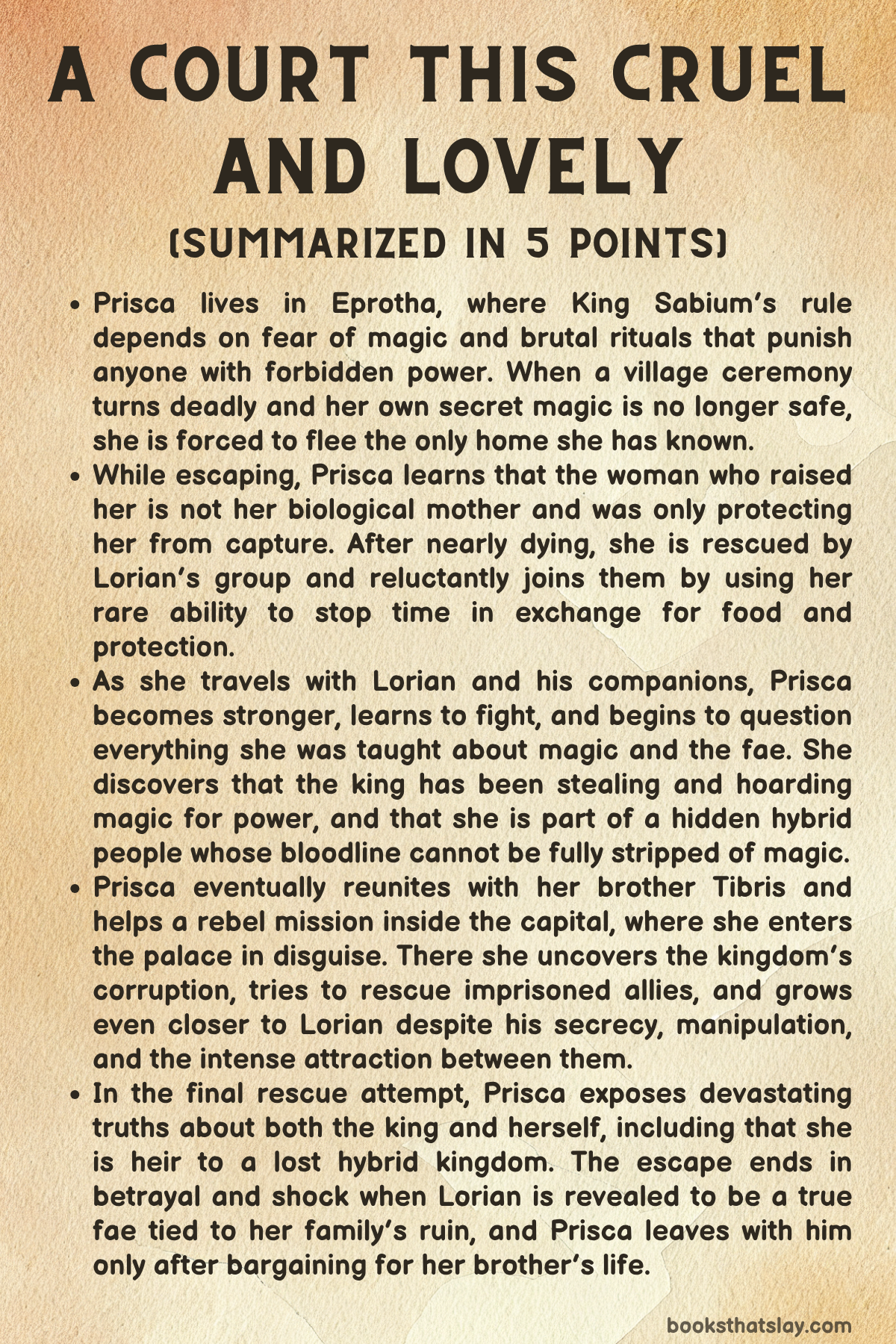
A Court This Cruel and Lovely by Stacia Stark is a fantasy romance set in a kingdom where magic is controlled through fear, ritual, and brutality.
At its center is Prisca, a young woman who has spent her life hiding a dangerous secret in a society that hunts anyone touched by forbidden power. When her concealment fails, she is forced into flight and pulled into a larger conflict involving rebels, fae, stolen magic, and a ruler built on lies. The story mixes court intrigue, survival, betrayal, and desire, following a heroine who grows from a hidden village girl into someone tied to the fate of an entire people.
Summary
Prisca lives in Eprotha, a kingdom ruled by King Sabium, where people are taught to fear magic and the fae. In this world, infants are stripped of their power in sacred ceremonies that supposedly protect the realm. Villagers later undergo another ritual in adulthood to learn whether any hidden magic remains in them. During one such public ceremony, the truth of the kingdom’s cruelty is made clear when a woman is discovered to possess a harmless magical gift and is immediately arrested, while her grandparents are executed. Prisca watches this horror with rising anger, already burdened by the knowledge that she herself has been hiding magic all her life.
When Prisca returns home, her mother reveals that it is no longer safe for her to stay. Guards are closing in, and the family can no longer protect her secret. In the chaos that follows, Prisca learns that the woman she calls mother is not her biological parent but the person who took her in as a baby to keep her safe. Before Prisca can fully understand what that means, her mother forces her to flee, pushing her into a river so she has a chance to escape capture. Prisca is swept away and nearly dies.
She is rescued by a group of dangerous strangers led by Lorian, a man she recognizes from recurring dreams. Though one of his companions shows her kindness, Lorian refuses to help her further and leaves her behind. Alone, injured, and hunted, Prisca tries to survive in the wilderness. She kills a bounty hunter in self-defense, takes his supplies, and keeps moving. Driven by hunger and desperation, she later tries to steal from a campsite, only to discover that it belongs to Lorian and his men. The attempt fails, but instead of turning her over, Lorian offers her a bargain: if she uses her rare ability to stop time to help his group move unseen, they will feed and protect her. With no better option, she agrees.
As Prisca travels with the mercenaries, she begins to understand that each of them possesses unusual powers and that their mission is tied to secrets larger than simple smuggling or paid violence. She trains with them, learns to fight, and slowly becomes harder, sharper, and more capable. At the same time, her connection with Lorian grows tense and complicated. He is controlling, ruthless, and often cruel, but he also protects her when she is threatened and pushes her to strengthen abilities she barely understands. Their attraction grows beside their mistrust.
Along the journey, Prisca discovers that Lorian’s group is secretly working with the fae, a revelation that shakes everything she has been taught. Eventually Lorian tells her the truth about Eprotha’s magic system: King Sabium does not steal power for the gods at all. He hoards it, redistributes it to strengthen his court, and uses fear to keep the population obedient. Prisca also learns that she and others like her are hybrids, descended in part from fae bloodlines tied to a lost kingdom across the sea. Their magic cannot be fully removed, which is why the king hunts them so aggressively. This knowledge changes Prisca’s view of herself and of the kingdom that raised her.
Prisca is soon reunited with her brother Tibris, who has been working with rebels trying to overthrow the king. He explains that he has been searching for her and that he and his ally Vicer are part of a resistance hidden inside the capital. Prisca wants to save her imprisoned friend Asinia, and the rebels agree to help only if she also aids in freeing an important rebel leader named Demos. She enters the capital under a false identity and becomes a servant in the castle, where she starts gathering information from the staff and from the queen’s household.
Inside the palace, Prisca sees the full scale of the kingdom’s corruption. The wealthy enjoy stolen magic as luxury and convenience while the poor suffer under scarcity, punishment, and terror. In the dungeons, she finds Asinia gravely ill and Demos barely surviving, both weakened by starvation and fae iron embedded in their bodies to suppress power. Prisca becomes determined not only to rescue them but to free all the prisoners condemned as corrupt.
Her plans grow more dangerous when she discovers that Lorian has infiltrated the court under the identity of a Gromalian prince. He is pretending to negotiate an alliance with the king while secretly pursuing his own goal: finding an amulet hidden within the castle that can weaken Sabium. Though furious at him for his lies and manipulations, Prisca has no choice but to work with him. Their alliance deepens into desire, resentment, and dependence. He helps her when Asinia needs medicine, and she helps him search the king’s hidden rooms. Yet every exchange between them carries a cost.
As Prisca digs deeper into the truth, more secrets emerge. She learns that King Sabium is actually Regner, an ancient ruler who has extended his own life by stealing magic and pretending to be his own descendants for generations. She also learns startling truths about her own past. A former nanny recognizes her and reveals that Prisca’s real name is Nelayra, that her family came from Crawyth, and that Demos is her biological brother. Her childhood kidnapping helped trigger the deaths of her parents. The weight of lost identity, stolen years, and buried bloodlines leaves Prisca reeling, but it also clarifies her place in the struggle ahead.
Within the castle, Prisca builds fragile alliances with women who have also suffered under the king’s system, including Madinia and other servants willing to risk everything. She manipulates court routines, studies the king’s magical transport system, and adapts when escape routes collapse. After a failed tunnel plan, she creates a new strategy timed to a grand ball, counting on her power to freeze time long enough to free the prisoners and send them out in stolen magical carriages.
The rescue begins successfully. Prisca, Lorian, Tibris, and their allies release the prisoners, while others create confusion throughout the castle. Prisca kills the king’s assessor, a man she has hated since childhood, and retrieves the amulet from the queen’s chambers. But the escape begins to unravel as hidden enemies reveal themselves, the city burns, and the king intercepts the fugitives at the walls with guards and stone hags.
At the confrontation, Prisca throws the amulet to Lorian, expecting it to help against Sabium. Instead, it strips away one of the biggest lies in the story. Lorian is not a hybrid at all. He is a true fae, the Bloodthirsty Prince, the same being blamed for destroying Crawyth and murdering Prisca’s parents. His companions are fae as well, and together they unleash their full power against the king’s forces. Prisca is left shattered by the truth. The man she has desired, trusted, and hated in turns is bound to the darkest part of her history.
Even in that chaos, another revelation lands: Prisca is the heir to the hybrid kingdom. Before she can fully absorb it, Demos is struck by an arrow while protecting her. Unable to save him by ordinary means, Prisca makes a desperate bargain with Lorian. In exchange for Demos’s life, she agrees to go with Lorian to his kingdom. Though her brother survives, Prisca’s victory is bitter. She has helped ignite rebellion, exposed the king’s lies, and stepped into her true identity, but she ends the book bound to the man connected to her family’s destruction, determined that one day he will answer for it.
Characters
Prisca
Prisca is the emotional and structural center of the novel, and her development drives nearly every major turn in the story. At the beginning, she is a young woman shaped by fear, caution, and quiet anger. She has grown up in a world where survival depends on concealment, so she has learned to suppress not only her magic but also her future, her wants, and even her sense of self.
What makes her compelling is that she is not introduced as someone already confident in her destiny. She begins as someone deeply constrained by her society, attached to her family and village, and still hoping that endurance might somehow be enough. Once she is forced to flee, those illusions collapse. From that point onward, her arc becomes one of painful expansion. She learns to survive physically, then emotionally, then politically.
Prisca’s strongest trait is not raw power alone but adaptability. She is frightened, traumatized, and often outmatched, yet she keeps adjusting to new truths. She kills when cornered, bargains when necessary, infiltrates when force is impossible, and learns how to read people inside a deadly court. Her time-stopping magic symbolizes that evolution well. At first it appears as an unstable, instinctive defense mechanism, but later it becomes both a weapon and a burden. Every use costs her something, which keeps her from seeming invincible. That cost matters because it reinforces one of her defining qualities: she is repeatedly asked to give more than is fair, and she keeps going anyway.
Her emotional complexity also makes her effective as a lead. She is angry, but not empty; vulnerable, but not passive; capable of love, but not softened into simplicity by it. Her connection to Asinia, Tibris, and later Demos shows her loyalty, while her interactions with Lorian reveal how desire, resentment, curiosity, and dependency can coexist. She is also someone constantly being told who she is by other people: hidden child, hybrid, servant, lady, rebel asset, heir. A major part of her character arc lies in her struggle to decide which identity is truly hers. By the end, she has not fully resolved that question, but she has stopped allowing others to define her entirely. That movement from secrecy to agency is the core of her transformation.
Lorian
Lorian is written as both romantic lead and destabilizing force, which gives him a difficult but effective role in the narrative. He enters the story as a hard, controlled, and morally ambiguous figure whose motives are hidden behind strategy and command. His first major act toward Prisca is one of refusal: he leaves her behind. That choice establishes the essential tension in his character. He is not presented as safe, transparent, or conventionally gentle. Instead, he is pragmatic to the point of cruelty, and his care for others emerges in ways that are often indirect, reluctant, or compromised by his larger mission.
What makes Lorian interesting is the gap between the version of himself he performs and the one that appears in flashes around Prisca. He is domineering, secretive, and frequently manipulative, but he is also observant and unexpectedly protective. He teaches, provokes, rescues, withholds, and comforts, sometimes in the same sequence of events. That inconsistency is not weak characterization; it reflects a person split between private desire and public purpose. He wants Prisca, but he also wants something from her. He helps her, but not without calculation. He reveals truths, but never all of them. This constant partial honesty is central to his appeal and his danger.
Lorian’s revenge against the king gives him emotional depth, but it does not excuse him. He is driven by loss and shaped by long violence, and the story allows that pain to explain his harshness without fully cleaning it. The later revelation that he is the Bloodthirsty Prince radically reframes his character. Up until that point, he exists in the space between enemy and ally; afterward, he becomes the embodiment of betrayal layered over desire. This twist works because the text has already prepared him as someone with hidden dimensions. His final form is not a contradiction of his earlier characterization but its most devastating completion. He is both the man Prisca has come to need and someone tied to the destruction of her past. That duality makes him the novel’s most volatile character.
Tibris
Tibris functions as one of the clearest emotional bridges between Prisca’s old life and her emerging role in the rebellion. As her brother, he represents the family bond that survives even after their world has been torn apart. Early on, he appears secretive and distant, which creates suspicion and tension, but that distance later gains meaning when it becomes clear that he has been involved in resistance efforts and trying, in his own way, to protect Prisca. His secrecy comes from burden, not indifference.
He is a character defined by divided responsibility. He is at once brother, rebel, conspirator, and someone carrying guilt about what he could not prevent. His efforts to find ways to protect Prisca before her exposure, including his earlier hopes of marking her as safe, show that he has long been acting with limited power in an impossible system. Unlike Prisca, whose transformation happens in the open for the reader, Tibris arrives already altered by what he has seen. That gives him a slightly more closed emotional presentation, but it also makes him believable. He has been surviving in harsher political realities for longer.
Tibris is also important because he anchors the story’s theme of family beyond blood alone. He is not simply a protective brother archetype. He makes choices, keeps secrets, allies himself with rebels, and sometimes withholds information in ways that frustrate Prisca. Yet the emotional truth of his character remains constant: he wants her alive, free, and meaningful in a world trying to erase her. His healing work, his role in prison rescue efforts, and his continued presence at her side all reinforce his steadiness. He may not dominate the story the way Prisca and Lorian do, but he gives it loyalty, history, and moral grounding.
Asinia
Asinia begins as Prisca’s best friend and quickly becomes one of the clearest symbols of what is at stake in the kingdom’s cruelty. Her capture personalizes the political threat and gives Prisca a mission that is emotional before it is strategic. She matters not only because Prisca loves her, but because her imprisonment reveals what the regime does to those labeled corrupt. Through Asinia, the story turns abstract persecution into bodily suffering, fear, and urgency.
Even in absence, Asinia remains important because she shapes Prisca’s decisions. Prisca’s determination to save her repeatedly pushes the plot forward, including the castle infiltration and the broader prison-break plan. That narrative role could have made Asinia feel purely functional, but the story preserves her importance by tying her to Prisca’s earlier life and to the human cost of delay. She is not a symbol only; she is a person whose condition worsens while others argue strategy. That difference matters. Her illness, weakness, and later recovery through outside intervention highlight how little control imprisoned people have over their own fate.
Asinia also helps define Prisca’s ethics. Prisca does not become invested in rebellion in an abstract sense alone; she remains motivated by specific people she refuses to abandon. Asinia stands for that refusal. Her role is quieter than others, but emotionally she is central because she keeps the narrative tethered to friendship, memory, and the world Prisca is trying not to lose entirely.
Demos
Demos begins as a prisoner whom Prisca is told to rescue, but he grows into one of the most significant revelations in her life. At first, he appears as a rebel leader in need of extraction, someone whose value is political and tactical. Once the truth of his identity is revealed, however, he becomes something far more intimate: a lost brother tied directly to her stolen past. This shift changes the emotional weight of his character. He is no longer simply part of the rebellion; he is part of the life Prisca was denied.
What makes Demos effective is the bitterness that accompanies that revelation. He does not exist merely to complete Prisca’s family and welcome her home. He has his own pain, and part of that pain comes from knowing that her kidnapping contributed to the destruction of their family. That gives him emotional texture. He wants connection, but he also carries grief, resentment, and lost time. His frustration at being unable to protect her adds another layer, showing that his feelings toward her are not cleanly heroic. They are shaped by years of absence and deprivation.
Demos also carries symbolic weight. His existence confirms the buried truth of Prisca’s origin and reinforces the story’s interest in inheritance, displaced identity, and interrupted lineage. When he later takes an arrow meant for her, his action solidifies the sibling bond at the very moment she has only just begun to reclaim it. He becomes proof that family in this story is both wound and anchor.
Vicer
Vicer represents the practical face of rebellion. He is not framed as romantic or mythic; instead, he comes across as strategic, resourceful, and often unsentimental. His importance lies in his ability to connect underground resistance to concrete action. He secures papers, coordinates help, arranges disguises, and negotiates with Prisca from the standpoint of what the rebellion needs. That makes him useful in plot terms, but it also gives him a distinct personality. He is someone who understands that survival under tyranny requires compromise, planning, and selective trust.
His relationship with Prisca is shaped by exchange rather than immediate warmth. He agrees to help her save Asinia, but not freely. He asks something in return. That is an important note in his characterization because it prevents him from becoming a purely noble rebel figure. He cares about overthrowing the regime, and that larger cause affects how he weighs individual lives. At the same time, he is not cold for the sake of it. He keeps helping, keeps adapting, and continues to support increasingly dangerous plans even when he doubts them.
Vicer’s value as a character comes from his realism. He serves as a counterpoint to both Prisca’s emotional urgency and Lorian’s hidden agenda. He does not romanticize rebellion; he manages it. In a story full of concealed identities and dramatic revelations, his grounded competence gives the resistance movement credibility.
King Sabium and Regner
The king is the central political villain, but his full significance emerges only when it becomes clear that Sabium is actually Regner, an ancient ruler extending his life through stolen magic and false succession. This revelation turns him from tyrant into architect of generational corruption. He is not just oppressive in the present; he is the source of a historical lie that has shaped the entire kingdom’s beliefs, rituals, and social order. That scale makes him more than a standard cruel monarch. He is a system made flesh.
His power is built on theft in every sense. He steals magic from children, from hybrids, from the kingdom’s history, and even from death itself by refusing to pass power naturally. He steals truth by masking exploitation as religious duty, and he steals legitimacy by pretending to be a line of rulers rather than one enduring predator. Because of that, he becomes the perfect antagonist for a story obsessed with hidden identity. Others conceal themselves to survive; he conceals himself to dominate.
What makes him especially disturbing is how normalized his cruelty has become. Public rituals, punishments, executions, and hybrid hunts are not chaotic acts but institutional ones. He has turned violence into governance. Even his treatment of heirs reveals a mind shaped by possession rather than kinship. He is a character built less around emotional complexity than around thematic function, but that function is powerful. He stands for rot preserved across time.
Galon
Galon is one of the warmest members of Lorian’s group, and that warmth gives him an important balancing function. In a company of secretive men with dangerous abilities, he is among the first to treat Prisca with recognizable kindness. He rescues her, gives her his cloak, and later helps train her. His power over water also gives him a softer elemental contrast to the violence around them, though he is still fully capable of action.
Galon’s significance lies in the trust he helps build. Without characters like him, the mercenary group might feel too uniformly threatening for Prisca’s growing attachment to them to be convincing. He helps humanize the group and suggests that loyalty exists within it beyond fear of Lorian. He is supportive without becoming naive, and his steadiness makes him one of the more reassuring presences in the story.
Marth
Marth functions as one of the more perceptive secondary characters, especially when it comes to emotional truths others would rather avoid. His ability to see into the past is fitting because he often seems to understand the hidden forces shaping the present. He participates in the group’s operations, captures Tibris when necessary, and later recognizes things about Lorian’s attachment to Prisca that Lorian himself tries to minimize.
His character matters because he often acts as quiet commentary on the larger story. He sees consequences forming before they fully arrive, particularly in relation to Lorian’s choices. He is not overly sentimental, but he is observant, and that observant quality gives him weight beyond page time. He helps reveal that the men around Lorian are not blind followers; they are evaluating him, too.
Rythos
Rythos often appears in supportive moments, and his role is that of a steady secondary ally within Lorian’s circle. He provides food, clothing, and practical aid, which gives him a caretaking function distinct from more aggressive or strategic characters. His presence helps round out the group dynamic, showing that the company’s strength is not only in combat but also in mutual maintenance.
He is especially useful as a stabilizing presence around Lorian. In moments where Lorian’s anger threatens to spill too far, Rythos helps restore control. That contribution may seem quiet, but it matters because it reinforces the idea that the group operates as a real unit with internal checks, not simply as extensions of one dominant man.
Thol
Thol represents an alternate life for Prisca, one based on ordinary affection, local belonging, and the possibility of safety within familiar boundaries. He is attractive not because he is more powerful than others, but because he symbolizes what life might have looked like if Prisca had never been forced into revelation and flight. His kindness and status as someone rooted in her village make him a figure of lost normalcy.
As the story goes on, Thol becomes less a romantic contender in practical terms and more a measure of Prisca’s transformation. Her thoughts about him highlight the widening distance between who she was and who she is becoming. Lorian’s jealousy of him works because Thol stands for something Lorian cannot offer: innocence, simplicity, and a future untouched by blood and history. That symbolic role makes Thol important even though he is not central to the action.
Madinia
Madinia develops from a court figure into one of Prisca’s most meaningful allies inside the castle. At first, she seems part of the ornamental and political world of the queen’s ladies, but her arc reveals the emotional pressure hidden beneath court refinement. Her accidental use of fire and attempt to destroy herself expose the desperation produced by living inside a violent system while carrying forbidden magic. That moment redefines her. She is not just another noblewoman; she is another person trapped by fear, expectation, and inherited cruelty.
Her alliance with Prisca grows from shared danger into active commitment. Once saved, she becomes willing to help with plans that could cost her life. That choice shows real courage because she has far more to lose socially than some of the openly rebellious figures. She also helps broaden the novel’s picture of resistance by showing that opposition to the king exists even inside the spaces he appears to control most completely. Her final suffering at the wall, especially after her father’s execution, gives her arc tragic force and underscores how rebellion can demand personal loss from every class.
Wila
Wila is a smaller but thematically powerful character. Early on, she appears hostile and difficult, someone other servants regard as abrasive. Later, it becomes clear that she is willing to risk herself for a larger cause. Her act of setting the queen’s dress on fire creates the opening that allows Prisca to gain access to the queen’s circle. Once imprisoned and sentenced to death, Wila becomes a stark example of sacrifice inside the rebellion.
What makes her memorable is the absence of glory in her fate. She does not die in triumph or escape at the last moment. Instead, she suffers the consequences of resistance in a brutal, public way. Her demand that Prisca keep fighting gives moral pressure to the larger plot. She represents those who take action knowing they may never live to see the result.
Auria
Auria is one of the story’s more effective examples of how trust is destabilized inside authoritarian spaces. She first appears as a helpful fellow servant, someone who offers comfort, gossip, and practical guidance to Prisca as she adjusts to castle life. That presentation encourages both Prisca and the reader to place her in the category of harmless secondary ally. Her eventual revelation as a spy for the king and a null immune to magic makes her betrayal especially sharp.
Auria matters because she exposes one of Prisca’s vulnerabilities: the need to believe in human connection even in hostile environments. Her betrayal is not just a plot twist. It is a reminder that the court teaches people to survive through concealment, performance, and treachery. As a null, she also introduces an interesting challenge to a story increasingly shaped by magical escalation. She cannot be handled through power alone.
Telean
Telean serves as a keeper of memory, identity, and lost lineage. Initially, she seems like a practical obstacle when she notices Prisca’s failing disguise. Instead, she becomes one of the most important links to the heroine’s buried past. As a former nanny and friend of Prisca’s birth mother, she carries personal knowledge that transforms vague mystery into concrete truth. Through her, Prisca learns her real name, her family background, and the emotional reality of what was stolen from her.
Telean’s role is restorative, but not comforting in a simplistic sense. The truth she brings is painful. It gives Prisca connection, but it also gives her grief she did not yet know how to hold. Telean therefore functions as a witness to a destroyed world. She helps recover history, but that recovery comes with responsibility. Her support of the rebellion later on shows that she is not just a messenger from the past; she is still willing to act in the present.
Patriarch Farrow
Farrow begins as an ideological supporter of violence against hybrids, which places him firmly within the moral framework of the regime. His significance changes when his own daughter, Madinia, reveals forbidden power. Faced with the suffering of someone he loves, his certainty collapses. He begs Prisca for help and offers a life debt in return. This change does not erase his earlier beliefs, but it does reveal the hypocrisy and fragility of prejudice built on distance.
He is useful as a character because he shows how oppressive systems depend on abstraction. It is easy for him to support burning hybrids when they are faceless others; it becomes impossible when hybridity enters his own family. His later fate reinforces the danger of late moral awakening in a system that devours even its loyal supporters.
Caraceli
Caraceli functions as a court threat shaped by jealousy, gossip, and malice rather than grand ideology. Her role in poisoning Prisca shows how court politics can become physically deadly even when motivations seem petty on the surface. She represents the danger of enclosed social worlds where status anxiety, suspicion, and resentment can escalate into violence.
Though she is not among the novel’s deepest characters, she contributes to the atmosphere of instability within the castle. Not every danger comes from the king directly. Some come from people who absorb the values of his world and weaponize proximity, rumor, and access.
Ivene
Ivene, the narminoi, appears briefly but plays an important interpretive role in the narrative. She is one of the few figures connected to knowledge as power rather than brute force or court status. Her cryptic clues about Prisca’s parents and erased memories place her in the tradition of truth-bearers who cannot simply hand over certainty. She does not resolve mystery; she activates it.
Her presence expands the world by suggesting that knowledge itself has been hunted, fragmented, and driven to the margins. That idea deepens the political setting. The kingdom does not merely suppress magic; it suppresses understanding. Ivene’s function within the story is to point toward the hidden architecture beneath visible events.
Cavis
Cavis has a relatively small role, but his early regret over leaving Prisca behind helps humanize Lorian’s company. He is one of the first indications that not all of the men share Lorian’s harder instincts equally. That difference matters because it prevents the group from feeling emotionally flat. Even brief reactions like his help show that conscience still exists inside a mission-driven unit.
Lina and Abus
Lina and Abus appear early during the Gifting ceremony, and their roles are important despite limited time on the page. Abus represents the ordinary villager who passes safely through the ritual, while Lina represents the terror hidden beneath that apparent order. Her discovery and the immediate execution of her grandparents expose the kingdom’s cruelty before Prisca herself is publicly caught. Lina is therefore essential to the opening because she turns fear into spectacle and makes the danger feel immediate.
Davis
Davis serves as a practical piece of the castle’s infrastructure, but he matters because his knowledge becomes useful to the escape plan. Through him, the narrative shows how large oppressive systems depend on ordinary workers who understand their mechanisms without always knowing how that knowledge may be turned against the regime. He is less a deeply psychological character than a functional one, yet he contributes to the realism of the castle as a living institution.
Daselis and Erea
Daselis and Erea help fill out the world of servants and lesser participants in the rebellion. Daselis is especially notable because she understands more than she initially reveals and chooses to trust Prisca at a critical moment. Her support suggests that resistance is spreading quietly through the lower ranks of castle life. Erea, meanwhile, represents the frightened, coerced participant, someone drawn into danger because neutrality is no longer possible. Together, they show that rebellion depends not only on heroes, but on ordinary people making pressured decisions.
Themes
Power as Theft, Control, and Social Order
Power in this story is never presented as a neutral gift or a natural right. It is organized, hoarded, redistributed, and weaponized through institutions that claim moral legitimacy while operating through fear. The kingdom teaches its people that magic must be surrendered for their own safety, but the plot gradually exposes that belief as a political lie. What appears to be sacred duty is actually a mechanism of control. Magic is extracted from infants, monitored in adulthood, and then concentrated in the hands of the ruling class. This makes power in the novel inseparable from class division. The poor are told deprivation is necessary, while the elite enjoy magical luxury, mobility, protection, and excess. That contrast gives the theme real force because it shows that oppression is not only violent but structured. It is built into daily life, into ritual, and into what people are trained to accept as normal.
This theme also works because power is not limited to obvious acts of force. It exists in surveillance, public ceremony, imprisonment, false religion, and the manipulation of knowledge. The king’s system depends on making people believe that the order around them is natural and inevitable. By hiding the truth of where magic goes, he turns theft into law. By labeling hybrids and other magical people as corrupt, he turns persecution into duty. The story therefore links political domination to narrative control. Whoever controls the explanation of the world controls the people living inside it. That is why the revelations about stolen magic matter so much. They do not simply expose a personal crime; they expose the foundation of the kingdom itself.
Prisca’s arc develops in direct tension with this structure. At first, her magic is something she hides to survive. Later, it becomes something others want to use, train, manage, or claim. Even when she gains more agency, the question of who gets to direct power remains central. Lorian pushes her to use her ability for his mission. The rebels need her for their plans.
The king’s regime would destroy her if it could not own her. In that sense, the novel asks whether power can ever exist outside exploitation in a world built on possession. Prisca’s struggle is not just to become powerful, but to stop her power from becoming one more object controlled by someone else. That makes the theme broader than simple magical conflict. It becomes a study of how unequal societies are maintained through extraction, myth, and the careful management of fear.
Identity, Memory, and the Fight to Name the Self
Identity in the novel is unstable from the beginning, but not in an abstract or decorative sense. It is unstable because survival has required concealment, silence, and false stories. Prisca starts the story believing she understands who she is: a village girl with a dangerous secret, raised by the family she knows, tied to an ordinary future that is already shrinking. As events unfold, nearly every part of that self-understanding is challenged. She is not the daughter she believed herself to be. She is not merely a hidden magical girl. She belongs to a larger bloodline, a lost history, and a political inheritance she never asked to carry. Her identity is not discovered in one clean revelation. It is broken open piece by piece, and each piece carries both empowerment and pain.
What makes this theme strong is that the search for truth does not bring immediate freedom. Knowledge burdens Prisca as much as it clarifies her. Learning her real name, her origins, and her family connections does not simply heal the losses of her childhood. It forces her to confront how much has been taken from her. Her past has been shaped by kidnapping, erasure, concealment, and manipulated memory. Even the people who protected her did so through secrecy. That means identity in the novel is not merely hidden by enemies; it is also obscured by love, fear, and necessity. This creates a more complex emotional structure than a standard lost-heir narrative. Prisca is not just reclaiming what is hers. She is also grieving the years in which she lived without it.
The theme deepens further through the number of characters living under assumed roles. Lorian performs one identity while hiding another. The king performs succession while actually remaining the same man across generations. Prisca enters the castle under a false name and false appearance.
Hybrids alter or conceal visible markers to avoid detection. In such a world, identity becomes political. To reveal the truth can be liberating, but it can also get a person killed. To hide can be necessary, but it can also fracture the self over time. That tension gives the novel much of its emotional charge.
The question underneath all of this is not only “Who is Prisca?” but “Who has the right to define her?” The kingdom would define her as corrupt. Others define her as weapon, heir, sister, daughter, or prize. Her character arc gains weight because she must move from being named by systems and secrets toward naming herself. She does not fully complete that journey by the end, but she reaches the point where identity is no longer something that merely happens to her. It becomes something she must actively claim, negotiate, and defend.
Desire, Trust, and the Damage of Betrayal
The central romance is shaped less by comfort than by instability, and that is what makes desire such a significant theme in the story. Attraction is never isolated from danger, secrecy, or unequal knowledge. Prisca and Lorian are drawn to one another in conditions that make trust difficult from the start. He abandons her, controls information, provokes her, and repeatedly uses his position to direct the terms of their alliance. At the same time, he protects her, trains her, responds to her fear, and shows forms of care that complicate any simple judgment of him. Because of this, desire in the novel is not presented as a refuge from the political plot. It is one of the places where the plot becomes most psychologically intense.
What the story captures well is how attraction can grow even where certainty does not. Prisca does not trust Lorian in any uncomplicated way, yet she is pulled toward him physically and emotionally.
Part of that pull comes from his power, but it also comes from recognition. He sees her strength even before she fully understands it herself. He treats her as someone dangerous, capable, and worth watching, which is very different from the silencing world she came from. That recognition has genuine emotional force, even though it is entangled with manipulation. The result is a relationship built on conflict, fascination, and partial dependence rather than ease. This makes every moment between them feel unstable, because intimacy never cancels the possibility of harm.
The theme reaches beyond romance into a larger question of what trust can look like in a world defined by hidden motives. Prisca is betrayed, protected, lied to, and helped, often by the same people. Her survival depends on reading those contradictions accurately. Lorian becomes the clearest embodiment of this problem. He is both source of comfort and source of devastation. When his true identity is revealed, the emotional impact lands so hard because the story has already trained readers to understand that desire does not erase danger. Instead, desire has made betrayal sharper. The person who matters most is also the one most capable of reshaping the meaning of everything that came before.
This theme also speaks to Prisca’s development. She does not stop wanting because wanting is risky. She continues to choose connection even while knowing it may cost her. That does not make her weak or naive. It shows that emotional vulnerability is part of her humanity, not a flaw to be corrected. The novel treats desire as a force that reveals character rather than softening conflict. Through it, the story examines how people attach themselves to others under pressure, how trust can be built from fragments, and how betrayal hurts most where truth and feeling have become impossible to separate.
Resistance, Sacrifice, and the Cost of Liberation
Resistance in this novel is not romanticized as a clean path toward justice. It is fragmented, improvised, morally difficult, and expensive. The rebellion operates through hidden networks, forged identities, coded messages, divided loyalties, and people taking risks without any guarantee of survival.
This gives the struggle political texture. It is not a movement powered only by heroic speeches or obvious leaders. It is sustained by servants, smugglers, prisoners, rebels, friends, siblings, and compromised insiders, each carrying different motives and levels of fear. The breadth of participation matters because it shows that tyranny is not undone by one brave person alone, even when the heroine stands at the center of events.
The theme becomes especially powerful through sacrifice. Characters repeatedly give up safety, status, bodily security, and eventually life itself in order to oppose the king’s system. Wila’s fate shows that rebellion often demands action without reward. Prisca’s adoptive mother sacrifices everything to give her a chance to escape.
Tibris spends years moving through danger while trying to protect his sister from afar. Madinia risks her position and her life after living under the illusion of court protection. Demos, once recovered enough to matter again, steps into danger for a sister he has only just regained. These sacrifices are not interchangeable. Each one reveals a different relationship to loss, but together they show that freedom in this story is built through accumulation of individual cost.
What makes this theme more than a simple celebration of courage is that the novel never presents liberation as complete or uncomplicated. Plans fail. Escape routes collapse. Allies cannot always be saved. The city burns even as prisoners are freed. Personal revenge, political strategy, and emotional loyalty often pull characters in different directions.
Prisca herself is forced into choices that leave damage behind. She can save some people but not all. She can strike back, but not without consequence. Even the climactic rescue is mixed with revelation, grief, and a new form of entrapment. That structure prevents the rebellion from becoming a fantasy of pure victory.
The theme also connects to leadership. By the end, Prisca is no longer simply resisting for private reasons, though those remain important. She is being pushed toward a larger historical role tied to collective survival. Yet the novel is careful not to make that transition feel triumphant in an easy way.
Leadership arrives through blood, loss, and obligation. That is why the ending feels so charged. Liberation has begun, but it has not been won. Resistance has opened possibility, but it has also demanded transformation from everyone involved. The story suggests that overthrowing a cruel order is only the beginning; what follows will require endurance equal to the fight that started it.