Sick Boys Summary, Characters and Themes
Sick Boys by Clarissa Wild is a dark college romance with a revenge story at its center.
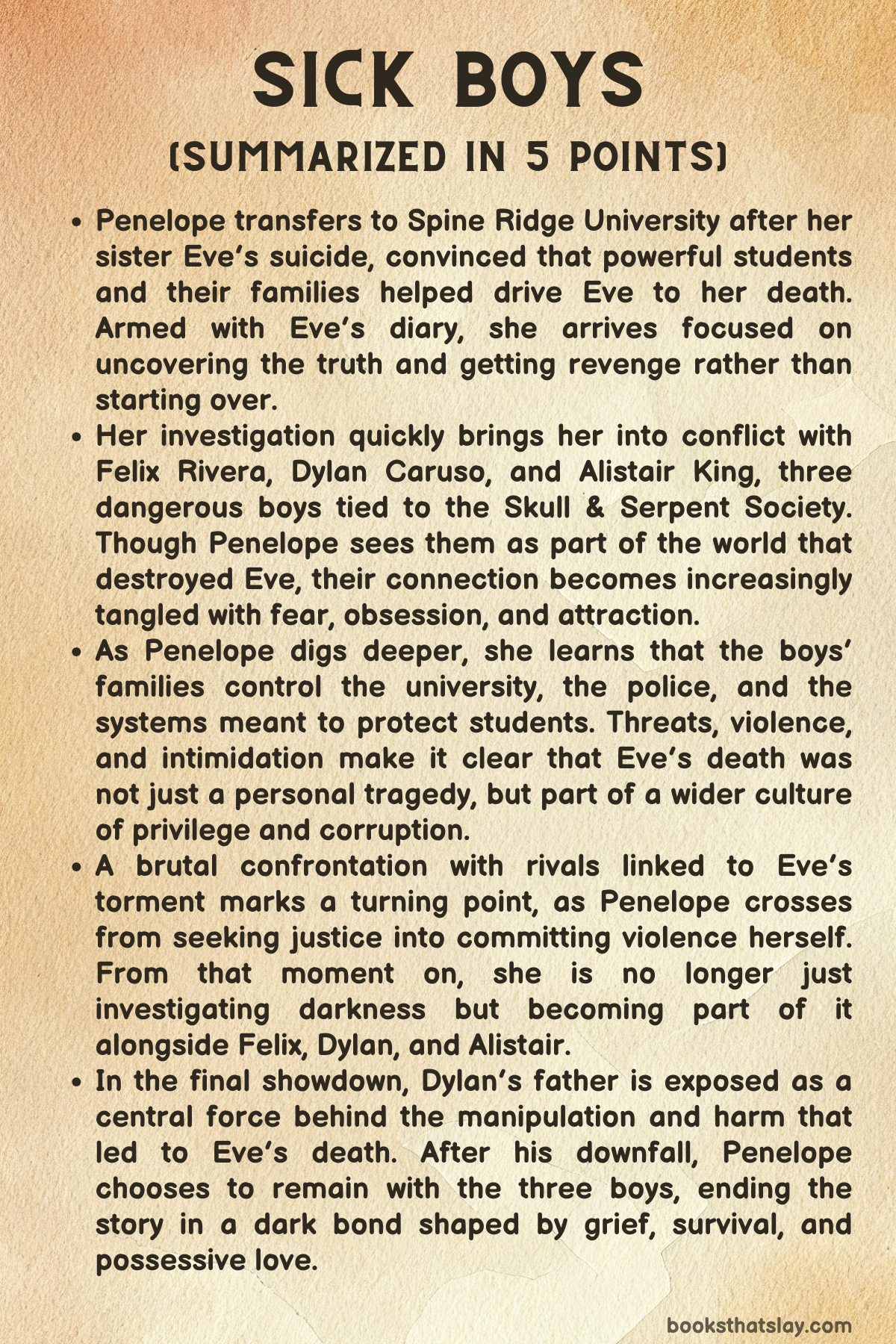
It follows Penelope as she transfers to Spine Ridge University after her sister Eve’s suicide, convinced that powerful students at the school helped drive Eve to her death. What begins as a search for answers turns into a dangerous bond with Felix Rivera, Dylan Caruso, and Alistair King, three feared boys tied to the Skull & Serpent Society. The book mixes grief, obsession, violence, and desire, building a story where Penelope is pulled deeper into the same world that destroyed her sister.
Summary
Penelope arrives at a bonfire near a cliffside called The Edge after receiving a final message from her sister Eve. Eve tells her she cannot keep going and warns her never to get involved with the Skull & Serpent Society. Before Penelope can reach her, Eve jumps from the cliff and dies. That moment defines everything that follows. Penelope is left with grief, guilt, and a need to know who pushed Eve to such a desperate end.
Weeks later, Penelope transfers to Spine Ridge University, the same school Eve attended. She is not there for a fresh start. She comes armed with Eve’s diary, which contains names, photos, and cryptic notes about students connected to Eve’s suffering. Penelope believes the diary will help her uncover the truth and punish the people responsible.
Almost immediately, she crosses paths with Felix Rivera, Dylan Caruso, and Alistair King, the feared leaders of the Skull & Serpent Society. They are rich, dangerous, and protected by their family power. Felix is the most aggressive, Dylan is sharp and unstable, and Alistair hides menace behind humor and recklessness. Penelope recognizes them from Eve’s funeral, where they stood watching from a distance, and that memory convinces her they know more than they admit.
Penelope’s first confrontations with the boys confirm that they see her as a threat. After she spies on Dylan and overhears part of a tense exchange involving his father, she is cornered by Dylan and Felix in a stairwell. They search her bag, discover Eve’s diary, and immediately focus on what it contains. Penelope fights back, injures Felix with a pen, and escapes. This sets the tone for their connection: violent, charged, and full of unfinished questions.
Back in her room, Penelope studies Eve’s diary more carefully. Some entries about Felix are especially alarming, filled with repeated warnings and the number 303. Before she can make sense of everything, the boys break into her dorm, trash the room, and steal the diary. Penelope responds with a bold move of her own by going straight to the Skull & Serpent house to demand it back. There, the boys use the diary to control and humiliate her. Felix, in particular, forces a cruel sexual encounter that leaves Penelope furious and shaken. Even so, she leaves with more determination, not less. She will not let them scare her away.
As Penelope continues digging, she finds proof that the boys’ families hold major power at the university. Dylan’s father is the dean, Felix’s father sits on the board, and Alistair’s father is the police chief. The deeper Penelope looks, the clearer it becomes that money and status have protected these boys and the people around them for a long time. Threats soon follow. A blood-stained note warns her to stop asking questions or end up like Eve. Penelope traces the message to Nathan, another piece of the larger network around Eve’s death.
Tension keeps building between Penelope and the three boys. They stalk her, trap her, question her, and try to force information out of her, but Penelope keeps fighting back. During one confrontation after class, she finally accuses them directly of bullying Eve and pushing her toward suicide. The accusation shocks them. It also reveals how much pain and rage Penelope has been carrying since Eve died.
At the same time, the bond between Penelope and the boys becomes more tangled. Attraction grows alongside fear and anger. Felix grows possessive. Dylan and Alistair are increasingly drawn to her too. Penelope hates what they have done, but she is also unable to break away from them completely, because they are tied to the answers she needs and because her feelings are changing in ways she does not fully understand.
A Halloween party at the Skull & Serpent house becomes a turning point. Penelope attends hoping to find Nathan and gather more information. Later, events shift to a violent clash involving members of a rival group, the Phantoms, especially Kai Torres and Josh. Their cruel references to Eve suggest they may have taken part in the harassment that wrecked her life. Dylan snaps and attacks them. What follows is chaotic and brutal: knives, gunfire, a chase through the woods, and a savage act of revenge. Penelope herself joins in, crossing a moral line as Josh is tortured and killed. By the end of the night, she is no longer only Eve’s grieving sister. She has become an active part of the darkness surrounding these boys.
The fallout is immediate. Josh and Kai are reported missing, authorities begin asking questions, and Penelope is drawn even deeper into the boys’ circle. When she is questioned alongside Felix, Dylan, and Alistair, she lies to protect them, claiming Josh attacked her and that the others acted in her defense. Her injuries make the story believable enough, and the adults in power choose to manage the matter quietly rather than expose the truth. This choice confirms one of the book’s central ideas: the system around Spine Ridge protects the powerful first.
As Penelope spends more time with Felix, Dylan, and Alistair, pieces of the past begin to fall into place. Felix admits he had misunderstood a message and believed Penelope herself shared blame for Eve’s death. When Penelope shows the full text Eve sent before jumping, it becomes clear that Eve had been warning Penelope away from the boys, not linking her to some deadly pact. This revelation shifts the balance. Felix realizes he was wrong, and guilt enters the relationship, though it does not erase what he has done.
Family tensions then take center stage. At a dinner with the boys’ parents, Penelope sees how much secrecy, control, and violence shaped their lives too. Felix reveals that his father killed his mother. Dylan’s home life is even worse than it appears, with his father obsessed with power, reputation, and keeping every scandal buried. The younger generation may be cruel, but the older one built the world that trained them to be this way.
The final crisis begins when Dylan is abducted by his father. Alistair risks his life to rescue him, and Felix races with Penelope to find them. Near The Edge, the truth finally comes out. Dylan’s father admits he manipulated events, targeted Penelope, and played a major role in the chain of actions that led to Eve’s death. His goal was always self-protection and preserving the image of his family. Penelope, overwhelmed by grief and rage, stabs him. In the struggle that follows, Dylan is shot trying to protect her. Then he and his father go over the cliff.
For a moment it seems Dylan may die too, but Felix, Alistair, and Penelope fight to save him. Dylan’s father loses his grip and falls to his death, ending the threat. In the aftermath, the surviving group is injured, exhausted, and forever changed. A recording of the dean’s crimes clears them of murder, and Felix’s father steps in to take control of the school. Instead of prison or expulsion, the matter is handled privately, and the students are ordered to repair the damage and do community service.
By the end, Penelope chooses to stay with Felix, Dylan, and Alistair. Her father objects, but she refuses to leave. The men who hurt Eve are gone or exposed, and Penelope decides that her future now belongs with the same three boys she once came to destroy. In the closing pages, they mark that choice with matching tattoos, turning their bond into something permanent. The story ends with Penelope no longer chasing revenge alone, but standing inside a dark, possessive kind of love built from grief, violence, and survival.
Characters
Penelope
Penelope is the emotional and moral center of the story, even though her morality changes dramatically as the plot moves forward. She begins as a grieving younger sister driven by loss, guilt, and a fierce need for answers after Eve’s suicide. Her decision to transfer to Spine Ridge is not an act of healing but a deliberate move toward danger, which shows how deeply revenge has taken hold of her. She is not passive, frightened into silence, or easily pushed aside.
From the beginning, she challenges people who are richer, more feared, and better protected than she is. Her courage is one of her defining qualities, but it is closely tied to recklessness. She keeps pushing even when every warning sign tells her to stop, because for her, stopping would mean betraying Eve.
What makes Penelope especially important as a protagonist is the way grief changes her from someone seeking justice into someone willing to commit violence herself. At first, she wants truth. Later, she also wants punishment. That shift is central to her arc. She starts the story believing she is entering a corrupt world from the outside, but gradually she becomes part of it.
Her attraction to Felix, Dylan, and Alistair complicates her sense of self because the boys represent both the source of her pain and the pull of her darkest desires. She feels humiliation, anger, fear, and physical longing all at once, and the story uses that confusion to show how revenge and obsession can erase clean moral lines. By the end, Penelope is no longer simply Eve’s sister trying to solve a tragedy. She has become someone marked by violence, secrecy, and possession, and her final choice shows that she accepts this transformed version of herself.
Felix Rivera
Felix is presented as the most dominant and openly threatening of the three boys. He carries authority in every room he enters, and much of that authority comes from force rather than charm.
His first interactions with Penelope establish him as someone used to obedience and irritated by resistance. He does not just want control; he expects it. His possessiveness toward Penelope appears early and grows stronger as the story continues, making him both the most dangerous and the most emotionally exposed among the three. He often acts through intimidation, sexual aggression, and sudden violence, which makes him the clearest symbol of the brutal culture surrounding the Skull & Serpent Society.
At the same time, Felix is not written as a flat villain. Under his cruelty lies damage, rage, and confusion that come from his family background. His revelation about his mother’s death and his father’s role in it adds a deeper layer to his behavior. It does not excuse what he does, but it helps explain why he equates love with ownership, fear, and domination. Felix is most comfortable when he is in command because vulnerability feels unsafe to him.
That is why Penelope affects him so strongly. She refuses to obey him easily, yet he cannot let her go. His arc is built around that contradiction. He begins by treating Penelope as a threat to silence and an object to claim, but he eventually reaches a point where he must admit he was wrong about her and that his own actions have caused serious harm. His desire for forgiveness is real, but the story does not make that forgiveness simple. Felix remains intense, possessive, and morally compromised to the end, yet he also becomes one of the people most desperate to protect Penelope once the larger truth comes out.
Dylan Caruso
Dylan is one of the most layered characters because he exists at the center of both personal and institutional corruption. He is intelligent, volatile, and deeply shaped by his father’s power. Unlike Felix, whose violence is direct and physical, Dylan often feels more psychologically split. He can be mocking and cruel one moment, then emotionally exposed the next.
He is drawn to Penelope not only because she is fearless, but because she disrupts the system of lies he has been living in. Her accusations force him to confront truths about Eve, about his father, and about himself that he cannot keep buried forever.
His relationship with his father is one of the strongest parts of his characterization. Dean Caruso is not just an authority figure in Dylan’s life but a source of pressure, manipulation, and fear. Dylan has grown up under a model of masculinity built on secrecy, image, and control, and that history has damaged his sense of right and wrong. Even so, he is not beyond feeling guilt or conflict.
His rage toward people who hurt Eve becomes especially revealing because it suggests that beneath his cruelty there is also buried shame and a need to act against what his father represents. The final confrontation at The Edge brings Dylan’s character into sharp focus. He is pulled between revenge, self-destruction, and protection. His willingness to risk his life for Penelope shows that his feelings are not casual or purely possessive. By the end, Dylan emerges as someone broken by his father’s legacy but not fully defined by it, and his survival becomes a sign that he may finally build an identity separate from that family control.
Alistair King
Alistair initially appears to be the least serious of the three boys, often using humor, provocation, and impulsive behavior to mask what he is really thinking. He steals for excitement, mocks tense situations, and often seems to enjoy chaos for its own sake.
That surface makes him unpredictable, which in itself is dangerous, but it also allows the story to reveal his depth more gradually. Under the reckless energy, Alistair is observant, loyal in his own way, and emotionally more transparent than he first appears. He is not as openly dominating as Felix or as inwardly divided as Dylan, yet he is still very much part of the cruelty and violence that define the group.
Alistair’s importance grows as the story shows his emotional bond with Dylan and his increasing investment in Penelope. He is not simply tagging along with the others. He is fully involved in the group dynamic, and his loyalty becomes especially clear when he risks himself to save Dylan.
That rescue sequence reveals courage and attachment beneath his chaotic exterior. His father’s position as police chief also matters, because it places Alistair inside the same structure of family power and protection that shields the others. Even when he behaves like the wild card of the group, he still benefits from a system designed to keep consequences away. His character works well because he mixes playfulness, menace, devotion, and moral damage in equal measure. By the end, Alistair feels like the emotional bridge inside the central relationship, someone who can be cruel and unstable but also deeply committed when it matters most.
Eve
Eve’s physical presence in the story is brief, but her influence is everywhere. She is the absence around which the entire plot turns. Through Penelope’s memories, the final message, and the diary entries, Eve becomes more than a victim figure.
She represents both innocence destroyed and warning ignored. Her death is the event that shapes Penelope’s choices, but the details surrounding it also reveal how isolated and overwhelmed Eve had become before she jumped. The diary suggests fear, paranoia, and desperation, showing that she had been living under emotional pressure long before the final night.
Eve also serves another purpose in the story: she is a mirror for Penelope. At first, Penelope sees herself as someone fighting for Eve, but over time she begins entering the same violent and sexually charged world that Eve warned her against. That parallel gives Eve’s role a haunting force. Even after death, she remains the moral question at the center of the book.
What happened to her is not just a mystery to solve but a warning about what unchecked cruelty, social power, and silence can do to a person. The tragedy of Eve is that she becomes the reason Penelope seeks justice, but she also becomes the path through which Penelope is pulled into corruption herself.
Kayla Pearce
Kayla serves as Penelope’s closest connection to ordinary campus life and to a more stable moral world. She is warm, social, and supportive, which makes her an important contrast to the darkness surrounding the main conflict.
From the start, Kayla offers Penelope friendship and practical help, and she repeatedly warns her about the Skull & Serpent boys. These warnings show that Kayla has instincts Penelope often ignores. She may not know every detail, but she understands enough to sense danger.
Her role is important because she reflects what Penelope could have had if she had chosen safety over revenge. Kayla is not naive, but she is still connected to everyday concerns, friendships, and emotional honesty in a way Penelope increasingly is not.
As Penelope sinks deeper into violence and secrecy, her inability to fully confide in Kayla becomes a sign of how much she is changing. Kayla’s fear and suspicion later in the story also help ground the plot. She responds to events the way a more normal person would, which highlights how far Penelope has drifted from ordinary moral boundaries. Kayla is not as central as the main quartet, but she is necessary because she keeps the emotional cost of Penelope’s choices visible.
Dean Caruso
Dean Caruso is the story’s clearest representation of institutional corruption. He is not merely a controlling father or a strict administrator. He is a man who values reputation and power above truth, safety, or justice.
His influence reaches into the university, into the handling of violence, and into the harassment that surrounds Penelope and Eve. He uses authority as a weapon, manipulating people and events so that blame never reaches where it belongs. In that sense, he is more dangerous than the boys for much of the story, because he operates behind official respectability.
His relationship with Dylan adds complexity to his role because it reveals how abuse can exist inside privilege. He has helped shape Dylan into someone damaged, fearful, and morally unstable, while still expecting total control over him. The final revelations confirm that he is central to the chain of harm that led to Eve’s death and Penelope’s terror. His motivations are chilling because they are rooted in image management. He is less concerned with human pain than with protecting the appearance of a perfect family and a controlled institution. His death at The Edge functions as the collapse of that false order. Once he is gone, the hidden rot he maintained can finally be spoken aloud.
Rivera
Felix’s father is a powerful figure whose presence helps explain why Felix grew up with such a distorted sense of power and love. He stands for wealth, authority, and private control, and the revelation that he killed Felix’s mother gives his character a sinister force even when he is not at the center of the action. He is part of the generation that created the environment in which the younger characters learned to hide violence behind family status. His home, influence, and behavior all suggest a world where money can absorb scandal and reshape truth.
Yet Rivera is not identical to Dean Caruso. Once the dean is dead, Rivera becomes a stabilizing authority of a dark kind. He still prefers private handling over open justice, and he is hardly a moral hero, but he is less chaotic and less actively destructive than Caruso. He is willing to use power to contain damage rather than to keep escalating it. This makes him a morally gray figure rather than a one-note villain. He remains troubling because he is still part of the same corrupt structure, but he also helps bring a fragile end to the immediate crisis.
Chief Diego King
Chief Diego King matters because he extends the reach of family influence into law enforcement. As Alistair’s father, he shows that the boys are protected not only by wealth and university administration but also by policing power. His willingness to accept a convenient story and quietly manage the case reflects the same system of selective truth that runs through the entire plot. Justice in this world is not based on fairness. It is based on who controls the narrative.
Unlike Dean Caruso, Chief King is not developed as the central mastermind behind events, but his role is still significant because he enables impunity. His acceptance of Penelope’s lie protects the group from criminal consequences and confirms that the adults around these boys are used to solving problems through influence rather than law. That makes him less emotionally dominant than some other older characters, but still essential to the novel’s view of corrupted authority.
Nathan
Nathan functions as a secondary but meaningful link in the chain of intimidation surrounding Penelope. He is not one of the main drivers of the plot, yet his actions show how fear and loyalty spread through the campus social structure.
By arranging the delivery of the threatening note, he becomes part of the machinery designed to keep Penelope silent. His character suggests that the corruption around the central families has many helpers, not all of whom hold equal power but all of whom help sustain the climate of fear.
He is also useful as a narrative bridge because he gives Penelope another lead and widens the circle of suspicion beyond the three main boys.
Later, when the truth about orders and manipulation becomes clearer, Nathan’s role shows how easily weaker or less central figures can be used by more powerful people. He is not the core evil of the story, but he is one more example of how harm is carried out through networks rather than through a single person acting alone.
Kai Torres
Kai represents the external threat posed by the rival group and also serves as a reminder that Eve’s suffering was not caused by only one source. His confrontations with Penelope and the others suggest cruelty, arrogance, and a willingness to weaponize Eve’s memory. He helps turn suspicion into direct violence by bringing the conflict into the open. His presence raises the sense that the campus is full of dangerous young men shaped by rivalry, pride, and entitlement.
At the same time, Kai is less psychologically developed than the central figures. His main purpose is to intensify the revenge plot and expose how wide the culture of abuse really is. His eventual defeat and his connection to orders from above reinforce the idea that many of the younger antagonists are both guilty in their own right and also part of a larger chain controlled by powerful adults.
Josh
Josh is one of the characters most directly connected to Penelope’s rage over Eve. His cruel comments about Eve and his behavior during the confrontation in the woods make him a figure onto whom the story places much of the ugliness of campus bullying.
He is written less as a deeply layered person and more as a face of casual cruelty. That simplicity is purposeful. In Penelope’s eyes, and in the eyes of Dylan and Alistair at that moment, Josh becomes someone who deserves punishment for the suffering he helped create.
His death is important not just because it removes one antagonist, but because it marks Penelope’s full crossing into violence. Josh’s role in the plot is therefore larger than his page time might suggest. He is the character through whom the revenge fantasy becomes real action, and his fate reveals how far all of them are willing to go once grief, rage, and power fully combine.
Lana Rivera
Lana appears briefly, but she helps humanize Felix by showing that he exists within a family structure that includes more than violence and control. Through her presence, the reader sees another side of the Rivera household and is reminded that Felix’s emotional damage comes from a larger domestic history. She is not a major mover of the plot, but she contributes to the atmosphere around Felix’s background and softens the one-dimensional image that pure menace might create.
Crystal, Jeremy, Calvin, and Sadie
These supporting characters help fill out the social world around Penelope and give shape to campus life beyond the main conflict. Crystal, Jeremy, and Calvin mainly function as background anchors to the student environment, showing the contrast between ordinary college routines and the hidden violence at the center of the story. Sadie, though minor, plays a more active role by delivering the threatening note and revealing how intimidation is often carried out through frightened intermediaries rather than direct confrontation.
These characters are not deeply developed, but they matter because they show that the central conflict affects a wider community, even when most of that community does not fully understand what is happening.
Themes
Grief as a Force That Shapes Identity
Grief does not remain a private sorrow here. It becomes a force that changes how Penelope sees herself, how she moves through the world, and what she is willing to become in order to live with loss. Eve’s death is not presented as an event that simply causes sadness and remembrance. It creates a fracture in Penelope’s life that removes any possibility of normal healing. She does not arrive at the university hoping for peace or closure. She arrives with a fixed purpose, carrying her sister’s diary like both evidence and inheritance. That choice matters because it shows grief turning into action before the story has even fully begun. Penelope does not want comfort. She wants answers, blame, and punishment.
What makes this theme especially strong is that grief keeps changing its form. At first, it appears as shock and guilt. Penelope is haunted by the final message, by the warning Eve gave her, and by the memory of being unable to stop the jump. This creates a deep sense of failure. She is not just mourning her sister; she is also living with the belief that she came too late. That feeling of lateness shapes many of her decisions. She becomes reckless because caution now feels useless. The worst thing has already happened, so fear loses much of its power over her. This is why she is willing to confront people who intimidate everyone else, why she enters dangerous spaces alone, and why humiliation does not send her running. In her mind, grief has already stripped life of safety.
The theme grows darker because grief does not keep Penelope morally pure. Many stories treat mourning as something that makes a character noble or sympathetic in a simple way. Here, sorrow hardens into obsession. Her pain pushes her toward cruelty, secrecy, and eventually violence. By the time she becomes involved in revenge against those linked to Eve’s suffering, grief is no longer separate from anger. It has fused with it. That shift shows how mourning can become an identity, especially when loss is tied to injustice. Penelope cannot heal because the truth has been buried, and every lie around her keeps the wound open.
Even more striking is the way Eve continues to shape the story after death. She is absent physically, but present in memory, text messages, diary entries, and the choices others make in response to what happened to her. Her death becomes the center around which other relationships form and collapse. Grief, then, is not treated as a quiet emotional backdrop. It is the pressure that drives the plot forward and remakes the living in the image of what they have lost.
Violence, Desire, and the Collapse of Moral Boundaries
The emotional world of the story is built around the disturbing closeness between attraction and harm. Desire is rarely shown as tender, safe, or emotionally clean. Instead, it develops inside fear, humiliation, revenge, and physical threat. This gives the relationships a deeply unstable quality and raises difficult questions about choice, hunger, and damage. Penelope does not fall into romance through trust or admiration. Her connection with Felix, Dylan, and Alistair grows through coercion, confrontation, and repeated tests of control. That is what gives this theme its force. The story does not separate emotional danger from erotic charge. It places them side by side and asks the reader to sit with the discomfort.
Penelope’s responses are central to this theme. She is often humiliated, cornered, or threatened, yet her reactions are not simple. Shame and anger exist beside physical desire, and that combination unsettles her. The narrative repeatedly shows her trying to understand what it means to want power over men who also frighten her, or to feel drawn toward the same people she holds responsible for her sister’s suffering. This does not erase the violence of what happens to her. Instead, it shows how trauma can confuse the body’s response, how desire can become entangled with fear, and how emotional clarity becomes harder when intimacy begins under conditions of force.
The boys also embody this collapse of moral boundaries. Their possessiveness is often expressed through aggression. They want Penelope, but they also want to dominate her, define her, and claim her against one another. Their attraction does not soften them into better people at first. In many ways, it makes their worst instincts sharper. Jealousy becomes territorial. Fascination becomes surveillance. Sexual interest becomes another language of power. This matters because the story is not simply presenting a dark romance dynamic for shock. It is showing a world in which emotional expression itself has been damaged by violence, wealth, secrecy, and broken family structures. These characters often do not know how to want without trying to own.
As the plot continues, physical violence becomes easier for Penelope to participate in, and that progression is deeply tied to the relationships around her. Revenge and desire begin to feed one another. By the time she joins acts of punishment against those linked to Eve’s torment, the line between justice and brutality has almost disappeared. This is one of the most unsettling achievements of Sick Boys. It shows not just that people can be drawn to danger, but that repeated exposure to cruelty can change what intimacy feels like, what punishment feels like, and what survival demands. Moral boundaries do not disappear all at once. They erode through repetition, through rationalization, and through the seduction of feeling powerful after feeling helpless.
Power, Privilege, and Institutional Rot
The university setting is not simply a backdrop for romance and revenge. It functions as a carefully built system that protects cruelty, rewards silence, and teaches vulnerable people that truth alone is not enough. Social power in this story comes from family name, money, official authority, and the ability to shape the consequences of violence. That structure matters as much as any individual act of harm. Penelope does not enter a campus where wrongdoers happen to be influential. She enters a place where influence itself is part of the machinery of abuse.
The three boys stand at the center of this world, but the story makes clear that they did not create it on their own. Dylan’s father, as dean, represents the direct link between family control and institutional protection. Felix’s father, through his wealth and role on the board, shows how money can shield wrongdoing from public accountability. Alistair’s father, as police chief, extends that protection beyond campus life and into law enforcement. Together, these positions create a closed circle of power. Students are not simply facing bullies; they are facing a network that can erase evidence, redirect blame, and decide whose suffering matters. This is why Penelope’s search for justice is so dangerous. She is not challenging only a few violent young men. She is challenging a structure designed to survive scandal.
Eve’s fate gives this theme its moral weight. The implication is not just that she was bullied, threatened, and abandoned. It is that the environment around her made those actions easier and their consequences harder to confront. When a school tolerates fear, glamourizes predatory status, and allows the wealthy to move above accountability, harm becomes ordinary. The diary becomes powerful because it is one of the few things that resists that ordinariness. It records names, images, and patterns. It refuses forgetfulness. That is why others want to steal it, control it, or silence the person carrying it.
What is especially effective is that adults do not serve as moral correction. They often deepen the corruption. Even when they know something is wrong, they manage, contain, or redirect it rather than expose it fully. Punishments are negotiated. Crimes are framed in acceptable language. Public order matters more than truth. This gives the story a cynical but convincing understanding of privilege: power does not only commit violence; it edits the story afterward. It decides which version becomes official.
Penelope’s struggle, then, is not only emotional or personal. It is also structural. Her grief collides with a world where evidence can be buried and where official systems are already loyal to the people she suspects. That makes revenge feel more possible than justice. It also explains why so many characters become morally compromised. When institutions fail, private violence begins to look like the only remaining form of action. The story uses that bleak reality to show how rotten systems do not merely protect damaged people. They produce more damage in everyone trapped inside them.
Possession, Agency, and the Search for Control
Control is constantly contested in the relationships at the center of the story. Nearly every major interaction asks the same question in a different form: who gets to define Penelope, and who gets to decide what her choices mean? Felix, Dylan, and Alistair often speak about her in possessive terms, treating her as someone to be claimed, guarded, or divided among themselves. On the surface, this seems to reduce her to an object of obsession. Yet the story keeps complicating that idea by showing how fiercely she resists, manipulates, withholds, and redirects power even when she is outmatched physically or socially. This makes agency one of the most contested and unstable themes in the narrative.
Penelope is certainly acted upon. She is threatened, followed, trapped, and humiliated. There are moments when her consent is violated or placed under pressure, and those moments must be taken seriously as acts of domination. At the same time, she is never written as emotionally passive. She lies strategically, carries weapons, sets traps, studies people, and continues moving toward danger with a purpose that belongs to her. Her choices are not always wise or morally admirable, but they are active. She refuses the role of frightened victim, even when the people around her try to force that role on her. This tension is what gives the theme depth. Agency here is not clean freedom. It is the difficult practice of asserting will inside conditions designed to crush it.
The boys’ possessiveness also reveals their own struggle with control. Their obsession with Penelope is not only sexual or romantic. She unsettles their existing balance of power. She knows things, asks questions they do not want asked, and exposes fears they normally hide behind arrogance. Felix’s need to dominate is tied to panic as much as desire. Dylan’s intensity reflects years of damage under a father who ruled through fear and image. Alistair’s reckless charm masks a desperate need to stay emotionally connected to the people he loves. Their attempts to claim Penelope often expose how unstable they really are. They want ownership because they are terrified of vulnerability.
By the end, the question of possession becomes even more complicated. Penelope chooses to remain with them, and that choice cannot be read only as surrender. It is also her decision to define her life after Eve’s death on her own terms, however dark those terms may be. She does not return to innocence, nor does she seek a conventional future approved by family or social norms. She chooses a bond formed through violence, survival, and mutual fixation. That ending is uncomfortable on purpose. It suggests that agency does not always lead to healthy or socially acceptable outcomes. Sometimes it leads a damaged person toward what feels emotionally true, even if that truth is shaped by trauma.
This is what makes the theme powerful. Control is never simple. Being claimed and choosing to stay are not presented as identical things, but neither are they fully separable in these relationships. The story keeps that contradiction alive. Penelope fights to remain the author of her own fate, even when that fate leads her into a form of love built around possession, loyalty, and scars that will not fade.