Kiss Her Goodbye Summary, Characters and Themes | Lisa Gardner
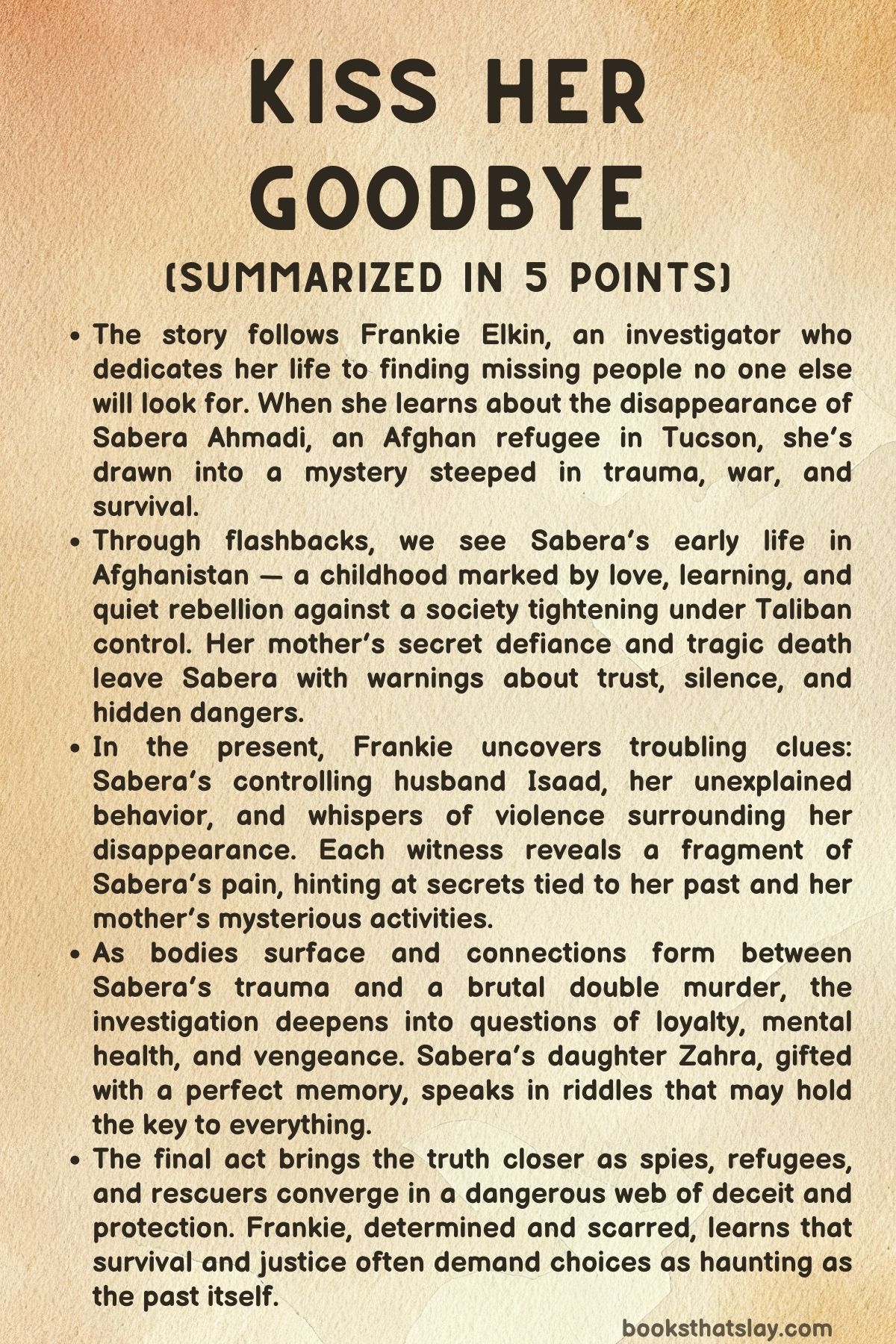
Kiss Her Goodbye by Lisa Gardner is a taut psychological thriller that explores trauma, resilience, and the haunting cost of survival. The novel follows Frankie Elkin, a wandering investigator who dedicates her life to finding missing people overlooked by others.
Her latest case involves Sabera Ahmadi, an Afghan refugee and mother who has vanished in Tucson, Arizona. As Frankie delves deeper, she uncovers layers of secrets spanning continents—from war-torn Kabul to America’s refugee communities. Through Sabera’s story, Gardner examines the enduring scars of conflict, the complexity of cultural displacement, and the lengths to which a mother will go to protect her child. It’s the 4th book in the Frankie Elkin series by the author.
Summary
The story begins in Afghanistan, where young Sabera Ahmadi grows up in a loving, educated household. Her father is a literature professor, her mother a bold fashion designer who secretly aids resistance movements, and her older brother Farshid is her closest companion.
Their home brims with warmth and books, even as war encroaches. When her mother falls mysteriously ill, Sabera is forced into premature adulthood.
On her deathbed, her mother entrusts her with cryptic advice—never trust her uncles, protect what she loves, and clean out the sewing room after her passing. Hidden among fabric and threads, Sabera discovers tokens of her mother’s secret life, revealing that she was part of a quiet rebellion against oppressive forces.
The political climate deteriorates swiftly as the Taliban reclaims Kabul. Herat and the family’s countryside refuge are no longer safe.
As violence spreads, Sabera’s father and brother attempt to shield their home but fall victim to brutal killings. Alone amid devastation, Sabera retrieves a few keepsakes and her brother’s rifle before fleeing into the chaos, clutching her mother’s words like a compass: “When I became a woman, I woke up.”
Years later, the narrative shifts to Arizona. Frankie Elkin, a self-taught investigator who searches for missing persons, is approached by Aliah, an Afghan refugee who pleads for help finding her friend Sabera.
Police dismiss the case, but Aliah insists Sabera would never abandon her young daughter, Zahra. Frankie, haunted by her own loneliness and addiction, accepts.
She finds a temporary home as a pet-sitter for an eccentric man, Bart, whose mansion is filled with reptiles. Her unlikely partner becomes Daryl, Bart’s stoic driver and ex-convict.
Frankie’s investigation leads her to Ashley, a weary resettlement worker who describes Sabera as educated but withdrawn, trapped in an unhappy marriage with her older husband, Isaad. Sabera’s co-workers recall her exhaustion, erratic behavior, and hints of alcohol on her breath—an unlikely detail for a devout Muslim woman.
Ashley suspects deep trauma beneath the surface.
At the refugee complex, Frankie meets Nageenah, another Afghan mother who reveals that Sabera disappeared weeks ago and that Isaad left soon after, abandoning Zahra in her care. Shortly before vanishing, Isaad received a mysterious package from a courier.
Nageenah’s account suggests Sabera’s life was shadowed by danger, secrecy, and fear.
The tension escalates when local news footage shows a woman resembling Sabera fleeing a double homicide scene. Aliah insists it is her friend, while police remain skeptical.
As Frankie and Daryl pursue leads, an attempted abduction of Zahra jolts everyone—the attacker calls the child by name, indicating premeditation. Zahra, gifted with an eidetic memory, utters an enigmatic phrase: “A lock to a key for a key that has no lock.” Frankie senses the words hide an important clue.
Through Sabera’s recovered diary entries, fragments of her past emerge. After losing her family in Kabul, she accepted protection from Professor Ahmadi, her father’s colleague.
Pregnant and desperate, she agreed to marry him to ensure safety. Their marriage, however, became another form of confinement.
Her husband’s love was possessive, his authority unyielding. The diary closes with a mother’s farewell to her daughter, urging her to remember strength and hope.
Frankie’s search uncovers more grim revelations: Isaad’s body is found, fingers burned as he tried to preserve a red notebook filled with equations. The evidence points to coercion and torture.
Investigators suspect multiple parties are hunting for something Sabera possesses—perhaps tied to her mother’s past as an MI6 asset and her family’s rumored involvement in hidden wealth or coded intelligence.
Amid mounting danger, Zahra’s cryptic drawings of mathematical matrices catch attention; they may encode valuable information. A retired captain named Sanders Kurtz and his brother, Dr. Richard, surface with MI6 records linking Sabera’s psychiatric episodes and cryptic statements about someone named “Jamil. ” These documents reveal Sabera’s mental instability, postpartum trauma, and possible pregnancy.
Yet her tox screens were clean—her confusion born not from substance use but from deep psychological wounds.
As the threads converge, the narrative shifts to Sabera’s perspective. Haunted by ghosts of Kabul, she believes her cousin Habib—whom she thought dead after she killed him in self-defense—has returned.
Terrified, she hides while plotting how to keep Zahra safe. Habib, driven by greed and vengeance, teams up with Rafiq, another embittered refugee, seeking a treasure rumored to be encoded in Sabera’s inherited secrets.
Sabera’s disappearance turns into a violent chase. She is captured, beaten, and forced to reveal the code her mother left behind.
During her captivity, Rafiq and his accomplice are killed with a hammer in a desperate struggle for survival. Sabera escapes but remains hunted, carrying both guilt and terror.
Frankie and her allies, including Daryl, Aliah, Roberta (Daryl’s former parole officer), and Captain Kurtz, orchestrate a plan to protect Zahra and draw out the remaining pursuers. They lure the enemies to Bart’s snake-filled mansion, turning the eccentric house into a fortress.
When Habib invades, dragging Aliah as hostage, chaos erupts. Daryl intercepts him but is badly wounded; Sabera kills her cousin in a frenzy of release and despair.
More attackers follow, but they are outmaneuvered by the team’s traps and last-minute reinforcements.
As the dust settles, the surviving group faces new betrayals. Lilla, a British operative posing as an ally, reveals ulterior motives and poisons Sabera, claiming the secret she carries will always endanger her.
Sabera collapses and is declared dead. Her allies mourn, believing the story has closed with tragedy.
But the final twist reveals Sabera alive. Lilla and Dr. Richard faked her death to free her from pursuit. Sabera, pregnant and emotionally scarred, prepares to leave for the United Kingdom with Zahra.
Before departing, she entrusts Frankie with a bundle of letters written for her daughter—a legacy of love and truth. Frankie promises to keep her secret.
The aftermath brings quiet restoration. Daryl recovers from his injuries, Aliah reopens her deli, and Frankie continues her mission to find the lost.
Though scarred by the ordeal, she finds renewed purpose. The story closes with a sense of fragile hope—proof that even in the ruins of war and trauma, resilience endures, and love, however bruised, survives.
Characters
Sabera Ahmadi
In Kiss Her Goodbye, Sabera is built out of contradictions that the story refuses to simplify: she is tender and bookish as a child, ruthless when survival demands it, and intensely private even with the people who love her most. Her early life in Afghanistan gives her a foundation of beauty, intellect, and pride—shaped by a dazzling mother and a principled father—yet it also trains her in secrecy, because she learns that what she notices in public spaces can get people killed.
After her mother’s decline and death, Sabera becomes the unwilling heir to unspoken knowledge and hidden danger, and that inheritance hardens her. When Kabul collapses, the losses of Farshid and her father do not just traumatize her; they reorganize her identity around one goal: endure and protect.
In America, her trauma manifests in fragmented ways—nightmares, dissociation, and a constant scanning for threats—yet her competence never disappears; it simply changes form, showing up in her ability to interpret people, hide her tracks, and weaponize misdirection. Sabera’s violence is never framed as casual or empowering; it reads as a last resort chosen by someone who has already learned what happens when you wait for mercy.
Even her “unreliability” is purposeful: her secrets, half-truths, and staged outcomes are not just plot twists but the psychological logic of a woman who has survived by controlling what others can know about her.
Frankie Elkin
Frankie functions as the story’s moral engine and its outsider lens, someone who walks into a community’s pain without claiming ownership of it. She is defined by stubborn empathy and practical courage rather than swagger; she does uncomfortable things because the alternative is leaving people behind.
Frankie’s investigation style is less about brilliance than persistence—asking again, showing up again, accepting personal inconvenience as the entry fee to someone else’s truth. Her vulnerability is visible in the way she absorbs secondary trauma, especially through nightmares and emotional whiplash, but she does not make that vulnerability the center of the case; she keeps moving because a child is at risk and because the system’s indifference has already created space for predators.
Frankie’s relationships reveal her strength: she accepts help without posturing, she listens when she is out of her depth, and she adapts when the situation demands humility. As the mystery deepens, Frankie also becomes a measure of trust—people decide whether to cooperate partly based on whether she feels safe—and that makes her less a classic detective and more a human bridge between frightened communities and reluctant authority.
Zahra Ahmadi
Zahra is not used as a simple symbol of innocence; she is written as a small child shaped by extraordinary pressure, absorbing patterns that adults overlook and carrying information in the only safe way available to her. Her intelligence is portrayed as both gift and burden: she remembers everything, speaks in riddles that sound like childlike nonsense until they become keys to the case, and expresses trauma through structured language—numbers, grids, repeated phrases—because structure is something she can control.
Zahra’s bond with her mother is central even in absence; she mirrors Sabera’s training in coded communication and survival awareness, suggesting that Sabera, despite her instability, has been deliberate about preparing her child. Zahra also acts like a truth-teller without fully understanding the stakes; what she repeats is accurate, but the adults must do the frightening work of interpreting it.
Most importantly, Zahra represents the story’s highest moral consequence: every adult choice—every lie, rescue plan, and act of violence—gets judged against whether it protects her without turning her into collateral damage.
Aliah
Aliah embodies community loyalty and moral clarity, a person who refuses to accept the convenient narrative that a missing refugee woman simply “ran off.” She is the first to insist on Sabera’s truth: Sabera would not abandon Zahra, and anyone saying otherwise is either ignorant or complicit in the system’s laziness. Aliah’s courage is grounded in everyday responsibility—running a deli, supporting newcomers, navigating cultural expectations—yet she repeatedly escalates her risk because she cannot tolerate abandonment.
She also carries complexity: she withholds information at first, not because she is deceitful, but because secrecy is sometimes how vulnerable communities survive scrutiny and retaliation. When she becomes a target, her arc exposes the cost of being the loudest advocate; the story shows how quickly helpers can become hostages in other people’s wars.
Aliah’s relationship with Zahra reveals her deepest strength—she can provide warmth and steadiness without trying to replace Sabera—making her both protector and witness, someone who keeps the child anchored while adults chase ghosts.
Isaad Ahmadi
Isaad is positioned as both potential villain and tragic casualty, and the tension around him reflects how easily trauma can be misread when viewed through suspicion. He initially fits the profile people fear: a husband who may be controlling, a man whose charm can curdle into anger, someone connected to the last moments before a disappearance.
Yet as the story unfolds, Isaad becomes more clearly defined by devotion and grief, particularly through his fixation on his red notebook and his mathematical work, which represent not just ambition but a salvaged identity from a destroyed life. His love for Sabera is complicated by the fact that he tries to interpret her symptoms through logic and medication, while she experiences them as warnings and prophecy; this mismatch creates emotional distance even when he is trying to help.
Isaad’s choices near the end show a man willing to fight for his family, but the brutality of his death also shows the limits of courage against organized cruelty. The lock of Sabera’s hair found with him turns him into a tragic messenger, someone pulled into a trap by proof that the person he loves might still be reachable.
Farshid Ahmadi
Farshid functions as Sabera’s emotional origin point—her closest companion, her protector, and the person who taught her what loyalty feels like before the world corrupted it. His “two halves of one whole” bond with Sabera becomes a psychological refrain that echoes long after his death, shaping how she interprets partnership, safety, and betrayal.
Farshid’s increasing disappearances and secretive behavior during Kabul’s decline place him in the archetype of the young man forced into resistance, and his refusal to let Sabera join him reflects both love and a tragic belief that he can hold the violence alone. His death at the compound wall is not only a plot event; it is the moment Sabera crosses from childhood dependence into solitary agency.
The rifle she takes is more than a weapon—it is the inheritance of his role, a symbol that she must now become the protector because the protector is gone.
Professor Ahmadi
Sabera’s father is portrayed as principled, educated, and dangerously visible, the kind of man whose beliefs become liabilities when a society collapses into extremism. His advocacy for women’s rights and his intellectual openness mark him as both admirable and vulnerable, especially because his gentleness makes him susceptible to manipulation by relatives who understand power better than he does.
His death by close violence rather than gunfire carries thematic weight: it suggests betrayal, intimacy, and cruelty delivered at the threshold of home, turning the family compound from sanctuary into slaughterhouse. He also serves as a measure of what Sabera loses besides people—she loses the future she imagined, the life of books and learning, and the belief that intelligence alone can protect you.
Even in absence, his influence persists through Sabera’s language skills, her love of learning, and her ability to read motives, as if her intellect is the part of him that survived inside her.
Sabera’s Mother
Sabera’s mother is an elegant force of nature whose charisma masks a life of danger, and her presence shapes the entire story even after she dies early in Sabera’s timeline. She is both performer and strategist: turning market trips into public theater while conducting secretive exchanges that a child can sense but not decode.
Her decline shifts her from glamorous to ghostlike, but she remains in control through her final instructions—warnings about uncles, commands about the sewing room, and the insistence on secrecy even from Farshid. “Chin up” becomes more than a catchphrase; it is the mother’s method of passing down courage as discipline, teaching Sabera to keep her face steady while the ground collapses.
The sewing room objects and hidden risks suggest that Sabera’s mother operated in a world of espionage or clandestine resistance, and that legacy becomes the invisible thread connecting Kabul’s fall to the later pursuit in America. Even as a memory, she is portrayed as the architect of Sabera’s survival mindset: trust selectively, speak carefully, and leave enemies “allowed nothing.”
Aunt Fahima
Fahima represents authoritarian domestic control, the kind that can look like “family protection” while functioning as surveillance and emotional punishment. She arrives as Sabera’s mother declines and replaces warmth with rules, corrections, and constant monitoring, shaping Sabera’s adolescence into something smaller and tighter.
Fahima’s strictness is not framed as simple villainy; it reads as a person clinging to order when the outside world is becoming ungovernable, but the effect on Sabera is corrosive—Sabera learns that affection can be conditional and that a girl’s behavior will always be judged. After the compound massacre, Fahima’s grief turns outward as blame, suggesting she processes trauma through accusation rather than care.
Her character helps explain why Sabera becomes so self-contained: in a house where observation equals control, privacy becomes survival.
Ashley Cantrell
Ashley stands at the intersection of bureaucracy and compassion, someone overwhelmed by the scale of need but still trying to treat people like people. She reveals the harsh mechanics of resettlement: rapid arrivals, limited resources, and the cruel countdown of short-term assistance that forces traumatized families into unstable housing and isolation.
Ashley’s observations about Sabera and Isaad—Sabera’s perfect English, Isaad’s charm that can turn unpleasant—provide early ambiguity that fuels suspicion while also showing Ashley’s attempt to read danger signs without the power to intervene. Her quiet disclosure about Sabera seeming impaired and Isaad looking angry is important because it reflects how helpers become reluctant witnesses, holding fragments of truth they are not trained or supported to act on.
Ashley’s role underlines the story’s critique of systems that treat survival as a paperwork process, leaving caseworkers carrying moral weight without real protection or authority.
Nageenah
Nageenah embodies the fragile solidarity of refugee communities, where neighbors become the safety net because official support is thin and trust is hard-won. She is cautious with outsiders, especially anyone who might be police or military, because her family’s safety depends on controlling information.
Her decision to take Zahra overnight shows both generosity and the ordinary heroism of people who already have too little but still share. Nageenah’s testimony gives the investigation its human texture: the loneliness of resettlement, the fear of predators, and the exhausting vigilance of protecting children in unfamiliar environments.
She also carries believable uncertainty—she did not see physical abuse, she noticed worrying patterns, she cannot fully explain Sabera’s absences—making her a credible observer rather than a convenient informant. Through Nageenah, the narrative shows how communities hold each other together while also being vulnerable to intimidation and rumor.
Detective Marc
Marc represents constrained authority: a law enforcement figure navigating evidence, politics, and cultural distance while trying not to overpromise what the system can deliver. In Kiss Her Goodbye, he is skeptical by training, initially reluctant to accept identity based on a scarf, and careful about what he can say through intermediaries.
Yet his pragmatism becomes a form of integrity; he follows the facts as they evolve, adjusts when the missing-person case becomes a broader pattern of violence, and treats Zahra’s situation with increasing seriousness once both parents are gone. Marc also highlights a key tension: communities distrust police for reasons that are not irrational, and police sometimes miss urgent cases because they rely too heavily on assumptions about domestic conflict or “voluntary disappearance.” His presence is most effective when he becomes less defensive and more collaborative, allowing civilian insight without surrendering investigative rigor.
Roberta
Roberta is the story’s blunt instrument of accountability, someone who refuses melodrama and forces people to justify what they think they know. In the book, she bridges worlds—connected to Detective Marc while personally embedded in Daryl’s life—and that makes her both gatekeeper and translator.
Her skepticism about the scarf and her irritation at Daryl’s meddling keep the group from spiraling into confirmation bias, but her willingness to show up anyway reveals underlying compassion. Roberta’s role in distracting Zahra with “dance” also signals emotional intelligence: she understands when a child needs space from adult panic.
She is not written as soft, but she is written as loyal, the kind of person whose protection looks like argument rather than comfort.
Daryl
Daryl is outwardly a driver and helper, but narratively he becomes the group’s shield—physical, logistical, and moral. His protectiveness is proactive: he chooses secure spaces, thinks about threats before others do, and uses his connections and presence to reduce vulnerability.
His history with a parole officer implies a complicated past, which makes his current steadiness more meaningful; he is someone who has rebuilt himself into a reliable protector. Daryl’s refusal to drive Frankie to a crime scene because he will “bring the crime scene” to her shows a streetwise understanding of risk, and his insistence on relocating Aliah and Zahra reflects a paternal, strategic care.
When violence erupts, Daryl is the one who physically intervenes, and his injuries underline the cost of being the person who stands between predators and the people predators want.
Bart
Bart represents wealth as a strange kind of sanctuary, a place with cameras, gates, and eccentric comforts that can be repurposed as protection in a crisis. His estate is initially just a practical solution for Frankie—lodging in exchange for pet-sitting—but it becomes a staging ground where safety is possible because resources exist.
Bart’s habit of watching through cameras introduces the theme of surveillance, echoing how refugees and investigators alike live under watch, though in his case it reads as casual privilege rather than fear. He is not the moral center of anything, but his property becomes a tool, illustrating how safety in this world often depends less on justice and more on access.
Genni
Genni brings warmth and groundedness into a narrative saturated with threat, and the fact that she is a drag queen is not treated as a gimmick but as part of a chosen-family environment that can absorb outsiders. She offers food, humor, and domestic steadiness, which becomes especially important once Zahra arrives and the household shifts from investigation to protection.
Genni’s ability to welcome Aliah and Zahra without judgment models a different kind of refuge—one built on acceptance rather than shared origin. She also functions as emotional ballast for Frankie and the group, proving that safety is not only locks and weapons but also care, routine, and the feeling that someone is happy you exist.
Captain Sanders Kurtz
Kurtz represents organized advocacy and the shadow network of people who operate between governments, nonprofits, and intelligence channels to protect vulnerable individuals. His arrival with MI6-obtained documents signals that Sabera’s story is not only personal but geopolitical, threaded into larger machinery that can both endanger and rescue.
Kurtz’s recognition of the magic squares highlights the theme of coded communication and the idea that intelligence can hide in plain sight. He is also a reminder that there are actors with reach and resources, but those resources come with secrecy and moral compromise, because protection often requires controlling narratives and moving people quietly rather than pursuing public justice.
Staci
Staci embodies institutional secrecy disguised as case management, the well-meaning but harmful decision to withhold critical information “for the client’s good” while others operate blind. Her concealment of Sabera’s psychiatric hold and pregnancy reframes earlier events, showing that the disappearance cannot be read as a simple domestic dispute.
Staci’s knowledge puts her in an ethically gray space: she is trying to respect confidentiality, yet the consequences of silence ripple outward, endangering a child and hindering the search. Her disclosures about Sabera repeating “I killed them” and the name “Jamil” deepen the psychological dimension of the plot, emphasizing that trauma is not neat, memory is not linear, and what someone says in crisis can be both confession and symptom.
Dr. Richard
Dr. Richard functions as a witness to Sabera’s most morally fraught transformation, the person who sees what she does under unbearable pressure and responds not with purity tests but with clinical urgency. His role in the refugee camp clinic places him at the edge of catastrophe—cholera outbreaks, shortages, and violence—where the usual rules of right and wrong become tangled with triage and survival.
When he observes Sabera after she kills Habib, his reaction suggests he understands that trauma can push people into actions they will carry forever. Later, his presence in the climactic sequence ties medicine to truth: he treats injuries, confronts manipulation, and becomes part of the moral argument about whether staging a death is justified to save a child.
Habib
Habib is the story’s embodiment of revenge and entitlement, a predator driven by the belief that family connection grants him access to what he wants. He survives when he should not, turning into a persistent nightmare that makes Sabera question reality and fuels her dissociation.
His obsession with a hidden “key” and his willingness to threaten, kidnap, and harm children show a man who has replaced human bonds with extraction—of money, secrets, and obedience. Habib is also a mirror of the broader theme of exploitation in conflict zones: he moves through chaos looking for profit, using trauma narratives as leverage.
His death at Sabera’s hands is not framed as triumphant revenge but as the completion of a grim cycle, the final severing of a threat that institutions could not contain.
Lilla
Lilla represents the cold competence of intelligence work, where protection and manipulation can look identical from the outside. She arrives as an unsettling force—efficient, secretive, unbothered by the emotional wreckage around her—and her willingness to stage outcomes underscores a worldview in which the story that survives matters as much as the person who survives.
Her apparent poisoning of Sabera and later reveal that the death was staged positions her as someone who treats morality as a tool, choosing deception because it ends the hunt. Lilla’s interest in Zahra signals that children are assets and liabilities in geopolitical games, and her final plan to move mother and daughter under protection suggests that the only real escape is disappearance into another system.
She is not simply villain or savior; she is the personification of power acting in secrecy, offering safety at the price of control.
Rafiq
Rafiq is portrayed as grief weaponized by larger forces, a man hollowed by the death of his son Omid and made vulnerable to coercion and radicalization. His bitterness is not used to excuse what he becomes, but to explain how someone can be pushed into cruelty when despair is paired with pressure.
He represents the tragic truth that not everyone who suffers becomes compassionate; some become dangerous, especially when offered a story that gives their pain meaning and a target. Rafiq’s role helps expand the threat beyond one family feud, showing how rumor, superstition, and opportunism can recruit ordinary people into violent pursuits.
Omid
Omid’s presence is brief but emotionally heavy, functioning as a moral wound that never closes for the adults around him. In the book, his death during the camp’s medical crisis is the moment that clarifies how powerless even the helpful can be, and it becomes a pivot point for multiple characters’ trajectories: it haunts Dr. Richard, devastates Rafiq, and intensifies Sabera’s sense that the world punishes the innocent without warning.
Omid is also a symbol of why the story refuses easy hero narratives—good intentions do not guarantee good outcomes, and survival often depends on randomness as much as strength.
Themes
Identity and Displacement
The narrative of Kiss Her Goodbye by Lisa Gardner explores identity as a fragile construct continuously reshaped by displacement, trauma, and survival. Sabera’s journey—from an educated Afghan girl to a refugee woman navigating life in America—reflects how identity becomes fragmented when history, homeland, and personal agency are stripped away.
Her early life in Afghanistan anchors her in familial love and cultural richness, but political collapse transforms her into someone unrecognizable even to herself. The forced migrations of her family, the death of her loved ones, and her marriage of necessity to Isaad all erode her sense of belonging.
In Tucson, the alien environment amplifies her inner dislocation; her voice becomes one of silence and concealment rather than expression. Yet within that silence lies endurance—the identity of a survivor who adapts even when belonging is denied.
Through Frankie Elkin, the novel adds a mirror image: a woman who is rootless by choice but equally alienated, existing on society’s margins while seeking lost people as a way to piece together her own fractured self. Both women embody different versions of exile—Sabera’s imposed by war and patriarchy, Frankie’s self-inflicted through guilt and loss.
The theme underscores how identity is not a fixed inheritance but an evolving response to rupture and memory, revealing that survival often demands the reshaping of the self until it becomes both shield and disguise.
Female Resistance and Silence
The story’s female characters—Sabera, her mother, Aliah, Ashley, and even Frankie—carry the shared burden of resistance conducted through silence, secrecy, and small acts of defiance. In a patriarchal world where open rebellion is punished, their endurance becomes an unspoken language of survival.
Sabera’s mother embodies this resistance first: a woman who trades forbidden goods and information under the gaze of conservative men, nurturing her daughter’s quiet strength with coded lessons. Sabera inherits this mode of defiance, turning secrecy into her armor when faced with political oppression, domestic control, and cultural exile.
Her silence conceals not weakness but strategy, a way to live under scrutiny without surrendering autonomy. In Tucson, this resistance manifests differently but with equal potency—Frankie’s refusal to conform to expectations of femininity or domesticity, Ashley’s exhaustion within bureaucratic neglect, Aliah’s steadfast faith amid discrimination.
Their struggles intersect through shared understanding rather than overt rebellion, emphasizing that in oppressive systems, women’s survival itself becomes an act of defiance. The novel transforms silence from a symbol of submission into one of moral courage and endurance.
By portraying resistance as intimate and interior, Gardner reveals how women navigate power not through confrontation alone but through endurance, coded communication, and moral clarity in a world that repeatedly tries to erase them.
Trauma, Memory, and Inheritance
Trauma in Kiss Her Goodbye functions not merely as aftermath but as a living, inherited force that shapes generations. Sabera’s memories of violence, her dissociative episodes, and the hallucinations of her dead family reveal how unprocessed grief becomes a haunting that transcends time and geography.
Her daughter Zahra’s eidetic memory, while extraordinary, represents the same burden—an inability to forget. In contrast, Frankie’s emotional numbness and obsession with rescuing others highlight another form of trauma: one defined by guilt and self-erasure.
Gardner constructs trauma as an ecosystem of echoes where survival depends on selective forgetting, yet the narrative insists that forgetting is impossible. Each character becomes a vessel for inherited pain—Sabera from her mother, Zahra from Sabera, and Frankie from her own buried past.
The novel portrays trauma as cyclical rather than linear, showing how it distorts perception, fractures relationships, and challenges identity. It also connects personal and political suffering, linking individual breakdowns to larger historical violence.
The fusion of memory and madness blurs boundaries between reality and delusion, demonstrating how those who endure trauma live in two worlds at once: the one that is gone and the one that demands endurance. Gardner treats memory not as a tool of healing but as a test of survival—the question is not whether to remember, but how to live with remembering.
Power, Control, and Patriarchy
Power dynamics pervade the novel, revealing the many ways control manifests—from the intimate to the institutional. Isaad’s dominance over Sabera mirrors the systemic subjugation of women in both Afghan and Western contexts.
His control is intellectual and paternalistic, disguised as protection but functioning as possession. The men who orbit Sabera—her uncles, Habib, Rafiq—represent different shades of patriarchal violence: coercion, entitlement, exploitation.
Yet Gardner extends the critique beyond the personal. Bureaucratic systems that process refugees, intelligence agencies that manipulate lives for geopolitical ends, and law enforcement that dismisses missing women—all become embodiments of structural control.
Frankie’s role as an investigator highlights this theme further: she operates within the same masculine-coded realm of authority but reclaims it through empathy and persistence. Her power comes not from domination but from witnessing and understanding.
In contrast, the state and its male agents wield power through erasure—reducing individuals to cases, refugees to statistics, women to suspects. Sabera’s final act of reclaiming agency, even amid deception and staged death, asserts a moral reversal: survival and motherhood become her final forms of power.
The novel ultimately suggests that true control lies not in coercion but in the refusal to submit, even when silence and secrecy are the only available weapons.
Guilt, Redemption, and Moral Ambiguity
At its core, Kiss Her Goodbye is a meditation on guilt and the human longing for redemption. Every major character is haunted by a moral wound—Sabera by the killing of her cousin Habib, Frankie by the unnamed losses that drive her nomadic crusade, Isaad by his complicity in violence and deception.
Their actions oscillate between mercy and vengeance, showing how guilt distorts intention. Gardner’s narrative refuses to divide her characters into simple victims or villains; instead, it situates them within moral gray zones where survival often demands transgression.
Sabera’s guilt evolves into self-punishment, manifesting in hallucinations and breakdowns, while Frankie’s need to “find the lost” becomes a penance that isolates her from life. Yet redemption, in Gardner’s world, does not arise from forgiveness or absolution—it comes through acknowledgment and endurance.
When Sabera sacrifices her identity to protect Zahra, she performs the ultimate act of moral clarity: choosing life over vengeance, concealment over destruction. Frankie’s decision to protect that secret continues the cycle of imperfect redemption, suggesting that morality is not about purity but persistence in doing what remains right after everything else has fallen apart.
In this moral landscape, guilt becomes both a curse and a compass, guiding broken people toward acts of quiet grace.