Everyone Here Is Lying Summary, Characters and Themes
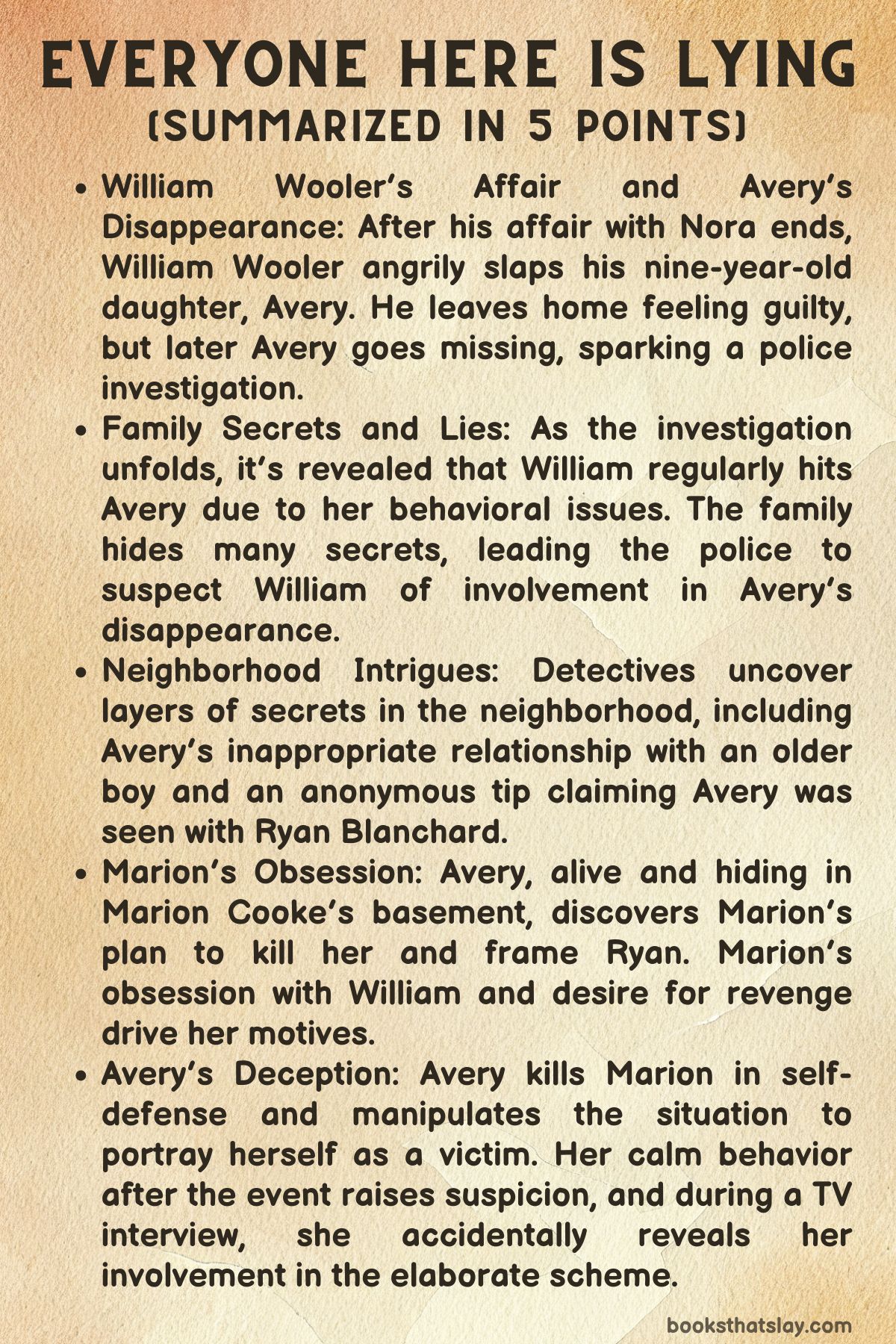
Everyone Here is Lying by Shari Lapena is a psychological thriller that explores the hidden fractures within families, marriages, and communities when tragedy strikes. At the center is the Wooler family, whose nine-year-old daughter Avery goes missing under disturbing circumstances.
As the search intensifies, secrets emerge—an affair, simmering tensions, and a child with troubling behavior—each detail complicating the mystery. Lapena’s storytelling pushes readers to question the truthfulness of every character, exposing how lies, fear, and desperation can warp reality. It is a story about appearances, deceit, and the devastating consequences of choices made in secrecy.
Summary
The story opens with William Wooler secretly meeting his lover, Nora Blanchard, at a motel. Nora abruptly ends the affair, telling him she must prioritize her family.
Distraught, William returns home, only to find his daughter Avery there unexpectedly. Avery, known for her defiance, provokes him until he loses control and strikes her.
Terrified by what he has done, William begs her to stay quiet. He leaves her in the kitchen, guilt-ridden, while his son Michael, unaware of what happened, searches for Avery after learning she left choir early.
By the time their mother, Erin, arrives, Avery has vanished.
The police become involved, and suspicions arise quickly. Investigators notice details in the Wooler home—such as Avery’s jacket hung on a hook too high for her to reach—that suggest she was inside with someone else.
Michael reveals Avery knew about the spare key, worsening his guilt. Erin is devastated, Michael is consumed with blame, and William hides the truth of his violent outburst.
The police begin canvassing the neighborhood, and tension spreads through the community. Nora, though trying to suppress her guilt over William, grows anxious that their affair could be exposed.
As detectives Bledsoe and Gully press the Wooler family, inconsistencies in William’s account surface. He has no alibi for the afternoon, and Michael admits William sometimes slapped Avery in the past.
Erin is shaken when she realizes her husband cannot explain his whereabouts, and suspicion grows that William harmed his daughter. Eventually, police discover his burner phone, forcing William to confess to both hitting Avery and having an affair, though he refuses to name his partner.
His evasiveness makes him look increasingly guilty.
Meanwhile, Avery’s friend Jenna tells police Avery claimed to have an older boyfriend, raising disturbing possibilities. But an anonymous tip points investigators toward Ryan Blanchard, Nora’s teenage son, who is accused of giving Avery a ride.
Though released due to lack of evidence, Ryan becomes a focus of suspicion, pulling Nora and her husband Al deeper into the scandal. Al admits he had been secretly watching Nora’s affair, leading to explosive confrontations at home.
Their family fractures, while Nora fears Ryan could be implicated.
The investigation broadens to other possible suspects, including Derek Seton, a local boy Avery once spent time with, but the most damaging lead comes from Marion Cooke, a nurse who claims to have seen Avery get into Ryan’s car. Police arrest Ryan, devastating his family.
Unbeknownst to them all, Avery is alive and hiding in Marion’s basement. Avery, angry at her father for hitting her, staged her disappearance to make him suffer.
Marion, obsessed with William and envious of Nora, seizes the opportunity to manipulate events. She hides Avery, feeds her, and anonymously tips police, deliberately framing Ryan to destroy the Blanchards.
As Avery watches the news coverage from the basement, she begins to realize Marion has her own agenda. She grows restless and angry when Ryan is arrested, since her original plan was only to punish her father, not implicate others.
Tension builds between Marion and Avery, as Marion plots to kill her captive to erase the risk of discovery. She crushes pills into Avery’s milk and prepares a rope to strangle her.
But Avery, realizing she is in danger, resists. When Marion tries to attack, Avery pushes her down the stairs.
Marion dies instantly, leaving Avery free.
Detective Gully arrives just in time to find Avery, who confesses she pushed Marion. Police secure the house and declare Avery a survivor of abduction.
She is reunited with her family, sparking emotional yet complicated responses. Erin is relieved but furious at William for his infidelities and failures.
William is crushed by guilt, and Michael remains unsettled. Avery tells police she fled to Marion after her father hit her, and claims Marion locked her away.
Her account raises questions, but detectives accept it for the time being.
As the dust settles, Avery enjoys the attention her story brings. The media paints her as a victim, while Erin considers relocating to protect her children.
Detectives, however, are left uneasy when the autopsy on Marion is ruled “undetermined,” suggesting Avery may have ensured her death. Yet without evidence, no charges are filed.
In a televised interview, Avery slips by mentioning that Marion “double-crossed” her, hinting at a deeper truth about her role in the ordeal. The revelation unsettles her mother, leaving lingering doubts about how much of the story Avery has concealed.
Ultimately, Everyone Here is Lying portrays a community ensnared by suspicion, betrayal, and manipulation. The Wooler family is shattered, the Blanchards scarred, and the detectives uneasy about what really happened.
At the center of it all is Avery—both victim and instigator—whose lies and choices leave everyone questioning whether the full truth will ever be known.
Characters
William Wooler
William is one of the central figures in Everyone Here is Lying, portrayed as both deeply flawed and tragically human. On the surface, he is a respected physician, a husband, and a father, but beneath that exterior lies a man struggling with weakness, guilt, and selfish desires.
His affair with Nora reveals his dissatisfaction and emotional hunger, while his inability to let go underscores his dependency on validation outside of his marriage. The incident with his daughter Avery—where he strikes her in anger—marks a pivotal moment in the story, transforming him into a man consumed by shame and fear.
His lies to the police, his nervous demeanor, and his eventual forced confession about the affair all unravel his carefully constructed facade. William is a character whose moral failings and cowardice contribute not only to his family’s disintegration but also to the chaos surrounding Avery’s disappearance.
Erin Wooler
Erin is the emotional anchor of the Wooler family, though her stability is constantly tested throughout the narrative. She begins as a mother trying to manage her children and maintain her household while working, but the ordeal of Avery’s disappearance forces her into a state of relentless anguish.
Erin’s trust in William shatters as she learns about his affair and his concealed lies, transforming her from a loyal partner into a woman embittered by betrayal. Her grief for Avery is authentic and raw, and her resilience in the face of mounting suspicion from the detectives sets her apart from William’s weakness.
Erin emerges as both a victim of her husband’s failings and a mother clinging desperately to hope, showing strength and despair in equal measure.
Avery Wooler
Avery is the nine-year-old child at the heart of the mystery, whose disappearance drives the novel forward. She is portrayed as both vulnerable and unsettling, embodying innocence but also an unnerving manipulative streak.
Her defiance at choir practice and her secret-keeping with Michael foreshadow her rebelliousness. Later revelations about her orchestrating aspects of her disappearance and relishing the attention shed light on her complex psychology.
Avery’s interactions with Marion reveal her capacity to manipulate adults, while her final televised slip betrays her desire for control and recognition. As both victim and instigator, Avery is a character who unsettles the reader, complicating the traditional role of the missing child.
Michael Wooler
Michael, William and Erin’s teenage son, is burdened with guilt throughout the story. His seemingly innocent act of revealing the location of the spare key to Avery becomes, in his mind, the spark for her disappearance.
His confession about William’s temper to the detectives exposes the family’s hidden dysfunction and further isolates him emotionally. Michael’s deep sense of responsibility for Avery reflects his need to protect her, yet he is powerless against the larger forces tearing the family apart.
Quiet, observant, and weighed down by shame, Michael functions as a tragic bystander, whose role emphasizes the collateral damage inflicted on children caught in adult failures.
Nora Blanchard
Nora is William’s lover, whose decision to end their affair triggers the series of events leading to Avery’s disappearance. Torn between her passion for William and her commitment to her family, Nora embodies the conflict between desire and responsibility.
Her fear of exposure, particularly when her burner phone is discovered, highlights her vulnerability to scandal. At the same time, she is trapped in a crumbling marriage to Al, whose coldness and surveillance further degrade her.
Nora is consumed with guilt, not only over her affair but also over her son Ryan being implicated in Avery’s disappearance. Her character reflects the destructive consequences of secrecy and suppressed longing, both for herself and her family.
Al Blanchard
Al is Nora’s husband, whose bitter, silent watchfulness reveals a man hardened by resentment. His suspicion of Nora’s affair becomes certainty as the story unfolds, and he takes a perverse satisfaction in her downfall.
His cold confrontations with Nora demonstrate his capacity for cruelty, though he himself is also deeply wounded by betrayal. Al’s quiet knowledge of her meetings with William, combined with his inaction, gives him an unsettling presence—an observer who relishes the disintegration of those around him.
His character adds tension to the story, embodying suppressed rage and vindictive satisfaction.
Ryan Blanchard
Ryan, Nora and Al’s teenage son, becomes entangled in the investigation when he is accused of abducting Avery. His silence during questioning, guided by his lawyer, only intensifies suspicion.
The accusation devastates him, shaking his sense of safety and future. Ryan’s role underscores the collateral impact of the adults’ actions, as he becomes a scapegoat for the toxic entanglements between the Woolers and his own family.
Despite his innocence, Ryan’s ordeal leaves lasting scars, showing how quickly suspicion can destroy a young life.
Faith Blanchard
Faith, Ryan’s sister, is more of a peripheral character but offers insight into the fractures of the Blanchard family. She observes the tension between her parents and the implosion of her household, worried about Ryan and disturbed by the revival of old family conflicts.
Through her, readers glimpse the wider emotional cost of Nora’s affair and the investigation, as she embodies the silent suffering of children within broken homes.
Marion Cooke
Marion is the most sinister figure in the novel, her obsession with William and jealousy of Nora driving her to orchestrate much of the chaos. Initially appearing as a concerned neighbor and nurse, she reveals herself to be manipulative, unstable, and dangerous.
Her role in hiding Avery, manipulating her, and falsely accusing Ryan demonstrates her cunning and her willingness to destroy others for her own twisted goals. Marion’s fixation on William reflects a delusional yearning for validation, while her hatred of Nora provides a motive for her destructive behavior.
Her ultimate death at Avery’s hands is fittingly ironic: her obsession consumes her and ends in her downfall.
Themes
Family Dysfunction and Fractured Relationships
The narrative in Everyone Here is Lying highlights the fragility of family life when layers of secrecy and resentment go unchecked. The Woolers, from the very outset, are depicted as a family already on edge: William’s strained relationship with Avery, Erin’s quiet suspicions, and Michael’s guilt illustrate that dysfunction is not rooted in a single incident but is the result of years of unresolved tensions.
William’s act of striking Avery becomes both a literal and symbolic rupture in the fragile bond between father and daughter. Erin’s faith in her husband crumbles once the affair and violence are revealed, and Michael’s guilt further destabilizes the family unit.
At the same time, the Blanchards mirror this disintegration, as Nora’s affair unravels her marriage to Al and casts suspicion on their son Ryan. What emerges is the portrait of two families whose outward appearances of normalcy disintegrate under pressure.
The story demonstrates how dishonesty, misplaced anger, and secrets become corrosive forces that seep into the foundations of family life. Ultimately, the novel positions family not as a sanctuary but as a volatile environment where betrayal, fear, and mistrust breed instability.
Guilt, Secrets, and the Weight of Silence
A recurring theme in Everyone Here is Lying is the destructive burden of secrets and the silences people maintain to protect themselves. William hides his affair with Nora, conceals his violent outburst toward Avery, and withholds the truth from both Erin and the detectives, decisions that steadily entangle him in suspicion.
Nora conceals her relationship with William from her husband and children, but her guilt festers, eventually leading to catastrophic consequences. Michael hides the fact that he revealed the location of the spare key, which tortures him with self-blame when Avery vanishes.
Even Avery herself embodies this theme, as her silence about her father’s actions and her decision to orchestrate her disappearance are deliberate manipulations that drive the entire plot. Marion Cooke’s deception adds another layer: her lies to the police, her manipulation of Avery, and her false accusations against Ryan are all motivated by jealousy and obsession.
The novel demonstrates that silence is not passive; it is an active force that shapes outcomes, isolates individuals, and heightens suspicion. Secrets in this world are rarely contained—they metastasize until they consume not just the individual but entire families and communities.
Obsession, Manipulation, and Control
Through Marion Cooke’s character, Everyone Here is Lying explores the devastating consequences of obsession and the human drive to control others. Marion’s fixation on William becomes the lens through which she reshapes reality, projecting herself as his potential partner and Nora as her enemy.
Her decision to harbor Avery, rather than return her, is not born of compassion but of a manipulative desire to orchestrate events to her advantage. Marion’s control over Avery mirrors William’s earlier loss of control with his daughter, drawing a parallel between obsession and violence.
Both characters act out of desperation to maintain influence, but while William collapses under guilt, Marion embraces her delusion fully, weaponizing lies to manipulate the investigation and destroy Nora’s family. Avery, though a child, also demonstrates a manipulative streak—using her disappearance to punish her father and enjoying the attention it brings her.
The theme underscores how obsession can manifest in different forms—romantic, parental, or psychological—and how the need to dominate others leads to dangerous consequences that spiral beyond one’s control.
Truth, Lies, and the Nature of Justice
The title Everyone Here is Lying encapsulates one of the central themes: the instability of truth in a world where lies serve as both defense and weapon. Every key character lies at some point, whether out of self-preservation, fear, or manipulation.
William lies about his whereabouts and his treatment of Avery, Nora lies about her involvement with him, Al conceals his secret surveillance of his wife, and Marion fabricates witness accounts to frame Ryan. Even Avery, ostensibly the victim, constructs her own web of deceit.
The detectives, while pursuing justice, are continually misled, highlighting how truth becomes obscured when every voice carries an ulterior motive. The novel questions whether justice is ever truly attainable in such circumstances, where competing narratives cloud objective reality.
Instead, what emerges is a fractured sense of justice—one shaped by media perception, unreliable testimony, and incomplete truths. The result is a sobering commentary on how easily justice can be distorted when truth itself becomes elusive.
Childhood, Innocence, and the Distortion of Youth
Avery’s character offers a disturbing meditation on the fragility of childhood and the distortion of innocence. While she is introduced as a vulnerable nine-year-old caught between her parents’ conflicts, her actions reveal a darker complexity.
Avery orchestrates her disappearance not simply as a frightened child but as someone seeking to manipulate events to her advantage. Her fascination with attention, her fabricated stories about an older “boyfriend,” and her willingness to exploit others’ fear complicate the idea of innocence.
She is both victim and agent, simultaneously endangered by adults like William and Marion yet also responsible for choices that exacerbate the crisis. This duality reflects the unsettling reality that children, though dependent and impressionable, are not always passive in the tragedies that engulf them.
The theme forces readers to question the boundaries between childhood mischief and dangerous manipulation, complicating the conventional narrative of innocence. In doing so, the novel unsettles the reader, offering a chilling perspective on the blurred lines of morality in youth.