Fangirl Down by Tessa Bailey Summary, Characters and Themes
Fangirl Down by Tessa Bailey is a contemporary sports romance about a golfer at the lowest point of his career and the woman who refuses to stop believing in him. Josephine Doyle has admired Wells Whitaker for years, even when everyone else has written him off.
After a personal and professional blowup pushes them together in an unexpected way, their connection grows through competition, attraction, and mutual care. The novel blends humor, heat, and emotional vulnerability while following two people who challenge each other to grow. At its core, it is a love story about respect, trust, ambition, and finding confidence in yourself through someone who truly sees you. It is the first book in her Big Shots series.
Summary
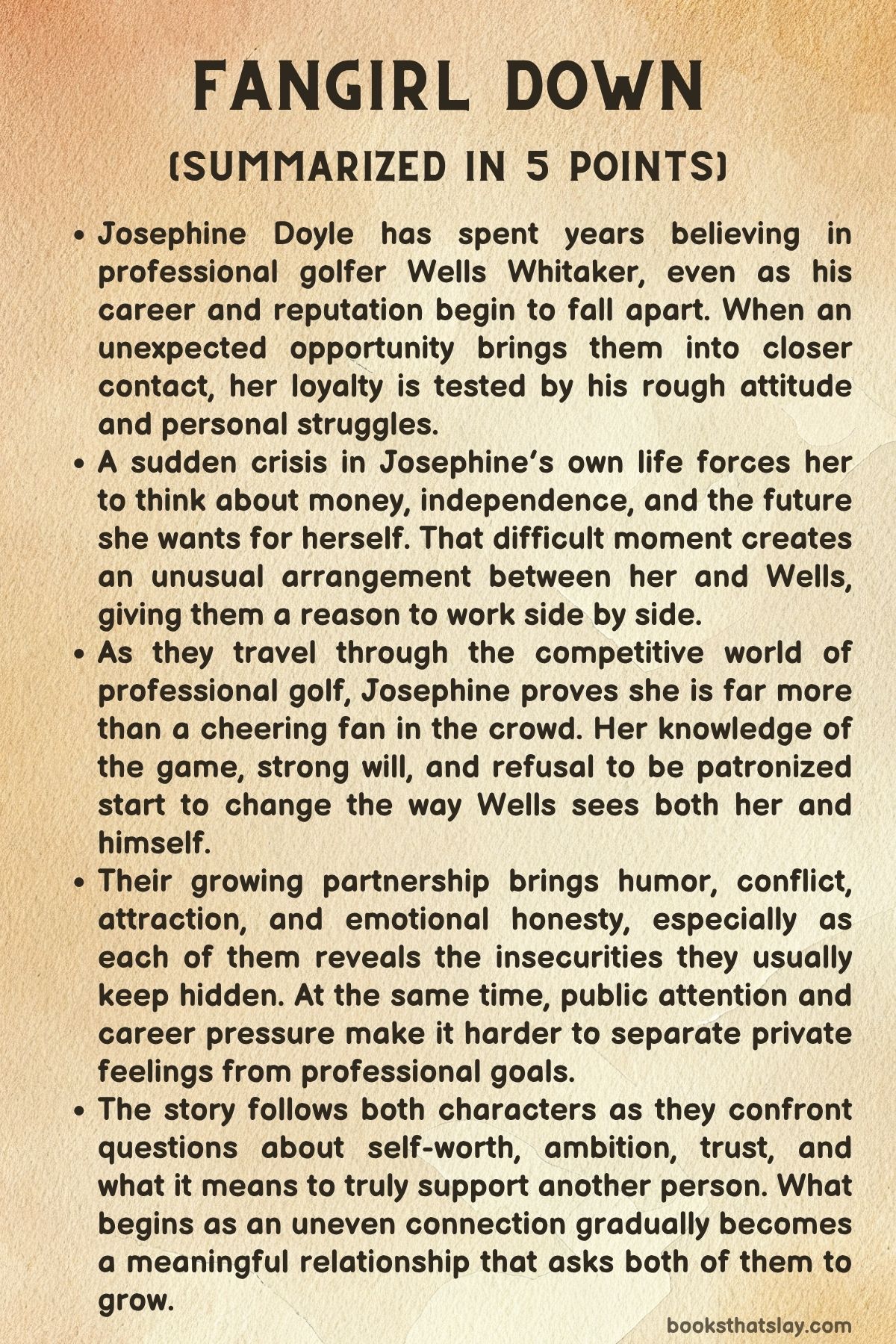
Josephine Doyle has spent years cheering for professional golfer Wells Whitaker. Even after his career begins to fall apart and his reputation worsens, she remains his last loyal supporter.
Raised in her family’s golf pro shop, Josephine understands the sport deeply and sees more in Wells than his recent failures. When she attends one of his events carrying a sign and expecting a raffle prize lunch and lesson, she instead becomes the target of his frustration.
Wells, angry with himself and convinced his career is finished, lashes out at her, rejects her support, and tears apart the sign she made for him. The moment deeply hurts Josephine, but it also reveals how lost Wells has become.
Not long after, a hurricane damages Josephine’s family business, the Golden Tee pro shop, which she has been trying to modernize and keep afloat. The disaster leaves her overwhelmed, especially because she had dropped insurance to save money.
Josephine also manages type 1 diabetes, something her parents have always worried about, and the pressure of proving that she can care for herself while also saving the shop weighs heavily on her. When Wells unexpectedly appears to check on her, she does not trust his motives at first.
He soon learns how serious her financial situation is and offers money, but Josephine refuses charity. In response, Wells proposes that she work as his caddie for the remainder of the tour so she can earn what she needs.
She agrees, setting the tone for an arrangement built on stubbornness, banter, and reluctant trust.
As they prepare to travel together, Josephine quickly proves she is not intimidated by Wells’s moods, reputation, or self-pity. She understands golf well enough to challenge him and refuses to let him hide behind excuses.
Wells, who has spent much of his life disappointing people and expecting abandonment, is unsettled by her honesty and optimism. He has a painful history with his parents, a complicated relationship with his mentor Buck Lee, and a long pattern of keeping everyone at a distance.
Josephine begins to break through that isolation simply by treating him like a person worth arguing with, not a lost cause.
At the first tournament stop, people react with surprise and skepticism to Josephine’s presence as a female caddie, especially beside someone as volatile as Wells. Their attraction also becomes impossible to ignore.
Awkward and funny moments bring them closer, including a misunderstanding at the hotel, a cocktail party where they nearly kiss, and private conversations that reveal more of who they really are. Josephine sees that Wells is lonely, defensive, and far more vulnerable than his public image suggests.
Wells starts to notice Josephine’s strength, intelligence, and independence in ways that go far beyond his old image of her as a fan in the crowd.
Once they begin working together on the course, Josephine becomes essential to Wells’s comeback. She reads the game sharply, gives him clear direction, and refuses to indulge his worst impulses.
Their chemistry turns openly flirtatious, and Josephine even uses teasing promises to motivate him to stay focused and keep his temper in check. Beneath the humor, though, something more serious grows.
Wells becomes increasingly aware of Josephine’s health needs and starts paying attention to her blood sugar monitoring and insulin routine. Rather than treating her like someone fragile, he wants to understand how to support her.
That effort matters deeply to Josephine, who has spent much of her life being underestimated or overprotected.
Their physical relationship begins after trust has already started to form, and it quickly becomes intense. Even so, the emotional shift matters more than the sexual one.
Wells is shaken by how strongly he responds to Josephine, because she makes him want closeness, steadiness, and honesty, not just physical release. Josephine, meanwhile, finds in Wells a partner who admires her fire instead of trying to soften it.
Their days on tour become a mix of improving performance, private jokes, rising desire, and growing dependence on one another. Publicly, they become an appealing story: a fallen golfer making a comeback with the help of an unexpected caddie.
Privately, they are building something neither of them fully knows how to name.
As Wells improves, the press and the golf world take notice, but public attention also creates new pressure. Josephine wants to be respected for her skill and work, not reduced to a pity story about a struggling woman with diabetes.
Trouble begins when private details about her situation and Wells’s decision to hire her become distorted in the media. A report suggests that Wells only brought her on out of sympathy, diminishing her talent and professionalism.
Josephine is furious, not because she doubts Wells’s care for her, but because she refuses to be seen as someone carried by his generosity. Wells had shared parts of her story in an effort to get back into competition, not realizing how badly it could be used.
Though they talk through the misunderstanding, Josephine asks that they take a step back romantically so they can be seen as serious professionals.
Their separation is brief in distance but difficult emotionally. Back in Florida, Josephine throws herself into repairing the Golden Tee, yet she misses Wells constantly.
Wells keeps training, thinking about her, staying connected in small ways, and even maintaining contact with her parents. When a blood sugar app alert makes him think Josephine is in danger, he panics, drives to her home, and forces his way inside, only to discover there was a syncing issue with her monitor.
His terror makes clear just how deeply he loves her. Once reunited, they stop pretending the relationship is casual.
Wells asks to date her properly, joins her family for brunch, and starts imagining a future that includes not only Josephine but also her family, her shop, and the life she has built.
Still, a major conflict remains: Josephine cannot stay on tour forever. The Golden Tee is her dream, and after the renovations are finally completed, she must return home to reopen it.
Wells admires what she has created, but the reality of losing her as his caddie frightens him. Josephine worries too.
She loves Wells and loves working beside him, yet she knows she cannot abandon the business she fought so hard to save. Their time together in California is full of tenderness, desire, and unspoken dread, because both understand that the end of this phase of their relationship is near.
Wells eventually makes a choice that hurts them both. Knowing Josephine will sacrifice her own dream to stay with him through the Masters, he fires her as his caddie so she has no choice but to go home and open the shop.
He frames it as needing to prove he can play without her, but underneath that is love, guilt, and a desire to force her toward the future she deserves. Josephine is heartbroken and angry, unable to understand why he would push her away when they are strongest together.
They part in pain, both still in love, both feeling betrayed.
While Josephine focuses on the final work at the Golden Tee, Wells struggles badly without her. He sends gifts and flowers, and when the Masters begins, he looks worn down and incomplete.
Yet he also carries visible reminders of Josephine with him, signaling that she is still part of everything he does. At home, Josephine finally watches him on television and realizes how much they both are suffering.
Encouraged by her parents, she goes to the tournament.
Wells wins the Masters with Josephine’s voice still guiding him in his mind. When he sees her in the crowd holding her sign again, the emotional distance between them disappears.
They apologize, forgive each other, and admit what has always been clear: they do not want separate futures. In the joy and relief of that reunion, Wells proposes, and Josephine accepts.
The epilogue shows the life they build together over the following years. Wells continues playing professionally for a time while Josephine runs the pro shop, and together they raise two children.
Eventually, Wells decides to retire from golf so he can spend more time with his family and help with the shop. The ending confirms that what began as a fan’s loyalty became a partnership based on devotion, equality, and shared purpose.
Characters
Josephine Doyle
Josephine Doyle stands at the emotional center of Fangirl Down because she combines devotion, intelligence, stubbornness, humor, and self-respect in a way that gives the story its energy. At first glance, she seems easy to define as an enthusiastic fan who has supported a struggling golfer for years, but that image quickly proves too small for who she really is.
Josephine is not passive, starstruck, or easily impressed. She knows golf from the inside because she grew up in her family’s pro shop, understands the technical side of the sport, and has a sharp eye for performance and discipline.
Her loyalty does not come from fantasy alone. She believes Wells can be better because she recognizes his talent and refuses to confuse a bad period in his life with his whole identity.
That distinction matters, because it shows that her optimism is not naïve. It is rooted in judgment, not denial.
Her characterization becomes even richer through the tension between her independence and the ways other people underestimate her. Josephine has lived for years under the shadow of concern because of her diabetes.
Her parents love her deeply, but their protectiveness has often limited how freely she can live. As a result, she has developed a fierce attachment to competence.
She wants to run the pro shop on her own terms, manage her condition without being smothered, and build a life that is not defined by fragility. This is one of the reasons she reacts so strongly whenever anyone treats her like an object of pity.
She is willing to accept help when it comes with respect, but she resists anything that reduces her to a problem to be solved. That trait gives her moral clarity throughout the story.
She can be vulnerable, frightened, uncertain, and emotionally overwhelmed, yet she never loses sight of her own worth.
Josephine also drives the romantic movement of the story because she refuses to let attraction erase standards. She is strongly drawn to Wells, but she does not become softer or more agreeable in order to hold his attention.
In fact, her appeal lies partly in the opposite. She teases him, challenges him, corrects him, and demands that he behave better.
She is not interested in being adored as a decorative presence. She wants to be seen fully: as a woman, as a golf mind, as a worker, and as a person capable of carrying real responsibility.
This insistence makes her relationship with Wells feel earned. She does not save him through self-sacrifice.
She helps him by telling the truth, expecting more from him, and allowing intimacy only where there is genuine trust.
One of the most effective parts of Josephine’s characterization is the way her emotional life expands without losing consistency. She begins as someone who believes in Wells from afar, but once she works beside him, she falls for the real man rather than the image she had built over the years.
That shift is important because it mirrors her own journey away from simplification. Just as she sees Wells more clearly, she also insists that others see her clearly.
By the end, Josephine remains ambitious, sensual, loving, and determined. She does not give up her dreams in order to become part of someone else’s story.
Instead, she builds a life where love strengthens her identity rather than replacing it.
Wells Whitaker
Wells Whitaker is written as a man whose public image hides a deep fear of failure, abandonment, and emotional dependence. He enters the story as a professional golfer whose career has gone off course and whose behavior has pushed nearly everyone away.
He is abrasive, self-destructive, defensive, and often cruel when he feels exposed. Yet these qualities are not presented as empty roughness meant only to make him seem masculine or rebellious.
They come from years of disappointment, insecurity, and emotional neglect. Wells has taught himself to expect loss, so he behaves as if connection is temporary and tenderness is dangerous.
His anger often works as a shield against shame. When he lashes out, he is usually trying to stay ahead of rejection.
What makes Wells compelling is that his change is not sudden or sentimental. He does not become kinder because romance magically repairs him.
He changes because Josephine forces him into honesty, and because being around her makes his old habits feel unbearable even to himself. From the beginning, he is shaken by the fact that she has remained loyal when everyone else has left.
Her continued belief unsettles him because it challenges the identity he has built around failure. He can understand criticism, contempt, and abandonment.
He does not know what to do with faith. As their relationship develops, Wells starts to confront how much of his life has been shaped by the assumption that he is only valuable when he is winning or entertaining.
Josephine becomes important to him partly because she sees him during a low point and still demands that he act like a man capable of better choices.
His development is closely tied to golf, but his arc is larger than professional recovery. The sport represents discipline, self-trust, and purpose, all of which he has lost.
Josephine’s presence as his caddie matters because she restores structure without controlling him. She reads the course well, but more importantly, she teaches him to stay present instead of spiraling into panic or self-hatred.
In this sense, Wells’s comeback is not just about improved performance. It is about learning that success cannot rest only on instinct, ego, or raw talent.
He has to listen, cooperate, and believe he deserves a future beyond one bad stretch of failure. His best moments come when he stops performing hardness and allows himself to care openly.
Wells is also one of the strongest examples in the novel of masculine vulnerability being treated seriously rather than mockingly. He is physically confident and sexually direct, but emotionally he is inexperienced in ways that surprise even him.
He does not know how to handle tenderness, domestic possibility, or fear for someone else’s wellbeing. His concern for Josephine’s diabetes, his efforts to understand her routines, and his panic when he thinks she is in danger reveal a man whose deepest feelings emerge through action long before he can fully articulate them.
Even his worst decision, pushing her away so she can return to her own dream, comes from love distorted by fear and guilt. That mistake fits his character because he still tends to act dramatically when emotion overwhelms him.
By the end, however, he becomes someone able to choose partnership rather than control. His growth lies not in becoming perfect, but in becoming emotionally legible, accountable, and capable of lasting devotion.
Tallulah
Tallulah serves as more than the lively best friend figure; she provides a crucial measure of Josephine’s emotional world outside the romance. Even from a distance, her presence helps define Josephine as a person with a history, private jokes, and relationships that are not centered on Wells.
That function matters because it prevents Josephine from reading as someone whose inner life begins only when the love story begins. Tallulah knows Josephine well enough to hear the truth beneath her defensiveness, excitement, frustration, and desire.
Their conversations reveal a side of Josephine that is more playful and less guarded, and that contrast adds dimension to her characterization.
Tallulah also represents freedom and expansiveness. Her travels, academic ambitions, and bold personality create a useful contrast with the more constrained life Josephine has led under family concern and financial pressure.
Through Tallulah, the story quietly suggests that Josephine deserves a life that is larger than caution, routine, and limitation. Their friendship feels valuable because it is not based on dependency.
Tallulah does not exist merely to cheer every romantic step. She listens, reacts, jokes, and offers perspective, giving Josephine the kind of friendship that allows honesty without judgment.
Her later scenes also show how secondary characters can mirror the main emotional arc without repeating it. Tallulah’s own romantic possibility arrives through a setup that is lighter in tone, but it reinforces the novel’s wider interest in unexpected matches and emotional openings.
She brings warmth and movement into the narrative while grounding Josephine in a female friendship that remains important even as romance intensifies.
Jim Doyle
Jim Doyle is one of the key figures shaping Josephine’s sense of self, and his role as a father is handled with a mixture of affection, protectiveness, and understated humor. He clearly loves his daughter and wants her safe, but that same love has often produced a kind of containment.
His concern over her health has helped create the conditions Josephine is trying to outgrow. This does not make him controlling in a harsh or simplistic way.
Instead, he is written as a believable parent who has struggled to separate care from caution. That nuance is important, because it allows the family dynamic to feel emotionally real rather than merely obstructive.
Jim also functions as a bridge between the worlds of golf, family, and romance. Because Josephine grew up in a golf-centered environment, his approval has symbolic force.
When Wells begins contacting him and asking questions about Josephine, those conversations carry emotional weight because they show Wells trying to understand her through the people who know her best. Jim becomes one of the first people to recognize that Wells’s feelings are serious.
His response is not framed as possessive fatherly hostility but as amused, observant, and gradually open-hearted. That choice gives the story a warmer emotional texture.
Most importantly, Jim helps reveal that Josephine’s competence comes from somewhere. Her work ethic, golf knowledge, and attachment to the pro shop are all tied to the life he and his wife built.
His presence reminds the reader that Josephine’s ambition is not abstract. It is connected to legacy, family memory, and practical labor.
Through him, the pro shop becomes more than a business. It becomes part of Josephine’s inheritance, identity, and future.
Evelyn Doyle
Evelyn Doyle contributes to the emotional structure of the story by representing maternal love that is deeply sincere but often anxious. She worries about Josephine not because she doubts her daughter’s character, but because she has spent years seeing her through the lens of medical vulnerability.
This instinct creates friction, since Josephine wants to be trusted with independence, yet Evelyn’s concern comes from genuine fear rather than condescension. That balance makes her an effective supporting character.
She is not an obstacle placed in the story only to be overcome. She is a parent learning, imperfectly, how to let an adult daughter define her own life.
Her support becomes especially meaningful in the later stages, when the emotional and practical stakes of Josephine’s future are highest. Evelyn helps show that family love can evolve.
She does not stop caring, but she gradually stops assuming that care must always look like restriction. Her encouragement when Josephine needs to make difficult personal choices reveals a softness that strengthens the family unit instead of tightening it.
This matters because Josephine’s eventual happiness is not framed as a rejection of family, but as a fuller adult version of belonging within it.
Evelyn also helps preserve the domestic stakes of the narrative. The love story unfolds in glamorous sports settings and emotionally intense private spaces, but the presence of Josephine’s mother keeps the narrative connected to home, routine, and continuity.
Through her, the story remembers that building a life involves more than passion. It also involves the patient work of being known across time.
Buck Lee
Buck Lee is one of the most interesting secondary figures because he occupies an unstable space between mentor, gatekeeper, and disappointment. He is central to Wells’s past, having helped redirect his life through golf, and that history gives Buck enormous symbolic importance.
Wells’s relationship with him is complicated because gratitude and resentment exist side by side. Buck once served as the person who recognized Wells’s talent and gave it shape, but over time he also became another authority figure whose approval could be lost.
This makes Buck emotionally significant even when he is not physically present. He stands for opportunity, discipline, and the painful hunger for validation.
Buck’s flaws are important to the story because they expose the limitations of male mentorship when it is not matched by emotional intelligence. He understands the professional game, reputation, and strategy, but he does not always recognize how carelessly he handles personal information or how deeply his assumptions affect Josephine.
His treatment of her reveals gendered bias that she immediately notices. Even when he is not deliberately cruel, he is capable of reinforcing structures that diminish her skill and reposition her as an accessory to a male comeback.
That makes him more than a neutral older figure; he becomes part of the system Josephine is fighting to be seen within.
At the same time, Buck is not written as a pure villain. His presence allows the novel to explore how people who once helped shape someone’s life can later become sources of pain, misunderstanding, or pressure.
He matters because Wells must decide whether to remain trapped in old patterns of approval-seeking or define himself more independently. Buck’s role in the story helps clarify that maturity sometimes requires gratitude without surrendering self-respect.
Nate
Nate plays a smaller but useful role as Wells’s manager and as a representative of the professional machinery surrounding celebrity and athletic success. He sees opportunity in Wells’s comeback, understands media value, and responds quickly when public attention starts to shift.
Through him, the story reminds the reader that personal healing is taking place in a world that turns emotion into narrative and struggle into marketable image. Nate is practical, alert to momentum, and tied to the business side of Wells’s career.
His presence also helps emphasize how isolated Wells had become before Josephine entered his daily life. The fact that Nate reconnects when success returns highlights the difference between professional support and personal loyalty.
Nate is useful, and often necessary, but he is not a source of emotional steadiness. That distinction makes Josephine’s role stand out even more.
She does not come back into Wells’s life because his image improves; she is there before improvement starts.
Nate therefore serves as a reminder of the difference between being managed and being known. The public world can package a comeback, secure deals, and smooth appearances, but it cannot create the inner confidence or relational trust Wells needs.
That deeper work belongs elsewhere.
Burgess Abraham
Burgess Abraham adds a different model of masculinity and friendship to the story. As one of the few people Wells genuinely considers a friend, he offers contrast to the isolation, ego, and emotional confusion that shape Wells’s usual interactions.
Burgess is steady, observant, and comfortable enough in himself to tease Wells while also recognizing what is happening in his heart before Wells fully admits it. That ability makes him valuable not because he gives long advice, but because his presence normalizes emotional recognition between men.
He also broadens the emotional world of the novel by bringing parenthood into view. His life with his daughter shows a version of care, responsibility, and tenderness that quietly anticipates Wells’s eventual future.
Burgess is not defined only by competition or image. He has a fuller life, and that gives the story another example of how masculinity can include affection, commitment, and domestic purpose without losing strength.
His interactions with Tallulah also create an enjoyable secondary romantic possibility, but more importantly, they echo the novel’s faith in surprising emotional connections. Burgess helps make the broader social world feel lived in rather than decorative.
He contributes to the sense that love and attachment are not isolated events but part of a larger network of relationships that shape how people change.
Themes
Self-Worth and the Fight Against Being Reduced
A central concern in Fangirl Down is the struggle to be seen in full rather than through a single simplifying label. Josephine faces this problem constantly.
People are quick to read her as a fan, as a woman in a male professional environment, or as someone whose diabetes makes her vulnerable and in need of protection. None of these descriptions are false, but none of them are sufficient.
The tension of her character comes from her refusal to let any one of them become the whole story. She is not content to be admired, pitied, or merely tolerated.
She wants recognition as a capable worker, a knowledgeable golf mind, and an adult woman with authority over her own life. This theme gains force because the story places her in situations where other people keep trying to flatten her into something more convenient for them to understand.
Wells faces a related but different version of the same problem. He has been reduced to his collapse, his temper, and his reputation as a gifted athlete wasting his chances.
He begins to believe that the worst period of his career reveals his deepest truth. Instead of seeing himself as someone in pain, he treats himself as a failure beyond repair.
What makes the relationship meaningful is that Josephine and Wells resist these reductions in each other. She refuses to treat him as finished, while he gradually learns not to treat her as fragile or symbolic.
He begins by seeing her as “his fan,” but he comes to understand her as a professional equal whose judgment, labor, and emotional courage shape his return.
The public world in the novel repeatedly reinforces the danger of reduction. Media stories simplify Josephine into a charity case and recast Wells’s choice to hire her as a sentimental rescue rather than a recognition of skill.
These distortions matter because they threaten more than reputation. They threaten identity.
The pain of being misunderstood is not shown as vanity. It is shown as a serious wound because it erases effort, complexity, and dignity.
The novel argues that love, at its best, resists simplification. To love someone well is not to put them on a pedestal or save them from themselves.
It is to recognize the whole person, including ambition, anger, intelligence, fear, sexuality, weakness, and pride. By the end, the emotional resolution works because both Josephine and Wells are no longer willing to accept smaller versions of themselves or of each other.
Care, Dependence, and the Difference Between Protection and Respect
Care runs through the story in many forms, and the novel pays close attention to the difference between helping someone and diminishing them. This distinction is especially important in Josephine’s life because her diabetes has shaped how others respond to her for years.
Her parents’ protectiveness comes from love, but it has also trained her to be alert to the ways concern can become a kind of control. She does not reject care itself.
What she rejects is care that assumes incapacity. This is why her connection with Wells becomes so meaningful.
He wants to help her, but he gradually learns that real support means paying attention without taking over, responding without patronizing, and staying informed without trying to own her body or choices.
The story handles this issue with unusual emotional precision. Wells’s concern for Josephine’s health deepens from surprise into serious commitment.
He stocks her room with things she needs, learns about her monitoring systems, carries glucose tabs, and reacts strongly when he thinks she is in danger. These actions show devotion, but their significance lies in how he changes while performing them.
He does not become noble by rescuing her. He becomes more emotionally mature by understanding that care requires humility.
He cannot erase her condition, and he cannot love her by pretending it does not matter. He has to meet her where she is, on terms that preserve her autonomy.
That makes his care feel intimate rather than performative.
The theme also extends to Wells himself. He is a man who has spent most of his life avoiding dependence because dependence has always seemed linked to humiliation or abandonment.
Yet his recovery on the course and in his personal life requires precisely the thing he fears: trusting another person. Josephine’s caddying is not just tactical support.
It is a form of care that asks him to listen, accept guidance, and stop mistaking isolation for strength. The novel therefore presents dependence not as weakness but as a condition of real human connection.
At the same time, it remains alert to power. Care can become domination if the stronger or more stable party starts defining the other person’s identity.
That is why respect matters so much here. The healthiest relationships in the story are not the ones where one person gives and the other receives.
They are the ones where care moves both ways, shaped by attention, consent, and mutual dignity.
Work, Ambition, and the Right to a Life of One’s Own
Ambition in this novel is not treated as an obstacle to love, but neither is it treated as something easily blended into romance without sacrifice. Josephine’s dream of rebuilding and running the Golden Tee is not a side note added to make her seem busy.
It is one of the deepest truths about her. The shop represents family legacy, skill, independence, and proof that she can build something durable on her own terms.
Her connection to it gives the story a strong material grounding. Love does not unfold in abstraction; it unfolds alongside rent, repairs, responsibility, and long-held plans.
This makes the emotional conflict far stronger, because the choice she faces is not between love and emptiness. It is between love and another form of meaning she has also worked hard to earn.
Wells’s relationship to work is different but equally significant. Golf has given structure to his life, identity to his talent, and purpose to his chaos.
When he begins failing, the collapse affects far more than his income or ranking. It destabilizes the very system through which he has understood himself.
Josephine helps him reconnect with his sport not merely by encouraging him emotionally, but by returning him to labor, rhythm, and discipline. The novel treats professional focus seriously.
Improvement is not magical. It comes through practice, concentration, cooperation, and the willingness to submit to process.
In that sense, romance strengthens work rather than distracting from it.
The brilliance of the central conflict lies in the fact that the couple’s ambitions do not automatically align. Josephine cannot stay on tour forever if she is to claim the life she wants at home.
Wells cannot ask her to abandon her dream simply because she has become essential to his. Their love becomes most serious at precisely the point when it can no longer remain convenient.
The later conflict has force because it asks whether intimacy can survive when both people need futures that are not identical. Wells’s decision to push her back toward the shop is painful and flawed, but it emerges from the recognition that loving her means honoring the dream she had before he entered her life.
The novel ultimately suggests that meaningful partnership does not require one person to shrink. It requires both people to imagine a shared future large enough to hold separate ambitions.
This is why the ending feels satisfying. It does not erase labor in favor of sentiment.
The resolution affirms that work matters, that chosen purpose matters, and that love becomes stronger when it respects the life each person has fought to build.
Performance, Public Image, and the Private Truth of Intimacy
Much of the emotional tension in Fangirl Down comes from the gap between what is visible in public and what is true in private. Wells is a public athlete whose career is shaped not only by how he plays but by how he is seen.
His anger, slump, comeback, and even his relationship become material for spectators, managers, reporters, and industry insiders. Josephine too is drawn into this public gaze the moment she steps into a visible role beside him.
The novel is deeply interested in how performance operates beyond sport. People perform confidence, toughness, indifference, gratitude, professionalism, and romance, often because the world rewards readable narratives more than complicated truth.
Wells has long relied on a performed version of himself: the rough, irritable, detached man who does not need anyone. That performance protects him from pity and disappointment, but it also traps him.
It prevents genuine connection because it makes vulnerability seem like exposure rather than intimacy. Josephine’s influence is powerful because she sees the cracks in that persona early and refuses to be impressed by it.
She responds not to the myth around him but to the frightened, angry, lonely man underneath. That act of recognition starts pulling him toward authenticity.
He becomes better, on and off the course, when he stops spending so much energy maintaining an image.
Josephine’s public role is equally fraught. She begins the story as a visible fan, then becomes a visible female caddie, and finally a media curiosity tied to Wells’s resurgence.
At each stage, people interpret her according to ready-made stories. She is either the loyal admirer, the novelty, the charity case, or the romantic accessory.
The violence of public simplification is one of the sharpest insights in the novel. Josephine is not merely annoyed by misrepresentation; she is wounded because it steals the seriousness of her work.
The media’s appetite for an easy storyline threatens to erase the actual partnership she and Wells have built.
Private intimacy in the novel works as a corrective to these distortions. The most important moments between the two leads happen away from cameras and crowds: in hotel rooms, on quiet walks, in early morning conversations, in moments of practical concern, embarrassment, or fear.
These scenes matter because they reveal what public narratives cannot hold. Desire exists, certainly, but so do awkwardness, tenderness, learning, shame, and care.
The novel suggests that real intimacy begins where performance fails. Love grows not through public declarations alone, but through repeated private acts of attention that no audience is present to reward.
By the conclusion, the public and private do not fully merge, but the characters no longer depend on performance to understand themselves. They know what is true between them, and that truth becomes stronger than the stories told from the outside.