Alchemy of Secrets Summary, Characters and Themes
Alchemy of Secrets by Stephanie Garber is a fantasy mystery about Holland St. James, a film-loving graduate student whose family history is tied to Hollywood legend, secret magic, and old bargains. After years of trying to prove that her mother was wrongly blamed for her parents’ deaths, Holland is pulled into a hidden world of magical banks, cursed hotels, dangerous abilities, and stories that may be more factual than anyone should believe.
The book mixes old Hollywood atmosphere with a fast-moving treasure hunt, as Holland races against a death prophecy and learns that the truth about her family has been hidden in plain sight.
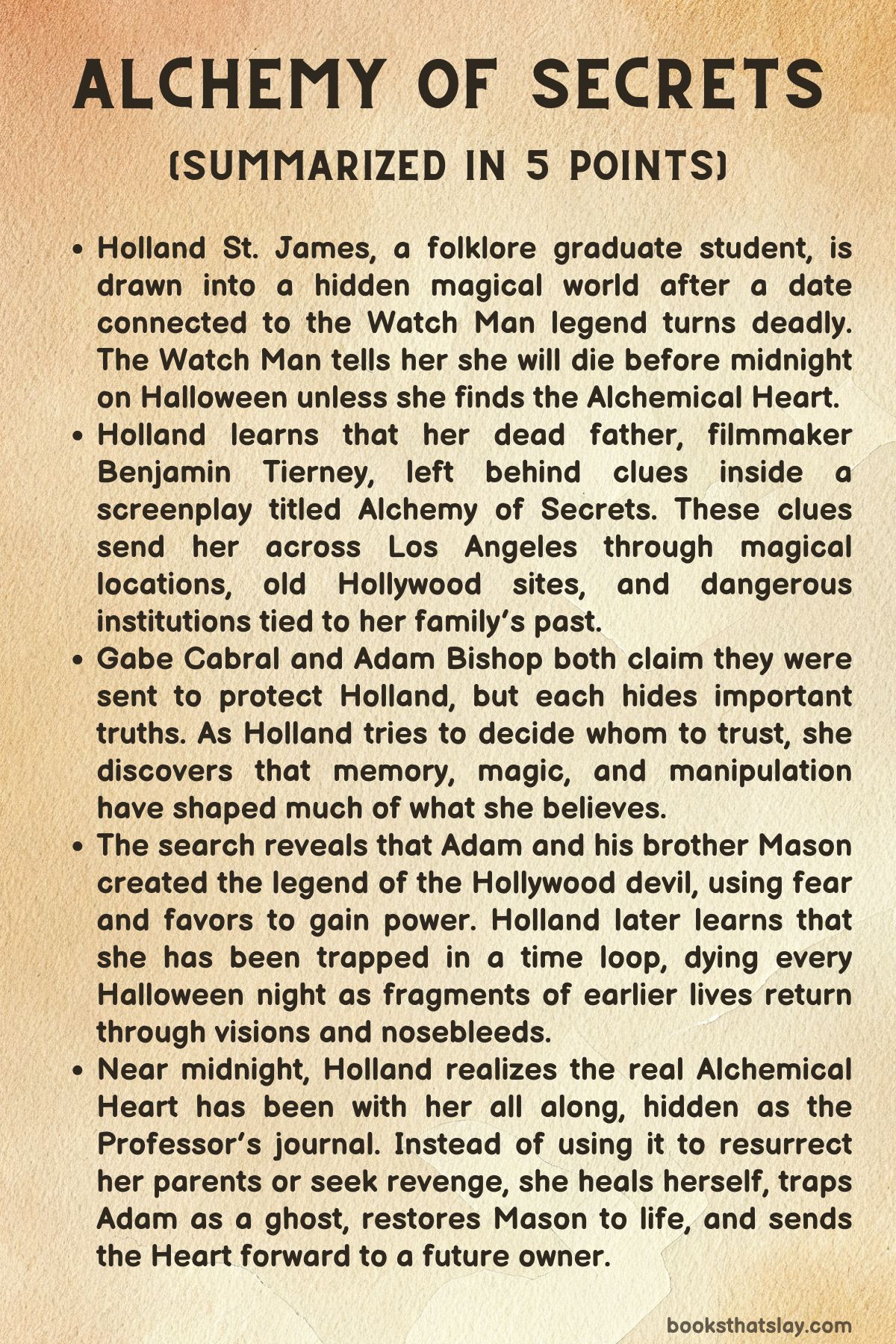
Summary
Holland St. James is a graduate student in folklore with a deep love of old movies and a painful connection to Hollywood history. Fifteen years earlier, her parents died in what the world remembers as a murder-suicide.
Her father, Benjamin Tierney, was a famous filmmaker, and her mother, Isla Saint, was a celebrated actress accused of killing him before taking her own life. Holland has never accepted that version of events.
Her private goal is to prove that her mother was innocent and that something stranger was behind their deaths.
Holland’s interest in urban legends has been encouraged by a secretive class called Folklore 517, taught by a woman known only as the Professor. The class studies rumors that sound impossible: a Watch Man who can tell people the hour of their death, a devil in Los Angeles who grants wishes in exchange for a Sidecar cocktail, a magical Bank that stores dangerous objects, and places where time does not behave normally.
Holland is warned never to discuss the class, but the legends soon stop feeling like stories.
On a date with a man named Jake, Holland sees a shop called Curios & Clockwork and is drawn inside. There, she asks about the Watch Man.
Soon after, Jake claims the Watch Man has predicted he will die that evening unless he kills Holland first. When Holland goes to his apartment, Jake admits he was hired to get close to her and learn secrets about her family.
He attacks her, but she escapes. Jake dies at the exact time the Watch Man predicted.
Inside Jake’s apartment, Holland finds a file on herself. It reveals that Jake’s real name was Axel Jorgenson and that he was paid to study her life.
Then the Watch Man calls Holland and tells her she will die at 11:59 p.m. on Halloween unless she finds the Alchemical Heart.
This begins a race through Los Angeles, with only hours before her predicted death.
Holland is intercepted by Gabe Cabral, a dangerous man who claims her twin sister, January, sent him to protect her. Gabe has the same antiquity eye tattoo as January, suggesting they are connected to the same hidden world.
He tells Holland that the Alchemical Heart is a powerful magical object that can grant abilities and attract both guardians and enemies. Some people want to destroy it, while others want to use it.
Holland connects the Heart to one of the Professor’s lectures about a mysterious book that predicted dates when the object would reappear.
Holland believes the Professor can help, so Gabe takes her to the Professor’s house. The place has been ransacked, and Adam Bishop appears.
Adam is Holland’s new thesis advisor, but he now claims that this role was only a cover and that January sent him too. He also has the antiquity eye tattoo.
Adam warns Holland not to trust Gabe, while Gabe warns her not to trust Adam. The confrontation turns violent.
Shots are fired, Gabe is wounded, and Holland flees with him.
At Holland’s hidden Santa Monica house, she treats Gabe’s gunshot wound and opens a package delivered earlier from the First Bank of Centennial City. Inside is the Professor’s journal.
Its notes suggest that Benjamin Tierney may have hidden the Alchemical Heart in a safety deposit box he leased fifteen years earlier. Holland also finds letters from the Bank in January’s belongings and realizes that her sister has kept major secrets from her.
Gabe explains that the Bank is not an ordinary institution. It stores magical objects, steals abilities, and erases memories.
Holland has an appointment there to claim her father’s box, and Gabe warns her that once she retrieves it, she will become a target. On Halloween morning, he gives her tools to help her survive and teaches her how to sense magic.
Their connection grows, but Holland remains unsure whether Gabe is honest.
At the Bank, Holland learns that the Professor is actually the Bank’s Manager. The Professor admits that Folklore 517 was used to identify potential recruits.
She offers Holland a job and an ability in exchange for whatever is inside Benjamin’s box. She also claims Gabe is a murderer who killed his wife.
Shaken by this, Holland reveals that Gabe is waiting outside. In the vault, Holland opens the deposit box and finds not the Heart itself, but a leather satchel containing pages from a screenplay written by her father.
The title is Alchemy of Secrets.
The screenplay is not just a story. It is a treasure hunt made for Holland, filled with personal clues that only she would understand.
Holland escapes the Bank with help from her friend Eileen, who reveals that she also works for the Bank and has a small magical ability. Eileen’s car leads Holland toward the Regal Hotel, a strange place where time moves differently.
Holland uses a key hidden by January to enter.
At the Regal, Holland finds Adam alive despite having been shot earlier. He protects her from hotel enforcers by adding her to his guest list, though this binds her to him for a full day in Regal time.
Holland learns that Adam has a brother named Mason Bishop, the man she previously saw watching her at the Hollywood Roosevelt. Adam tells Holland that Mason is dangerous, and Holland decides to follow Adam’s lead.
Together, Holland and Adam visit the Watch Man, who reveals that Benjamin Tierney once faced a death prophecy too. To live longer, Benjamin had to find the Alchemical Heart and give it to one of two devils.
He found it but refused to hand it over. The Watch Man tells Holland that the so-called devils were Adam and Mason Bishop, brothers who built a frightening reputation in Hollywood by encouraging people to believe they could grant favors and collect debts.
Adam admits that he and Mason created the devil myth. Mason, however, became a killer after stealing a powerful ability from their father.
Adam claims he stopped Mason and trapped him in the Hollywood Roosevelt as a powerless ghost.
Holland continues following her father’s screenplay clues. They lead her to Jericho Monroe Entertainment, Benjamin’s old studio, where her friend Cat helps them onto the lot.
Holland discovers that Adam’s true ability is not simple charm: he can erase and rewrite memories. This frightens her, especially because she has already experienced missing time, nosebleeds, and visions of Gabe and Adam replacing each other.
Still, she presses on.
At the studio, Holland finds more clues tied to her father’s work, including a prop department request connected to Alchemy of Secrets. She and Adam search for a chained book, believing it may hold the next answer.
Gabe appears and unlocks it first, but the book turns out to be a decoy containing only a pencil. Holland realizes the pencil points to another clue in her father’s screenplay.
That clue leads to a set from an old show, where Holland finds a buried jar holding the final page and a note telling her that she already has everything she needs.
Gabe confronts her and takes the page, but Holland escapes into an old tunnel. When Adam finds her again, she remembers the final clue and heads to the Hollywood Roosevelt, wearing one of her mother’s old costumes to blend into a Halloween party.
There, Chance Garcia shows her photographs suggesting Adam may have been connected to people who died mysteriously over many decades. Holland begins to doubt him.
At the Roosevelt, Holland meets Mason. He reveals the truth: Holland has been living the same Halloween over and over.
Each time she dies just before midnight, the day resets. Her nosebleeds and visions are fragments of earlier loops breaking through.
In some loops she trusted Gabe, and in others she trusted Adam. Mason claims Adam kills her every time.
Near midnight, Holland discovers that her necklace and January’s matching necklace fit together, forming what appears to be the Alchemical Heart. Adam finds her, uses his ability to control her thoughts, kisses her, tears the necklace away, and stabs her.
As she is dying, Holland realizes the necklace is a decoy. The real Alchemical Heart is the Professor’s journal, which has been with her all along.
Holland asks the Heart to heal her. Instead of killing Adam as Mason wants, she uses the Heart to turn Adam into a ghost bound to the Roosevelt, the punishment he once gave Mason.
Mason is restored to life. The Heart then transforms into Manuel Vargas, the man who first brought Holland news of her father’s safety deposit box.
Holland is tempted to ask him to bring back her parents, but she understands that her father wanted her to live, not to undo the past. She asks the Heart to awaken her own hidden ability, then sends it forward in time so it can find a future owner who will use it wisely.
After midnight, Holland meets the Professor, who accepts that the Heart is gone for now and again offers Holland work at the Bank. Holland does not agree, but she does not close the door either.
The next morning, Holland runs on the beach with a new sense of strength. January finally calls.
Mason appears briefly, admitting he owes Holland for restoring his life, then vanishes, leaving behind a black-and-gold business card.
Characters
Holland St. James
Holland St. James is the central character of Alchemy of Secrets, and her journey is shaped by grief, curiosity, distrust, and a strong need to reclaim the truth about her family. She begins as a folklore graduate student who is fascinated by urban legends, old Hollywood, and the stories people dismiss as fantasy.
Her academic interest is personal, however, because the official story of her parents’ deaths has haunted her life. Holland believes her mother, Isla Saint, was falsely blamed, and much of her determination comes from the need to clear her mother’s name.
This makes her brave, but it also makes her vulnerable to manipulation, because anyone who offers answers about her parents can influence her choices.
Holland is intelligent and observant, especially when clues are connected to film, childhood memories, or her father’s creative habits. Her ability to interpret Benjamin Tierney’s screenplay clues shows that she understands him emotionally as well as intellectually.
The treasure hunt works because Benjamin trusted Holland’s memory, imagination, and attention to detail. She is not a traditional action heroine who enters the magical world fully prepared; instead, she survives by reading patterns, questioning stories, and gradually learning whom not to trust.
Her weakness is that she wants certainty in a world built on lies. She repeatedly shifts her trust between Gabe, Adam, the Professor, and Mason because each of them holds part of the truth.
This instability is intensified by the time loop, her memory gaps, and the nosebleeds that reveal how fractured her experience has become. By the end, Holland grows from someone seeking one clean answer into someone who accepts that truth can be painful, layered, and incomplete.
Her final choice not to resurrect her parents shows maturity. She honors her father’s wishes, accepts loss, and chooses her own future rather than trying to undo the past.
Gabe Cabral
Gabe Cabral is introduced as a threatening protector, a character who enters Holland’s life with force, secrecy, and just enough proof to make her follow him. His connection to January gives him credibility, but his behavior keeps him morally uncertain.
He steals Holland’s phone, controls information, refuses to explain everything, and repeatedly warns her not to trust him. This makes him both useful and frightening.
Gabe’s role is to pull Holland into the magical world while also showing her that protection can become another form of control.
Gabe is marked by guilt and danger. He has lived inside the world of abilities, the Bank, and magical politics long enough to understand how ruthless that world can be.
His warnings about the Bank are not abstract; they come from direct knowledge of its cruelty. He knows that abilities can be stolen, memories can be erased, and powerful people often disguise exploitation as order.
His own ability, which allows him to manipulate darkness, open locked places, and move through danger, makes him seem capable of almost anything. Yet his physical wound and his reluctance to reveal his predicted death humanize him.
His treatment of Chance and his harshness toward Holland complicate him. Gabe often acts as if emotional softness is a liability, which makes him cruel even when he is trying to help.
Still, the time loop reveals that Holland has trusted him in previous versions of events, suggesting that his loyalty may be more real than it first appears. Gabe functions as a contrast to Adam: both withhold information, but Gabe’s secrecy often comes from fear and damage, while Adam’s secrecy comes from control.
Gabe remains morally gray, but not empty of care.
Adam Bishop
Adam Bishop first appears as an attractive, authoritative academic figure, but his true nature is far more dangerous. He enters Holland’s life as her new thesis advisor, immediately challenging her work and dismissing the Professor.
This allows him to occupy a position of intellectual power over her before his magical power is revealed. Adam’s charm is one of his strongest weapons, even before the reader learns that his actual ability involves altering memory.
His danger lies in how calmly he can reshape reality for others.
Adam is persuasive because he offers Holland structure during chaos. He explains the devil myth, names Mason as the true monster, and presents himself as the brother who tried to stop evil.
For a time, this makes him seem like the more trustworthy alternative to Gabe. Yet signs of his manipulation appear throughout his interactions.
He smooths over conflict too easily, changes people’s responses, and leaves others confused or bleeding after his ability is used. His power violates identity because it does not merely force obedience; it rewrites what people believe happened.
His final betrayal reveals the full extent of his selfishness. Adam does not love Holland in any honest way.
He wants the Alchemical Heart and uses intimacy, fear, and memory control to get close enough to take it. His villainy is especially disturbing because it is wrapped in gentleness and reason.
He does not appear as a simple monster; he presents himself as wounded, protective, and misunderstood. This makes him a study in manipulation, showing how dangerous a person becomes when charm, power, and entitlement are combined.
In Alchemy of Secrets, Adam represents the threat of someone who controls not only actions but also memory and self-trust.
Mason Bishop
Mason Bishop is first framed as a ghostly villain, the dangerous brother behind Hollywood’s devil legend. For much of the story, he exists in fragments: a man in a white dinner jacket, a shadow at the Roosevelt, a name attached to murder, and a threat described by others.
This delayed introduction makes him mysterious and unstable in the reader’s mind. By the time Holland speaks with him directly, she has already heard several versions of who he is, most of them shaped by Adam.
Mason’s importance lies in the way he changes the story’s moral balance. He is not innocent, and his past remains dark, but he is also not the simple villain Adam describes.
His ghostly imprisonment makes him both dangerous and trapped. He understands the time loop and knows that Holland has died many times, which gives him knowledge no one else can fully provide.
His offer to help her comes with violent conditions: he wants resurrection, revenge, and Adam’s destruction. This makes his honesty useful but not pure.
Mason is compelling because he is both victim and threat. Adam’s punishment turned him into a ghost, but Mason still pushes Holland toward murder.
He exposes Adam’s crimes while revealing his own hunger for restoration. Holland’s refusal to become his weapon is crucial because it prevents Mason from controlling the ending.
When he is restored to life, his debt to Holland remains unresolved. His final gesture, leaving the black-and-gold business card, suggests that his story is not finished and that freedom may not make him harmless.
January St. James
January St. James is Holland’s twin sister and one of the most important absent presences in the novel. Although she appears mostly through phone calls, belongings, hidden notes, and other characters’ claims, her choices drive much of the plot.
January knows far more about the magical world than Holland does, and her silence becomes one of the story’s central betrayals. She has tried to protect Holland, but that protection depends on withholding the truth.
January’s relationship with Holland is emotionally complicated. As twins, they share a deep bond, symbolized by their matching necklaces, but they have also been separated by secrecy.
January’s work with the Bank and her connection to Adam place her in a morally uncertain position. She may have acted out of love, fear, duty, or some combination of all three.
Her backpack, hidden key, and clues suggest that she prepared for Holland to need help, even if she could not explain everything openly.
Her absence creates tension because Holland must interpret January without being able to confront her directly. Every object January leaves behind becomes a message, but none of those messages fully answers Holland’s questions.
January represents the cost of secrecy within families. She loves Holland, but by keeping Holland ignorant, she leaves her unprepared for the danger surrounding them.
The final phone call suggests the sisters still have a future conversation ahead of them, one that may force January to explain not only what she knew, but why she chose silence.
The Professor
The Professor begins as a mysterious mentor who gives Holland access to hidden folklore, but her later identity as the Bank’s Manager changes the meaning of everything she taught. Her classes are not innocent academic gatherings.
They are recruitment tools, designed to identify students who might be useful to the Bank. This makes her a character built around performance.
She appears scholarly, eccentric, and wise, but beneath that persona is a calculating institutional figure.
Her power comes from knowledge and access. She understands the legends, the Bank, the Alchemical Heart, and Holland’s family history.
She knows how to make stories feel irresistible. Her teaching style gives students the sense that they are being trusted with forbidden truth, when in reality they are being studied.
This makes her manipulation quieter than Adam’s but still serious. She does not need to rewrite memory to shape people; she shapes them through curiosity.
The Professor’s offer to Holland is one of the novel’s more interesting temptations. She does not simply threaten Holland; she offers her a place in the magical world, an ability, and a form of purpose.
Her argument is that power can be organized, controlled, and administered. Yet the Bank’s practices reveal the violence beneath that order.
The Professor is not chaotic like Mason or openly predatory like Adam, but she represents institutional danger: polished, patient, and always ready to turn wonder into ownership.
Benjamin Tierney
Benjamin Tierney is dead before the main action begins, but he is one of the story’s guiding forces. He was a visionary filmmaker, a father who understood his daughter, and a man who found the Alchemical Heart but refused to give it to people who would misuse it.
His unfinished screenplay becomes his final message to Holland, transforming his art into a protective map. Through the treasure hunt, Benjamin speaks to Holland across years of silence.
His love for Holland appears in the form of clues tailored to her memories. He trusts her knowledge of film, her childhood experiences, her ability to recognize hidden meanings, and her emotional connection to him.
This makes the treasure hunt more than a puzzle. It becomes a father’s final act of faith.
Benjamin does not leave Holland a direct explanation because direct truth would have been too dangerous. Instead, he hides the truth inside the language they shared: movies, props, posters, and games.
Benjamin’s moral strength lies in refusal. He could have used the Alchemical Heart to save himself, empower the wrong people, or bargain with dangerous figures.
Instead, he protected it and created a path that would allow Holland to choose what to do with it. His death prophecy gives him a tragic dimension, but his legacy is not only tragedy.
He leaves Holland the tools to survive, and more importantly, the confidence that she already has what she needs.
Isla Saint
Isla Saint is central to Holland’s emotional motivation, even though she is seen mostly through memory, reputation, and public accusation. The world remembers Isla as the actress who murdered her husband and then died by suicide, but Holland rejects that story.
Isla represents the damage caused by false narratives, especially when those narratives harden into accepted truth. Her name carries both glamour and disgrace, forcing Holland to live under a history she believes is wrong.
As a famous actress, Isla belongs to the old Hollywood atmosphere that shapes the novel. Her costumes, roles, and image survive after her death, but they do not fully reveal the woman she was.
Holland’s use of her mother’s dress near the end is significant because it allows her to step physically into Isla’s legacy while trying to correct the story attached to her. The dress becomes more than a disguise; it is a way for Holland to carry her mother into the truth-seeking process.
Isla’s character also shows how women can be trapped by stories told after they are gone. Because she cannot defend herself, others define her.
Holland’s determination to clear her name is an act of love and resistance. Even though Isla remains distant in the plot, her presence gives emotional weight to Holland’s search.
The question is not only what happened to Benjamin, but who had the power to decide what the world believed about Isla.
The Watch Man
The Watch Man is one of the most unsettling figures because his power is tied to certainty. He tells people when they will die, and his predictions are treated as unavoidable.
This makes him frightening even when he is not directly violent. His presence forces characters to confront fate in a precise, almost mechanical form.
Jake’s death proves that the Watch Man’s predictions are not easy to escape, and Holland’s deadline gives the story its urgency.
Yet the Watch Man is not simply a messenger of doom. He knows about Benjamin Tierney, the Alchemical Heart, Adam, Mason, and the larger pattern surrounding Holland’s repeated deaths.
His role is partly prophetic and partly archival. He preserves information others have hidden, including the envelope from Benjamin.
His drugging of Adam and selective communication with Holland show that he has his own methods and loyalties, though they remain difficult to define.
The Watch Man represents the burden of foreknowledge. Knowing the time of death does not necessarily grant freedom; it can create panic, desperation, and bad choices.
Jake becomes dangerous because he believes killing Holland might save him. Holland, by contrast, uses the prediction as motivation to seek truth.
Through him, the story asks whether fate is fixed or whether knowledge of fate can create the conditions for change.
Eileen Cheng
Eileen Cheng appears at first as one of Holland’s ordinary friends, but her connection to the Bank reveals how deeply the magical world has already entered Holland’s life. Eileen’s role is smaller than Gabe’s or Adam’s, but it is important because she complicates Holland’s sense of who around her can be trusted.
She is bound by secrecy through her work and cannot freely disclose her employer’s identity, which reflects the broader culture of silence surrounding magical institutions.
Her ability to find parking spaces easily is almost comic compared with the more dangerous powers in the novel, but it is meaningful because it shows that not all abilities are grand or violent. Some are practical, small, and tied to everyday life.
This gives the magical system a wider range and suggests that the Bank’s influence extends into ordinary routines. Eileen’s power also makes her useful at a critical moment, helping Holland escape and reach the next stage of her search.
Eileen is not portrayed as a villain, but her loyalty to the Bank makes her morally uncertain. She helps Holland, yet she is also part of the institution trying to control magical objects and recruit people.
Her character shows how ordinary people can become attached to powerful systems because those systems give them purpose, employment, or advantage. She is a reminder that complicity does not always look cruel; sometimes it looks friendly, helpful, and familiar.
Chance Garcia
Chance Garcia is Holland’s friend and a former child actor whose past connects him to Hollywood’s strange undercurrents. At first, he seems like a supportive figure on the edge of Holland’s life, but his concern for her becomes increasingly important.
Unlike Gabe and Adam, Chance does not have obvious magical authority over Holland. His value comes from emotional loyalty, industry knowledge, and his willingness to help when she asks.
Chance is also vulnerable because he has been shaped by fame. His history as a child actor makes him part of the same Hollywood machine that Benjamin and Isla once inhabited.
Gabe’s cruel reference to conspiracy theories about Chance’s old show wounds him because it touches on the strange and exploitative nature of his past. Chance’s character suggests that Hollywood damages people not only through murder and magic, but through rumor, image, and loss of control over one’s own story.
His warning to Holland through the photographs of Adam is one of his most important contributions. He gives her evidence when she is beginning to doubt herself, helping her question Adam’s version of events.
Chance may not understand the full magical conflict, but he understands that something is wrong. His loyalty is quieter than Gabe’s and less dramatic than Adam’s false protection, but it is more honest.
He represents friendship that is imperfect, human, and grounded in care.
Cat
Cat serves as part of Holland’s circle of friends and becomes useful when the search leads to Jericho Monroe Entertainment. She works within the film industry and helps Holland access spaces that would otherwise be difficult to enter.
Her role highlights the way Holland’s ordinary life and the hidden magical mystery overlap. The studio is not just a workplace or a piece of Hollywood history; it becomes a site where family secrets, film props, and magical clues meet.
Cat’s most revealing moment comes when Adam uses his ability on her. She becomes dazed and redirected, showing the reader the disturbing nature of his power in a personal way.
Until then, Adam’s influence can be mistaken for charisma. Through Cat, the violation becomes clearer.
Her thoughts and choices are altered for convenience, and she is sent away without truly consenting.
Although Cat is not as central as January or Eileen, her presence helps establish what Holland stands to lose. Holland is not only navigating supernatural danger; she is trying to protect relationships with people who are not fully equipped to understand what is happening.
Cat’s confusion under Adam’s influence also reinforces Holland’s fear that memory itself cannot be trusted. In a story where identity depends heavily on remembered truth, Cat becomes one of the examples of how easily that truth can be stolen.
Jake / Axel Jorgenson
Jake, whose real name is Axel Jorgenson, is important because he is the first personal betrayal Holland experiences in the main plot. He appears to be an ordinary date, someone Holland chooses to trust when she breaks the Professor’s rule and speaks about the Watch Man.
His later confession reveals that the relationship was staged. He was hired as an actor to date Holland and extract information about her family.
Axel’s role exposes the cruelty of the forces surrounding Holland. She is not merely being watched from a distance; her emotions are being used as entry points.
His fake intimacy shows how performance and deception operate throughout the novel. As an actor, he plays the role of romantic interest, but that performance becomes deadly when the Watch Man’s prediction makes him believe he must kill Holland to survive.
He is not a major villain, but he is a tragic and frightening catalyst. His fear makes him dangerous, and his death proves that the Watch Man’s predictions carry real weight.
Axel’s file also gives Holland her first concrete evidence that someone has been studying her life in detail. Through him, the story moves from academic curiosity into direct threat.
His short presence leaves a lasting impact because he teaches Holland that even personal connection can be manufactured.
Manuel Vargas / The Alchemical Heart
Manuel Vargas first appears as a messenger from the First Bank of Centennial City, but his later transformation reveals him as the living form of the Alchemical Heart. This makes him one of the most unusual characters in the story.
He is both person and object, guide and power source, temptation and test. His early delivery of the safety deposit box warning sets the plot in motion, while his final appearance clarifies that the Heart has been near Holland’s story from the beginning.
As the Alchemical Heart, Manuel represents power that responds to choice. Many characters want the Heart for control, revenge, survival, or institutional gain.
Holland’s decision matters because she refuses the most obvious temptations. She does not bring back her parents, kill Adam in the ordinary sense, or hand the Heart to the Bank.
Instead, she asks for her own ability to awaken and then sends the Heart forward in time.
Manuel’s character gives the magical object a moral presence. The Heart is not a passive prize to be seized; it tests the desires of those who find it.
Its human form makes the ending more intimate because Holland must speak her wish directly. Manuel helps reveal Holland’s growth: she is no longer a child trying to recover the past at any cost, but a person capable of making a restrained, difficult choice.
Themes
Stories as Power
Stories in Alchemy of Secrets are not harmless entertainment. They create reputations, hide crimes, recruit believers, and shape what people think is possible.
The devil legend becomes powerful because Adam and Mason understand that belief can be used as a tool. By encouraging Hollywood to fear and desire the myth of a devil who grants favors, they build influence without needing to explain the mechanics of their power.
The Professor uses stories in a different but equally strategic way. Her folklore class makes students feel chosen, as if they have been invited into forbidden knowledge, but it is also a method of observation and recruitment.
Benjamin Tierney uses storytelling more lovingly. His screenplay becomes a map for Holland, filled with clues only she can read because they are rooted in shared memories.
The novel shows that stories can imprison people when they are false, as with Isla Saint’s public image, but they can also preserve truth when direct speech is too dangerous. Holland’s growth depends on learning not to accept the loudest version of any story.
She must ask who created it, who benefits from it, and what it leaves out. In this world, storytelling is a form of magic even before actual magic appears.
Memory, Identity, and Control
Memory is treated as one of the most fragile and valuable parts of identity. Adam’s ability to erase and rewrite memories is terrifying because it attacks a person’s trust in the self.
When he changes Cat’s thoughts, the violation is quiet but severe; she is not physically harmed in an obvious way, yet her inner life is altered for someone else’s convenience. Holland’s own memory gaps make this theme even more personal.
Her nosebleeds, visions, and sudden changes in awareness reveal that she has lived through repeated versions of the same day, but those lives have been hidden from her conscious mind. She is not only trying to solve an external mystery; she is trying to recover the truth of her own experience.
The Bank’s practice of stealing abilities and wiping memories turns this personal fear into an institutional one. Memory is not safe from people with enough power.
This gives Holland’s search emotional urgency because every clue she solves helps restore some part of reality that others have distorted. The theme also raises a moral contrast between influence and respect.
Adam controls by changing what people remember, while Benjamin trusts Holland to remember. That trust becomes one of the forces that saves her.
Fate, Choice, and Repetition
The Watch Man’s predictions create a world where death seems fixed, precise, and unavoidable. Jake’s attempt to escape his predicted death only drives him toward violence and still fails to save him.
Holland’s deadline appears equally absolute: she will die before midnight unless she finds the Alchemical Heart. The later reveal of the time loop complicates this idea.
Holland has died many times, and each reset suggests a cruel pattern that keeps returning her to the same danger. Yet repetition does not mean nothing changes.
Her flashes of memory, physical reactions, and growing distrust of easy answers show that something from each failed loop remains. Fate in the novel is not a locked door so much as a trap with weak points.
Holland cannot escape by panic, obedience, or trusting the wrong protector. She escapes by understanding the pattern, recognizing Adam’s role in her deaths, and making a choice that breaks the expected ending.
Her final decision also matters because she refuses to let Mason dictate revenge. The story’s treatment of fate is therefore not passive.
Prophecy and repetition shape the conditions of Holland’s life, but her moral decisions determine what those conditions become.
Family, Legacy, and the Burden of Secrets
Family in the novel is built from love, silence, inheritance, and unfinished grief. Holland’s search begins because she cannot accept the story attached to her parents’ deaths.
Her devotion to Isla Saint is not abstract; it is a daughter’s refusal to let the world define her mother as a murderer without proof. Benjamin Tierney’s legacy is equally powerful.
He leaves Holland a path through his screenplay, trusting her intelligence and their shared memories. This turns inheritance into something more meaningful than property or fame.
He gives her a way to find the truth, but he also gives her the chance to choose what kind of person she wants to become. January’s secrecy adds a more painful side to family loyalty.
She tries to protect Holland by hiding the magical world from her, but this protection leaves Holland isolated and unprepared. The matching necklaces symbolize connection, yet they also conceal a false clue, showing how family objects can carry both love and misdirection.
The Bishop brothers offer a darker version of family legacy, shaped by rivalry, stolen power, and punishment. Through these contrasts, the novel suggests that inheritance is never simple.
What people receive from family can guide, burden, endanger, or save them, depending on how truthfully it is handled.