All About Love Summary and Key Lessons | Bell Hooks
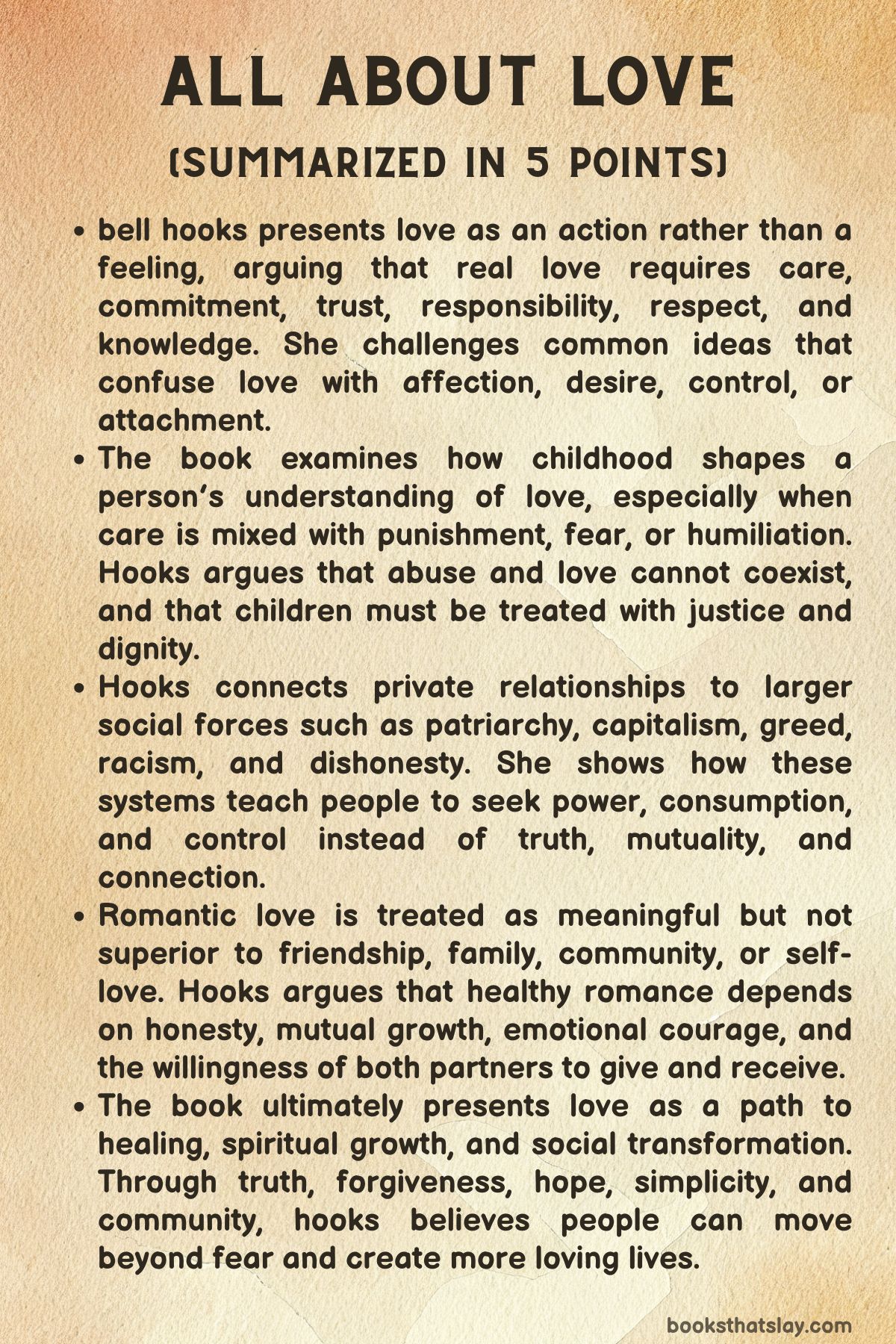
All about Love by bell hooks (real name – Gloria Jean Watkins) is a reflective nonfiction work about love as an action, a practice, and a social force. Rather than treating love as a private emotion or romantic ideal, hooks presents it as a way of living built on care, trust, truth, respect, responsibility, commitment, and knowledge.
Drawing from her childhood, relationships, spiritual beliefs, feminist thought, and cultural criticism, she argues that many people are taught false ideas about love through abuse, patriarchy, greed, and fear. The book asks readers to rethink love not as fantasy, but as a discipline that can heal individuals and reshape society.
Summary
All about Love begins with bell hooks looking back at her earliest experiences of love and lovelessness. As a child, she briefly knew what it meant to feel wanted, cherished, and protected.
That sense of safety did not last, and its absence shaped much of her emotional life. The loss of love left her with deep pain and a lasting hunger to understand what love truly is.
From the start, hooks makes clear that the book is not only personal reflection but also a call for cultural change. She believes that modern society suffers from a lack of love and from a refusal to speak honestly about what love requires.
A central concern of the book is the confusion surrounding the word love. Hooks argues that people often speak of love without sharing a clear meaning of it.
This confusion allows harmful behavior to be excused as love, especially within families and romantic relationships. She rejects the idea that love can exist alongside abuse, domination, humiliation, or cruelty.
For hooks, love is not merely a feeling. It is a choice and a practice.
It must include care, commitment, trust, knowledge, responsibility, and respect. Without these elements, what people call love may actually be attachment, need, habit, control, or dependency.
Hooks pays close attention to childhood because she sees the family as the first place where people learn what love is supposed to mean. Many children are taught that punishment, shaming, and violence can be expressions of love.
Hooks recalls being physically punished and told that such treatment was for her own good. This kind of experience teaches children to confuse fear with care.
She argues that children have rights and must be treated with justice. Parents who truly love children do not treat them as property.
They guide them with patience, honesty, discipline, and respect. The lessons learned in childhood often follow people into adulthood, shaping their expectations in friendships, families, and romantic partnerships.
Honesty is another major foundation of love in the book. Hooks believes that truth telling is necessary for justice and intimacy.
Many people learn to lie as children to avoid punishment, disappointment, or conflict. As adults, they may continue lying to protect power or avoid responsibility.
Hooks is especially critical of patriarchal culture, which often teaches men that deception is acceptable if it helps them maintain control. She argues that secrecy damages trust, while privacy is different and healthy.
Without honesty, real intimacy cannot grow. To love another person, one must be willing to see oneself clearly and allow others to know the truth.
From honesty, hooks moves into commitment and self-love. She challenges the familiar idea that one must love oneself before loving others by giving it practical meaning.
Self-love is not selfishness or vanity. It is the daily work of self-acceptance, accountability, healing, and growth.
Many people are taught by family, society, racism, sexism, poverty, or abuse that they are unworthy of love. Hooks argues that these messages must be confronted.
Practices such as self-reflection, affirmations, purposeful living, and emotional responsibility can help people rebuild their relationship with themselves. For hooks, self-love is not separate from loving others; it is the ground from which loving action becomes possible.
Spirituality also has an important place in hooks’s vision. She distinguishes spirituality from organized religion, though she draws from religious traditions, Christian faith, Buddhist practice, and spiritual teachers.
Spiritual life, for her, means recognizing connection among living beings and honoring the presence of the sacred in life. Love is tied to this spiritual awareness because it moves people beyond selfishness and toward care for others.
Hooks believes that spiritual practice gives people strength to love, especially when love requires courage, forgiveness, or sacrifice.
The book then expands from personal relationships to social values. Hooks proposes a love ethic: a way of living in which love guides decisions in politics, work, family, community, and public life.
A love ethic affirms that everyone has the right to freedom, dignity, and a full life. It asks people not only to speak against injustice but to act against the systems that create it.
This includes challenging patriarchy, racism, greed, and domination. Hooks argues that no society can be loving while it accepts oppression.
Love must become a public value, not just a private desire.
Greed is one of the major barriers to love in hooks’s analysis. She describes a culture driven by consumption, material success, and individualism.
In such a culture, people become isolated, lonely, and disconnected. They may treat relationships like possessions, using others for personal satisfaction and discarding them when needs change.
Hooks connects this mindset to capitalism, mass media, addiction, and the loss of shared moral vision. Her response is simple living.
By reducing attachment to material excess, people can make more room for connection, generosity, and care.
Community offers another path toward love. Hooks argues that people learn loving practice not only in romance or the nuclear family but also among friends, extended kin, neighbors, and chosen communities.
She criticizes the way capitalism and patriarchy weaken wider networks of care by isolating people into small family units. Community requires honest communication, mutual support, service, forgiveness, and shared responsibility.
Hooks also stresses the value of solitude. Being alone in a healthy way helps people avoid clinging to others out of fear.
Solitude allows people to return to community with greater respect and freedom.
Romantic love receives careful attention, but hooks refuses to treat it as the highest or only form of love. She explains that many people seek in romance the love they lacked in childhood.
This can create painful patterns, as partners expect each other to heal old wounds without having the tools to do so. Hooks reflects on her own relationships with emotionally unavailable men and shows how patriarchal gender roles damaged the possibility of mutual love.
She argues that true romantic love must be based on mutuality. Both partners must give and receive.
Both must support each other’s growth. Love cannot flourish where one person dominates and the other serves.
Hooks also separates sexual attraction from love. Desire may be powerful, but it does not prove the presence of care, respect, trust, or commitment.
True love, in her view, is a soul connection that helps both people become more fully themselves. It requires courage because being loved means being known.
It also requires work, openness, and the willingness to change. Love may not always last forever in the same form, but when it is real, it transforms those who experience it.
In the later sections, hooks considers loss, death, healing, and destiny. She argues that fear of death often prevents people from living fully.
A culture obsessed with death, violence, and safety can become hostile to love. Loving practice teaches people to accept change, grief, and mortality.
Love does not remove pain, but it gives people a way to face sorrow without being destroyed by it.
Healing is possible through love, forgiveness, compassion, and hope. Hooks sees cynicism as one of the greatest enemies of love because it grows from fear and despair.
To heal, people must release shame, make peace with the past, and remain open to possibility. The book ends with a spiritual vision of love as humanity’s true destiny.
Through the image of angels and divine guidance, hooks suggests that wounds can become openings to growth. Love is not only something people seek; it is the path that leads them back to wholeness, connection, and grace.
Key Figures
bell hooks
bell hooks is the central voice and reflective consciousness of All about Love. Since the book is nonfiction, she is not a character in the fictional sense, but she functions as the primary figure through whom the reader understands love, lovelessness, healing, fear, spirituality, and social change.
She presents herself with unusual honesty, describing both her longing for love and her difficulty receiving it after early emotional wounds. Her childhood taught her that affection could exist beside punishment and humiliation, and this confusion shaped her adult relationships.
Much of her development in the book comes from learning to reject false definitions of love and accept that love cannot coexist with abuse, deception, domination, or neglect.
Hooks is also shown as a thinker who refuses to separate private life from public culture. Her personal heartbreak becomes the starting point for a wider critique of family structures, patriarchy, capitalism, religion, media, and social values.
She is vulnerable, but never passive. She studies love, questions inherited beliefs, examines her own failures, and insists that love must be practiced with intention.
Her role is both personal and instructional: she is a wounded person seeking healing and a teacher asking readers to rethink love as action. By the end, hooks emerges as someone who has not escaped pain, but has learned to treat pain as a doorway to growth, courage, and grace.
hooks’s Father
hooks’s father represents one of the earliest and most damaging models of loveless authority in her life. He is associated with fear, punishment, control, and emotional distance.
Through him, hooks learns how easily adults can misuse power while claiming that their actions are loving. His physical discipline and harshness teach her that the language of love can be distorted to justify harm.
This becomes one of the book’s most important emotional lessons: when abuse is presented as love, a child may grow up confused about intimacy, safety, and worth.
He also represents the larger force of patriarchy. His authority in the household reflects a cultural system that gives men power and often excuses their violence, secrecy, and emotional withholding.
Hooks does not present him only as a private family figure; he becomes part of a larger pattern in which men are trained to deny vulnerability and maintain control. His presence echoes later in hooks’s romantic life, as she finds herself drawn to emotionally unavailable men who resemble him.
In this way, her father’s influence extends beyond childhood. He becomes a symbol of how early wounds can shape adult desire until they are consciously examined.
hooks’s Mother
hooks’s mother is a more complicated figure because she is connected to both care and limitation. Hooks remembers her mother as someone capable of service, generosity, and giving.
Her mother’s willingness to help others leaves a strong impression on hooks and teaches her the value of freely offered care. In this sense, the mother becomes one of the first examples of communal love in hooks’s life.
She shows that giving can be meaningful when it is rooted in concern for others rather than control or obligation.
At the same time, hooks’s mother exists within a family structure shaped by patriarchy and dysfunction. She does not fully protect hooks from the emotional and physical harm present in the household.
Her love is therefore mixed with the painful realities of silence, endurance, and social conditioning. Hooks does not treat her mother as a villain, but she does show how care alone is not enough to constitute love.
Love must include responsibility, respect, justice, and protection. The mother’s role helps hooks distinguish between affection and genuine loving practice.
She may have given care, but the family environment did not consistently provide the safety and justice hooks needed.
hooks’s Parents
Taken together, hooks’s parents represent the contradiction between care and lovelessness. They provide food, shelter, attention, and moments of affection, yet they also create an atmosphere where fear, punishment, shaming, and emotional pain exist.
This contradiction becomes central to hooks’s argument that care is only one part of love. A household may contain affection and still fail to be loving if it lacks respect, trust, responsibility, and justice.
Their influence also shows how children inherit definitions of love before they are old enough to question them. Hooks’s parents teach her, indirectly and painfully, that love is often confused with obedience, discipline, and authority.
As an adult, she must unlearn these lessons. Their role in All about Love is therefore foundational: they are not analyzed simply as individuals, but as the first environment in which hooks learns both the possibility and the failure of love.
Through them, she develops one of the book’s clearest claims: adults must treat children as full human beings with rights, dignity, and emotional needs.
Former Romantic Partner of Fifteen Years
Hooks’s former partner of fifteen years is one of the most important figures in her adult emotional life. His absence at the beginning of the book creates the grief that pushes hooks to think more deeply about love.
The end of the relationship leaves her afraid that love may not exist or may never be found again. Yet this pain also becomes a turning point.
Through loss, she begins to search more seriously for definitions, practices, and examples of love that are not based on fantasy.
This partner represents the difficulty of sustaining love without mutual emotional work. Hooks describes a long relationship in which she had hoped to receive the love she had missed in childhood.
Instead, she found herself with someone emotionally withholding, a man whose patterns resembled those of her father. The relationship reveals how people often seek healing from partners who are unable or unwilling to give what is needed.
It also shows how patriarchy damages intimacy by encouraging men to expect care without equal vulnerability or responsibility. This partner matters less as a fully developed individual than as a mirror of hooks’s own wounds, hopes, and eventual awakening.
The Younger Partner
The younger partner represents another attempt at romantic connection and another confrontation with the limits imposed by patriarchy. At first, hooks is drawn to him because he seems different from traditionally dominant men.
He appears less attached to conventional masculinity, and this gives her hope that a freer, more mutual relationship might be possible. Over time, however, he begins to adopt the same patriarchal attitudes that damage so many relationships between men and women.
His significance lies in the way he reveals that rejecting dominance on the surface is not enough. A man may seem gentle or unconventional, but if he has not developed emotional maturity, accountability, and a commitment to mutual growth, he may still reproduce harmful patterns.
Like hooks’s earlier partner, he wants care without fully understanding the reciprocal nature of love. Through him, hooks shows that romantic love requires more than attraction, need, or shared ideals.
It demands practice, self-knowledge, and a willingness to give as well as receive.
Men in Patriarchal Culture
Men in the book function as both individuals and representatives of a wider social training. Hooks argues that patriarchal culture teaches men to seek control, hide vulnerability, lie to maintain power, and deny their longing for love.
This does not mean she presents men as incapable of love. Rather, she suggests that many men are wounded by the very system that gives them social power.
They are taught to associate honesty, softness, and emotional openness with weakness. As a result, they may become estranged from their own feelings and unable to form genuine intimacy.
Hooks’s analysis of men is critical but also hopeful. She believes men can love, but only if they surrender domination and accept mutuality.
The men in her life often fail to do this, but their failure is used to expose a cultural problem rather than merely a personal one. Men become examples of how power can replace love when people are trained to value control over connection.
Their transformation would require truth telling, emotional responsibility, and the rejection of sexist thinking.
Women in Patriarchal Culture
Women in hooks’s analysis are often positioned as the expected caretakers of emotional life. They are taught to give, nurture, forgive, and sustain relationships, even when their own needs are ignored.
Hooks challenges this role because it distorts love into self-sacrifice without mutual care. When women are expected to serve men emotionally while men remain withholding, love becomes unequal.
The result is frustration, resentment, and spiritual exhaustion.
At the same time, hooks does not present women as automatically more loving or more truthful. Women, too, can be shaped by fear, fantasy, secrecy, and domination.
They may accept harmful relationships because they have been taught that romance will save them or that suffering proves devotion. Hooks’s own life becomes an example of this struggle.
Her feminist awareness helps her reject traditional gender roles, but it does not immediately free her from the desire to be loved by unavailable men. Women in the book therefore represent both the burden of gendered expectations and the possibility of liberation through self-love, truth, and mutuality.
Children
Children are among the most morally significant figures in the book. Hooks sees childhood as the first school of love, where people learn whether they are worthy of respect, protection, and care.
Children are vulnerable because adults have power over them, and that power is often misused. When children are beaten, shamed, neglected, or controlled in the name of love, they may carry distorted ideas of love into adulthood.
Hooks insists that this is not merely a private family problem but a justice issue.
Children also represent possibility. If they are raised with respect, loving discipline, honest communication, and emotional safety, they can learn to love themselves and others with greater clarity.
Hooks argues that children should not be treated as property. They are full human beings with rights.
Her concern for children deepens the ethical force of the book because it shows that a loving society must begin with how it treats its youngest and least powerful members.
Friends
Friends are important because they offer a form of love that is often undervalued. Hooks argues that many people place romance above friendship, treating romantic partnership as the ultimate source of meaning.
Her own life shows the danger of this hierarchy. When she gave more importance to a romantic bond than to friendship, she found it harder to leave or recover from a damaging relationship.
Friendship, by contrast, can model respect, honesty, care, and responsibility without the cultural pressures attached to romance.
Friends also help create community. They allow people to practice love beyond family and sexuality.
In hooks’s view, friendship can teach people how to communicate truthfully, support one another’s growth, forgive, and remain connected without possession. Friendship becomes a corrective to the fantasy that one romantic partner should meet every emotional need.
It spreads love across a wider network and helps individuals avoid isolation.
Community
Community is treated almost like a living character in the book because it shapes, teaches, and sustains love. Hooks believes people cannot learn the art of loving in isolation.
Community provides the space where people practice communication, service, forgiveness, generosity, and mutual care. It can be found in extended family, friendship, spiritual groups, neighborhoods, and chosen bonds.
Community also stands against the loneliness produced by capitalism and patriarchy. A society that isolates people into small private units makes them easier to control and more likely to seek comfort through consumption or unhealthy relationships.
Loving community offers another way to live. It reminds people that care does not have to come from one source and that belonging can be built wherever people commit to honest connection.
For hooks, community is not sentimental. It requires work, accountability, and the willingness to remain open to others.
Spiritual Figures and Angels
Spiritual figures and angels represent guidance, mystery, protection, and the movement toward love. Hooks writes of angels as beings or presences that offer comfort and direction.
They are not merely religious symbols; they stand for the unseen forces that help people move through fear, struggle, and woundedness. Her discussion of angels allows the book to end with a sense of spiritual possibility rather than simple argument.
The story of Jacob wrestling with the angel is especially meaningful because it connects struggle with blessing. The wound Jacob receives is not treated as shameful but as part of transformation.
For hooks, this reflects a larger truth about love and healing. People do not become whole by denying pain.
They grow by facing it, learning from it, and allowing it to open them to grace. Angels therefore embody the book’s final movement toward hope: love is not only a human practice but also a sacred destiny.
Themes
Love as Action Rather Than Feeling
Hooks rejects the popular idea that love is mainly an emotion, mood, or romantic sensation. She presents love as a disciplined practice made visible through behavior.
This matters because feelings alone can be unstable, unclear, and easily confused with attachment, desire, dependency, or fear of being alone. By defining love through action, hooks gives it ethical weight.
Love must include care, trust, commitment, knowledge, responsibility, and respect. Without these qualities, affection cannot be called love in any complete sense.
This theme changes how readers understand family, romance, friendship, parenting, and society. A parent may feel affection for a child, but if that parent humiliates or abuses the child, hooks would not call that love.
A romantic partner may feel desire, but if they lie, dominate, or refuse accountability, the relationship lacks the practice of love. This definition also gives people hope because it means love can be learned.
Love is not reserved for the lucky or the naturally gifted. It is a daily practice that requires honesty, courage, and intention.
In All about Love, this view makes love both deeply personal and socially transformative.
The Damage Caused by Patriarchy
Patriarchy appears throughout hooks’s analysis as one of the strongest barriers to love. It damages men by teaching them that control matters more than vulnerability, that emotional honesty is weakness, and that domination proves masculinity.
It damages women by pressuring them to provide care, patience, and emotional labor without receiving equal respect in return. Under such conditions, relationships become power struggles rather than places of mutual growth.
Hooks shows that patriarchy affects private life as much as public life. It shapes parenting, romance, marriage, media, religion, and ideas about truth.
Men may lie to preserve control. Women may remain in painful relationships because they have been taught to value romantic commitment over self-respect.
Children may suffer when family structures place adult authority above justice and emotional safety. The result is a culture where many people want love but are trained in habits that make love difficult.
Hooks does not argue that men and women are doomed to repeat these patterns. She insists that people can choose mutuality instead.
To love well, they must surrender sexist thinking and build relationships where both people are free, responsible, and fully human.
Healing Through Truth, Forgiveness, and Self-Love
Healing begins when people are willing to tell the truth about their wounds. Hooks does not present healing as forgetting the past or pretending pain did not happen.
Instead, she argues that people must face the ways they were harmed and the ways they may have harmed others. Truth telling allows a person to stop confusing abuse with love, secrecy with protection, or fear with loyalty.
It creates the clarity needed for growth.
Self-love is central to this healing. For hooks, self-love is not narcissism.
It is the practice of accepting oneself, taking responsibility for one’s life, and refusing to believe messages of unworthiness. People who have been shamed, neglected, or abused may need to rebuild their inner lives through reflection, affirmation, and purposeful action.
Forgiveness also plays a major role, not because it excuses harm, but because it frees people from being trapped by resentment and shame. Compassion reconnects people to themselves and to others.
Hope is equally important because cynicism closes the heart before love can enter. Healing, then, is a loving practice that turns pain into wisdom rather than allowing it to become fear.
Love as a Social and Spiritual Ethic
Hooks refuses to limit love to romance or private emotion. She argues that love should guide how people build families, communities, workplaces, politics, and social movements.
A love ethic means valuing freedom, justice, dignity, and collective well-being. It asks people to act against racism, sexism, greed, violence, and domination because these forces make love impossible.
Love becomes a public responsibility rather than a private luxury.
This theme also has a spiritual dimension. Hooks connects love to divine presence, interconnection, and the sacred value of life.
Spirituality, for her, is not limited to one religion. It is a way of recognizing that human beings are connected and that love is the path toward wholeness.
This spiritual view strengthens the social argument because it gives love a purpose larger than personal satisfaction. To live by a love ethic is to choose simplicity over greed, community over isolation, truth over denial, and courage over fear.
Such a life is demanding because it requires daily commitment, but hooks presents it as the only path toward genuine freedom and lasting transformation.