A Fire in the Flesh Summary, Characters and Themes
A Fire in the Flesh is a fantasy romance novel by Jennifer L. Armentrout that blends divine politics, prophecy, captivity, and love under extreme pressure. It follows Seraphena “Sera” Mierel after she is taken into the court of Kolis, a dangerous Primal whose obsession with a lost woman threatens both the mortal and godly realms. At the center of the story is Sera’s bond with Nyktos, the ruler she loves, and the terrifying power growing inside her. The book builds on questions of identity, sacrifice, fate, and choice, while pushing its characters toward a breaking point that changes the balance of the world.
Summary
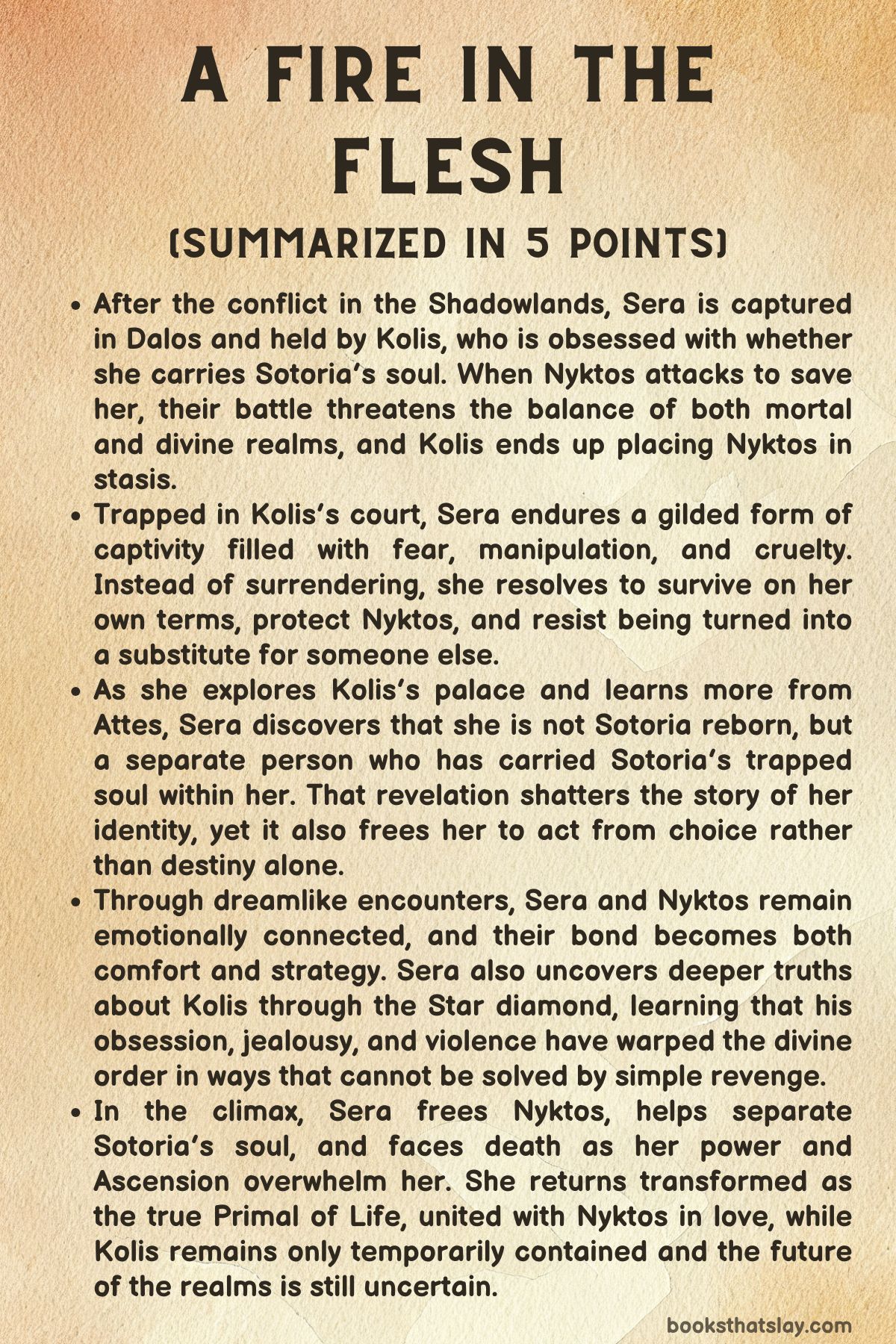
After the brutal conflict in the Shadowlands, Sera is left wounded and barely conscious in Dalos, the City of the Gods. Even in pain, her thoughts stay fixed on Nyktos. She is in Kolis’s control, and he is less interested in Sera as herself than in whether the soul of Sotoria, the woman he once loved, still exists through her. The situation becomes more dangerous when Nyktos arrives in his full Primal power and attacks Kolis. Their fight is catastrophic, and Sera realizes that if either of them kills the other, the damage could spread far beyond personal revenge and destabilize both mortal and divine existence. Desperate to stop them, she uses the embers of life within her, but the effort nearly kills her. Kolis takes advantage of the moment and strikes Nyktos down, placing him in stasis and claiming Sera for himself.
Sera is then pulled deeper into Kolis’s world. He forces healing upon her through the sacrifice of magical sea beings, which leaves her horrified and guilty. Her first instinct is to fight back. She tries to kill Kolis and quickly learns how little ordinary weapons matter against him. He responds with threats, control, and a constant insistence that she belongs to him. Held inside a luxurious but terrifying cage, Sera faces not only physical imprisonment but the psychological strain of Kolis’s obsession. Rather than submitting to the role others once prepared her for, she begins choosing her own reasons to survive. She wants to protect herself, save Nyktos, and resist Kolis because she loves Nyktos and refuses to be used.
She searches for ways to escape and starts testing the limits of her prison. In the palace, she finds scenes that reveal how corrupted Kolis’s court has become: frightened servants, predatory gods, and a system built on fear and appetite. Her escape attempt fails, but it gives her a clearer view of the threat around her. Kolis’s court is not simply cruel; it is distorted by his instability and by the imbalance he has helped create. Back in captivity, Sera begins to understand that the safest path may be to use Kolis’s fixation on Sotoria against him.
Help comes from Attes, though his role is complicated. He reveals truths that shake Sera’s understanding of her purpose. She is not Sotoria reborn. Instead, Sotoria’s soul has been trapped within her because of old interference with fate. That means Sera has been shaped by forces far older than her own choices, but it also means she is not just a replacement for someone else. This revelation hurts her, because it tears away one of the foundations on which her life has been built. At the same time, it gives her a painful kind of freedom. She can stop Kolis not because she was designed to fulfill someone else’s destiny, but because she chooses to act.
Her connection with Nyktos becomes one of the only things keeping her steady. Through vivid dream encounters that prove to be more than dreams, the two find each other across distance and imprisonment. Their bond offers comfort, desire, and emotional refuge, but it also becomes a source of strategy. Nyktos warns her that only he can complete her Ascension, a fact that may become critical later. Meanwhile, Kolis keeps pressing her for emotional and physical closeness, convinced that if she is truly Sotoria, she will eventually return his feelings. Sera has to lie, manipulate, and endure his presence while protecting the truth of her love for Nyktos.
As Sera spends more time in Kolis’s court, she witnesses his violence more directly. He uses death, humiliation, coercion, and spectacle to control gods and servants alike. He punishes others through her actions and tries to make her complicit in his cruelty. He also reveals pieces of the larger cosmic order: the Primals of Life and Death are necessary to balance the realms, and killing Kolis outright may not be possible without terrible consequences. This forces Sera to rethink everything she believed about her mission. If Kolis cannot simply be destroyed, then the answer must lie elsewhere.
That answer begins to take shape with the Star diamond, an object tied to ancient power. When Sera finally touches it, she experiences visions that reveal key truths. She sees Kolis’s jealousy, his fractured bond with Eythos, and the moment he killed his brother. She also discovers that Eythos’s soul has been trapped within the diamond. These revelations expose Kolis not as a tragic lover wronged by fate, but as a being shaped by obsession, entitlement, and a refusal to accept loss. Armed with this knowledge and pushed to her limit, Sera unleashes the embers inside her. She destroys her cage, damages the palace, frees Nyktos from stasis, and uses the broken remains of ancient bone to place Kolis into stasis instead.
Reunited with Nyktos, Sera finally has a chance to flee, but her condition is worsening fast. The embers have become too deeply bound to her, and her Ascension is near. Even freedom cannot erase the fact that she is dying. She, Nyktos, Attes, Keella, and their allies gather to determine what can still be saved. Sera insists on retrieving and using the Star diamond despite the cost to herself. She helps free Eythos’s soul, giving Nyktos a final moment with his father, and then faces another painful necessity: Sotoria’s soul must be separated from hers and placed into the Star so that it can exist independently. Sera accepts this, even though it means losing the strange companionship she has carried within herself.
By this point, Sera knows her time is almost gone. She returns with Nyktos to places that matter to her, especially the lake that has long represented peace and memory. Their final hours together are marked by honesty, grief, desire, and promises that neither of them really wants to make. Sera urges Nyktos to live if she dies. He resists, but he cannot stop what is happening. When Kolis begins to awaken, the last window closes. Sera expects Nyktos to take the embers from her for the good of the realms, but he refuses to give her up so easily. Instead, he tries to Ascend her, risking everything because he cannot accept her death.
Sera then passes through death itself. In that strange, empty state, she gains a deeper understanding of what she truly is. She is not merely a chosen vessel or a doomed consort. She is something far greater, tied to the very cycle of existence. She sees the origins of the Ancients, the danger of unchecked power, and her place in the order of life, death, and renewal. When she returns, the transformation is violent and world-shaking. Her Ascension sends a shock through every realm.
Afterward, Sera awakens changed. Her senses, hunger, instincts, and power are all new. Nyktos stays with her as she finds her way back to herself. Their bond becomes even clearer, and he finally confesses openly that he loves her. Sera realizes that love, not fate alone, helped make her return possible. She is no longer the fragile woman caught between prophecy and captivity. She has become the true Primal of Life and the Queen of the Gods.
The novel closes with relief, desire, and unfinished danger. Kolis is weakened but not gone. The Rot has ended, and signs of renewal begin to spread through the land. Sera and Nyktos, now united fully in love and power, have won a turning point rather than a final peace. What remains is the future they must face together, carrying both the scars of what happened and the force of what they have become.
Characters
Seraphena “Sera” Mierel
Sera is the emotional, moral, and thematic center of A Fire in the Flesh. Her character is defined by the tension between what others want her to be and who she chooses to become. At the beginning, she is trapped in a terrible situation where nearly everyone around her sees her as a vessel, a weapon, a prize, or a solution to a cosmic crisis. What makes her compelling is that she refuses to remain any of those things. Even while terrified, injured, and imprisoned, she keeps assessing, resisting, and adapting. Her courage is not shown as fearlessness but as persistence under pressure. She feels shame, rage, grief, and panic, yet she still keeps making choices. That gives her arc real weight, because her strength comes from willpower rather than invulnerability.
Sera’s identity crisis is one of the strongest parts of her characterization. Much of her emotional pain comes from discovering that the purpose assigned to her life was built on partial truths and manipulations. Learning that she is not Sotoria reborn but instead someone carrying Sotoria’s soul inside her shatters the story she had been given about herself. This revelation could have reduced her, but it actually deepens her character. She stops acting because she was prepared for a duty and starts acting because she chooses to protect the people she loves and the world around her. That shift from assigned destiny to chosen purpose gives her growth real depth.
Her relationship with power is also important. Sera carries the embers of life, but the novel does not present this as a simple blessing. Power harms her, isolates her, and pushes her toward death. She has to learn when to restrain it, when to use it, and what it will cost. This makes her more interesting than a straightforward heroic figure. She does not master power through confidence alone; she survives by enduring pain, learning through failure, and accepting that some victories require sacrifice. By the end, when she becomes the true Primal of Life, the transformation feels earned because it grows out of suffering, love, and hard choices rather than destiny alone.
Sera’s emotional life is equally important to her characterization. Her love for Nyktos gives her a reason to endure, but it does not erase her trauma. Her captivity under Kolis leaves lasting psychological damage, and the story allows that damage to remain visible. She is not turned into a pure symbol of survival. She is still shaken, disgusted, grieving, and vulnerable. That complexity makes her feel fully human even as she becomes something far greater than human. Her final transformation does not erase the woman she was; it confirms that the woman who suffered, chose, fought, and loved was always the source of her strength.
Nyktos
Nyktos is presented as immense in power, but his most important trait is restraint. He is capable of overwhelming destruction, and the story makes that clear from the moment he arrives to challenge Kolis. Yet the deeper portrait of his character comes through his effort to hold himself back, especially when rage, grief, and love would all justify violence. He is not simply a dark, dangerous ruler. He is someone who feels deeply and often suffers because he understands the cost of acting on instinct. That makes him a stronger romantic lead and a more layered divine figure.
His love for Sera is central to his characterization, but it is not portrayed as possession. In contrast to Kolis, Nyktos consistently treats love as care, protection, and recognition. He wants Sera alive not because she belongs to him but because she matters as herself. Even when he disagrees with her choices, his concern comes from fear of losing her, not from a desire to dominate her will. This difference becomes one of the clearest moral contrasts in the novel. Nyktos’s love is intense, physical, and consuming, but it is never built on erasing Sera’s identity. It is built on seeing her fully.
Nyktos also carries tragedy. He has lived with losses, prophecy, and emotional suppression for a long time. The revelation that he removed the part of his soul tied to love because he feared what he had foreseen adds another layer to his character. It shows how hard he has tried to protect himself and others from pain. Yet even that act cannot stop his bond with Sera. His love survives the attempt to contain it, which turns his emotional arc into something larger than romance. It becomes a statement that truth cannot always be controlled through force or denial.
His arc in this story is about surrendering to feeling rather than authority or duty. He begins as someone who understands the laws of balance and sacrifice, but when Sera begins to die, he breaks from what is expected. His attempt to save her, even at enormous risk, reveals both his weakness and his greatness. He is not idealized as perfectly rational or perfectly noble. He is allowed to be desperate and irrational. That makes him more believable and emotionally powerful. By the end, he is not simply a king beside a queen. He is a partner whose love has been tested through helplessness, terror, and devotion.
Kolis
Kolis is the clearest embodiment of corrupted power in the story. He is not frightening only because he is strong, but because he has built an entire emotional logic that excuses his cruelty. He believes his desires, wounds, and memories give him the right to control others. That is what makes him more disturbing than a simple tyrant. He sees his obsession as love, his punishments as justice, and his violations as temporary lapses that should be forgiven if he says the right words afterward. He does not understand the humanity of the people he harms because he treats his own pain as the center of reality.
His fixation on Sotoria defines much of his behavior. He is unable to accept death, separation, or the possibility that the person he loved cannot be restored on his terms. Instead of grieving, he tries to reclaim. Instead of remembering, he possesses. This turns his love into something predatory. His obsession with Sera is especially chilling because he never truly sees her. He sees a possibility, a replacement, a projection of loss. Even when he shows tenderness, the tenderness is twisted by entitlement. He wants not mutual love but confirmation of his own longing.
Kolis is also a character built around contradiction. He presents himself as wronged and abandoned, yet he is responsible for enormous suffering. He claims to value balance, yet he repeatedly destabilizes it. He speaks of love, yet commits acts of cruelty that expose how little he understands it. He wants obedience, admiration, emotional reassurance, and physical closeness, all while using fear and force. These contradictions do not weaken his characterization; they make him more believable as an abuser. He is not monstrous because he lacks emotion. He is monstrous because he turns emotion into a license for harm.
At a larger level, Kolis represents what happens when power, grief, and entitlement fuse together without accountability. He is tied to death not only in role but in spirit. His court is decayed, his relationships are warped, and his city reflects the emptiness produced by his rule. Yet the novel does not make him shallow. His jealousy toward Eythos, his need for love, and his inability to accept loss all suggest a being who might once have been different. That trace of what he could have been makes what he has become even more disturbing.
Attes
Attes is one of the most morally complicated supporting characters because he operates in the uneasy space between loyalty, strategy, and guilt. At first, he can appear unreliable, since he works close to Kolis and withholds information. However, his role becomes clearer as the story progresses. He is trying to limit disaster from within a terrible system, and that forces him into compromises that damage trust. This makes him interesting because he is neither purely noble nor self-serving. He is a character who understands that direct heroism is not always possible in a broken political order.
What gives Attes depth is his connection to old truths. He knows more than most characters about Eythos, fate, Sera’s bloodline, and the hidden structure of the conflict. He functions partly as a revealer of buried history, but he is more than a device for exposition. His knowledge weighs on him. He has seen the consequences of silence and half-measures, and he knows that any solution now will come with a cost. His interactions with Sera show both respect and regret. He recognizes her importance, but he also understands how much has been taken from her by plans made before she had any say.
His oath to help Sera and Nyktos is a key part of his characterization. In a story full of broken trust, coercion, and manipulation, his decision to bind himself carries real meaning. It suggests that beneath his caution lies genuine conviction. He is not driven by romance or ambition but by a grim understanding of what must be prevented. That makes him valuable not just as an ally but as a witness to the scale of the crisis.
Attes also adds a useful contrast to more emotionally extreme characters. Where Kolis is impulsive and Nyktos is driven by love, Attes is strategic. He thinks in terms of consequences, balance, and survival. Yet he is not cold. His concern for Sera, his anger over what she suffers, and his efforts to secure the means to stop Kolis show that he still has a moral center. He becomes a steadying force in the story, even if he can never be a comforting one.
Callum
Callum is one of the most tragic and unsettling figures in the novel because he exists as both victim and instrument. His history explains much of his cruelty without excusing it. Once Sotoria’s brother, he was consumed by guilt after failing to protect her and ended his own mortal life. Kolis then turned him into a Revenant, effectively forcing him into a continued existence shaped by death, dependence, and emotional damage. This background makes Callum more than a sneering antagonist. He is a person whose grief was exploited and reshaped into service.
His behavior toward Sera is often vicious, mocking, and psychologically cruel. He taunts her, threatens innocents in front of her, and acts as one of Kolis’s most immediate tools of intimidation. Yet what makes him interesting is that his cruelty seems rooted in unresolved pain and denial. He has a personal stake in the question of Sotoria’s return, and that makes Sera’s existence deeply destabilizing for him. He is caught between wanting to believe, refusing to believe, and resenting what belief would mean. This produces a constant emotional volatility around her.
Callum’s status as an exception among Revenants also matters. Unlike the emptier beings Kolis has created, he retains enough feeling to suffer. That retained feeling makes him more dangerous in some ways and more pitiable in others. He is still capable of bitterness, memory, and obsession. He is trapped in a form of life that keeps old wounds active without allowing genuine healing. That is part of what makes him so effective in the story: he embodies what happens when grief is frozen rather than lived through.
He also acts as a distorted mirror for loyalty. Like Nyktos and Attes, he is shaped by attachment to others. Unlike them, his attachment has curdled into service to a destructive master. His presence shows how love and guilt can be twisted when power intervenes. He is cruel, but he is also evidence of Kolis’s corruption reaching into the most intimate spaces of human sorrow.
Sotoria
Sotoria has limited direct presence, yet she is central to the emotional and symbolic architecture of the story. She exists first as a memory, an obsession, and a missing figure around whom others have built desire, guilt, and fantasy. For Kolis, she is the lost love he cannot release. For Callum, she is the sister he failed. For Sera, she begins as part of a destiny she does not fully understand. This means Sotoria functions less as a conventional absent character and more as a force shaping the lives of those who remain.
What is striking is that the story gradually gives Sotoria a clearer identity beyond everyone else’s projections. She is not simply the idealized woman Kolis mourns. Her presence through Sera suggests will, resistance, and judgment. When she speaks through Sera, it is not with longing for Kolis but with rejection. That matters because it undermines his entire emotional framework. He has built his obsession on the assumption that love can be reclaimed if he holds on hard enough. Sotoria’s responses expose that belief as false.
Sotoria also deepens Sera’s arc because her presence creates both burden and companionship. Sera is forced to live with another soul tied to her fate, and that connection complicates her sense of self. Yet the separation of Sotoria’s soul later in the novel is handled with tenderness, suggesting that what existed between them was not only intrusion but also a strange bond. Their final parting gives Sotoria more emotional reality and shows that she is not merely a plot mechanism.
As a character, Sotoria represents the difference between being loved and being claimed. Everyone talks about her, but few truly honor her autonomy. The story gradually restores that autonomy by showing that her soul cannot simply be used to complete someone else’s fantasy. In that way, she becomes a quiet but crucial challenge to the novel’s most dangerous form of obsession.
Eythos
Eythos is dead for most of the narrative, yet his influence stretches across nearly every major revelation. He is the architect of hidden plans, the father whose choices shaped Sera’s bloodline, and the brother whose death helped create Kolis’s downfall. Because so much of the present crisis comes from past attempts to control fate, Eythos emerges as a complicated figure rather than a wise absent patriarch. He clearly acted from a desire to preserve balance and protect the future, but he also interfered in ways that burdened later generations.
His relationship with Kolis is one of the story’s most important lost relationships. The vision of Kolis killing him reveals how jealousy, insecurity, and perceived betrayal destroyed what might once have been a bond of love or trust. Eythos becomes important not only as a victim but as a reminder that the current conflict is built on family wounds as much as cosmic imbalance. His death is not a distant historical event. It is the emotional fracture line running beneath the whole plot.
As Nyktos’s father, Eythos also matters because of what his trapped soul represents. He is both memory and unfinished business. When his soul is finally freed from the Star diamond, the moment feels meaningful not only because it resolves a mystery but because it offers Nyktos a brief, emotional closure. His final expression of pride helps fill an absence that has haunted Nyktos for a long time. That small scene gives Eythos a human dimension that balances the larger consequences of his choices.
Overall, Eythos represents the danger of trying to solve future catastrophe through secrecy and manipulation. He is not villainous, but he is not innocent either. His legacy is mixed: protection, damage, foresight, and burden. That complexity makes him one of the more interesting background figures in the story.
Keella
Keella brings clarity, authority, and a different model of power to the novel. As the Primal of Rebirth, she naturally stands in contrast to Kolis and helps frame the broader question of what divine responsibility should look like. She is direct, perceptive, and willing to challenge others, including Kolis. Her first major significance comes from the fact that she sees Sera clearly as Nyktos’s rightful consort, which immediately places her in quiet opposition to Kolis’s version of reality.
Her importance grows because she helps move the story from survival into transformation. When the crisis becomes more spiritual and cosmic, Keella is one of the few characters with the knowledge and power to help. She understands the relationship between souls, rebirth, and balance in a way most others do not. This makes her essential to the separation of Sotoria’s soul from Sera and to the broader understanding of what Sera is becoming. She is not merely supportive; she is one of the characters who can act effectively in the realm of divine consequence.
Keella also carries moral steadiness. She does not seem dazzled by power or manipulated by emotional spectacle. In a story full of unstable gods and wounded rulers, she offers competence. That stability makes her presence reassuring, but she never becomes bland. She remains firm, practical, and serious about the stakes. Her role is not to comfort but to help reality come into focus.
As a supporting character, Keella strengthens the story’s exploration of renewal. Rebirth in her case is not sentimental. It is difficult, technical, and tied to sacrifice. That fits well with the novel’s larger movement, where change comes through pain rather than miracle alone.
Nektas
Nektas serves as both protector and grounding presence. In a world of Primals, prophecies, and catastrophic power, he brings a different kind of strength: loyalty expressed through constancy. He is one of the figures who helps make Nyktos’s side feel like more than a political faction. Through him, the story shows a kind of devotion built on history, trust, and chosen allegiance.
His role is especially important in emotional terms. Nektas often appears around moments of danger or recovery, which gives him the quality of a guardian. He may not dominate the story’s emotional arc, but his presence stabilizes it. He is protective of Sera, deeply loyal to Nyktos, and unafraid to intrude when he senses something is wrong. That can add humor or interruption, but it also reinforces the idea that these characters are surrounded by real relationships rather than isolated inside romance and conflict.
He also represents continuity. While so much in the story is changing or collapsing, Nektas remains dependable. This matters because the novel deals heavily with betrayal, obsession, and hidden agendas. A character like Nektas gives the narrative a needed sense of trust. He reminds the reader that not every bond is corrupted or unstable.
Though he is not as psychologically layered as Sera, Nyktos, or Kolis, he is still important because of what he contributes to the emotional structure. He helps make survival feel collective rather than solitary, and his recognition of Sera as queen confirms the shift in her status in a way that feels personal as well as political.
Rhain
Rhain is not present as often as some of the other supporting characters, but he matters because he reveals Sera’s instinctive capacity for sacrifice. When he is brought before Kolis as a captive, the scene becomes less about him alone and more about who Sera is under pressure. Still, Rhain is more than a device for her heroism. He stands for Nyktos’s wider world of loyalty and alliance, showing that Sera’s choices affect a community, not just a romance.
His communication with Sera during his captivity suggests courage and urgency. Even in danger, he is focused on resistance and on the larger conflict. This gives him a certain nobility and helps show why Nyktos has such strong allies. Rhain belongs to the network of people who continue fighting even under overwhelming odds, and that matters because it broadens the story’s scale.
The emotional significance of Rhain also increases later when he thanks Sera and receives Aios’s necklace back. That exchange is small but meaningful. It shows that survival and loyalty still have personal value amid divine war. He becomes one of the figures who helps mark Sera not only as powerful but as beloved by those whose lives she has changed.
In character terms, Rhain functions as a reminder that courage can exist without centrality. He does not control the story, but he helps measure the moral world around the leads. His presence adds texture to the alliance against Kolis and shows the quiet dignity of those who endure on the edges of epic struggle.
Veses
Veses is one of the more unsettling secondary characters because she embodies adaptation to cruelty rather than resistance against it. Her interactions with Sera are charged with threat, ambiguity, and bitterness. She understands Kolis’s court in ways Sera does not at first, and that makes her both informative and dangerous. She has survived by adjusting herself to a brutal environment, and that survival has come at a visible emotional cost.
Her treatment under Kolis exposes the court’s deep rot, but what makes her character compelling is that she does not fit neatly into the role of victim alone. She can be mocking, provocative, and difficult to read. When she claims to have enjoyed punishment or speaks with chilling detachment about what she has endured, the effect is disturbing because it suggests either extreme coping, self-deception, or a will shaped by prolonged abuse. The story does not simplify her, and that ambiguity works in her favor.
Veses also functions as a warning for Sera. She reflects what life around Kolis can do to a person over time. Her damaged perspective, her hard-edged behavior, and her knowledge of how Kolis operates all suggest the long-term consequences of living too close to that kind of power. She is not a mirror of Sera exactly, but she is a possible outcome of prolonged exposure to domination and violence.
Because of this, Veses adds moral and emotional discomfort to the story. She is not easy to sympathize with cleanly, and that is the point. She reveals how survival in an abusive system can distort speech, desire, and selfhood.
Elias
Elias begins in the background as one of Kolis’s guards, which makes his later revelation more effective. He is a character built around hidden allegiance. At first, he appears to be one more servant of a brutal court, but later it becomes clear that his loyalty lies elsewhere. This twist matters because it introduces the idea that Kolis’s rule is not as complete as it appears. Even inside his power structure, there are fractures.
What makes Elias interesting is his quietness. He is not dramatized heavily, which suits his role. He works through patience, observation, and timing rather than bold declarations. When he finally reveals that he serves the true Primal of Life, the moment gives him sudden significance. He becomes one of the signs that the world has been waiting, however silently, for the restoration of proper order.
His character also reflects one of the novel’s recurring ideas: appearances are unstable, but loyalty still matters. Elias has had to live in disguise, which suggests discipline and conviction. He does not receive the narrative attention of more emotional characters, yet his usefulness and symbolic value are strong. He helps the transition from captivity to escape and becomes part of the proof that Sera’s rise is already reshaping allegiances.
Dametria
Dametria has a relatively brief role, but she serves an important human purpose in the story. Through her conversation with Sera, the narrative briefly opens outward from captivity and divine conflict into memory of homeland, belonging, and the possibility that ordinary life continues elsewhere. That matters because Sera’s world has narrowed so drastically by this stage that even a small confirmation about Lasania carries emotional force.
Dametria’s significance lies in her gentleness and subtle recognition. She is one of the few figures in Kolis’s court who offers Sera something like a thread of reassurance rather than manipulation or threat. Her whispered reminder that she was present at Sera’s crowning also reinforces Sera’s legitimacy at a moment when Kolis is trying to erase it. In that sense, Dametria becomes a witness to truth.
She is not developed as deeply as the major characters, but her presence is still useful because it restores perspective. She reminds both Sera and the reader that identity is not solely determined by the prison one is trapped in. There are still histories, places, and relationships outside Kolis’s control.
Kyn
Kyn is defined by aggression, frustration, and alignment with oppressive power. He is not given the emotional depth of Kolis or Callum, but he is effective as a representation of the forces that sustain Kolis’s rule. He wants action, domination, and enforcement. Where Attes is thoughtful and conflicted, Kyn is more openly committed to violent solutions. This contrast between the brothers helps sharpen both of their roles.
His behavior shows how systems of cruelty rely not only on a central tyrant but on willing enforcers who are eager to carry out the tyrant’s will. Kyn’s treatment of conflict and punishment reveals little moral hesitation. That makes him less psychologically complex, but still important. He adds pressure and danger to the political environment and helps show why Dalos remains so threatening even beyond Kolis himself.
Kyn’s main function is to embody the appetite for power without introspection. He is useful in the story because not every antagonist needs to be emotionally layered. Some need to show how violence becomes routine when loyalty is stripped of conscience.
Ione
Ione appears briefly, but her role has major consequences. As someone who can read thoughts and identify lies, she enters the story at a moment when truth seems likely to destroy Sera. Instead, she chooses deception and tells Kolis what he wants to hear. That single act makes her immediately interesting. In a court ruled by surveillance, compulsion, and violation, she uses her gift to protect rather than expose.
The ambiguity of her motive adds depth. The story does not fully unpack why she lies, which leaves room to read her as compassionate, strategic, resistant, or some combination of all three. What matters most is that she exercises agency in a place where truth is usually a weapon. By refusing to let her power serve Kolis completely, she creates one of the novel’s most quietly significant acts of defiance.
Ione’s role also supports one of the story’s central ideas: truth is not always aligned with morality. Sometimes preserving life requires withholding or bending what is known. In that sense, she becomes a small but memorable example of resistance through judgment rather than force.
Themes
Identity Against Destiny
Sera’s journey is shaped by the painful collapse of the identity others built for her. For much of her life, she has existed inside roles designed by other people: a chosen figure, a vessel for power, a possible answer to a divine crisis, and a woman whose value seems tied to what she contains rather than who she is.
The story keeps returning to the fact that nearly everyone around her tries to define her from the outside. Kolis wants her to be Sotoria restored. Older plans tied to her bloodline treat her as part of a larger design.
Even the embers of life within her make her seem less like an individual and more like a sacred object under constant contest. What makes this theme so strong is that Sera’s growth does not come from discovering that fate was perfectly right about her. It comes from learning that fate, prophecy, and divine planning have all failed to account for her full humanity.
That shift becomes even sharper when she learns that she is not Sotoria reborn. Instead of giving her a simple revelation that confirms her destiny, the novel strips away a major illusion. She is not the person Kolis wants her to be, and she is not the neat fulfillment of a mythic role.
At first, this truth wounds her because it takes away certainty. Yet that loss becomes the beginning of real selfhood. Once the false narrative falls apart, Sera can no longer rely on inherited purpose. She must decide for herself why she will endure, whom she will protect, and what kind of power she wants to become.
This theme matters because it treats identity as something earned through choice rather than assigned through blood, prophecy, or desire. Sera becomes more powerful as the story progresses, but her power is meaningful only because it follows a moral awakening. She refuses to become a replica of someone else’s memory or a passive instrument of cosmic design.
By the end, her transformation carries emotional force because it confirms a truth the story has been building all along: her worth does not come from resemblance, usefulness, or destiny. It comes from the person she has chosen to be under unbearable pressure. That makes identity not a background concern but one of the central conflicts holding the entire narrative together in A Fire in the Flesh.
Love Versus Obsession
The contrast between love and obsession shapes nearly every emotional conflict in the story. Two bonds stand at the center of this contrast: Sera’s relationship with Nyktos and Kolis’s fixation on Sotoria through Sera.
Both connections are intense, both involve longing, and both are tied to powerful beings whose choices affect entire realms. Yet the novel makes a sharp distinction between feeling deeply and using feeling as an excuse to possess, control, or erase another person. That difference gives the emotional structure of the story much of its force.
Kolis’s obsession is built on refusal. He refuses to accept death, refuses to accept the boundaries between memory and reality, and refuses to recognize Sera as separate from the woman he lost. Because of that, his idea of love becomes inseparable from entitlement. He believes his grief authorizes domination. He wants emotional reassurance, physical closeness, obedience, and recognition, but he does not want mutuality.
He does not love Sera as a person with her own fear, history, and will. He loves what she might confirm for him. This makes his behavior deeply revealing. His tenderness is unstable because it always rests on the condition that she reflect his desire back to him. When she does not, affection becomes punishment, and longing becomes violation.
Nyktos offers a direct contrast. His love is also fierce and consuming, but it is grounded in recognition. He sees Sera as herself even when he fears losing her. He tries to protect rather than absorb her identity. His bond with her is powerful not because he wants to own her, but because he cannot remain untouched by what happens to her. Even when he acts recklessly, his recklessness comes from despair and devotion, not from a belief that her will should disappear inside his own. This distinction matters because the novel does not present love as harmless or neat. Love can still drive extreme choices, but it is shown as something fundamentally different from obsession when it honors the personhood of the beloved.
The theme becomes stronger because it is not limited to romance. Kolis’s fixation on the past, Callum’s unresolved grief, and the attempts by various divine figures to shape lives according to old losses all show how attachment can become corrupt when it cannot accept reality.
The story argues that love requires recognition, consent, and the ability to let another person remain fully themselves. Anything else, no matter how passionate or grief-stricken, becomes a form of possession.
Sacrifice, Balance, and the Cost of Survival
The story treats survival as something costly, unstable, and tied to a larger system of balance that no one can escape. Characters do not simply fight for victory in the ordinary sense. They are forced to confront the reality that every act of preservation may demand another kind of loss.
This theme runs through the divine structure of life and death, the embers inside Sera, the rules governing the Primals, and the repeated question of what the world can survive. Personal desire is never allowed to exist in isolation from cosmic consequence, which gives many of the major choices their tragic weight.
Sera’s body becomes the clearest site where this theme is expressed. The embers of life inside her are not only a source of power but also a burden that consumes her from within. Each use of that power brings her closer to collapse. Her survival is repeatedly prolonged through painful means, often involving sacrifice by others, and she is acutely aware of the moral discomfort this creates.
Healing comes at a price. Escape comes at a price. Knowledge comes at a price. Even hope seems to ask for blood, pain, or the surrender of something irreplaceable. This constant exchange keeps the narrative from becoming a simple tale of empowerment. Power is real, but so is cost.
The world of the novel also depends on a fragile equilibrium between life and death. Kolis cannot simply be killed without consequences, and Sera herself cannot easily be saved without risking the same balance she is trying to protect. That tension transforms the conflict from revenge into a broader ethical crisis. Characters must choose not only what they want, but what they are willing to endanger in order to get it. Nyktos’s refusal to let Sera die, even when the logic of balance suggests one course of action, captures the emotional pain built into this theme. Love pushes toward rescue, but the structure of the world resists easy rescue.
What makes this theme especially effective is that sacrifice is never romanticized into purity. It is often terrifying, messy, reluctant, and morally complicated. Sera does not embrace suffering because suffering is noble. She endures it because the alternatives are worse. The narrative insists that balance is not a serene principle but a brutal reality that demands reckoning. In that sense, survival becomes more than staying alive. It becomes a continual negotiation between self, duty, love, and the wider order of existence. That gives A Fire in the Flesh much of its emotional gravity.
Trauma, Captivity, and the Struggle to Reclaim Agency
Sera’s captivity is not treated as a temporary obstacle that disappears once escape becomes possible. The story pays close attention to how trauma works on the mind, body, and sense of self. Her imprisonment under Kolis involves humiliation, surveillance, coercion, fear, and physical violation, but the deeper damage comes from the repeated attempt to break her ability to define her own reality. She is confined in a cage designed not only to hold her but to remind her that someone else controls access, movement, privacy, and safety. This creates an atmosphere where agency becomes the most threatened part of her identity.
What makes the theme powerful is that agency is reclaimed in stages rather than recovered all at once. Sera does not wake up empowered by pure determination. She experiences panic, revulsion, shame, anger, and exhaustion. She calculates, endures, missteps, and tries again. Even her moments of resistance are shaped by the fact that open defiance may get other people killed. That complexity gives the narrative emotional credibility. The question is never simply whether she is brave enough to fight back. The question is how a person keeps a self intact when every surrounding force is trying to reduce her to a body, a symbol, or an object of use.
The aftermath of violation also remains present in a meaningful way. Trauma does not vanish when Nyktos returns or when Sera gains power. Memories surface unexpectedly. Physical touch can trigger fear. Shame and disgust linger even in moments of safety. By allowing these responses to remain visible, the story refuses the idea that transformation erases injury. Sera’s eventual rise to divine power does not cancel what happened to her. Instead, her survival gains force because it includes pain that cannot be easily solved.
This theme also broadens beyond Sera. Kolis’s court is full of beings shaped by domination, fear, and emotional damage. Callum, Veses, the Chosen, and others all reflect different forms of survival under corruption. Some resist, some adapt, some become cruel themselves, and some barely remain whole.
Through them, the story suggests that captivity is not only physical confinement. It can also take the form of grief turned into servitude, desire twisted by power, or identity worn down by constant violation. Reclaiming agency therefore becomes one of the novel’s deepest struggles. It is the effort to remain a self in a world determined to make that self disappear.